
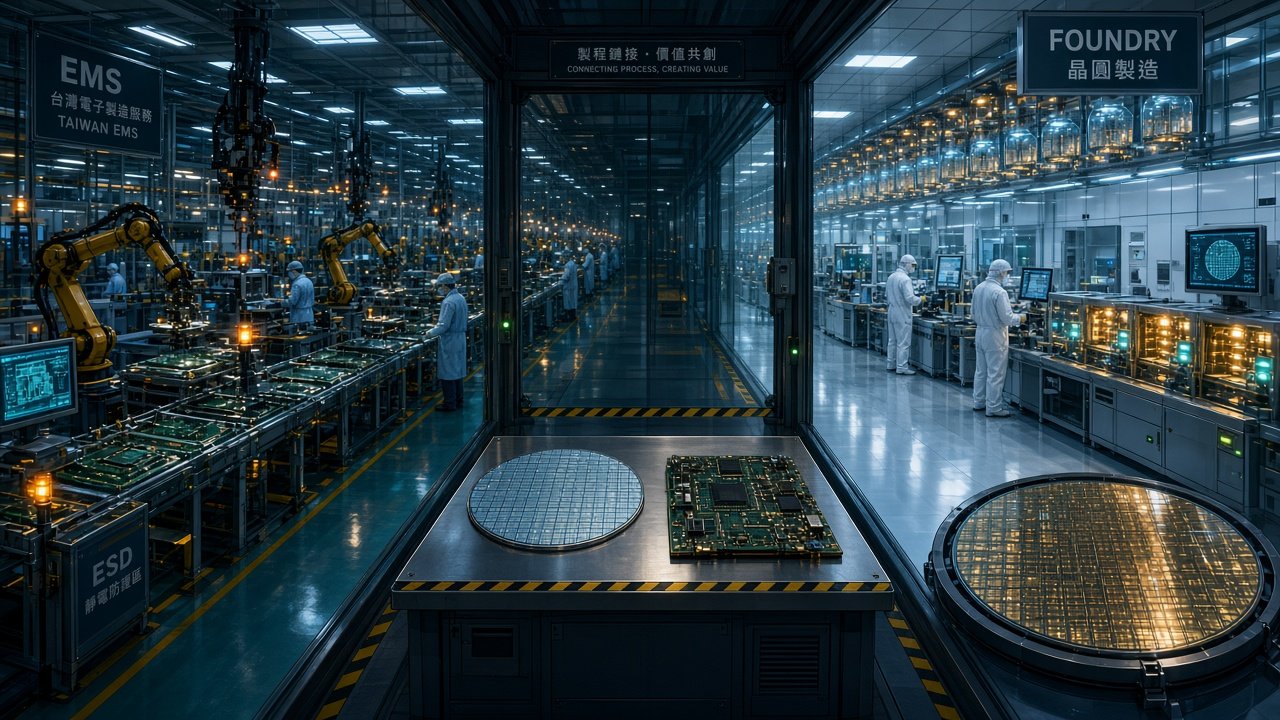
Open an iPhone and you meet a geography lesson disguised as consumer electronics. The branded logic silicon was almost certainly fabricated by Taiwan Semiconductor Manufacturing Company. The board and modules passed through a Taiwanese managed supply chain. The final screws, adhesives and test stations were likely staffed in a Hon Hai Precision campus that the world knows as Foxconn, often in Zhengzhou or another inland Chinese city built for volume. Three layers. Two Taiwanese institutional inventions. One Chinese demographic and fiscal platform. That is modular capitalism in hardware form.
The West did not abolish manufacturing when it outsourced. It specialised rents. Cupertino, Seattle and Santa Clara kept design, software, brand and the fat margins that follow. Taiwan built the intermediaries that make modular production runnable at planetary scale: electronics manufacturing services, original design manufacturers, and the pure play foundry. The People’s Republic of China supplied migrant labour, local government competition for foreign investment, and the land packages that turned assembly into city sized machines. Conflating Foxconn with TSMC flatters neither. One is labour intensive and thin. The other is capital intensive and geopolitically sacred.
Call the arrangement an invisible empire if you like. Foxconn is Taiwan’s largest company by revenue yet culturally overshadowed by TSMC’s cleanroom mystique. Assembly is the repressed other of the semiconductor glory narrative. Investors celebrate process nodes and AI racks. Workers and critics remember nets under dormitory windows. Both memories are true. Only one usually makes the keynote slide.
Terry Gou’s connectors become a civilisation
Terry Gou founded Hon Hai in 1974 in Tucheng, then a Taipei suburb, with about US$7,500 and a plastic moulding habit. Early work was television parts and connectors. An Atari order in 1980, then IBM hunting trips, taught Gou that American brands would pay for speed if someone else carried the inventory risk. By the late 1980s Hon Hai was already a serious Taiwanese firm. In 1988 it opened its first plant in Shenzhen. In 1991 it listed on the Taiwan Stock Exchange as 2317. The trade name Foxconn promised fox like quickness. The corporate culture promised obedience.
Gou’s slogans were not subtle. “Obey, obey and absolutely obey” belonged to the same managerial theatre as military roll calls and dormitory campuses. Price aggression funded vertical integration: connectors, then chassis, then barebones PCs for Compaq, HP, IBM and Apple in the mid 1990s, then full systems. China was the force multiplier. Special economic zones, bonded processing trade, and cadre promotion via GDP and employment made Foxconn’s land and labour appetite a local political asset rather than a nuisance.
Coastal wages eventually rose. Labour unrest flickered. Foxconn and its customers answered with inland relocation rather than a retreat from China. That pattern matters for today’s China+1 talk: the first great re sorting was already China to China, from Shenzhen Longhua toward Zhengzhou and other inland nodes, chasing incentives and a fresher migrant pool while keeping the Taiwanese managerial layer intact.
The iPhone turned that appetite into something closer to logistics civilisation. From 2006 and 2007 Foxconn scaled smartphone assembly for Apple just as the handset boom arrived. Apple’s asset light model and Foxconn’s asset heavy campuses were symbiotic, not accidental. Estimates have long put Apple near forty to fifty percent of Foxconn revenue, though Hon Hai does not break the figure out cleanly. Treat the range as industry folklore with a hard core of concentration risk.
By FY2024 Hon Hai reported NT$6.86 trillion in revenue, about US$213 billion at then prevailing rates, up 11.3 percent year on year, with net profit NT$152.7 billion and earnings per share NT$11.01, a seventeen year high. Gross margin sat near 6.25 percent and net margin near 2.23 percent. That is Taiwan’s largest company by sales, routinely larger than TSMC on the top line, and yet a low single digit margin business. Fortune Global 500 rankings have placed it near twentieth for a roughly US$198 billion revenue year. Headcount is seasonal and definition sensitive: peaks historically near a million across China campuses, with other filings and secondary tallies in the high hundreds of thousands. Do not treat any single number as a stable census.
Zhengzhou and the ethics of launch economics
Zhengzhou “iPhone City” is the clearest monument to the bargain. Built from about 2010 with Henan and local incentives that the New York Times later sketched as more than US$1.5 billion in factories and housing plus infrastructure and airport support, the campus became a customs ready launch machine. Peak capacity lore runs to roughly half a million phones a day. Workforce estimates swing from about one hundred thousand off peak toward two to three hundred thousand at seasonal crest. Chinese local state capacity was not backdrop. It was Apple’s silent co author: land, dorms, tax, power, recruitment, customs.
The 2010 suicide cluster at Shenzhen Longhua remains the moral hinge of the Foxconn story. Around fourteen worker deaths were widely reported that year. The episode produced wage rises, safety nets on buildings, counselling programmes, and a permanent global ethics discourse. Apple dual sourced more aggressively toward Pegatron from roughly the iPhone 4 era. Inland relocation accelerated. Scholarly work associated with Jenny Chan and colleagues documented military style discipline, overtime structures, and dormitory control. Company and Apple supplier responsibility framing emphasised reforms, audits, and voluntary overtime in a wage system that made extra hours economically rational for many migrant workers.
Present the dispute as contested, not as a slogan. Workplace pressure, youth migrant mental health, compensation incentives, and the sheer density of launch schedules all belong in the ledger. What does not belong is slave labour shorthand. Foxconn is a Taiwanese listed private enterprise operating mostly in China, not a People’s Liberation Army factory and not a metaphor that erases agency. The uncomfortable truth for brand capitalism is that launch economics load both wages and control. Discipline and desire share a factory floor.
Gou stepped down as chairman in mid 2019. Young Liu, previously associated with Sharp after Foxconn’s roughly US$3.5 billion controlling acquisition in 2016, took the reins. Gou later ran unsuccessfully for Taiwan’s presidency. Liu’s Foxconn talks smart manufacturing, smart EV, smart city, AI servers, contract design manufacturing for vehicles, and geographic China+1. The paradox endures: enormous revenue, thin margins, reputational toxicity, and continued indispensability.
Why East Asia won the outsource lottery
Modular product architectures made the split possible. Personal computers, then smartphones, allow design, fabrication and assembly to live in different firms and countries. Timothy Sturgeon and the global value chain literature called this shared supply base electronics: brands could switch among capable factories because interfaces were standardised enough. Taiwan’s notebook ODMs learned across many customers. Quanta, Compal, Wistron and Inventec built reusable platforms and brutal new product introduction speed. Hsinchu handled chips. The Taipei basin handled ODM headquarters. The Pearl River and Yangtze deltas handled assembly and components. Hong Kong historically intermediateed trade.
US strategic choice mattered as much as Asian capability. Treating manufacturing as a cost centre created the opening that Foxconn and TSMC filled. High value to weight ratios and short product cycles favoured East Asian clusters over slower Western plants. Seasonal hiring, dormitory campuses and twenty four hour ramps for launches proved hard to replicate in high wage jurisdictions. Wisconsin’s Foxconn episode remains a digression that proves the point: transplant the brand without the Chinese style state and labour package, and the megafactory romance collapses.
Path dependence sealed the triangle. Once Apple, Dell and their peers locked supplier bases into the Pearl River and Yangtze deltas, switching costs became enormous. Tooling, component ecosystems, Taiwanese process managers on Chinese shop floors, and customs routines formed a sticky whole. Electronics uniquely layered Taiwanese ODM and foundry sophistication onto the older “world factory” story of garments and toys. Same coastal geography. Different institutional altitude.
Jargon needs a brief clearing. Apple is the brand owner, an OEM in industry speak, increasingly also a fabless silicon designer. Foxconn is mostly EMS: build to print at enormous scale. Quanta and Compal are classic ODMs: they design platforms that brands rebadge. TSMC is a foundry: it fabricates wafers for others and does not assemble finished phones. Boundaries blur in practice. Categories still stop lazy conflation.
Flex and Jabil, the Western EMS names, posted FY2025 revenues near US$25.8 billion and US$29.8 billion. Serious firms. An order of magnitude below Foxconn. Different end markets too: industrial, medical, automotive, networking rather than iPhone civilisation. DigiTimes style tallies still credit Taiwanese firms with roughly two thirds of top twenty EMS and ODM revenue. That is not nostalgia. It is the scoreboard of modular capitalism.
Peers sketch the rest of the map. Pegatron is Apple’s quieter alternative assembler, often the cost competitive spare tyre when brands want dual sourcing without another Foxconn sized public profile. Quanta rode notebooks into AI servers and often challenges for second place in EMS and ODM revenue during the boom. Compal remains a major PC ODM with a slower AI pivot. Wistron and its hyperscale specialist Wiwynn sit deep in Nvidia rack ecosystems. Inventec keeps a quieter second tier notebook and server seat. Luxshare, a Mainland Chinese firm, has taken meaningful Apple assembly share and symbolises indigenous EMS catch up inside the PRC. TrendForce style estimates for the iPhone 15 era put Foxconn near fifty eight to sixty percent, Luxshare near twenty eight to thirty, Pegatron near thirteen. Shares move. Apple does not publish them.
TSMC is the sibling, not the synonym
Morris Chang founded TSMC in 1987 with Taiwanese government and ITRI backing on a radical bet: a pure play foundry that would never compete with customers by selling its own branded chips. That trust bargain unlocked fabless design from Apple silicon to Nvidia, AMD, Broadcom, Qualcomm and MediaTek. Process leadership then created asymmetric dependence. At the leading edge, Western fabless firms need TSMC more than TSMC needs any single Western brand.
The numbers refuse to rhyme with Foxconn’s. TSMC’s calendar 2024 revenue was NT$2.894 trillion, roughly a US$90 billion class business. Calendar 2025 summaries put revenue near NT$3.809 trillion, about US$122 billion. Counterpoint has placed pure play foundry share around seventy to seventy three percent in 2025 and early 2026 quarters, with Samsung Foundry a distant second near seven to nine percent. Advanced nodes at seven nanometres and below rose from about sixty nine percent of wafer revenue in 2024 toward seventy four percent in 2025. Policy briefings widely repeat that TSMC makes more than ninety percent of the world’s leading edge logic. Apple was long the largest customer. Analyst estimates circulating in early 2026, including Creative Strategies via CNBC, project Nvidia near twenty two percent of TSMC revenue against Apple near eighteen, a changing of the guard if the trajectory holds.
Geopolitics now treats TSMC as sacred infrastructure. Arizona receives CHIPS Act support up to US$6.6 billion in grants and US$5 billion in loans, with multi fab roadmaps that have expanded repeatedly in company and press statements since the earlier more than US$65 billion three fab framing. Japan’s JASM Kumamoto Fab 1 entered mass production in December 2024; Fab 2 aims toward late 2027; combined investment is often cited above US$20 billion. Europe’s ESMC in Dresden broke ground in August 2024 for mature and mid nodes at twenty eight and twenty two nanometres plus sixteen and twelve, with German state aid near €5 billion and production targeted around late 2027. Friendshoring is real. Leading edge concentration remains stubborn. Export controls constrain SMIC at the bleeding edge, though exact capability claims stay noisy.
This is why China+1 rhetoric must split assembly from fabrication. Moving iPhone lines to India or Vietnam is hard logistics and politics. Moving leading edge fabs is existential CapEx, talent and yield. Silicon shield debates in Taipei and Washington are about TSMC’s chokepoint, not Foxconn’s dormitories. Decoupling stress tests the two firms differently. Essays that flatten them into one “supply chain risk” misunderstand both Taiwanese pillars.
China+1 without China exit
COVID, the 2022 Zhengzhou disruptions, tariffs and Apple risk management pushed final assembly into a re-sort, not an exit. India rose to roughly eighteen percent of global iPhone production in 2024 and 2025 reporting. Foxconn held about sixty five percent of Indian iPhone output in 2024, with Tata and others also in the frame. A Reuters window in March to May 2025 found about ninety seven percent of Foxconn India iPhone exports heading to the United States as tariff politics reshaped shipping maps. Analyst notes have discussed annual Indian volumes in the twenty five to thirty million range. Mexico hosts a Guadalajara area Foxconn campus in the roughly US$900 million class for Nvidia GB200 liquid cooled AI servers. Vietnam takes other consumer lines. China remains the majority base for phones and the gravity well for components, tooling and know how.
AI servers are Foxconn’s attempt to climb the rack without escaping contract logic. Company guidance has pointed toward trillion New Taiwan dollar AI server revenue scale and ambitions of forty percent or more market share. Quanta and Wiwynn contest that claim competitively. Phone floors commoditise. Racks pay better, still as contractors. Packaging technologies around advanced nodes redistribute some rents toward the semiconductor stack, but EMS firms remain intermediaries. EV contract design manufacturing remains a strategic bet more than a proven second act. Sharp fills brand and display gaps. Automation rhetoric, “AI to produce AI,” tries to shrink the labour story that made Foxconn infamous without pretending margins suddenly resemble Nvidia’s.
Luxshare’s rise sharpens the China question further. Dual sourcing can be China for China politics as much as pure cost theatre: keep final assembly geographically Chinese while reducing single vendor leverage. That is diversification inside the platform, not departure from it. Meanwhile Made in China 2025 and dual circulation rhetoric push indigenous capability precisely where Taiwanese intermediaries once looked unassailable. The triangle flexes. It has not dissolved.
Two Taiwans of production
Foxconn is Taiwan’s biggest company by revenue and culturally the repressed other of the semiconductor glory narrative. Assembly is visceral: dormitories, overtime, suicide nets, launch panic, inland cities invented for Apple. Foundry is abstract until geopolitics makes it sacred: cleanrooms, EUV tools, silicon shield debates, CHIPS Act ceremonies. Both are specialised production. Neither is interchangeable.
Revenue is not power. Foxconn outsells TSMC and still collects thinner rents than the brands it serves or the foundry that feeds their silicon. Asset light West and asset heavy East were always a paired system. Apple’s trillion dollar valuation rests on Foxconn scale campuses and TSMC fabs alike. Outsourcing relocated manufacturing and specialised it. It did not make manufacturing optional.
The present tense is therefore not the end of China manufacturing. It is a reallocation of final assembly under tariff and risk pressure, while leading edge silicon stays concentrated, while Luxshare contests the phone floor inside China, and while Foxconn tries to migrate from handsets to AI racks and cars without rewriting the thin margin grammar of EMS. Modular capitalism relocated manufacturing. It did not abolish it. Taiwan invented the intermediaries. China scaled them. American brands collected the rents. The twin pillars still hold the roof. They just no longer pretend to be the same pillar.