
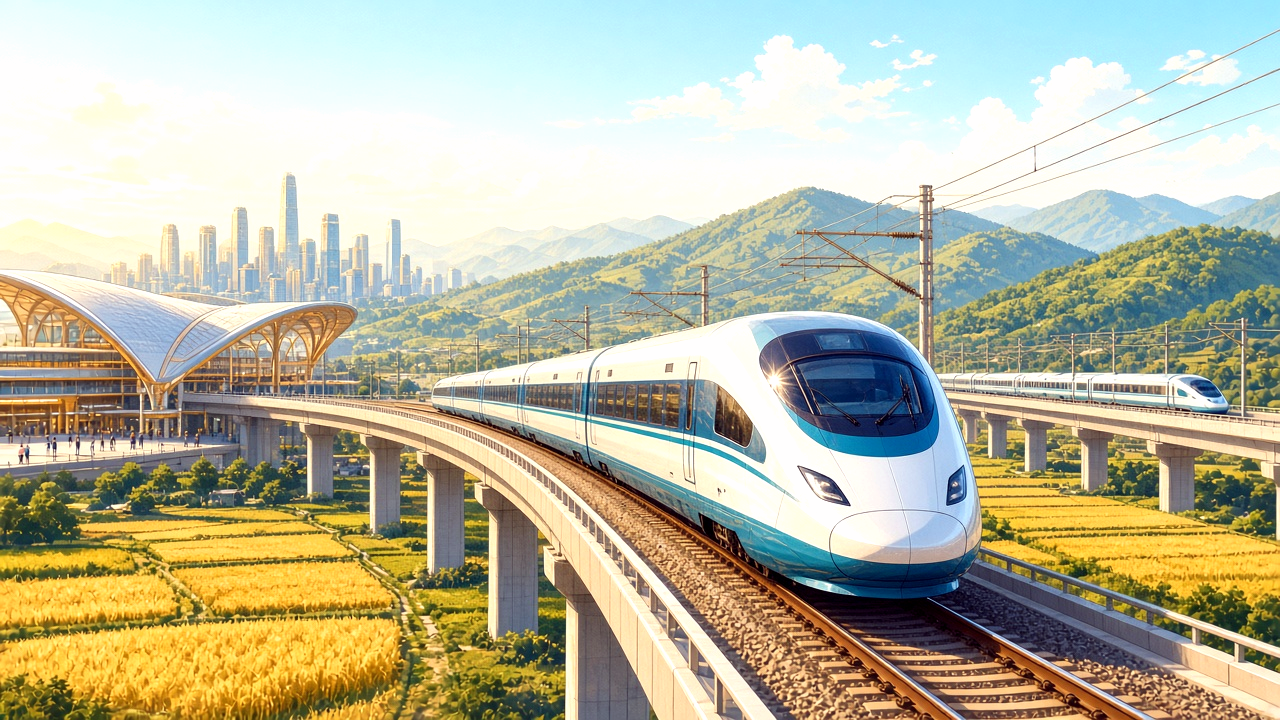
Stand on a Fuxing platform at dawn and the country feels engineered. Stainless noses, blue belts, departure boards that treat three hundred kilometres an hour as ordinary. China did not borrow a few trains from Europe and Japan. It built the world’s train set, then kept pouring track until the map looked like a circuit board.
By the end of 2025 the National Railway Administration and Ministry of Transport put high speed operating mileage at fifty thousand kilometres. A year earlier the official figure was forty eight thousand. The International Union of Railways, counting on a stricter same edition basis at the end of 2024, logged forty seven thousand eight hundred and three kilometres for China against a world total near sixty eight thousand. That is roughly seven tenths of everything that qualifies as high speed rail on Earth. Spain, Japan, France and Germany follow at a respectful distance. They are systems. China is the system.
This essay is about that industrial fact: the network, the CRRC factory complex that feeds it, the technology catch up from licensed platforms to the Fuxing standard, the Belt and Road packages that try to sell the whole kit abroad, and the honest counters. Emptyish lines exist. Local and railway debt is real. Tech transfer arguments never died. Scale does not cancel any of that. It just changes the weight of the argument.
A railway civilisation in one generation
China’s modern high speed era is young enough to remember in living careers. The Beijing to Tianjin intercity line opened for full passenger service in August 2008 as an Olympic showcase. The Beijing to Shanghai dedicated passenger corridor followed in 2011. From there the build rate became a planning style rather than a project. Standard designs. Parallel viaducts. Local governments hunting stations the way earlier decades hunted industrial parks.
The Ministry of Transport’s 2024 industry bulletin is blunt about the stock that now sits on those rails. National railway route length reached one hundred and sixty two thousand kilometres, of which forty eight thousand were high speed. Fixed asset investment in railways that year hit eight hundred and fifty point six billion yuan, up more than eleven percent. Passenger trips on the national railway exceeded four point three billion. Electric multiple unit fleets grew to four thousand eight hundred and six standard sets. This is not boutique infrastructure. It is mass mobility at continental scale.
In 2025 the machine did not pause. Official tallies put total railway mileage at one hundred and sixty five thousand kilometres and high speed at the round fifty thousand mark, with another two thousand eight hundred and sixty two kilometres of high speed opened and investment above nine hundred billion yuan. Electrification and double tracking edged up again. Western regions alone held sixty seven thousand kilometres of railway. Density figures look modest on a continental landmass until you remember how much of that mass is desert, mountain and grassland that still got steel.
Comparisons abroad are almost comic if you keep the units honest. Japan’s Shinkansen, the teacher everyone cites, sat near three thousand two hundred and seventy kilometres in the UIC 2025 atlas. France’s TGV network was under three thousand. Germany under two thousand. The entire European operational high speed map in that atlas was about thirteen thousand kilometres. Asia Pacific held more than fifty two thousand, and China was most of that pile. The West still debates whether California can finish a segment. Beijing debates which county seat gets the next stop.
How CRRC became the world’s rolling stock giant
Track without factories is a postcard. China built both. In the mid 2000s the Ministry of Railways ran a deliberate import and absorb campaign. Foreign consortia won large orders on condition that production and know how landed inside Chinese plants. Bombardier’s Regina lineage became CRH1. Kawasaki’s E2 based Shinkansen technology fed CRH2 at Qingdao Sifang. Siemens’ Velaro family underwrote CRH3. Alstom’s Pendolino line became CRH5. The trains that Chinese passengers first called Harmony were licensed cousins wearing Chinese paint.
Localisation was the point, not a side effect. Joint ventures, domestic suppliers, and successive redesigns pushed speeds and components toward Chinese specifications. The CRH380 series raised design speeds into the mid three hundreds. Then came the China Standard EMU programme. In June 2017 Fuxing sets branded CR400AF and CR400BF entered regular Beijing to Shanghai service at up to three hundred and fifty kilometres an hour. CRRC’s later filings still call that platform the golden card of Chinese high end equipment going global. Marketing language, yes. Also a statement of industrial intent.
Corporate form followed technology. On 1 June 2015 the old rivals CSR and CNR merged into CRRC Corporation Limited, a state backed champion sized for export as much as for domestic renewals. By 2024 CRRC reported revenue of about two hundred and forty six billion yuan, with multiple unit revenue above sixty two billion and nearly two thousand MU sets sold. In 2025 revenue rose to roughly two hundred and seventy three billion yuan, high speed train revenue to sixty eight billion, and MU deliveries to two thousand one hundred and eighty one. New international orders were cited near sixty five billion yuan, with a backlog above three hundred and fifty billion. These are Hong Kong listed results, not propaganda posters.
Global market share claims need a warning label. Some industry notes credit CRRC with around seventy percent of the world’s high speed trainsets by volume. Others peg high speed rolling stock revenue share nearer a third. Both can be true when China’s domestic fleet dominates unit counts while Europe and North America keep CRRC partly outside competitive tenders. The European Commission opened an anti subsidy investigation in February 2024. United States procurement rules have treated CRRC as a restricted Chinese military linked company for federal work. The world’s largest builder is therefore both omnipresent and selectively unwelcome. That paradox is politics, not a verdict on bogie quality.
Catch up, re innovation, and the patent fight
Beijing’s story prefers a clean arc: import, digest, innovate, lead. Foreign partners remember contracts, licence walls, and Chinese patent filings that looked too familiar. Kawasaki’s 2004 order for China was real. So was later Japanese anger when China described heavily evolved CRH380A trains as independently re innovated. China Daily and Chinese officials rejected infringement claims in 2011. Wharton and other Western write ups framed the episode as classic latecomer learning with sharp elbows. The brief for this essay will not pretend a courtroom settled the metaphysics of originality.
What can be said without theatre is narrower. China began with foreign platforms. It built a domestic supplier base fast enough to standardise a continent. Fuxing is not a photocopy of a 2004 Shinkansen. Nor was it born from a garage with no ancestors. Industrial policy compressed decades of European and Japanese iteration into a Chinese production system that then out built everyone. If that offends purists of IP romance, it also describes how steel industries, shipyards and electronics clusters have always moved when states decide to pay for learning.
Standardisation mattered as much as any single train. Repeating viaduct spans, signalling families, and EMU interfaces cut unit costs. The World Bank’s 2019 study of China’s high speed development estimated construction costs at roughly seventeen to twenty one million dollars per kilometre, about two thirds the level seen in many other countries even with heavy tunnelling and elevated sections. Cheap is the wrong word. Disciplined repetition is closer. A protected home market then gave CRRC volume that no European champion could match inside its own borders.
Trunks that print money, edges that bleed it
Financial honesty starts with a split ledger. The World Bank’s analysts, writing on the network as of about 2015, estimated an economic rate of return near eight percent for the system as a whole. That is a social return, not a ticket office fantasy. On finances they were harsher and more useful. Lines with traffic densities above roughly forty million passengers a year and stronger yields could cover operations, maintenance and debt service. Many thinner corridors, especially two hundred and fifty kilometre per hour lines with lower fares and densities around ten to fifteen million, might barely cover running costs and would struggle with debt for years.
Beijing to Shanghai remains the textbook cash cow. The listed Beijing Shanghai High Speed Railway company reported 2024 revenue of about forty two billion yuan and net profit near thirteen billion, even as own line passenger counts slipped slightly. Cross line operations and fare power on the busiest corridor in the country still pay. That profitability is real. Extrapolating it to every prefecture stop in Gansu is fiction.
China State Railway Group, the giant operator, carried liabilities on the order of six point two trillion yuan at the end of 2024 on assets near nine point eight trillion, with a liability ratio around sixty three and a half percent in synthesised disclosures reported through Chinese finance press. Revenue crossed the one point two trillion yuan mark in the same framing. This is not CRRC’s balance sheet and not China Railway Engineering’s construction book. Mixing the three invents a cartoon debt monster. Keeping them apart still leaves a serious claim: decades of build created a stock of assets whose thin edges need cross subsidy, soft budget constraints, or local government appetite for prestige concrete.
Ghost stations belong in the same paragraph, not as a meme. Channel News Asia and others documented idle or closed stops where trains whistled through empty halls after demand failed to arrive. Zhengzhou area intercity stations such as Nancao and Mengzhuang shut passenger service in 2017. Local notices later restored several of those stops in September 2024. Some ghosts get exorcised when schedules and feeder buses improve. Others remain expensive ornaments. The pattern is uneven utilisation, not a nationwide empty museum.
Selling the kit: Whoosh, Laos, and Europe’s half finished billboard
Belt and Road rail is not a catalogue of locomotives. It is a package: Chinese standards, civil works consortia, CRRC sets, signalling, training, and China Development Bank or Eximbank credit. Host governments buy speed and political theatre. They also buy overruns and repayment calendars.
Jakarta to Bandung, marketed as Whoosh, is the clearest high speed export billboard. About one hundred and forty two kilometres of Chinese standard line cut a three hour slog toward forty to forty five minutes at up to three hundred and fifty kilometres an hour. Commercial service began in October 2023 under KCIC, a sixty forty Indonesian Chinese joint venture. Costs rose from an early band near six billion dollars toward roughly seven point three billion after land fights, geology and pandemic delay. About three quarters of the money was CDB debt. Indonesian state railway vehicles later absorbed hundreds of millions more in overrun facilities. CRRC supplied CR400AF Yawan sets. Southeast Asia’s first high speed railway is therefore also a case study in how turnkey finance behaves when soil and politics misbehave.
The China Laos railway is longer and more entangled with sovereign stress. The Kunming to Vientiane corridor runs about one thousand and thirty five kilometres. The Lao section opened in December 2021 at a widely cited cost near six billion dollars, with Laos taking a minority equity stake financed partly by Eximbank borrowing. Official publicity by late 2024 claimed cumulative passengers and freight in the tens of millions. Critical briefings from ISEAS and others keep asking whether a low income landlocked budget can service a steel backbone built at Chinese unit costs. Ridership can rise and the debt question can remain.
Further west, the Belgrade to Budapest upgrade was sold as Europe meeting Belt and Road. Timelines slipped; Hungarian signalling software troubles pushed talk of passenger launch toward 2026 in trade reporting. Serbia took Chinese higher speed EMUs in the two hundred kilometre an hour class, a different animal from a three hundred and fifty kilometre dedicated passenger line. Thailand’s link toward Nong Khai and the Lao border remains a 2030ish promise in official Thai comments. The pan Asian map looks inevitable in Beijing slide decks and provisional everywhere else.
Counters that deserve oxygen
First, empty lines are not a Western hallucination. They are what happens when a developmental state builds ahead of demography and then discovers that prefecture vanity is not the same as passenger density. The World Bank thresholds still bite. Cross subsidy from coastal trunks keeps the map political. Local governments still lobby for stops because a station is a land and status machine, not only a transport node.
Second, debt is the shadow twin of speed. Operator liabilities in the trillions of yuan, municipal financing vehicles, and construction SOE leverage are the price of compressing a century of railway building into two decades. Defenders note that the assets are real, the liability ratio has been managed, and busy lines earn. Critics note that many lines will not earn on any private hurdle rate and that accounting can hide soft rescues. Both can speak at once.
Third, technology transfer fights are not ancient history. Every Fuxing launch abroad revives the question of what China absorbed, what it reinvented, and what foreign firms think they were owed. China’s answer is standard EMU sovereignty. Kawasaki’s earlier anger was a preview of a wider distrust that now shows up as procurement walls in Brussels and Washington rather than as courtroom drama in Tokyo.
Fourth, safety memory still matters. The Wenzhou rear end collision on 23 July 2011 killed forty people and punctured the mythology of frictionless ascent. Speeds were moderated. Governance was scrambled. The network recovered and expanded anyway. Ignoring Wenzhou flatters the brochure. Obsessing over it alone misses fifteen subsequent years of dense, mostly uneventful operation that moved billions of trips.
Fifth, export success is not the same as conquering rich markets. Whoosh and Laos prove China can deliver packages in emerging Asia. Exclusion from core European and American high speed fleets proves that politics can fence out the volume leader. CRRC’s international order book can grow in the Global South while the Global North treats Chinese rail kit as a security file.
What the train set is for
China’s high speed project is infrastructure, industrial policy and foreign policy sharing one timetable. At home it stitches labour markets, pulls overnight tourism into day trips, and frees conventional tracks for freight. Abroad it offers a visible alternative to Western project finance, complete with standards lock in and rolling stock aftermarkets. The same package that looks like development in Bandung can look like dependency in Vientiane. The same balance sheet that funds fifty thousand kilometres can haunt fiscal hawks in Beijing.
None of that requires romanticism about empty halls in Zhengzhou’s outer orbit, or amnesia about licensed origins, or silence on Whoosh’s overrun politics. The honest sentence is sharper. China industrialised high speed rail the way it industrialised solar panels and shipyards: protect the market, standardise the product, flood the world with capacity, then argue about quality and debt after the concrete has set.
Stand on that Fuxing platform again. The train set is real. Most of the world’s high speed kilometres wear a Chinese inventory tag. CRRC’s factories keep printing sets. CDB term sheets travel with them. The counters travel too. Emptyish feeders, heavy liabilities, disputed ancestry, and host country politics are not footnotes. They are part of the operating manual. Ignore them and you get a propaganda reel. Ignore the fifty thousand kilometres and you get a different kind of blindness. The rails are down. The bill is long. The timetable keeps running.