
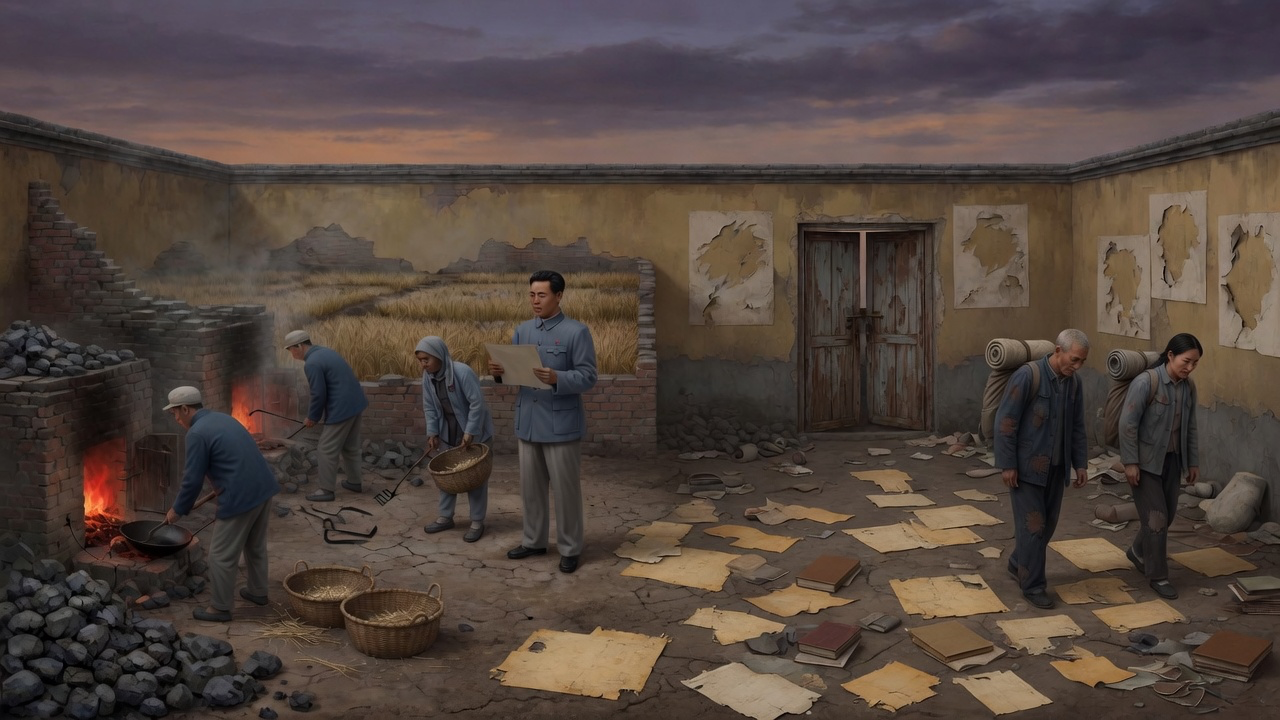
Western accounts often fold the Great Leap Forward and the Cultural Revolution into one blur: Mao, chaos, and a great many deaths. That shorthand hides what actually happened.
They were two different campaigns, about a decade apart, with different aims and different ways of killing. The Great Leap Forward, launched in 1958, tried to leap to communism through people’s communes, backyard steel furnaces, and harvest figures that existed mainly on paper. It produced a famine that peaked in 1959–1961. The Cultural Revolution, launched in 1966, tried to smash a supposed “bourgeois headquarters” inside the Party. Its main targets were the officials — above all Liu Shaoqi and Deng Xiaoping — who had pulled the country out of that famine. People died in struggle sessions, factional fighting, and later “cleansing” campaigns, not from empty granaries on the Leap’s scale.
After 1981 the Chinese Communist Party still treats them as different crimes. It calls the Cultural Revolution the worse political catastrophe, and the Leap a serious but correctable economic binge. That split is partly honest and partly convenient. It is also the right place to start, because reform-era China buried one nightmare in order to keep ruling with the lessons of the other.
This essay keeps the two apart: what each campaign promised, how it worked, when people died, what the death-toll research actually says, what the 1981 Resolution admitted, and how failure in the Leap became the motive for the Cultural Revolution. There is no single true body count.
What the Great Leap was trying to do
In 1958 the pitch was simple and vast. Overtake Britain in steel. Fold the peasantry into self-sufficient people’s communes. Treat political will as if it were a factory. Put the Party in command of the plough and the furnace alike.
The commune became a rural state in miniature: farming, light industry, militia, canteens, and schools under one administration. Steel and grain were the two tests of success. Backyard furnaces were supposed to multiply metal. Inflated harvest reports were supposed to prove abundance and justify taking grain for the cities, industry, and exports. After the 1957 Anti-Rightist Campaign, technical caution had already been punished. Mao was also reclaiming the initiative from the Eighth Party Congress line of 1956, which had preferred building productive capacity to rash advance.
In late summer 1958 people’s communes were rolled out nationwide. Autumn brought the furnace campaign. Farmers melted tools into unusable pig iron while the harvest waited in the fields. Communal dining halls, deep ploughing, and close planting followed. Local cadres competed to report ever larger yields. Bumper crops existed on paper. The state procured grain on those fictitious numbers and left villages without enough seed or food. Cities, industry, and exports came first. Rural stomachs came after.
Then came Lushan, in July and August 1959. Defence minister Peng Dehuai wrote Mao a private letter criticising the Leap. Mao turned a policy argument into a heresy hunt. Peng was purged. Lin Biao took over defence. Correction stopped. Reporting hunger began to look like “Right opportunism.” Silence became lethal policy. The Party later called 1959–1961 the Three Years of Natural Disasters. Demographers call them the famine peak. The weather was real. The 1960 Soviet withdrawal of aid was real. Serious scholarship still puts policy and institutions in the driving seat.
The climb-down ran from winter 1960 through about 1962: “readjustment” under Liu Shaoqi, Zhou Enlai, Chen Yun, and Deng Xiaoping. The Seven Thousand Cadres Conference of January 1962 forced a reckoning. The economy crawled back. The communes survived the catastrophe. Mao did not forget who had run the rescue.
How the famine was produced
The mechanisms are not mysterious. Huge commune mergers weakened incentives and militarised labour for dams and crash industrial projects. Backyard furnaces pulled hands from the fields. False statistics turned grain extraction into a death spiral: procure on fairy-tale numbers, leave no food, and punish anyone who says the numbers are lies. After Lushan that feedback loop snapped. Cadres who told the truth risked Peng’s fate.
People died of hunger, disease, and exhaustion. Births collapsed. In the worst counties, oedema and flight were common. Local horrors, including cannibalism in a minority of documented places, belong in the record as case evidence, not as a cartoon of the whole country. The Leap’s main wreckage was economic and demographic: harvest collapse, industrial farce, missing births, and a countryside hollowed out by policy.
By the mid-1960s, recovery under Liu and Deng had restored enough grain and order that Mao looked politically surplus. That eclipse is the hinge. Without it, the Cultural Revolution has no plot.
From famine to purge
The Leap’s failure made the pragmatists look indispensable. Private plots, limited markets, realism, and experts came back. People ate again. Mao read the recovery as revisionism: a Soviet shadow, capitalist methods, and his own demotion from unchallengeable economic authority to an awkward elder.
At the Tenth Plenum in September 1962 he put class struggle back at the centre. The Socialist Education Movement and the Four Cleanups targeted “Party persons in power taking the capitalist road.” The personality cult thickened under Lin Biao and the People’s Liberation Army. Culture was warmed up for politics. By May 1966 the instrument was ready: smash the recovery coalition, mobilise a new crowd, and redefine legitimacy as permanent revolution.
The hinge in one sentence: the Leap’s economic failure made Liu and Deng look necessary. The Cultural Revolution was Mao’s political revenge against that fact.
Red Guards, then the restoration campaigns
The Cultural Revolution offered a different utopia. Stop capitalist restoration. Dig out revisionists. Smash the Four Olds — old ideas, culture, customs, and habits. Keep revolution permanently on the boil. Class struggle, in this telling, does not fade under socialism. It intensifies inside the Party. A phantom bourgeois headquarters, identified with Liu and Deng, becomes the enemy that explains everything.
May to August 1966 opened the decade: the 16 May Circular, the August plenum and the Sixteen Points, Red Guards unleashed, Red August in Beijing, and Liu and Deng framed as the enemy headquarters. Autumn 1966 into 1967 brought factional seizures of power. Shanghai’s January Storm briefly flirted with a commune, then settled into revolutionary committees of rebels, cadres, and the army. Veterans who tried to restore order in the “February Adverse Current” were crushed. The army supported the Left until the chaos began to threaten the army itself.
Western shorthand still gets the timing wrong. Street theatre and Red Guard house raids were not the whole death machine. Andrew Walder and Yang Su, working from county annals, show that most rural Cultural Revolution deaths fell later, roughly 1968–1971, in restoration terror and cleansing campaigns after the rebellion was reined in. The return of order was not gentle. Labels, jails, investigations, and the “cleansing of class ranks” outlasted the teenagers in armbands.
Mao’s December 1968 rustication order emptied the cities of surplus rebels and idle youth. Scholarly estimates for the broader sent-down wave run to about 16–18 million by the late 1970s. Treat that as an approximate aggregate, not a census. Lin Biao’s alleged plot, flight, and death in September 1971 cracked the myth of the chosen heir. The endgame ran through the Gang of Four, Deng’s 1975 repairs and second purge, Zhou Enlai’s death, the April 1976 mourning protests, Mao’s death in September, and the Gang’s arrest in October. The Party’s official clock, fixed in 1981, runs from May 1966 to October 1976. Violence was densest around 1966–1969, with state killing running hard into the early 1970s.
The main wreckage here was political, institutional, and cultural. The Party shattered. Elites were purged. Schools were gutted. Culture was vandalised. The economy limped; it did not starve at Leap scale. Output continued in broken form. The damage was chaos, closed universities, and wasted talent. People died by beating, struggle, jail, massacre, exile, and forced suicide — not by the famine bureaucracy’s empty bowl.
Death tolls: ranges, not one number
A hard rule: every toll needs an author, a method, and a caveat. There is no such sentence as “the death toll was X.”
For the Great Leap famine, deaths concentrated in 1959–1961. Careful demographic work usually sits in a range of about 15–35 million excess deaths, with a thick cluster around 20–30 million or more. Ansley Coale’s early work sat near 16.5 million; his 1984 figure of about 27 million remains a widely used mid-range. Peng Xizhe (1987) put the figure at about 23 million from provincial demography. Yao (1999) sits toward the lower specialist end, near 18 million. Ashton, Hill, Piazza and Zeitz in Population and Development Review (1984), and Judith Banister (1987), cluster near 30 million; Ashton and colleagues also flag roughly 33 million lost or postponed births. Jasper Becker preferred Banister’s 30 million band. Cao Shuji (2005), working from gazetteers, offered about 32.5 million, a heavyweight Chinese estimate. Yang Jisheng’s Tombstone synthesises toward about 36 million; critics flag his low baseline crude death rates. Frank Dikötter’s Mao’s Great Famine (2010) argues a minimum of 45 million, lifting Cao-type figures and stressing beating and torture killings. Demographers such as Cormac Ó Gráda have attacked that method. Treat 45 million-plus as a loud, disputed ceiling, not settled science. Still higher claims — Yu Xiguang near 55 million, Chang and Halliday or Rummel near 38 million — are cited often and fought over harder.
A usable briefing line: major Chinese syntheses often land in the 30–36 million zone; contested outliers climb above 45 million. The Leap killed by mass famine produced by policy. That is the moral texture.
For the Cultural Revolution, killings peaked roughly 1966–1971. The best work from local annals points to about 1–2 million deaths, plus tens of millions struggled against or persecuted. Walder and Su in China Quarterly (2003), reading about 1,520 county annals, estimated 750,000 to 1.5 million rural deaths, similar numbers permanently injured, and about 36 million politically persecuted in their rural focus, with the bulk of deaths in 1968–1971. Walder’s later national gazetteer work, summarised in a 2019 Stanford account from more than 2,000 local histories, puts nationwide deaths for about 1966–1971 in a 1.1–1.6 million band and leans toward the upper end. He notes that earlier public guesses swung from tens of thousands to 8 million. Reported CCP internal probes from 1982 and 1987, via Hong Kong press accounts Walder cites, floated roughly 1.2 and 1.7 million: useful gossip from inside the machine, not a peer-reviewed census. Political history summaries in the MacFarquhar and Schoenhals orbit, and Fairbank-type handbooks, often sit near 1 million unnatural deaths as an order of magnitude. Song Yongyi’s surveys show a literature sprawl from about 500,000 to 8 million: Rummel near 7.7 million, Ding Shu near 2–3 million, Chang and Halliday at least 3 million violent deaths. Averaging incompatible guesses is not a method. Post-Mao political talk of about 100 million who “suffered” measures exposure to persecution, not deaths.
The comparison that matters: Leap deaths are tens of millions of excess deaths from scarcity. Cultural Revolution deaths in careful work are roughly 1–2 million, with a wider literature wandering from under a million to several millions. Different orders of magnitude. Different kinds of crime. Smaller than the Leap is not comfort. It is taxonomy.
What the Party admitted in 1981
On 27 June 1981 the Party adopted the Resolution on Certain Questions in the History of Our Party since the Founding of the People’s Republic of China. It is a political peace treaty, not a death certificate. Quote it. Then test it.
On the Leap, nested in the “ten years of initially building socialism,” the Resolution calls the general line of 1958 an understandable hunger for modernity that was blind to economic laws. Named sins: excessive targets, arbitrary orders, boastfulness, and the “communist wind.” Mao and many other leaders were smug, impatient, and drunk on subjective will. The Lushan struggle against Peng was entirely wrong: it killed correction and prolonged the disaster. The 1959–1961 mess combined Leap errors, the anti-Right-opportunism struggle, natural disasters, and the Soviet breach. Credit for the rescue goes to Liu, Zhou, Chen, and Deng, and to the Seven Thousand Cadres Conference. The tone is: grave economic Leftism, fixable, and already partly fixed in the early 1960s.
On the Cultural Revolution the language hardens. It was the most severe setback and the heaviest loss since 1949. It was initiated and led by Mao. His theses on a bourgeois headquarters, capitalist roaders, and endless cultural revolution are judged wholly wrong. Lin Biao and Jiang Qing sit in a separate criminal category for exploiting Mao’s error. There was no Liu–Deng headquarters. Liu’s case was a frame-up. It was not a revolution. It was not progress. Friend and foe were confused. Mao bears chief responsibility for a Left error comprehensive in scale and long in duration — while, in the Resolution’s arithmetic, his lifetime merits still outrank his late disasters.
The scorecard is revealing. Leap: serious losses in a decade that also built capacity; rash economics; Mao sharing collective blame, with a spotlight on Lushan; corrected in office by 1960–1962. Cultural Revolution: worst since 1949; comprehensive politics; initiated and led by Mao; ends only with the Gang’s fall and full negation after December 1978. Deng-era uses follow: respect economic laws and rehabilitate Peng from the Leap ledger; kill continuous revolution, rehabilitate Liu, and bury the cult from the Cultural Revolution ledger.
What the Resolution will not say is the Left continuum from 1957 through the Leap and Socialist Education into 1966. Soft-pedalling that arc makes the Cultural Revolution look like a unique eruption rather than the political sequel to a discredited utopia. Half insight. Half self-serving memory. Still the sharpest official judgement China has published on its own Maoist wreckage.
Points that are easy to get wrong
First, weather and the Soviet breach belong in the Leap ledger. The Resolution lists them. They do not dethrone policy. After Lushan, cadres who could not report the truth turned meteorology into an alibi.
Second, Cultural Revolution violence was not only Red Guard street theatre. Walder’s timing matters: rural deaths concentrated in the restoration years. Ignoring army-backed cleansing flattens the decade into a myth about teenagers.
Third, the economy under the Cultural Revolution did not repeat Leap-scale starvation. That fact is not an exoneration. It is a reminder that political terror and cultural vandalism can gut a civilisation’s institutions without emptying every granary.
Fourth, persecution of tens of millions is not the same metric as deaths. Treating “suffered” as “killed” inflates rhetoric and weakens history. Keep the axes separate.
Fifth, Western shorthand that says “Maoist chaos” as one blob erases the plot. Without the Leap’s failure and the Liu–Deng rescue, Mao has less motive for a purge revolution. Without the Cultural Revolution’s negation after 1978, Deng’s reform package loses its founding enemy. Memory is strategy.
Why the distinction still matters
Cut them apart one last time. The Great Leap Forward tried to forge utopia with furnaces and communes, then starved China through false statistics, grain procurement, and a chill on truth. Peak death years: about 1959–1961. Primary damage: economic and demographic, in a scholarly excess-death conversation that clusters in the tens of millions and argues bitterly at the ceiling. The Cultural Revolution purged politics, smashed the old, and broke Liu and Deng. Peak killing years: about 1966–1971, densest after rebellion gave way to restoration. Primary damage: political, institutional, cultural. Careful death estimates sit near 1–2 million, with tens of millions persecuted and a literature that wanders higher.
The hinge is not a metaphor. Leap failure crowned the cleanup men. Mao answered with continuous revolution. The 1981 Resolution still ranks the Cultural Revolution as the worst comprehensive setback since 1949, and the Leap as grave but correctable economic Leftism. Reform China needed that ranking: bury the cult, rehabilitate the pragmatists, and keep the Party’s monopoly by confessing the nightmare it would not repeat as theatre.
Western readers who mash the two into one Maoist fog miss the difference in the machines and the political sequel. Chinese official memory that softens the line from Anti-Rightist through Leap into Cultural Revolution misses the other half. Hold both. The Leap starved. The Cultural Revolution then purged the people who had made China eat again. One country. Two disasters. They should not be conflated.