
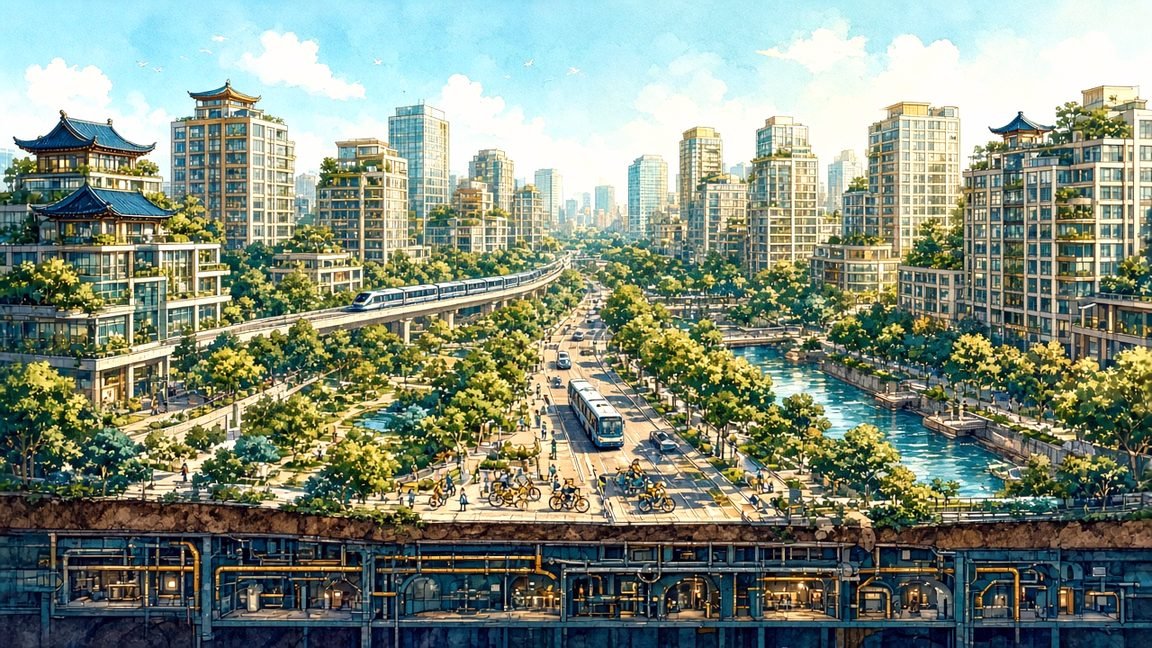
Western visitors often meet a Chinese city as a skyline: glass, towers, a river, a lot of light. That is the postcard. It is not the phenomenon.
The phenomenon is that China urbanised a continental population in a single working lifetime, and did it by assembling a different kind of city. Not a denser London. Not a taller Chicago. A kit of superblocks, gated residential compounds, new districts poured on farmland, and city clusters stitched by metro and high-speed rail. By the end of 2025, according to the National Bureau of Statistics, 953.8 million people lived in urban areas — 67.89 percent of the country, up from about 18 percent when reform began in 1978. That is hundreds of millions of people moved, housed, employed, and re-addressed in four decades.
This essay is about that urban type: how Chinese cities are counted, how they are physically built, why empty new districts were so often mistaken for collapse, and why the real unit of the map is no longer the named city but the cluster. The brightness is part of the story. So are the empty flats, the hukou, and the towns that are shrinking while the big nodes still grow.
A rural country that became an urban machine
In 1978 China was still a rural civilisation with industrial cities as islands. The official urban share was under a fifth. Township and village enterprises, then the special economic zones, then the coastal export belt, pulled people off the land. Shenzhen is the compressed version of the whole arc: a border town designated a special economic zone in 1980, now a city of more than 17 million people in the 2020 census urban count, with a 2025 GDP approaching 4 trillion yuan.
The speed did not stop at the famous names. NBS figures show the urbanisation rate of permanent residents rising from 49.95 percent in 2010 to 63.89 percent in 2020 and 67.89 percent in 2025. In the five years of the 14th Five-Year Plan, urban population grew by about 10.4 million a year. Even as the national population began to fall — 1,404.89 million at the end of 2025, down 3.39 million on the year — the cities still absorbed people. Rural China is emptying into urban China faster than the country as a whole is shrinking.
That is the first fact of the phenomenon. Urbanisation here is not a slow organic thickening of old towns. It is a planned, financed, and physically poured transfer of a civilisation from village to tower.
The city that is also a province
A Chinese “city” (市, shi) is an administrative container before it is a skyline. A prefecture-level city can include a dense core, suburban districts, county-level cities, and a large rural hinterland. Chongqing’s municipality covers more than 80,000 square kilometres — larger than many countries — and its headline population is not the population of a single street grid. Shanghai’s municipal total and Shanghai’s continuous urban area are different numbers. Beijing’s “city” includes mountains and farmland.
This is why internet lists of “the world’s biggest cities” so often go wrong on China. Count the municipality and Chongqing looks like a continent. Count only the built-up core and it is still enormous, but it is a different object. Dariusz Sokołowski, writing in the Bulletin of Geography in 2023, spent a paper just on the mistakes that follow from treating Chinese city borders as if they were Western ones.
A 2024 study in Land, using township-level 2020 census data, tried to count actual urbanised areas rather than administrative labels. It found 1,058 such areas in 2020, up from 758 in 2000, while the number of official administrative cities barely moved (663 in 2000, 685 in 2020). Megacity urbanised areas, in that delineation, rose from five to seventeen. The Pearl River Delta produced fused urban regions that no longer match a single city name. Guangzhou–Foshan and Shenzhen–Dongguan are lived as continua. The map still prints two words.
So the phenomenon has a bureaucratic half and a physical half. The bureaucratic half is the shi: a government that can plan, tax land, and build across a territory far larger than the lights you see from a hotel window. The physical half is the continuous urban tissue that has spilled across those lines.
Superblocks, compounds, new districts
Walk a Chinese city at ground level and the unit you keep entering is not the street. It is the superblock and, inside it, the residential compound — the 小区 (xiaoqu). Towers sit on a podium. A gate, a guard, a courtyard with trees, shops on the perimeter, parking underneath. The block is large. The arterial roads around it are wide. Intersections can be hundreds of metres apart. Wade Shepard, writing about Kangbashi, noted 40-metre streets and a civic square on the scale of a capital. That is not a bug of one desert new town. It is a family resemblance.
The form has a history. Work-unit compounds of the planned-economy city, Soviet-influenced superblocks, then the commodity-housing boom after housing was marketised in the 1990s, all left the same large-grain pattern. Developers sold apartments in towers. Local governments sold the land under them. The result is a city that is extremely dense in people per building and oddly coarse at street level. You can live among tens of thousands of neighbours and still walk a long way to a useful corner.
Beside the old city sits the new district (新区). Pudong is the ancestor. Milton Friedman, visiting early, called it a “statist monument to a dead pharaoh.” It is now one of the busiest urban districts on earth. Zhengdong New Area in Zhengzhou, empty enough in 2013 for 60 Minutes to film it as a ruin-in-advance, had about 1.3 million people by 2023. The sequence is almost a method: draw a new CBD on farmland, put in roads, metro, government offices, and housing, then wait for jobs and schools to pull bodies in. Western cities usually thicken first and extend later. Chinese cities often extend first and thicken later.
That is the kit. Superblock. Xiaoqu. New district. A metro that arrives before the crowd. A skyline that is a construction schedule, not a portrait of who already lives there.
What “ghost city” got wrong — and what it got right
From 2009, when Al Jazeera filmed Ordos Kangbashi, “ghost city” became the Western shorthand for Chinese urbanisation. Empty boulevards. Dark towers. A museum in the desert. Time magazine followed. The pictures were real. The conclusion — that China had built cities nobody would ever use — was a timing error dressed as a verdict.
Shepard’s Ghost Cities of China (2015) is still the clearest popular correction. These were not Detroit. They were new inventory, often on a 15- to 20-year fill horizon, financed by land sales and occupied first as assets and only later as homes. Chinese buyers commonly take a concrete shell and fit it out years after purchase. A dark window at 9 p.m. can mean “nobody lives here,” or it can mean “the owner is still in another city, and the interior is unfinished.” Kangbashi, designed for around 300,000 people and mocked when it held 30,000, had on the order of 150,000 residents and thousands of businesses by the late 2010s, by Shepard’s later counts. It did not become Manhattan. It did become a town.
Remote sensing added a more careful language. A 2020 study in Landscape and Urban Planning used night lights to find 1,048 “ghost neighbourhoods” — new residential areas still severely under-occupied after five or six years — covering about 354 square kilometres, with theoretical capacity for some 13.6 million people. That is not “China is empty.” It is a measurable slack in a building machine that ran ahead of household formation. The same paper noted that these neighbourhoods clustered in the most dynamic urbanising regions, not only in the desert: the Pearl River Delta, the Yangtze River Delta, Shandong. Overbuilding is a feature of boom regions, not only of failed ones.
Two things can be true. The ghost-city slideshow was a bad theory of Chinese cities. Vacant housing is still a real stock. Estimates of empty homes have run to tens of millions of units; the figures are fought over, but the housing slump after 2021 made the slack impossible to wave away. Evergrande and its peers did not collapse because Kangbashi had a large square. They collapsed because local-government land finance, developer leverage, and a culture of housing-as-savings were braided together until the braid snapped. The phenomenon includes both the fill-in success of Pudong and Zhengdong and the hangover of unsold, unfinished, or never-lived-in stock.
The cluster is the city now
Ask what a Chinese city is in 2026 and the honest answer is often: a node in a cluster. The National Bureau of Statistics, in its 14th Five-Year Plan review, said 19 national-level city clusters hold more than 70 percent of the population and contribute more than 80 percent of regional GDP. A 2026 Ministry of Housing and Urban-Rural Development report on the UN New Urban Agenda put the same clusters at about 75 percent of population and 85 percent of GDP. Either way, the named city is no longer the whole story. Jing-Jin-Ji, the Yangtze River Delta, and the Guangdong–Hong Kong–Macao Greater Bay Area are the three coastal giants. Chengdu–Chongqing is the inland counterweight. The 15th Five-Year Plan, published in 2026, tells those three to become world-class city clusters and tells Chengdu–Chongqing to become a growth pole.
Twenty-nine cities had a GDP above 1 trillion yuan in 2025, six more than in 2020. Shanghai cleared 5.5 trillion, Beijing 5 trillion, Shenzhen approached 4 trillion, Chongqing and Guangzhou passed 3 trillion. Dalian and Wenzhou joined the club. Roughly a third of the 29 sit in the Yangtze River Delta. The “trillion-yuan city” is less a trophy than a map of where the clusters have thickness.
What stitches the nodes is infrastructure that arrives as a system. By the end of 2025, 54 cities had urban rail in operation, 11,710 kilometres of it, the world’s largest metro estate. High-speed rail — more than 50,000 kilometres, already treated at length on this site — puts a second-tier city inside a coastal giant’s commuting imagination. The Chengdu metropolitan area, with more than 30 million people and over 3 trillion yuan of GDP in 2025, is racing to put metro or suburban rail into every city in its circle. Nationally, 21 metropolitan areas have been approved; the planning talk is of 27, “one per province.” The phenomenon is scaling up a level: from city to metro area to cluster.
Brightness is not decoration
Chinese cities are visually loud in a way that still startles people who grew up in brick Europe or wooden Japan. LED ribbons. Night markets. Lit bridges. Glass that holds the sunset. Some of that is spectacle. Some of it is a night economy that the state has, at times, promoted as consumption policy. Some of it is simply newness. A city whose housing stock was mostly built after 1990 will look brighter than a city whose housing stock was mostly built before 1960. Concrete and glass read as light. Tile and soot read as age.
The residential courtyard is the quieter half of the same fact. Inside the xiaoqu, the towers share a garden, a playground, a pond, a ring of ground-floor shops. Density is vertical. Life is horizontal at the podium. That combination — hard skyline, soft interior — is as characteristic as the neon. It is why a Chinese city can feel both overwhelming from the taxi and intimate once you are through the gate.
None of this makes the city gentle. Wide roads and superblocks are hostile to walking. The gate that creates a courtyard also privatises the street. Copycat towns and themed suburbs — a Hallstatt here, a “Dutch” district there — are real, and some of them remain more photogenic than lived. The brightness can be a skin. Under it, the older work-unit neighbourhoods and urban villages (城中村) are where a large share of migrant workers actually sleep. The phenomenon includes the polished new district and the village that the new district has not yet erased.
Hukou, empty rooms, shrinking towns
Three counters belong in the same frame.
First, hukou. Permanent-resident urbanisation at 67.89 percent counts people who live in cities. It does not count how many of them hold a local urban household registration, with the school places, health cover, and purchase rights that still attach to it. “People-centred new urbanisation,” the official slogan since the 2010s and again in the 15th Five-Year Plan, is in part an admission that the body arrived before the status. A city that uses migrant labour and delays migrant membership is a different civic object from a city of citizens.
Second, vacancy. The night-light neighbourhoods, the unfinished towers of the post-2021 property slump, and the cultural habit of holding empty flats as savings are one problem with three faces. Local governments lived off land-use rights sales. Developers lived off pre-sales. Households lived off the belief that housing only rose. When the belief broke, the construction machine did not have another equally powerful engine. Urbanisation continues. The business model that built the last twenty years of skyline does not.
Third, shrinkage. The UN’s 2025 urbanisation work notes that more than a third of the world’s shrinking cities are in China. The 2020 census already showed population rushing into provincial capitals and a handful of coastal giants — Shenzhen added on the order of 7 million people in a decade — while much of the northeast and many small prefectures lost people. Chengdu, in some accounts, has even registered periods of decline inside a still-expanding west-China story. Size is not a guarantee. The phenomenon is concentrating. Nineteen clusters, 29 trillion-yuan cities, and a long tail of places whose young people have already left.
The next city is a renovation
The 14th Five-Year Plan years were the last great chapter of extension: more metro, more clusters, more trillion-yuan names, another four points of urbanisation. The 15th Plan, issued in 2026, talks a different language. Urban renewal. Old gas pipes. Old residential compounds. County towns that still have potential. Metropolitan areas as the unit for sharing schools and transport. Super-large cities told to thin their cores and radiate, not to pile higher. Beijing and Shanghai have already seen central-district densities fall; the NBS calls that a treatment for “big-city disease.”
That shift does not cancel the phenomenon. It is what a phenomenon does when the easy land is gone and the population has peaked. China already built the urban hardware of a developed country across a developing-country income distribution. The hardware is the towers, the 11,710 kilometres of metro, the new districts that filled, and the ones that did not. The software — hukou, local public goods, a housing system that is not a casino — is the unfinished half.
Hold the type in mind and the skyline makes sense. A Chinese city is a government that can move earth, a compound that can hold a village’s worth of families in the air, a new district that looks empty until it doesn’t, and a cluster that has already outgrown the name on the station wall. It is the largest urban fact of the last half-century. It is also, now, a stock to be lived in rather than a volume to be poured.