
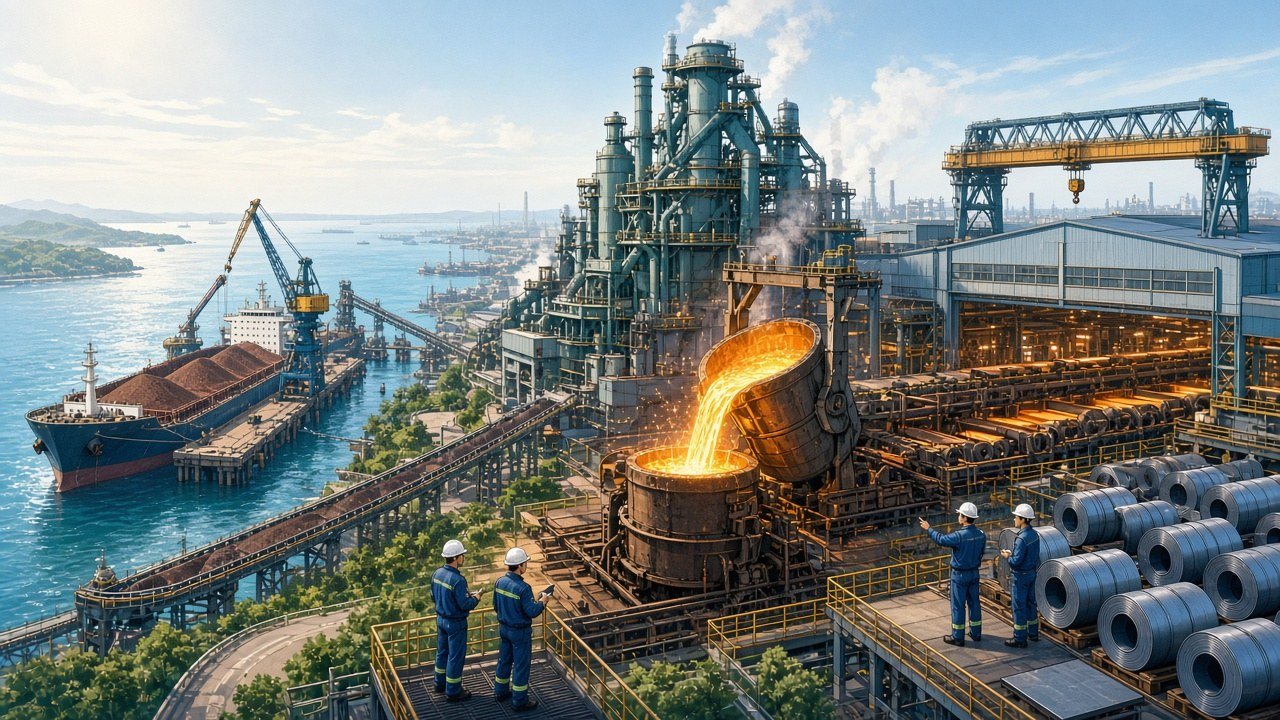
China Baowu Steel Group made about 125 million tonnes of crude steel in 2025. That was enough to keep it first in the World Steel Association’s company ranking, roughly twice the tonnage of ArcelorMittal in second place. China as a whole still poured about 961 million tonnes that year, more than half of everything melted on Earth. Those figures are not a triumph of marketing. They are the arithmetic of an industrial system that spent seventy years treating steel as the skeleton of national power, then spent another decade trying to stop that skeleton from growing without end.
Baowu is the firm that concentrates that story. It is not China’s only steel giant. Ansteel, HBIS, Shagang and others still cast tens of millions of tonnes apiece. But Baowu’s lineage runs through the reform era’s flagship coastal mill, the inland Soviet-aided plants of the 1950s, and the state-directed mergers that Beijing used when overcapacity became a political problem. To understand Baowu is to understand how Chinese steel was built, why it got too large, and what “largest in the world” does and does not mean.
Steel before Baowu: Anshan, Wuhan and the planned base
Modern China did not invent the idea that steel comes first. Soviet planning doctrine put heavy industry, and iron and steel within it, at the centre of catch-up industrialisation. Rails, machinery, weapons, ships and urban frames all begin as metal. In the early People’s Republic that logic was blunt. Without steel you could not build the factories that would make more steel, or the tools that would make everything else. Party pamphlets defined heavy industry as the producer of means of production. Steel sat near the top of that list because every other plan target assumed metal would be there.
The physical plant China inherited was thin and uneven. The most important modern complex sat at Anshan in Liaoning. It had grown under Japanese colonial rule in Manchuria as the Anshan works and then the Shōwa Steel Works, linked to the South Manchuria Railway and to nearby iron ore at places such as Takushan. By the early 1940s its capacity was in the order of three and a half million tonnes, large by Asian standards of the time. War, Soviet dismantling of equipment after 1945, and civil war left the site wrecked. Communist authorities rebuilt it from 1948 as Anshan Iron and Steel, Angang.
Soviet aid then remade Angang as a centrepiece of the First Five-Year Plan. In 1951 the “three major projects” began: a new blast furnace, a seamless pipe plant and a large rolling mill, designed with Soviet institutes and counted among the 156 priority projects of Sino-Soviet industrial cooperation. National crude steel output rose from roughly 1.3 million tonnes in 1952 to about 5.2 million tonnes by 1957. The absolute numbers look small beside today’s Baowu alone. The political meaning was large. Steel was how a poor agrarian state proved it could industrialise on a planned timetable rather than wait for market accidents.
Wuhan followed as a second inland pole. Preparatory work in the early 1950s led to a Qingshan site on the Yangtze, Soviet help with site selection, and construction from 1955 under the same planned-economy wave. Wuhan Iron and Steel poured its first iron from Blast Furnace No. 1 on 13 September 1958. Together with Anshan, Baotou and other inland works, it formed a map of mills sitting near ore, coal and political priority rather than near deepwater ports. That inland pattern would later collide with a different idea imported from Japan: build the mill on the coast and bring the ore by ship.
Reform era expansion and the overcapacity problem
Reform after 1978 did not shrink steel. It multiplied it. Provincial governments, township enterprises and state mills all raced to add furnaces as construction, machinery and exports demanded metal. Quality varied wildly. Long products for construction often outran flat products for cars and appliances. Local officials counted tonnage as proof of growth. Banks and governments soft-financed plants that would have failed a hard budget test. The result was a steel industry that was nationally huge and organisationally scattered.
By the mid 1990s China had become the world’s largest steel producer. Official Chinese accounts put national output at about 32 million tonnes in 1978 and above 100 million tonnes by 1996. The climb after that was steeper still, as urbanisation and investment after WTO entry pulled in cement, rebar and plate at a pace no earlier industrialiser had matched. From about 2006 China flipped from net steel importer to net exporter for many products. Foreign mills felt the surplus as price pressure. Chinese mills felt it as vanishing profits whenever domestic construction paused.
Fragmentation was the domestic price. Hundreds of producers, many small, chased local GDP and employment. When demand slowed, prices collapsed and losses piled up in older inland works while newer capacity kept arriving. By the end of 2015 China was producing about 799 million tonnes of crude steel against capacity above 1.1 billion tonnes, a utilisation rate near 71 percent on the official capacity series used by outside analysts at the Peterson Institute. Excess capacity became a fiscal headache at home and a trade fight abroad, as cheap Chinese exports met tariffs and anti-dumping cases in the United States, Europe, India and elsewhere.
Beijing’s answer from late 2015 was supply side structural reform for steel and coal. A State Council guidance of February 2016 set a target of cutting 100 to 150 million tonnes of crude steel capacity between 2016 and 2020. Officials reported more than 65 million tonnes of iron and steel capacity closed in 2016 alone, ahead of that year’s 45 million tonne target. The International Monetary Fund later summarised about 115 million tonnes of steel capacity curbed across 2016 and 2017, alongside a drive against illegal induction furnace output. The campaign mixed closures, worker resettlement funds and pressure on banks not to refinance zombie mills. Consolidation was the other half of the same policy. Fewer, larger groups would be easier to police, upgrade and hold accountable. That is the climate in which Baosteel and Wuhan Iron and Steel were pushed together.
Baosteel as a modern coastal mill
Baosteel was never meant to be one more inland copy of Anshan. It was meant to be a leap.
In October 1977 Chinese metallurgy officials returned from Japan describing a fifteen to twenty year technology gap, including the simple humiliation that Japanese cars used light cold-rolled sheet while Chinese embassy cars still wore thick, rusty hot-rolled panels. In October 1978 Deng Xiaoping visited Nippon Steel’s Kimitsu works and told his hosts, in substance, to help China build a plant like that. On 23 December 1978, the day after the Third Plenum that launched reform, the first pile was driven at Baoshan on the southern bank of the Yangtze estuary in Shanghai. The design capacity was six million tonnes of steel and six million tonnes of iron. It was billed as the largest project since the founding of the People’s Republic.
The site choice was the point. Traditional Chinese steel thinking favoured ore and coal at the mill gate. Baosteel copied the Japanese coastal model: deepwater access, imported high-grade ore, and proximity to China’s largest industrial city. Alternative sites such as Jinshanwei were rejected after surveys of waves, berthing and hot-metal logistics. Shanghai won because only its industrial base and port system could support a mill of that sophistication at the time. The cost nearly killed the project. Contemporary debate put the bill near 30 billion yuan when national fiscal revenue was about 80 billion. Critics said China was overdrawing itself for one plant. After a week’s inspection, Chen Yun backed completion. Deng insisted the municipal party committee take charge and that history would prove the decision right.
Blast Furnace No. 1 was ignited on 15 September 1985. Phase one entered operation that November. Later furnaces followed in 1991 and 1994. Japanese equipment, training and management practice shaped the early years; Chinese engineers then localised and expanded. In 1998 the Baoshan works were merged with other Shanghai metallurgical assets and Meishan to form Shanghai Baosteel Group. The listed company Baoshan Iron and Steel went to the Shanghai exchange in December 2000. What mattered industrially was not only tonnage. Baosteel was built to make the flat products China had lacked: cold-rolled sheet, automotive steel, tinplate, electrical steels and other grades that earn more than commodity rebar. Company and local histories still stress auto sheet and oriented electrical steel as signature lines, along with ship plate and a wide carbon steel catalogue. The coastal mill became the technological benchmark against which older inland plants were judged.
Baosteel also practised an early version of the consolidation role Beijing later assigned to Baowu: absorb weaker assets, close obsolete capacity, and carry national industrial policy. That habit would define the group after 2016.
How China Baowu was assembled
In September 2016 the State Council approved the merger of Baosteel Group and Wuhan Iron and Steel Group. Xinhua noted their 2015 crude steel outputs at about 35 and 26 million tonnes. A ceremony in Shanghai on 1 December 2016 completed the creation of China Baowu Steel Group. Reuters reported about 60 million tonnes of annual capacity, 730 billion yuan in assets and 228,000 employees. At birth Baowu was China’s largest steelmaker and the world’s second, behind ArcelorMittal.
The merger was not a private market romance. It was SASAC industrial policy. Beijing wanted fewer central state firms, higher industry concentration, and a champion able to cut capacity without dissolving into local protectionism. Reuters recorded the wider goal of placing 60 percent of national steel capacity in the hands of the ten largest firms by 2025. Closing furnaces is easier when the balance sheet that owns them is large enough to absorb the social cost. Baosteel itself raised its own closure target to 11 million tonnes of capacity over 2016 and 2017 while the merger was under way, ahead of an earlier schedule.
Baowu then became the vehicle for further absorptions, often through free or administrative transfers of controlling stakes from provincial state owners to the central group. In June 2019 it took 51 percent of Magang (Maanshan Iron and Steel) in Anhui, lifting group capacity from roughly 70 toward 90 million tonnes and adding long products and railway wheel steels to a flats-heavy portfolio. Magang sits a few hours’ drive from Shanghai, so the deal thickened Baowu’s presence along the Yangtze industrial corridor. In 2019 and 2020 it moved to control Chongqing Iron and Steel in the southwest, extending the map inland again. In August 2020 it agreed a 51 percent stake in Taiyuan Iron and Steel (TISCO), a major stainless producer with about 13 million tonnes of steel capacity including roughly 4.5 million tonnes of stainless. Later deals brought Kunming Iron and Steel, Xinyu (Xinsteel) and, in 2023, agreements around Shandong Iron and Steel Group and its Rizhao operations into the same orbit.
The logic is consistent. Beijing uses Baowu as a national champion that concentrates ownership, disciplines capacity, and bargains for technology and raw materials. Provincial governments trade control for central capital and political cover. Workers and cities experience it as another round of restructuring. The World Steel Association’s ranking method reinforces the effect: when ownership exceeds 50 percent, the subsidiary’s full tonnage usually counts toward the parent. Merger arithmetic and furnace arithmetic move together.
Scale today and what biggest means
By the mid 2020s the ranking was no longer in doubt. World Steel Association figures put China Baowu at 130.09 million tonnes of crude steel in 2024 and 124.76 million tonnes in 2025. ArcelorMittal produced 65.15 and 63.43 million tonnes in those years. Nippon Steel and Ansteel followed in the high fifties in 2025. Baowu’s absolute output fell with China’s national total, which slipped from 1,005.1 million tonnes in 2024 to 960.8 million tonnes in 2025, yet the firm remained first by a wide margin. Of the dozens of companies worldwide that cast more than three million tonnes in 2025, about a third were Chinese. Scale is a national fact that Baowu simply heads.
Main manufacturing geography still mirrors the merger map: Baoshan in Shanghai, Qingshan in Wuhan, the Zhanjiang (Dongshan) coastal works in Guangdong, Meishan near Nanjing, plus Maanshan, Taiyuan stainless, Chongqing and other controlled sites. Product mix at the Baosteel core remains skewed toward higher value flats: automotive sheet for domestic and export car plants, ship plate, electrical steels for transformers and motors, tinplate and other coated products. The wider group also rolls longs and stainless. That mix matters for margins in good years. It does not erase the fact that Chinese steel prices are still set in a market with too many furnaces.
“Biggest” here means tonnage. It does not automatically mean most profitable, most advanced in every specialty niche, or cleanest. Listed Baosteel can post solid profits when prices hold. Group-level returns across all absorbed mills are more cyclical, and industry gluts still punish everyone. ArcelorMittal and the best Japanese and Korean mills still compete on technology, customer qualification and balance-sheet returns in ways that raw million-tonne tables do not capture. Electric-arc furnace steel, which uses scrap and usually emits less carbon per tonne than the blast furnace and basic oxygen route, accounted for only about 10.6 percent of China’s crude steel in 2025 on World Steel Association process data, against about 30 percent globally. China’s steel system, Baowu included, is still a coal and ore system at heart. Tonnage leadership and green steel leadership are different races.
Iron ore, scrap and the supply problem
Baosteel’s founders accepted import dependence as the price of modernity. That bargain now sits under half the world’s steel.
Chinese mills consume vast volumes of seaborne iron ore, chiefly from Australia and Brazil. World Steel Association iron ore tables for 2024 show China producing about 1.30 billion tonnes of ore domestically while importing about 1.24 billion tonnes. Much domestic ore is lower grade. The coastal blast furnaces that define Baowu’s Shanghai and Zhanjiang model run on traded, higher-grade feed. When ore prices spike, Chinese steel margins compress. When Chinese steel demand wobbles, the entire seaborne ore trade feels it. Baowu’s size makes it both a price taker in the short run and a strategic buyer whose offtake plans move mine investment decisions.
Baowu has tried to diversify upstream. With Rio Tinto it holds 46 percent of the Western Range joint venture in the Pilbara, a project designed to add on the order of 25 million tonnes a year of iron ore capacity and support the older Paraburdoo hub. In Guinea it took a stake in the northern Simandou blocks through the Winning Consortium structure, completed in 2024 according to contemporaneous reporting, in one of the world’s largest high-grade undeveloped ore fields. Simandou’s railway and port bill is measured in many billions of dollars and involves several Chinese and international parties; ownership is not a simple single-mine cartoon. The strategic intent is clearer than the org chart: reduce reliance on the Australia–Brazil duopoly without abandoning blast furnaces overnight.
Scrap and electric furnaces are the other lever. Baowu has invested in scrap processing, including a large facility in Anhui opened in 2021. China’s scrap pool is growing as the car and building stock ages. Policy talk has long favoured a higher electric furnace share. Yet as long as that share remains near a tenth of national output, ore ships will matter more than scrap yards for the group’s emissions and cost base.
Capacity cuts, emissions and the limits of scale
Environmental politics and overcapacity politics are now the same conversation. Steel is among China’s largest industrial sources of carbon dioxide, particulate matter and local air pollution. Capacity cuts after 2016 were sold both as market repair and as cleaning up. Ultra-low emission retrofits on sinter plants and blast furnaces, output caps in winter heating seasons in the north, and crude steel “flat or down” administrative targets in later years have all been used to restrain the furnace park. Baowu signs memoranda with miners such as Rio Tinto and Fortescue on lower-carbon ironmaking pilots. Those pilots matter. They do not yet rewrite a system that still makes about nine tenths of its steel via oxygen converters.
None of this has made Chinese steel small. It has tried to make it more orderly. Consolidation into Baowu-style champions is supposed to replace a race among weak local mills with planning inside large balance sheets. Critics note that new, more efficient furnaces sometimes replace old ones, so gross closures can overstate net shrinkage, and that export surges can reappear when domestic demand softens. Defenders note that utilisation and profits did improve after the first wave of cuts, and that a group producing 125 million tonnes can be told to hold output in a way a cloud of township mills cannot.
The honest summary is narrow. Baowu is the world’s largest steel company by the tonne. It sits at the end of a line that runs from Japanese colonial Anshan and Soviet Wuhan through Deng’s Kimitsu-inspired Baosteel to a decade of state mergers. China built the steel industry that builds China. Baowu is what that industry looks like when Beijing decides the champion should also be the disciplinarian. How far tonnage can fall while quality, profits and carbon intensity improve is the open question the next decade of Chinese steel policy will have to answer in ordinary numbers, not slogans.