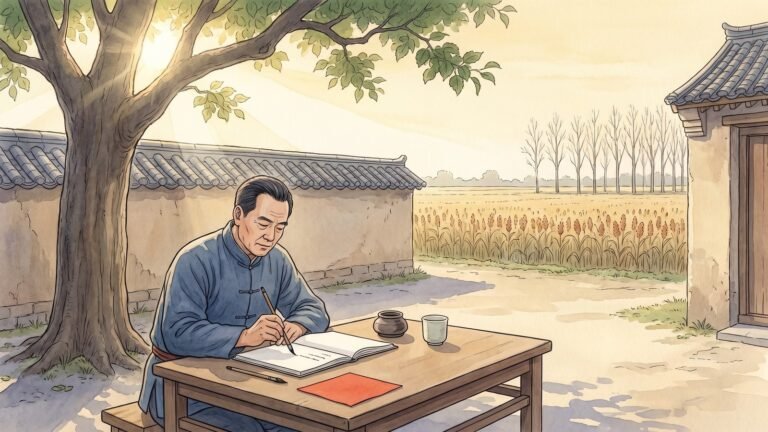
In the summer of 1943, a Cambridge biochemist arrived in Chongqing, China’s battered wartime capital, carrying little more than a red notebook and a question that would occupy the rest of his life. Joseph Needham was already one of Britain’s most distinguished scientists, a fellow of the Royal Society at thirty-six. But China undid him. Over the next three years he drove thousands of miles through free China in a Chevrolet truck, visiting universities that had fled inland with their libraries on their backs, collecting evidence for an idea that most of his contemporaries found absurd: that China, far from being a civilization without science, had invented paper, printing, gunpowder, the compass, cast iron, the chain drive and the stirrup centuries before Europe. Back in Cambridge he began Science and Civilisation in China, a project that eventually ran to twenty-seven volumes across seven books and continued after his death in 1995. It posed what came to be called the “Needham Question”: why did modern science and industry develop in Europe rather than in China, when China had led the world in technology for more than a millennium? The question is still argued about today. Needham became, almost by accident, the founding figure of a peculiarly British tradition: the writer who makes China legible to the English-speaking world.
That tradition is older than Needham, and it is unusually productive. For a country whose direct imperial stake in China ended with the handover of Hong Kong in 1997, Britain produces a remarkable share of the books through which the West understands China: its history, its politics, its food, its ghosts. The historians Rana Mitter, Robert Bickers and Julia Lovell anchor the academic end of the shelf. Around them clusters a wider company: the journalist Tania Branigan, the Shanghai storyteller Paul French, the food writer Fuchsia Dunlop, the memoirist Alec Ash, the essayist and parliamentarian Yuan Yang. To read their books in sequence is to watch Britain argue with itself about what China is, what it was, and what its rise means.
The treaty port witnesses
British writing about China began as the literature of intrusion. The treaty ports opened by the Opium Wars after 1842 filled with British consuls, customs officers, missionaries, merchants and journalists, and many of them wrote. The travel writer Isabella Bird rode and rowed up the Yangtze in the 1890s and published The Yangtze Valley and Beyond in 1899, unsentimental and closely observed, still one of the best accounts of the river before the dams. Reginald Johnston, the Scottish scholar-official who became tutor to the boy emperor Puyi in the Forbidden City, recorded that strange intimacy in Twilight in the Forbidden City in 1934. Somerset Maugham passed through in 1919 and distilled the expatriate world of compradors and missionaries into the fifty-eight vignettes of On a Chinese Screen. In 1936 Peter Fleming, then twenty-nine, travelled overland from Peking to India across the closed province of Xinjiang and wrote News from Tartary, the wittiest of all interwar China travel books. Three years later W. H. Auden and Christopher Isherwood went to the war against Japan and came home with Journey to a War, part reportage, part sonnet sequence. These writers were often agents of the very power that had forced China open, and their books carry that bias openly, which is precisely why historians still mine them.
The mood darkened after 1949, when the door shut and the foreign communities of the treaty ports were expelled. For a generation, British writing on China was done from the periphery: from Hong Kong, from Taipei, from the reading rooms of London. What survived was scholarship rather than testimony, and it produced, alongside Needham’s great project, a quieter classicism: historians and translators who kept the field alive while the country itself was largely closed to them.
Wild Swans and the reopened door
When China reopened in the 1980s, the first British book to seize the new era was written by someone who had walked through the door in the other direction. Jung Chang arrived in Britain in 1978 to study linguistics at the University of York, one of the first students from the People’s Republic to win a scholarship to the West. In 1991 she published Wild Swans, the story of three generations of the women of her family: her grandmother, a warlord’s concubine; her mother, a Communist official broken by the Cultural Revolution; and herself, a Red Guard who became an exile. It has sold more than ten million copies and been translated into more than thirty languages. It is banned in China, where she has never been allowed to return since a visit in 1988. Whatever historians have since added to the picture, Wild Swans did something no academic book could have done: it made tens of millions of Western readers feel the twentieth century in China as a family story. It also established a template, the personal as the political, that a later generation of Chinese-born writers in Britain, from Xinran, whose The Good Women of China began as a Nanjing radio phone-in, to Guo Xiaolu and Ma Jian, would expand in their own directions.
Jung Chang also demonstrated the tradition’s combative streak. In 2005 she and her husband, the historian Jon Halliday, published Mao: The Unknown Story, a biography of ferocious hostility that put the death toll of Mao’s rule at over seventy million and portrayed him as a monster from first to last. It became an international bestseller and a scholarly battleground: reviewers praised its narrative drive while many China specialists, including some of the historians celebrated in this article, faulted its sourcing and its refusal of ambiguity. The argument was itself instructive. British writing on China is not a chorus; it is a family quarrel conducted in public, between memoir and archive, between those who see the Communist century primarily as catastrophe and those who insist on its complexity. The shelf is stronger for the disagreement.
The historians’ generation
The generation of British scholars who came of age as the archives opened is now, by any measure, the centre of gravity of China writing in English. Rana Mitter is its most public face. Born in Cambridge in 1969 to a Bengali Indian family, he trained at King’s College, Cambridge, ran Oxford’s China Centre from 2013 to 2020, and in 2023 crossed the Atlantic to become the S. T. Lee Chair in US-Asia Relations at the Harvard Kennedy School. His signature book, published in Britain as China’s War with Japan, 1937–1945 and in America as Forgotten Ally, recovered the eight-year war of resistance against Japan, with its fourteen million Chinese dead and eighty million refugees, as one of the central theatres of the Second World War, and restored wartime China to its place as the fourth ally alongside Britain, America and the Soviet Union. The book won the Duke of Westminster’s Medal for Military Literature and was named a book of the year by both the Financial Times and The Economist. Its sequel in spirit, China’s Good War (2020), asked how that war is being remembered anew under Xi Jinping as the foundation of a new nationalism. Mitter writes regularly for the Guardian and Foreign Affairs, presents on BBC Radio 3, and has become the writer Western editors call first when China does something they do not understand.
If Mitter’s subject is the war, Robert Bickers’s is the empire, and specifically the British world inside China that the writers of the treaty ports had inhabited. A professor at the University of Bristol, Bickers began with Britain in China (1999), then wrote Empire Made Me (2003), a biography of a Shanghai policeman that turned the International Settlement’s machinery into one man’s drifting, compromised life. The Scramble for China (2011) widened the lens to the whole foreign presence in the Qing empire between 1832 and 1914. Out of China (2017), shortlisted for the Wolfson History Prize, followed the story in reverse: how, across the twentieth century, the Chinese drove the foreign enclaves out, and how the memory of that era of domination still shapes Beijing’s politics today. Bickers also curates Historical Photographs of China, an online archive of some twenty thousand digitised images of life in the treaty ports, much of it rescued from the attics of families whose grandfathers served in the customs or the consulates. Where Mitter explains China’s present through its war, Bickers explains it through the long century, now half forgotten, when Britain itself was China’s most aggressive foreign presence, a reckoning that sits at an uncomfortable angle to British self-regard, which is part of its power.
Julia Lovell, professor of modern China at Birkbeck, University of London, moves between history and translation. Her The Opium War (2011) dismantled the myths on both sides of the conflict that opened the era of the treaty ports; she is also the translator of Lu Xun, the founder of modern Chinese fiction, whose satire she renders with an ear for its cruelty and comedy. In 2019 she published Maoism: A Global History, tracing Mao’s ideas from Peru’s Shining Path to Nepal’s insurgency and India’s Naxalites, and won the Cundill History Prize for it. Around these three stands a wider circle: Henrietta Harrison at Oxford, whose The Perils of Interpreting reconstructed the Macartney embassy of 1793 through the lives of the two interpreters caught between the British and Qing courts; Frances Wood, long the head of the Chinese collections at the British Library, whose Did Marco Polo Go to China? dared to ask the impolite question in its title; and historians of the earlier China hands such as the story told in Simon Winchester’s biography of Needham, The Man Who Loved China.
There is also a thriving shelf of popular general history, a genre British writers have made almost a house specialty. John Keay’s China: A History (2008) compressed three thousand years into six hundred pages without losing the thread. Jonathan Clements has written brisk lives of everything from the First Emperor to the Art of War. The broadcaster Michael Wood, whose six-part television series The Story of China aired on the BBC in 2016 and reached audiences in China itself, travelled from the oracle bones of Anyang to the studios of contemporary Beijing with the enthusiasm of a schoolmaster who never lost his sense of wonder. Even the Anglophone field’s most famous name belongs to the British story in a way: Jonathan Spence, the great Yale historian of China, author of The Search for Modern China and The Death of Woman Wang, was born in Surrey in 1936 and educated at Winchester and Cambridge before crossing the Atlantic, a one-man reminder that the British and American China traditions have always traded people as freely as ideas.
The journalists and the storytellers
Britain’s newspapers have been the second engine of the tradition. The Guardian, the Financial Times, the Economist and the BBC have maintained China bureaux for decades, and their correspondents keep turning postings into books. James Kynge’s China Shakes the World (2006), born of nineteen years reporting for the FT, caught the shock of Chinese industrial rise earlier and more vividly than almost anyone. Jonathan Fenby, a former editor of the Observer and of the South China Morning Post, has produced a shelf of crisp general histories, from The Penguin History of Modern China to his biography of Chiang Kai-shek. Michael Sheridan’s The Gate to China (2021) told the rise of Shenzhen through the port of Hong Kong. David Rennie, the Economist’s long-serving Beijing bureau chief, and Rob Gifford, whose China Road (2007) was reported from a single hitchhiked journey along Route 312 from Shanghai to the Kazakh border, carried the same craft into the podcast and radio era.
Two recent books show where the tradition is heading. Tania Branigan spent seven years as the Guardian’s China correspondent, from 2008 to 2015, and then spent years more on Red Memory (2023), an account of how the Cultural Revolution is remembered, suppressed and exploited in China today, told through a Red Guard, a widow, an artist and the keepers of private museums. It won the 2023 Cundill History Prize, was shortlisted for the Baillie Gifford Prize, and proved that the British reporter’s book on China can still carry the field’s biggest honours. Paul French, who lived in Shanghai for two decades, took a different route: forensic microhistory. Midnight in Peking (2012) reconstructed the unsolved 1937 murder of Pamela Werner, a British schoolgirl, from the files of a Scotland Yard detective lent to the Peking police; it won the Edgar Award for best true crime. He followed it with City of Devils, on the gangsters of Shanghai’s Badlands, and Her Lotus Year (2024), on Wallis Simpson’s lost year in China before she met the king. Between them, Branigan and French show the two poles of the genre: the moral history of the revolutionary century, and the noir archive of the world of the treaty ports that Bickers chronicled from the university side.
The commentary wing matters too. Isabel Hilton, the Scottish journalist who made her name with The Search for the Panchen Lama, founded chinadialogue in 2006, a bilingual publication based in London covering China and the environment that became required reading on both sides of the language divide. Kerry Brown, a former diplomat who served in Beijing and now directs the Lau China Institute at King’s College London, turns out a steady stream of short, sharp books on Chinese politics for general readers. Jonathan Chatwin, in Long Peace Street and The Southern Tour, has walked the physical routes of China’s revolutionary memory and written up what he found at street level. These writers rarely win the big prizes, but they keep the weekly conversation about China in Britain informed, bilingual and sane.
Food, mountains and the long immersion
Not every British writer on China writes about power. Fuchsia Dunlop went to Sichuan University as a British Council student in 1994, became the first Westerner to train as a chef at the Sichuan Institute of Higher Cuisine, and has spent three decades writing about Chinese food with an authority no outsider had previously achieved. Her memoir Shark’s Fin and Sichuan Pepper (2008) is as honest about the outsider’s compromises, from the banquet dishes and the banned foods to the moral queasiness, as it is intoxicated by the cuisine. Invitation to a Banquet (2023), a history of Chinese food in thirty dishes, won the Fortnum and Mason Food Book Award; several of her books are published in Chinese translation in China itself, where chefs treat her as one of their own. Alec Ash, who lived in China from 2008 to 2022 and now edits China Books Review, wrote Wish Lanterns (2016) about the hopes of six young Beijingers born after 1980, and The Mountains Are High (2024) about the city escapees who have fled to Dali, in the Yunnan hills, to opt out of the rat race; it is a book about contemporary China written at walking pace. And Yuan Yang, born in China, raised in Britain from the age of four, a Financial Times correspondent in Beijing and since 2024 the Labour MP for Earley and Woodley and the first Chinese-born member of the House of Commons, published Private Revolutions (2024), a portrait of four Chinese women coming of age in the 2010s, in which the writer’s own divided formation is the quiet undertow.
Why Britain?
None of this is an accident of individual talent. Britain’s writing on China rests on institutions that no other European country quite matches. The universities of Oxford, Cambridge, Bristol, Birkbeck, King’s College London and SOAS built China studies on two centuries of accumulated archives: the records of the Maritime Customs, the consulates of the treaty ports, the Hong Kong government, the missionary societies. The broadsheet newspapers and the BBC kept paying for correspondents in Beijing long after the business case for foreign bureaux collapsed elsewhere. London publishing, with Penguin, Allen Lane and Faber at the centre, has always had a market for the serious general book about a far country, the same appetite that sustained the Victorian travel writers. And underneath it all runs the imperial inheritance itself: Britain was the power that forced China open, occupied Hong Kong for a century and a half, and then handed it back. Writing about China is, for British writers, partly a way of writing about their own country’s diminished but entangled place in the world, which gives the best of the tradition its characteristic doubleness, admiration for China and unease about the Britain that encountered it held in a single frame.
The conditions are getting harder. Foreign correspondents have been expelled or squeezed; archives that opened in the 2000s have partly closed again; the immersive decades that produced Dunlop, French and Ash are difficult to repeat. Some of the tradition’s leading figures have decamped to America, as Mitter and Ash have done, and the political weather in Britain itself, from the arguments over Huawei to Confucius Institutes and campus partnerships, has made China a domestic controversy as well as a foreign subject. Yet the shelf keeps growing, and its centre of gravity has shifted in a telling direction: from the China of the treaty port witnesses, a China Britain acted upon, to the China of Mitter, Branigan and Yuan Yang, a China that acts, and that Britain, like everyone else, must now spend its energy trying to understand. Needham’s red notebook, still the founding gesture, asked why China had once led the world. The British writers who came after him have ended up answering a different question: what it means that China is leading again, and what kind of country is doing the asking.