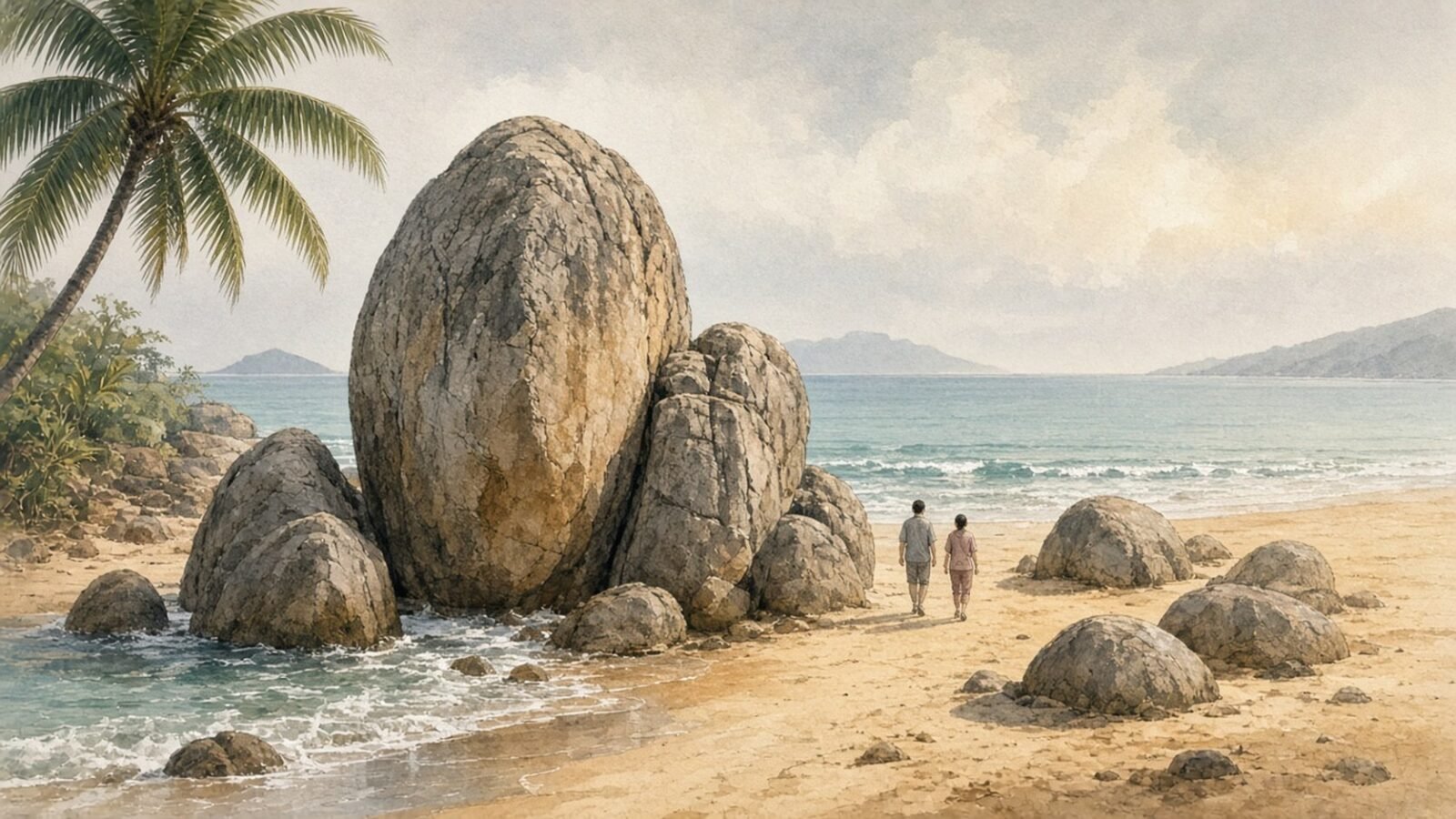
On the southern shore of Hainan Island, where the beach ends in a scatter of enormous granite boulders under the palms, two of the rocks carry inscriptions that together form the most romantic address in China: tianya haijiao, the edge of the sky and the rim of the sea. For most of Chinese history that was not tourism marketing but a statement of fact. Hainan, the island off the country’s southern coast, separated from Guangdong by the thirty kilometres of the Qiongzhou Strait, was where the map ran out: a tropical fringe of rainforest and coral at the bottom of the empire, notorious for a thousand years as the place where disgraced officials were sent to disappear. Su Shi, the greatest poet of the Song dynasty, spent his last exile there in the 1090s, teaching village children and writing verses about coconut palms, and reported, with the wry grace that made him beloved, that the island had cured him of worrying about the court. The story of Hainan is the story of how China’s outermost edge became, in one generation, one of its front doors, and along the way the island turns out to have been quietly giving China things for a very long time: its cotton, its officials, its revolutionaries’ father, and now its rockets.
The island of the Li
Hainan is China’s second-largest island, after Taiwan, thirty-four thousand square kilometres of mountains, jungle and beach, crossed by the Wuzhishan range whose Five Finger Peak rises above the clouds in the island’s centre. Its first people were the Li, whose ancestors crossed from the mainland thousands of years before there was a China, and whose villages in the central highlands preserved, into living memory, a culture of remarkable distinctness: boat-shaped houses, tattooed grandmothers whose patterned faces recorded their lineage, and above all a mastery of textiles. It is one of the quiet hinges of Chinese economic history that the mainland learned cotton weaving, in large part, from this island. In the thirteenth century a woman named Huang Daopo, fleeing a hard life in the Yangzi delta, lived for decades among the Li of Hainan and learned their techniques of cotton ginning, spinning and weaving; returning home around 1290, she taught them to the weavers of Songjiang, near modern Shanghai, and the Yangzi delta became the cotton heartland of China, clothing an empire. Shanghai’s weavers worshipped her as a goddess for six hundred years. The debt runs from the fashion of the Ming dynasty back to the looms of the Li villages, and it is rarely remembered.
Han Chinese settlement crept around the coasts over two millennia, and the island was formally administered from the Han dynasty onward, part of Guangdong province until 1988. But it remained a frontier in the deep sense: a place the centre used rather than governed. Its most famous use was exile. From the Tang onward, officials who lost the court’s lethal games of faction were banished to Hainan, which functioned in the imperial imagination the way Siberia functioned for Russia. The Tang chancellor Li Deyu died there in exile in 850. Five hundred years later the island produced the reverse flow: Hai Rui, born in Qiongshan in 1514, who became the Ming dynasty’s byword for the incorruptible official, a man so famously unbribable that his coffin, shipped home along the coast, was mourned by crowds the whole way, and whose impeachment memorials against the emperor’s own misconduct remain set texts in the literature of courage. The exile island sent the empire back its conscience.
The gateway no one noticed
Hainan’s other ancient role was maritime, and here too it was underestimated. The island sat squarely on the sea roads of the Maritime Silk Road: the monsoon trade that ran from the Arab and Persian Gulf to the ports of south China passed its shores, and its harbours sheltered merchants of every Asian nation for a thousand years. The Hainanese themselves became one of the great seafaring and migrant peoples of Southeast Asia. Small, outward-looking and famed as cooks, they carried their food culture across the South China Sea, and one dish in particular conquered the world under a borrowed name: the chicken rice of Singapore and Malaysia, today the national comfort food of both, is the Wenchang chicken of Hainan, carried south by island migrants and perfected in the hawker stalls of the Straits. The island’s counties, Wenchang above all, sent so many sons overseas that they became qiaoxiang, sojourner homelands, laced with arcaded streets built by remittances and shaded by coffee bushes brought home from Malaya. Xinglong coffee, grown by returned migrants, made Hainan a coffee island decades before the mainland discovered espresso.
It was from Wenchang, in 1861, that the island’s most consequential migrant family came: a boy named Han Jiaozhun went to sea, reached Boston, stowed away on an American revenue cutter, and became Charlie Soong, the Bible-printing Shanghai millionaire whose daughters, the Soong sisters, married Sun Yat-sen, Chiang Kai-shek and the banker H.H. Kung, and whose family’s story is told elsewhere on this site. Hainan’s most famous son thus never lived his public life on the island at all, which is itself a very Hainanese outcome: the island exports people, and the people come back with the world.
From battlefield to free port
The twentieth century was not gentle to the island. Japan occupied Hainan in 1939, coveting its iron ore and its position athwart the South China Sea. But the occupation produced the island’s proudest modern legend: the Qiongya Column, the communist guerrilla force that held out in the Wuzhishan highlands for twenty-three years, from 1927 to 1950, never destroyed, never quite suppressed, the red flag that, in the official phrase, never fell. When the People’s Liberation Army came for the island in the spring of 1950, in the last major campaign of the civil war, it came in the island’s own fashion: across the strait in wooden junks and fishing boats, against a Nationalist defence with warships and aircraft, guided through the surf by the guerrillas coming down from the mountains. The conquest of Hainan, completed in May 1950, closed the civil war on the mainland’s doorstep, and the junk fleet that took a modern island remains one of the founding epics of the PLA.
The island’s postwar career was, for decades, a strategic backwater’s: rubber plantations for a country cut off from Malaya, a naval frontier, a place whose beauty was a rumour. Then, in 1988, came the decision that remade it. Hainan was separated from Guangdong and made China’s youngest province, and, in the same breath, the largest Special Economic Zone in the country, an island-sized experiment in the reforms that were transforming the coast. The experiment was riotous. The early 1990s brought a property boom and bust of legendary wildness; the island learned, expensively, the difference between speculation and development. What grew out of the wreckage was real: Sanya’s beaches filled first with domestic tourists and then with the world’s; the island became China’s winter garden, supplying the country’s off-season vegetables and tropical fruit; retired couples from the frozen northeast began migrating south each winter in their hundreds of thousands, China’s snowbirds; and since 2001 the fishing town of Boao has hosted the Boao Forum for Asia, the annual gathering styled, only half in jest, the Asian Davos. In 2018 Beijing raised the stakes again: the whole island, all thirty-four thousand square kilometres of it, is being built into China’s largest Free Trade Port, the country’s most ambitious experiment in openness, due to mature in the middle of this decade.
The island’s own gifts
And the rockets. On the coast of Wenchang county, a short drive from the village where Charlie Soong was born, China built its newest spaceport. The Wenchang Space Launch Site, opened in 2016, is where the Long March 5, the country’s heavy-lift rocket, rises over the sea, because the physics of rocketry rewards the equator’s spin and the safety of an ocean downrange, and Hainan has both. The island that the empire considered the rim of the world now hosts the launches that put modules of the Chinese space station into orbit, and on launch days the beaches fill with families watching the future go up over the coconut palms, a scene that Su Shi, who loved the island’s sky, would have recognized as poetry.
The island keeps older treasures too, and guards them harder. In the rainforest of the central mountains lives the Hainan gibbon, the rarest primate on earth, whose entire world population, a few dozen individuals, sings at dawn in one patch of highland forest, and whose slow recovery from the edge of extinction is one of Chinese conservation’s quiet successes. The coral coasts, the mangrove bays, the medicine gardens of the Li and Miao highlands, the night markets of Haikou with their qingbuliang dessert stalls: the island’s wealth has turned out, in the end, to be the things the empire valued least, the warmth, the water, the forest, the sky.
That is Hainan’s lesson, and it is a hopeful one to end on. For a thousand years the island was defined by the centre as a margin: the place of exile, the end of the sky. The exiles it received became its teachers, the migrants it sent out became its wealth, the jungle the mainland ignored became its pharmacy and its ark, and the empty horizon it was famous for became a launch window. China has many frontiers, but only one of them looks like this: the edge of the sky, as the old poets feared, and, as it turned out, the rim of everything that comes next.