The best-known book ever written about tea contains no whisk, no teapot and no mention of a teacup. It describes a boiled drink, salted at the first boil, judged on the thickness of its foam, brewed in an iron cauldron that sat on a cross-shaped iron stand above a brazier with three small square windows in its front. The iron brazier in the book’s central illustration is even dated, by its own inscription, to the year after the Tang court destroyed the Turkic empire in the west. This is what the eighth century looked like when a solitary scholar with a grey beard and a talent for making enemies sat down to explain how to boil leaves. Everything we associate with the ceremony of tea, the whisk and the white bowl and the jade-coloured foam and the pot that turns tea into an art form, arrived later, in the Song, and belongs to a different and arguably more interesting story. Lu Yu’s book is not the beginning of tea culture. It is the moment tea stopped being a medicine and became a machine.
Lu Yu – Lu Yu, courtesy name Hongjian, born around 733 in Jingling in the prefecture of Fu, in what is now Hubei – was the orphan of a monk. The New History of the Tang, written a century later, records that nobody knew who his parents were, and that a Buddhist monk is said to have found him by the water and raised him. He was given no surname by his foster family. Instead, the young Lu Yu cast his own horoscope, drew the Yi hexagram that reads “the wild goose gradually approaches the land, and its feathers may be used as a standard of conduct”, and from that single line took Lu for a surname, Yu for a given name, and Hongjian for a courtesy name. It is a startling thing for a child to do, and it sets the tone of a life that would be spent insisting on his own terms. He was given the rudiments of writing and asked if he wanted to study the Classics. He refused, on a ground that could not be bettered: he had no brothers and no descendants, and what business had he with the filial learning? Instead he was set to gather cow dung and plaster walls. He herded thirty oxen, and, to keep himself occupied, wrote characters on the animals’ flanks with a bamboo stick. He ran away, joined a troupe of comic performers, and wrote thousands of words of jest. Then he came back, and the prefect Li Qiwu took him under his wing and taught him letters properly.
The Boy Who Took the Title
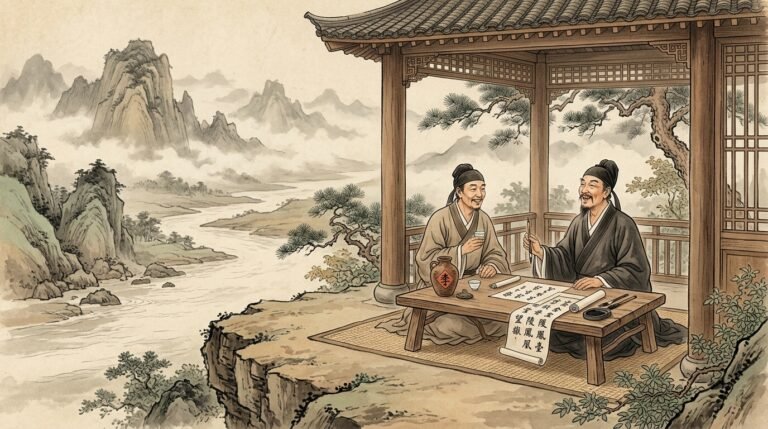
By the middle of the century Lu Yu had become something of a celebrity in a very particular circle: the scholars of the lower Yangzi, the gentry of the Wu region, the men who drank tea and argued about it. He had also, by his own account, discovered that his calling was not scholarship but tea. The usual summary of his life says he retired to a monastery and became a monk, and that he was “the Sage of Tea”. Both parts are wrong in instructive ways. There is no good evidence that Lu Yu ever took monastic vows, and he certainly did not retire to the Jingci Temple or to the famous southern monastery outside Chang’an, as the story has been retold for a thousand years. The temples that genuinely appear in the record are the monastery of Longyun in his home country and the Miaoxi Temple on Zhu Mountain above Huzhou, where in the winter of 773 the provincial governor Yan Zhenqing gathered fifty scholars to compile a rhyming dictionary. Lu Yu was there, and he named the pavilion they built on the terrace the Pavilion of the Three Gui, after the day on which it was raised: a year, a month and a day that were all designated by the tenth of the heavenly stems. Yan’s inscription records eighty participants and singles out two men by name, the poet-monk Jiaoran and Lu Yu. It is the earliest secure picture we have of him, and it is of an old man in a white hemp robe sitting with the most powerful literary figures in the region.
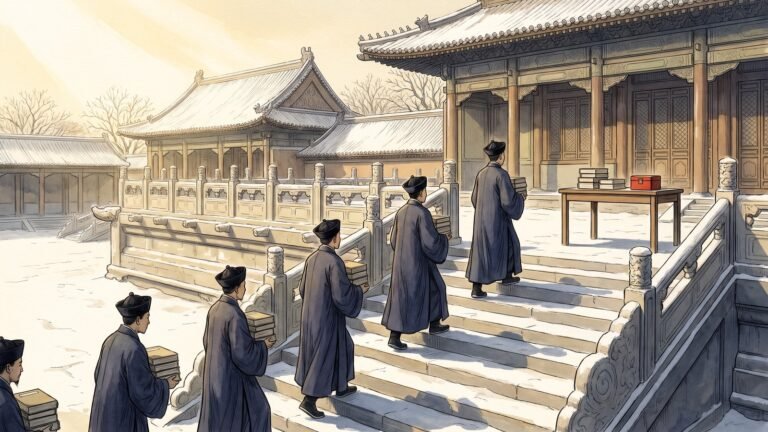
The court’s relationship with Lu Yu is one of the most useful things in his biography because it is so thoroughly negative. When the emperor summoned him, he was appointed Literary Instructor to the Crown Prince; he was then transferred to be Assistant Ritual Officer of the Court of Imperial Ceremonies. He accepted neither appointment. The New History of the Tang puts it in four words: “and he took office in neither.” No rank, no stipend, no court protection, no official library to draw on. What he had instead was something the court could not give him: the right to be the only authority. The Tang state liked him enough to want him and respected him enough to leave him alone, and by declining both jobs he converted that ambivalence into a kind of authority that no official title could have supplied. When the tea sellers of the capital made moulded earthenware figures of Lu Yu and set them up in the furnace to be worshipped as the Tea God, they were not paying homage to a civil servant. They were paying homage to a man who had made himself the author of a subject.
His dates are uncertain and the sources disagree interestingly. The official biography says he died at the end of the Zhenyuan reign, around 805. The colophon to the Siku edition of his own book says he died at the beginning of that reign, about 785. Modern scholarship settles on the winter of 803 or 804, when he would have been about seventy-two. He was buried near Huzhou, at the foot of the Guzhu tea mountain, and a pagoda was built for him that the local administration later had to repair. It is worth noticing how completely the official record has him: the range of his reputation was equally wide. He was not only the author of the book and the object of a kind of veneration; he was, by the eighth century, a technical authority whose opinion other people cited. When the writer Zhang Youxin produced his own treatise on boiling tea in the early ninth century, he leaned on Lu Yu, and then did something slightly audacious with him: he recorded a set of twenty ranked waters that he attributed to Lu Yu, along with a list of seven waters from an earlier author named Liu Bochu, and he told a story about Lu Yu arriving at a gathering in rustic dress and being put in the wrong place. The ranking of the twenty waters was almost certainly not Lu Yu’s, and Ouyang Xiu, writing in the eleventh century, said so with some relish, arguing that the attribution was simply the result of Lu Yu’s fame: since everyone knew him as a sage about tea, someone would eventually invent a water book in his name. The story of Lu Yu’s decline of office, his unruly temperament, his strange inventions and his impeccable taste in water had already begun to grow into a shape that no one was entirely responsible for. It is a mark of how completely he was taken up by the imagination of his own century that the most famous technical document in the history of tea had, within a generation, acquired a bibliography it did not have. He declined two appointments, wrote one short book, and was afterwards remembered not for his office but for having been right about leaves in hot water. Almost everything else about Chinese tea history is downstream of that book.
Ten Chapters and Forty-One Objects
The Classic of Tea is short. The text runs to a little over seven thousand characters and is arranged in three scrolls of ten chapters: the source, the implements, the making, the vessels, the boiling, the drinking, the history, the sources of supply, the abridgments and the diagrams. It is, in form, a manual. It reads like one because it is one, and reading it as a poem about refinement is a mistake that English-language tea writing has been making for a century and a half.
The spine of the book is its ninth chapter, and it is the part almost nobody knows. The Classic of Tea lists nine difficulties, and they are the nine things that can go wrong: the making of the tea, its sorting, the implements, the fire, the water, the roasting, the grinding, the boiling and the drinking. That is a specification, not a sentiment. Every subsequent chapter is an attempt to remove one of those nine failures, and the manual closes with a field version for the traveller who has to brew on a rock in a pine grove, where most of the apparatus is abandoned. Then comes the line that made the book a standard rather than a treatise: in a city or in the household of a prince, the twenty-four implements are to be complete, and if even one is missing then tea is finished. The book claims twenty-four and then, in the chapter on implements, actually names twenty-five. The discrepancy has never been resolved, and it is the sort of detail that tells you what kind of text you are reading: not a polished treatise but a working document with a copyist’s slip somewhere in it.
What is genuinely new in Lu Yu is not the tea. It is the systematisation. Before him, tea was described in a line or two: the Guang Ya, a dictionary of the third century BC, has the recipe that the people of Jing and Ba gathered leaves, pressed them into cakes, roasted the older leaves until they turned red, pounded them to powder, put the powder in a ceramic vessel, poured hot water over it and dressed it with onion, ginger and orange peel. No mill, no sieve, no salt, no foam, no cauldron, no taxonomy of objects. Lu Yu takes a household remedy and turns it into an engineered procedure with named components, a firing discipline, a vocabulary for judging the result and a supply chain behind it.
He also writes like a man with a vocation. The tea plant itself gets five names in the first chapter: cha, ku, shen, ming and lian. He grades it by soil, by whether it grew wild or in a garden, by whether it faced the sun or the shade, by whether the leaf is a shoot or a bud, and by whether the leaf is curled or flat, and he states the principle that would later become a science of place: the purple-leafed plant of the shady wood is the best, the sunny cliff the next. That is an early terroir document, and it was written six centuries before the word terroir entered any European language.
The last two chapters are where the book stops being domestic. Chapter eight lists the districts that supplied tea to the imperial court, and it reads like a modern appellation map: Yangxian and its famous purple shoot, Mengding, Guzhu. Chapter nine gives the abridged procedures for emergencies and for the field. Neither would have been possible without a state apparatus behind them, and that is the subject of the next section, because the Tang state did not merely drink tea. It taxed it, monopolised it, stole it and legislated it for two centuries.
The Brazier Dated to 764
The single most revealing object in the Classic of Tea is the brazier. It is a small three-legged iron stove with three square windows in its front, set over a pan to catch the ash, and its top is a flat plate on which the cauldron can be carried. Above the windows is an inscription of twenty-one characters, and the inscription includes a date: cast in the year after the Tang destroyed the Hu. That is 764. Lu Yu is therefore describing a specific object, in a specific year, made for a specific use, and he is recording its maker’s boast as part of the manual, which tells you what kind of technical confidence the book is trying to teach.
Onto that brazier goes a cauldron of pig iron with a lipped rim and two small ring handles, set not directly on the metal but in a cross-shaped iron stand, so that the heat passes through the cradle rather than scorching the base of the pot. The surface is deliberately left pitted and uneven, so that the foam will cling. Above the stand, the lid of the cauldron is kept warm. Beside the fire sits the grinder, and here the book is emphatic in a way that has been widely misread: the tool is not a millstone. It is a short wooden roller, round at the core and square on the outside, mounted so that it turns like a wheel and is worked back and forth against a block. It is, in effect, a hand-cranked roller mill, and it is the single most significant piece of equipment in the book. The millstone and pestle that everyone associates with grinding tea are a Song development. Lu Yu’s machine is earlier, and it is better.
Then the sieve, which is a shallow cylindrical case of split bamboo with a fine silk or gauze bottom, and a bamboo scoop that measures the sifted powder, and a bird’s feather for sweeping the mill clean. And the salt, in a small three-legged lidded jar. And the bowls. And the gourd ladle. And the wooden tongs used to stir.
Then the boiling, which is the part of the procedure that most reliably surprises people who assume they know what Tang tea was. Water comes to the boil. At the first boil a film rises, and the black mica of it is thrown away. Salt is added at that point, in proportion to the water, and the text then breaks off with a sentence that has been argued over for eleven centuries: “Is this not merely to salt it and thereby blunt its single taste?” Whether that is an instruction or a protest is genuinely unresolved, and both readings have serious defenders. At the second boil, a ladle of water is taken out and the tea powder is knocked into the middle of the vortex with the bamboo tongs; the reserved water is then poured back in to arrest the boil and raise the foam. At the third boil the tea is poured into the bowls and the foam is distributed evenly between them. Beyond that the water has gone old, and the book says flatly that old water must not be drunk.
The foam is the point. Lu Yu gives it a vocabulary and a set of similes, and the last of them is the one that has become the standard: foam like accumulated snow. Before that there is foam like jujube blossom drifting on water, like green duckweed just beginning to grow in a still pool, like fleecy clouds on a clear sky, like green coins floating on the surface of a river, like chrysanthemum petals falling into a dish. The first three bowls are for the finest tea, the fourth and fifth for the next grade. There is no whisk anywhere in the process. The foam is raised by the violence of the pour and the skill of the pourer, and it is judged by eye.
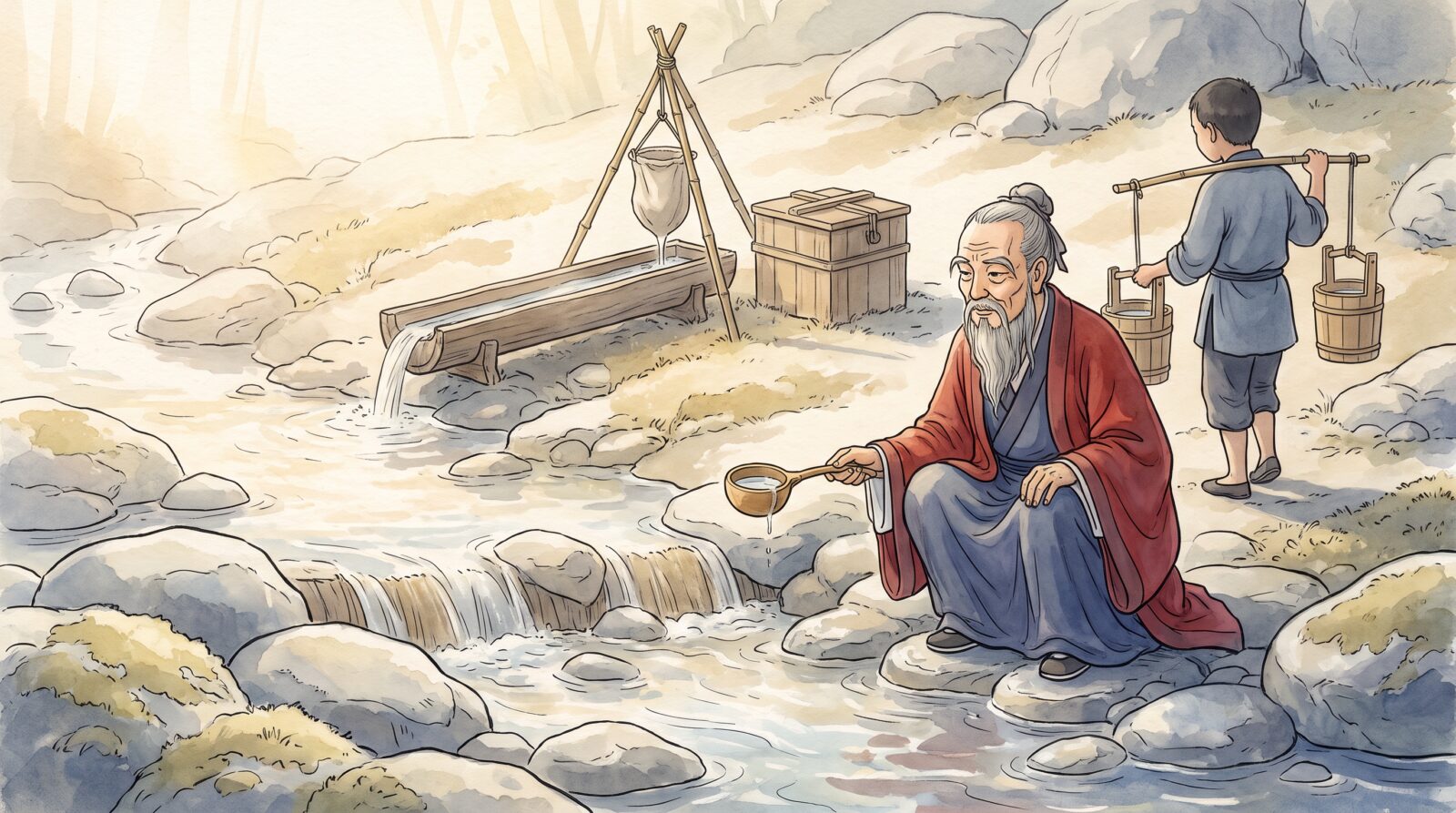
And the water is ranked, not by the famous numbers that have been attached to Lu Yu for a thousand years. The seven waters are Liu Bochu’s, from a different book by a different author, and the twenty waters with their elaborate ranking of the rivers of China are attributed to Lu Yu in a later text whose authenticity Ouyang Xiu rejected in terms, arguing that it was simply the sort of thing that gets attributed to a famous name. The Classic of Tea itself ranks water three ways: mountain and stream water first, river water second, well water last, with a preference for a slow flow over a stone pool and a prohibition on waterfalls, on violent rapids and on well water. That is all. It is enough.
The State Takes the Cup
The Tang state discovered tea and decided to tax it, and the fiscal history of the drink is more consequential for Chinese history than the drink itself. The often-repeated story that a chancellor named Lu introduced a tea tax in 780 is a conflation: 780 is the year of Yang Yan’s Two-Tax Law, which reformed the entire fiscal system and had nothing to do with tea. The first tea tax proper came in 782, proposed by Zhao Zan, at a rate of a tenth on tea and on lacquer, bamboo and timber; it was abolished in 784 and reimposed in 793 by the chancellor Zhang Pang, who also divided tea into three grades and recorded a revenue of 400,000 guan. In 821 the sales tax was doubled. In 835 the chief councillor Wang Ya, who also held the salt and iron monopoly, attempted to bring tea under state monopoly on the model of salt; the peasant revolt that followed forced his successor Linghu Chu to repeal it in the same year. Under the reign of Wuzong in the 840s the monopoly came back and stayed, and tea became one of its main revenue lines.
While this was going on the drink was spreading through the cities. The Tang writer Feng Yan records that tea-drinking began among monks at a temple on Mount Tai, spread from the northern plains, and reached the capital, where the cities opened shops that boiled tea and sold it by the cup to anyone who cared to drop a coin in the slot, Buddhist and layman alike. He calls Lu Yu by his old courtesy name, “the man of Chu, Lu Hongjian”, notes that the well-to-do went about with the implements in a bamboo basket on their backs, and mentions that a certain Chang Boyan had extended Lu Yu’s work so successfully that the way of tea had spread everywhere and that not a prince or minister of the court was left who did not drink it.
He also tells the story that established Lu Yu as a difficult man. A high official named Li Jiqing hosted a gathering and Lu Yu arrived dressed in rustic clothes, unannounced, and was put to the back of the hall and made to wait; and afterwards Lu Yu wrote a short book called the Essay on the Ruination of Tea, which was not a good-natured joke. It is the one episode that reminds us that the man who wrote a manual on boiling leaves was also willing to use his pen as a weapon, and that the reputation for a temper was part of the reputation for authority.
Meanwhile the court was drinking tribute tea. By the late Tang, tribute tea was drawn from seventeen prefectures, the most famous of them Yangxian with its purple shoot, and Mengding and Guzhu, and the first imperial tea factory in Zhejiang was set up in 770. The poet Li Ying wrote a song about the tribute roasting at Guzhu, describing the official red chop pressed onto the boxes that went up to the capital. The trade itself was international: the Uighurs came to the Tang court with fine horses and left with tea, and the horse-for-tea exchange that would later become the Tea Horse Road was already running. It was also, by the end of the Tang, an industry with its own enforcement problems, so thoroughly that Pei Xiu, the salt and iron commissioner, could memorialise the emperor in 852 to regularise it, in a set of twelve articles that roughly doubled official tea revenue to around 800,000 guan a year. The chancellor Lu Zhi, writing on the people’s behalf in the 790s, put the annual tea yield at some 500,000 guan and proposed that the money should fill the public granaries instead of the treasury. These are large numbers. Tea was not a beverage in the Tang economy; it was a fiscal instrument, and the same tax receipts that paid for the administration also began, quietly, to pay for the roads, the horses and the frontier garrisons that the empire would need to survive.
Outward
The evidence for tea in China before the Tang used to rest on texts, and the texts were thin and legendary. Archaeology has since overtaken them. Chemical analysis of plant remains from the Han Yangling tomb complex near Xi’an has detected caffeine and theanine in tea residues roughly 2,100 years old, and phytolith analysis of a cemetery in western Tibet has turned up tea of a comparable antiquity, around 1,800 years old. That is to say that tea was physically present in China and on the Tibetan plateau in the second and third centuries AD, centuries before the celebrated dowry of tea that the Song dynasty legend attached to the marriage of the Chinese princess Wencheng to the Tibetan king. The legend is lovely and probably backwards. The archaeological data suggests the tea-and-horse trade of the plateau is not a Tang invention at all but the hardening of something much older, and that the collapse of northern agriculture in the An Lushan rebellion and the loss of the western routes made the trade intensify rather than begin.
It was Silla that carried tea east. The Samguk Sagi records that in the twelfth month of 828 the Silla court sent an embassy to Tang China bearing tribute; Emperor Wenzong received the envoys at the Linde Hall and dismissed them with gifts; and the envoy who returned, named Dae Ryeom, brought tea seed with him and planted it on Jirisan, in the south of the Korean peninsula. The same record notes that tea had existed in Korea since the reign of King Seondeok and that from this moment it flourished. There was no treaty. It was a gift, carried home by a man who had been given a plant.
Japan received tea by two routes, and the more famous of them is the one that needed a treaty to be invented later. The first came with the official missions to Tang China and with the monks who returned with them around 806; tea was drunk at the great temple at Nara in 815, the cloisters forbade it for a century, and the monk Kukai is credited with the earliest use of the term for the tea ceremony. The second route was the one that mattered, and it belongs to a single man. The monk Eisai went to Song China in 1168 and again between 1187 and 1191, and he came back with tea seed, which he planted on the island of Hirado and gave to the monk Myoe, who planted it at Toga-no-o and at Uji. In 1211 Eisai wrote the Kissa Yojo Ki, the Tea and Sutra, in Japanese rather than in Chinese, and in 1214 he presented the text and the tea to the shogun Minamoto no Sanetomo. The significance of this is easy to miss. Eisai wrote for a reading public, in a vernacular language, at a moment when the Tang habit of treating tea as a subject for an expert treatise had entirely given way to the Song habit of treating it as a social performance with its own connoisseurship, its own contests and its own equipment.
That Song transformation is where the whisk appears, and it is worth stating plainly, because the whisking of tea in a bowl is so deeply associated with Chinese tea in the popular imagination that the Song innovation is usually projected backwards. The bamboo whisk is first described in the Da Guan Cha Lun, the Tea Treatise of Emperor Huizong, written between 1107 and 1110. Cai Xiang’s earlier Cha Lu of the 1040s uses a metal spoon rather than a whisk. The Song method of whisking powdered tea in a bowl, judged by the colour of the foam and won in public contests by the marks left as the foam retreated, is a different drink from Lu Yu’s boiled and salted tea, and it is the drink that the Japanese tea masters took up and transformed into the ceremony of chanoyu and wabi-cha. The Song also gave the world white tea, and the connection between the whitest foam and the most prized tea became the great aesthetic of the age.
Even the teapot, the object that now seems to be the essence of Chinese tea, is later than Lu Yu by centuries. The excavated Yixing kilns in Jiangsu are not earlier than the middle of the Northern Song, and the teapot as an object matures in the Ming, with the first named potter, Gong Chun, working around 1615 and the first monograph on the subject, Zhou Gaoqi’s Yangxian Minghu Xi, appearing a few years later. The famous Song poems praising the purple bowl refer to the tea bowl, which was a connoisseur’s object, not to a pot made of purple clay. Conflating the two is the commonest error in the English literature on tea, and it is an error that would have astonished Lu Yu, whose entire apparatus fitted on a tray and whose iron cauldron was carried on a cross-stand over a fire he could build anywhere.
The last chapter of this story runs west, and it runs fast. It is worth being careful, though, not to let the westward story swallow the one that came before it. The usual shape of the history is a line that starts in a Tang monastery and ends in an English factory, and that shape flatters the narrative while obscuring the actual mechanics. Tea reached Europe because European merchant companies had, by the early seventeenth century, built a shipping system that could carry it, and because the drink became cheap enough to be a mass commodity rather than a luxury. The factory argument is real but it is also a long chain: tea as caffeinated fuel for northern industrial labour is a well-trodden historiographical claim and a causation that stretches over two centuries. What Lu Yu actually contributed is much more modest and much more durable. He did not invent tea, and he did not export it, and he was not the reason the British drank tea in the eighteenth century. He did something more useful for later history, and stranger: he took a plant that other people had been drinking for centuries without much ceremony and worked out how to make the ceremony repeatable, measurable and worth writing down. Every later development – the Song whisk, the Ming pot, the Japanese ceremony, the European teapot – is either a refinement of what he specified or an alternative to it. The list of implements he listed is the ancestor of every tea tray laid out since, and the ninety-nine per cent of readers who have never heard of him are using a piece of his procedure without knowing whose it was. Tea reached Europe through the Dutch East India Company in the first years of the seventeenth century, and the story of Catherine de Medici carrying tea to France in 1563 is traditional rather than documented. By the nineteenth century the drink was so central to British life that it was worth a revolution and a war: the Boston Tea Party of 1773 was an act of smuggling disguised as a protest, and Robert Fortune’s fourth journey through China in 1848 was a systematic theft of tea plants and skilled workers that handed the tea industry to India. It is a long causal chain from Lu Yu’s cauldron, and the temptation to draw the line straight is strong. But the line is worth drawing, because the reason it can be drawn at all is that a single man in the eighth century insisted on writing down exactly how a thing should be done, with its implements, its failures and its measurements, and then got a court of his own.
Lu Yu died around 804, probably at the foot of the Guzhu tea mountain, probably still correcting a manuscript. He had no successor in his own lifetime, and the book he left behind sat in a canon that later generations quietly revised: the whisk was added to the practice and the manual was not rewritten to include it; the seven waters and the twenty waters were attached to his name by other hands; the purple shoot became confused with the purple pot; and a magistrate of the late Ming wrote a continuation of his chapters as though he had never existed. The safest thing to say about the Classic of Tea is that it is the oldest surviving book about tea. The other thing worth saying is that it is the oldest surviving book about tea that anybody wrote down, which is a different and larger claim. The practice is older by centuries; the manual is not. Between them there is a gap that a twentieth-century tea writer did much to paper over by telling us that tea was always this, only cruder, and that the Chinese have always understood it as we do now. They had not. The Tang drink was salted, boiled and judged on foam; the Song drink was whisked, pale and judged on colour; the Ming drink was steeped in a pot; the Qing and modern drinks are infusions. Lu Yu’s is the first of these and none of the others, and treating it as an early version of the last one is the single most common error in the literature. It is a book about machinery as much as about leaves, and everything the reader associates with tea ceremony came afterwards, from a different country and a different century, by way of a Song emperor who liked to stir his own tea in a bowl and watch the colour of the foam.
References
- 茶經 (The Classic of Tea) — Lu Yu, Wikisource, 欽定四庫全書本 (Siku Quanshu) edition
- The Classic of Tea — Lu Yu, Chinese Text Project, 欽定四庫全書本 edition
- The Classic of Tea, concise recension — Lu Yu, Project Gutenberg eBook 23949
- 新唐書 卷196, 隱逸傳 (New Book of Tang, juan 196, Biography of Lu Yu) — Ouyang Xiu and Song Qi, Wikisource
- 新唐書 卷199, 食貨志 (New Book of Tang, juan 199, Treatise on Revenue and Expenditure) — Ouyang Xiu and Song Qi, Wikisource
- 封氏聞見記 卷六, 飲茶 (Record of Things Heard and Seen, juan 6, on tea drinking) — Feng Yan, Wikisource
- 煎茶水記 (Record of Tea Water for Boiling) — Zhang Youxin, Wikisource
- 大觀茶論 (Treatise on Tea) — Emperor Huizong of Song, Wikisource
- 茶錄 (Tea Record) — Cai Xiang, Wikisource
- 全唐文 卷743, 裴休請革橫稅私販奏 (Complete Tang Prose, juan 743, Pei Xiu on abolishing irregular levies and private sale) — Wikisource
- 三國史記 卷10, 新羅本紀 (History of the Three Kingdoms, juan 10, Annals of Silla) — Wikisource
- 續茶經 (Continuation of the Classic of Tea) — Lu Tingcan, Wikisource, 四庫全書本 edition
- Tea in China: A Religious and Cultural History — James A. Benn, University of Hawai’i Press, 2015
- The Tale of Tea: A Comprehensive History of Tea from Prehistoric Times to the Present Day — George L. van Driem, Brill, 2019
- Earliest tea as evidence for one branch of the Silk Road across the Tibetan Plateau — Liu and others, Antiquity 90, 2016
- Tea and Place: The Evolving Discussion about Terroir in Song China — Journal of Chinese History, Cambridge University Press, 2016
- All about tea: Camellia sinensis — Horniman Museum and Gardens, accessed 31 October 2026
- The Making of a Collection: Yixing ware — Hong Kong Museum of Tea Ware, Government of the Hong Kong Special Administrative Region, 10 July 2009
- Yixing ware — Wikipedia, Wikipedia, accessed 31 October 2026
- History of tea in Japan — Wikipedia, Wikipedia, accessed 31 October 2026
- Robert Fortune — Wikipedia, Wikipedia, accessed 31 October 2026
- Boston Tea Party — Wikipedia, Wikipedia, accessed 31 October 2026