No original brushstroke by Wang Xizhi survives. Not one. Everything known to the world as his handwriting, from the most famous rubbing in the Chinese calligraphic canon to the paintings of the Orchid Pavilion gathering that hang in museums in Tokyo, Paris and New York, reaches us through a chain of copying and carving that begins a century and more after he died. That is not a scandal and it is not a mystery; it is the ordinary condition of the medium. But it does mean that the most celebrated Chinese calligrapher who ever lived is known almost entirely through reproductions, and that the most interesting thing about him is the machinery that preserved him.
An Afternoon in 353
Wang Xizhi was born, on the most commonly accepted reckoning, around 303, in Linyi in Shandong, and died around 361. The dates are contested in a way that tells you something about the state of the record: the University of Washington’s account of Chinese writing gives 307? to 365?, and a Chinese reference work on classical thought lists three separate possibilities, 303 to 361, 307 to 365, or 321 to 379. His courtesy name was Yishao. He held the office of Right Army General and was the Inspector of Kuaiji, and in consequence he is commonly referred to as Wang Youjun, Master of the Right Army. He was, in the phrase the University of Washington course uses, the foremost of the calligraphers of the Eastern Jin and is revered today as the Sage of Calligraphy.
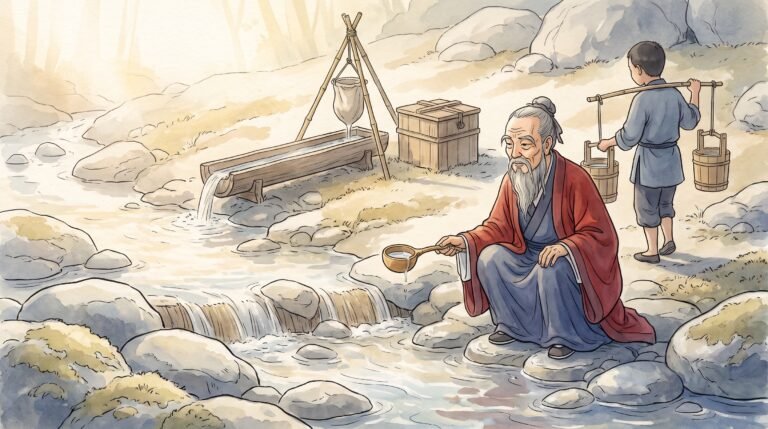
His reputation rests on a single afternoon. On the third day of the third month of the ninth year of the Yonghe era, which is 353, Wang invited friends to a purification rite at the Orchid Pavilion at Kuaiji, in what is now Shaoxing in Zhejiang, where he was serving as governor. The University of Washington account describes the ritual: a poetry contest was held alongside a stream, down which cups of wine were floated, and anyone of the forty-two people in attendance who could not finish his composition by the time the cup reached them had to pay the forfeit and drink. Forty were invited and forty-two came, which is the kind of detail that a gathering becomes famous for. Wang then wrote the preface to the collection of poems made that day, on the spot, and it is the preface and not the gathering that has carried his name for seventeen centuries.
The essay is a lament and it is not a simple one. It begins in the pleasure of a spring day, moves through an account of the poets of the past and their own unfulfilled ambitions, and arrives at the observation that the same inexorable process which had carried the ancients away was carrying the company forward, and would carry them too. The famous line is 死生亦大矣, death and life are indeed a great matter. The essay’s argument is subtler than that: the awareness of transience is not a consolation but a condition of the pleasure, and it is precisely because the day is going to end that the writing on it matters. Two hundred years later the Tang dynasty would turn the whole performance into a canon, and the canon would be built on the claim that the brush knew this. A reader looking at the Preface now sees a document that has been carefully copied and carefully carved, made to look spontaneous by people for whom spontaneity was the whole point, and the irony is not lost on the tradition that it produced.
The gathering acquired its legend quickly, and the legend is itself part of the transmission problem. References to it appear throughout the poetry and painting of later eras, and it was repeatedly re-enacted: the classic subject of the painting tradition, and of the literati’s drinking parties, and of the Japanese print tradition, and eventually of a whole apparatus of collecting around the physical stele. What began as forty-two men and a floating cup became a way of talking about time.
The Unrepeatable Stroke
The original is lost. The University of Washington account puts the situation plainly: although Wang’s calligraphy was valued and collected from early on, few original works survive, and those that do are letters and notes, not the Preface. Because authentic handwritten examples were already rare by Tang times, copies circulated, both legitimate reproductions and forgeries. The Encyclopedia Britannica, describing the script in which the Preface is written, says it survives only in several fine tracing copies and other forms of duplication such as rubbings.
The stories that grew up around the Preface are worth setting down because they are the first evidence of the canon forming. The National Palace Museum records two legends. The first says that the Tang emperor Taizong loved the original so much that he took it to his grave with him, where it became one of his funerary objects and was never seen again. The second says that Wang Xizhi wrote the Preface while drunk, and that when he sobered up he tried to rewrite it a thousand times without ever matching the first attempt. The museum is careful to call both of them legend, and to note that they are among the reasons the work has enjoyed centuries of undying popularity. They are also, in a sense, accurate descriptions of what the copying process produces. A performance that cannot be repeated is precisely the thing that generates the story that it cannot be matched, and the legend of the thousand failed rewrites is the popular name for the condition that the Feng Chengsu copy exists to solve.
The canonical transmission runs through a chain that can be set out with some precision. The earliest and most authoritative version is the Tang copy attributed to Feng Chengsu, made in the eighth century under the emperor Taizong, and now in the Palace Museum in Beijing. From that descended the Shenlong edition, so called from the Shenlong reign era of 642, and the Shaoxing edition, named after the Southern Song imperial collection. The practice of taking ink impressions from carved stone, the rubbing, and the practice of carving an engraved copy in the form of a model-book, the 帖, are what turned a performance into a reproducible object. The Dingwu engravings of the Tang imperial rubbings became the vector by which Wang’s handwriting circulated across East Asia for a thousand years.
And here the central irony of the whole subject comes into view. A Chinese brushstroke is an irreproducible event. It is made by a loaded brush meeting absorbent paper, and the moment the brush lifts, the evidence of the pressure, the speed, the angle and the moisture is gone. Nothing about the physical process is repeatable, and any attempt to repeat it produces a forgery in the strict sense. And yet the tradition that Wang Xizhi founded rests entirely on reproduction: tracing, copying, carving, rubbing, printing. The great scholar of the subject, in the account that does the most to make the mechanism clear, frames it as a friction between a performance and the only thing that can preserve a performance, which is a mechanical copy that is by definition not the performance. A man famous for the spontaneity of his writing survives only in the most deliberate of media.
The transmission chain has one more layer that is easy to miss because it is invisible in the finished object. A rubbing is made by laying damp paper over an incised stone and beating it with a pad until the ink applied to the surface of the stone transfers to the paper. What comes away is a negative of the carving, and the way the light falls in the resulting image is determined by the angle of the chisel and the depth of the cut, not by anything the writer did with a brush. A stroke that was drawn with a soft, loaded, turning brush and a stroke that was cut with a flat chisel at a fixed angle are fundamentally different objects, and the second is only ever a translation of the first. This is why the connoisseurship of Wang Xizhi became a connoisseurship of the copy: the copies themselves differ from one another in the ways that carvings differ, and the great question in the tradition became which carver produced which text. The Dingwu engravings are named for the place, not for the writer, for exactly this reason.
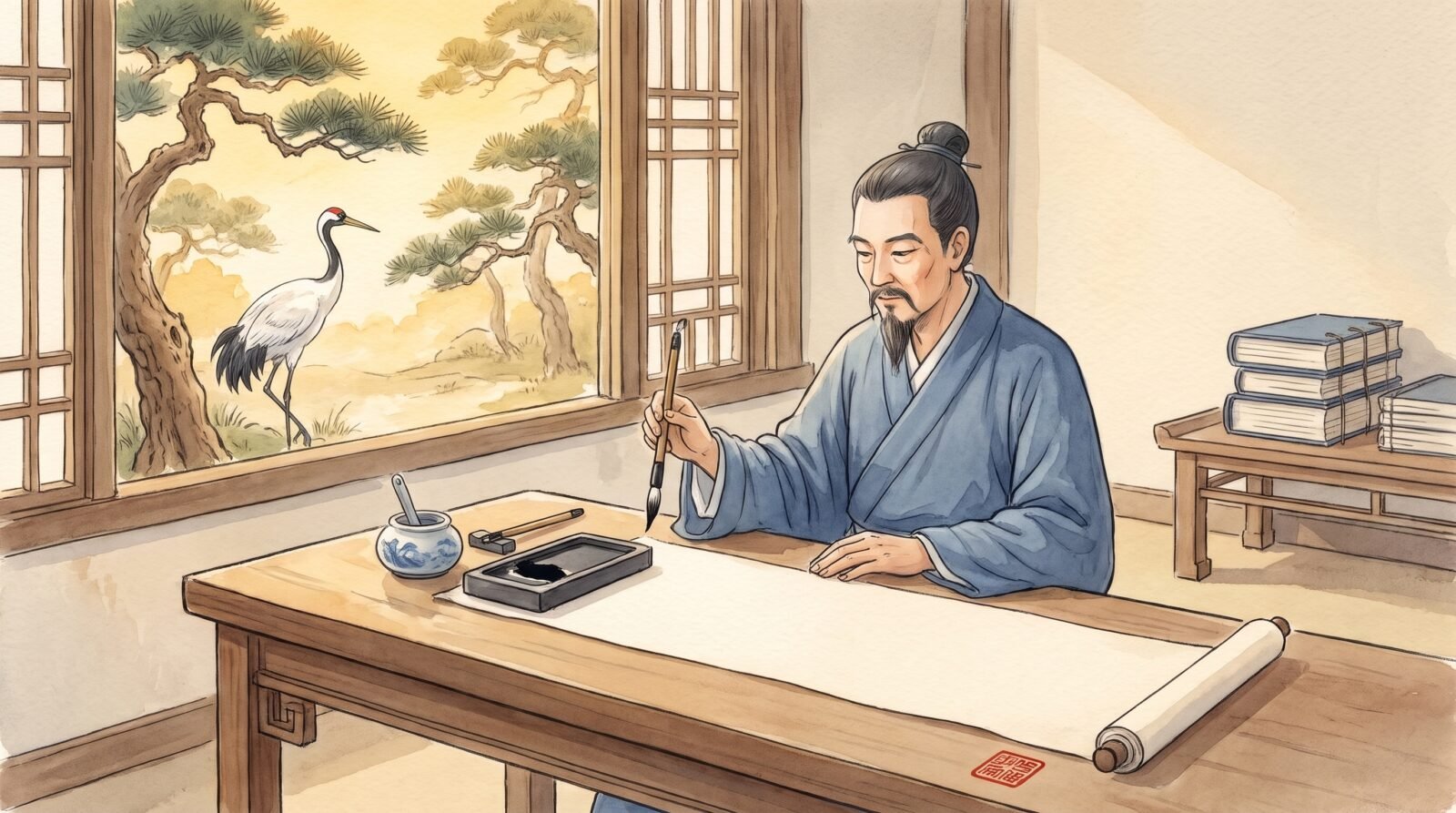
The material conditions matter too, and they explain part of the style. The Preface was written on silk-worm cocoon paper, 蚕茧纸, which is thin, uneven and slightly lustrous, and the brush was the weasel-hair brush, 鼠须笔, which is stiff at the tip and springy in the middle. The ink was pine-soot, made from the soot of pine branches burned in a controlled flame. Each of these choices constrains the hand. A soft, even paper invites a continuous, even stroke; a paper with a visible texture demands modulation. The vocabulary of the discipline grew out of describing exactly what the hand does under those constraints: 提按, the lift and the press; 顿挫, the pause and the check; 转折, the turn; and the distinction between 中锋, the stroke drawn with the tip on the centre line, and 侧锋, the stroke drawn with the tip laid over. Above the level of the individual character sits 行气, the flow of breath through the passage, which is the term for the relation between characters rather than within one, and which in the Preface is the quality the eye reads as the writer’s state of mind.
Two Wangs, and a God That Was Not There
Wang Xizhi’s seventh son, Wang Xianzhi, born 344 and dead in 386, was also renowned, and in his own time his reputation even eclipsed his father’s. The University of Washington course points out that by the end of the Six Dynasties period Wang Xizhi had been reinstated as China’s foremost calligrapher, displaying what was considered the most classical and sophisticated style. The lesson the course draws is about the difficulty of judging style. Wang Xianzhi’s most celebrated work is the Duck-Head Pill letter, in which the spacing between words is the point, and the comparison the course invites is between Wang Xizhi’s On the Seventeenth and Wang Xianzhi’s On the Twelfth, where the differences are as legible as the shared dynasty. The pair became the 二王, the Two Wangs, and their works were the fixed points against which every later calligrapher measured himself.
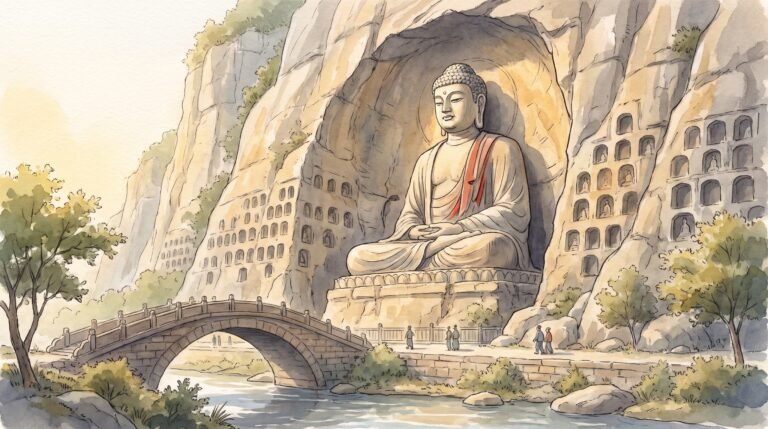
The script transition they completed is the other great legacy. Over the Six Dynasties the arc of Chinese writing moved from clerical to regular to running and cursive, and the University of Washington account identifies the northern counterpart of the Wang style: because of the political division between north and south, a very different kind of calligraphy flourished in the north, and almost all surviving examples of it come as memorial writings on stone tablets rather than as paper. That is the whole argument of the Longmen caves in a single sentence, and it is why the Wei stele inscriptions at Longmen and the Preface of Wang Xizhi belong in the same history even though they share almost nothing in appearance.
It is worth pausing on what a letter by Wang Xizhi actually is, because the survival of the letters and the loss of the Preface together define the shape of the evidence. The two letters the University of Washington course reproduces are a note accompanying a gift of oranges and the letter known as On the Seventeenth, and they are not compositions. They are communications, written to particular people for particular purposes, and what makes them precious is exactly what makes them awkward: they are not performances at all. They have the incidental quality of a handwriting that was not trying to impress anybody. The Preface, by contrast, is a performance, composed for an audience of forty-one peers and then, implicitly, for posterity, and it is the performance that has been endlessly reproduced. The tradition preferred the copy over the letter, because the copy is the artefact that can be owned, traded, engraved and compared. This is the exact inverse of what happens with a painting, where the original is what is precious and the reproduction is a substitute. Chinese calligraphy inverted that relationship before Europe had finished arguing about it.
The Three Perfections, the 三绝, are the third piece of this apparatus, and they need care. The idea is that the ideal artist combines poetry, calligraphy and painting in a single person, and the phrase is applied to Wang Xizhi with the Orchid Pavilion as its exhibit. But the attribution is a later literary construction, formed around Su Shi and the Song literati, and the honesty of the matter is that Wang was not a painter. The apparatus that made the three perfections into a doctrine was assembled several centuries after the fact, and it assembled them in a way that retrofitted a painter’s status onto a calligrapher whose own medium did not require it. The association with the Preface is therefore not that Wang painted the scene, but that the tradition wanted the writer of the most famous poem about a gathering to be the painter of the gathering too. The National Palace Museum in Taipei puts the consequence in a more useful form, observing that countless calligraphers have emulated the Preface’s elegant form and spirit and drawn significant artistic inspiration from it.
The National Palace Museum’s own framing of the Preface is worth quoting at length, because it shows how the object was received rather than how it was made. The preface, it says, recounts a spring gathering in 353 at the Orchid Pavilion where a collection of poems was compiled, celebrated for its literary excellence and masterful calligraphy, though the original work has been lost and numerous reproductions and stone rubbings remain. It begins by describing the refreshing joy of a spring outing and the delight of engaging in one’s favourite activities; the tone then shifts to a lamentation of life’s fleeting nature and the impermanence of all things. Wang Xizhi finds a connection with past writers, feeling their sorrow as his own, just as future readers will resonate with his words, and despite life’s fluctuations there is an eternal bond between past and present. The Taipei exhibition features the Original Dingwu Version of the Orchid Pavilion Preface and invites visitors to look beyond the calligraphy and the preface themselves to the inscriptions and notes by Song and Yuan artists such as Zhao Mengfu.
Stone, and the Business of Being the Greatest
Once the Preface had become a text to be transmitted, it had to become a text to be circulated, and the Tang did the circulating. The mechanism ran 摹, copying, to 刻, engraving, to 拓, the rubbing, to 帖, the model-book, and from the model-book the imperial album. The Chunhua model-books, the 淳化阁帖, compiled in 992 under the Song, were the first great systematic anthology of calligraphic exemplars, and they are where the tradition becomes self-consciously a canon. The Tang court in particular made Wang’s style a state template by setting it in stone, and the monuments are the great stele inscriptions of the eighth century: Yu Shinan’s Kongzi Miaotang bei of 641, Ouyang Xun’s Jiuchenggong Liquan ming of 632, Chu Suiliang’s Yi Que beipai of 649, Yan Zhenqing’s Duobaota bei of 752 and his Yan shi jiamiao bei of 780, and Liu Gongquan’s Xuanmita bei of 875. These are technically anonymous, in that they are not signed by Wang, and they are authorially his, because the whole point was to set a recognisable Wang in a permanent public form.
The economic structure behind this is often missed. A canon is not only a list of exemplars; it is a market. Model-books were expensive to produce and expensive to own, and their owners were the same literate elite whose own status the canon defined. The National Palace Museum’s framing of the Preface as the object around which Song and Yuan artists wrote their own inscriptions makes the point: the Preface was not a finished cultural monument but a surface on which one generation after another marked its own relationship to the past. When Zhao Mengfu wrote a colophon on a version of the Preface, he was not preserving Wang Xizhi. He was situating himself in a lineage, and the lineage was what he was selling, and to himself.
The three upsurges of mass emulation named in the Chinese reference work are the rhythm of that business: Xiao Yan, emperor of the Liang dynasty from 502 to 549, who promoted it; Li Shimin, the Tang emperor Taizong, who was himself an accomplished calligrapher and could judge what he was buying; and Zhao Guangyi, the Song emperor Taizong, who collected on a scale that set the terms for everything after him. The National Palace Museum’s 2026 exhibition makes the point about scale, and about who was doing the collecting, and it makes it with a list of nine men across a thousand years: emperors, influential government ministers and erudite scholars. The Preface was not a museum object that arrived somewhere. It was a thing that powerful people chased, and the tracking of who chased it, and what they wrote about it once they had it, is the surviving evidence of the obsession. Weng Fanggang and his generation turned that obsession into method, and method is what turned an afternoon into a discipline.
A reference work that lists a man’s dates three different ways and still calls him the greatest calligrapher of all time is telling you something about how the tradition thinks: the claim is not that Wang Xizhi wrote a particular number of characters on a particular afternoon. The claim is that a course of training runs through him.
From Esteeming Method to Esteeming Idea
The Song made the decisive shift, and the standard name for it is 尚意, esteeming the idea or the personal intention, against the 尚法, esteeming the method, of the Tang. Su Shi, Huang Tingjian and Mi Fu are the names that carry it. The change is not that the Song calligraphers were sloppier; it is that the criterion of quality moved from correctness to character. A brushstroke now had to reveal something about the person making it, and the revealing was the point. This is also where the Three Perfections settle into their final form, because the Song literati were painters and poets as well as writers, and a doctrine that unites the three suits them exactly.
The National Palace Museum, which mounted an exhibition on the subject at Taipei in early 2026 under the title A Penchant for the Orchid Pavilion, has described the phenomenon in a phrase that is more useful than any other: the Orchid Pavilion obsession. The exhibition brought together nine renowned calligraphers and collectors, emperors, powerful ministers and erudite scholars, who lived over a period of nearly a thousand years and who all shared an extraordinary level of passion for the Preface. What they all had in common, the museum notes, was that they put their ardour on display in the model-books they collected, in the copies they made, in their own original calligraphy, and in poetry and verse. The Qing epigrapher Weng Fanggang, 1733 to 1818, thought that the phrase Orchid Pavilion obsession was simply the best description for the unique artistic and literary aesthetic that grew up around the work. A thousand years of that is not a cult of a book. It is a cult of a text as a shared physical object, and it is the clearest evidence that what the tradition valued was not Wang Xizhi’s ideas but his hand.
The Yuan inherited the method and rebuilt it. The Four Masters of the Yuan — Zhao Mengfu, Huang Gongwang, Wang Meng and Wu Zhen, with Xianyu Shu alongside them as the great calligrapher of the group — took the Wang style and made it something different. Zhao Mengfu in particular went back to Wang Xizhi and to the ancient models with a directness that later critics found almost insolent, and he wrote his own colophons on the Preface in a hand that deliberately competed with Wang’s. It is worth being clear about what that means: the Preface, as an object, became the arena on which a later master proved his claim to have understood the original. The National Palace Museum’s exhibition of the Original Dingwu Version is in effect an exhibition of that competition, with the Song and Yuan inscriptions given equal billing with the Wang.
The Ming made it portable, and made it personal. The Four Masters of the Ming — Shen Zhou, Wen Zhengming, Tang Yin and Qiu Ying — worked out of the Wu school in Suzhou, and their enterprise was as much commercial as artistic: a workshop economy in which the making and the reproduction of pictures and calligraphy was the business of the city. Then Dong Qichang, 1555 to 1636, supplied the theory that gave the whole thing its shape. His 南北宗论, the doctrine of the Northern and Southern Schools, divided Chinese painting into two lineages, the Northern School of the professional court and professional painters and the Southern School of the amateur scholar, and it placed Wang Xizhi and the literati in the second. The consequence was enormous and it was not primarily aesthetic. If the Southern School was the lineage of the scholar-amateur, then the highest painting and the highest calligraphy belonged to the same people, and the Emperor’s own painters were on the other side of the line. Dong’s programmatic revival of antiquity, 仿古, was therefore a political act inside the Chinese art world, and it fixed a hierarchy that Western collectors, arriving later and reading the theory rather than the objects, absorbed wholesale.
How the Canon Went West, and What It Looked Like
The transmission out of China was a twentieth-century operation with its own assumptions. The Metropolitan Museum of Art holds, among its Chinese holdings, a hanging scroll by the Japanese painter Tomioka Tessai, titled Poetry Gathering at the Orchid Pavilion, painted in 1913 in ink and colour on paper in the Taisho period and given to the museum in 2022. The subject is Wang Xizhi’s gathering. The object is a Japanese painting of a Chinese literary event, and the collection record notes the Japanese culture and period explicitly. That single record contains the whole story: the gathering had become an international subject, and the national attribution of the object was honest in a way that would surprise anyone who thinks of the Orchid Pavilion as exclusively Chinese property.
The Smithsonian’s Freer Gallery of Art, in its gallery guide to Chinese arts of the brush, explains why the story of Chinese calligraphy and Chinese painting cannot be told apart. The round brush, it records, was devised by the Chinese before they invented paper in the first century BCE, and was used for both writing and painting; its tapered tip, composed of a careful grouping of chosen animal hairs, is the source of the ever-changing linear qualities of the twin arts. Over two thousand years, five major script types developed: seal, clerical, standard, running and cursive. Painting as an art of personal expression began its formative period around the fourth century CE, the same century as Wang Xizhi, and the guide places the art critic Xie He, active between 479 and 502, and his Six Principles for judging a painting in exactly the years of the Wang. The basic evolution of the Chinese writing system was complete by the fourth century, but calligraphy continued to develop as an artistic medium until the present. That last sentence is the correct summary of the whole enterprise, and it is the reason the National Palace Museum in Taipei could in 2013 hold an exhibition whose stated purpose was to search for the true image of the work of Wang Xizhi and to re-evaluate the roles he played, through his influence on later generations.
The Tokyo National Museum did the same thing three months earlier, in a special exhibition in the Heiseikan that ran from 22 January to 3 March 2013 and addressed the same question from the Japanese side, with Wang’s calligraphy treasured by successive Chinese emperors as its frame. The two exhibitions, in Taipei and in Tokyo, together constitute a fairly precise statement of the modern position: the canon was exported, and the receiving countries are now capable of interrogating it. The National Palace Museum is the more instructive of the two for what it holds, because its Orchid Pavilion Preface is not merely a famous object but a document in a continuing argument, and because its own catalogue entries record the sequence of Song and Yuan hands that turned Wang’s afternoon into a lineage.
There is also a social history embedded in all of this that is worth stating plainly, because it explains why the canon took the shape it did. The University of Washington account describes the political and cultural centre of the Southern Dynasties as Jiankang, present-day Nanjing, and the Wang family as typical of the southern aristocratic class that had fled the political turbulence of the north and established new private estates in the south. During the Six Dynasties, calligraphy became an art form closely associated with the literate elite, and the educated man developed his individual writing style as a means to express his inner self and to distinguish himself socially. The factors the course lists as contributing to the maturation of a good calligrapher are natural ability, a literary background, family connections and exposure to a variety of written models, on the ground that the only way to master calligraphy was to practise the major styles and base innovations firmly on previous examples. That is a description of an elite whose status was inherited but whose reputation had to be performed. A man who could write in a way that revealed him was thereby converting an inherited position into a personal one. The Preface is what that looks like when it works perfectly, and the machinery that preserved it is what happened next.
What the Western framing consistently gets wrong is the direction of travel. For most of the nineteenth and twentieth centuries, Chinese painting was received as painting and Chinese calligraphy as a decorative subsidiary, a beautiful handwriting to be set above a poem. The Smithsonian’s own guide makes the opposite case in a single sentence: since painting and calligraphy share many of the same materials and techniques, the relationship between the two art forms has always been a close one in China. But the stronger point is the one the Chinese tradition has always made and the Western reception has usually missed. Wang Xizhi was not a painter who wrote beautifully. He was a writer whose writing was judged, with great seriousness, to be a disclosure of his character, written down on a particular afternoon in a particular company, and then, because the writing was too good to be lost and too fragile to survive, copied and carved and rubbed until the afternoon itself became unrecoverable and the copies became the only version anyone has. The brush and the stone are not two media that happen to intersect. One of them is the reason the other one is remembered.
It is worth being clear about what is being claimed here, because the claim sounds like a paradox and is not one. A brushstroke is a physical event with a duration measured in fractions of a second, and it cannot be repeated; this is why a copy of Wang Xizhi is, strictly speaking, a forgery, and why the tradition has spent seventeen centuries distinguishing the genuine from the counterfeit. But the same brushstroke, once it has been carved, can be reproduced indefinitely and at scale, and the reproduction does not claim to be the event. It claims to be the shape of the event, and the shape is what the tradition wanted. The Cultural Heritage Online survey of Longmen makes the point in the neighbouring case without making it about calligraphy: the most significant surviving collection of Wei and Tang calligraphy in China is the collection of steles cut into the cliffs, precisely because steles are reproducible in a way that paper never is. What survives of Wang Xizhi is not his writing. It is the argument that his writing was worth cutting into rock. That argument, not the handwriting, is what the twentieth century received and what the twenty-first is still arguing about, in Taipei and in Tokyo and in the collection records of museums on three continents, all of them holding copies of a lost afternoon in a style that somebody, eight hundred years later, decided to cut into a cliff.
References
- Six Dynasties Calligraphy — University of Washington, China’s Written Culture course module
- Wang Xizhi — Encyclopaedia Britannica
- Lanting Xu — Encyclopaedia Britannica
- Wang Xianzhi — Encyclopaedia Britannica
- Chinese Calligraphy — Encyclopaedia Britannica
- Poetry Gathering at the Orchid Pavilion (Lanting) — Tomioka Tessai, 1913, The Metropolitan Museum of Art, accession 2022.432.2
- Gallery Guide: Chinese Arts of the Brush — Freer Gallery of Art, Smithsonian Institution
- Chinese Arts of the Brush, gallery guide text — Freer Gallery of Art, Smithsonian Institution
- A Penchant for the Orchid Pavilion — National Palace Museum, Taipei
- Orchid Pavilion: The Excursion and Reflection — National Palace Museum, Southern Branch
- Wang Xizhi: Master Calligrapher — Tokyo National Museum, special exhibition, 22 January to 3 March 2013
- The Sage of Calligraphy — Key Concepts in Chinese Thought and Culture
- Master of Arts: Wang Xizhi in Japan and China — World History Foundation
- Orchid Pavilion Preface (Lanting Xu) in cursive script — Asian Art Museum, San Francisco
- The Expressive Significance of Brush and Ink — National Palace Museum, calligraphy exhibition