Some airports are machines for moving bodies. Beijing Daxing International Airport is closer to a rumor made concrete: the suggestion that a building can be at once an infrastructure, a civic room, a gateway, a piece of geography, and a work of civic theater. When it opened in September 2019, it did not merely add capacity to one of the world’s busiest aviation markets. It changed the map of northern China in the imagination. The capital, long associated with the solemn north-south axis of the Forbidden City and the disciplined ring roads of the modern metropolis, suddenly had a second front door to the world, located far enough south that the city’s gravitational field had to be redrawn.
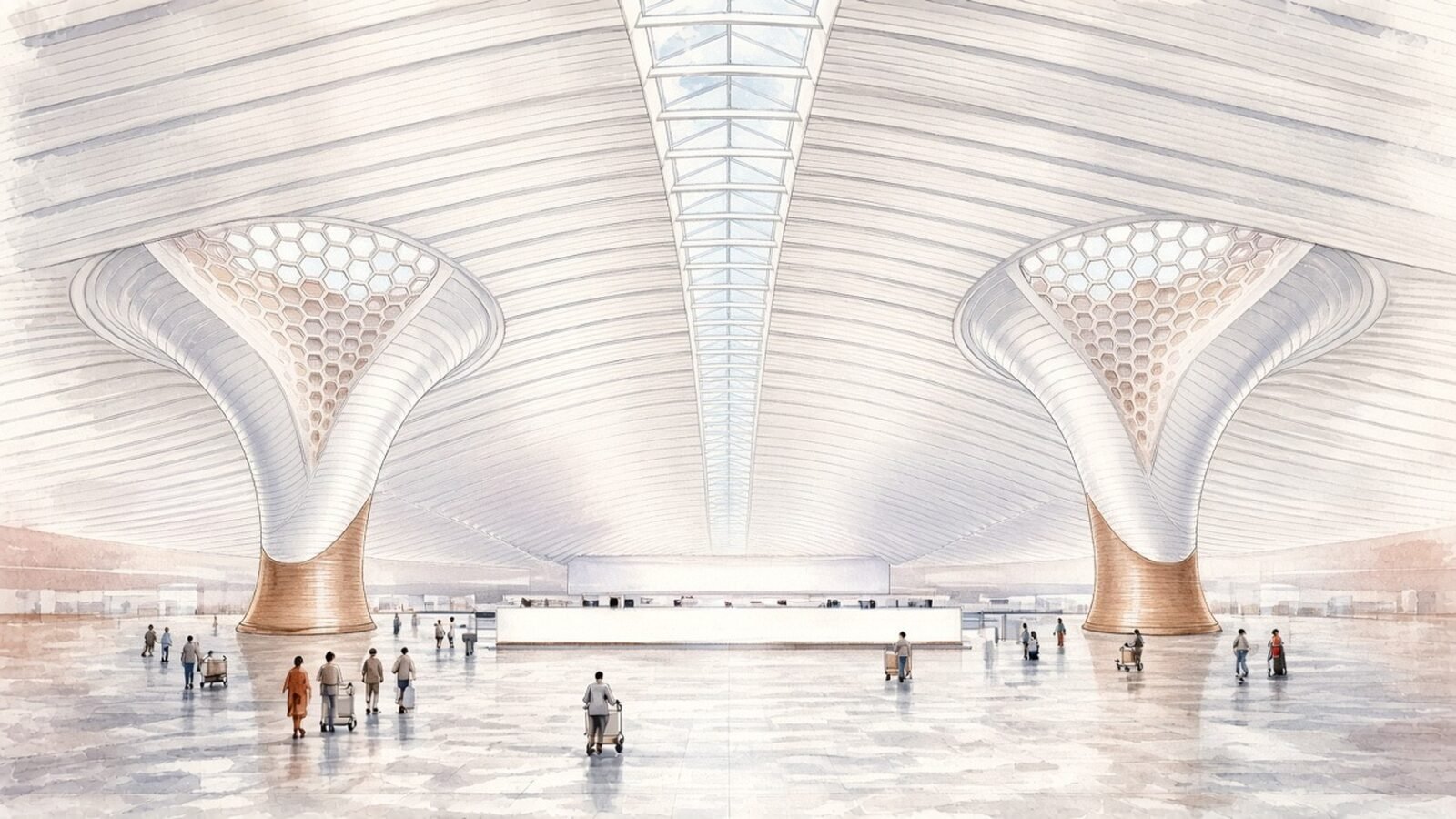
Daxing is often described by its shape before its statistics. From above, the terminal resembles a starfish, or a sea star, with six long arms reaching outward from a luminous central courtyard. The metaphor is apt because the building behaves less like a box than like an organism. Arrivals and departures do not simply queue; they radiate. Passengers enter the central atrium and find that almost every gate feels near, almost every decision appears legible. The arms extend toward the airfield like piers into a mechanical sea. Under the roof, the curve of the structure softens the brute scale of aviation. Light pours down through skylights arranged around the core. The eye travels outward and upward. Even before boarding, the traveler has been given a preview of flight: ascent without leaving the ground.
The airport sits at the edge of Beijing’s southern plain, close to the boundary with Hebei Province, in a region where the capital’s expansion has long spilled beyond administrative lines. Its location is part of its meaning. Beijing Capital International Airport, the older giant to the northeast, had become famous for congestion and for the way its growth pushed against the limits of the urban core. Daxing answers with distance. It is far enough from the center to create room, close enough to be reached by high-speed rail, metro, expressway, bus, and taxi, and strategically placed to serve not only Beijing but also Tianjin and the wider Beijing-Tianjin-Hebei region. In planning language, that tri-city area is often called Jing-Jin-Ji, a phrase that compresses three names into one ambition: coordinate the north.
The ambition is visible before the architecture is understood. Approaching Daxing by road at dusk, the terminal appears as a low constellation on the flat horizon, its white-and-orange roof glowing like a instrument left on after sunset. The airfield around it is vast and disciplined, but the building refuses to be merely functional. The roof rises and falls; the central dome seems to breathe; the columns lean with a casualness that would be alarming if it were not calculated. The design, led by Zaha Hadid Architects with engineering and planning collaborators, carries the signature of late parametric modernism: a geometry generated not from a classical façade but from flows, sightlines, walking distances, aircraft stands, baggage paths, and the choreography of millions of annual passengers.
To call Daxing beautiful is to risk missing the point. Beauty here is not decorative; it is operational. The starfish plan shortens the distance from check-in to gate. The central hall gathers services around a civic void rather than scattering them across endless corridors. The roof’s radial geometry brings natural light deep into the building while also marking orientation: a traveler standing near the core can sense, almost intuitively, which arm leads to which pier. This is architecture as wayfinding. It replaces the anxious signage of older terminals with space itself.
Inside, the emotional register is calm. The main hall is high and wide, but not cathedral-cold. Warm tones temper the metal and glass. The floor pattern leads the feet before the mind has decided. There are moments when the airport feels like a mall, and moments when it feels like a station, and moments when it feels like a diplomatic reception room for the nation. That mixture is deliberate. Contemporary Chinese infrastructure often aims to be legible to both domestic passengers and international visitors: familiar enough to be efficient, grand enough to be memorable. Daxing succeeds because its grandeur is mostly horizontal and luminous rather than oppressive.
The building also embodies a specifically Chinese relationship between speed and permanence. China has become synonymous with rapid construction, but Daxing’s speed is not the whole story. The deeper story is coordination: a new airport, new rail links, new roads, new urban districts, new logistics zones, and new expectations all arriving together. An airport is never only an airport. It is a promise that the region around it will change. Fields become interchanges. Villages become logistics parks. A distant district becomes a address. The map acquires a new verb: to Daxing.
For passengers, the most practical miracle is orientation. Modern aviation has made many terminals feel like punishment for mobility: long walks, abrupt level changes, repetitive retail, seats bolted into rows beneath ceilings too low to inspire anything except patience. Daxing is not immune to queues or security theater, but its plan is generous. The central space gives the eye room to forgive the crowds. The arms narrow as they extend toward gates, creating a gradient from the public city of the hall to the semi-private theater of boarding. Even the baggage claim and ground transportation level benefit from the same radial clarity. You do not so much navigate Daxing as you are conducted by it.
The ground transportation center is a key piece of the mythology. High-speed trains connect the airport to the capital and beyond; the Daxing Airport Express links the terminal to the city’s subway network; intercity rail ties it to the surrounding region; buses and coaches reach districts that trains do not. The result is an airport that behaves like a node rather than an endpoint. This matters in a country where the high-speed rail network has already trained passengers to think of distance in hours rather than miles. Daxing is designed for the traveler who may arrive from Shanghai by train, transfer to a flight, and continue onward without ever entering central Beijing. It is a portal between systems.
That systems thinking has a regional shadow. Beijing’s growth has been constrained by water, air quality concerns, and the sheer inertia of the existing urban fabric. Moving aviation capacity south eases pressure on the northeast and encourages development toward the Xiong’an New Area, the ambitious planned region southwest of the capital. Daxing therefore sits at the hinge of several national narratives: decongestion, coordination, technological confidence, and the creation of new urban centrality beyond the old core. The airport is a building, but it is also a policy diagram translated into steel, glass, concrete, light, and time.
Critics have rightly asked whether grand infrastructure always produces balanced development, and whether speed can outrun need. Mega-airports can encourage sprawl, can privilege connectivity over community, and can become monuments whose scale exceeds their daily usefulness. Daxing has faced questions typical of its class: will the surrounding districts mature quickly enough, will demand match the long-term vision, will the region’s fragmented governance cooperate as elegantly as the terminal’s arms? These questions matter because an airport’s true success is measured not on opening day but in the ordinary Tuesday five years later, when the novelty has faded and the building must simply work.
The early signs of working are strongest where passenger experience meets clarity. The roof is memorable, but so is the simpler fact that people can find gates without panic. The atrium is photogenic, but so are the quiet thresholds where international arrivals meet family, drivers meet passengers, and the choreography of visas, luggage, customs, and taxis becomes almost graceful. A great airport is judged by the worst day as much as the best: cancellations, storms, security alerts, peak holiday surges. Daxing’s design offers resilience through redundancy and through clarity, but only operation can prove it.
There is also an aesthetic argument to be made for Daxing as a new kind of Chinese civic space. The great traditional spaces of Beijing—the hutong courtyard, the imperial axis, the temple garden, the socialist boulevard—each taught the body how to move through collective life. Daxing belongs to a newer lineage: the transit palace. It is not a place to linger for its own sake, and yet it must make lingering tolerable. It must handle farewells and reunions, business urgency and tourist bewilderment, the scent of coffee and the sterile hush of premium lounges, the squeak of rolling suitcases and the multilingual announcements that stitch the world together. It is a room for the temporary nation of travelers.
The airport’s form invites metaphors, and the starfish is only the first. It resembles a phoenix spreading wings, a snowflake, a flower, a landing target, a compass rose. The Chinese context adds another layer: the south gate, the welcome to the capital, the pearl at the end of a high-speed thread. But perhaps the most useful metaphor is the transit system as a living cell. The core is the nucleus; the arms are channels; the runways are membranes; the aircraft are messages leaving and arriving. The building metabolizes distance. It converts intention into movement.
For the photographer, Daxing is almost too cooperative. Its curves catch dawn and dusk; its central oculus glows; the repetition of columns creates rhythm; the sight lines down the piers frame aircraft like exhibits in a museum of motion. The image created for this article imagines that drama at sunrise: deep indigo fading into peach, a terminal-starfish warming on the horizon, runways leading the eye toward the vanishing point, and a jet climbing away into contrail and starlight. It is an illustration rather than a photograph because Daxing deserves more than documentation. It deserves a mythic first light.
The best architecture often makes people feel that the future has already arrived and is politely waiting for them to catch up. Daxing does this without pretending that flight is innocent. Aviation remains carbon-heavy, noisy, and entangled with geopolitics and inequality. The airport is a gateway to the world and a participant in the world’s contradictions. Yet within its bounds, for the length of a layover or the pause before departure, it offers a vision of order and possibility. The roof does not solve climate change, but it gathers light. The runways do not erase borders, but they make them briefly negotiable. The concourse does not remove the fatigue of travel, but it gives fatigue a better room.
As Beijing continues to define itself in the twenty-first century, Daxing matters because it refuses the tired opposition between old capital and new metropolis. The Forbidden City is not threatened by an airport; the airport is not an apology for history. Together they describe different scales of ambition. One organizes power around an axis. The other organizes mobility around a center. One says: the center holds. The other says: the center moves.
To arrive at Daxing for the first time is to feel the size of that movement. The aircraft banks, the plain unrolls, the runways appear with mathematical calm, and then the terminal rises—not like a tower demanding worship, but like a low constellation promising connection. Descent becomes approach; approach becomes threshold; threshold becomes the brief suspension in which a journey has not yet ended and another has not quite begun. In that suspension, the airport reveals its deepest function. It is not a place. It is the machinery of becoming elsewhere.