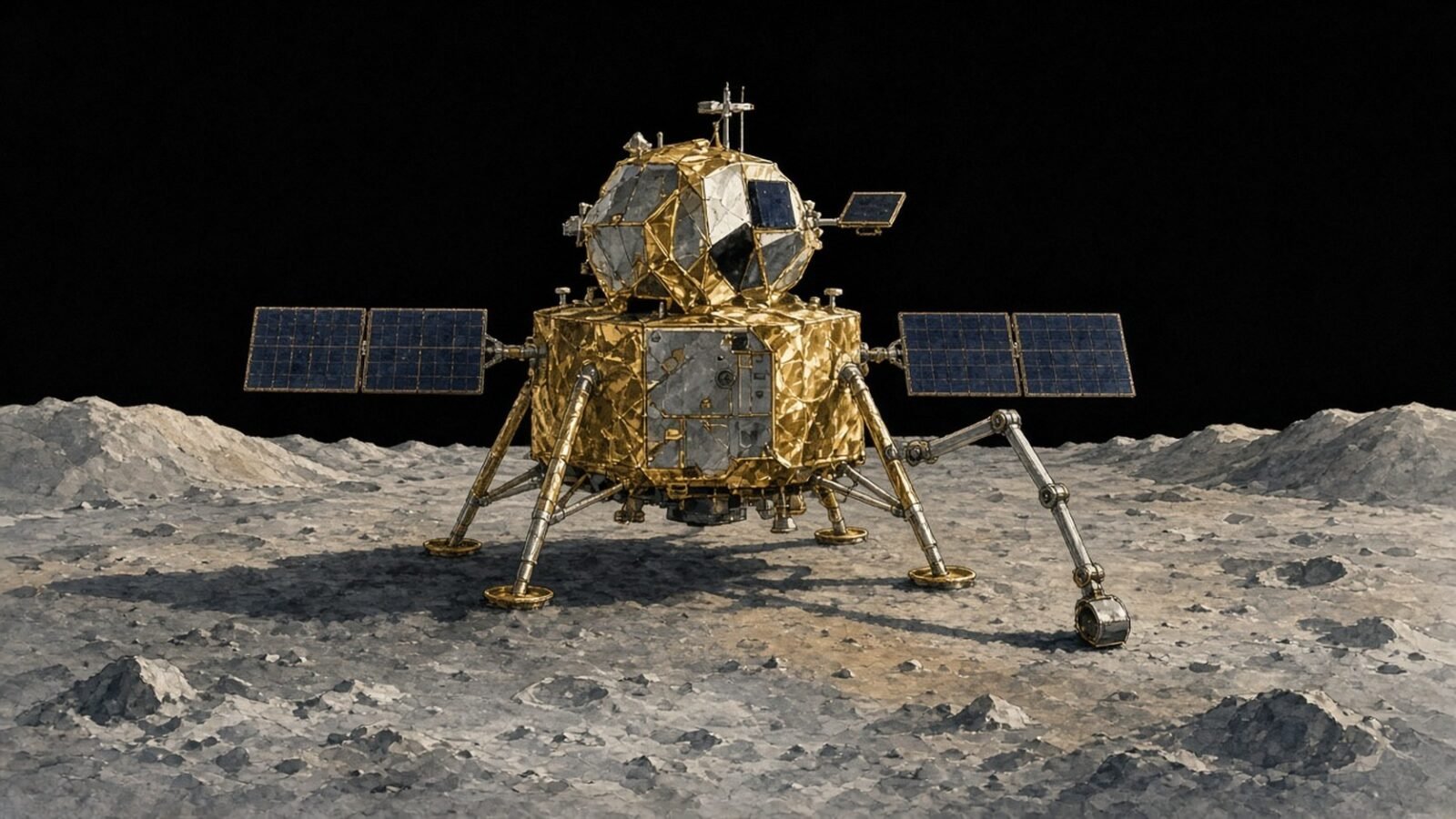
Early on 2 June 2024, Beijing time, a Chinese spacecraft landed on a flat plain of dark basalt inside a crater called Apollo, on the side of the Moon that never faces Earth. Two days later a small rocket took off from the top of the lander carrying a sealed container of lunar soil. On 25 June a scorched capsule came down by parachute on the grasslands of Siziwang Banner in Inner Mongolia. The container held 1,935.3 grams of material: the first samples ever returned from the lunar far side.
Two years on, what matters most about Chang’e-6 is what laboratories have done with that material. Papers in Nature, Science, PNAS and other journals have produced the first dates for far-side volcanism, the first estimate of water in the far-side mantle, the first far-side magnetic readings and a proposed age for the Moon’s largest impact basin. Not all of them agree. This article covers how the mission worked, who flew instruments on it, what the samples have shown, who has been allowed to study them, and what China plans next.
Why the far side, and why this crater
The Moon keeps one hemisphere turned towards Earth. The far side gets as much sunlight as the near side. It is simply out of sight and out of radio contact. The two halves also look very different. The near side is covered in dark basalt plains, the maria. The far side is mostly bright, cratered highland with thicker crust. According to figures cited in the first Nature paper on Chang’e-6 basalts, about 93 per cent of the Moon’s mare and buried “cryptomare” basalts are on the near side. Near-side rocks are also richer in thorium and in KREEP, geologists’ shorthand for potassium (K), rare earth elements and phosphorus.
Explaining this lopsidedness, the lunar dichotomy, is a long-standing problem. Until 2024 every returned sample came from the near side: six Apollo landings, three Soviet Luna missions and China’s Chang’e-5, which brought back about 1,731 grams in December 2020.
Chang’e-6 went to the South Pole–Aitken (SPA) basin. At roughly 2,500 kilometres across, it is the largest and oldest well-preserved impact basin on the Moon. The landing site lay in the southern part of Apollo, a basin about 490 kilometres wide inside SPA where the crust is among the thinnest on the Moon. The hope was to collect local far-side lava mixed with debris from much older impacts.
A four-part spacecraft and a bridge in lunar orbit
Chang’e-6 was built as the backup to Chang’e-5 and had the same four modules: an orbiter, a returner (the re-entry capsule), a lander, and an ascender mounted on top of the lander. CNSA, China’s space agency, gave the launch mass as 8,350 kilograms.
Because there is no direct line of sight to Earth from the far side, China first launched a relay satellite, Queqiao-2 (“Magpie Bridge 2”). It went up on a Long March 8 from Wenchang, Hainan, on 20 March 2024 and settled into an elongated 24-hour lunar orbit from which it could see both Earth and the landing zone.
The timeline
- 3 May 2024: launch on a Long March 5 from Wenchang at 17:27 Beijing time (10:27 BST).
- 8 May: entry into lunar orbit.
- 2 June, 06:23 Beijing time (23:23 BST on 1 June): landing in southern Apollo basin at about 41.6° S, 154.0° W.
- 4 June, 07:38 Beijing time: the ascender lifts off with the samples, the first launch from the lunar far side.
- 6 June: automated docking in lunar orbit and transfer of the sample container to the returner.
- 25 June: the returner skips once off the upper atmosphere to lose speed, then lands in Inner Mongolia at about 14:07 Beijing time, after a mission of about 53 days.
Drill and scoop
The lander spent about two days on the surface and used two tools. According to the first description of the samples, published in National Science Review in 2024, eight scoops from one spot, each no more than about 3 centimetres deep, produced roughly 1,610 grams. A drill added a core of about 325 grams, which was later divided into 100 layers for study. A small rover of about 5 kilograms called Jinchan (“Golden Toad”) drove off the lander and photographed it on the surface.
At the handover in Beijing on 28 June 2024, CNSA spokesperson Ge Ping said: “We have found that the samples brought back by Chang’e-6 were more viscous compared to previous samples, with the presence of clumps.” The samples went to the National Astronomical Observatories of the Chinese Academy of Sciences (NAOC), which looks after China’s lunar collection.
What came back
The National Science Review study, led by NAOC’s Li Chunlai, found that the far-side soil is paler, less dense (0.983 grams per cubic centimetre in bulk, against about 1.24 for Chang’e-5) and more porous than the Chang’e-5 soil. It has much more feldspar and glass and very little olivine. It also contains less potassium, thorium and uranium than soils from the thorium-rich near-side region.
The soil is a mixture. Basalt makes up 30 to 40 per cent of the larger fragments and probably comes from the lava plain under the lander. Most of the rest is breccia, glassy agglutinates and pale anorthosite and norite, with at least 11 per cent “exotic” material thrown in from elsewhere. That mixture is why the sample is so useful: it records both local volcanism and the SPA basin’s early impact history.
Passengers from Europe and Pakistan
Chang’e-6 carried four international payloads:
- NILS (Negative Ions at the Lunar Surface), an ESA instrument built by the Swedish Institute of Space Physics, mounted on the lander.
- DORN, a French instrument for measuring radon escaping from the soil, to study how volatiles and dust move between the ground and the Moon’s thin exosphere.
- INRRI, a small Italian laser retroreflector that can serve as a target for laser ranging from orbit.
- ICUBE-Q, a Pakistani cubesat of about 7 kilograms built by Islamabad’s Institute of Space Technology with Shanghai Jiao Tong University and Pakistan’s space agency SUPARCO. It was released into lunar orbit on 8 May 2024 with two cameras and a brief to collect magnetic-field data.
NILS produced the first result. ESA said it started collecting data 280 minutes after landing and, working in short bursts to stop it overheating, gathered more than three hours of data. That was about three times what the team needed. Neil Melville, ESA’s technical officer for the experiment, said:
“This was ESA’s first activity on the surface of the Moon, a world-first scientifically, and a first lunar cooperation with China. We have collected an amount and quality of data far beyond our expectations.”
Later peer-reviewed papers reported negative hydrogen ions whose flux followed the incoming solar wind.
Volcanoes on the hidden hemisphere
On 15 November 2024 Nature and Science each published a paper dating the local basalt. In Nature, Qian W. L. Zhang, Li Qiu-Li and colleagues at the Institute of Geology and Geophysics, Chinese Academy of Sciences (IGGCAS), dated 108 basalt fragments with lead isotopes. About 99 per cent gave one age, 2,807 ± 3 million years, which the authors called “a surprisingly young eruption age”. That puts it between the Apollo basalts, at roughly 3.8 to 3.2 billion years, and Chang’e-5’s basalts at about 2 billion. In Science, Zexian Cui, Yi-Gang Xu and colleagues at the Guangzhou Institute of Geochemistry used two dating methods, lead–lead and rubidium–strontium, and reported 2,830 ± 5 million years.
Where the numbers disagree
The two ages differ by about 23 million years, more than their stated uncertainties allow. A third team, from the Chinese Academy of Geological Sciences, reported a main basalt age of about 2.823 billion years in a Science paper described by Xinhua in February 2025. All three agree on volcanism about 2.8 billion years ago, but the precise figure depends on the laboratory.
The teams also emphasise different things. Both 2024 papers found that the lava came from a mantle source poor in KREEP. The Guangzhou team described “almost no KREEP component”. The Chinese Academy of Geological Sciences team, as reported by Xinhua, stressed that a KREEP layer also exists on the far side. Its researcher Liu Dunyi said: “Without samples from the far side, it was like solving a puzzle with half the pieces missing.” These findings are not necessarily contradictory, since a depleted lava source can sit beneath crust that contains KREEP-bearing material. But the debate is still at an early stage.
A 4.2-billion-year-old fragment
The IGGCAS team also found one high-aluminium basalt fragment dated to 4,203 ± 4 million years, from a KREEP-rich source. They argue it is a local rock, probably from a buried lava deposit just south of the landing site. If so, volcanism in this part of the far side lasted at least 1.4 billion years.
The 2.8-billion-year age also tests the method used to date unsampled lunar surfaces by counting craters. That method’s calibration curve rested entirely on near-side samples and had a large gap between about 3.2 and 2 billion years. Crater-count ages published for the landing site before the samples came back ranged from about 2.4 to 3.1 billion years depending on the model. The measured age falls inside that range, and both 2024 papers concluded that the curve works on the far side too.
A drier, more depleted mantle
Because basalt is melted mantle, it carries information about the interior beneath the basin. In April 2025 a Nature paper led by Hu Sen and Lin Yangting of IGGCAS gave the first estimate of water in the far-side mantle. Working with 5 grams of soil, they measured water in apatite crystals and in tiny melt pockets trapped inside other minerals. They estimated 15 to 168 micrograms of water per gram in the parent magma and only 1 to 1.5 micrograms per gram in its mantle source. That is at the bottom of the roughly 1 to 200 range estimated from near-side samples. The authors suggest the Moon’s interior water may be split between the hemispheres like its surface features, while noting that one site cannot prove this for the whole far side.
In July 2025 a second Nature paper, led by Zhou Qin of NAOC, found from strontium and neodymium isotopes that the basalt came from an “ultra-depleted” mantle source, among the most depleted ever measured. The team offered two explanations. The depletion could date from when the early magma ocean crystallised, which would imply similar deep mantle on both sides of the Moon. Or the mantle could have lost melt later, most plausibly during the giant SPA impact.
A PNAS study from Tian Hengci’s group at IGGCAS, published in January 2026, favours the impact explanation. Chang’e-6 basalts have heavier potassium isotopes than any previously reported lunar basalts. The authors argue that the SPA impact evaporated lighter potassium from the mantle, and that this loss of volatiles may have suppressed later far-side volcanism.
Magnetism, impacts and the early timeline
A lunar dynamo that came back?
Magnetised rocks show that the Moon once had a magnetic field generated in its core. Apollo samples suggest a strong field between about 4.2 and 3.5 billion years ago, a sharp drop around 3.1 billion years ago, and a long weak phase afterwards. In December 2024 a Nature paper led by Cai Shuhui of IGGCAS reported field strengths of about 5 to 21 microtesla, with a median near 13, from four millimetre-sized clasts of the 2.8-billion-year basalt. The authors read this as a rebound of the dynamo rather than a steady fade.
That is contested. The paper itself cites earlier work arguing that the Moon had no long-lived magnetic field at all, or that its core dynamo ran only for about its first 140 million years. The new result rests on four small clasts, and the authors acknowledge large uncertainties.
Dating the biggest crater
A 2025 National Science Review paper led by Su Bin and Chen Yi of IGGCAS argued that norite fragments in the soil crystallised from SPA impact melt. It dated them to 4,247 ± 5 million years, which the authors take as the age of the SPA impact. A younger group of fragments, at about 3.87 billion years, they link tentatively to the Apollo basin impact.
This conflicts with other estimates. A study led by Katherine Joy of the University of Manchester, published in Nature Astronomy in late 2024 and based on Apollo samples and meteorites, argued for about 4.33 billion years. Even the July 2025 Chang’e-6 mantle paper used 4.33 billion years in its model. The dated norites are ejecta scattered by later impacts, not rock taken from the basin floor, so the question is still open.
In February 2026 a team led by Yue Zongyu used the 2.807 and 4.247 billion-year ages to revise the crater-counting curve in Science Advances. They concluded that impact rates on the two hemispheres were essentially the same and that early bombardment declined smoothly. That argues against the “Late Heavy Bombardment”, a proposed spike in impacts about 3.9 billion years ago. It is a significant contribution to a long-running dispute, not the final word.
The oldest crust
In May 2026 Nature Communications published a study of far-side anorthosite, part of the Moon’s original crust. The fragments closely match Apollo anorthosites from the near side. Zircon in one fragment is dated to 4,410 ± 8 million years. The authors argue that the primary crust formed the same way on both hemispheres, and that the dichotomy developed later.
Overall, the samples have narrowed the explanations for the dichotomy without settling on one. The dating paper pointed to crustal thickness controlling where lava reached the surface. The mantle and potassium studies point to the SPA impact reshaping the interior. The anorthosite study argues against a Moon that was lopsided from the start.
Who gets the samples
CNSA lends lunar samples through a formal application system and keeps most of the material in storage, much as NASA has done with Apollo samples. By November 2024, according to People’s Daily, only 85.48 grams of Chang’e-5’s 1,731 grams had been lent, to 131 Chinese teams.
The domestic queue
For Chang’e-6, CNSA picked 16 teams from 13 institutes in August 2024, all with good track records on Chang’e-5, for a first round of proposals. A general call for Chinese researchers followed in November 2024. On 27 December 2024 CNSA announced its first combined Chang’e-5 and Chang’e-6 loan batch: 8,550.4 milligrams for 18 researchers at 16 institutions, including the University of Hong Kong. Another round covering both missions ran from 8 May to 8 June 2026. Individual allocations are small: the Chinese Academy of Geological Sciences team received 2 grams.
The international route
Under CNSA’s rules, an expert committee reviews applications every six months, and loans normally last up to a year, renewable once for six months. In 2024 officials said repeatedly that international access to Chang’e-6 would follow the domestic rounds. However, as of late September 2026 I have not found any public CNSA announcement of a foreign institution receiving a direct Chang’e-6 loan. All published international selections so far concern Chang’e-5.
The Chang’e-5 process shows how international access is likely to work. CNSA opened applications in November 2023 and received 24 from 11 countries and organisations. On 24 April 2025 it approved seven institutions: the Institut de Physique du Globe de Paris, the University of Cologne, Osaka University, SUPARCO, the Open University in the UK, and Brown and Stony Brook universities in the US. A second round, announced on 24 April 2026, added IRAP in Toulouse, the University of Manchester and Türkiye’s TÜBİTAK Space Technologies Research Institute.
The Wolf Amendment
Since 2011 the Wolf Amendment, a clause in NASA’s funding law, has barred NASA money from bilateral work with China unless the agency certifies to Congress that there is no security risk. In November 2023 NASA made such a certification for Chang’e-5 samples only. Its internal email stated that “the normal prohibition on bilateral activity with PRC on NASA funded projects remains in place”. According to Space.com, Stony Brook’s Timothy Glotch was funded by his own university for his Chang’e-5 work.
At a press conference on 27 June 2024, CNSA vice-administrator Bian Zhigang said, as quoted by the Associated Press: “The source of the obstacle in US-China aerospace cooperation is still in the Wolf Amendment.”
American scientists have still contributed through multinational teams. The November 2024 Science dating paper lists James W. Head III of Brown University and Clive R. Neal of the University of Notre Dame as co-authors. Its funding came from the Chinese Academy of Sciences, and the sample came from CNSA under a materials transfer agreement. In 2023 Head told Science magazine: “I am very careful to never spend NASA funds on bilateral studies.”
What comes next
Chang’e-7, with an orbiter, lander, rover and a hopping probe designed to look for ice in shadowed craters near the south pole, was due to launch in August 2026. On 23 August the China Manned Space Agency said, in a statement carried by Xinhua, that the probe “does not meet launch conditions, and its launch therefore cannot take place during the planned window this year”. No official reason was given. Some reports blamed a typhoon, but specialist trackers note that no Chinese official source has named a cause. Partners, including Thailand’s NARIT, now expect a launch in 2027. The mission carries six international instruments.
Chang’e-8 is planned for around 2029. It will target the Leibnitz-Beta Plateau near the south pole and test ways of using lunar resources. In April 2025 CNSA selected ten international projects for it from 41 proposals, including rovers from Pakistan and Türkiye, a robot from Hong Kong and instruments from Italy, Russia, Thailand, South Africa, Peru, Egypt, Bahrain and Iran.
Both missions are meant to form the start of the International Lunar Research Station (ILRS), a China-led project. Chief designer Wu Weiren has described a basic model in the south polar region by 2035 and an extended version in the 2040s. CNSA said in April 2025 that 17 countries and international organisations had joined. Counts of national governments alone are lower.
China’s target for landing astronauts on the Moon is still before 2030, using the Long March 10 rocket, the Mengzhou spacecraft and the Lanyue lander. On 11 February 2026 a prototype Long March 10 flew a low-altitude test in which the Mengzhou capsule carried out an abort at maximum aerodynamic pressure. This followed an earlier landing and take-off test of Lanyue. The first orbital Mengzhou flight is officially targeted for 2026, although specialist observers have reported it may slip to 2027.
Conclusion
Chang’e-6 was an engineering success: a relay satellite placed in advance, an automated far-side landing, a launch from the lunar surface, a docking in lunar orbit and a skip re-entry to the Inner Mongolian grassland. It is turning into a scientific success too. Less than two kilograms of soil, handed out a few grams at a time, has dated far-side volcanism to about 2.8 and 4.2 billion years ago, given a first figure for far-side mantle water and a first far-side magnetic reading, proposed an age for the SPA basin and tested the method used to date surfaces across the inner Solar System.
The results do not all agree, and they should not be presented as if they do. Basalt ages from different laboratories differ by tens of millions of years. The SPA date conflicts with estimates from Apollo samples. The magnetic rebound rests on four small clasts. Every conclusion about the far-side mantle so far comes from a single site. Further tests will come from the Chang’e-6 material still in storage, from international loans if Chang’e-6 follows the Chang’e-5 path, and from future samples collected elsewhere on the far side and at the south pole.