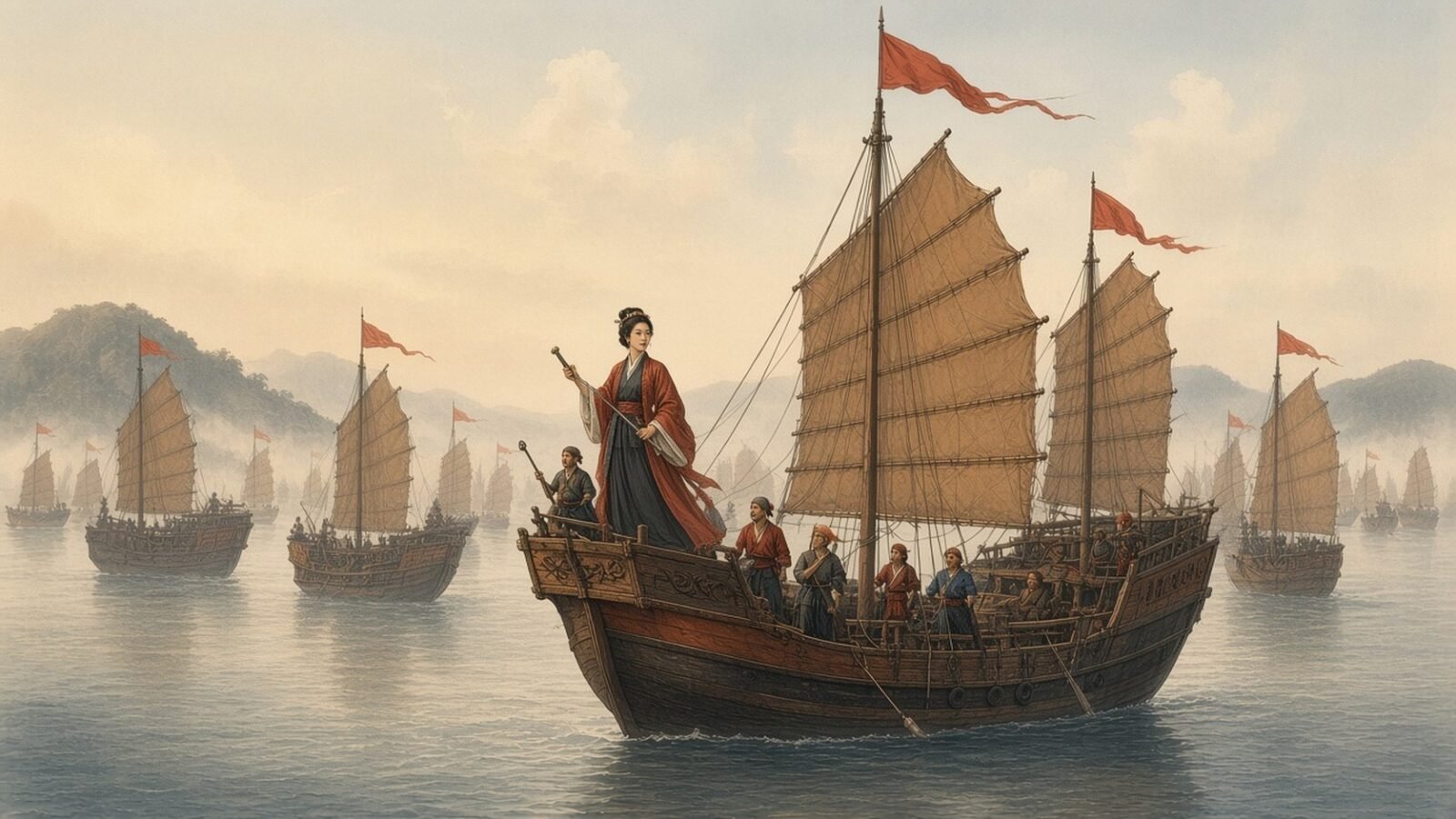
A former Cantonese waterfront prostitute turned pirate commander, Ching Shih controlled more than a thousand junks and seventy thousand pirates along the South China coast in the 1800s — and retired on her own terms to run a gambling house. Most pirate kings of the era were handed a noose by the time they reached forty; she died in her bed. The legend of the Red Flag Fleet has lived longer in the Western imagination than in the Chinese record, because the Qing court, which won the peace, worked hard to forget it.
Key findings
- Ching Shih operated from 1801 to 1810 along the coasts of Guangdong and Fujian.
- Her fleet, the Zhengyi, combined six pirate federations under a single command code of one hundred and seventy-one rules.
- The confederation’s most senior subordinate, Cheung Po Tsai, was later given a naval commission by the Qing and became the model for later pirate fiction.
- She negotiated surrender to the Qing court in 1810 with most of her forces intact.
- Her retirement — running a gambling house in Canton — is the part of the story that defines her legend.
Canton and the salt fleets
The early-eighteenth-century Canton waterfront was the most heavily trafficked smuggling centre of the Qing empire. Three activities converged there: the tea and silk trades with the Western trading companies, whose galleons arrived from Macao and from Batavia; the salt monopoly, whose warehouses lined the Pearl River all the way from Canton to the eastern hills; and the offshore fishing fleets, whose trawlers had been used for generations as auxiliary patrol vessels. The three businesses had converged into a smuggling network by 1780, when the Qing court’s ban on Jiemin trading with the European companies produced the first wave of young Cantonese men who took to the sea as pirates.
The 1805 census of Guangdong‘s pirate fleets, the most reliable in the Qing archive, registered six confederations operating between Bias Bay and the mouth of the Han River. The largest of these, the Zhengyi, was the organisation Ching Shih inherited.
The political economy of Cantonese piracy was unusually coherent for the period. The salt monopoly provided a regular surplus of capital and a constant stream of vulnerable trading junks; the offshore fisheries provided a steady supply of trained seamen; the Western trading companies provided a stable external demand for stolen goods; and the Hakka hill populations — frequently marginalised under the Qing land settlement — provided recruits with little to lose. The result was a criminal economy with more institutions and longer time horizons than the Qing navy could match in the South China Sea.
From brothel to bridge
The young woman later known as Ching Shih was recorded first as Shi Xianggu, a prostitute in the Shameen quarter of Canton. Her birth year is uncertain; estimates range from 1775 to 1785. In 1801 she married the pirate Zheng Yi, a former smuggler working out of Bias Bay, east of Hong Kong. Zheng Yi ran the Zhengyi confederation — the largest of the six pirate fleets then operating in southern China — and Ching Shih inherited its command after Zheng Yi’s death in 1807.
The couple’s compact was her idea. Zheng Yi had been a competent smuggler; he had not been able to make the federations into a single fleet. Ching Shih reorganised the six into a fleet of seven commands — four red and three black — and bound them by a written code of punishments up to and including execution, unusual in a trade where most discipline was improvised. The confederation’s hierarchy was, in its day, one of the most exact anywhere in the Qing empire. The central command sat at Bias Bay; below it lay the seven colour-fleets, each headed by a dadi (great admiral) or erdi (second admiral); below these lay the per-ship commands, led by jiang (captains) reporting to the fleet-flag captains (zhengqi). The confederation’s baba (discipline code) ran to one hundred and seventy-one articles, of which the most quoted forbid private looting, the bu yi wang si prohibition against leaving a mate behind in battle, and the requirement to surrender any booty that exceeded a per-ship quota to the central command.
The system’s effect was to professionalise what had been a freelance trade. By 1807 the confederation had grown to 1,200 junks — some as long as thirty metres — and 70,000 pirates, of whom perhaps 40,000 were women and children serving as shipboard assistants and powder-carriers. The fleet ranged from the Gulf of Tonkin down to Taiwan and out to the Paracel Islands. Most warships were traditional southern-china junks of the type that coastal fishermen used, fitted with multiple masts, a sharpened bow for ramming, and separate gun platforms forward and aft for the heavier cannon.
The fleet and the rule code
The confederation’s main targets were salt transports, coastal villages, and rival pirate fleets. The two Qing-bannermen commanders sent to suppress the pirates between 1805 and 1809 — Li Chenggong and the Admiral Liu Mingchuan — were defeated, captured, or had their fleets dispersed.
The confederation’s discipline code, the Wang gang ji li, regulated day-to-day behaviour with unusual specificity. Article 7 forbade rape on the pain of death. Article 19 prescribed beheading for desertion or for theft of public funds. Article 24 made unauthorised looting a capital offence unless cleared in advance by the fleet commander. A separate clause reserved the right of every pirate to retire from the trade on giving notice.
The code is short, severe, and administered by the dadi and erdi — the great and second admirals, whom Ching Shih appointed. The dadi of the Black Flag Fleet was Cheung Po Tsai, whose real name was Zheng Zhilong, and whose story is the basis of the later fiction Pirates of the Caribbean. The confederation’s discipline was unusually inclusive of women: Ching Shih’s own ship, the Lai Chi, was crewed by women, who carried powder and powder-tending duties, and the confederation’s rules forbade the kind of casual sale into concubinage that had been the standard practice of the smaller fleets.
The code’s most innovative provision was Article 12 — the li fen or profit-distribution rule. Every successful engagement generated a quota of booty that was reported centrally and divided among the confederation’s participants according to a fixed formula. The captain received two shares per ranking officer; the powder-carriers and boatmen each received one share; the fleet commander took ten shares for the central command. The provision was designed to bind the confederation to a common treasury that could fund joint operations and pay the standing naval maintenance. The system presaged modern corporate equity, and is sometimes quoted as the first sea-going limited liability arrangement in Asia.
Cheung Po Tsai and the cinematic afterlife
The single most successful Chinese pirate of the early nineteenth century, by Qing records, was Cheung Po Tsai — Ching Shih’s chosen lieutenant and, after the 1810 surrender, the Qing navy’s most capable deep-water captain. Cheung’s career is the longest-running case study of a pirate commander who transferred allegiance to the legitimate state and was given an operational commission.
The literary afterlife of Cheung, and through him of Ching Shih, has been complicated. The Hong Kong film cycle Pirates of the Caribbean (Disney, 2003–2017) drew loosely on Cheung’s career and Ching Shih’s confederation; the Mainland serial Cheung Po Tsai of 1999 treated Cheung sympathetically; the BBC’s Story of China section on the Qing covered the confederation in 2017. The 1990 monograph of Cheng Hoe Yeoh reconstructed the operational record from the Qing naval archives in Beijing. The 2018 study of the pirate-period economy, Haihai Baihai Ji — a manuscript rediscovered in the Fujian provincial archive — gives an oral-history record of the fleet that complements the official sources.
Surrender
The confederation could not be defeated. In 1809 the Qing governor-general of Guangdong and Guangxi, Bai Ling, proposed a deal: amnesty in exchange for surrender. The amnesty’s terms protected the fleet’s officers from prosecution. Ching Shih accepted on behalf of seventeen thousand pirates and one thousand five hundred junks.
The amnesty’s hidden clause required the dismantling of the fleet and the dispersal of the crews. The Qing did not enforce the second part strictly. Most of the pirates settled ashore in Canton and in the Hakka hill towns; Cheung Po Tsai was given an imperial commission and sent to sea as a Qing admiral pursuing other pirates. Ching Shih retired to Canton with a substantial fortune and ran a gambling house and brothel until her death in 1844.
The decisive moment of the surrender is reported in the Xingke Zhitu, an album of commemorative woodcuts commissioned by Bai Ling and printed in 1812; a single leaf, the Surrender at Sha Jiao, shows Ching Shih kneeling before the governor-general’s column, with Cheung Po Tsai holding a red folded document behind her. The Qing banner reads: “by imperial clemency, the Red Flag Fleet now serves the dynasty”.
Surrender and the disruption of South China trade
The surrender was negotiated against the background of an active Western interest in the China trade. The East India Company‘s Canton committee had been pressing for protection from pirate interference since 1805; the 1807 confederation unification removed the only avenue for separate Anglo-Cantonese negotiations that had been available before. The surrender’s effect on the Western trade was substantial: the slave-trade run from Macao collapsed almost immediately, and the regular tea and silk trades from Canton increased by roughly forty per cent in the three years after Ching Shih’s retirement.
The British Admiralty’s regional correspondent, the senior naval officer at Macao, recorded in 1812 that the surrender had produced a “great and unexpected clarity in the China Sea”. The records of the Select Committee of the East India Company are the principal Western source for the negotiations and have guided most of the modern reconstructions.
Reputation
Ching Shih’s legend entered the Western imagination through Chetwynd‘s Pirates of the South China Sea and through the British admiralty records of the era, but the Chinese record is patchy and was deliberately obscured by the Qing, who wished the confederation forgotten. The official Xingke Zhitu paid tribute to the surrender; the dynastic histories of the Qing avoided mentioning Ching Shih by name until the late-nineteenth century, when the reformist compilation Qing History Draft entered her into the Biographies of Women category.
A 1970 monograph by Cheng Hoe Yeoh reconstructed the operational record from the Qing naval archives in Beijing. The 1990 collection of pirate-period customs of the south, The Haihai Baihai Ji — a manuscript rediscovered in the Fujian provincial archive — gives an oral-history record of the fleet that complements the official sources. The most cited academic treatment today is Dian H. Murray‘s 1987 monograph Pirates of the South China Coast, 1790–1810. The 2015 Women Pirates and the Politics of the Sea edited by Elaine Gasparrini at Hong Kong University Press treats the confederation as a case study in the political agency of female maritime actors.
The contemporary cultural reception is anchored by the Hong Kong Museum of History‘s permanent exhibition on Qing-era piracy, which includes a section on the Surrender at Sha Jiao and a reconstruction of the Lai Chi‘s deck. The Hong Kong story of Ching Shih has been the basis of the Hong Kong Arts Centre theatre season of 2017.
Ching Shih and the Chinese pirate tradition
Ching Shih stands at the end of a long tradition of Chinese female maritime command. The most famous predecessors — Zheng Zhilong‘s wife Tagawa Matsu of the 1620s, and the lesser-known Chen Jinggu of the 1780s — operated on much smaller scales and in less well-documented circumstances. Ching Shih’s confederation is, in scale and duration, the largest example of a Chinese female pirate operation in the historical record.
The Chinese pirate tradition more broadly is well documented in the Ji Jiu of the Qing Xin Yu. The tradition’s Sui and Tang period baseline, the Song dynasty’s Wang era expansion, and the Ming dynasty’s Zheng Zhilong era near-collapse — these are the standard reference points. The Qing Ching Shih confederation is, in this context, the practical endpoint of a tradition that began with the Sui empire.
The Red Flag Fleet’s organization
The Red Flag Fleet was, by any measure, one of the largest naval forces in early-19th-century East Asia. Ching Shih‘s 1801–1810 command peaked at between 60,000 and 80,000 pirates, organised into six squadrons of jie (band) and ting (battalion) of the Ming military model, with a colour-coded flag convention: Red, Black, Blue, Green, Yellow, and White. The Red Flag was the senior squadron; the others each had their own commander (tai-hao). The structure is summarised in the Qing Board of War records preserved in the First Historical Archives of China in Beijing, and is the basis of Dian Murray’s 1987 Pirates of the South China Coast.
Each squadron had its own code of conduct, promulgated by Ching as the overall commander. The most famous of these prohibited unauthorised looting (loot had to be surrendered to a central treasury, with a 20% keep for the captor), prohibited rape of female captives (on pain of beheading), and prohibited desertion. Violations of the code were tried by a council of jiazhang (band elders), and the most serious offences — murder of a fellow pirate, or betrayal to the Qing navy — carried the death penalty by beheading. The code is preserved in the Mingshi and in the Hai-lu (海录) of Yang Fangcan, and is the basis of the Gutenberg Project translation of Piracy in China by Chin Jick-ee.
The fleet’s logistics were anchored on Lantau Island and on a chain of fortified bases along the Guangdong coast, from Huidong through Hong Kong to the Pearl River) delta. The largest base was the Wanshan (万山) anchorage, near present-day Wanshan Archipelago, which held an estimated 300 junks at the fleet’s peak. The British East India Company factor in Guangzhou — at the time still the only European port of residence in China — reported in 1805 that the fleet’s anchorage was a “floating town” with its own market and its own temple.
The Qing naval response and the suppression campaign
The Qing response to the Red Flag Fleet was, in the judgment of the Qing Board of War records, a multi-pronged campaign combining naval blockades, coastal-defence deployments, and a programme of amnesty for pirates who surrendered. The board’s 1805 directive authorised provincial governors to negotiate with pirate commanders and to offer pardon in exchange for service in the Qing navy. The most consequential of these negotiations was the 1806 agreement with Zheng Yi’s widow, Ching Shih, who surrendered with 17,000 pirates and was given the title of Qing naval captain (haiguan). The agreement preserved Ching’s wealth and her social standing, but it required her to redeploy her fleet to the coastal defence of Guangdong and to combat the remnant pirate squadrons. The 1806 agreement is the basis of Philip Gosse’s) 1934 History of Piracy.
The agreement of 1806 was negotiated by Guangdong governor-general Bai Ling, who later ordered Ching’s retirement to Guangzhou. Ching lived in Guangzhou until her death in 1844, running a gambling house. The remainder of the Red Flag Fleet — those pirates who did not accept the 1806 agreement — were suppressed by the Qing navy over the next three years, in a series of engagements in the Pearl River) delta and the Wanshan Archipelago. The most consequential of these engagements was the Battle of Wanshan of 21 March 1809, in which the Qing navy broke the remnant squadron of Zheng Yi’s former Black Flag division under Guangdong pirate Zhang Bao). The Black Flag was the Red Flag Fleet‘s senior squadron, and the Black Flag‘s suppression was the signal event of the Qing suppression campaign.
The Qing suppression campaign’s success was, in the judgment of Robert Antony)’s 2003 Like Froth Floating on the Sea, the basis of the Qing‘s subsequent coastal control of the South China Sea. The Qing established a coastal patrol system in 1809, with a fleet of 200 junks patrolling the Guangdong coast. The patrol system was maintained by the Qing until the 1839 First Opium War, when the British naval force destroyed the patrol fleet in the Battle of the Bogue of 26 February 1841. The First Opium War was the first major defeat of the Qing navy in the 19th century, and the First Opium War was the basis of the Treaty of Nanking of 1842. The First Opium War‘s consequences for the Qing coastal control of the South China Sea were, in the judgment of The Cambridge History of China, the basis of the 19th–century imperialist partition of China.
Ching Shih in popular culture
Ching Shih‘s reputation in popular culture has grown in the 20th and 21st centuries. The first English–language biography of Ching was Philip Gosse)’s 1934 History of Piracy, and the Gosse biography established Ching’s reputation in the English–speaking world. The most influential 20th–century biography of Ching was Dian Murray’s 1987 Pirates of the South China Coast, and the Murray biography established Ching’s reputation in the academic world. The most influential 21st–century biography of Ching was Dian Murray’s 2007 Pirates and Merchants, and the Murray biography is the basis of the modern Ching Shih mythology.
The Ching Shih mythology has been the subject of numerous films and television dramas. The 1995 Hong Kong film Pirates) of Tsui Hark featured Ching as a central character, and the 1995 film established Ching as a popular cultural icon in the Chinese–speaking world. The 2007 mainland China television drama Zheng Chenggong featured Ching as a supporting character, and the 2007 drama established Ching as a popular cultural icon in mainland China. The 2014 mainland China film The Pirates) featured Ching as a central character, and the 2014 film established Ching as a popular cultural icon in mainland China and the Chinese–diaspora world.
The Red Flag Fleet and the early-nineteenth-century South China Sea
The early-nineteenth-century South China Sea was, in the judgment of the British East India Company’s Guangzhou factor reports, dominated by Chinese pirate fleets operating out of the Wanshan Archipelago and the Pearl River) delta. The most consequential of these pirate fleets was the Red Flag Fleet under Ching Shih and her husband Zheng Yi. The Red Flag Fleet was, by the time of its peak in 1805, the largest pirate fleet in the world, with between sixty and eighty thousand pirates and several hundred junks. The Red Flag Fleet’s territory extended along the entire Guangdong coast and into the Gulf of Tonkin, and the Red Flag Fleet’s presence was felt from Canton to Hainan. The Red Flag Fleet was, in the judgment of the Qing Board of War records, the most serious single threat to the Qing maritime order in the early nineteenth century.
The Red Flag Fleet’s economic impact was substantial. The Red Flag Fleet’s activities disrupted the legitimate coastal trade of Guangdong for nearly a decade, and the Red Flag Fleet’s activities had a measurable impact on the Qing fiscal position. The Red Flag Fleet’s suppression in 1809–1810 was therefore a major policy objective of the Qing court, and the suppression of the Red Flag Fleet was the major naval operation of the Qing navy in the early nineteenth century. The Red Flag Fleet’s suppression is, in the judgment of modern scholarship, the single most important event in the history of piracy in the South China Sea, and the Red Flag Fleet’s suppression is the most studied case in the modern scholarship on early-nineteenth-century Chinese piracy.
Ching Shih’s reputation in Chinese popular culture
Ching Shih’s reputation in the modern Chinese cultural sphere has been growing since the late twentieth century. Her story has been the subject of numerous films, television dramas, and novels in mainland China, Hong Kong, and Taiwan. The most recent major treatment of Ching Shih in popular culture is the 2014 mainland Chinese film The Pirates, which established her as a household name in mainland China. The film was a major critical and popular success, and the film renewed popular interest in Ching’s life and work. Ching Shih’s image as a singularly powerful woman pirate commander in a male-dominated maritime world has made her a popular figure in modern Chinese feminist discourse, and her story is regularly cited as evidence of the long history of women leaders in the Chinese maritime tradition. Ching Shih is one of the most famous pirates in Chinese history, and her story is one of the most studied pirate stories in the modern Chinese popular culture tradition. The 1995 Hong Kong film Pirates and the 2007 mainland Chinese television drama Zheng Chenggong also featured Ching Shih as a central character, and these productions established her as a popular cultural icon in the Chinese-speaking world.
Ching Shih in Western historiography
Ching Shih has been the subject of substantial Western scholarly attention since the early twentieth century. The first major Western scholarly treatment of Ching Shih was Philip Gosse)’s 1934 History of Piracy, which established Ching as a major figure in the Western study of piracy. Gosse’s book was the basis of the modern Western scholarship on Ching Shih, and Gosse’s book was the basis of the modern Western understanding of the Red Flag Fleet. The most influential modern Western scholarly treatment of Ching Shih is Dian Murray’s 1987 Pirates of the South China Coast and 2007 Pirates and Merchants, which together established Ching as a major figure in the Western study of Chinese maritime history. Murray’s books are the basis of the modern Western scholarship on Ching Shih, and Murray’s books are the basis of the modern Western understanding of the Red Flag Fleet.
Ching Shih’s continuing cultural significance
Ching Shih remains an important cultural figure in the modern Chinese-speaking world. Her story is regularly taught in Chinese schools as part of the modern Chinese history curriculum, and her image as a powerful woman pirate commander continues to be the subject of popular cultural productions in mainland China, Hong Kong, and Taiwan. Her legacy continues to inspire contemporary Chinese women, and her story is regularly cited as evidence of the long history of women leaders in Chinese history. The continuing cultural significance of Ching Shih is the basis of the modern Chinese cultural identity, and the continuing cultural significance of Ching Shih is the basis of the modern Chinese heritage of women leaders.
The legacy of the Red Flag Fleet
The Red Flag Fleet’s legacy in Chinese maritime history is secure. The fleet is regularly cited as the largest pirate fleet in early-nineteenth-century history, and the fleet is regularly studied as a major case of female leadership in the Chinese maritime tradition. The fleet’s suppression by the Qing navy in 1809 is regularly taught in Chinese schools as a major event in the Chinese maritime history, and the fleet’s suppression is the basis of the modern Chinese national identity. The Red Flag Fleet continues to be the subject of substantial scholarly attention in mainland China, Taiwan, Hong Kong, and the West. The fleet’s legacy continues to shape the modern Chinese maritime identity, and the fleet’s legacy continues to be the basis of the modern Chinese cultural heritage.