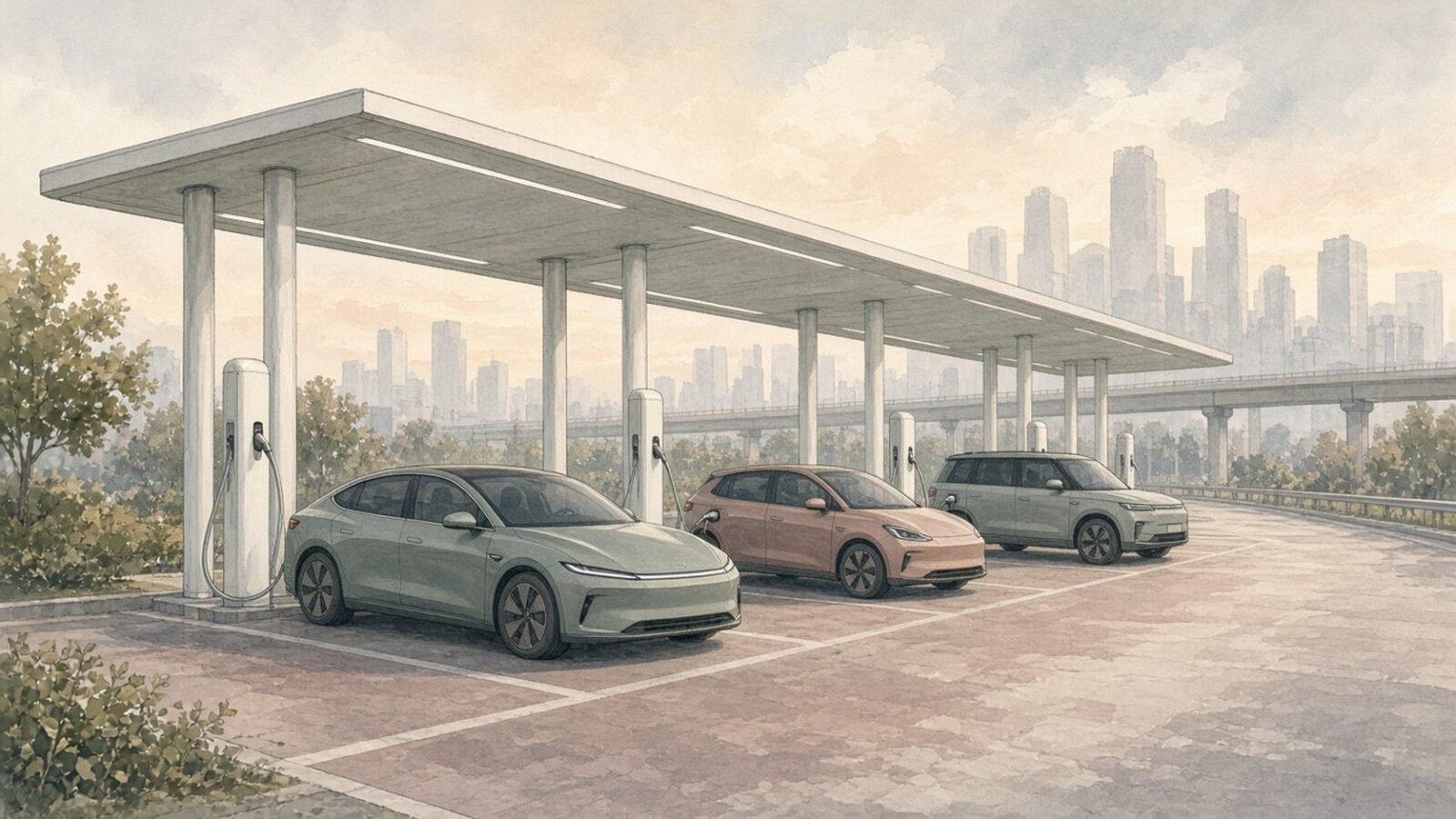
For as long as electric cars have existed, one number has haunted them: the clock. Not range, not price, not even charging availability. Time. The petrol car’s killer feature was never the engine; it was the five-minute refill, a century-old habit so deeply wired into driving culture that every EV, no matter how quick or quiet, was judged against it. In 2025 and 2026, two Chinese giants, BYD and Geely, decided to stop apologizing for that gap and simply erase it. What followed is one of the most extraordinary engineering escalations the auto industry has ever seen: a head-to-head, record-for-record sprint that has pushed charging power past a megawatt, then past a megawatt and a half, and now toward numbers that would have sounded like science fiction three years ago. This is the story of how the five-minute charge went from marketing fantasy to production reality, who is actually winning, and why the hardest part of the revolution may have nothing to do with batteries at all.
The petrol-parity problem
To understand why the five-minute figure matters so much, you have to appreciate the psychological weight it carries. A combustion car with a 50-liter tank spends three to five minutes at the pump and drives away with more than 600 kilometers of range. For two decades, EV advocates responded to this with a shrug and a spreadsheet: most people charge at home, most trips are short, and a 30-minute fast-charging stop is really just a coffee break. All true, and all beside the point. Surveys kept showing the same result. A 2025 J.D. Power study named range anxiety and charging times as the top purchase barriers in Europe, and the pattern repeats in market after market. Consumers don’t compare EVs to their actual driving habits; they compare them to their worst imaginable day: the holiday road trip, the unexpected detour, the freezing morning when the battery is low and the schedule is tight.
Even the best Western fast-charging infrastructure couldn’t close that gap. IONITY’s 350-kilowatt network, the fastest widely deployed in Europe, needs roughly 20 to 25 minutes to take an average EV from 10 to 80 percent, and Tesla’s V4 Superchargers top out around 250 kilowatts. Good, even excellent by the standards of 2022, but still three to five times slower than filling a tank. The industry consensus was that charging speed had hit a practical ceiling: push much more current into a lithium-ion cell and you trigger lithium plating, dendrite growth, heat, and accelerated degradation. Speed and battery life were supposed to be a trade you couldn’t win. BYD and Geely looked at that consensus and treated it as a starting gun.
BYD fires first: the megawatt era
BYD’s opening salvo came in March 2025, when chairman Wang Chuanfu unveiled the Super e-Platform and with it a phrase that instantly entered the EV lexicon: megawatt flash charging. The numbers were startling. A full-domain 1,000-volt architecture covering the battery, motor, power electronics, and every auxiliary system, paired with a charging current of up to 1,000 amps, delivers a peak charging power of 1,000 kW. One megawatt. On the launch stage, BYD demonstrated its Han L sedan gaining 400 kilometers of range in five minutes and coined the slogan that captured the ambition: "oil-electric parity," meaning charging an EV as fast as refueling a petrol car.
The enabling technology was a re-engineered version of BYD’s signature Blade Battery, the long, flat lithium-iron-phosphate (LFP) cell that had already made the company’s reputation on safety. LFP chemistry is inherently more thermally stable than the nickel-rich chemistries favored by many Western automakers, which gave BYD headroom to chase charge rates. The flash-charging Blade cells ran at a claimed 10C rate, meaning the pack could theoretically accept ten times its capacity per hour, achieved through redesigned electrodes, lower internal resistance, full-tab current paths, and aggressive liquid cooling. The first production cars, the Han L sedan and Tang L SUV, went on sale almost immediately and each moved more than 10,000 units in their first full month.
Critically, BYD understood something many rivals didn’t: a megawatt battery is worthless without a megawatt plug. So alongside the cars, it began building. The company’s all-liquid-cooled flash-charging terminals, rated at up to 1,360 kW of output capacity, started appearing across China at a pace the industry had never seen. BYD also equipped its stations with on-site energy storage, a clever bit of engineering that lets a station dump a megawatt into a car even where the local grid connection couldn’t supply it directly. The storage buffers the load, charging steadily from the grid and discharging violently into the vehicle.
Then, on March 5, 2026, BYD did it again. The second-generation Blade Battery arrived with Flash Charging 2.0, pushing peak power to 1,500 kW through a single connector, a 50 percent increase in barely a year. The new figures: 10 to 70 percent state of charge in five minutes, and a near-full 10 to 97 percent in nine minutes. Cold weather, long the Achilles heel of fast charging, was addressed too. At minus 30 degrees Celsius, the system can still go from 20 to 97 percent in about twelve minutes, only marginally slower than in the warmth.
By mid-2026, BYD had built more than 5,700 flash-charging stations in China, at one point deploying charging power at 2.4 times the monthly rate Tesla adds to its entire Supercharger network, and it announced plans for 20,000 stations by the end of the year. The network is also going global. BYD’s overseas rollout covers Europe, Latin America, the Middle East, Africa, and Asia-Pacific, with 200 to 300 chargers planned for South Africa alone. In a move that raised eyebrows across the industry, a Toronto job posting revealed plans to bring flash charging to Canada, the first confirmed deployment in North America. The stations use the CCS2 connector, so other brands’ cars can physically plug in, even if only Super e-Platform vehicles can drink at the full 1.5-megawatt firehose.
Geely’s answer: bricks, blades, and a faster clock
If BYD’s approach was overwhelming force, Geely’s has been a pincer movement, attacking through its premium Zeekr brand, its Lynk & Co joint brand, and an in-house battery program that has been quietly building toward this moment for years. The lineage runs through the Golden Brick Battery, an in-house LFP pack first revealed by Zeekr in late 2023, and the Golden Short Blade Battery brand unveiled at the 2025 Shanghai Auto Show alongside what Geely bills as the world’s largest standalone EV safety laboratory. In a notable bit of industrial diplomacy, Geely also announced it would share key battery-safety patents, including its pack bottom-impact testing device, with the wider industry. The subtext was clear: ultra-fast charging raises legitimate safety questions, and Geely wanted to be seen as the grown-up setting the standards, not just a speed merchant.
The speed, though, kept coming. In late 2025, the upgraded Zeekr 001 debuted with the latest Golden Battery, and in testing it demonstrated peak charging power above 1,200 kW on Geely’s new "Extreme Charge Megawatt Pile," which can deliver up to 1,500 kW, matching BYD’s best. Under optimal conditions, the system can carry a pack from 10 to 80 percent in roughly seven minutes.
Then came the record that made the industry sit up. In April 2026, Geely’s Lynk & Co brand announced the 900-volt Energee Golden Brick Battery in the Lynk & Co 10+ sedan, with genuinely eyebrow-raising numbers: 10 to 70 percent in 4 minutes and 22 seconds, 10 to 80 percent in 5 minutes and 32 seconds, and 10 to 97 percent in 8 minutes and 42 seconds. Each figure pips BYD’s Blade 2.0 to the post. The charging curve tells the engineering story: the pack accepts a peak of around 1,100 kW at low states of charge, tapers to roughly 500 kW by 75 percent, and still pulls 350 kW at 97 percent, a trickle rate that would be most EVs’ peak. China watchers noted that the industry had begun measuring charging performance in seconds, not minutes.
And Geely isn’t done. In September 2026, the company teased its next leap: an "AI smart charging" system rated at a staggering 2.2 megawatts, roughly 50 percent more than BYD’s Flash Charging 2.0, with a claimed charging time of around four minutes. Geely says AI-driven algorithms will manage cell temperature and longevity in real time, and claims the battery will survive as many as 3,500 charge-discharge cycles with limited degradation. Important caveats apply: the company hasn’t said over what state-of-charge window the four-minute figure applies, and independent verification doesn’t exist yet. But as a statement of intent, it lands exactly where Geely wanted it: one step ahead of BYD on the spec sheet.
The engineering beneath the headlines
How do you actually push a megawatt into a battery without cooking it? The answer, for both companies, is less a single breakthrough than a stack of mutually reinforcing ones, and the first layer is voltage. Power is volts times amps, and heat from electrical resistance scales with the square of the current. The obvious way to raise power without raising heat is therefore to raise voltage, which is why the industry marched from 400-volt architectures to 800-volt ones, and why BYD’s Super e-Platform and Geely’s Energee pack now run at 1,000 and 900 volts respectively. At 1,000 volts, a megawatt requires "only" 1,000 amps; at 400 volts it would take 2,500 amps and over six times the resistive heating. High voltage is the headroom everything else is built on, and it demands its own hardware: BYD leaned on silicon-carbide power chips from its in-house semiconductor arm to handle the switching stresses that would destroy conventional silicon.
The second layer is the cells themselves. Both companies chose lithium-iron-phosphate chemistry, once dismissed as the low-energy, budget option, precisely because its olivine crystal structure is exceptionally resistant to thermal runaway. That stability buys the thermal budget needed for extreme charging. Inside the cells, engineers attacked internal resistance from every angle: optimized electrolytes that move lithium ions faster, redesigned electrode coatings, and full-tab architectures that give current a broad, low-resistance highway out of the cell instead of a narrow foil bottleneck. The result is the 10C charge rate: the pack accepting, at peak, ten times its capacity per hour.
The third layer is thermal management, the unsung hero. Megawatt charging means shedding enormous heat in real time, which is why both companies’ systems are liquid-cooled end to end: chilled cables, cooled connectors, and pack-level cooling plates working in concert. Geely’s newest twist is to put software on the front line. Its "AI smart charging" approach uses predictive algorithms to modulate the charge curve against cell temperature and state of health moment by moment, which is how it claims both the four-minute speed and the 3,500-cycle lifespan. The taper curves reveal the philosophy: Geely’s pack slashes intake from 1,100 kW to 500 kW at three-quarters full, protecting the cells exactly when they’re most vulnerable to plating.
Finally, the station itself is part of the battery system. BYD’s flash-charging sites integrate energy storage so the grid sees a steady, manageable load while the car sees a megawatt burst; the station is effectively a buffer battery charging another battery. It is a reminder that "the five-minute charge" is not a battery spec at all. It is an achievement of the entire chain, from chemistry and cell design through pack architecture, vehicle voltage, power semiconductors, cooling, software, charger, and grid, engineered as one system. That systems thinking, more than any single number, is what separates the leaders from everyone still quoting kilowatts in the low hundreds.
Two very different empires, one destination
It’s worth pausing on who these two companies actually are, because their strategies in the charging race mirror their corporate DNA. BYD is the vertically integrated colossus: it makes its own cells through its FinDreams battery subsidiary, its own semiconductors, its own motors, and by some estimates produces more than three-quarters of every car in-house. That integration is why it could launch a battery, a platform, two cars, and a national charging network simultaneously, because every layer of the stack was already under one roof. Its approach to the charging race is characteristically muscular: win with deployment. Twenty thousand stations is not a technology demo; it’s a land grab, aimed at making flash charging a proprietary utility that sells cars the way Superchargers once sold Teslas.
Geely is a different animal: a sprawling holding group whose brands include Zeekr, Lynk & Co, Volvo, Lotus, and a stake in Aston Martin, built by acquisition and federation rather than vertical integration. Its charging offensive runs on premium-brand engineering, notably Zeekr’s Golden Battery and Lynk & Co’s Energee pack, and on ecosystem diplomacy, like the open-sourcing of safety patents and partnerships rather than a monolithic proprietary network. Its path to charging parity is narrower but sharper: beat BYD’s numbers, set the safety standards everyone else adopts, and let premium engineering halo down through the group’s many brands. In China, Geely’s self-built network of roughly 10,200 piles is no match for BYD’s build-out, but Geely’s European footprint, anchored by Volvo’s and Polestar’s established presence, may prove the better springboard when the technology travels west. Both strategies, though, converge on the same insight: in the post-range-anxiety era, the charging experience itself is the product. The battery is no longer just a component; it is the brand.
The honest fine print
Before anyone declares the petrol car dead, the caveats deserve equal billing, because they are substantial. First, "full charge" is a flexible phrase. No manufacturer quotes 0 to 100 percent, because lithium-ion charging is not linear: every pack in the world, from a phone to a freight truck, charges fast when empty and slow when nearly full. The headline numbers are real but carefully framed: 10 to 70 percent in five minutes, 10 to 97 in nine. That final few percent always costs disproportionate time, and it always will.
Second, degradation. Pushing a megawatt or more into a battery generates enormous heat, and electrical losses rise with the square of the current. Independent testing of BYD’s system measured cell-surface temperatures above 76 degrees Celsius during a flash charge, within design limits, but a reminder of the violence involved. The physics risk is lithium plating: at extreme charge rates, lithium ions can deposit on the anode surface as metal rather than intercalating safely inside it, permanently eating capacity and potentially growing dendrites. Both BYD and Geely attack this with high voltage (which lowers current for a given power), ultra-low-resistance cells, and sophisticated liquid-cooled thermal management, and both make longevity claims, Geely’s 3,500-cycle figure being the boldest. But skeptics remain. BMW’s battery production chief Markus Fallböhmer has cautioned publicly that "one performance indicator can be optimized, but other aspects must be compromised," warning that extreme charge rates can trade away long-term battery life, safety margin, and cost. The honest truth is that nobody outside the companies yet has multi-year, high-mileage, real-world durability data on megawatt-charged packs. The warranties will tell the story before the teardowns do.
Third, and this is the big one, comes infrastructure. A battery that can swallow a megawatt is only as useful as the charger in front of it, and outside China, those chargers barely exist. Europe’s fastest widely deployed network still tops out at 350 kW, a quarter of what these cars can accept. In the United States, there is effectively no public network for either brand at all; the ecosystem is dominated by Tesla, Electrify America, and ChargePoint, and BYD’s North American activity is limited to private and fleet deployments plus that intriguing Canadian beachhead. Even within China, the networks are uneven. BYD’s 5,700-plus flash stations dwarf Geely’s self-built footprint of roughly 10,200 charging piles across 2,100 stations in 215 cities, an impressive network but a fraction of BYD’s build-out, and one reason many analysts argue the infrastructure race, not the battery race, will decide the winner. Geely’s four-minute headline is spectacular; BYD’s 20,000-station plan is arguably more consequential.
There’s also the grid question. A single 1.5-megawatt charging session draws as much power as a small neighborhood. Multiply that by a bank of stalls at a highway service area and you’re talking about industrial-scale loads. Both companies mitigate this with integrated energy storage, and BYD has been thinking about "grid-storage-charging" architecture since patents filed back in 2006, but scaling megawatt charging nationally is as much an electrical-grid project as an automotive one. China’s unmatched ability to build power infrastructure quickly is a hidden enabler of the whole story.
The arms race widens
BYD and Geely are not alone at the top. CATL, the world’s largest battery maker, used its April 2026 Super Technology Day to unveil the third-generation Shenxing fast-charging battery, claiming 10 to 80 percent in 3 minutes and 44 seconds and 10 to 98 percent in 6 minutes and 27 seconds, figures that beat both automakers, at least on the announcement slide, with a promise of over 90 percent capacity retention after 1,000 cycles. Dongfeng has demonstrated a 1,500 kW charger certified under China’s new GB 46519-2025 national standard, and Huawei is targeting megawatt-class charging for commercial vehicles. In the space of about eighteen months, China went from having no megawatt charging to having a crowded field of it, backed by more than five million public chargers nationwide to absorb the shock.
Meanwhile, the Western response has been conspicuously quiet. Tesla’s network remains superb and ubiquitous but caps out around a quarter of a megawatt. The European and American 350 kW networks were state of the art in 2023 and now look a generation behind. The uncomfortable question for Western automakers is no longer whether five-minute charging is possible, since Chinese production cars do it daily, but whether their own platforms, most of which top out at 800 volts and 350 kW, can catch up before Chinese brands export the entire ecosystem. BYD’s flash-charging rollout across Europe, the Middle East, Latin America, Africa, Asia-Pacific, and now Canada suggests the export has already begun.
What it all means
Strip away the spec-sheet warfare and something genuinely historic has happened: the last structural advantage of the combustion car, refueling speed, has been matched in production vehicles you can buy today. Not in a lab, not in a concept car, but in a Han L at a BYD flash station outside Shenzhen, or a Lynk & Co 10+ on a Zeekr megawatt pile. The five-minute charge is real, and the four-minute charge is on the teaser posters.
What remains contested is everything around the battery: whether the packs truly survive a decade of megawatt hits, whether grids and stations can scale fast enough to make the capability usable outside China’s richest corridors, and whether BYD’s infrastructure juggernaut, Geely’s spec-sheet brilliance, or CATL’s supplier scale ultimately defines the standard. For drivers, though, the outcome is already visible. Range anxiety was always really time anxiety, and time anxiety is now measured, in the world’s largest car market, in the length of a coffee you no longer have time to finish. The petrol station’s century-long monopoly on the five-minute stop is over. What replaces it is being built, megawatt by megawatt, right now.
References
- Electrek: BYD is bringing its 5-min ‘Flash’ electric car charging to Canada
- CnEVPost: BYD offers closer look at Qin Max, flagship of its hot-selling Qin family
- Denkström: BYD’s New Charger Adds 400 km in Five Minutes
- Motor Illustrated: 5-Minute Charge, the Real Advantages (and Real Limits) of BYD’s Technology
- New Atlas: Geely’s new EV battery charges in under 5 minutes
- Digital Trends: China’s Geely teases absurd fast-charging tech that can juice up an electric car in just four minutes
- New Mobility News: Geely joins megawatt charging race as it prepares Benelux launch
- Benzinga: China’s Geely To Share Battery Safety Patents, Unveils World’s Largest EV Safety Lab At Shanghai Auto Show
- Digital Trends: EV batteries that can charge in just over six minutes are here (CATL Shenxing Gen 3)
- Shaffer Con: Tesla Sets Supercharger Record; BYD Megawatt Charging Expands Across China
- Travelers Today: China Tops 5 Million Public EV Chargers
- ChargePoint SA: BYD Dolphin Surf March 2026 sales and BYD flash-charging rollout in South Africa