There are historians who write about China from the perspective of leaders and slogans and there are historians who try to write about China from the perspective of the people who had to live through those slogans. Frank Dikötter belongs firmly in the second camp, and it is that choice that has made his work so widely read, so awarded, and so argued over. He is a Dutch historian, now Milias Senior Fellow at the Hoover Institution at Stanford and Chair Professor of Humanities at the University of Hong Kong, often described as the most widely read living historian of modern China with books translated into more than twenty languages. But the titles alone do not explain his influence. What matters is the method and the relentless focus on ordinary lives caught inside extraordinary political campaigns.
A historian formed by archives
Dikötter began his career far from Maoist China. Born in the Netherlands in 1961, he studied in Geneva and London and held positions at the School of Oriental and African Studies in London, where he was British Academy Postdoctoral Fellow, Wellcome Research Fellow and eventually Professor of the Modern History of China. His early books were about the history of ideas in China rather than the history of the Communist Party itself. The Discourse of Race in Modern China in 1992, his work on the history of drugs, on prisons, on sexuality and on everyday material culture in Republican China, all showed the same instinct. He was interested in how the state classifies people, how it talks about normality and deviance, and how those classifications are lived on the street.
That instinct became a method when provincial archives in China began to open, unevenly and briefly, in the late 1990s and 2000s. Dikötter has described himself as someone who pioneered the use of archival sources for modern Chinese history, and he means something very concrete by that. Not the central party archives in Beijing, which remain largely closed, but county and municipal archives, grain bureaus, public security reports, internal investigations, cadre confessions, letters of complaint that were never answered. He spent years reading hand written meeting minutes where a village head reports that people are eating tree bark, or a factory manager lists how many workers have been labeled as rightists this week. The accumulation of that detail is the core of his style. He lets the documents speak at length and then places beside them the memories of survivors.
This approach carries both power and risk. The power is immediacy. You are not reading a synthesis of secondary sources about collectivisation, you are reading what a work team wrote on the night it confiscated a landlord family. The risk, as critics have noted, is that the archive itself was produced by a paranoid bureaucracy and therefore distorts reality in its own way. Dikötter’s answer to that has been volume and cross checking. He reads thousands of files from different provinces and different levels of the system so that a pattern that appears in Henan and Yunnan and Guangdong is harder to dismiss as local exaggeration.
China before the revolution and why it matters
Before he became known for the Mao years, Dikötter wrote China Before Mao: The Age of Openness, published in 2007. That book is essential to understanding everything that came after because it sets up his larger argument about rupture. In his telling, Republican China in the 1920s and 1930s, for all its warlord violence and poverty, was a surprisingly open society with a vibrant press, cosmopolitan cities, diverse intellectual currents and a degree of market and cultural freedom that later disappeared. The point is not nostalgia. The point is to challenge the standard Communist narrative that 1949 was a liberation from feudal darkness into light. If the preceding period was messy but plural, then what follows looks less like an inevitable ascent and more like a deliberate closing down.
That framing leads directly into what is now his best known achievement, the People’s Trilogy, three large books that document the impact of communism on the lives of ordinary people in China on the basis of new archival material. The three volumes together cover the period from Mao’s victory in 1949 to Mao’s death in 1976, and they are meant to be read as a single continuous history of power and suffering.
The Tragedy of Liberation: 1945 to 1957
The second volume chronologically but the first in the emotional logic of the trilogy is The Tragedy of Liberation: A History of the Chinese Revolution 1945 to 1957. The title is deliberately provocative because the Chinese Communist Party refers to its victory in 1949 as a liberation. Dikötter argues that the story of liberation and the revolution that followed is not one of peace, liberty and justice.
This book draws on hundreds of previously classified documents, secret police reports, unexpurgated versions of leadership speeches and eyewitness accounts of those who survived. It covers the civil war aftermath, the land reform campaigns that turned village against village, the campaign to suppress counterrevolutionaries, the Three Antis and Five Antis movements in the cities, the first waves of collectivisation and the Hundred Flowers and Anti Rightist campaigns. In one of his prefaces he calls the initial period of the revolution one of the worst tyrannies of the twentieth century which sent to an early grave at least five million civilians.
What makes the book hard to put down and hard to forget is the way he interweaves stories of ordinary civilians with the brutal politics of Mao’s court. You read about a Shanghai factory owner forced to attend struggle sessions day after day until he confesses to economic crimes he does not understand, and then you read Mao’s reaction to the reports coming in from Shanghai. You read about peasants who had waited years for land only to be told months later that the land must be pooled into a cooperative, and then you read a county cadre’s quota for how many landlords must be found even where none exist. The tragedy in the title is not only the number of deaths but the systematic dismantling of social trust. People were asked to write confessions, denounce friends and answer queries about political reliability until the language of self criticism became the only safe language.
Mao’s Great Famine: 1958 to 1962
If The Tragedy of Liberation is about the construction of a coercive system, Mao’s Great Famine: The History of China’s Most Devastating Catastrophe is about what happens when that system is given a utopian task and absolute power. Published in 2010 and winner of the 2011 Samuel Johnson Prize for Non Fiction, Britain’s most prestigious award for non fiction, it remains his most famous and most contested book.
The book deals with the Great Leap Forward, Mao’s 1958 to 1962 campaign to overtake Britain and America in steel and grain production within a few years by mobilising the entire population into people’s communes. Dikötter’s central argument is that the famine that followed was not primarily caused by bad weather or by Soviet withdrawal or by technical mistakes, but by systematic political violence, forced requisition and ideological fantasy. Grain was taken from villages at gunpoint to meet inflated targets and to supply the cities and exports, while local officials, terrified of being labeled as rightist or defeatist, reported ever higher yields that did not exist.
The human cost he calculates is staggering. Drawing on public security and party reports of deaths and population loss, he estimates the loss of human life due to unnatural causes during those years to be around forty five million. Other historians using different methods have produced lower figures, from around thirty million to thirty six million, while some archival researchers have suggested even higher numbers. The precise number will likely never be settled because registration collapsed in many counties during the worst months and because many deaths were never recorded as famine deaths but as illness or accident. What Dikötter established beyond reasonable dispute through document after document is the mechanism. This was a man made disaster in which Mao knew about the starvation and continued to prioritize procurement and political campaigns.
The book is full of details that stay with a reader longer than any statistic. Children sent to guard grain stores from their own parents, communal canteens where food was wasted in early 1958 and then vanished by 1959, backyard furnaces that melted down farming tools to produce useless pig iron, officials who invented ways to hide deaths because reporting them was dangerous. It cures the misconception that the famine was caused due to inadvertent reasons like the weather and shows it was caused more due to man made factors. That sentence, written by a reviewer, captures the book’s enduring shock. For many readers inside and outside China it was the first time they had encountered a detailed narrative of the famine built from internal party sources rather than from official euphemism.
The Cultural Revolution: A People’s History 1962 to 1976
The final volume, The Cultural Revolution: A People’s History 1962 to 1976, closes the circle. It starts not in 1966 with the usual image of Red Guards and big character posters, but in 1962 in the aftermath of the famine, when Liu Shaoqi and other leaders tried to put the party and the economy back together through pragmatic adjustments. Dikötter presents the Cultural Revolution not as a sudden eruption of youthful idealism that spun out of control, but as a deliberate project by Mao to regain dominance after his Great Leap Forward had been discredited inside the party.
Employing research from interviews and memoirs as well as new archives, he gives the reader a sense of both the high politics driving events and how these decisions played out and took a life of their own in cities and villages across China. The book follows that familiar Dikötter movement from Politburo meeting to commune courtyard. One chapter may open with a secret speech by Mao about class struggle and close with a family in Tianjin dividing a single bar of soap for a month because factories have stopped producing consumer goods.
He also shows how much China worked towards Mao, to borrow a phrase that Ian Kershaw used for Hitler’s Germany, where local activists anticipated what the leader wanted and went further than ordered. Once Mao signaled that bourgeois elements should be attacked, schools, factories and neighborhood committees competed to prove their revolutionary fervor. The violence was not only top down but bottom up and sideways, as people used the political chaos to settle old scores or protect themselves by denouncing others. The result was a decade in which education collapsed, the economy stagnated, historical relics and temples were destroyed, and millions were displaced, humiliated, beaten or killed. Yet even here Dikötter insists on the ordinariness of survival. People grew food in hidden plots, repaired machines with scrap, taught children in secret, wrote love letters in the language of Mao quotes because that was the only publishable language left.
Beyond the trilogy
To read only the People’s Trilogy is to miss the breadth of Dikötter’s project. His later books extend the same archival sensibility into the post Mao era. China After Mao: The Rise of a Superpower in 2022 and China After Mao sequels and the new book Red Dawn Over China in 2026 trace how the party adapted after 1976, embracing markets while retaining Leninist control. His argument is that the reform era was never a liberalization in the Western sense but a recalibration of party power using economic growth as a source of legitimacy.
His earlier cultural histories remain valuable precisely because they are not polemical. Exotic Commodities, Narcotic Culture, Crime Punishment and the Prison in Modern China and books on the history of eugenics and race show a scholar who can work with subtlety and ambiguity when the sources allow it. In those books he is less interested in counting victims and more interested in how modern China invented categories like the addict or the psychopath. That continuity matters. The same state that classified opium users in the 1900s was classifying class enemies in the 1950s using surprisingly similar documentary techniques.
How to read him and why he provokes debate
No historian who writes about death on this scale escapes debate, and Dikötter has been challenged on several fronts. Some historians of China have argued that his death toll for the Great Leap Forward is at the high end and that local reports of deaths in party archives can be unreliable because cadres sometimes inflated or deflated numbers for their own purposes. Others have argued that by focusing so intensely on horror he underplays the genuine support the revolution had among poor peasants in the early years, or the ways people negotiated and resisted rather than merely suffered. A few have questioned whether a Dutch historian writing in English, working largely in provincial archives that opened briefly in the 2000s and have since become much harder to access, can claim representativeness.
These are serious historiographical questions and they deserve serious engagement. Dikötter himself has responded that representativeness is exactly what comes from reading hundreds of files from many provinces, and that the pattern of coercion, fabrication and violence appears with depressing consistency. He also notes that the party’s own internal investigations, which were never meant for publication, often admit to far higher levels of suffering than the public reports did, which makes them credible in a different way from propaganda.
What even critics tend to grant is that he changed the field. Before Mao’s Great Famine, English language histories of the Great Leap Forward often treated it as an economic policy failure with tragic consequences. After it, no serious account could ignore the role of systematic violence, terror and the destruction of any feedback mechanism that might have stopped the disaster. Before The Tragedy of Liberation, the early 1950s were often skipped over in general histories as a period of consolidation. After it, they are seen as a foundational moment of terror that set the template for everything that followed.
For a general reader, his books offer something rare. They do not require you to know Chinese or to have read earlier debates. They start with people, not with theory. You meet a farmer, a teacher, a factory worker, a housewife, a local secretary who believes in the revolution and then slowly realizes what it costs. The long paragraphs, the accumulation of case after case, create a cumulative weight that is more persuasive than a single argument. You begin to understand not just what happened but how it felt to have to attend a meeting every evening where you had to criticize your neighbor in order to prove your own loyalty.
Why read Dikötter now
There are practical reasons. As archives in China have closed again and as official historiography has tightened, the window of access that made the People’s Trilogy possible has largely shut. The books have become primary sources in themselves, preserving excerpts and summaries of documents that scholars may not be able to see again for a long time. If you want to know what a county public security report from Anhui in 1960 looked like, you may now have to read it in his footnotes.
There are also moral reasons. In a world where China is discussed mostly in terms of gross domestic product, military spending and technology competition, Dikötter’s books are a reminder that the political system that governs China today is the direct institutional descendant of the system that produced the events he describes. He does not argue that today is the same as 1960, and he is careful to note how much living standards have improved. His point is about method. A party that learned to govern through campaigns, classification and control has kept those tools even as it changed its economic policy.
For readers who have never read any modern Chinese history, I would suggest starting with The Tragedy of Liberation, then Mao’s Great Famine, then The Cultural Revolution. Read them in order because the emotional and political logic builds. Then go back to China Before Mao to see what was lost, and forward to China After Mao to see what was transformed. Alongside, keep a notebook of the small details that catch you, because those details are the point. The number forty five million matters, but so does the story of a village that was forced to melt its cooking woks to meet a steel quota and then had nothing to cook with when the harvest failed.
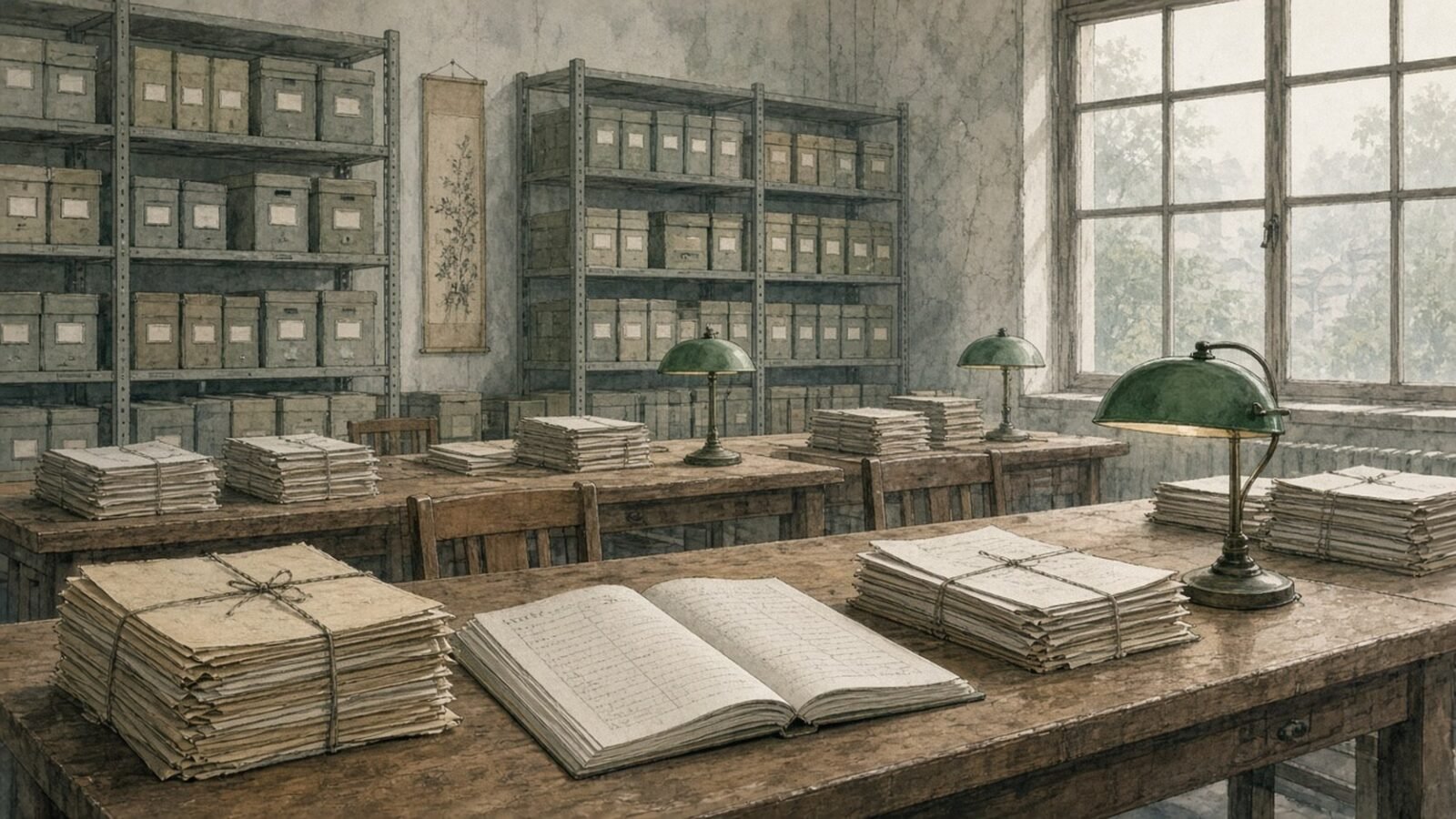
The illustration that accompanies this post tries to capture that approach. It is not a portrait of Mao or a propaganda poster. It is an archive room where documents have spilled off shelves, where secret reports labeled top secret and people’s commune investigation from 1960 lie open on a table, where faint figures of farmers with carrying poles and workers in blue uniforms and students with red armbands emerge from the paper itself, walking toward a distant Gate of Heavenly Peace. The archive is both setting and character. In Dikötter’s work the archive is where ideology becomes paper, and paper becomes hunger, and hunger becomes memory. If you open one of his books you are, in effect, entering that room.