For more than two thousand years, the city that the world once knew as Canton has stood at one of the great meeting points between China and the sea. Today it is Guangzhou, a vast modern metropolis of towers, expressways, factories, financial districts, universities and crowded commercial streets, yet beneath the glass skyline lies a much older city whose identity was created by merchants. Long before Shanghai became synonymous with international commerce and long before Hong Kong appeared on European maps as a major port, Guangzhou was already connecting southern China with Southeast Asia, India, the Middle East and eventually Europe and the Americas. Ships arriving through the Pearl River carried silver, spices, cotton, medicines and unfamiliar travellers. Ships departing from the city carried silk, porcelain, tea, lacquerware and manufactured goods that would transform tastes thousands of miles away. At different moments Guangzhou has been an imperial administrative centre, an international port, the heart of the famous Canton System, a battlefield in the conflict between China and the Western powers, a centre of revolutionary politics, an industrial city and one of the commercial engines of modern China. Its appearance has changed almost beyond recognition, but commerce has remained one of the strongest threads running through its history. The story of Guangzhou is therefore more than the history of one Chinese city. It is also the story of how China encountered the wider commercial world and how generations of Cantonese merchants learned to prosper at the point where different languages, currencies, customs and political systems collided.
Before Canton
The origins of Guangzhou stretch deep into the ancient history of southern China. The region around the Pearl River Delta was inhabited long before the establishment of an imperial Chinese city, but a decisive moment came in 214 BC when the Qin empire extended its authority into Lingnan and established administrative control in the region. Panyu, located in the area of present day Guangzhou, became an important centre, and after the collapse of the Qin dynasty the general Zhao Tuo established the kingdom of Nanyue and made Panyu his capital. Archaeological discoveries associated with the Nanyue kingdom reveal a society already connected with networks extending beyond southern China. Geography made such connections almost inevitable. Guangzhou sits near the meeting point of river systems flowing through a fertile and economically productive hinterland, while the Pearl River provides access to the South China Sea. Goods from inland southern China could be assembled near the city, transferred onto ships and carried through coastal and maritime trading networks. Over the centuries the settlement developed not merely because rulers chose to govern from there, but because merchants repeatedly discovered that it was an exceptionally useful place in which to exchange goods. The name Guangzhou emerged as an administrative designation during the third century, and over time it became attached to the city itself. European visitors would later use the name Canton, derived through European forms associated with the Chinese name Guangdong, and for several centuries Canton became the internationally familiar name for the city. Guangzhou remained the Chinese name, however, and the modern return to Guangzhou in English usage represents less a renaming of the city than a change in how outsiders describe it.
By the Tang dynasty Guangzhou had developed into one of the great maritime ports of Asia. Chinese ships sailed southwards into Southeast Asia and across the Indian Ocean trading system, while merchants from foreign lands arrived in southern China seeking the products for which Chinese workshops had become famous. Persian and Arab merchants were among the foreign communities associated with the city, joining traders from different parts of Asia in a remarkably cosmopolitan commercial environment. Maritime commerce brought wealth but also languages, religions, technologies and new forms of cultural contact. The existence of foreign communities did not mean that Guangzhou was culturally detached from China. On the contrary, it became important precisely because it served as a gateway through which the Chinese state could manage international commerce while local merchants translated the demands of distant markets into opportunities for Chinese producers. During the Song dynasty imperial authorities developed increasingly sophisticated institutions for regulating overseas trade, collecting customs revenue and supervising foreign merchants. Guangzhou was among the most important centres of this maritime system. Tea, ceramics, textiles and other goods flowed towards the coast, while aromatics, spices, precious materials and foreign commodities travelled inland. Government records, commercial communities and archaeological discoveries all point toward an important reality: international Canton did not suddenly appear when Europeans arrived in large numbers during the seventeenth and eighteenth centuries. It had already been participating in global commerce for many centuries. The later European merchant community entered an established Asian trading world rather than creating one from nothing. Guangzhou government histories describe the city as an important Chinese foreign trade port for more than two millennia and identify it as a major starting point for maritime routes connecting China with Southeast Asia, South Asia and regions farther west.
The Arrival of the European Trading Companies
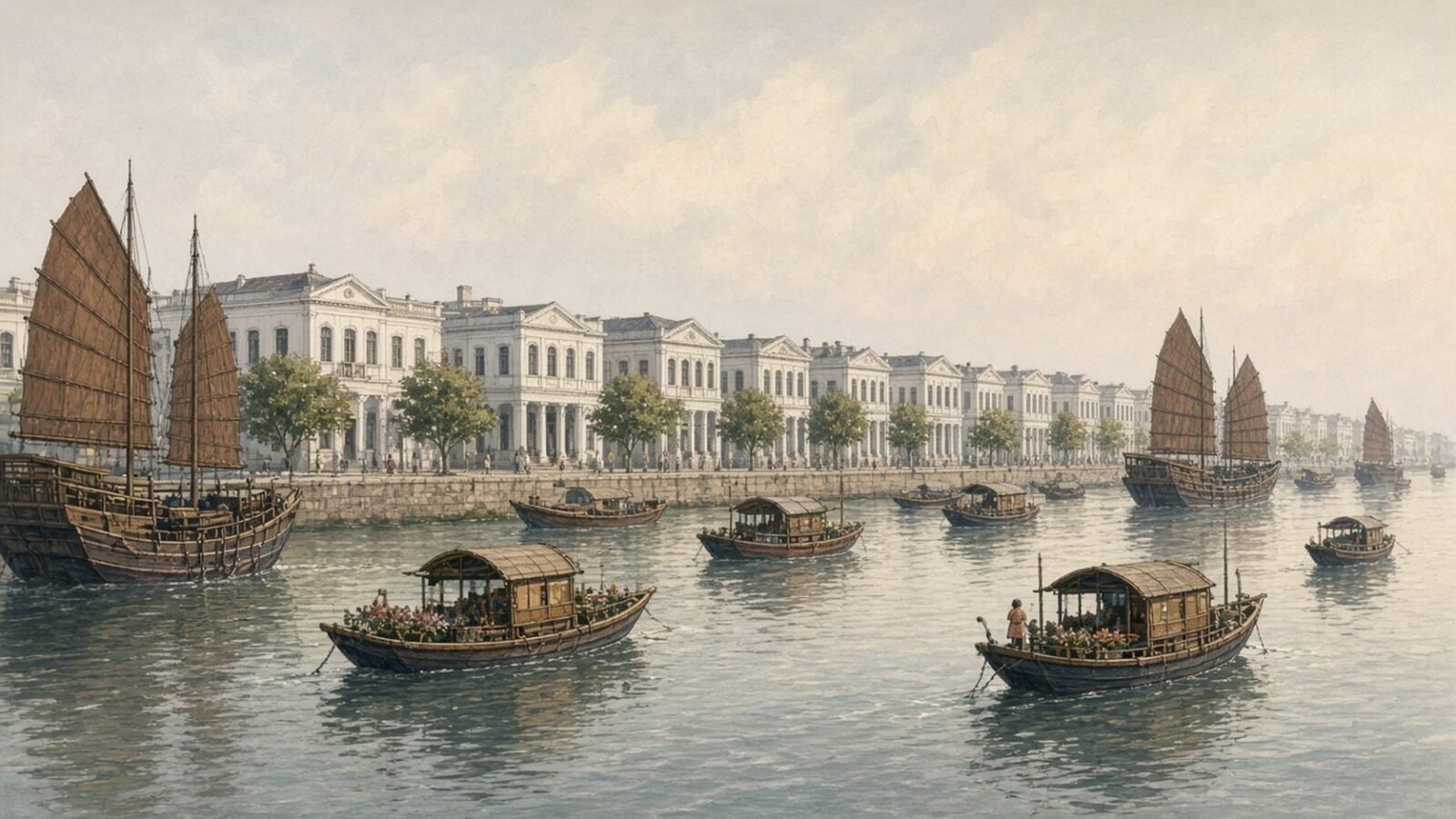
The expansion of European maritime empires brought a new group of merchants into southern Chinese waters. Portuguese traders reached the coast during the sixteenth century and eventually established themselves at Macau, which became a crucial commercial intermediary between China and international maritime networks. Other European powers followed. Dutch, English, French, Danish and Swedish merchants sought access to Chinese products, particularly silk, porcelain and eventually tea. Their ambitions were considerable, but they entered a commercial system controlled by Chinese authorities and dependent upon Chinese merchants. Canton gradually became the principal location for this interaction. European companies rented warehouses and residential buildings along the waterfront. These were known in English as factories, though they were not manufacturing plants in the modern sense. They were trading establishments containing offices, storerooms, accommodation and commercial facilities. The merchants who lived there were known as factors. Paintings and decorated porcelain from the eighteenth century preserve remarkable images of this world, showing a line of European style trading houses facing the Pearl River, with national flags rising above the buildings and a constant movement of Chinese boats in front of them. British Museum objects depicting the Canton waterfront show establishments associated with Britain, Holland, Sweden, France, Denmark and other trading nations, while records note that the British East India Company had established a Canton office by the early eighteenth century.
Behind this picturesque waterfront stood an extraordinarily complicated system of commerce. Foreign merchants were not generally free to travel through China and purchase whatever they wished directly from producers. Their access to the Chinese market depended heavily upon licensed Chinese merchants who acted as intermediaries. These men were known in Western accounts as hong merchants, from a Cantonese commercial term associated with firms or trading establishments. The hong merchants were responsible not merely for buying and selling goods but for guaranteeing foreign commercial behaviour, paying duties, negotiating with officials, arranging supplies and resolving disputes. They stood between two worlds whose legal and political assumptions were often profoundly different. A European merchant might imagine himself engaged in private trade with a Chinese businessman, while Qing officials could view the transaction as part of a regulated system in which foreigners were permitted to trade under carefully defined conditions. The hong merchant had to understand both sides and survive between them. He might make an enormous fortune when business flourished, yet he could also be held financially responsible when foreign partners failed or when imperial authorities imposed extraordinary demands. Success required capital, personal networks, political intelligence, diplomatic patience and a remarkable tolerance for risk.
The Canton System
The system reached its most famous form during the eighteenth century. In 1757 the Qing government concentrated legal maritime trade with European merchants at Canton, creating the arrangement conventionally known as the Canton System. For the foreign trading communities of Europe and later the United States, Guangzhou became the principal legal gateway into the Chinese market. Foreigners were subjected to numerous restrictions. Their commercial activities were concentrated around the factories beside the Pearl River, and they dealt with Chinese trade principally through the authorized hong merchants. Their movements and residence were regulated, and their relationship with government officials was generally mediated rather than conducted on the equal diplomatic terms that European governments increasingly demanded. Yet the restrictive nature of the system should not obscure its commercial success. Canton became one of the busiest and richest trading centres in the world. Vast quantities of tea passed through its warehouses. Porcelain, silk, furniture, lacquer, paintings, fans and countless decorative objects were ordered for overseas customers. Chinese artisans became extraordinarily skilled at adapting products to foreign tastes. A European family could send a coat of arms to Canton and receive a porcelain dinner service decorated with it. Merchants could commission paintings of ships, ports and families. Workshops produced objects combining Chinese craftsmanship with European designs, creating a material culture that belonged completely to neither world and yet circulated through both.
Tea was especially important. By the eighteenth century tea drinking had become embedded in British social life and demand rose dramatically. Every chest of tea shipped through Canton connected an extraordinary chain of people. Farmers cultivated and harvested the leaves, regional merchants transported them, specialists graded and packed them, Chinese wholesalers negotiated their sale, foreign companies arranged shipping, insurers protected cargoes, sailors carried them across oceans and retailers eventually sold them in London, Edinburgh, Boston or Amsterdam. Guangzhou stood near the centre of this enormous commercial machine. Silk and porcelain followed similar paths. The wealth generated by the trade was visible not only in the foreign factories but throughout the Chinese merchant community. Cantonese commercial families invested in houses, gardens, land, education, charitable institutions and further trade. Smaller traders, shopkeepers, porters, boat operators, craftsmen and food sellers all depended in different ways upon the seasonal rhythms of international commerce. The waterfront that fascinated visiting Europeans was therefore only the narrowest visible portion of an economy extending deep into Guangdong and farther into the Chinese interior.
No figure illustrates the wealth and influence of the Canton merchant world more dramatically than Wu Bingjian, generally remembered in Western accounts as Howqua or Houqua. Born in 1769, he became the leader of the Cohong and one of the richest merchants of his age. His wealth astonished foreign visitors. Estimates made during his lifetime placed his fortune in the tens of millions of dollars, an extraordinary sum in the early nineteenth century. Yet his significance was greater than his fortune. Howqua became a central figure in international commercial relationships linking Chinese merchants with British and American houses. Foreign businessmen relied upon his credit and judgment, and his commercial reputation extended far beyond Guangzhou. He invested in overseas enterprises and maintained extensive financial relationships with American merchants. His career demonstrates why the hong merchants should not simply be viewed as passive instruments of Qing regulation. They were sophisticated businessmen operating across cultural and financial boundaries. The British Museum describes Howqua as leader of the Canton Cohong and records his reputation as one of the wealthiest merchants in the world. Another important hong merchant, Lu Guangheng, known as Mouqua, similarly participated at the highest levels of the Canton trade and was remembered as an English speaking Chinese businessman who dealt directly with foreign merchants.
Foreign merchants also created powerful commercial dynasties from their Canton experience. The British East India Company dominated British trade for much of the eighteenth and early nineteenth centuries. American merchants entered the Canton trade after independence, with the ship Empress of China reaching the port in 1784 and helping inaugurate a direct commercial relationship between the United States and China. Firms such as Russell and Company became major participants in the American China trade. British private merchants became increasingly important as the monopoly of the East India Company weakened. William Jardine and James Matheson built careers in the China trade and established Jardine Matheson in Canton in 1832, creating a company whose later history would become closely associated with Hong Kong and the wider Asian economy. Dent and Company became another powerful British merchant house. Indian merchants also played major roles, including Parsi trading families whose networks connected Bombay, Canton and other ports across the Indian Ocean. Armenian merchants, Southeast Asian traders and Chinese communities overseas formed additional strands in this complicated commercial web. Canton at its height was therefore not simply a meeting between China and Britain. It was a marketplace in which Chinese, European, American, Indian and other Asian networks overlapped. The British Museum notes the extraordinary geographical range of Guangzhou commerce, including connections with Europe, the Americas, South Asia, Japan, Russia and Chinese communities in Southeast Asia.
Tea, Silver and Opium
The prosperity of the Canton trade eventually produced a dangerous imbalance. European consumers wanted enormous quantities of Chinese tea, silk and porcelain, but Chinese demand for British manufactured goods remained comparatively limited. For many years foreign merchants made up the difference with silver. Large quantities of precious metal therefore flowed towards China. British traders increasingly sought another commodity that could reverse this flow, and opium grown in India became the answer. Although the Qing government prohibited the drug, private merchants and smuggling networks expanded the traffic dramatically during the early nineteenth century. The East India Company did not generally carry illegal opium directly into Canton itself, but the economic structure of British rule in India and the Company system supported production and auction of the drug, which private merchants then carried toward China. The trade linked India, the Chinese coast, British finance and the Canton commercial community in a system that was profitable for merchants and deeply damaging to Chinese society and state finances. Silver began flowing out of China, addiction became a major concern and Qing officials increasingly regarded the situation as intolerable.
In 1839 the Daoguang Emperor sent the official Lin Zexu to Canton with orders to suppress the opium trade. Lin forced foreign merchants to surrender huge quantities of opium, which were destroyed at Humen near the mouth of the Pearl River. The crisis became one of the central causes of the First Opium War between Britain and Qing China. British military superiority at sea exposed severe weaknesses in Qing coastal defence, and the conflict ended with the Treaty of Nanjing in 1842. The consequences for Canton were profound. The treaty opened additional Chinese ports to British trade and ceded Hong Kong Island to Britain. Canton therefore lost the privileged position it had held as the principal legal centre of European maritime commerce with China. Shanghai would rise with extraordinary speed, Hong Kong developed into a major colonial port and foreign merchant houses increasingly moved parts of their operations away from Guangzhou. The Canton System that had dominated an era of global trade was effectively finished.
From Foreign Factories to Shamian
The ending of the Canton System did not end Cantonese commerce. Guangzhou remained an enormous regional market with deep connections to the Pearl River Delta, but its relationship with foreigners changed. Tensions continued after the First Opium War and contributed to the Second Opium War during the 1850s. The old foreign factory district was destroyed during the conflict, ending one of the most distinctive architectural landscapes of eighteenth century global commerce. In the aftermath, foreign communities became associated with Shamian, a small island area developed under British and French concession arrangements. European style banks, churches, trading houses, consulates and residences gave Shamian an appearance very different from the crowded Cantonese districts nearby. Parts of this architectural landscape survive today, making Shamian one of the places where modern visitors can most easily imagine the strange mixture of commerce, empire and cultural encounter that characterized nineteenth century Guangzhou. The destruction of the old factories also symbolized a larger change. Foreign trade was no longer concentrated in a small enclave controlled through the old hong merchant system. Western firms possessed much greater freedom under the treaty port arrangements imposed upon Qing China, while steamships, banks, telegraph systems and modern insurance were transforming the mechanics of Asian commerce. The Canton merchant world had to adapt once again.
Chinese merchants proved remarkably capable of doing so. Guangzhou remained famous for its commercial culture, its craft industries and the entrepreneurial energy of its inhabitants. Merchant wealth helped shape districts such as Xiguan, where prosperous Cantonese families built distinctive residences and participated in networks extending through Hong Kong, Southeast Asia and the overseas Chinese world. Emigration created another dimension of Guangzhou commerce. Guangdong became one of the principal regions from which Chinese migrants travelled overseas during the nineteenth and early twentieth centuries. Communities with Cantonese origins developed throughout Southeast Asia, Australia and North America. Their remittances, investments and family connections created new forms of international exchange. A merchant in Guangzhou might have relatives in Hong Kong, Singapore, San Francisco or Vancouver. Goods, letters, money and information moved through these networks. The global history of Canton was therefore no longer concentrated only in foreign merchants arriving in China. Cantonese people themselves increasingly carried the commercial culture of southern China abroad.
Revolution and the Birth of the Modern City
By the beginning of the twentieth century Guangzhou had become much more than a trading port. It was also one of the great laboratories of political change in China. Guangdong had strong connections with overseas Chinese communities, many of whom supported reform and revolutionary movements. Sun Yat Sen, whose political career was deeply connected with Guangdong, found financial and political support among overseas Chinese networks. Guangzhou became associated with uprisings, political organization and competing visions of the Chinese future. The collapse of the Qing dynasty in 1911 opened a turbulent period in which Guangzhou repeatedly served as an important political centre. At the same time the physical city was being transformed. Traditional walls and gates increasingly gave way to roads, modern commercial streets and new municipal infrastructure. Arcaded streets provided sheltered shopping areas suited to Guangzhou’s hot and rainy climate. Western architectural influences appeared alongside Cantonese building traditions. Electricity, telephones, modern schools, hospitals, newspapers and new forms of transportation altered everyday urban life.
In 1921 Guangzhou formally established a municipal government, a development that local historical accounts identify as a pioneering moment in the emergence of the modern Chinese city administration. Municipal authorities pursued road building, sanitation, public works and urban planning. The ambition was not simply to preserve an old provincial capital but to construct a city capable of functioning within the modern industrial and commercial world. Plans associated with the era of Sun Yat Sen imagined Guangzhou as a great southern port and modern metropolis. The city also continued developing new industry. Shipbuilding, machinery, textiles, food processing and other enterprises expanded the economic base beyond traditional merchant commerce. Guangzhou was becoming a modern industrial city while remaining deeply connected with the trading traditions that had made Canton famous.
War interrupted this transformation. Japanese forces occupied Guangzhou in October 1938, beginning a period of occupation that lasted until 1945. Commerce suffered, populations were displaced and the city became part of the wider devastation of the Second World War in China. After the Japanese surrender political conflict returned as the Chinese Civil War entered its final phase. Communist forces entered Guangzhou in October 1949, incorporating the city into the newly established People’s Republic of China. The political and economic system changed dramatically, but Guangzhou’s geography could not be changed. It remained the great southern gateway facing Hong Kong, Macau and the international maritime world. That geographical position would eventually restore the city to a central place in China’s foreign commerce.
The Canton Fair and a New Merchant Age
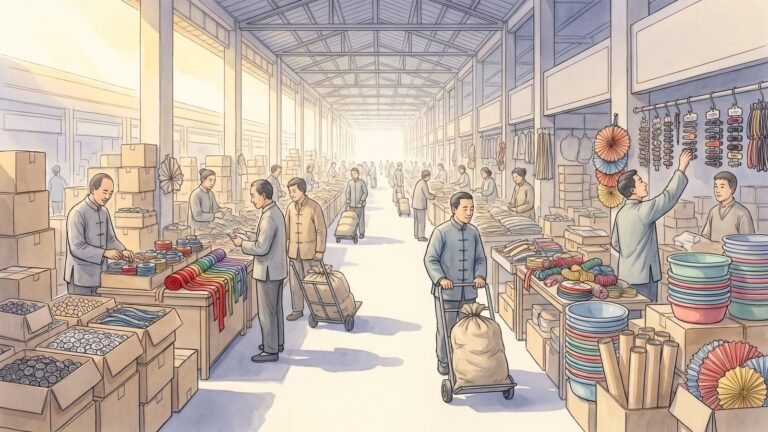
One of the clearest symbols of Guangzhou’s continuing commercial importance appeared in 1957 with the creation of the China Export Commodities Fair, later known in English as the Canton Fair and now formally called the China Import and Export Fair. At a time when the People’s Republic had comparatively limited commercial connections with much of the Western world, the fair provided a crucial place where Chinese producers and foreign buyers could meet. The first fair opened in Guangzhou on 25 April 1957. Over subsequent decades it became one of China’s most important international commercial events and was held regularly in the spring and autumn. The choice of Guangzhou was no historical accident. Here was a city with centuries of experience in receiving foreign merchants, organizing commercial exchange and translating the enormous productive capacity of the Chinese interior into goods demanded by overseas markets. In a radically different political and economic system, Guangzhou was performing a role that would have been recognizable to the hong merchants of the eighteenth century. Foreign buyers arrived, examined Chinese goods, negotiated prices and arranged shipments to distant markets. The surroundings had changed, but the commercial instinct of the city had survived. The Canton Fair, established in 1957, remains a major international trade event and continues to bring huge numbers of Chinese enterprises and overseas buyers to Guangzhou.
The transformation accelerated after China began its programme of reform and opening in 1978. Guangdong stood near the front of the changes because of its proximity to Hong Kong and Macau, its overseas Chinese networks and its established commercial culture. Factories spread through the Pearl River Delta. Investment flowed in from Hong Kong and elsewhere. Small workshops became manufacturers, manufacturers became exporters and entire towns specialized in particular products. Guangzhou served as a commercial, financial, transportation and administrative centre for this astonishing industrial region. Traders who once moved tea, silk and porcelain through Canton now had modern counterparts dealing in garments, electronics, machinery, furniture, appliances, automobile components and eventually advanced technologies. Containers replaced tea chests, aircraft replaced sailing ships and electronic payments replaced bags of silver, yet the underlying logic remained strikingly familiar. Guangzhou prospered because it connected producers with buyers and China with the world. Official accounts of the city’s reform era emphasize the importance of Hong Kong and Macau investment, experiments in market reform and Guangzhou’s continuing role as a centre of external trade.
The Rise of Modern Guangzhou
The physical transformation of Guangzhou during the late twentieth and early twenty first centuries was extraordinary. The traditional commercial centre around Yuexiu and Liwan remained important, but the city expanded far beyond its historic core. Tianhe developed into a vast modern district of offices, shopping centres and residential towers. In 1992 municipal authorities decided to develop Zhujiang New Town as a new urban centre, and the district eventually became one of the most recognizable skylines in China. Office towers, financial institutions, luxury hotels, cultural buildings and apartments rose beside the Pearl River. Across the water the Canton Tower became a visual symbol of twenty first century Guangzhou. The development of the Pazhou exhibition district gave the Canton Fair an immense modern home, while expanding metro lines connected historic neighbourhoods with newly urbanized districts. Guangzhou became simultaneously an old city and a new city, one in which arcaded shopping streets, ancestral halls, colonial era buildings and traditional markets could exist within a short journey of some of the most futuristic architecture in China.
Modern Guangzhou is now part of an urban and industrial landscape extending across the Pearl River Delta and increasingly described through the framework of the Guangdong Hong Kong Macau Greater Bay Area. The city’s economy encompasses manufacturing, automobile production, finance, technology, logistics, professional services, retail and international trade. Its administrative territory contains eleven districts, and by the end of 2024 its population was reported at almost nineteen million people. Yet statistics alone fail to capture the continuity between Canton and Guangzhou. The old merchant city survives in habits of commerce, in Cantonese language and cuisine, in streets crowded with wholesalers, in family businesses, in the Canton Fair, in the port, and in the instinctive outward orientation of a city that has spent centuries receiving visitors from distant places.
What makes Guangzhou especially fascinating is that modernization has not completely erased the different historical cities beneath it. Walk through Liwan and traces of the wealthy merchant culture of old Xiguan remain visible. Visit Shamian and the architecture recalls the age of treaty ports and foreign concessions. Around Yuexiu lie reminders of the ancient political centre and the revolutionary city of the early twentieth century. The Pearl River continues to provide the geographical line connecting these worlds. Ships once anchored before the foreign factories carrying silver and tea. Steamers later served the treaty port. Industrial vessels carried the products of modern factories. Today container ships move through an immense regional logistics system while illuminated towers rise along the riverbanks. Each period has rebuilt the commercial landscape of the city, but none has entirely removed what came before.
The transition from Canton to Guangzhou is therefore not a simple story in which an old trading port disappeared and a modern metropolis replaced it. It is a story of continuous reinvention. Ancient Panyu became an imperial southern centre. Imperial Guangzhou became a maritime gateway. That gateway became Canton, the place through which generations of Europeans imagined China and through which Chinese merchants encountered an expanding global economy. The Canton System created fortunes and frustrations in equal measure. Hong merchants such as Howqua became figures of international importance, while British, American, Indian and other merchants built businesses whose influence extended across oceans. Tea and silver linked the city with distant consumers, while opium and imperial conflict brought violence and profound political change. The treaty port era destroyed the old commercial order but produced new forms of business. Revolution and war remade the political city. Industrialization changed its landscape. The Canton Fair reopened a commercial window to the world, and reform transformed Guangzhou into the centre of one of the greatest manufacturing regions on earth.
Perhaps this continuity explains why the old word Canton has never completely vanished. It survives in Cantonese, Canton porcelain, Canton embroidery, Canton cuisine and above all the Canton Fair. The word evokes merchant ships, waterfront warehouses, tea chests, porcelain workshops and crowded river scenes, while Guangzhou evokes metro trains, airports, container terminals, financial towers and a metropolis of almost nineteen million people. Both names describe the same place at different moments in its extraordinary history. The distance between them seems immense, yet the city has always possessed the same fundamental advantage: it stands where the rivers of southern China meet the maritime world. For more than two thousand years people have arrived there to buy, sell, negotiate, translate, speculate and seek fortunes. Empires have fallen, trading systems have disappeared and skylines have been rebuilt, but Guangzhou remains what Canton was at its greatest moments, one of China’s great doors to the world.