Wuhan is not one city. It is the awkward but durable union of three: Wuchang on the southern bank of the Yangtze, Hankou on the northern bank, and Hanyang at the western tip of the junction where the Han River) runs into the Yangtze. Until 1927 they were practically three cities with three economies and three foreign concession areas; until 1949 they were three cities with three mayors and three railway stations. The 1927 Wuchang Uprising made the name Wuhan a national slogan; the 1949 Communist takeover made it a single municipality. Today the conurbation has about thirteen million people and is the largest city in central China.
Key findings
- Wuhan is the union of three towns: Wuchang (political, educational), Hankou (commercial, treaty port), and Hanyang (industrial).
- The 1927 Wuchang Uprising made the name Wuhan politically meaningful, and the brief Wuhan national government of 1927 was the left wing of the Kuomintang (KMT) before Chiang Kai-shek‘s Shanghai coup ended it.
- The 1949 unification created the modern municipality and bound the three towns under the Communist Party.
- Wuhan today is a single administrative unit of thirteen million people, the transport hub of central China, and the site of the 2020 COVID-19 pandemic that briefly shut the global economy.
The geography that made three towns
The three towns of Wuhan exist because of a single piece of geography: the point where the Han River) empties into the Yangtze. The junction created a triangle of alluvial land — high enough to build on, watered by both rivers, and ringed by hills that gave defensive positions. The two rivers also created a natural transport network: junks could move up the Han from Xiangyang and Hanzhong to the junction, then either up the Yangtze toward Sichuan or down toward Shanghai. The spot was, in short, the natural inland port of central China, and from at least the Shang dynasty it had a settlement.
By the Han dynasty there were already two towns at the junction: Wuchang on the south bank of the Yangtze and Hanyang on the north bank at the foot of the Han. The third town, Hankou, grew out of a fishing village on the north bank of the Yangtze just east of the Han junction during the Song dynasty, and became the dominant commercial centre by the Ming dynasty. By the early nineteenth century the three had distinct identities — Wuchang as the provincial capital and gentry seat, Hankou as the merchant and treaty port, and Hanyang as the workshop town.
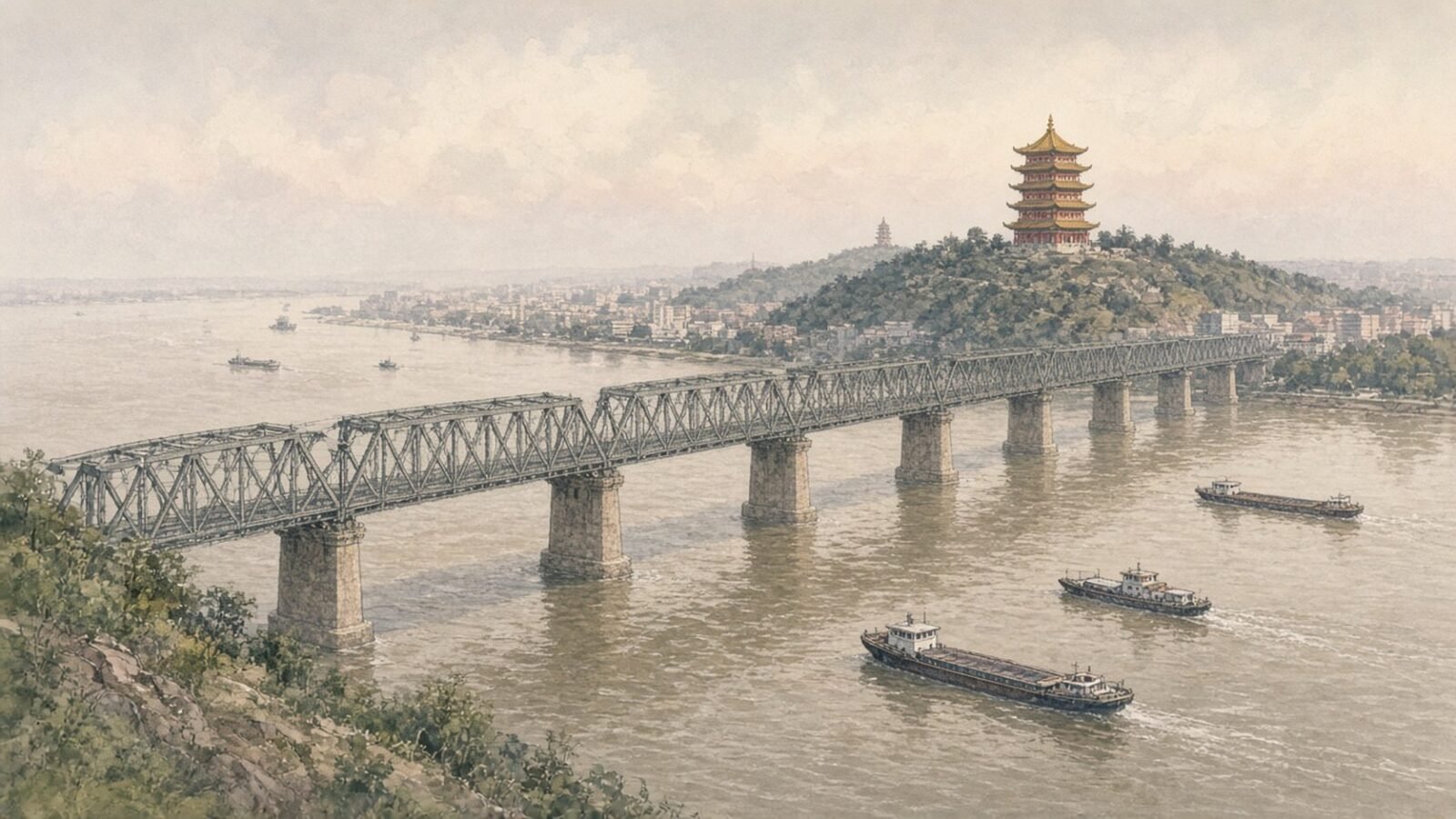
The three towns were physically separate for most of their history. They had separate walls, separate customs barriers, separate currencies, and (in the treaty port era) separate foreign concessions. The Yangtze and Han) were both navigable but slow and dangerous; people crossed by ferry or sampan. The first bridge across the Yangtze at Wuhan, the First Yangtze Bridge, did not open until 1957, after the Communist takeover.
Wuchang: the political and educational town
Wuchang was the seat of the Huguang provincial governor from the Yuan dynasty onward, and the political centre of the three towns. The provincial yamen, the examination hall, the Confucian temple, and the military garrison were all in Wuchang, and the city’s elite was the gentry class that ran the Huguang bureaucracy.
The town’s educational role began in 1893 with the founding of Hubei Self-Strengthening School (later Wuhan University), the precursor to one of China‘s most respected universities. In the next two decades, Wuchang acquired a cluster of modern schools — a normal school for teachers, a military academy, a technical school, and several foreign-language schools — that made it a centre of late-Qing reform. The military academy, the Hubei Military Academy, was run by Zhang Zhidong and trained many of the officers who would later lead the 1911 revolution.
The town’s economic base was the bureaucracy: government offices, examination halls, and the households of officials. There was little industry and only modest commerce. The town’s identity was conservative, gentry, and Confucian, with a strong sense that Wuchang was the legitimate capital of the province.
Hankou: the commercial town
Hankou grew on the opposite bank. The Yangtze’s north bank at Hankou was wide, flat, and ideal for a port, and the town’s economy was built on shipping, brokerage, and trade. By the late eighteenth century Hankou was one of the four great commercial cities of the Qing empire — the others being Beijing, Suzhou, and Guangzhou — and its customs revenue was the third largest in the country.
The opening of Hankou as a treaty port in 1861 transformed the town. The British, French, German, Russian, and Japanese concessions were carved out along the riverfront, each with its own wharves, warehouses, banks, and consulates. The Russian concession, opened in 1896, was the largest and contained the tea trade houses that moved Hubei brick tea to Russia and Central Asia. The British concession housed the Hongkong and Shanghai Banking Corporation branch, the Jardine Matheson offices, and the Standard Oil depot. The German concession built breweries and engineering shops. The Japanese concession, established later, became a centre of the opium and arms trade.
The treaty port economy was both immense and artificial. Most of the trade was in the hands of foreign firms — tea, silk, vegetable tallow, and tung oil out; opium, textiles, machinery, and kerosene in — and most of the profits left China. But the port also created a Chinese merchant class that accumulated capital, learned Western business practice, and would later fund the modern Chinese banking system. The Hankou bank run of 1911, when a Revolutionary attack on the city panicked foreign depositors, was one of the first modern banking crises in China.
Hanyang: the industrial town
Hanyang sat at the tip of the Han-Yangtze junction and was the smallest of the three towns until the late nineteenth century. Its industrial base began in 1890 with the Hanyang Iron and Steel Works, founded by Zhang Zhidong as part of the Self-Strengthening Movement.
The ironworks was the largest industrial enterprise in late-Qing China. It employed about 3,000 workers at its peak and produced rails, girders, and plates for the first Chinese railways. The plant’s location was a strategic mistake: the iron ore came from the Daye mines downstream, but the coking coal had to come from Pingxiang in Jiangxi, a thousand kilometres away, and the cost of moving the coal by junk and rail made the iron uncompetitive with British imports. The plant struggled financially and was eventually leased to a Japanese consortium in 1898, then sold outright in 1908.
Despite its commercial failure, the ironworks had lasting effects. It trained a generation of Chinese industrial workers, established the pattern of state-led heavy industry that the Communists would later imitate, and gave Hanyang an industrial base that survived the Qing collapse. The re-established Hanyang steelworks remains a substantial Wuhan employer today.
The 1927 Wuchang Uprising and the Wuhan national government
The 1927 Wuchang Uprising — actually the second, after the 1911 Xinhai Revolution — was the moment the three towns became one in name. The Kuomintang‘s left wing, in alliance with the Communist Party, had moved its capital from Guangzhou to Wuhan in late 1926 after the Northern Expedition reached the Yangtze. The Wuhan national government, led by Wang Jingwei, declared itself the legitimate KMT government in January 1927.
The Wuhan national government lasted only four months. Chiang Kai-shek‘s Shanghai massacre of 12 April 1927, in which KMT right-wing forces and the Green Gang killed thousands of suspected communists and labour organisers in Shanghai, split the KMT decisively. The Wuhan government’s response was slow, and by the time it condemned the massacre, Chiang had established a rival government in Nanjing. The Wuhan government’s leftist coalition collapsed when its communist partners were purged by Wang Jingwei in July 1927, and the rump Wuhan government merged with the Nanjing government in August.
The episode gave Wuhan a symbolic importance in Chinese political memory that outlasted the government itself. The name Wuhan — a portmanteau of Wu from Wuchang and Han from Hankou — was used as a slogan during the 1927 period and entered the national vocabulary as the city of revolutionary possibility. The same slogan was revived by the Communists in 1949 when they took the city.
The 1949 unification
When the People’s Liberation Army reached Wuhan in May 1949, the three towns were still separate administrative units. The Communists merged them into a single municipality almost immediately, and the Wuhan Municipal People’s Government was established in June. The unification was partly administrative efficiency and partly political symbolism — the new China needed the visual proof that the three towns had become one.
The unified Wuhan was reorganised under Soviet planning principles. The old foreign concessions were cleared and their buildings reused. The Hankou racecourse became a public park; the Russian concession became the site of the new municipal government; the German concession’s brewery became the Wuhan brewery. The Hanyang ironworks was nationalised and merged with the Daye mines to form the Wuhan Iron and Steel complex, which became one of the largest steel producers in China and a Soviet-aided showcase project in the 1950s.
The 1957 opening of the First Yangtze Bridge, the first railway-and-road bridge across the Yangtze south of Nanjing, physically joined Wuchang and Hankou for the first time. The bridge was a joint Soviet-Chinese project and was heavily promoted as a symbol of socialist engineering. A second bridge, the Second Yangtze Bridge at Hanyang, opened in 1995; seven more bridges have opened since, plus a cross-river rail tunnel and a cross-river metro tunnel.
Modern Wuhan
Modern Wuhan has about thirteen million people in the built-up area, making it the largest city in central China and one of the nine national中心城市 designated by the central government. Its economy is built on steel, automobiles, optoelectronics, and a substantial service sector.
The automobile industry is centred on Dongfeng Motor Corporation, founded in Wuhan in 1969 as the Second Automobile Works and headquartered there today. Dongfeng is the third-largest automotive company in China by sales and operates dozens of joint ventures with Honda, Nissan, Renault, PSA, and Volkswagen. The Wuhan Economic and Technological Development Zone, south of Hanyang, is the industrial core and contains Dongfeng‘s main assembly complex.
The optoelectronics industry has been built on the Wuhan National Laboratory for Optoelectronics, founded in 2003 and associated with Huazhong University of Science and Technology. The lab has spun off a cluster of fibre-optic and laser companies, including Yangtze Optical Fibre (the world’s largest optical-fibre producer by volume) and Wuhan Raycus (the largest Chinese maker of industrial fibre lasers). The cluster has made Wuhan one of the world’s leading centres of photonics manufacturing.
The 2020 COVID-19 pandemic began in Wuhan. The first cluster of cases was identified at the Huanan Seafood Wholesale Market in December 2019, and the WHO declared a Public Health Emergency of International Concern on 30 January 2020. Wuhan was locked down on 23 January 2020 — the largest quarantine in human history — and the lockdown lasted 76 days. The pandemic and the lockdown briefly made the Wuhan name globally infamous, and the city’s subsequent reopening was widely cited as evidence that strict containment could work.
The Yangtze bridges and the railway hub
The bridges across the Yangtze at Wuhan are now a tourist attraction in their own right. The First Yangtze Bridge, a Soviet-designed truss bridge with Chinese-made steel, is the most famous; the second, a cable-stayed bridge at Hanyang, opened in 1995; the third, the Baishazhou Yangtze Bridge, is the first suspension bridge across the Yangtze; and the eighth, the Yingwuzhou Yangtze Bridge, opened in 2017 with a 2,000-metre main span.
The bridges have made Wuhan a transport hub of unusual density. The city sits at the junction of the Jingguang (Beijing-Guangzhou) conventional railway, the Wuhan-Guangzhou high-speed railway, and the Shanghai-Wuhan-Chengdu high-speed corridor, and Wuhan railway station is one of the busiest in China. The Wuhan Metro opened in 2004 and now has eleven lines carrying about four million passengers daily.
The city is also the river port that it has always been. The Yangtze is navigable for oceangoing vessels upstream to Yichang and beyond, and the Wuhan port handles about 100 million tonnes of cargo annually, mostly coal, iron ore, and containers. The unification of the three towns, and the bridges that make them one, are the practical reasons the city remains the natural inland port of central China.
Wuhan and the Yangtze River Economic Belt
The unification of the three towns gave Wuhan the administrative coherence to lead the Yangtze River Economic Belt, the central government’s 2016 plan to integrate the Yangtze corridor from Shanghai to Chongqing into a single economic region. The plan covers nine provinces and two municipality-level cities (Shanghai and Chongqing), and Wuhan is the largest inland city in the corridor. The plan calls for the construction of high-speed rail, motorway, and inland waterway infrastructure linking the corridor’s cities, and Wuhan is at the centre of the network.
The Wuhan metropolitan area has been a major beneficiary of the plan. The 2017–2025 Wuhan municipal development plan calls for the construction of an additional six cross-river links (four bridges, two tunnels), the extension of the Wuhan Metro from eleven to sixteen lines, and the creation of three new urban centres on the eastern, southern, and northern edges of the conurbation. The China Optics Valley in Hongshan District, south of Wuchang, is one of these centres and is the largest optoelectronics cluster in China.
Wuhan after the COVID-19 pandemic
The 2020 COVID-19 pandemic and the 76-day Wuhan lockdown left a deep mark on the city. The lockdown ended on 8 April 2020, and the city reopened gradually over the following months. The economic recovery was faster than expected: by the end of 2020 Wuhan‘s GDP had returned to pre-pandemic levels, and by 2022 it had surpassed them. The pandemic has also reshaped the city’s economy in lasting ways. The biotech sector — already substantial before 2020 — has grown rapidly, with new investments in vaccine development, diagnostics, and pharmaceutical manufacturing. The Wuhan Institute of Virology has been at the centre of international scientific cooperation on the virus, and the city has been the site of several major international conferences on pandemic preparedness.
The pandemic also reshaped the city’s international reputation. Before 2020, Wuhan was known in the West primarily as a transport hub and the site of the 1927 Wuchang Uprising. After 2020, it became a touchstone for the global debate on pandemic preparedness, public health, and the WHO‘s role in coordinating the international response. The city has embraced the new identity in some ways — the Wuhan Anti-Epidemic Museum opened in 2023 and is one of the largest pandemic museums in the world — and resisted it in others. The Huanan Seafood Wholesale Market site was demolished in 2020, partly for hygiene reasons and partly to prevent it becoming a permanent site of pilgrimage.
The Wuhan conurbation and the East Asian high-speed rail network
The unification of the three towns under a single municipality in 1949 created the physical platform on which the modern Wuhan economy has been built. The Beijing-Guangzhou conventional railway was rebuilt as a four-track line in the 1990s, and the Wuhan-Guangzhou high-speed railway, opened in 2009, was the first segment of the Chinese high-speed network to operate at 350 km/h in regular service. The Wuhan railway station at Wuchang handles about 100,000 passengers daily, and the Wuhan north station at Hankou is the hub of the Shanghai-Wuhan-Chengdu high-speed corridor.
The bridges that make Wuhan one city are part of a wider transport network. The First Yangtze Bridge is a Soviet-designed truss bridge completed in 1957; the second, a cable-stayed bridge at Hanyang, opened in 1995; the Baishazhou Yangtze Bridge, opened in 2000, was the first suspension bridge across the Yangtze and remains the most heavily used; the Yingwuzhou Yangtze Bridge, opened in 2017, has a 2,000-metre main span; the Qingshan Yangtze Bridge, a road-rail bridge, opened in 2021; the Wuhan Yangtze River Tunnel, a road tunnel, opened in 2008; and the Wuhan Metro Line 2 cross-river tunnel, opened in 2012, was the first cross-river metro tunnel in China. Eleven crossings now join the three towns — six bridges, two road tunnels, two metro tunnels, and one rail tunnel — and the metropolitan area’s road network has been reorganised around them.
Wuhan’s universities and the science city
The unification of the three towns also created the conditions for Wuhan to become one of the largest university cities in China. Wuhan hosts about 1.3 million university students — more than the entire population of Hawaii — spread across more than eighty institutions. The largest are Wuhan University (founded 1893), Huazhong University of Science and Technology (founded 1952 as a merger of several institutions), and Wuhan University of Technology (founded 2000 from three earlier schools). The universities are concentrated in the Wuchang and Hongshan districts and form the largest university cluster in central China.
The science city around the universities — particularly around Huazhong University of Science and Technology — has been the seedbed for the optoelectronics industry. The Wuhan National Laboratory for Optoelectronics opened in 2003 and is one of five national laboratories in China; its research has produced more than 200 spin-off companies, including Yangtze Optical Fibre, Wuhan Raycus, and Accelink Technologies. The cluster is now the largest optical-fibre manufacturing base in the world and produces more than 25% of the global supply of optical fibre preforms.
The universities have also been the source of the Wuhan biotech cluster. Wuhan hosts the Wuhan Institute of Virology (a Chinese Academy of Sciences institute), the Wuhan Institute of Biotechnology, and the Huazhong Agricultural University. The institute cluster has produced the world’s first commercialised SARS vaccine, the first CRISPR gene-editing clinical trial in China, and substantial work on COVID-19 vaccines. The biotech industry in Wuhan is the third-largest in China, behind Shanghai and Beijing.
Wuhan and the Yangtze economy
The unification of Wuhan was, at bottom, a recognition that the Yangtze economy needed a single inland hub. The Yangtze river corridor, running from Shanghai to Chongqing, contains about a third of China‘s population and a half of its manufacturing output. Wuhan is the largest inland port on the corridor and the natural trans-shipment point between ocean-going vessels, river barges, rail, and road.
The Yangtze is navigable for ocean-going vessels upstream to Yichang, about 1,000 km from the sea, and the Three Gorges Dam upstream of Yichang has raised the water level enough that 10,000-tonne vessels can reach the dam. The Wuhan port, with annual cargo throughput of about 100 million tonnes, is the largest container port on the middle Yangtze and the second-largest inland container port in China after Chongqing. The unification of the three towns, and the bridges and rail links that made them one, are the practical reasons Wuhan remains the natural inland port of central China.
The unification has not erased the three towns’ distinct identities. Wuchang remains the political and educational centre, with the provincial government offices and most of the universities; Hankou remains the commercial centre, with the central business district, the major shopping streets, and the river port; and Hanyang remains the industrial centre, with the steelworks, the automotive plants, and the new development zone. The three-town character of Wuhan is part of what gives the city its texture, and is increasingly visible to residents and visitors alike.
Wuhan and the Yangtze River civilisation
The unification of the three towns has given Wuhan a continuing role in the Yangtze river civilisation that began at least three thousand years ago. The Chu state, which controlled the middle Yangtze in the Warring States period, had a capital in the area, and the early Chinese classics describe the river port at the Han-Yangtze junction as the symbolic centre of the south. The unification of Wuchang, Hankou, and Hanyang in 1949 gave the city the administrative coherence to act as the inland capital of a south-north axis that the PRC has spent the last seventy years building.
The 21st century has reaffirmed the role. The Yangtze River Economic Belt, the Belt and Road Initiative, and the Made in China 2025 industrial strategy all converge on Wuhan. The city’s 13 million people, its 11-line metro system, its world-class university cluster, and its transport hub status make it the natural inland counterpart to Shanghai. The unification of the three towns, and the bridges and tunnels that make them one, are the practical reasons this role exists. The city’s nineteenth-century geography — three towns on a river junction — has given way to a single twenty-first century city of thirteen million people, and the bridges across the Yangtze are the visible sign of that change. Wuhan is no longer three towns. It is one city that remembers being three, and that memory — preserved in the street names, the older neighbourhoods, the river ferries that still cross from bank to bank — is part of what makes the city worth understanding. The ferries are still there. The street names still distinguish Wuchang, Hankou, and Hanyang. And the bridges, eleven of them now, are the visible sign of the change. The unification was a project of the PRC, but the bridges belong to Wuhan itself — practical proof that three towns can become one city if the geography, the history, and the political will line up the right way. That lesson is what makes the city worth writing about, and what makes it worth remembering.