The Min comes out of its gorge in the wrong mood. In late spring the snowmelt off the mountains above Dujiangyan arrives faster than the flat below can swallow, and a river that was narrow and swift among the hills turns broad and brown on the plain, dropping its silt exactly where it slows and spilling over banks that were never built for that much water. The administrator Qin sent to deal with this in the third century BCE looked at the problem, declined to hold the river back, and took a fraction of it sideways instead — and then spent twenty centuries being turned into a god for it. The canal his enemies designed to bankrupt Qin, the one that very nearly got him killed, is the reason to start with that man; the canal that everybody forgets, built on the far side of the empire by the same state in the same decade of will, is the reason to go on reading.
The Province Qin Won and the River It Bought
In 316 BCE a Qin general named Sima Cuo argued to his king that the small, rich, mountainous kingdom of Shu should be swallowed whole rather than merely coerced. His reasoning was cold and modern. Annex it, he said, and you gain its grain, its salt, its leather and its bronze; you gain a population that pays tax; and you gain a platform from which the rest of China can be attacked. The king agreed, and Sima Cuo and his colleague Zhang Yi went south and took the kingdom in a single campaigning season. The conquest more than doubled Qin’s territory, and it left Qin holding a large tract of country that no rival state could attack except from the south, through Chu.
What the accounts of the conquest describe next is not a province but a laboratory. Chengdu was ringed with an enormous wall. The land was surveyed and cut into rectangular plots. Column after column of colonists was marched south under Qin overseers — some of them settlers recruited from the north, many of them convicts or people displaced from territories Qin had just swallowed, sent to build a new life or a new grave. The Shu basin became a commandery, and commanderies were where Qin tested administrative machinery before applying it anywhere that mattered more. And, because a conquered kingdom’s grain is worth nothing until the land actually grows it, the state began diverting the Min River eastward onto the Chengdu plain. That work is Dujiangyan, and it is covered at length elsewhere on this site. What is worth asking here is not how the system works but why Qin built it, and why it was a military project before it was an agricultural one.
The geography explains the urgency. The Min is about 735 kilometres long and is the longest tributary of the Yangtze, but almost all of that length is in the mountains. Where it meets the plain it does something that is described in the technical literature as building an alluvial fan — dropping a wedge of gravel, sand and silt, and spreading sideways over it. That fan is the reason the plain is fertile and the reason it is also a floodplain. The river arrives carrying, in the flood season, on the order of five to six thousand cubic metres of water a second; in the dry season it drops to roughly five hundred. A twelvefold swing, arriving on a channel that has just changed character from steep mountain stream to slow lowland river. Slowing the water down, as Li Bing’s design does, has a second consequence that is easy to miss: a slower river cannot carry its own sediment, so the flood is bad partly because the water has just stopped being able to lift the silt that makes the land good.
King Zhaoxiang of Qin, who reigned from 306 to 251 BCE, sent Li Bing to take charge. The title he was given is usually rendered as governor, or as joint military and civil governor; the word is shou, a commandery-level office that combined administrative and coercive authority, and holding one meant you were expected to move soldiers as well as paperwork. The date is not certain. The Records of the Grand Historian implies an appointment around 277 BCE, while the later Chronicles of Huayang place him in Shu in 272 BCE; historians who have worked on this, notably Steven Sage, have leaned on the former, but the discrepancy is real and the safer statement is that Li Bing arrived at some point in the two decades between the conquest and the completion of the eastern campaigns. He came at an awkward moment. Zhang Ruo had just suppressed the last of the marquis rebellions and marched east to attack the city of Yan, and he left behind no incumbent officeholders at all. Li Bing inherited a province with no local administration, a population of settlers and enemies, and a river that was trying to kill everybody on the plain.
Two things about that inheritance are worth holding on to. First, the labour was there already, and it was coerced; the builders of Dujiangyan were, in the main, exiles from conquered lands and the local population. Second, the army was already moving, and an army eats. This is why the waterworks at Shu were not treated as a luxury or a public amenity. Qin moved its grain by river, and a river that floods unpredictably is a logistics problem before it is anything else. To understand Li Bing’s method is therefore to understand that he was solving two problems at once with one piece of engineering.
Dredge Deep, Build Low
The principle is inscribed above the river on a pavilion at Dujiangyan in Li Bing’s own words, and it is easier to state than to execute: when the river runs in a zigzag, cut it straight; when the bed is broad and shallow, dig it deeper. The first clause is about cutting off bends, which shortens the channel, straightens the flow and increases the gradient. The second is the more radical, because a broad shallow bed means a low-energy river that drops its load. Narrowing it and deepening it restores the velocity, and with the velocity comes the capacity to keep carrying silt through to the sea instead of depositing it in the fields.
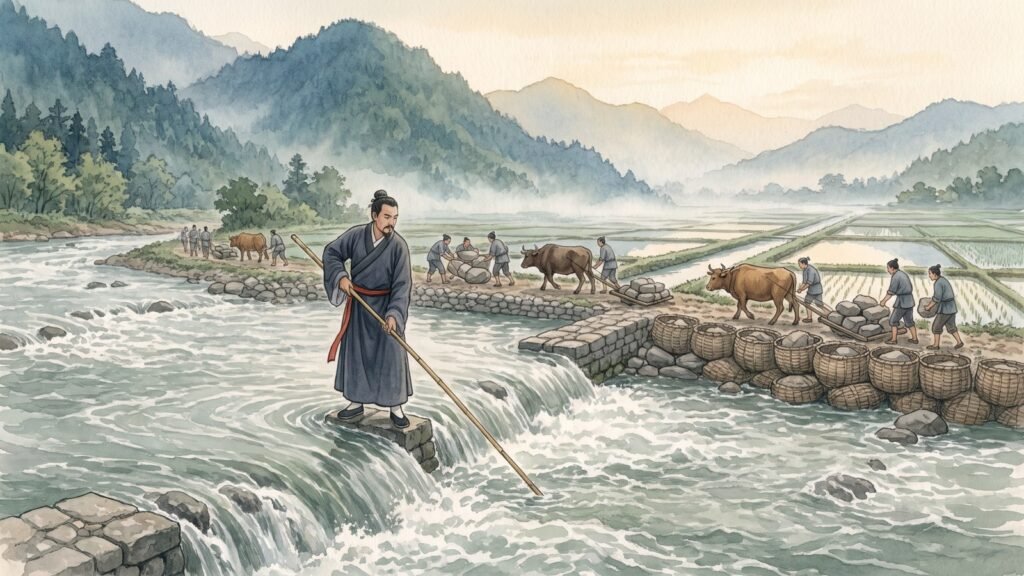
Three structures do the work. The Fish Mouth, a long artificial levee built out into the channel and shaped with a projecting cone of its own, divides the flow permanently into an inner stream and an outer stream. The inner is deep and narrow and carries the irrigation; the outer is shallow, broad and does the flushing. The division is not fixed: the inner channel is said to take around sixty per cent of the river in the dry season and closer to forty per cent in flood, so the same fixed piece of masonry hands more of the water to the fields when the fields need it and less when the river is dangerous. The Flying Sand is a spillway, and a spillway is simply a low place in a wall built on purpose to be overtopped: about two hundred metres of opening between the inner and outer channels through which surplus water, and roughly four-fifths of the flood-season sediment, are deliberately thrown out of the irrigation channel. The curving approach makes the current whirl, and the whirl is what does the cleaning. The Bottle-Neck Channel is the entrance cut through the mountain that starts the whole distribution system, and its narrow throat does double duty as a check gate — a fixed constriction that sets how much can pass and forces the excess to spill over the Flying Sand rather than downstream.
What is striking is what Qin did not do. There is no dam. The standard explanation, recorded in the heritage literature, is logistical: a dam across the Min would have closed the navigation channel that Qin needed to move troops and freight to the eastern front. That is a constraint that no amount of engineering heroism can argue with, and it dictates the entire form of the solution. Instead of storing the flood, you pass it. Instead of raising the river, you take a measured fraction of it out sideways and leave the main channel running. The design is therefore an abstraction rate that is fixed by masonry rather than by season: the intake at the Bottle-Neck is a physical throttle, and the flood limit is a consequence of its width rather than of a decision taken in the moment.
The mountain was the immediate obstacle. Hand drilling with stone hammers would, by the accepted estimate, have taken some thirty years to get through. Li Bing’s answer was thermal: build a fire against the rock, and when it is white-hot, throw cold water on it. The rock cracks. The forests of the region supplied the timber. After eight years of work a channel about twenty metres wide had been gouged through. Downstream the Fish Mouth levee took four years, built from long sausage-shaped woven bamboo baskets packed with stone — the Zhulong — braced by wooden tripods called Macha, an arrangement that is flexible, cheap, and was still in flood-fighting use on this river in recent memory. The king is said to have allocated a hundred thousand taels of silver, which is a figure no historian can convert, but which at least tells you that the court treated this as a major undertaking rather than a local repair.
The Canal That Was Meant to Bankrupt Qin
While Li Bing was taking a fraction of the Min sideways, Qin was also building something on the other side of the empire that nobody remembers, and that was almost certainly the more consequential of the two. The state of Han, which bordered Qin and could see the juggernaut coming, hit on an elegant piece of psychological warfare. Qin was a state that liked building. Qin was always building. So Han sent a water engineer named Zheng Guo to Qin to propose that Qin dig an enormous canal — on the argument that Qin’s resources would be swallowed up by the project and it would never have the strength to march east. The engineer was supposed to waste Qin’s labour. He did not waste it.
The account comes from Sima Qian, writing a century later, and it is worth quoting closely because the story it tells is a story about a man arguing with the men who are about to kill him. Han, Sima Qian says, heard that Qin was fond of enterprises, and so, intending to dissipate its energies and prevent it from attacking eastward, dispatched Zheng Guo to give Qin controversial advice by proposing that it excavate a canal from the Jing River west of Mount Zhong as far as Hukou, and from there run east along the Northern Mountains and into the Luo. It would be more than three hundred li long, and it would irrigate the fields. When the work was half done the true purpose was discovered, and Qin intended to kill Zheng Guo. Zheng Guo said: at first I was acting in order to cause dissension, but when the canal is completed it will surely be a benefit to Qin. The king thought this was true, and in the end the work went on. When it was finished it was used to move the stagnant water off the land, and it irrigated more than forty thousand qing of salty ground, with a harvest of one zhong to the mou. The land inside the passes became fertile, there were no years of calamity, and Qin grew rich and strong and finally unified the feudal states. Hence the name: the Zheng Guo Canal.
Those numbers need handling with care, because they are the sort that get repeated for centuries and then believed. Three hundred li is a Qin measure; the Qin li was a little over three hundred metres, which puts the original line at somewhere around ninety to a hundred kilometres. Modern engineering descriptions give considerably larger figures for the historic works — the international register of irrigation heritage put the original canal at about 125 kilometres irrigating some 186,000 hectares, while the Chinese ministry responsible for water resources describes a system of roughly 150 kilometres — so it is fair to say the alignment was rebuilt, extended and shifted so often over two millennia that no single length is the length. The forty thousand qing is worse. Most modern conversions put a qing at about half a hectare, which would make the ancient figure absurdly small; a figure of 27,000 square kilometres, which circulates widely in popular accounts, is larger than the entire Guanzhong plain the canal was meant to irrigate. Treat these as evidence that we do not know, not as measurements. The honest summary is that the canal turned ground that had been saline and marginal into some of the most productive land in China, and that it did so at a scale which changed what the state of Qin could feed.
What actually mattered was the geology, and it is where the second half of the story begins. The Jing is a slow, sand-laden river. The Chinese water ministry puts its annual sediment discharge at around 265 million tonnes — for comparison, that is the order of sediment a large river carries, and it has to go somewhere. It went into the canal. The engineering was a race against a rising floor. Joseph Needham, in the abridged fifth volume of his Science and Civilisation in China with C. A. Ronan, notes that by the Han dynasty much of the canal had silted up and only a short section was still flowing, and that a new canal was cut in 95 BCE under an engineer named Bai Gong. After that, rebuilding the intake became routine rather than exceptional, for two thousand years. The international heritage record makes the arithmetic explicit: over that span the Jing bed cut down by nearly twenty metres, which meant the intake had to migrate upstream roughly five kilometres to keep drawing water at the same elevation. It was moved and rebuilt in the eleventh and fourteenth centuries; in the fifteenth it was moved again and a new diversion tunnel was driven, taking eighteen years; there were further tunnels in 1517 and 1822; the canal was rebuilt behind an upstream weir in 1932 and renamed for its new intake works; and in 1966 that weir was destroyed by flood and replaced with a concrete overflow dam a short distance downstream. Fourteen stone steles recording irrigation rules survive at the site.
So the canal that was designed to bankrupt Qin bankrupted nobody, and the engineer sent to waste Qin’s labour spent a decade building Qin the thing that let it conquer the world. The structure built in 246 BCE was not a monument. It was a moving target that had to be chased upstream for two millennia.
Keeping Water in Its Place
Nothing in that story works twice without administration. Qin did not leave Li Bing’s weir to run itself and Zheng Guo’s canal to silt up; the state built a habit of treating water as a permanent administrative commitment, and the evidence for it survives in three different registers — law, careers, and ritual.
The law is the plainest. The government issued a formal water distribution order for the Zhengguo Canal as early as the second century BCE. By the Tang the apparatus was fully written down: the water administration regulations and the Tang statutory codes set out rules for sluice gates, weirs and dams, specified how water was to be apportioned, laid down the appointment and dismissal of the officials in charge, and provided for their assessment and supervision. Song, Yuan, Ming and Qing codes added more detail. One of the Tang provisions is a small masterpiece of applied hydraulics and social history: irrigation water was given priority over water-powered mills, so that a miller could not legally take the water a field needed. That is a water right, articulated, defended, and enforced — and it is early.
The careers show the same reflex. Du Shi, an administrator of Nanyang in the early first century CE, had an array of dykes and canals built for land reclamation and the growth of local agriculture; the locals were so fond of him they called him Mother Du, and the Book of the Later Han records that he was a man who loved the common people and wanted to spare their labour. Two centuries later, on the Zhengguo Canal itself, a modern canal administration was only created in 1934 and an irrigation committee in 1951, with section chiefs selected from among the farmers who worked the channels. That is a very long continuity of a particular kind of work, and it is continuity of function more than of institution: the Qin commandery office, the Han county magistrate, the Tang statute, the Republican-era canal bureau are not the same body, but they are recognisably doing the same job.
The ritual is the strangest and possibly the most important. On the riverbank at the foot of Mount Yulei stands the Two Kings Temple, a timber complex of some ten thousand square metres. It began as a shrine to a king of ancient Shu, was moved, was renamed, and by the Qing was called the Two Kings Temple because the locals had conferred on Li Bing and on his son the posthumous title of king. They still observe a traditional birthday for him on the twenty-fourth day of the seventh lunar month, and people still come to prostrate themselves at his image. In the rear hall is his son Erlang, depicted standing firm with a tool in his hands, ready to level mountains.
That last point deserves honesty, because it is where the record runs out. There is no historical evidence that Erlang was Li Bing’s son. He is a legendary figure of Chinese folk literature, and the local people made him a son for a very human reason: a family line with no heir was a serious problem in Chinese society, and the people of the plain wanted their engineer to have one. The temple absorbed an existing god rather than inventing a cult. Nearby, the Dragon-Taming Temple tells the same story in a different costume — Li Bing was given the posthumous title Grand Prince of Peace, and during the Song the temple was renamed after a legend in which Erlang, rather than his father, is the one who subdues the flood. The machinery is the same: the deity of the river is honoured, the engineer is raised beside him, and the two are addressed together as two kings.
What the legend is doing is worth stating plainly. The Records of the Grand Historian preserves the story in which Li Bing, confronted with a local cult that demanded a bride for the river god, refused the usual confrontation — an earlier administrator, Ximen Bao, had tried suppression and had triggered a revolt — and instead staged the thing. He built the temple, offered his own two daughters, put on a great feast by the river, and raised a cup to the god. The god did not drink. Li Bing drew his sword and went off along the bank; the crowd saw two bulls locked together there, which was Li Bing in a duel with the deity. He came back sweating, called for help, and one of his officers killed the bull Li Bing had designated as the god. The people were satisfied.
Read as politics, it is a provincial governor converting a dangerous tax into a marriage the river had consented to. Read as engineering culture, it is a story about what kind of man is allowed to command a river. He does not defeat the water; he overawes it, and he wins by being the one who fights it at its own level. That is precisely the self-image of the diversion weir, and it is why the bulls ended up inside the temple.
There was also, improbably, a statue that measured the water. During the Eastern Han a stone figure of Li Bing was set in the river itself as a gauge: if the level rose above his shoulders it meant flood, if it fell below his calves it meant drought. It was recovered from the riverbed in 1974, stands 2.9 metres tall and weighs about four and a half tonnes, and is dated to 168 CE — roughly three and a half centuries after the man it depicts was appointed. It is often described as the oldest known stone statue of a human figure from China, which is a claim worth repeating as a claim rather than as a certainty. It is also the single most legible object in the whole story: a god with a graduated scale, standing in the current, doing arithmetic.
And the continuity had its failures. The conquest of Chengdu by the rebel leader Zhang Xianzhong in 1644, followed by the Ming-Qing transition, brought depopulation and a deterioration of the irrigation system severe enough to set rice cultivation back by decades — an environmental historian has argued that the farmland of Sichuan partly re-wilded in this period, which is a reminder that a hydraulic system is a social system before it is a set of structures. The 1933 Diexi earthquake destroyed the original works outright, and they were rebuilt afterwards by a local family, the Zhangs, over several generations.
Rome’s Water and Qin’s Water
The obvious comparison is an aqueduct, and the obvious comparison is a bad one, which is why it is worth making badly and then taking apart. Rome built its first aqueduct, the Aqua Appia, in 312 BCE and was still building in Frontinus’s day. Sextus Julius Frontinus, appointed curator aquarum — water commissioner — by the emperor Nerva in 97 CE, wrote De aquaeductu, a two-book official report to the emperor on the state of the water supply, including the laws governing its use and maintenance. He describes nine aqueducts in detail, with their histories, their capacities and their discharge rates. It is one of the earliest pieces of infrastructure documentation in the Western record, and it was written by a soldier, senator and provincial governor who had just been handed a broken system and set about measuring it.
The engineering was formidable and deserves a fair hearing. The Aqua Marcia, built between 144 and 140 BCE by the praetor Quintus Marcius Rex and paid for largely out of the spoils of Corinth and Carthage, ran about 91 kilometres, the longest of the eleven aqueducts that eventually supplied Rome. Roughly the first 80 kilometres were underground, then the channel emerged onto monumental arches to preserve pressure for distribution, and the last stretch of arches ran beside the Via Latina into the city. At the Aniene valley it crossed on the Ponte Lupo, more than 30 metres high and 80 metres long, with a road on top. There was a settling basin at the seventh mile. Frontinus, with a quinaria — a calibrated pipe size he used as a unit of flow — measured the Marcia’s source at about 4,690 quinariae in 97 CE, making it the second greatest single source for the city. Depending on how a quinaria is converted, that is somewhere between forty-seven and three hundred and sixty million gallons a day, and the range says more about the state of Roman measurement than about the aqueduct.
Rome also had the thing Qin is often said to have lacked: an answer to water theft. By the early second century BCE illegal diversions had cut the flow badly enough that in 184 BCE the censor Cato the Elder passed laws to remove illegal pipes and private supplies. Frontinus inherited a city where people were stealing its water and reported it to the emperor in writing. Give Rome its due. It had a named office, a written code, a surveyor-in-chief, a slave or tenant population to staff the maintenance, and above all a client with an insatiable and non-negotiable thirst.
Here is where the comparison breaks. A Roman aqueduct does a single, well-defined job: move a fixed volume of water from a known source to a known set of consumers, and deliver it at the city rather than in the countryside. Its degradation is predictable and mostly political. It is reduced by leakage, by illegal taps, by the theft of lead from the pipes, and by the unwillingness of the owners of the houses it serves to pay for repairs. Every one of those is a problem of governance, and governance is something the Roman state was unusually good at. It kept a public register of the water, it fixed the legal allocation, it wrote the commissioner a brief, and it had an instrument for coercion — the censor, an office that existed precisely to call powerful men to account over public property. Rome’s water system fails by theft and by neglect, and both are addressable by law.
A Qin system does a different and much harder job. It does not deliver water; it regulates a river, redistributes the timing of a flood across an agricultural province, and does so continuously, because the river is doing the opposite every year. The enemy is not a thief but a season. Sediment that Rome’s engineers dealt with at the taps and in the pipes, the Qin dealt with at the source, because their silt was being deposited into the channel they were trying to draw from — the Zhengguo Canal’s intake chasing the bed of the Jing upstream by five kilometres over two thousand years is the clearest possible statement of what they were up against. Rome’s maintenance problem is how to stop owners taking the water. The Qin maintenance problem is how to get several thousand people into the channel with dredging gear before the snowmelt, every year, for ever, and how to make sure that when one province’s harvest is at stake in July, somebody turns up.
That difference in the shape of the problem has a consequence worth naming, because it is the reason Qin water governance is so visible in its rituals. The benefit of a canal is diffuse — it is the whole province’s grain, visible to no one in particular. The cost is concentrated — it is a work gang, in one place, in one season, unpaid. The Zhengguo Canal’s contemporary register shows the answer being built in legal form, with distribution orders and steles and codes that assign responsibility and rank it above the claims of mills. The Two Kings Temple shows the same answer arriving in a form that nobody has to file a document about. Both are attempts at the same thing: binding a permanent obligation to a temporary, resentful workforce, in a landscape where the river has more power than the state and always will.
The Men Who Are Not in the Record
It is worth ending on the two engineers, because they are the least documented people in this story and the only two who actually did the work.
Zheng Guo survives as a name, a canal, and one sentence of defiance: at first I was acting in order to cause dissension, but when the canal is completed it will surely be a benefit to Qin. Everything else about him has been overwritten. Later tradition is said to give him a partner in the enterprise, a second engineer who shares the credit, and I could not find that name corroborated in anything earlier or more solid than the retelling; the transmitted record credits Zheng Guo alone. Almost certainly he was a Han agent who changed his mind, or wanted it recorded later that he did, and it is impossible now to tell which. The canal, at any rate, took about ten years to build, and it has been rebuilt so often since that the thing the spy designed has effectively been designed several hundred more times.
Li Bing is barely better documented, and the gap between what is written down and what is remembered about him is the whole subject of this essay in miniature. We do not know when he was born or when he died. We know that a king named him governor of a conquered province of exiles, that he surveyed a river and chose not to dam it, and that within a few centuries a poet had put two lines about him on a wall. The confident dates are reconstructions by modern historians from two texts that disagree. The portrait that survives is the oldest in China and was carved 168 CE, more than three centuries after he held office, so even the face is a later invention. The temple where it stands was not built for him; it was built for a Shu king, then moved, and it acquired Li Bing because a river needs somebody to be answerable for it, and then acquired his son because a family needs somebody to continue it.
Which leaves the two projects. One of them is still standing, still irrigated, and listed by UNESCO as part of a cultural landscape with Mount Qingcheng, and it is the reason an entire city has a relaxed relationship with work that people in drier places find baffling. The other one is mostly a corridor, moved and re-cut and re-moved so many times that its original line survives only in Sima Qian’s sentence. Both of them were built by men whose names we know because a state wanted them known, in a landscape where a river could undo an empire’s best thinking in a single wet spring. The engineering was real. So was the myth, and they have been leaning on each other for two thousand years.
References
- The First Emperor: Selections from the Historical Records — Sima Qian, translated selections, Oxford University Press, 2007, p. 102
- Zhengguo Canal — Wikipedia article citing Sima Qian, and Needham and Ronan’s fifth volume, pp. 200–201
- Shu (kingdom) — Wikipedia article on the Qin conquest of Shu and the settlement of the basin
- Li Bing (Qin) — Wikipedia article on Li Bing’s appointment, the contested dates, and the river-god marriage in the Records of the Grand Historian, ch. 116
- Dujiangyan — Wikipedia article on the Fish Mouth, Flying Sand and Bottle-Neck structures, the Two Kings Temple and the river statue of 168 CE
- Mount Qingcheng and the Dujiangyan Irrigation System — UNESCO World Heritage Centre, inscribed 2000
- Zhengguo Canal — International Commission on Irrigation and Drainage, World Heritage Irrigation Structures register, recognised 2016
- Zhengguo Canal — Ministry of Water Resources of the People’s Republic of China, irrigation heritage pages, 2025
- The Retreat of the Human: Processes of Rewilding after Warfare in Sichuan, China — Shang Yuan and Edwin Schmitt, Environment and History, volume 29, issue 1, 2023, pp. 109–131
- The Retreat of the Elephants: An Environmental History of China — Mark Elvin, Yale University Press, 2004, p. 121
- The Origin of Chinese Deities — Cheng Manchao, Foreign Languages Press, Beijing, 1995, pp. 170–180
- Du Shi — Wikipedia article drawing on the Book of the Later Han, vol. 31, and de Crespigny’s biographical dictionary of the Later Han
- Frontinus — Wikipedia article on the curator aquarum and De aquaeductu
- Aqua Marcia — Wikipedia article on the length, route and measured discharge of Rome’s longest aqueduct
- Frontinus: De aquaeductu urbis Romae — edited with introduction and commentary by R. H. Rodgers, Cambridge University Press, 2004