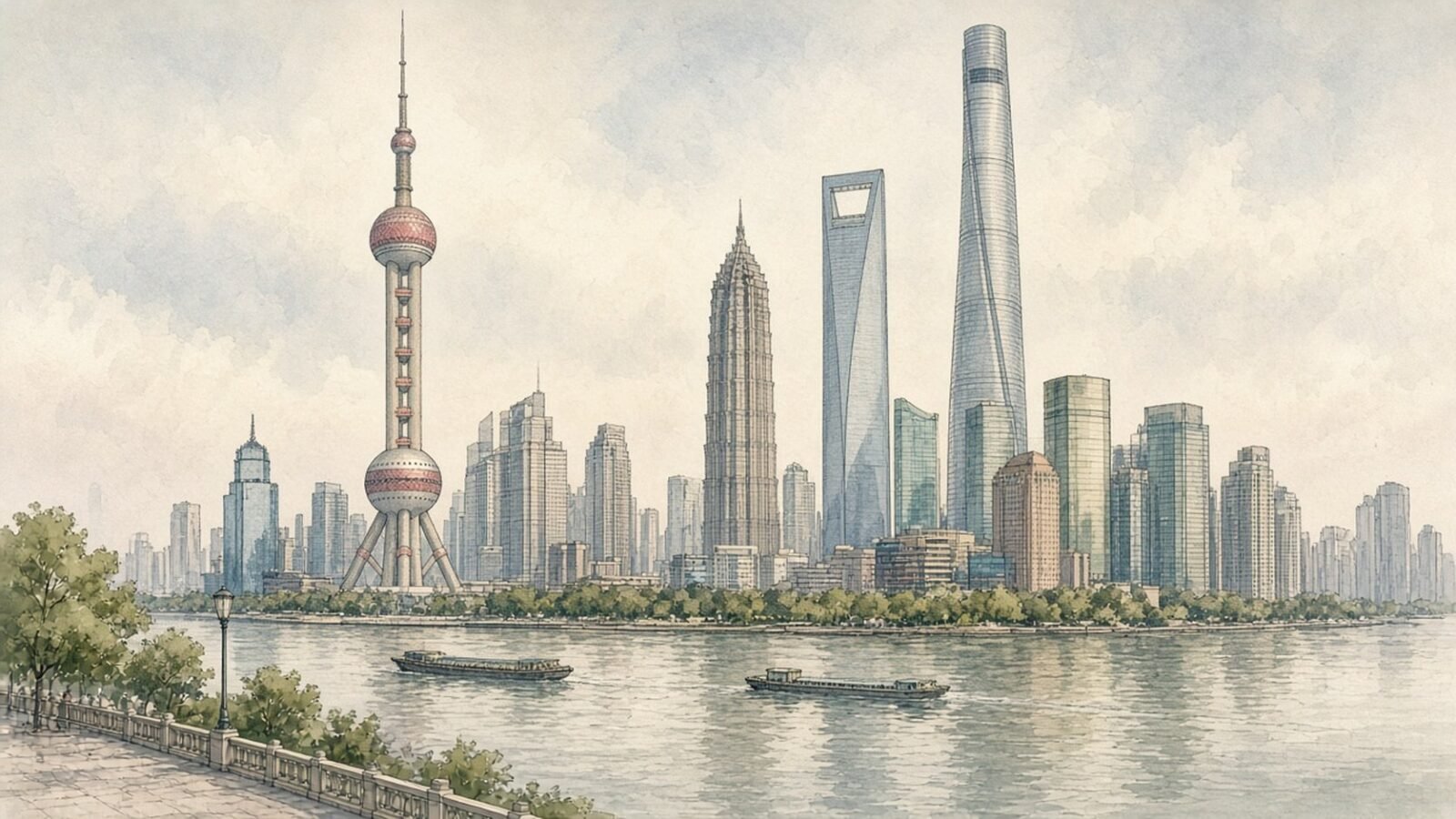
Every evening on the Bund, thousands of people turn their backs on the most famous mile of architecture in Asia and photograph the other side. What they are photographing did not exist when some of them were born. Where the towers of Lujiazui now stack the sky — the twist of the Shanghai Tower, the pagoda crown of the Jin Mao, the great trapezoid window of the World Financial Center, the pink spheres of the Oriental Pearl — there was, within living memory, a landscape of rice paddies, warehouses, shipyards, and low tile-roofed villages, crossed by creeks and reached by ferry. The transformation of that muddy eastern bank into the vertical Wall Street of China is the fastest piece of city-building ever attempted on such a scale, and it was done deliberately, as a statement. The story of Lujiazui is the story of what China decided to say to the world in 1990 — and of the skyline it raised to say it.
The Wrong Side of the River
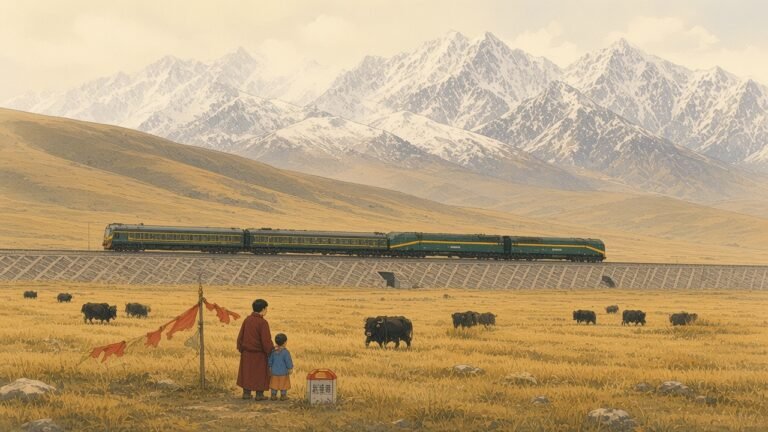
Pudong means, simply, “east of the Huangpu,” and for most of Shanghai’s history that meant nowhere. The city grew west and north of the river; the east bank stayed rural, a wedge of delta farmland given over to vegetable plots and fish ponds, with a fringe of wharves, cotton mills, and shipyards along the water. Old Shanghai had a saying that summed up the social geography with perfect clarity: better a bed in Puxi than a room in Pudong. Families on the west bank would sooner crowd three generations into a lane-house room than marry a daughter across the river. The ferries that crossed the Huangpu carried workers and vegetables; they did not carry anyone’s ambitions.
The very name Lujiazui remembers how thoroughly rural the place was. The “zui” means a mouth or spit of land — the fat tongue where the Huangpu bends east — and the “Lu” was the family of Lu Shen, a Ming dynasty scholar-official who retired to his estates on this bend five centuries ago, wrote poetry about his riverside retreat, and left his surname on the mud. For four hundred years after him, the most significant structures at Lujiazui were warehouses. When a British photographer climbed the Cathedral tower in the 1930s and pointed his camera east across the river, his plate recorded a flat horizon of godown roofs and factory chimneys, with farmland beyond. Anyone standing on the Bund in 1985 saw essentially the same view. Anyone who stood there in 2015 saw a skyline that made Manhattan look modest. The entire change happened between those two dates, and most of it happened in a single decade.
The Trump Card
The decision came from the top, and it came late on purpose. When China launched its first Special Economic Zones in 1980, Shanghai — the country’s industrial champion, carrying a huge share of the national budget on its back — was deliberately left out; the reforms were to be tested in the south, in Shenzhen and its sisters, far from the precious industrial base. Shanghai spent the 1980s watching Guangdong boom while its own infrastructure crumbled under decades of underinvestment. Deng Xiaoping, who spent his winters in the city, came to regard the exclusion as a mistake, and said so. Shanghai, he told his colleagues, was China’s trump card, and it had been sitting unplayed in the deck. On April 18, 1990, the central government announced from Shanghai itself the decision to develop and open Pudong: a new area of some five hundred square kilometers on the east bank, with preferential policies to match the southern zones, and at its tip, directly facing the Bund across the river, a Finance and Trade Zone called Lujiazui.
The symbolism was the strategy. Shenzhen had been built next to Hong Kong, facing outward, an experiment at arm’s length. Pudong was built facing the Bund — the old monument of foreign finance — and its purpose was to reclaim that monument’s meaning in Chinese hands. The planners did not want factories; they wanted banks, exchanges, and headquarters, and they wanted them visible. Every photograph of the new skyline would automatically include the old one. That pairing was the message: the first skyline had been built by foreign power on Chinese soil; the second would be China’s answer, built by China, a hundred meters higher.
Drawing the Future
For a place destined to be chaotic, Lujiazui was, from the beginning, meticulously drawn. In 1992 the city threw the master plan open to an international consultation that reads like a roll call of the era’s architectural gods: Richard Rogers from London, Dominique Perrault from Paris, Toyo Ito from Tokyo, Massimiliano Fuksas from Rome, each submitting a vision for the peninsula’s mile of riverfront. The final plan, distilled by Shanghai’s own planning institute, took the best of the foreign ideas and bent them to Chinese geometry: a great central park at the tip, a curved ring of towers around it, and — the masterstroke — a grand axis, Century Avenue, running five kilometers straight from the Pearl Tower southeast to Century Park, a ceremonial boulevard one hundred meters wide that gave the whole district a spine. The zones around Lujiazui were assigned their own futures: Waigaoqiao for free-trade logistics, Jinqiao for manufacturing, Zhangjiang for technology — a complete city economy drawn on farmland with a straightedge.
Then came the money. Pudong’s development corporations leveled the fields, laid the pipes, and auctioned the land to fund the next phase, and the towers began to queue. The financing model was itself a quiet revolution: land in China belonged to the state, but the right to use it could be leased for decades at a time, and Pudong turned that lease into an engine — selling long leases on leveled land to developers, plowing the proceeds into roads, bridges, and utilities, and watching each completed tower raise the value of every plot still unsold. Foreign banks were offered terms to cross the river; domestic banks were told. By the end of the first decade, tens of billions of dollars had flowed into the new area, more than a hundred towers had risen in Lujiazui alone, and the district’s GDP was being charted in the financial press with the kind of awe once reserved for the Asian tigers. What followed in Lujiazui over the next twenty-five years was effectively a relay race of superlatives, each tower in turn the tallest in China, each one raising the district’s silhouette another hundred meters against the sky.
Bridges, Tunnels, and the Last Ferry
None of it could begin until the river was beaten. For all of Shanghai’s history, the Huangpu had no bridge at all — the city’s entire life crossed by ferry, and in the rush hours of the 1980s the queues at the Lujiazui ferry pier could stretch for an hour, bicycles and all. The new district needed crossings, and it got them in a rush that matched everything else about Pudong. The Nanpu Bridge, a great cable-stayed span completed in 1991, was the first bridge ever built over the Huangpu in Shanghai; the Yangpu Bridge followed in 1993, briefly the longest cable-stayed bridge in the world; the Lupu Bridge leaped the river upstream in 2003 with a steel arch that was, on completion, the longest of its kind anywhere. Beneath the water went tunnel after tunnel for road and metro. When Deng Xiaoping made his famous southern tour in 1992 to kick the reforms back into high gear, he stood on the Yangpu Bridge site, looked at the cranes, and pronounced the benediction that Shanghai had waited a decade to hear: the city should be bolder, move faster, aim higher. The ferries kept running — a few still run today, for pocket change, the cheapest river cruise in China — but the age of the hour-long queue was over.
The Pearl Goes Up First
The first statement was not a bank but a broadcast tower, and it remains the most loved building on the skyline. The Oriental Pearl Radio and TV Tower, completed in 1994, rises four hundred and sixty-eight meters on eleven steel spheres threaded up three giant columns — an arrangement, its designers said, drawn from an eighth-century poem by Bai Juyi, in which pearls large and small tumble onto a plate of jade. The chief architect, Jiang Huancheng of Shanghai’s own design institute, gave the city something no imported tower could have: an instant emblem that was unmistakably of the place. Lit pink against the night, reflected in the river, the Pearl appeared on every magazine cover and postcard in the country. It was the tallest structure in China for thirteen years, and it did its real job perfectly: it told a hundred million television viewers, nightly, that something unprecedented was happening across the river from the Bund.
The Pagoda of Capital
The Jin Mao Tower, finished in 1999, raised the argument to a different league. Eighty-eight floors — the number chosen with care, eight being the sound of prosperity in Chinese — climbing to four hundred and twenty meters, designed by the Chicago firm of Skidmore, Owings and Merrill under Adrian Smith, the Jin Mao was an exercise in translation: an American supertall skyscraper taught to speak Chinese. Its silhouette steps back in rhythmic setbacks that recall, deliberately, the tiers of a pagoda, and its proportions are woven through with eights. Through its upper half runs the atrium of the Grand Hyatt, a golden barrel vault rising more than thirty stories around which the corridors of the hotel coil like the rings of a tree — one of the great interior spaces of the twentieth century, and one that thousands of visitors a year paid simply to stand beneath. The Jin Mao was the building that proved Pudong could do more than big: it could do beautiful.
The Bottle Opener and the Twist
The third tower had the hardest birth. The Shanghai World Financial Center was conceived by the Japanese developer Minoru Mori, the man who had spent a lifetime building Tokyo’s skyline, designed by the New York firm Kohn Pedersen Fox as a clean blade of glass rising to four hundred and ninety-two meters, crowned by a circular aperture — a moon gate in the sky. Then history intervened twice. The Asian financial crisis of 1997 froze the project at the foundation stage for years; and when it revived, the round hole ran into an unexpected storm of Chinese public feeling, from citizens who saw in the circle on a Japanese-built tower an echo of the rising sun. The aperture became a trapezoid. The tower finally opened in 2008, a hundred and one floors of banks and trading rooms with an observation deck across the sky-window’s glass floor, and Shanghai, with its customary affection, immediately nicknamed the world’s third-tallest building the bottle opener.
The relay’s final leg was the Shanghai Tower, completed in 2015: six hundred and thirty-two meters, a hundred and twenty-eight stories, the tallest building in China and the second tallest on earth. Designed by the American firm Gensler with a young Shanghai-born architect, Jun Xia, as design director, it solved the physics of the supertall with a single elegant gesture: the whole tower twists one hundred and twenty degrees as it rises, a spiral that wind-tunnel tests showed would shed nearly a quarter of the typhoon wind loads on the structure, saving tens of millions of dollars in steel. Its double skin of glass creates sky gardens stacked between the walls; its elevators, among the fastest ever built, climb at more than twenty meters a second. From the observation deck on the hundred and eighteenth floor, the Jin Mao and the World Financial Center — each, in its year of opening, the tallest building in China — lie below like toys on a table.
The Balcony of the Nation
A financial district that exists partly to be looked at needs places to look from, and Lujiazui made the observation deck into a civic institution. The Oriental Pearl’s spheres had been receiving visitors since 1994; the Jin Mao added its deck at three hundred and forty meters, with a view straight down the golden throat of the Grand Hyatt atrium; the World Financial Center countered with a glass-floored skywalk at four hundred and seventy-four, where visitors queue to stand on transparent panels with the streets a third of a mile beneath their shoes. The Shanghai Tower’s Top of Shanghai observatory, at five hundred and forty-six meters, completed the ladder — the highest public viewing platform ever built, from which, on the rare crystalline day after a cold front has scrubbed the air, the whole delta lies visible: the river bending away south, the Bund a stone ribbon far below, the city running unbroken to the horizon in every direction. Tens of millions of people have now looked down from these balconies. For many of them — tourists from every province, families who saved for the ticket — the view is not tourism at all but something closer to a civic ritual: a chance to see, with their own eyes, the physical fact of what their country had become.
The Machine Inside the Glass
It is easy to be hypnotized by the towers and miss what they contain, which is the point of the whole exercise. Lujiazui was built to be a machine for finance, and the machine works. The Shanghai Stock Exchange, refounded on the Bund in 1990 with a few dozen listed companies, moved across the river in 1997 into a building of its own in the heart of the district; today it is one of the largest exchanges in the world. Around it gathered the rest of China’s financial central nervous system — the futures exchange, the gold exchange, the foreign exchange center, the insurance exchange, the diamond exchange — along with the China headquarters of hundreds of foreign and domestic banks, funds, and firms. By the mid-2010s the district held hundreds of thousands of finance professionals, and when the government launched China’s first pilot free trade zone in 2013, it put it in Pudong, folding Lujiazui into the experiment two years later. Shanghai now ranks alongside New York, London, and Hong Kong in the global league tables of financial centers — the precise ambition that had been written into the planning documents in 1990, when the site was still cabbages.
Life in the Vertical City
For all its banking gravity, Lujiazui learned to be a place of ordinary pleasures. Along the river runs Binjiang Avenue, a landscaped promenade where Shanghai families stroll at dusk and watch the Bund light up across the water — the reverse pilgrimage, the far bank admiring the old one. The Super Brand Mall, for years among the largest shopping centers in Asia, anchors the district’s weekends; the circular Apple store with its glass cylinder plaza has become a landmark in its own right; the riverside paths draw runners at dawn. Five kilometers down Century Avenue, Century Park — the largest in central Shanghai, laid out with advice from a British landscape practice — gives the district its green lung, and the metro’s Line 2, which first burrowed under the river in 1999, now shares the crossing with a dozen lines and tunnels and bridges. The ferry still runs, mostly for nostalgia and photographers. The saying about the bed in Puxi and the room in Pudong has become a joke the city tells about itself: apartments in Pudong now trade at prices that would buy palaces in most of the world, and nobody needs persuading to cross the river.
What the Skyline Says
There is a photograph, endlessly reproduced, that tells the whole story: the Lujiazui skyline shot from the same rooftop in 1990, 2000, and 2010 — farmland, then a lone pink tower among cranes, then the forest complete. No city in history has ever shown its own transformation so obligingly in a single frame. But the deeper meaning of Lujiazui is the one the planners intended from the start, and it can only be read from the promenade of the Bund, looking east. On the west bank stands the skyline that foreign capital built in China’s century of weakness, stone by stone, under treaties signed at gunpoint. On the east bank stands the skyline that Chinese capital built in the generation of China’s rise, glass by glass, by invitation and by choice. The two face each other across five hundred meters of river, and the conversation between them is the entire modern history of the country in a single view. Lujiazui was designed to be an answer. Standing on the Bund at night, watching the towers cycle through their colors while the old clock tower chimes behind you, it is hard to argue that the answer was not received.