In the middle of the eighth century, if you could have seen the earth from the moon on a clear night, one city would have burned brighter than any other. Chang’an, capital of the Tang dynasty, held around a million people inside its walls — at a time when London was a riverside town of a few thousand, when Rome had shrunk to a fraction of its ancient self, when only Baghdad, newly rising on the Tigris, could even be mentioned in the same breath. But size was the least of it. Chang’an was the eastern terminus of the Silk Road, the destination of every camel that plodded west out of Persia and every pilgrim who walked east out of India, and it had absorbed the world into its streets. Persian jewelers, Sogdian wine merchants, Korean students, Japanese monks, Turkish generals, Indian astrologers, Arab sea traders up from Canton — all of them lived, worshipped, traded, and argued in a city laid out with a geometric confidence that no European capital would match for a thousand years. For two centuries Chang’an was not merely the greatest city in China. It was, by a comfortable margin, the greatest city on earth.
A City Drawn with a Ruler
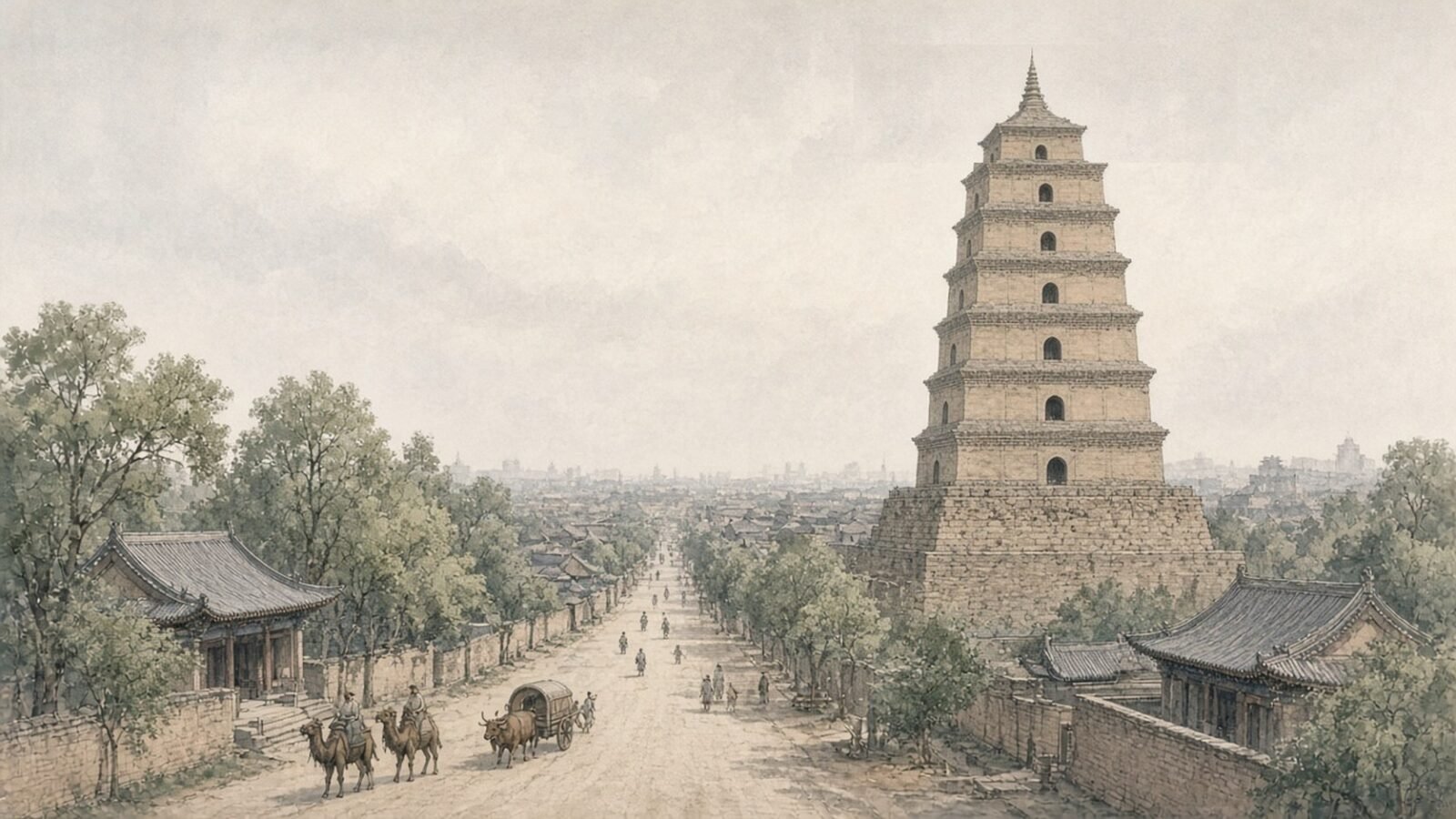
Chang’an was not a city that grew; it was a city that was decided. When the Sui dynasty reunified China in 582 after three centuries of division, the emperor ordered a new capital built from scratch on the plain south of the Wei River, a short distance from the ancient, silted-up Han dynasty Chang’an. The architect was Yuwen Kai, and what he produced was a statement of cosmic order rendered in rammed earth. The city was a near-perfect rectangle, roughly ten kilometers east to west and eight north to south, enclosed by a wall five meters high. Its streets ran dead straight, north to south and east to west, dividing the city into one hundred and eight walled wards, each a small city of its own with gates that closed at night. Down the middle ran Zhuque Avenue, the Avenue of the Vermilion Bird, a ceremonial boulevard one hundred and fifty meters wide — wide enough to park three modern runways on it — leading from the central Mingde Gate straight to the imperial city and the palace complex at the city’s northern edge.
The plan was more than engineering; it was philosophy made habitable. The city faced south, like the emperor. Its wards, markets, temples, and parks were disposed according to ideas about the harmony of heaven and earth that reached back to the classical books of rites. And the plan traveled. When Japan’s court decided to build permanent capitals of its own, it copied Chang’an almost line for line — first Nara, then Kyoto, whose central avenue and grid still faintly remember the Tang original. A Japanese aristocrat walking the streets of Kyoto in the ninth century was, in a sense, walking through a miniature Chang’an, and he knew it.
The Drumbeat of the Wards
Daily life in the great city ran to the sound of drums. At dawn, drums beat from towers across the city and the hundred and eight ward gates swung open; at dusk they beat again, and the gates closed, and the streets emptied under curfew. Within their ward walls, residents carried on — there were wineshops and storytellers and monasteries inside the wards, and the curfew was more honored in some districts than others — but the great avenues belonged at night to the patrols. Once a year, at the Lantern Festival, the whole apparatus was suspended: for three nights the gates stayed open, the avenues filled with music and lamplight, and a million people wandered a city turned entirely to celebration. Poets wrote about those nights for centuries afterward, the way people write about things they know will not last.
The administration of a million people demanded, and got, a bureaucracy of remarkable competence: registers of every household, granaries against famine, a water supply drawn through canals and wells, fire watches, market inspectors who standardized weights and fixed the opening prices of the day. The government that ran Chang’an was staffed increasingly by men chosen through the imperial examination system, the great Tang experiment in government by merit — not perfectly fair, not free of aristocratic privilege, but a door through which a poor boy with a brush and a memory could, in principle, walk into the highest offices of the empire. The examination cells where candidates sat for days writing essays on the classics became one of China’s most consequential inventions, and they anchored Chang’an’s identity as a city not only of soldiers and merchants but of scholars.
Where the Silk Road Ended
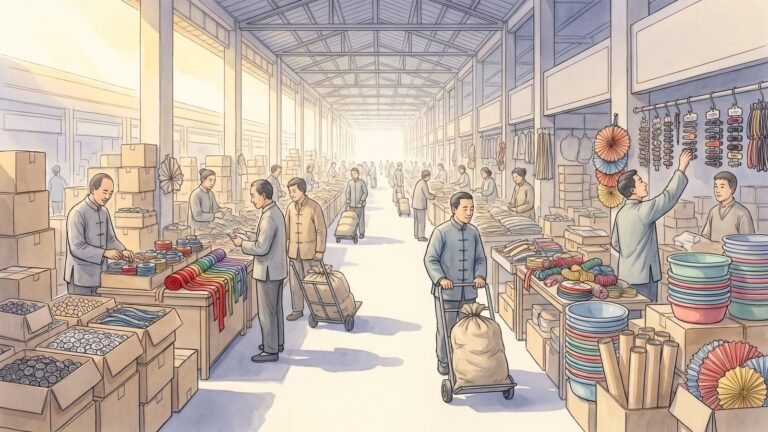
Everything that traveled the Silk Road — every bolt of samite, every silver coin of Sasanian Persia, every glass bead from the Syrian coast — eventually washed up in Chang’an’s West Market. The market was one of two enormous walled commercial compounds, each covering two full wards, and it was the more famous of the pair: several thousand shops arranged by trade, goldsmiths beside apothecaries beside dealers in horses and saddles, with an office of market inspectors to settle disputes and a pond where, in grimmer moments, executions were carried out as public warnings. Here the language of business was as often Sogdian as Chinese. The Sogdians, merchant princes from the oasis cities of what is now Uzbekistan, were the great middlemen of the Silk Road, and their caravanserais and trading houses anchored the commerce of the Western Regions. They dealt in everything the deserts could carry: Persian brocade and Byzantine glass, cloves and sandalwood from the southern seas, lapis lazuli from Badakhshan, amber, coral, frankincense, fine Ferghana horses that Tang poets praised as sweating blood.
The camels that carried it all became one of the signatures of Tang art — the great three-colored glazed pottery camels and their foreign grooms that now fill the world’s museums were, in their day, simply the freight haulers of the overland trade, commemorated in tombs because their owners had grown rich on their backs. A contemporary poet counted the sound of them: bells without number ringing far off across the sands, laden with white silk bound for Anxi, the Tang garrison far down the road in Central Asia. The traffic ran both directions. Chinese silk, porcelain, paper, and tea moved west; and in the middle sat Chang’an, taking a measure of everything, taxing it, tasting it, and folding it into the life of the city.
The Wineshops of the Western Quarter
Nothing captured Chang’an’s cosmopolitan ease better than its wineshops. Wine had come to China from the western regions centuries earlier, and by the Tang, grape wine from Turfan was a fashionable taste. The wineshops of the western wards were famous for their hostesses — the “Hu ji,” Western girls, often Sogdian or Persian, who served the wine and danced between the tables. They became a fixture of Tang poetry, half real and half legend: the golden-haired, blue-eyed — poets exaggerated freely — barmaids to whom the young aristocrats of the city lost their afternoons and their money. Li Bai, the greatest poet of the age and its most famous drinker, made them immortal. “Where do I wander when the fallen blossoms are trampled out?” he wrote of the young men of the capital. “Laughing, I enter the wineshop of the Western girl.”
The entertainment was as imported as the wine. The Sogdian whirl — the huxuan dance, a spinning, skirt-flaring performance from Central Asia — took the capital by storm; courtiers and even emperors learned it, and the court’s most famous consort, Yang Guifei, was said to perform it beautifully. Musicians from Kucha in the Tarim Basin dominated the court orchestras; their modes and their instruments, above all the pipa, the pear-shaped lute that rode the Silk Road east, became the sound of the Tang. Polo arrived from Persia and became an obsession of princes and emperors, played on horseback with a fury that occasionally killed the players. Even religion arrived by caravan and was given a temple and a hearing, as we will see. To be fashionable in eighth-century Chang’an was, in large part, to be foreign — and the Tang, at its confident height, saw no threat in that at all. It saw only the world’s tribute of good things, flowing naturally toward the center of civilization, which was, of course, itself.
Every Faith Under Heaven
The temples of Chang’an would have made a tourist’s itinerary on their own. Buddhism had been in China for six centuries by the Tang, but in Chang’an it reached its metropolitan splendor: vast monastery complexes like Ci’en Temple, where the pilgrim Xuanzang — who had walked to India and back, an epic later retold as the Journey to the West — translated the scriptures he had carried home, and where the Great Wild Goose Pagoda, built in 652 to house them, still stands in modern Xi’an. Daoism flourished under imperial patronage; the Tang emperors claimed descent from Laozi himself.
But the remarkable thing about Chang’an was what else it sheltered. Zoroastrian fire temples served the Persian community. Manichaean shrines appeared with the Uyghur connection. Muslim merchants from the sea trade worshipped in the city — a mosque tradition in Xi’an reaches back, in legend and perhaps in fact, to the Tang. And Christianity arrived. In 635 a bishop named Alopen, traveling the Silk Road from the Church of the East in Persia, was received at court; the emperor, having had the scriptures examined, declared the teaching acceptable and ordered a monastery built in the capital. In 781 the community erected the great limestone monument now known as the Nestorian Stele, its story carved in elegant Chinese with a sprinkle of Syriac — the first indelible record of Christianity in China, buried in the collapse of later centuries, dug up in the seventeenth century, and standing today in Xi’an’s Beilin Museum. For a few generations, in one city, a man could walk from a Buddhist sutra lecture to a Zoroastrian fire temple to a church whose priests chanted in Syriac, and no one in authority thought it strange. The Tang collected faiths the way it collected horses and music: the world was interesting, and the empire was big enough for all of it.
Guests of the Emperor
The foreigners of Chang’an were not only merchants and monks. The city was full of students, hostages, exiles, and adventurers, and the Tang court had a talent for absorbing all of them. Japanese embassies — the kentoshi missions — crossed the sea at terrible risk to drink at the source: they studied Tang law, Tang Buddhism, Tang city planning, Tang poetry, and carried the whole package home, where it shaped Japan for centuries. The monk Kukai studied esoteric Buddhism at Chang’an’s Qinglong Temple under the master Huiguo in 804-805 and carried the lineage back to found the Shingon school, still one of Japan’s great Buddhist traditions. Korean students sat the imperial examinations and passed. Turks commanded Tang armies. And in the most poignant of all the foreign stories, the last heir of Sasanian Persia — the prince Peroz, son of the final shah, whose empire had fallen to the Arab conquest — ended his road in Chang’an, where the Tang court received the refugee royalty of Persia with honor and gave him a title and a place. The King of Kings’ line spent its last generation as guests on the far eastern end of the world, in the only city grand enough to make the exile feel almost natural.
Tea, Fashion, and the Good Life
It was in the Tang that tea became China. The drink had been a southern habit and a monastic aid to meditation, but in the eighth century it conquered the empire, and a Chang’an scholar named Lu Yu wrote its scripture — the Classic of Tea, the first book in the world devoted to the leaf, its water, its wares, and the proper spirit of its brewing. Within a generation the teashops of the capital were as busy as its wineshops, and tea was riding the caravans west and the boats south until it became, permanently, the beverage of China.
The Tang was also, by the standards of any age, a remarkably open era for women, and Chang’an was its showcase. Women of the capital rode horses — the tomb figurines show them astride in riding dress, some even playing polo — wore the daring low-cut fashions and high-waisted dresses immortalized in court painting, and adopted foreign styles with enthusiasm: Persian-influenced sleeves, Central Asian boots, hair piled in extravagant coils. The era produced the only woman ever to rule China in her own name, the Empress Wu Zetian, whose long ascendancy ran through the dynasty’s early prime, and the court at Chang’an hummed with accomplished women poets, musicians, and power-brokers. Later dynasties, more anxious and more cramped, would look back on the Tang’s ease with women and foreigners alike with a kind of shocked nostalgia — proof, perhaps, that confidence is the rarest luxury any capital can afford.
The Age of the Poets
It is impossible to speak of Chang’an without speaking of poetry, because the Tang is when Chinese poetry reached its eternal peak, and Chang’an was its stage. The examination system made poetry a road to office; every ambitious man in the empire came, sooner or later, to the capital, and they wrote about it endlessly — its examinations and its wineshops, its springs along the Wei River, its parties in the Apricot Garden where successful candidates celebrated. Li Bai drifted through it all, brilliant and unemployable, immortalized by his friend Du Fu as one of the Eight Immortals of the Wine Cup: “Li Bai composes a hundred poems after a dou of wine, and sleeps in the wineshops of Chang’an.” Du Fu himself spent a decade in the city chasing a career that never quite came, and turned his disappointment into some of the most searching poetry ever written in Chinese. Wang Wei painted and versified from his villa in the hills south of the city. Bai Juyi, a little later, wrote poems so clear that, the story goes, he read them aloud to an old washerwoman to make sure she understood. The Tang collected its own verse by the tens of thousands of poems, and a great share of them were written in, about, or in longing for Chang’an. The city was the capital of an empire of ink.
The Fire and the Long Memory
Golden ages do not announce their endings, and Chang’an’s came as a civil war. In 755 the general An Lushan — himself a son of the Silk Road, of Sogdian and Turkish descent, a favorite of the court who had charmed the emperor and, it was whispered, the beautiful Yang Guifei — rose in rebellion with the armies of the northeast. The capital fell in 756. The old emperor Xuanzong fled west toward Sichuan; at the post station of Mawei his mutinous soldiers demanded the death of Yang Guifei, whom they blamed for the ruin, and the most famous love story in Chinese history ended with a silk cord while the empire burned. The rebellion was eventually crushed, with the help of Uyghur cavalry who exacted a terrible price in plunder, but the Tang never truly recovered. Warlords carved up the provinces; the revenue shrank; in 845 the court, short of money and turned suspicious, suppressed Buddhism and the foreign religions together, dissolving the monasteries and scattering the cosmopolitan clergy. Chang’an’s openness had always rested on the empire’s confidence, and the confidence was gone.
The end, when it came, was mechanical. In 881 the rebel Huang Chao took the city and the great wards burned. In 904 the warlord Zhu Wen, remaking the empire in his own image, ordered the capital moved east to Luoyang — and to make the move irreversible, he had Chang’an’s palaces and great houses demolished, the timbers thrown into the Wei River to be floated downstream. The greatest city on earth was unbuilt, plank by plank, and floated away. It never again served as a national capital.
What the City Left Behind
And yet Chang’an never really vanished. The modern city of Xi’an sits on its bones: the Ming dynasty wall that visitors walk today encloses a fraction of the Tang city, but the Great Wild Goose Pagoda still stands where Xuanzang’s translators worked, the Nestorian Stele still tells its story of 781, and the Muslim Quarter’s markets still hum along streets where Persian and Arab traders first put down roots twelve centuries ago. Farmers in the Wei valley still turn up glazed camels in their fields. In Japan, Kyoto’s grid still whispers the original plan, and Shingon monks still chant lineages transmitted at Qinglong Temple. The Tang itself became the measure by which China has judged its golden ages ever since; overseas Chinese called themselves “people of the Tang,” and the Chinatowns of the world are, in Chinese, Tang People Streets.
There is a reason the memory of Chang’an has such warmth in it. Every civilization has a capital it dreams about, but Chang’an dreamed back. It took the world in through its gates — the camel bells and the wine, the whirl of the Sogdian dancers, the chanting of monks in four languages, the prince from fallen Persia and the monk from Japan — and it made all of it, for two luminous centuries, Chinese. That was the secret the poets understood and the historians keep returning to: the Tang was not great because it walled the world out. It was great because, at its best and bravest, it let the world in.