In the spring of 1601 a mechanical clock was carried into the Forbidden City at Beijing, and for the first time in the history of the Ming court the hours were announced by something other than a watchman striking a bronze bell. The clock had come from Lisbon by way of Goa and Macao, and the Italian Jesuit who had asked for it, Matteo Ricci, was learning at the same time that the emperor who was supposed to receive it had not appeared in public for fourteen years. Over the next two centuries a small band of European missionaries, scholars and technicians would serve at the Chinese court, calculate its calendars, cast its cannon and argue with its literati about the name of God, and the encounter they made was never the triumph it is usually told as.
Getting in: the southern coast
The first European missionary to reach the coast of China in the sixteenth century died without setting foot on the mainland. Francis Xavier, a Navarrese Basque and one of the seven original companions of Ignatius of Loyola, had spent nine years in India, Malacca and Japan, where he had learned that a foreign religion could only take root if it spoke the local language and dressed in local cloth. In 1552 he sailed east in the hope of entering China, but the voyage went wrong. His ship was driven off course, and the only place where Europeans were permitted to land was a small anchorage off the Guangdong coast, an island then known to Portuguese sailors as Sancian and to the Chinese as Shangchuan. Xavier waited there through the autumn for a boatman who had agreed, for a large sum, to row him ashore. The boat never came. He fell ill with a fever and died, alone but for a Chinese servant, in late 1552. The exact day is disputed: the best-attested tradition gives early December, with some accounts saying the second and others the third, while a minority of older sources, which have been repeated for centuries, place the death in March. His body was carried to Goa, where it still rests, and the failure of his expedition set the pattern for everything that followed. For the next three decades, small parties of Jesuits and friars arrived on the Guangdong coast, were granted a few months of trading permission at the Portuguese settlement of Macao, and were turned away.
The man who finally changed that was Alessandro Valignano, who reached Macao in September 1578 as Visitor of the Society of Jesus in the East Indies. He had spent the preceding years in Japan, where the mission had been destroyed by persecution and by the shogunate’s expulsions, and where he had drawn two conclusions that would govern China: that missionaries must learn the language and the classics of the country they meant to convert, and that the religion had to be presented in a form the local elite could recognise as dignified rather than foreign. Valignano summoned Michele Ruggieri from India to Macao in 1579 to begin the study of Chinese, and summoned Matteo Ricci to join him in August 1582. Ricci was thirty, an Italian from Macerata, a former medical student with a memory trained by the Jesuit schools in Rome to hold whole libraries of images in sequence. He had been told by his superiors to learn Chinese and little else. He spent the next two years doing precisely that, and then did rather more.
Valignano himself went north in 1582, and there the most instructive episode of the early mission took place. In Beijing he asked the Wanli court for permission for the Jesuits to reside in the capital, and found himself drawn into the great public disputation of the age, the one in which Buddhist monks defended their tradition against the new learning. The debate was conducted in Chinese, at court, with the emperor’s tacit interest, and it established the terms on which the Jesuits would be heard for the next century: they would be judged not by what they said about Christ but by whether they could hold their own in an argument about the heavens and the calendar.
He understood something else as well, and it is the most important thing to grasp about the early mission. The Chinese state was not a country that could be conquered by a foreign power, as the Portuguese had discovered in the Pearl River in 1519 and 1521. It was a civilisation that would absorb what it wanted from the outside and refuse the rest, and the only door that opened was the door of usefulness. Valignano’s plan, therefore, was to send the Jesuits north as scholars rather than as preachers, equipped with objects that demonstrated competence: a prism that refracted sunlight, a set of astronomical instruments, and a clock. A missionary who arrived with a gift that officials could not duplicate and could not explain had a reason to be listened to.
The way in came in 1583. Michele Ruggieri had already been received in Zhaoqing, a prefectural city upstream from Guangzhou, and in September 1583 Ricci was authorised to join him; the sources differ over whether the day was the tenth or the fourteenth, one document and one tradition each. The prefect who had welcomed them, Wang Pan, had asked for something the Jesuits did not expect: he wanted a clock. The Jesuits had a small mechanical timepiece and a set of prisms, and they gave them. In return they were permitted to build a residence and a chapel at the foot of the city’s pagoda, the first European-style building in the interior of China. Wang Pan gave the chapel a horizontal board, a polite piece of face-saving, calling it the Temple of the Holy Flowers.
Expulsion came in 1589, when a new governor took the Zhaoqing residence for himself and gave the Jesuits the choice between selling it and moving. They had dressed as Buddhist monks at first, on advice from Japan and from the viceroy of the two Guangs, but the disguise was a failure: a man in a monk’s robe who claimed to worship a Lord of Heaven was simply another monk. Ricci chose to move, and in return was granted a plot near the river at Shaozhou, in the northern part of the province, where a new residence and church were completed in 1590 in Chinese rather than European style. Shaozhou was a busy commercial town and, as Ricci observed, the place where the Sixth Patriarch of Chan Buddhism had died. He was given a pupil there, Qu Taisu, who worked through the first book of Euclid with him and is sometimes credited with a preliminary version of the translation. More important was the freedom the provincial capital gave them. Around 1594, with Valignano’s approval and Rome’s grudging assent, the Jesuits let their hair grow and adopted the dress of a Confucian gentleman. The change was announced to the Chinese as a correction: they had never been Buddhists, they said, and their dogmas and discipline were entirely different from the monks’.
Nanjing was the next step and the making of Ricci. He reached the southern capital in 1595 and stayed, with interruptions, until 1600. Nanjing was where the empire’s examinations were administered for the south, where the great Jiangnan Academy trained the men who would staff the southern bureaucracy, and where the literary culture of the lower Yangzi was concentrated. Ricci had already published his treatise on friendship, which circulated in manuscript and taught that the friendship of learned men was the bond of the moral life. In Nanjing he met the officials and scholars whose friendship would carry the mission north: among them Xu Guangqi, a scholar-official of formidable reputation and practical bent, and Li Zhizao, a Hangzhou scholar with a taste for mathematics and geography. He also attempted Beijing once, in 1598, and failed, being forced south again within six months.
The map is the single most extraordinary object the encounter produced, and it needs describing accurately, because the received version is simpler than the truth. Ricci’s first attempt, printed at Zhaoqing in 1584 and now lost, was a modest wall map derived from European sources; a larger Nanjing edition followed in 1600. The famous version, the Kunyu wanguo quantu, or Complete Map of the Ten Thousand Countries, was cut in Beijing in 1602 on six woodblocks, each about 61 by 167 centimetres, printed on bamboo paper, and designed to hang as a screen. It was sponsored by Li Zhizao, prepared with Chinese collaborators including the scholar Zhong Wentao, and printed by a block cutter from Hangzhou named Zhang Wentao, and arranged so that China lay at the centre of an oval projection of the globe, with five continents, four oceans, the equator and tropics marked, and four corner diagrams showing the hemispheres, an armillary sphere and the heavens. An eight-panel version followed in 1603, and in 1608 twelve copies of the 1602 map were printed at the emperor’s request; hemispheric projections came in 1609. Complete copies survive in Miyagi, Kyoto, the Vatican Library, Bologna and the Library of Congress. Its authorship is a shared thing, and the scholarship has been careful to say so: a European projection, a Chinese woodblock technique, Chinese financing and Chinese carvers. Ricci did not draw the world. He reorganised it.
By the end of 1599 Ricci had gathered the materials that would buy the mission its future: the clocks, the armillary spheres, the prisms, the maps, the printed books, the harpsichord, the painted images of the Virgin and Child. The year 1601 would decide whether the whole enterprise had been a manoeuvre of impressive futility. It was not, but what saved it was not an argument. It was a clock.
A seat at the table
The journey north in the winter of 1600 went badly before it went well. The party was detained for six months on the way and robbed of some of its cargo, which included the clocks. The theft turned out to be a gift, because the eunuch responsible had a clock of his own that was not working, and was ordered to restore the property and then find someone to mend it. That someone was Ricci, and in January 1601 he entered Beijing. The Ministry of Rites, whose minutes survive, discussed the matter with no particular warmth. Its recommendation was to pay the foreign priest a small stipend, give him a hat and a belt, and send him home, taking care not to let him stay in the capital or mix with eunuchs. The memorandum drew no reply. That silence was, in effect, permission, and for the next nine years Ricci and his companions remained in Beijing without official status, without salaries that mattered, and without ever quite understanding what they were there for.
Whether they ever met the Wanli emperor is one of the most instructive disagreements in the whole history. The Jesuit account, which comes down to us through Trigault and through Ricci’s own letters, has Ricci summoned into the palace, kowtowing before the empty throne of an emperor who had withdrawn from public business after 1587 and had been in mourning for his eldest son. Other Jesuit retellings, written later and with a taste for the picturesque, have him repairing the imperial clocks in person, teaching the court mathematicians, and composing songs for the palace musicians. The Chinese record is far more reticent. The Ming Shilu for the relevant months contains no audience at all, only the bureaucratic discussion already quoted, and the emperor’s own diaries for those years do not mention the clocks. Modern historians have concluded that the gifts were received, that a technical problem with the clock did bring the Jesuits into the palace, and that no Westerner was ever presented to the Wanli emperor face to face. Some accounts nevertheless persist in dating the presentation of the clocks, and of the legendary audience, to around 1610, which would suit the emperor’s long seclusion and his mourning, but the chronology of the Jesuit letters themselves points to the new year of 1601. The safest statement is this: the mission entered the palace through its objects and never through its theology.
In 1605 Ricci bought a house near the Xuanwumen gate, a busy district of inns and banks frequented by candidates arriving for the triennial metropolitan examinations. The gate suited him exactly, because his men were the examination men. The compound, which Chinese soon called the Nantang, or Southern Church, became the first permanent Jesuit residence in the capital. Ricci furnished it as a kind of cabinet: European books, the clocks, the armillary spheres, the quadrants, the prisms, the painted panels. When he died in May 1610 the house passed to the mission and to Adam Schall von Bell, who would make it the seat of the Jesuit presence in Beijing for two more generations.
None of this would have mattered much without the Chinese. The Jesuits needed men inside the scholarly class, and in the middle years of the Wanli reign they found them. Xu Guangqi was the crucial one, and he was not a marginal figure. A scholar-official of the first rank, a colleague of the leading mathematician and astronomer of the age, Xu had already shown what he wanted from the West: not consolation but technique. In 1603 he was baptised, taking the name Paul, and he began to study astronomy, geography, hydraulics and philosophy with Ricci. He is often described as one of the three Chinese Christians who held up the early church, and his importance was not that he was impressive but that he was typical. The converts who mattered in late Ming China were not peasants. They were men of the examination elite who had concluded, often enough, that the things their curriculum taught them about the heavens were not adequate. Li Zhizao, who paid for the world map and wrote on arithmetic with Ricci, and Qu Taisu, who had worked on Euclid in Shaozhou, belonged to the same circle, and around them stood scholar-officials, some converts and some not, who wanted European learning for reasons that had nothing to do with theology: the calendar, water control, the geography of the empire, and the possibility that the sun was not quite where the classic said it was.
The product of that collaboration was the Jihe yuanben, the translation of Euclid’s Elements printed at Beijing in 1607. It is often said, and wrongly, that the Jesuits and their Chinese partners translated the whole of Euclid. What they translated was the first six books, the part that treats plane geometry, from the edition of 1574 compiled by Christopher Clavius, Ricci’s own teacher at the Roman College and the man whose commentary did much of the work. The method of translation was itself an interesting piece of technology: Ricci read the Latin aloud, often badly at first and then well, and Xu rendered it into classical Chinese in a firm and economical prose. A Chinese source records Xu telling Ricci that once he had grasped the subtlety of the book he could talk of nothing else, and that he worked at it day and night until he reached the end of the six books that were, in Ricci’s phrase, the most necessary. Ricci stopped the work there deliberately, wanting to see how the Chinese received it before committing more time. Xu would have gone on to the end, and wrote in the preface to the revised edition of 1611 that it was hard to know when and by whom the project would be completed. It was completed in 1857, when Alexander Wylie and the mathematician Li Shanlan translated the remaining books and the whole was printed in Nanjing in 1865. For two and a half centuries, in other words, Chinese readers who wanted Euclid had to stop at the triangle.
The doctrinal argument was carried in a book whose title translates as The True Meaning of the Lord of Heaven, the Tianzhu shiyi. Its history is often compressed, and the compression is misleading. Ricci drafted the text in Chinese from about 1596, circulated it in manuscript among friends for comment, and printed a final version at Beijing in 1603 with the financial backing of Feng Yingjing, a conspicuously anti-Buddhist Confucian official. A first edition in 1601, which some accounts mention, is more plausibly a set of corrected sheets or an earlier printing that has not survived; the claim that the book appeared in 1601 and was revised in 1603 has the merit of covering both possibilities, and the disagreement is best left open. The argument of the work is conducted as a dialogue between a Chinese literatus and a Western scholar. It argues that the classics use two terms for the supreme being, Shangdi and Tian, that both are properly read as the personal God of Christianity, and that the founder of the religion is not a teacher of ethics but the creator of heaven and earth. Around that core Ricci built a sustained attack on Buddhist and Daoist cosmology: on the emptiness, on the karma and the transmigration of souls, on the ritual of vegetarianism and the release of animals, on astrology and on the endless elaboration of the Five Phases. It is a remarkable document, and it is not a gentle one. Ricci treated Buddhism as a rival system rather than as a religion, and his Buddhist opponents, who were far better informed about their own tradition than he was about theirs, said so. Ricci’s debates with them can be dated: in 1599 in Nanjing with the monk San Huai, who afterwards printed his reply, and in 1601 in Beijing with Huang Hui, a tutor to the crown prince. The most formidable of them, the monk Yunqi Zhuhong, composed a treatise on heaven that answered the Tianzhu shiyi directly and is usually dated to around 1610; the sometimes-cited reply of 1603 may rather be an earlier exchange. What is certain is that the argument was not a conversation: Ricci believed Christianity the original truth of which Buddhism was a degraded copy.
Europe read about all this with enormous appetite. Nicolas Trigault, a Belgian Jesuit who had reached China around 1610 or 1611 and had been stationed at Nanjing and Hangzhou, returned to Europe in 1613 and published in 1615 the Latin adaptation of Ricci’s journals, De Christiana expeditione apud Sinas. It is the principal source for everything in the previous three paragraphs, and every European reader of the later seventeenth century knew it. It also contains the sentences that began the long quarrel described in the next section, and it acted as a recruiting sergeant. Trigault travelled through France, Germany, Italy and the Netherlands, assembled a party of twenty-two missionaries of unusual scientific weight, and brought them to Macao in 1619. Among them were Johann Schreck, a German who had corresponded with Kepler and had studied with Galileo, and Johann Adam Schall von Bell, who would run the Qing calendar office for twenty years. The mission that had begun with one Italian and a clock had, in two decades, become a European scientific expedition aimed at the Chinese state.
The two quarrels
Two disputes ran through the Jesuit presence in China, and they were of completely different characters. One was about words and ceremonies and was fought mostly in Europe. The other was about arithmetic and was fought in Beijing, with imperial troops, and it was the more dangerous of the two.
The Rites controversy, as the Chinese came to call it, concerned whether the ceremonies of Confucian ritual and the veneration of ancestors were religious acts. If they were, no Catholic could take part in them without committing idolatry. If they were civil observances of the kind of courtesy that a loyal subject pays to his ruler and a son pays to his father, then they could be tolerated, and a Chinese Christian could be a good Confucian at the same time. The Jesuits, following Ricci, took the second view, with limits: the rites could be performed as long as they were understood as honouring the dead rather than petitioning a god, and as long as the sacrifice to Heaven was the only true sacrifice. The opposition came from the Dominicans and Franciscans, who reached the interior of China from 1632 and found the accommodation intolerable. Rome wobbled for half a century, issuing a decree in 1656 that allowed the rites in practice while condemning the theory, and then, in 1692, the Kangxi emperor settled the Chinese side of the question with a document known as the Edict of Toleration, which permitted the churches to stand, allowed converts to worship in them, and told the Chinese authorities to let them alone. It was a remarkable document, generous by any standard, and the high point of the Jesuit position in China.
It was also, from the point of view of the papacy, the evidence of a scandal. In November 1700 the Kangxi emperor issued a formal reply to a memorial the Jesuits had submitted, confirming that the rites performed in honour of Confucius and the ancestors were civil and not religious, and that the terms Shangdi and Tian in the Chinese classics referred to the true God. The reply was printed and sent to Rome, where it had no theological standing whatever, because the emperor was a heathen and the Jesuits had asked the wrong question. Rome’s answer was the bull Cum Deus optimus of 20 November 1704, which forbade the rites and restricted the use of the Chinese terms for God, reinforced by the bull Ex illa die of 1715 and by Benedict XIV’s Ex quo singulari of 1742, which closed the subject and required missionaries to take an oath renouncing the Jesuit position. The oath was published in Chinese in 1721 and demanded of every priest in the mission, including Chinese priests, that they deny the Kangxi declaration and forbid discussion of the matter. Many older summaries compress this into a papal condemnation in 1700; the documentary sequence is 1700 for the emperor’s reply and 1704, 1715 and 1742 for the papal decisions.
Between those dates came the legation of Cardinal Charles-Thomas Maillard de Tournon, who reached Macau in 1707 with a decree from the Holy Office and an instruction to require obedience from the Jesuits. He was held at Canton, then ordered away, and he never reached Beijing. In 1706 the Kangxi emperor had already begun to regulate the foreign clergy, requiring each missionary to hold a certificate, or piao, from the imperial household, and to accept the Jesuit interpretation of the rites as a condition of staying. Tournon’s expedition did no lasting good for his side and considerable harm to both. In 1721, after reading the bull of 1715, the Kangxi emperor produced one of the most quoted documents in the history of the Qing court. In the translation made from the Chinese in 1969, it reads: “Reading this proclamation, I have concluded that the Westerners are petty indeed. It is impossible to reason with them because they do not understand larger issues as we understand them in China… I have never seen a document which contains so much nonsense. From now on, Westerners should not be allowed to preach in China, to avoid further trouble.” The missionaries named in the papal decree were expelled; the French Jesuits who had refused to sign the oath were sent out of the capital. For the first time the Qing court had made its own religious policy against the wishes of Rome, and Rome had not yet decided what to do about it.
The calendar quarrel was of another order altogether, and it had been building for half a century before it came to a head. In the second year of the Chongzhen reign, on a day in June 1629, the Directorate of Astronomy predicted a solar eclipse badly. The prediction was checked by a Jesuit, and the Jesuit was right. The embarrassment was total, because the calendar was not merely an instrument but a claim about the empire’s capacity to order the heavens, and a wrong eclipse forecast was read as a sign that the moral order had been damaged. Xu Guangqi, now a senior official with the task of saving the state, was given charge of a calendar bureau, and the European mathematicians were brought in to run it. Schreck arrived from the north and began the astronomical work, planning instruments and preparing a programme of translations; he died suddenly in 1630, and the work was carried on by Giacomo Rho, who also died in 1638, and by Schall von Bell. The result was a large body of new material, the Calendrical Treatises of the Chongzhen Reign, much of it based on the work of Copernicus, Kepler and Galileo as filtered through Tycho Brahe, and it was ready well before the dynasty that ordered it collapsed.
In 1645 Schall presented the work to the new Manchu rulers and renamed it, the text of the Shixian or Timely Modelling calendar. It was a political act as much as a scientific one. The Manchus, who had conquered China in 1644 with the help of Chinese collaborators, needed a calendar that the Han elite would accept and that would place the new dynasty in continuity with the old. The Shixian calendar, based on the European calculations and the Tychonic system, did that, and with it the Jesuits acquired something they had never had before: an office. Schall was made head of the Imperial Astronomical Bureau, a position he held for two decades and which was the single most powerful thing the Society of Jesus possessed in China.
The trouble was on the calendar’s title page. It said, in effect, that the calendar was printed by the Imperial Astronomical Bureau according to the new western method and promulgated throughout the empire. The phrase was an announcement, not a footnote. Yang Guangxian, a scholar-official of the old school who had been passed over for the bureau’s directorship, saw in it an encroachment on the dynasty’s legitimacy and on the ancient Chinese method. He was not a foreigner-hater and he was not simply a rival for a post; his objections had a serious intellectual form, and the historians who have examined the case most closely still disagree about how much of it was a clash of rival science and how much a clash of rival careers. What followed was the calendar case. Yang Guangxian and his allies denounced the western method as absurd, filed charges, and in 1664 secured the arrest of Schall, of Verbiest and of other Jesuits, and of the Chinese Christian officials who had worked with them. Schall was sentenced to death and the sentence was commuted; several Jesuits were banished to Canton and then held under surveillance in Beijing. The regency in power after the Shunzhi emperor’s death, dominated by four Manchu princes who saw little reason to protect either the Jesuits or the late emperor’s memory, gave the anti-western faction its window.
Then the argument turned on something no one in the Ministry of Rites had planned for. In 1668 a strange daylight phenomenon appeared in the Beijing sky for several days, and Yang Guangxian’s own newly restored Chinese methods produced errors in the calendar for the following year that were visible on the page. The young Kangxi emperor, who had been assuming personal rule, asked for the best evidence available. Between December 1668 and March 1669 the competitors were tested against the instruments at the observatory, with the emperor’s own people taking part. Verbiest’s predictions of the movements of the sun and the planets were right where the Chinese and Manchu methods were wrong. In March 1669 the Kangxi emperor reversed the verdict, dismissed Yang Guangxian, and in 1670 appointed Verbiest acting director of the Astronomical Bureau. The other Jesuits were released over the following two years, though preaching was still restricted. The New Western Method was restored, and the calendar case was over.
What happened next shows how dangerously the science had become entangled with the succession. The phrase “according to the new western method” was quietly removed from the calendar’s title page, and the 1679 issue, the first of the eighteenth year of the Kangxi reign, was issued under the old name without the claim. The restoration was real but qualified. The old Great Concordance calendar, the Datong system, had been restored for a couple of years in the mid-1660s during the case itself, and the sources disagree both about the exact year of that restoration and about the year in which the new method was formally reinstated, so it is safer to say that the calendar passed through a period in the middle 1660s in which the western computations were suspended, and that by the end of the decade they were back.
Science and service at the Qing court
The best-known episode in which European technology actually decided a Chinese battle happened before the Qing, and it was the making of the cannon. In 1626 the Manchu leader Nurhaci attacked the Ming fortress of Ningyuan in Liaodong. The Ming guns were of a type that burst; the artillery officer had the wit to load them with sand and rubble so that the recoil broke the tube rather than the wall. The Jesuits had offered the court European castings, and a party of gunners under the German Jesuit Georg Kistler and the Portuguese Belchior Dias had cast a battery of about two dozen pieces, of which a handful were of cast iron rather than bronze, something no Chinese foundry had attempted at that scale. The cannon broke the Manchu assault. Accounts of the number of guns differ, and the number that were iron rather than bronze is disputed, but the fact of the battery and its effect are not. The Ming made political capital of the episode, displaying the pieces in Beijing and having the technology explained in print. The Manchus, who took Beijing seventeen years later, found the story useful and repeated it in their own official history, which is why a European cannon at Ningyuan remains one of the most durable facts in the history of the encounter.
Ferdinand Verbiest arrived at the Qing capital in 1660, at the invitation of Schall, and spent the next twenty-eight years there. He became the most technically accomplished European ever employed by a Chinese emperor. He rebuilt the observatory and cast its instruments; he supervised, by one reckoning, more than a hundred of the heavy European cannon cast for the Qing in the campaigns against the Revolt of the Three Feudatories; he designed a new gun carriage and a water-raising machine driven by a piston and a flexible hose, which was set up in the palace gardens and performed before the court; he built steam-powered models that moved under their own power; he drew maps of the empire’s roads, rivers and walls; and he wrote the treatises that made him, in the judgement of the Qing, the authority on the early dynasty’s history. Among his works were a study of the Chongli era, usually dated to the late 1680s, a treatise on the true geography of the empire, and the Record of What I Have Seen and Heard of the Imperial Dynasty, compiled in the early 1690s and read by Qing historians for generations. When Verbiest died in January 1688 the Kangxi emperor ordered an official funeral and a eulogy, and his pupils took up his work in the bureau.
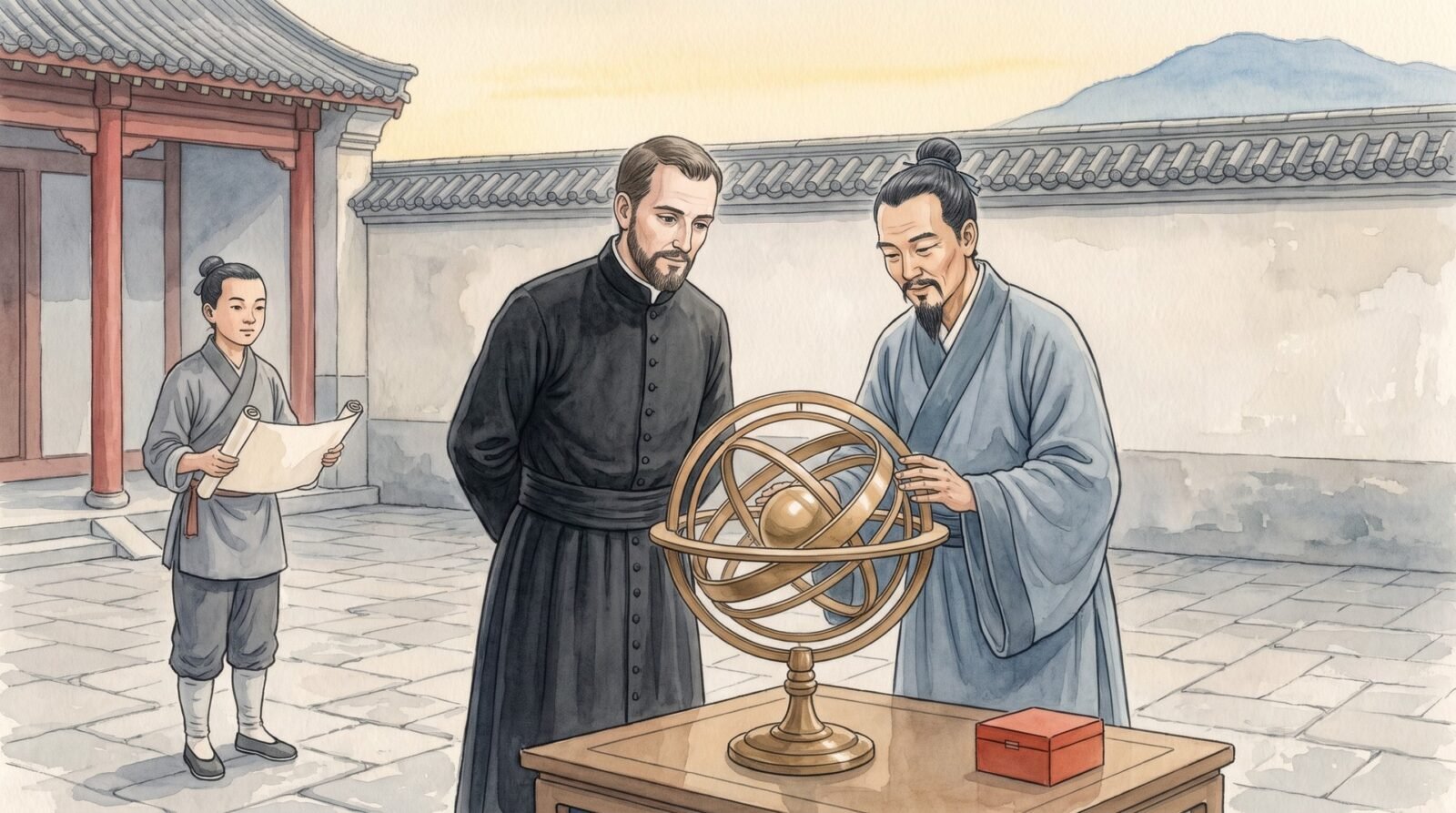
The instruments he left made the point permanent. Between 1669 and 1674 Verbiest built six large bronze instruments at the observatory, in the Tycho tradition, with a quadrant, sextants, azimuth compasses, a celestial globe and two armillary spheres; they stand at the Ancient Observatory in Beijing to this day. He also had compiled a perpetual calendar extending the tables for two thousand years, presented in 1678, in a calculated gesture at dynastic permanence. In the years after the case, Kangxi had his own mathematicians taught and set up an academy of mathematics under his third son, taking care not to let the missionaries’ monopoly harden. The southern and northern schools of mathematics, as historians call them, the practical geometry and water control of Xu Guangqi’s circle and the more algebraic northern line of Wang Xi and Mei Wending, were both fed by the Jesuit encounter, though the neat division is a later historiographic convenience that some specialists now question.
Life at court was a peculiar mixture of intimacy and condescension. The Jesuits had no rank in the Chinese bureaucracy and no formal access to the emperor, but they were admitted to his private apartments more often than most Chinese officials, and they received the wages and the robes that marked them as members of the imperial household. Some were described, in the Manchu idiom and with real precision, as family slaves, and the arrangement gave them a security that no other foreigner enjoyed and a dependence that no dignity allowed. Kangxi was a genuinely curious man about European mathematics and the physical world, and he used the Jesuits without illusion about them. When his officials reported that the Westerners were growing more contentious and were even attacking Confucius, the emperor’s response was reported in the Chinese record in a form that sums up the whole relationship: he treated them well merely to make use of their skills.
What the Qing state took from this arrangement was larger than the court intended and smaller than the Jesuits hoped. The empire’s astronomical office ran on European methods with European instruments and, for most of the eighteenth century, with European staff, and the calendar became a little more accurate. Chinese mathematicians learned to use logarithms, to handle algebraic notation, and to work with a kind of problem that had no classical Chinese form. The court painter’s art absorbed European perspective, and the empire’s cartography was remade by survey. What did not happen was the thing the missionaries had been sent to achieve and the thing many Chinese scholars had half expected, which was a general Europeanisation of learning. The transmission stayed at court, stayed in a small circle, and stopped at the point where the government stopped paying for it. When Kangxi’s third son and the academy of mathematics lost their imperial backing under the Yongzheng, the institutions went with them.
The clearest case is painting. In 1715 the Italian Jesuit Giuseppe Castiglione arrived in China with the reinforcements that Louis XIV’s mission sent to Kangxi, and he served the last three Qing emperors as a court painter, working under the Chinese name Lang Shining. He was not the only European hand in the imperial workshops, and the famous Kangxi Southern Inspection Tour album, begun in 1691 under Wang Hui, was a collaborative Chinese enterprise in which the Jesuits’ contribution was chiefly the surveying and the astronomy, not the brushwork. But Castiglione changed the conventions. His animals, with their soft modelled fur and their light, and his figures with their cast-iron shadows and their European perspective, were so successful that a whole generation of Qing court painters learned to imitate them. He worked with Jiao Bingzhen on the new edition of the Pictures of Tilling and Weaving, the great agricultural series begun for the Kangxi emperor in 1696 in forty-six leaves and engraved for wide distribution in 1712, and he supplied illustrations for the agricultural sections of the great imperial encyclopedia, the Gujin tushu jicheng, compiled between 1701 and 1706 under Chen Menglei and Jiang Tingxi. The Jesuit contribution to Qing art was not that it was Western. It was that it was western-facing, and that the court wanted it. The same was true of the great survey begun in 1708, which produced the Huangchao quantu tu, the first accurate large-scale map of the empire based on systematic measurement. That is the shape of the whole story at the Qing court: the Chinese state set the terms, decided what was worth having, and paid for it. The Jesuits supplied the expertise; the Manchus and their Han collaborators supplied the purpose.
The end: usefulness running out
Kangxi died in 1722. His successor Yongzheng had won a bitter succession struggle against his brothers, and he had spent those years watching the Kangxi court, including the Jesuits, and forming a view of them. He had no interest in Western science or Western curiosities. The document of his that survives in a form historians can use is a letter to the governor Nian Gengyao, in which he explained his father’s policy. The current emperor, he wrote, had hardly made personal use of any European, because he had no interest in science or in foreign treasures; the missionaries had been kept in the capital because the Kangxi court had needed their services, and now that the services were no longer needed the arrangement had no reason to continue. In January 1724 Yongzheng issued the edict that ended the open mission. Preaching was forbidden; the missionaries in the provinces were to be sent to Canton and Macao; churches and mission property were confiscated; and only those with technical duties at court were to be left in the capital. The Kangxi emperor’s own declaration of 1721 had already said that the Westerners should not be allowed to preach in China, and it is sometimes given as the date of the Yongzheng prohibition; the two things are better kept distinct, the first being a declaration and the second a systematic expulsion.
What Yongzheng did not manage was to stop the religion, because by 1724 the church in China was no longer mainly a European institution. The converts were numerous enough, scattered enough and stubborn enough to survive without the missionaries. The great families of Christians, the Wang and the Liu and the others, formed village communities with their own generational clergy, their own altar servers, their own marriage and burial customs, their own saints’ days and their own way of keeping the faith, and they developed a repertoire of concealment: churches built without a cross, prayers said with a nod rather than a bow, a list of names kept in a place where a magistrate would not think to look. European missionaries still came, in ones and twos, hidden in the holds of junks and in sacks of merchandise, and the famous case of 1784 to 1785 shows how effective the network was: when four Italian priests were intercepted in Hubei while being relayed north by a chain of Christian porters, the resulting investigation uncovered and arrested eighteen foreign missionaries and several hundred Chinese Christians across more than ten provinces. The sentences were ferocious. Some were sent into exile at Ili; some were given over to be enslaved. What the episode proved was that the church had survived the ban, not that the ban had failed to hurt.
Under Qianlong the pressure tightened further. A Qing edict of the 1730s forbade the Manchu banners from joining the religion. In Fujian in 1746 and the two years after it, a Spanish Dominican bishop and three of his brethren were executed, and their deaths caused a diplomatic scandal in Madrid and Manila. In the 1750s cases followed one another: a missionary brought secretly into Sichuan in 1753, another smuggled into Shandong in 1754, the torture of the Portuguese Jesuit Jose de Araujo in the Jiangnan, and in 1755 the execution at Suzhou of the Italian Jesuit Tristano d’Attimis and the Portuguese Antonio Jose Henriques. The Qing state had by then made the point thoroughly.
The end of the Jesuits as an institution was, however, a European decision. On 21 July 1773 Pope Clement XIV signed the brief Dominus ac Redemptor, suppressing the Society of Jesus throughout the world. The news reached Peking unofficially in August 1774 and was promulgated at Nanjing on 15 November 1775 by Bishop Gottfried Xaver von Laimbeckhoven, himself a Jesuit, who had to tell his own order of its death. Only a few dozen Jesuits remained in China, twenty-six of them in the empire when the suppression took effect there in 1775. The Portuguese, French, German and Italian mission houses all ended, and the arrangement that had governed missionary travel since the Treaty of Tordesillas dissolved with them. The ex-Jesuits stayed on at the court, serving the Qianlong emperor as artisans and astronomers without being able to call themselves Jesuits, and their astronomical work in the bureau was carried on by four Portuguese former Jesuits until 1805. The Society was restored in Rome in 1814 but did not return to China until after the Opium War.
It is worth dwelling on the Portuguese patronage that lay behind all of this, because it is the hidden scaffolding of the entire story. The division of the world between Spain and Portugal, made by the papal bulls of 1493 and the Treaty of Tordesillas in 1494, gave the Portuguese crown the right to appoint bishops and missionaries in Asia, the arrangement known as the padroado. Missionaries travelled from Europe to Goa and Macao, under a pass that Lisbon issued, and in practice the Portuguese crown and the Society of Jesus between them made the decisions about who went. It worked reasonably while Portugal was rich and assertive. It worked badly as the empire declined. Rome created the Congregation of the Propagation of the Faith in 1622 to escape Lisbon’s control; the friars of the Spanish orders came east in the 1630s; and when five French Jesuits arrived in 1687, sent by Louis XIV with the title of mathematicians of the king, they broke the Portuguese monopoly in the one place where it mattered. The result at court was a visible one: the Nantang was the Portuguese church, and the Beitang, built between 1699 and 1703 on land the Kangxi emperor granted to the French in 1694, was the rival foundation of a rival patronage. Two churches a few hundred paces apart in the same city, with different fonts of water and different patrons in Rome, told the Chinese more about the nature of the European presence than any amount of preaching had.
So what did the encounter leave? On the Chinese side, a set of durable acquisitions that were absorbed so completely as to become invisible: the idea of the earth as a sphere with five continents, the armillary sphere and the quadrant as instruments of instruction, Euclid in Chinese, a calendar bureau that worked on European arithmetic, a court painting that could render light and distance, and a school of mathematics that thought in logarithms and symbolic notation. It also left a set of arguments that had been settled in the Qing state and reopened in Rome: that the rites of Confucius and the ancestors were civil, that the classics used the words for God, that a convert need not choose between the Christian and the Confucian life. The historian who says the Jesuits changed China has to add that they changed it by being useful to a state that was already changing, and that when the state stopped needing them the arguments went with them.
On the European side, the Jesuits returned with a picture of China that was itself an act of invention: a claim that the empire was ancient, rational and rich; a dictionary; the first European descriptions of the classics, the examination system and the administrative machinery; the discovery, or the rediscovery, of Confucius as a philosophical teacher; and a set of habits of mind, comparative religion, comparative law, the idea that a civilisation could be understood before it was judged. The most durable European product of the China mission was the conviction, formed in the contact, that China was a rival. The two centuries of Jesuit correspondence that followed served as the great rehearsal for the encounter that was to come, and the rehearsal was conducted in a register that turned out to be mistaken: the European side learned a great deal about Chinese learning and very little about Chinese power.
The historians who have worked most closely on this story have also dismantled several comfortable pictures. The world map was not Ricci’s alone; it was financed, drawn, cut and printed by Chinese hands. The accommodation was not a disinterested tolerance; it was a strategy, and the Chinese who adopted it knew exactly what it was worth. The Jesuits were not merely scholars; they were agents of a European crown, and Chinese officials knew it, and the suspicion of spies was never entirely wrong. The clock was not a gift that won an empire; it was a technical dependency that bought access, and access bought nothing else. And the calendar case shows how little control either side had: the Jesuits did not defeat Chinese astronomy, and the Qing did not expel Western astronomy. A younger emperor simply asked which of two predictions was correct, and the answer turned out to be the one made with the better instruments. That, rather than any conversion, is the moment at which the two systems touched most closely, and the moment at which the European presence became, for the time being, indispensable and therefore safe.
References
- The Cambridge History of China, Volume 9, Part 1: The Ch’ing Empire to 1800 – Edited by Willard J. Peterson, Cambridge University Press, 2002
- The Cambridge History of China, Volume 9, Part 2: The Ch’ing Dynasty to 1800 – Edited by Willard J. Peterson, Cambridge University Press, 2016
- The Memory Palace of Matteo Ricci – Jonathan D. Spence, Viking Penguin, 1984
- China in the Sixteenth Century: The Journals of Matthew Ricci, 1583-1610 – Matteo Ricci with Nicolas Trigault, translated by Louis J. Gallagher, Random House, 1953
- Handbook of Christianity in China, Volume One: 635-1800 – Edited by Nicolas Standaert, E. J. Brill, 2001
- Chinese Books: A Guide to the Chinese Collections in the Archivum Romanum Societatis Iesu – Nicolas Standaert and Ad Dudink, Archivum Romanum Societatis Iesu, Rome
- Archival Holdings of the Archivum Romanum Societatis Iesu – Archivum Romanum Societatis Iesu, Rome, including the Fondo Gesuitico
- Catalogo dei manoscritti del Fondo gesuitico – Biblioteca Nazionale Centrale di Roma, Rome, shelfmarks Ges. 1-1752
- Kun yu wan guo quan tu (Great universal geographic map), Beijing, 1602, six panels – Matteo Ricci with Li Zhizao and Zhong Wentao, Library of Congress, Geography and Map Division, call number G3200, LCCN 2010585650
- Kunyu Wanguo Quantu map – Royal Geographical Society, London, Collections
- 1607, A Year of (Some) Significance: Translation of the First European Text in Mathematics, Elements, into Chinese – Man-Keung Siu, Department of Mathematics, University of Hong Kong
- Revisiting the Calendar Case (1664-1669): Science, Religion, and Politics in Early Qing Beijing – Ad Dudink, HAL Sciences, Paris
- The China Mission at Work (Seventeenth and Eighteenth Centuries): Outcomes of the Res Sinicae Project – Jesuit Sources, Ricci Institute for Chinese-Western Cultural History, Boston College
- Publications of the Ricci Institute for Chinese-Western Cultural History – Ricci Institute, Boston College
- The Early Modern Jesuit Mission to China: A Marriage of Faith and Culture – Education About Asia, Association for Asian Studies
- The Chinese Rites Controversy: Papal Decrees of Clement XI and Benedict XIV and the Kangxi Decree of 1721 – Internet History Sourcebooks, Fordham University, translated from the Chinese by D. J. Li, 1969