Chongqing has never been a simple city to move through. It is a place of ridges and gorges, rivers and bridges, stacked neighborhoods and tunnels carved through stone. For much of its modern history, the challenge has not merely been building transport infrastructure, but building it in a way that respects the terrain, connects separated communities, and allows a municipality of more than thirty million people to function as a single economic body. Chongqing East Railway Station belongs to that longer story. It is not just another train station with a larger waiting hall or more platforms. It is a statement about where Chongqing believes its future lies: outward, upward, and especially eastward and southward, toward stronger links with coastal China, central China, and the broader national high-speed rail network.
When Chongqing East opened on 27 June 2025, with forty-six trains and a building drawn for lines that are still being finished, it marked the arrival of a new phase in the city’s rail history. After years of planning, excavation, bridge-building, and urban redesign, a vast new gateway appeared on the south bank of the Yangtze River in Nan’an District. To a casual visitor, it may look like an impressive piece of contemporary infrastructure: broad concourses, layered circulation spaces, high-speed trains, metro connections, buses, taxis, and commercial development gathered around a single node. But to understand why it was built, one has to look beyond the architecture. Chongqing East exists because the city’s older rail geography had become a constraint, because national high-speed rail corridors demanded a new eastern door, and because Chongqing wanted to reshape its own urban future around a station that could serve not only trains, but also industry, commerce, tourism, and daily life.
A Station Born from a Mountain City’s Transport Dilemma
Chongqing’s rail story has long been shaped by geography. The historic urban core developed around the confluence of the Jialing River and the Yangtze River, with the Yuzhong Peninsula acting as a commercial and administrative heart. Building railways in such a landscape is difficult. Flat land is scarce, river crossings are expensive, and steep slopes limit the routes available for tracks, stations, and approach roads. As a result, Chongqing’s major passenger stations ended up serving different directions and different parts of the city, but none of them fully solved the problem of creating a smooth, multi-directional rail network.
For decades, Chongqing Station near the old city center carried much of the city’s rail identity. It was convenient for the historic core, but it was constrained by space and by the surrounding urban fabric. Later, Chongqing North Railway Station in Yubei District became the workhorse of the city’s high-speed rail expansion, especially for routes heading north and east. Chongqing West Railway Station, opened in 2018, strengthened connections toward western and southwestern destinations. These stations were important, and they remain important today. Yet together they revealed a structural imbalance: Chongqing had powerful rail doors to the north and west, but its rapidly growing southern and eastern urban areas lacked a comparable gateway.
That imbalance mattered for more than convenience. In a city as large and polycentric as Chongqing, railway stations shape where people live, where businesses locate, where tourists arrive, and where capital flows. A station is not only a place to catch a train. It is an anchor for urban development. If the major stations are concentrated in one part of the metropolitan area, then growth, investment, and accessibility tend to follow them. Chongqing’s leaders recognized that the city needed a new pole of development, one that could rebalance the urban structure and give the eastern and southern banks of the rivers a world-class transport interface.
Chongqing East Station was therefore conceived as part of a larger reorganization of the city’s passenger rail system. Instead of relying primarily on a north-centered model, Chongqing moved toward a multi-station pattern: north, west, and east. The new station would complete a triangular framework capable of handling traffic from more directions, reducing pressure on older terminals, and allowing the city to grow in a more balanced way.
What Chongqing East Station Actually Is
Located in Nan’an District, near the Longmenhao area on the south side of the Yangtze River, Chongqing East Station is one of the most significant transport projects in southwestern China in recent years. It is large by any standard. The station complex and its surrounding integrated transport facilities cover more than a million square metres, making it one of the biggest railway hubs in the region. Its layout is designed to accommodate multiple high-speed rail corridors, with a substantial platform and track arrangement that allows simultaneous operations in several directions.
But scale alone does not explain the station’s importance. What makes Chongqing East distinctive is its ambition to be more than a rail terminal. It is designed as a comprehensive transport hub, combining high-speed rail, regional rail, metro lines, bus services, taxi pick-ups, private vehicle access, and pedestrian circulation. The idea is to reduce friction between different modes of transport. A passenger arriving by train should be able to move into the city quickly, whether heading to a business district, a university campus, an industrial park, the airport, or a residential neighborhood.
The station also reflects a broader trend in Chinese infrastructure planning: the shift from “station as building” to “station as city.” Chongqing East is part of a planned station area that includes commercial space, office development, public realms, and transport-oriented urban growth. Rather than treating the station as a sealed terminal surrounded by roads and parking lots, planners imagined it as a porous urban district, where rail infrastructure supports daily life and economic activity. Rooftop public spaces, layered concourses, and connections to surrounding blocks are all part of this philosophy.
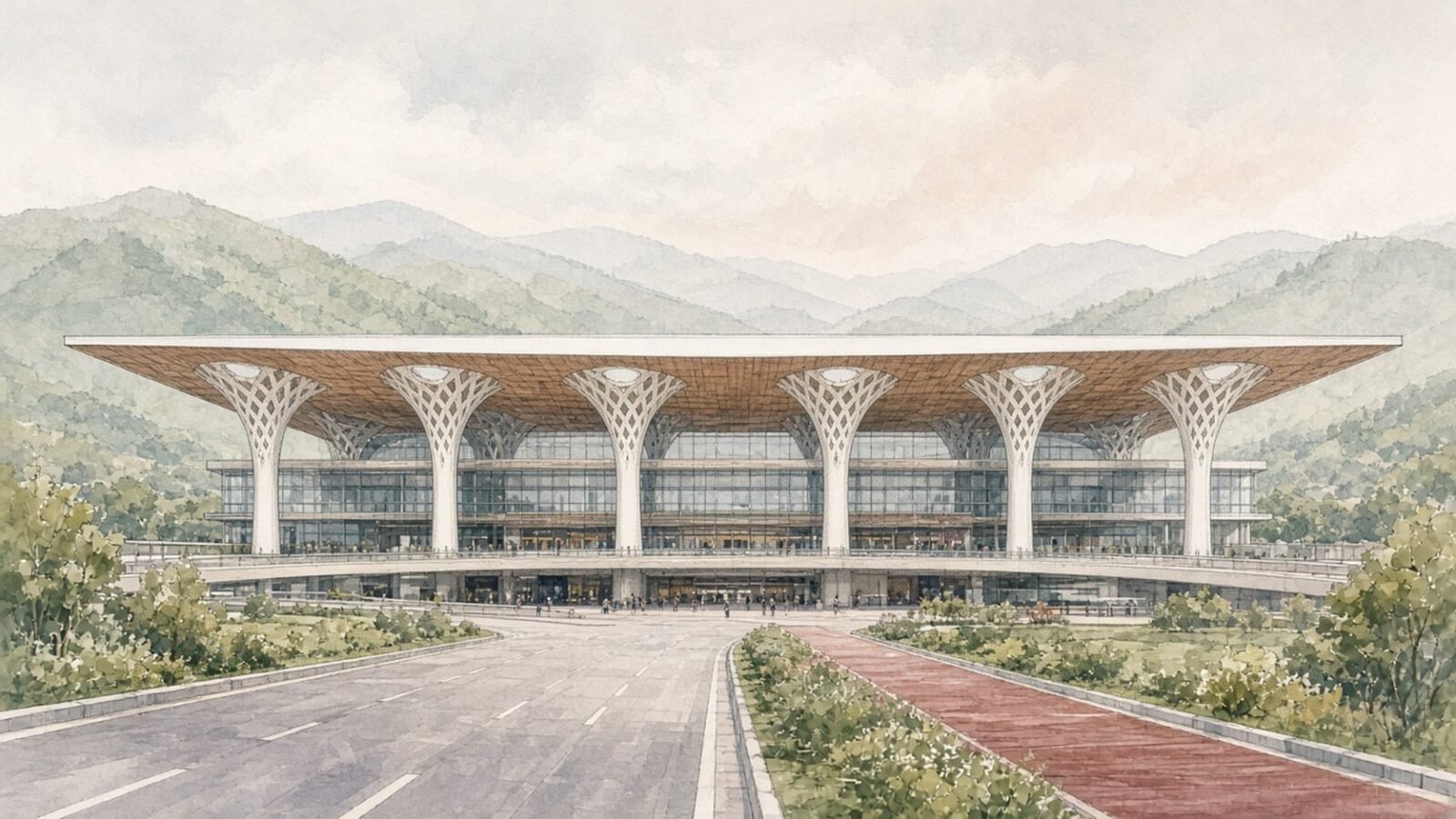
In architectural terms, the station tries to speak the language of Chongqing itself. The city is often described as a mountain city, a river city, and a bridge city. Chongqing East’s design echoes those identities through elevated platforms, cascading spaces, and visual references to the region’s topography. It does not merely sit on the land; it appears to rise from it. That symbolism matters. A major station is a civic monument as much as a functional facility. It tells visitors what kind of place they have entered. Chongqing East says that this is a city that is dense, engineered, ambitious, and connected.
The Old Problem: Chongqing’s Rail Geography Was Becoming a Bottleneck
To understand why Chongqing East was built, it helps to imagine the city’s rail network before the new station existed. Chongqing North had become the dominant high-speed gateway, especially for services toward Beijing, Shanghai, Guangzhou, and other major eastern and northern cities. It was a successful station, but success created pressure. As train frequencies increased and surrounding urban development intensified, the approaches to the station became more constrained. Expanding a major rail hub inside a dense mountain city is not like expanding one on a flat plain. Every additional track, road, or concourse requires negotiation with terrain, existing neighborhoods, and limited land.
Chongqing West helped relieve some pressure by serving western and southwestern corridors. Yet its location also meant that it did not fully address the city’s eastern and southeastern ambitions. Much of Chongqing’s future growth, especially in manufacturing, logistics, urban expansion, and riverside development, was oriented toward the southern and eastern parts of the central urban area. A station in the west could not by itself catalyze those zones.
There was also a network problem. High-speed rail is most powerful when trains can move through a city efficiently, not merely terminate there. Chongqing had become a major node, but parts of its rail arrangement still reflected older patterns where trains ended their journeys at stations with limited through-capacity. As national corridors matured, the city needed a facility that could better support continuous movement across the rail network. Chongqing East was intended to play that role.
This is why the station should not be understood simply as a response to overcrowding. It is also a response to topology. Chongqing’s rail system needed a new geometric center of gravity. The old stations solved the problems of their eras, but they could not alone support the next stage of integration between Chongqing, the Chengdu–Chongqing urban agglomeration, central China, and the southeastern coast.
The National High-Speed Rail Map Made an Eastern Door Necessary
China’s high-speed rail network is often described through the phrase “eight vertical and eight horizontal,” a planning framework that envisions a nationwide grid of major corridors. Chongqing is not a peripheral city in this system. It is a crucial node connecting western China, central China, the Yangtze River Economic Belt, and the southwest. But being a node is not enough. A node must have the station capacity and track arrangement to handle the flows that the network creates.
Chongqing East is closely tied to corridors heading southeast and east. One of the most important is the Chongqing–Xiamen / Chongqing–Shantou direction, which links the upper Yangtze region with coastal Fujian and Guangdong. The opening of the Chongqing–Qianjiang section of this corridor was a milestone, and Chongqing East serves as a key urban gateway for such services. For travelers, the practical effect is dramatic: places that once required long, winding rail journeys or road trips become reachable in a fraction of the time. For businesses, the effect is equally significant. Shorter travel times reduce the friction of distance and make cross-regional coordination easier.
Other corridors also matter. Chongqing’s connections toward Wanzhou and the Three Gorges region are strengthened by new high-speed capacity. Links toward Guizhou and Yunnan remain central to the city’s role as a southwestern hub. The Chengdu–Chongqing twin-city economy, one of China’s major national growth poles, depends on faster and more frequent rail movement between the two municipalities and their surrounding cities. While not every one of these routes terminates exclusively at Chongqing East, the station is designed to give the Chongqing rail枢纽 greater flexibility in handling them.
This flexibility is essential. In a mature high-speed rail network, cities compete not only by having stations, but by having stations that can integrate multiple flows without excessive bottlenecks. Chongqing East allows the city to present itself as a through-connected hub rather than a terminal city. A traveler from the coast heading inland, a businessperson moving between Chengdu and central China, a tourist visiting the Wuling Mountain area, or a family returning to a county-level city under Chongqing’s administration can all benefit from a more rational rail arrangement.
Purpose One: Turning Chongqing from Endpoint into Through-Node
One of the central purposes of Chongqing East Station is to improve through-movement. Historically, many passengers arriving in Chongqing experienced the city as a destination: the train ended, the station emptied, and onward travel depended on road transport or secondary rail connections. But Chongqing’s ambition is to be more than a final stop. It wants to be a place where flows pass through, exchange, and continue.
Through-operation is not just a technical railway matter. It changes the psychology of the network. When a city can handle trains smoothly in multiple directions, it becomes more attractive for business, tourism, and logistics coordination. Companies prefer locations where partners, clients, and employees can move without complicated transfers. Tourists prefer gateways that make multi-destination itineraries easy. Governments prefer hubs that generate economic spillovers across a wider region.
Chongqing East contributes to this by adding capacity and routing options to the Chongqing rail system. It helps distribute trains across a broader station network, reducing the risk that one terminal becomes overloaded. It also supports the idea of Chongqing as part of a larger corridor economy, linking the Yangtze upstream and downstream, the southwest and the southeast coast, and the Chengdu–Chongqing core with national markets.
In this sense, the station is infrastructure for connectivity, not merely for passenger comfort. It is a tool for inserting Chongqing more deeply into China’s internal geography. The city has long been an inland powerhouse, but inland status can become a disadvantage if transport networks bypass it or force circuitous movement. Chongqing East is an attempt to turn inland location into network advantage.
Purpose Two: Shortening the Distance to the Coast and Central China
Chongqing’s relationship with China’s coast has always been complex. The city is a major river port, historically connected to the Yangtze economy, but it is also far from the southeastern coastal megaregions that drive so much of the country’s trade, technology, and finance. Rail has narrowed that distance, but not all rail routes are equal. A station that can efficiently serve southeastern corridors changes the practical geography of the city.
Before high-speed rail improvements, travel from Chongqing to many coastal destinations could feel long and fragmented. Journeys to parts of Fujian, Guangdong, Jiangxi, or Hunan might involve indirect routing, slower conventional lines, or inconvenient transfers. Chongqing East, together with new high-speed sections, compresses those distances. The station becomes a launchpad toward the sea.
This matters for tourism. Chongqing is already one of China’s most visually distinctive cities, known for its hotpot, night views, stilted landscapes, mountain roads, and proximity to the Three Gorges, Wulong karst, and southeastern Chongqing’s ethnic minority regions. Faster rail links make it easier for coastal visitors to enter these areas and for Chongqing residents to travel outward. Tourism is not just about leisure; it is about image, service employment, hospitality investment, and cultural exchange.
It also matters for labor and entrepreneurship. Young professionals can move more easily between Chongqing and coastal cities. Families separated by distance can visit more often. Companies can maintain satellite offices, supply-chain contacts, and recruitment pipelines with less friction. In a knowledge economy, face-to-face movement still matters, even in an age of video calls. A high-speed rail hub reduces the cost of maintaining relationships across regions.
Chongqing East therefore functions as a psychological as well as physical gateway. It tells residents that their city is not stuck in the interior. It tells investors that Chongqing can connect to national and global circuits. And it tells neighboring provinces that Chongqing is a partner in corridor development, not a remote endpoint.
Purpose Three: Rebalancing Chongqing’s Urban Development
If Chongqing East were only a rail facility, it would still be important. But its urban purpose may be even more consequential. Chongqing is a municipality of enormous geographic size, with a sharp contrast between dense urban cores and outlying districts. The central city has long been shaped by the rivers, the peninsula, and the northern expansion toward Yubei and Jiangbei. The southern and eastern banks have significant potential, but they have also needed stronger anchors to attract investment, talent, and public services.
A major railway station can provide that anchor. It creates a fixed point around which transit, commerce, housing, and civic space can organize. In Chongqing’s case, the station area in Nan’an District is intended to become a new urban gateway, a place where the city meets the national rail network. This can help redirect growth toward underutilized or underperforming zones, easing pressure on the older core while creating a new center of gravity.
The station also supports the idea of a polycentric city. Rather than forcing all major flows through one historic center, Chongqing can develop multiple nodes, each with its own specialization. Chongqing North can continue serving northern and eastern corridors. Chongqing West can anchor western and southwestern links. Chongqing East can become the face of southeastern connectivity and urban renewal. Together, these nodes can make the metropolitan area more resilient and more balanced.
This rebalancing has social implications as well. Transport infrastructure often determines access to opportunity. If good jobs, cultural facilities, and service industries concentrate only in one part of the city, residents elsewhere face longer commutes and lower quality of life. By strengthening the eastern and southern urban areas, Chongqing East may help distribute opportunity more evenly. It may not solve housing affordability or regional inequality by itself, but it changes the map on which those problems are played out.
Purpose Four: Creating a Station-City Economy
Modern railway stations in China are increasingly designed as engines of “station-city integration.” The idea is that a station should not be an isolated island of transit, but a productive urban district. Chongqing East follows this logic. Around the station, planners envision a mix of offices, retail, hotels, conferences, cultural venues, public spaces, and residential development. The station becomes the spine of a larger economic ecosystem.
This kind of transit-oriented development can generate value in several ways. First, it captures some of the economic benefit created by improved accessibility. When a station reduces travel time, land around it becomes more valuable. If that value is planned well, it can fund public space, transport upgrades, and community facilities. Second, it creates agglomeration effects. Businesses like being near airports, highways, and especially high-speed rail stations because these interfaces reduce transaction costs. Third, it makes the station area a daily destination, not merely a place people pass through.
For Chongqing, the station-city economy has symbolic importance too. The city has often been admired for its dramatic urban form, but it has also faced the challenge of being perceived as remote or difficult. A vibrant station district can change that perception. It can offer a first impression of a modern, efficient, culturally distinctive Chongqing. Visitors arriving by train would not simply exit into a parking garage; they would enter a designed urban environment that reflects the city’s ambitions.
The commercial potential is obvious, but the civic potential may be even more important. A great station area can become a public living room: a place for meeting, working, resting, consuming, and observing the city. In a mountain metropolis where public space is often fragmented by topography, a large integrated station district can provide rare continuity. It can connect people to trains, yes, but also to one another.
Why It Was Built Now
Large infrastructure projects are rarely accidental. They emerge from the convergence of planning cycles, economic needs, political priorities, and technical feasibility. Chongqing East was built now because several forces aligned.
One force is the maturity of China’s high-speed rail network. In the early 2000s, the priority was to build trunk lines and get trains moving. By the 2020s, the challenge had shifted toward optimization: filling gaps, improving connectivity between corridors, and making hub cities more efficient. Chongqing East fits this second phase. It is not the first high-speed station in the city, but it is part of a more refined attempt to make the network work as a system.
A second force is national regional strategy. The Chengdu–Chongqing Twin-City Economic Circle has been elevated in policy discussions as a major engine for western China. The Yangtze River Economic Belt emphasizes ecological protection and coordinated development along the river. The New Western Land-Sea Corridor seeks to connect western provinces to global markets through integrated land, rail, and port links. Even though Chongqing East is primarily a passenger station, it supports these strategies by improving human mobility, business confidence, and regional integration.
A third force is urban pressure. Chongqing’s older stations and road networks face congestion. The city’s spatial structure demands new poles of development. The eastern and southern areas need infrastructure that can justify and accelerate investment. Building a major station is expensive, but not building one may eventually be more expensive in lost opportunity, traffic strain, and uneven development.
Finally, technical capability made the project feasible. Building a huge station in mountainous terrain, with deep foundations, extensive civil works, river-adjacent logistics, and complex urban interfaces, requires advanced engineering. China’s experience with high-speed rail, metro construction, bridge-building, and large public facilities gave Chongqing the confidence to pursue a project that would have been far more difficult a generation earlier.
Design as a Civic Statement
Chongqing East’s architecture is not merely functional. It is also communicative. The station’s layered forms, elevated spaces, and references to mountain and river landscapes make it a piece of civic storytelling. It presents Chongqing as a city that has learned to build with its geography rather than against it.
Inside, the design aims to manage the flow of very large numbers of people. Wayfinding, separation of arriving and departing passengers, integration with metro lines, and access to commercial services all shape the experience. A station can be impressive but confusing, or efficient but soulless. Chongqing East attempts to avoid both extremes by combining scale with spatial clarity.
The emphasis on public space is particularly notable. Rooftop gardens, terraces, and pedestrian-friendly zones suggest that the station is meant to be enjoyed, not merely crossed. This reflects a broader change in Chinese urban design. Earlier generations of infrastructure often prioritized throughput above all else. Newer projects increasingly recognize that public spaces create social value, support mental well-being, and make cities more livable.
Sustainability is another theme. Large stations consume enormous amounts of energy, so daylighting, ventilation, material efficiency, and smart systems matter. Chongqing East’s design includes efforts to reduce environmental impact and improve operational efficiency. In a city sensitive to heat, humidity, and air quality, these features are not cosmetic. They affect how comfortable and usable the station becomes over decades of service.
The station also carries cultural symbolism. Chongqing has a strong local identity shaped by river trade, wartime history, industrial labor, food culture, and a reputation for directness and resilience. A new gateway station can either erase local character under generic modernity or amplify it. Chongqing East leans toward the latter. It is modern, but not placeless. It is large, but it tries to speak in a Chongqing accent.
What the Station Means for Ordinary Travelers
For policymakers, Chongqing East is a strategic asset. For urban developers, it is a land-value engine. For railway operators, it is a capacity node. But for ordinary people, its meaning is simpler: time, choice, and dignity of movement.
Time is the most immediate gift. A station that reduces transfers, shortens access to trains, and connects more directly to destinations gives people back hours. Those hours can be spent with family, at work, resting, or exploring. In a fast-moving society, travel time is not a neutral interval. It shapes quality of life.
Choice matters too. A multi-station system gives travelers alternatives. Depending on destination, a passenger may choose Chongqing North, Chongqing West, or Chongqing East. This can reduce crowding and make journeys more predictable. It also allows rail operators to schedule services more flexibly.
Dignity of movement is less often discussed but equally important. A well-designed station treats travelers as citizens, not merely as footfall. Clear signs, safe circulation, accessible facilities, clean public spaces, and efficient transfers communicate respect. Chongqing East, at its best, can offer that experience. It can make the act of leaving or arriving feel like part of the city’s culture rather than a stressful interruption.
Challenges, Risks, and the Question of Success
No major infrastructure project is free from risk. Chongqing East is impressive, but impressiveness does not guarantee success. The station must be used well, integrated well, and managed well over time.
One challenge is operational complexity. Large hubs can become confusing if signage, transfers, and crowd management are poorly designed. A station that is architecturally beautiful but difficult to navigate fails its primary purpose. Chongqing East will need continuous improvement based on real passenger behavior, not just design assumptions.
Another challenge is urban equity. Station-area development can raise property values, attract investment, and improve amenities, but it can also displace lower-income residents and small businesses if not carefully managed. Transit-oriented development should serve the many, not only the affluent. Chongqing will need policies that ensure housing, public space, and local commerce remain accessible.
There is also the broader question of debt and returns. China has built an extraordinary rail network, but some projects have faced criticism for costing more than the economic benefits they generate in the short term. Chongqing East should not be judged only by ticket revenue. Its value lies in agglomeration, time savings, tourism, urban rebalancing, and strategic connectivity. But those benefits must actually materialize. A station surrounded by empty offices or poorly served by transport would be a white elephant, however beautiful it may be.
Finally, success depends on integration with the rest of the city. A railway station cannot create urban vitality alone. It needs reliable metro service, bus connections, safe pedestrian routes, cycling infrastructure, commercial activity, and public programming. If the surrounding city does not meet the station halfway, the station will remain an island. Chongqing East’s future will therefore be written not only on its platforms, but in the streets, districts, and policies that surround it.
Chongqing East as a Bet on the City’s Future
At its core, Chongqing East Station is a bet. It is a bet that Chongqing’s future will be more connected, more polycentric, and more outward-facing. It is a bet that the city’s southeastern and southern corridors deserve a world-class gateway. It is a bet that high-speed rail will continue to reshape urban life in China, not by replacing cities, but by reorganizing them around new nodes of movement and exchange.
This bet reflects a larger transformation in how Chinese cities think about infrastructure. Roads, rails, airports, and stations are no longer seen merely as public works. They are instruments of spatial strategy. A new station can redirect growth, alter regional hierarchies, and change the story a city tells about itself. Chongqing East does all three. It redirects attention toward Nan’an and the eastern urban frontier. It strengthens Chongqing’s position within national corridors. And it reframes the mountain city as a hub rather than a remote interior fortress.
There is something especially fitting about placing such a station in Chongqing. The city has always been a place of thresholds: where rivers meet, where mountains rise, where inland and coastal economies intersect. Chongqing East extends that threshold logic into the rail age. It is a door, but not a door that closes. It is a door that opens in several directions at once.
Conclusion: More Than a Station
Chongqing East Station was built for practical reasons: capacity, connectivity, corridor integration, and relief for older terminals. But it was also built for imaginative reasons. It embodies a vision of Chongqing as a city that can master its terrain, balance its growth, and connect itself more deeply to China and the world.
The station’s purpose is not exhausted by the number of trains it handles or the square metres it covers. Its true purpose is to change relationships: between north and south, west and east, inland and coast, infrastructure and everyday life. It is meant to make Chongqing faster to reach, easier to leave, and more coherent as a metropolitan system.
Whether it fully achieves those goals will depend on management, integration, and the broader urban ecosystem that develops around it. But the decision to build it already reveals something important. Chongqing did not merely add another station. It redrew its own map. In doing so, it declared that the future of this mountain city would not be determined by rivers and ridges alone, but by the connections it chooses to make.