The Tower That Should Not Have Existed
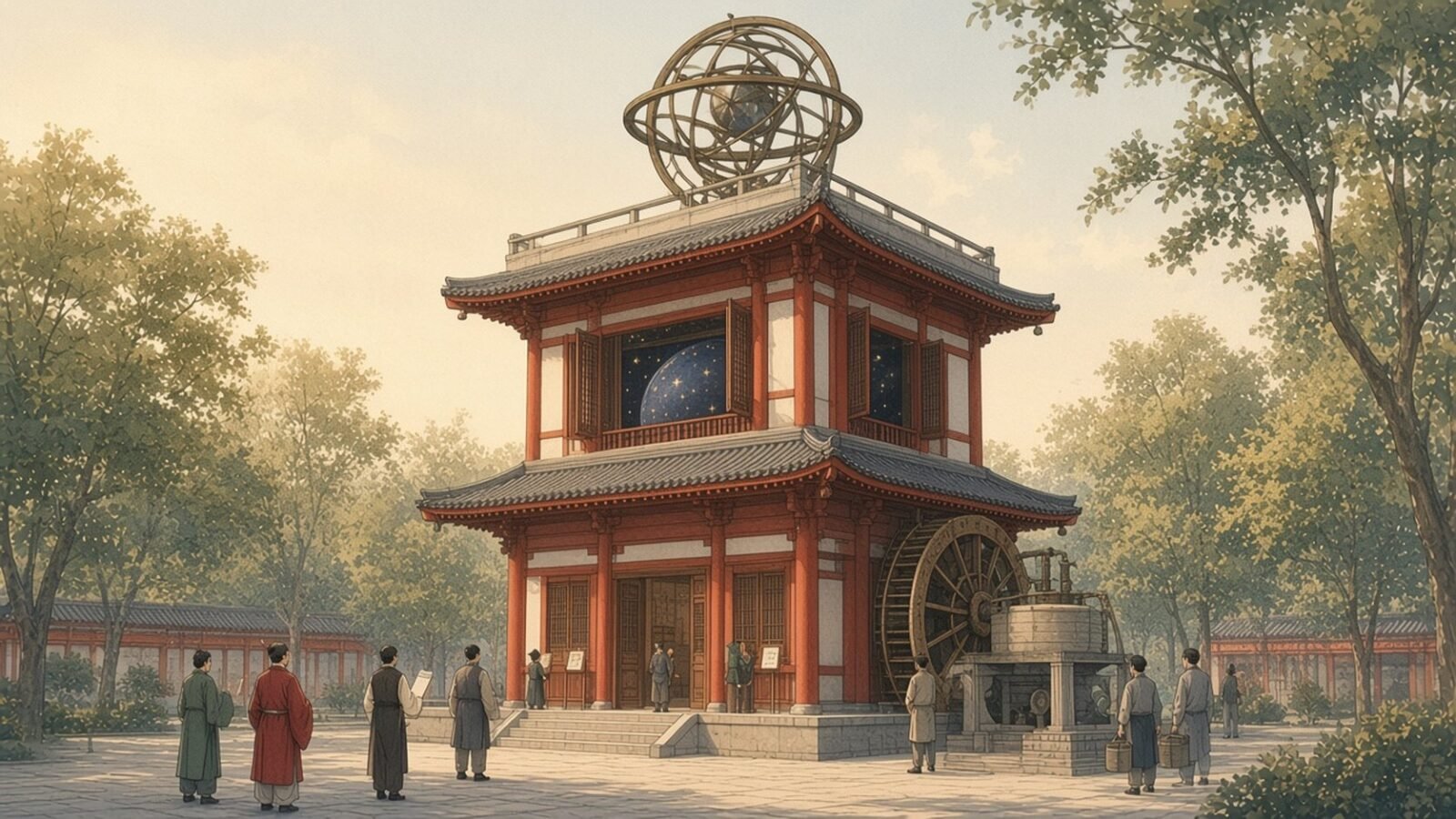
In the late spring of 1092, in the imperial capital of the Northern Song dynasty, an enormous tower of carved wood, bronze, and gold-leafed tile was raised on the eastern flank of the palace precinct at Kaifeng. It rose about thirty feet into the damp spring air. It was the most ambitious clock the world had ever seen, a pagoda-shaped structure that housed a celestial sphere, an armillary sphere, a water-driven escapement mechanism that turned a central shaft, a wooden waterwheel that lifted and dropped a sequence of bronze counterweights, and a ring of one hundred and thirty-three small mechanical figurines that stepped out of doors in the side of the tower at the right hour of the day or night to strike a bell, a drum, a gong, or to mark the position of the sun in the zodiac. The tower was not the only clock in Kaifeng. The Song imperial court already ran an elaborate water clock, an armillary sphere, and a celestial globe in the Astronomical Bureau. The 1092 tower was a replacement, and a deliberate one, designed to do everything the old equipment did at once, to do it more accurately, and to do it visibly. It was, in the most literal sense, a one-of-a-kind installation, a public monument to the new science of the Northern Song court, and a statement of imperial technological prestige intended to outshine every other clock in East Asia. The tower worked. It ran in the Kaifeng palace for thirty-four years, until the Jurchen armies of the Jin dynasty sacked the city in 1126 and 1127 and carted off or destroyed most of the imperial workshops. The mechanism was never rebuilt. The drawings that explained how it worked survived, in a single illustrated treatise written by the engineer who designed it, but the engineer’s notes were not read carefully in any language for another eight centuries. When they were read carefully, in the twentieth century, they did not look like a curiosity. They looked like the first working mechanical clock in the world.
The treatise is called Xin Yi Xiang Fa Yao, the Essentials of a New Method for Mechanising the Movement of the Heavens, and it is the most under-read foundational text in the history of horology. Its author was a man named Su Song, who in 1092 was a seventy-two-year-old official of the middle rank, a polymath who had already distinguished himself in pharmacy, in geography, in mathematics, in the politics of the Northern Song court, and in the design of astronomical instruments. He was not, in any modern sense, a clockmaker. He was a civil servant who had been charged by Emperor Zhezong, in 1086, with the design of a new astronomical clock, and who had spent the next six years of his life working out, in collaboration with a small workshop of artisans and engineers, a mechanism that he had never seen before. Su Song’s tower was, in its mechanical heart, the first clock in the world to use a true escapement. It was also the first clock of any kind to drive a celestial sphere, an armillary sphere, and a ring of animated figures from a single power source. It is, with the invention of paper money and the compass, one of the most striking single achievements of the eleventh-century Song state, and it is, for complicated reasons that have as much to do with the history of European science as with the history of Chinese science, the achievement that got away.
Su Song: A Northern Song Polymath
Su Song was born in 1020 in the Fujian prefecture of Tong’an, the son of a minor official, and was educated in the standard Chinese curriculum of the time, which meant the Confucian classics, history, and a fair amount of mathematics and astronomy on the side. He entered government service in his twenties and spent the next forty years rising through the bureaucracy of the Northern Song, much of it in the capital at Kaifeng. He was a working scholar in the manner of the Song literati, and his scholarly output was, by the standards of the period, enormous. He compiled a treatise on pharmacology, a long commentary on a classical Chinese almanac, a mathematical survey, and a pharmacological atlas of the empire. He served for several years as an administrator of the imperial court pharmacy, and he spent one of his terms in office in the Astronomy Bureau, which is where he acquired the technical expertise that he would later apply to the clock.
The Song court was, by the standards of any pre-modern Eurasian state, a profoundly technical one. The Northern Song in particular was the period of the Chinese compass, of printing with movable type, of the use of gunpowder in military weapons, of the development of the sternpost rudder, of chain-pump irrigation, of the systematic production of paper money, and of the rise of the great state-sponsored engineering works of the Yangzi and the Yellow River basins. The court employed thousands of artisans in its workshops at Kaifeng, and the workshops produced astronomical instruments, water clocks, and armillary spheres on a regular schedule. The Astronomical Bureau of the Song court, in Su Song’s day, was one of the great technical institutions of the world. It had a continuous history of instrument-making going back several centuries, and it was, in particular, the place in which the Chinese tradition of water-clock design had reached a remarkable refinement by the 1070s. The Song court had, in other words, the institutional context in which a serious astronomical clock project could be attempted. Su Song’s contribution to the tradition was, in this sense, the late and high point of a much longer development.
Su Song was not, in temperament, a typical court engineer. He was, in the main, a careful, conservative, and meticulous man. He had spent most of his life in a kind of civil-service career that rewarded caution and rewarded above all the production of written records. He wrote the Xin Yi Xiang Fa Yao in 1092, at the end of the six years of work on the clock, and the book was not a private notebook. It was a state-sponsored treatise, designed to be archived in the imperial library, with full drawings of the mechanism and a careful description of how the tower worked. Su Song’s drawings of the clock are, in fact, the first fully illustrated drawings of any clock mechanism in the history of horology, and they are detailed enough that a modern team of museum engineers was able to use them, in 2009, to build a working reconstruction of the clock in the Kaifeng Drum Tower. The reconstruction works. The drawings work. The texts of the treatise are detailed, technical, and only intermittently legible to modern readers, but the drawings are unambiguous. The clock worked as drawn.
Kaifeng in 1090
The city in which the tower was raised was, in 1092, the largest city on earth. Estimates of the population of Kaifeng in the late eleventh century run from about one million to about one and a half million inhabitants, and the city had been the capital of the Northern Song for nearly two centuries. The city was, by the standards of the period, a colossal administrative and commercial centre. Its population was famously ungovernable. The Song court kept a permanent garrison of several thousand soldiers in the capital. The streets were, by 1090, lit at night. The city’s restaurants, tea-houses, and brothels were, by contemporary accounts, more numerous and more elaborate than those of any other city in East Asia. The imperial palace at Kaifeng was one of the great architectural complexes of the medieval world. It was a city in which the clock could be displayed. The technological and the imperial were, at the court of the Northern Song, points of contact in a way that had not been true in earlier Chinese dynasties and that would not, in the same way, be true again.
The astronomical clock project, in particular, was an imperial commission, and the imperial context is important. The emperor under whom the clock was built was Emperor Zhezong, who was, in 1092, in his early twenties and had been on the throne for seven years. Zhezong’s reign was politically unstable, dominated by the rivalry between the reformist faction of Wang Anshi and the conservative faction of Sima Guang, and the astronomical clock was, in part, a way for the young emperor to demonstrate that the court was still capable of major institutional projects. The clock was a statement. It was not just an instrument. It was a monument.
The construction of the clock itself took place in the workshops of the Astronomical Bureau on the eastern side of the palace, and the tower was assembled in the spring of 1092 and demonstrated to the court shortly thereafter. The project was, by Song standards, a major one. Su Song had at his disposal a small team of court artisans and metalworkers, and the tower required a substantial amount of bronze, several dozen skilled woodworkers, and a continuing commitment of labour over several years. The cost of the project is not recorded in detail, but it was, by the standards of the Song court, a significant one. The decision to build the clock was, in other words, a deliberate imperial investment in technical infrastructure of a kind that few other states in the eleventh century would have considered.
The Escapement
The mechanical heart of Su Song’s tower was a device that he called the tianchi, a name that translates as the “celestial balance” or “celestial clepsydra” and that the imperial engineers and Su Song himself described in terms drawn from the older water-clock tradition of the Chinese court. The device was, in modern terminology, a true mechanical escapement — the mechanism that converts continuous rotational motion into discrete timed steps. The principle is the principle of the mechanical clock as we know it. The water-driven wheel turns a main shaft; the shaft is connected to a series of levers and balance arms; the levers engage and release a small locking mechanism that lets the shaft turn in precise increments; the increments are counted and the counts are displayed on a series of dials, on a celestial sphere, on an armillary sphere, and on the ring of mechanical figurines that mark the hours. The mechanism is, in essence, a clock of the same fundamental type that would not be invented in Europe until the thirteenth century at the earliest, and that became widespread in Europe only in the fourteenth and fifteenth centuries. The standard account of horology, in the European tradition, treats the mechanical escapement as a European invention, with its earliest surviving examples in English monastic clocks of the late thirteenth century. Su Song’s clock is older by about two centuries.
The standard account is, on this point, wrong. It is wrong in detail, and it is wrong in the broader picture. The escapement, in Su Song’s design, was driven by water, not by a falling weight, and it did not have the symmetric balance wheel that would become standard in European clockwork. It was, on the other hand, a real mechanical escapement. It had the property of converting a continuous driving motion into discrete timed steps, which is the property that defines the class. The mechanism has been carefully reconstructed by modern engineers, and it works. Joseph Needham, in volume four of Science and Civilisation in China, treated the question with appropriate care and concluded that Su Song’s tower was the first known clock to use a true mechanical escapement. The conclusion has been broadly accepted by historians of Chinese science, even by those who have been inclined to push back on the more sweeping claims sometimes made for Chinese priority in this area.
The Chinese description of the device emphasises, in keeping with the older water-clock tradition, the role of the water in driving the mechanism. Water flowed from a constant-head tank into a series of bronze vessels. The water, in a sense, was the source of the energy. The escapement, in Su Song’s design, was what regulated the rate at which the energy was released. The clepsydra turned a wheel, and the wheel, through a series of gears, drove the central shaft of the clock. The shaft turned once every twenty-four hours, as did the celestial sphere mounted on top of the tower. The armillary sphere, which represented the visible heavens, turned in a separate, slightly faster motion that tracked the sidereal day. The mechanism was, in other words, a complete astronomical clock of the period, capable of showing solar time, sidereal time, the position of the sun in the zodiac, the phase of the moon, and several other quantities that an astronomical instrument of the late eleventh century was expected to display.
It is worth pausing on what the appearance of this kind of mechanism in 1092 means. Mechanical escapements are, in the standard European history of horology, late-medieval. The English monastic clock of the late thirteenth century is one of the earliest European examples. The famous Salisbury Cathedral clock of 1386 is the first European clock whose mechanism is described in any technical detail, and even that description is much less complete than Su Song’s. The invention of the escapement in 1092 in Kaifeng, working at the level of reliability required for an imperial instrument, is a remarkable event. It is the more remarkable for the fact that the design is documented in a published treatise, with drawings, and that the treatise survives.
The Waterwheel and the Celestial Sphere
The tower had three visible architectural components. The lower section was a square stone base about nine feet on a side, in which were housed the bronze water tanks, the constant-head reservoir, the driving waterwheel, and the escapement mechanism itself. The middle section was a tiered pagoda of about fifteen feet in height, in which the central shaft, the celestial sphere, and the armillary sphere were mounted, and on which the ring of small doors through which the mechanical figurines emerged was arrayed. The upper section was a small ornamental roof, a finial, and a small platform on which the celestial sphere was visible to anyone standing outside the tower in the palace compound.
The driving waterwheel, in Su Song’s design, was a wooden wheel of about ten feet in diameter, fitted with a series of bronze scoop-shaped buckets around its rim. The water from the constant-head reservoir fell onto the buckets, filling them as the wheel turned, and the weight of the filled buckets turned the wheel. The arrangement is sometimes called the dragon-and-tiger waterwheel in the Su Song treatise, because the buckets were arranged in two interlocking sets of thirty-six buckets each, with the water falling in turn on one set and then the other. The arrangement had the effect of smoothing the driving power, so that the waterwheel turned smoothly rather than in surges. The waterwheel drove a series of gears that stepped up the speed, and the higher-speed shaft was then metered by the escapement.
The celestial sphere on top of the tower was a working model of the heavens. It was a copper sphere, about three feet in diameter, marked with the positions of the principal stars and constellations, and supported on an axle that ran from pole to pole. The sphere turned once in a sidereal day, slightly faster than the apparent daily motion of the sun. The armillary sphere, a set of rings representing the celestial equator, the ecliptic, and the meridian, was also mounted on the tower, and it moved in concert with the celestial sphere. The arrangement is, in many respects, the same arrangement that the same court had maintained in its armillary instruments for several centuries. What was new, in 1092, was that the motion of the sphere and the armillary was being driven by the same mechanism that was marking the hours on the dial and that was operating the ring of figurines. The clock and the astronomical instruments were, for the first time, a single integrated device.
The Annunciator
The most spectacular feature of the tower, and the one that has been most discussed in the secondary literature, was the ring of mechanical figurines that surrounded the central shaft. The figurines, of which there were one hundred and thirty-three in total, were small wooden figures dressed in painted silk, and they were mounted on the tower in such a way that each could be made to emerge from a small door in the side of the tower at a particular hour of the day or night, perform a small choreographed action, and then withdraw. Some of the figurines struck a small bell. Some struck a small drum. Some raised a small placard with the name of the hour. Some marked the position of the sun in one of the twelve zodiacal divisions of the day. The effect, by all accounts, was striking. A contemporary poem by the Song literary figure Su Shi describes the tower and the figurines at length, and the description makes clear that the device was, for its time, a major public spectacle in the imperial capital. The figurines were not strictly necessary for the operation of the clock, in the sense that the clock would have worked as a horological instrument without them. They were, however, the public face of the device. They were what an observer in the palace compound would have seen. The figurine mechanism was, in other words, a deliberate piece of imperial theatre, designed to make visible to the wider court the working of a clock that would otherwise have been visible only to the astronomers and officials who consulted its dials.
The figurine mechanism was driven by a separate set of cams mounted on the main shaft of the clock, with one cam for each of the operations the figurines were to perform. The cams were small wooden wheels of slightly irregular shape, cut so that a small follower attached to a particular figurine would be lifted at the right hour. The follower, when lifted, would release a small latch that would allow the figurine to step out of its door, perform its action, and then be pulled back into the tower by a small counterweight. The arrangement is, again, the same arrangement that would later be used in European astronomical clocks of the late medieval period, and the resemblance is not coincidental. The figurine mechanism in Su Song’s tower is, in essence, a small theatre, a clock-driven automaton, and it is one of the earliest examples of a clockwork automaton in the history of engineering.
The Destruction of 1126
Su Song died in 1101, nine years after the completion of the tower. He was eighty-one. The clock ran on. The Northern Song state, however, did not last. The Jurchen peoples of the northeast, having consolidated their state under the dynastic name of Jin, began a series of campaigns against the Northern Song court in the 1120s. The Jurchens had been a relatively minor polity on the borders of the Song for several decades, but they had acquired significant military power and a sophisticated political structure. The Jin campaign of 1125 to 1127, which has been called the Jingkang Incident, ended with the capture of the Song capital, the seizure of the emperor and his father, and the total destruction of the imperial palace, the astronomical workshops, and most of the court library at Kaifeng. The clock was, by all accounts, destroyed in the sacking. The mechanism was not preserved. The drawings in the Xin Yi Xiang Fa Yao survived, because the treatise had been copied into the imperial library, and the library’s holdings were not all destroyed in the sack. The clock itself was gone.
The destruction of the clock was not, in itself, the end of the Song tradition of astronomical instruments. The remnants of the Song court re-established themselves in the south, in the Yangzi basin, and founded what is now known as the Southern Song dynasty, with a new capital at Lin’an (modern Hangzhou). The Southern Song court maintained an astronomical bureau and continued to make astronomical instruments, but the new bureau was, by all accounts, less well equipped than the old one at Kaifeng, and it did not attempt to build another clock on the scale of Su Song’s tower. The political and military pressures of the Southern Song period, which was a long retreat from the north, did not allow for major imperial technological projects. The Southern Song clock tradition continued, but it did not have the resources of the old one. The Southern Song state itself fell, in 1279, to the Mongol armies of Kublai Khan, and the astronomical bureau of the Southern Song was, in turn, dismantled.
The drawings in the Xin Yi Xiang Fa Yao were copied into several Song and Yuan library catalogues, and the treatise itself survived in the imperial libraries of the Ming and the Qing, but it was not a text that was read carefully by any engineer in any language for several centuries. The treatise was, for most of its history, an antiquarian curiosity. The Chinese technical tradition had moved on, and the clock was no longer the kind of instrument that the imperial court was interested in. The European clock tradition had also moved on, and the early European escapement clocks of the thirteenth and fourteenth centuries were developed independently, without any direct borrowing from Su Song’s design. The transmission of clock technology between China and Europe, in the period between the eleventh and the seventeenth centuries, is a complex and partly contested subject, and Su Song’s tower sits uneasily in the standard accounts of it.
What the Tower Tells Us Now
There is a tendency, in the older European history of horology, to treat the mechanical clock as a European invention, with the first examples in the late thirteenth century and a gradual development through the medieval and early modern periods. Su Song’s clock, in that older picture, is either a curiosity or a misclassification. The European clock, on that view, is a clock; Su Song’s tower is a kind of elaborate water clock with mechanical adjuncts. The position is not sustainable, on the evidence of the Xin Yi Xiang Fa Yao and the modern reconstruction at Kaifeng. The mechanism is not a water clock with adjuncts. The water is the power source. The escapement is the regulating element. The clock is a mechanical clock, of the same class as the late-medieval European clocks, and it is two centuries older than the earliest European examples.
There is a corresponding tendency, in some recent accounts of the history of Chinese science, to use Su Song’s clock to make sweeping claims about Chinese priority in the development of mechanical technology. The position is also not quite right. The Song dynasty of the eleventh century was an extraordinary technological culture, and the court at Kaifeng was one of the most technically sophisticated states in the world. The clock, however, did not become a recurring technology in the Chinese state after Su Song. The Southern Song, the Yuan, the Ming, and the Qing all had astronomical instruments, and several of them had elaborate water clocks, but none of them built another clock on the scale of Su Song’s tower. The clock was, in other words, a one-off. The European clock, by contrast, became a recurring technology, and the European tradition of clockmaking, from the thirteenth century onwards, sustained a continuous development of horology that the Chinese tradition did not match. The historical problem, in other words, is not whether the Song court could build a clock. The court could. The historical problem is why the technology was not sustained, and why the European tradition, in the same period, was. The question is a comparative one, and the answer is not yet clear.
What is clear, from the drawings in the Xin Yi Xiang Fa Yao and from the modern reconstruction, is that the Song court of the late eleventh century was, in the technical sense, a thoroughly modern state. The tower at Kaifeng was the work of a workshop of engineers who had a clear understanding of mechanical power transmission, of gear ratios, of escapement mechanisms, of astronomical motion, and of the principles of clockwork. The clock was not a Chinese clock in the older sense of a clepsydra. It was, in the most literal sense, a modern clock, of a kind that the world would not see again for two hundred years. The fact that the design was not sustained, and the fact that the tradition that did sustain the mechanical clock emerged in late-medieval Europe rather than in Song-dynasty China, is a matter of historical contingency. The drawings of Su Song’s tower are, in the meantime, a permanent record that a particular workshop, in a particular Chinese capital, in the year 1092, was capable of designing and building the most sophisticated clock that any human being had ever seen.