At a glance
Empress Wu Zetian ruled the Chinese empire as emperor in her own right for just over fifteen years, from 690 to 705, in what is conventionally called the Zhou dynasty interregnum. She was the only woman in Chinese history to take the imperial title, not as regent, not as empress dowager, but as Huangdi, the Son of Heaven. By the time she was overthrown in a palace coup in 705, she had destroyed most of the surviving Tang imperial line, restructured the civil service around a network of Buddhist loyalists, and presided over a regime that was both more authoritarian and more ideologically coherent than the Tang dynasty had been for two generations. Her reign changed the political grammar of later Chinese history, even though her own dynasty did not survive her.
Early life
Wu Zhao, who would later take the name Wu Zetian, was born in 624, around the same year as the founding of the Tang dynasty itself. Her father, Wu Shiyue, was a minor official in the early Tang government, descended from a family of the kind that the Tang court liked to recruit into its service. The Wu family was not from the great aristocratic houses of the early Tang, but they were educated, and Wu Zhao grew up in a household where the classics and the arts were cultivated. Her mother is sometimes described in later sources as a woman of unusual intelligence, and it is possible that the emphasis on learning in the household came from her.
In the early 630s, when Wu Zhao was still a young girl, her father died and the family moved to a more modest position. The young Wu Zhao was, by many accounts, a striking person: tall, full-faced, with the kind of presence that several of the early Tang chronicles remember. She was, by some accounts, also unusually well read. The later histories record that she was admitted to the imperial palace in the early 640s as a low-ranked palace attendant. The Tang harem of the time was a complex institution with many ranks and many routes to promotion, and Wu Zhao entered it at the bottom.
From the early 640s to the early 650s, Wu Zhao was in the palace as one of the lower-ranked attendants of Emperor Taizong. The harem attendants of a deceased emperor were, by convention, expected to withdraw from public life and live out their days in a convent or in retirement. The convention was usually enforced, but it was not absolute. When Taizong died in 649 and was succeeded by his son Li Zhi, the future Emperor Gaozong, the young Wu Zhao was one of several lower-ranked women who were assigned to the new empress’s household. In 651, she was sent to the new palace of Gaozong as one of his concubines, with a rank that placed her well below the established empress and the senior consorts.
Rise to power
Wu Zhao’s rise to power is one of the most closely studied political ascents in Chinese history. The main sources are the official Tang histories, completed in the early eighth century, and the unofficial court chronicles that survive in fragments. The accounts agree on the broad lines but disagree on the motives and the details.
By the early 650s, Wu Zhao had attracted the attention of Emperor Gaozong. The reasons for the attraction are variously explained. Some accounts emphasise her looks, others her intelligence, others her ability to manage the court’s complex etiquette. What is clear is that she bore her first son, Li Hong, in 652, and that by 654 she had been promoted to the rank of zhaoyi, one of the nine senior concubines. The empress at that time was Empress Wang, the daughter of a senior official, who had borne no children. Empress Wang was, by the early Tang accounts, childless and in formal ways. Wu Zhao’s promotion was a direct challenge to her position.
The turning point came in 656, when Wu Zhao bore a second child. The empress Wang had by then become estranged from Gaozong, and the senior consort, Consort Xiao, had also lost favour. In 656, Wu Zhao was promoted further, and in 660, in the aftermath of a succession of palace controversies, the empress Wang was deposed and Wu Zhao was made empress in her stead. The next decade saw the consolidation of Wu Zhao’s position. She worked actively with the chancellors of the time, including the senior minister Li Yifu, and she had a network of supporters among the officials who owed their advancement to her.
In 660, Emperor Gaozong began to suffer from a chronic illness that progressively weakened his eyesight and his capacity to handle the day-to-day business of government. Wu Zhao, as empress, increasingly took over the writing of the imperial responses and the management of court business. By the late 660s, she was, in practice, the chief executive of the imperial government. The convention of the time was that an empress might act in this capacity when the emperor was incapacitated, and the regency was not, in itself, controversial. What was controversial was the direction in which Wu Zhao used her regency.
Buddhist legitimation
The political use of Buddhism by Wu Zhao is one of the most striking features of her reign, and it has been the subject of intense scholarly study for more than a century. The central text is the Great Cloud Sutra, a Buddhist scripture that was circulating in Chinese by the late 600s. The Great Cloud Sutra describes a female incarnation of the Buddha, identified by name in the Chinese translation as Maitreya, who is reincarnated as a female ruler. The Chinese translation of the sutra includes a prophecy that this female ruler will establish a new dynasty and rule as a Buddhist monarch.
The Great Cloud Sutra was, until the twentieth century, generally assumed to be a translation of an originally Indian text. Modern scholarship has shown that the sutra is most likely a Chinese composition, produced in the late Northern and early Sui dynasties and translated into a form of literary Chinese that imitated the style of older translations. The text is not a single composition but a compilation, and the prophecies about a female ruler are added to a translation of an older Indian Buddhist text. The Chinese additions appear to have been written with the explicit purpose of providing a Buddhist legitimation for a Chinese female ruler.
Whether Wu Zhao herself ordered the production of the Great Cloud Sutra is a question that cannot be answered definitively. The traditional account, in the Old Tang History and the New Tang History, is that the text was produced by a Buddhist monk named Xue Huaiyi, who had been a lover of Wu Zhao in the early years of her regency. Xue Huaiyi was a politically active monk who had connections at court and who was willing to work with Wu Zhao on a project of Buddhist legitimation. The traditional account also says that the sutra was distributed to the monasteries of the capital and the provinces in 690, just before Wu Zhao’s formal assumption of the imperial title.
Whatever the precise authorship of the Great Cloud Sutra, the text was the cornerstone of a much larger Buddhist project. Wu Zhao’s government promoted the building of Buddhist monasteries, the translation of new Buddhist texts, and the inclusion of Buddhist monks in the imperial ritual. The most striking of the new Buddhist buildings was the Ming Qiu Public Foundation, a large monastic complex in Luoyang that became, in the early years of the Zhou dynasty, a centre of political power. The Ming Qiu Foundation was, in effect, the ideological centre of the new Zhou government, and it was the place where the most important political rituals of the Zhou interregnum were performed.
The Zhou dynasty
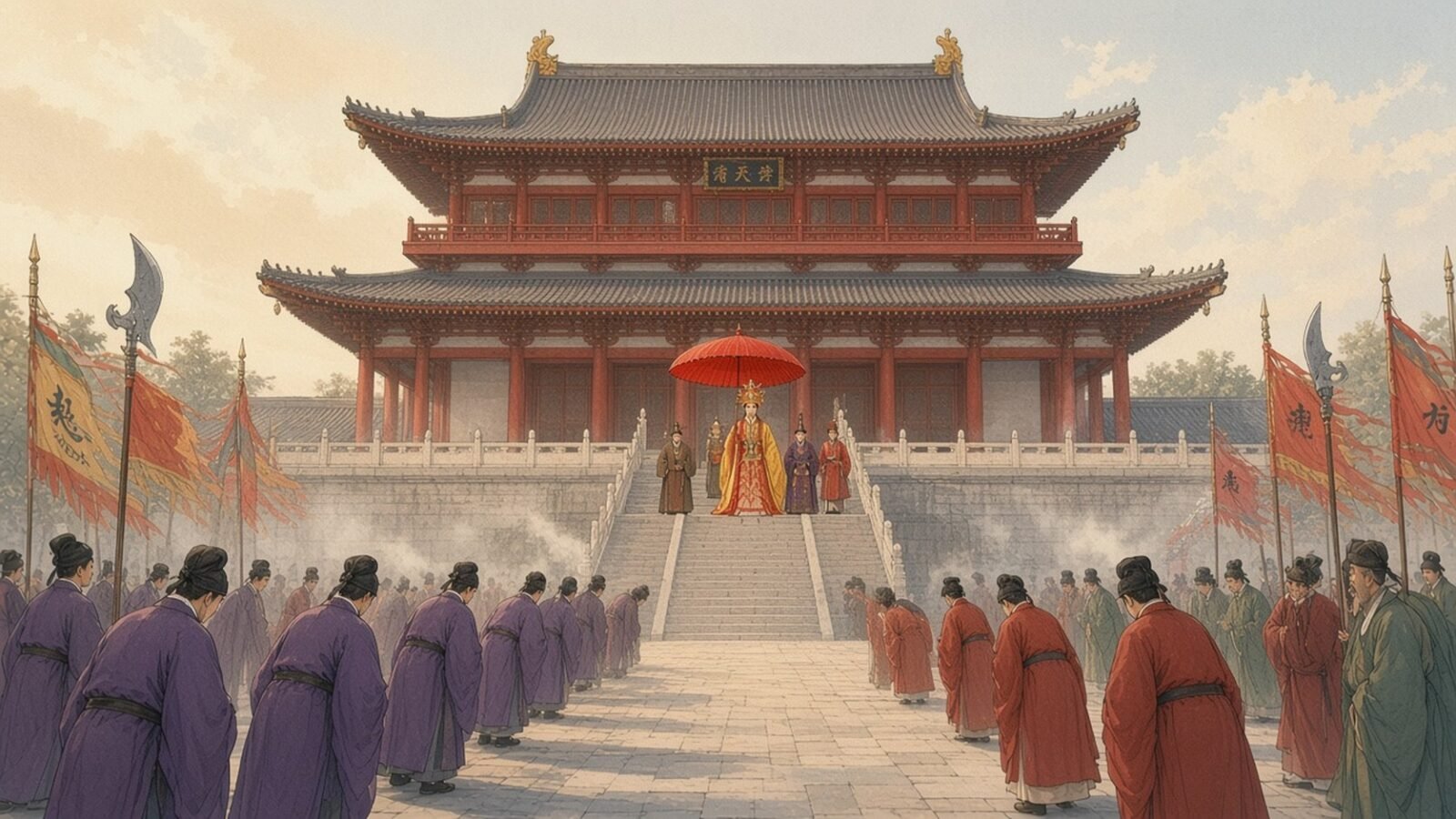
In 690, Wu Zhao took the imperial title and proclaimed the establishment of a new dynasty, the Zhou, which would rule in place of the Tang. The act was, in formal terms, a coup. The Tang ruling house, descended from the Li family that had founded the dynasty in 618, was pushed aside, and a new ruling house, the Wu, was proclaimed. The change of dynasty was justified, in the public rhetoric of the time, by the prophecy of the Great Cloud Sutra. The new dynasty was, in effect, a Buddhist monarchy, and its ideological basis was the prophecy that a female ruler would establish a new era in the last days of the present age.
The actual government of the Zhou interregnum was a complex of personal, ideological, and bureaucratic elements. Wu Zhao was, by the late 680s, an experienced political operator with a network of supporters among the officials of the Tang government and a network of allies among the Buddhist clergy. The new Zhou government was built on this network. The chancellors of the new dynasty were chosen partly for their administrative ability and partly for their loyalty to Wu Zhao personally. The most senior ministers of the Zhou period were the chancellor Wei Juyuan, the chancellor Li Jingye, the chancellor Yao Yuanzhi, and the chancellor Li Zhimian.
The early years of the Zhou interregnum saw a number of striking innovations. The civil service examinations were reformed, with the addition of a new section on the works of the Buddha. The new examinations were designed to test the loyalty of the candidates to the new dynasty, and they were used to bring into the government a new generation of officials who had been educated in the new Buddhist schools. The examination system was also used to limit the influence of the great aristocratic families, who had dominated the Tang government in the seventh century. The new officials were drawn from less established families, and they owed their advancement to the Zhou government.
The Zhou interregnum also saw a striking expansion of the Buddhist monastic establishment. New monasteries were built in the capital and the provinces. New Buddhist texts were translated. The monastic population grew. The state provided substantial support for the Buddhist monastic system, and the monks in turn provided ideological support for the Zhou government. The relationship between the state and the Buddhist church was, in the early Zhou, closer than it had been at any previous point in Chinese history.
Repression and terror
The Zhou interregnum was also a period of intense political repression. The new dynasty had been established by a coup, and the surviving members of the Tang imperial house were a constant threat. Wu Zhao’s response was systematic. In 691, soon after the establishment of the new dynasty, a major plot by the Tang princes was uncovered and crushed. Several of the surviving sons of Gaozong were executed or forced to commit suicide. The survivors were placed under house arrest. The descendants of Li Yuan, the founder of the Tang dynasty, were similarly repressed. The imperial cult of the Tang house, which had been maintained at the ancestral temple in Chang’an, was abolished.
The Zhou government also used the security apparatus of the state against potential opponents. The most notorious of the security officials was the secret police chief Lai Junchen, who served as the head of the imperial secretariat in the early years of the Zhou. Lai Junchen was a former monk who had been recruited into the imperial service by Wu Zhao. He built an extensive network of informants and informers, and he presided over a series of political purges that eliminated many of the senior officials of the Tang government. The purges were, in effect, a reign of terror that lasted from 691 to 697. Several hundred officials of the Tang court were executed or forced to commit suicide.
The political purges of the early Zhou were, in their day, the most extensive in the history of the dynasty. They were also controversial. Some of the most senior officials of the Tang court had been Wu Zhao’s allies for decades, and their execution shocked the political establishment. The purges were also, in effect, a response to the resistance of the Tang aristocracy, who had not yet accepted the legitimacy of the new Zhou dynasty. The purges were, in this sense, part of the process of establishing the new dynasty.
By the late 690s, the political situation had stabilised. The Tang princes had been eliminated. The great aristocratic families had been brought under control. The new Zhou government had a corps of officials who owed their advancement to it. The political repression continued, but it was less systematic than it had been in the early years of the dynasty. Lai Junchen was eventually overthrown and executed, in part because he had become a liability for the government.
The Luoyang inscription and the question of authority
One of the most striking artefacts of the Zhou interregnum is the Luoyang inscription, a stone inscription at the Longmen Buddhist caves near Luoyang that bears the imperial title of Wu Zhao in a form that uses a character that was newly invented for her reign. The character combines the radical for the sun with the radical for the moon and the radical for void, and it is intended to be read as a feminine equivalent of the emperor character. The use of the new character is one of the most striking visual statements of the new Zhou regime.
The Luoyang inscription is also one of the most important pieces of evidence for the political use of Buddhism by the Zhou government. The inscription is dated to the 6th year of the Zhenzheng era of the Zhou dynasty, which corresponds to 692. It includes the imperial title of Wu Zhao in the new character, and it includes a long Buddhist eulogy of the dynasty. The inscription is one of the most striking examples of the political use of the Buddhist cave temples of the Longmen.
The new character was not, however, used in the imperial title of Wu Zhao in the official records of the Zhou government. The official records used the standard emperor character, and the new character was reserved for the use of the imperial family. The contrast between the new character and the standard character is a striking visual expression of the ideology of the Zhou dynasty.
End of the reign
The last decade of Wu Zhao’s reign was marked by a slow recovery of Tang loyalism, a series of palace intrigues, and the decline of the political capacity of the empress herself. By the late 690s, Wu Zhao was in her mid-seventies, and her capacity for the day-to-day business of government had begun to decline. The secret police apparatus, which had been the cornerstone of her power, had been weakened by the overthrow of Lai Junchen. The great aristocratic families, which had been repressed, were beginning to recover their political position. The Buddhist monastic establishment, which had been the ideological support of the Zhou government, was beginning to be seen as a burden on the state.
The turning point came in 705, when Wu Zhao was overthrown in a palace coup led by the chancellor Zhang Jianzhi and a group of senior officials. The coup was timed to coincide with the illness of Wu Zhao, and it was justified by a petition from a group of officials who claimed that the empress had been misled by her younger favourites. The coup succeeded, and Wu Zhao was placed under house arrest in the palace. The Tang dynasty was restored, with Li Xian, the son of Wu Zhao and the former Crown Prince, taking the throne as Emperor Zhongzong.
Wu Zhao died later in 705, a few months after the coup. She was buried with imperial honours, but the new Tang government was careful to limit the cult of her memory. The Ming Qiu Foundation was abolished. The Buddhist monks were removed from the political establishment. The Tang imperial cult was restored. The archives of the Zhou government were, for the most part, destroyed. The historiography of the Zhou dynasty was rewritten to emphasise the legitimacy of the Tang restoration.
Historiographical erasure
The historiography of the Zhou interregnum is one of the most striking examples of political erasure in Chinese history. The official histories of the Tang dynasty were rewritten to treat the Zhou interregnum as a brief interruption of the legitimate Tang dynasty, and the achievements of Wu Zhao were either attributed to her predecessors or attributed to her successors. The new historiography was careful to present Wu Zhao as a usurper who had illegitimately seized the throne.
The most important of the official histories is the Old Tang History, completed in 945, and the New Tang History, completed in 1060. Both histories include sections on the Zhou dynasty, but they treat it as a brief interregnum and they minimise the significance of Wu Zhao’s reign. The biographies of the senior officials of the Zhou dynasty are included in the official histories, but they are presented as Tang loyalists who served under the legitimate dynasty.
The erasure of the Zhou dynasty was not, however, complete. The Buddhist monastic records of the time preserve some of the institutional history of the Zhou dynasty. The epigraphic record, including the inscriptions at the Longmen Buddhist caves and the inscriptions at the great stupa temples of Luoyang, preserves a great deal of evidence for the political use of Buddhism by the Zhou dynasty. The travel records of the Japanese monks who visited China in the eighth century also preserve evidence for the political situation of the Zhou interregnum.
The modern historiography of Wu Zhao has been built on this evidence. The most important modern studies are the biographies of Wu Zhao by Gu Jiegang and the chapters on the Zhou dynasty in the Cambridge History of China. The modern historiography has been particularly interested in the political use of Buddhism by Wu Zhao, and in the extent to which the Zhou dynasty was a genuine interruption of the Tang dynasty or a continuation of the Tang in a new institutional form.
Why it matters
The reign of Wu Zhao matters because it changed the political grammar of later Chinese history. The establishment of a new dynasty by a woman was, in itself, a striking innovation, and it established a precedent that later dynasties had to take into account. The use of Buddhism as a political ideology was, in itself, a striking innovation, and it established a precedent that later dynasties had to take into account. The combination of the two innovations made the Zhou interregnum a distinctive moment in the history of Chinese political culture.
The Zhou interregnum also matters because it was a test of the political system of the Tang dynasty. The Tang political system had been built on the assumption that the dynasty would be ruled by the Li family, and the establishment of a new dynasty by a member of a different family tested the system in a way that no previous challenge had done. The fact that the system survived the challenge, even though the dynasty that had built the system was overthrown, is a sign of how robust the Tang political system had become.
The reign of Wu Zhao also matters because it shows what was possible for a woman in the late traditional Chinese political system. The system was, in principle, a patriarchal system that excluded women from formal political authority. The fact that a woman could rise to the imperial title and rule as emperor in her own right shows that the system was more flexible than the formal ideology of the system suggested. The system was flexible enough to allow a woman to take the imperial title, but it was not flexible enough to allow a woman to establish a lasting dynasty. The most that any woman could do was to rule for a generation and then to be overthrown.
The legacy of Wu Zhao also extends to the cultural sphere. The poetry of the Zhou period is one of the high points of Tang poetry. The visual arts of the Zhou period, including the Buddhist sculpture of the Longmen caves, are some of the most striking of the period. The official culture of the Zhou period was, in many ways, a continuation of the Tang, but it was also distinctive. The poetry of the Zhou period is more confident than the poetry of the late Tang, and the visual arts of the Zhou period are more elaborate than the visual arts of the late Tang.
The Zhou restoration question
One of the most interesting questions about the Zhou interregnum is whether it should be understood as a genuine interruption of the Tang dynasty or as a continuation of the Tang in a new institutional form. The two readings have been advanced in different ways by different historians. The traditional Chinese reading, embodied in the official Tang histories, is that the Zhou interregnum was a brief interruption of the legitimate Tang dynasty. The modern reading, embodied in the works of Gu Jiegang and his successors, is that the Zhou interregnum was a continuation of the Tang in a new institutional form, and that the change of dynasty was, in effect, a change of the imperial house rather than a change of the political system.
The arguments for the latter reading are strong. The Zhou government was staffed largely by officials who had served the Tang government. The Zhou administrative system was largely a continuation of the Tang administrative system. The Zhou tax system was largely a continuation of the Tang tax system. The Zhou military system was largely a continuation of the Tang military system. The Zhou foreign policy was largely a continuation of the Tang foreign policy. The most significant changes were the political use of Buddhism, the change of the imperial house, and the partial purges of the great aristocratic families.
The arguments for the former reading are also strong. The change of dynasty was, in formal terms, a major event. The establishment of a new imperial house was a major event. The abolition of the Tang imperial cult was a major event. The political use of Buddhism was a major event. The purges of the great aristocratic families were a major event. The Zhou interregnum was, in this sense, a distinctive moment in the history of the Tang dynasty, and it should be treated as a separate period.
The modern reading tends to combine the two positions, treating the Zhou interregnum as a distinctive period in the history of the Tang dynasty that introduced some significant innovations but did not constitute a complete break with the Tang. The Zhou interregnum is, in this reading, a transitional moment between the early Tang and the late Tang, with some features of both and some features of neither.
The two capitals
The Zhou interregnum was administered from two capitals, the eastern capital Luoyang and the western capital Chang’an, with the formal capital moving between them. The new Zhou dynasty placed special emphasis on Luoyang as the ideological centre, and the Ming Qiu Foundation, the Buddhist monastic complex that was the institutional centre of the Zhou government, was located there. The Tang court had, since the founding of the dynasty, maintained its main capital at Chang’an, and the move of the administrative centre to Luoyang was a striking symbolic statement.
The shift of the administrative centre to Luoyang was also a practical matter. The Tang dynasty had used Chang’an as the location of the imperial palace since its founding in 618, and the palace had become overcrowded and difficult to maintain. Luoyang had been a secondary capital under the Sui dynasty and under the early Tang, and it had the necessary infrastructure to support an imperial government. The Zhou government rebuilt the Luoyang palace and expanded the city. The Ming Qiu Foundation was located on the eastern side of the city, near the imperial palace.
The two-capital system had implications for the political culture of the Zhou dynasty. The shift of the administrative centre to Luoyang was a way for the new dynasty to mark its distance from the Tang imperial establishment at Chang’an. It was also a way for the Zhou government to draw on the institutional infrastructure of Luoyang, which had been maintained under the Sui and the early Tang. The shift of the administrative centre was, in effect, a way of signalling that the Zhou government was a new dynasty with a new political vision.
The culture of the Zhou court
The culture of the Zhou court was, in many ways, a continuation of the high Tang culture of the early eighth century. The court maintained the imperial academy, supported the imperial library, and patronised the major poets of the day. The poets of the Zhou period, including Shangguan Wan’er, Song Zhiwen, and Li Jiao, were among the most distinguished of the early eighth century, and they produced some of the most striking poetry of the Tang.
The Zhou court also supported a substantial programme of monumental building. The new palace at Luoyang was one of the largest building projects of the period. The Longmen Buddhist caves were expanded, with new statues and new inscriptions. The Wei River stele, an important stone inscription at the mausoleum of the Tang founder Li Yuan, was restored and re-erected. The official histories of the period describe an extensive programme of road building, bridge building, and public works.
The visual arts of the Zhou period are some of the most striking of the Tang dynasty. The Buddhist sculpture of the Longmen caves, including the great Vairocana Buddha commissioned by Emperor Gaozong and completed under Wu Zhao, is one of the high points of Tang sculpture. The Buddhist sculpture of the Zhou period is distinguished by its monumentality, its formal sophistication, and its elaborate iconographic programmes. The Zhou period also saw a striking expansion of Buddhist painting, with new commissions for monasteries and for the imperial palace.
Afterlife in literature
The Zhou interregnum left a substantial mark on the literary imagination of later Chinese culture. The historical novels of the Ming and Qing dynasties often included Wu Zhao as a character, often as a villain, and the most famous of these treatments is in the novel Stories to Awaken the World by Feng Menglong and the related dramas of the Yuan and Ming periods. The literary Wu Zhao is usually presented as an ambitious and ruthless woman who uses her sexuality and her political cunning to seize the throne.
The most famous of the literary treatments of Wu Zhao is the play The Palace of Eternal Life by Hong Sheng, written in the late seventeenth century. The play combines the historical story of Wu Zhao with the romantic story of the Tang emperor Xuanzong and his concubine Yang Guifei, and it presents Wu Zhao as one of the most striking villains of Chinese literary history. The play is still performed in the Chinese opera tradition, and it remains one of the most influential literary treatments of the Zhou interregnum.
The literary treatment of Wu Zhao has been criticised in recent decades for its tendency to present Wu Zhao as a sexually transgressive woman. The modern historical scholarship has worked to recover a more nuanced view of Wu Zhao, and the modern Chinese popular culture has begun to present Wu Zhao in a more balanced way. The most striking of these achievements is the recent film The Empress of China and the related television series, which present Wu Zhao as a serious political figure rather than a stereotypical villain.
Modern reassessment
The modern reassessment of Wu Zhao has been one of the most striking developments in the historiography of the Tang dynasty. The traditional Chinese historiography had treated Wu Zhao as a usurper, and the early modern Western historiography had treated her as a curiosity. The recent scholarship has worked to recover the political achievements of her government, and has begun to treat her as a serious political figure rather than a curiosity or a villain.
The modern reassessment has been particularly interested in the political use of Buddhism by Wu Zhao, and in the extent to which the Zhou dynasty was a genuine interruption of the Tang dynasty. The modern scholarship has also been interested in the gender politics of the Zhou dynasty, and in the extent to which the Zhou government represented a distinctive response to the gender norms of the Tang dynasty.
The modern reassessment has not, however, been uncritical. The political purges of the early Zhou are still seen as a serious violation of the political norms of the Tang dynasty, and the destruction of the Tang imperial house is still seen as a serious violation of the family ideology of the Tang dynasty. The modern view of the Chinese state has been more sympathetic to the political achievements of Wu Zhao, but it has not been uncritical of the methods she used.
References
- The Old Book of Tang (Jiu Tang shu) – Liu Xu, Zhonghua Book Company, 945 (the foundational chronicle for the Wu Zhao period)
- The New Book of Tang (Xin Tang shu) – Ouyang Xiu and Song Qi, Zhonghua Book Company, 1060 (the revised Tang historiography)
- Zizhi Tongjian, volumes 199-208 – Sima Guang, Zhonghua Book Company, 1084 (the comprehensive chronological history covering the Wu Zhao reign)
- The Cambridge History of China, Volume 3: Sui and Tang China, 589-906, Part 1 – edited by Denis Twitchett, Cambridge University Press, 1979
- The Empress Wu – Gu Jiegang, Foreign Languages Press, 1988
- Wu Zhao: The Only Woman Emperor in Chinese History – Shuang Shen, Rowman & Littlefield, 2023
- The Great Cloud Sutra and the Reign of Wu Zhao – Antonino Ferro and Victor Mair, in Journal of the International Association of Buddhist Studies, 1996
- Buddhism in Chinese Society: An Economic History from the Fifth to Second Century – Jacques Gernet, Columbia University Press, 1995 (for the institutional context of Wu Zhao’s Buddhist policy)
- Tang China: A Social and Economic History – Brian L. Dutton, Cambridge University Press, 1992
- Longmen: The Buddhist Cave Temples of Luoyang – Mary Jane Clark, Weatherhill, 2009 (for the visual evidence of the Zhou period)