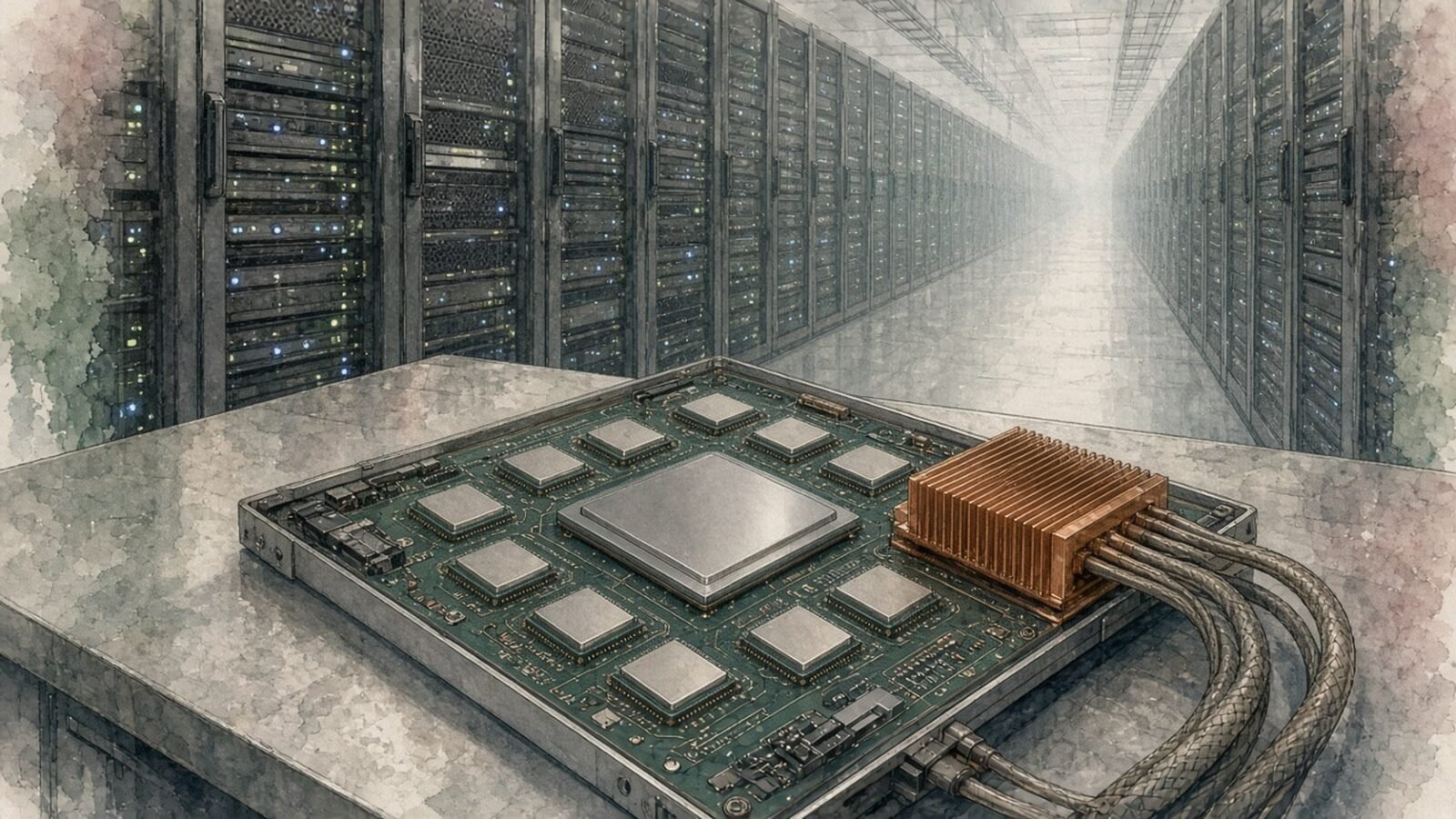
On September 22, 2026, at its annual Apsara Conference in Hangzhou, Alibaba did something that would have been unthinkable for a Chinese online commerce company just a few years ago. It unveiled a flagship AI accelerator designed to compete head on with the most advanced silicon in the world. The Zhenwu V900, built by Alibaba’s chip subsidiary T-Head, is the company’s most powerful internally developed AI chip to date, a processor designed for both training and inference that Alibaba claims delivers three times the performance of its predecessor . The announcement was never going to be about one chip alone. Alongside the V900, Alibaba outlined a sweeping expansion of its AI infrastructure stack, from new Yitian server CPUs to supernode systems that connect more than a thousand accelerators into a single coherent machine, all the way up to a corporate target of more than 20 gigawatts of global data center capacity by 2032.
Taken together, the message was unmistakable. Alibaba no longer wants to be a customer in NVIDIA’s world. It wants to be a foundational builder of its own.
For most of its history, Alibaba was a consumer of other people’s silicon, buying NVIDIA GPUs by the container load to power everything from Taobao’s recommendation engines to the early training runs of the Qwen model family. The idea that this same company would stand on a stage in Hangzhou and present a complete alternative computing stack would have sounded like fantasy only a few years ago. Yet here we are, and the V900 is the sharpest point of a strategy that now touches nearly every layer of the modern data center.
What exactly is the Zhenwu V900?
The V900 is T-Head’s latest high end AI accelerator, built on the company’s proprietary parallel computing architecture. According to the specifications displayed at the conference, the chip carries 216 GB of onboard memory and offers 1,200 GB/s of chip to chip interconnect bandwidth, with native support for low precision compute formats including FP8 and FP4 . Those numbers matter more than they might first appear. In modern AI infrastructure, memory capacity and bandwidth are frequently the binding constraints rather than raw floating point math. Large models with trillion scale parameters must be partitioned across many chips, and every partition boundary costs performance in data movement and synchronization. A chip with 216 GB of memory reduces how aggressively a model must be split across devices, while FP8 and FP4 support lets operators trade a small amount of numerical precision for substantial throughput, directly lowering the cost of every inference request. T-Head is explicitly designing for that economics first reality, and it is a reality that hyperscalers running enormous fleets live in every day.
It is worth pausing on the memory figure, because it is where the V900 most visibly differentiates itself. NVIDIA’s H200, long the workhorse of large scale AI training clusters, carries 141 GB of high bandwidth memory, and the V900’s 216 GB exceeds it by a wide margin. In an era where models are routinely sharded across dozens of devices because no single accelerator can hold them, memory capacity has become one of the most important levers for system efficiency: more memory per chip means fewer chips, fewer interconnect hops, and less energy burned moving weights around. T-Head has clearly internalized the lesson that the most expensive operation in a modern AI cluster is not computation but communication, and it has architected its flagship part around that insight.
The chip is scheduled to enter mass production and go on sale in the first quarter of 2027
, arriving roughly a year after its predecessor and continuing a release cadence that has accelerated dramatically over the past twenty four months. When generations ship annually and each claims a multiple of the last one’s performance, the limiting factor quickly stops being design talent and starts being manufacturing capacity, packaging yield, and memory supply. All three sit squarely within China’s weakest links, a tension we will return to later.
One chip is not the product. The system is.
Perhaps the most revealing part of the announcement was what surrounded the chip. T-Head made clear that the V900 is designed to operate as part of a larger system rather than as a standalone accelerator. The company uses its proprietary ICN Switch interconnect chips to bind multiple V900s into supernodes with native memory semantics and unified memory addressing, and claims that more than 1,000 V900 chips can work together as a single coherent system . Scale that up further and the ambition becomes plain. Combined with Alibaba Cloud’s newly designed data center network architecture, T-Head says a single cluster using these chips can scale to as many as 500,000 accelerators , a hyperscaler grade figure that puts it in the same conversation as the largest training infrastructures on the planet.
This is a deliberate echo of the philosophy NVIDIA itself has been preaching for years. The unit of competition in AI infrastructure is no longer the GPU, or even the server. It is the rack, the pod, and ultimately the entire compute fabric, including the optical interconnects, the storage topology, and the scheduling software that stitches it all together. Alibaba demonstrated a next generation supernode server at Apsara that integrates the V900 with the ICN Switch, its Panmai smart NIC, and its Zhenyue SSD controller , bringing computing, networking, and storage under one unified architecture. The claim embedded in that system design is that coordination across those layers, not the peak throughput of any single component, is what determines how fast trillion parameter models actually train and how cheaply agentic workloads can be served.
The strategy predates the V900 and, importantly, it is already running in production rather than living only on slides. Supernode servers built on the current generation Zhenwu M890 have entered large scale commercial deployment and support models with more than 2 trillion parameters, including Alibaba’s own Qwen3.8 and Moonshot AI’s Kimi K3 , with the underlying capabilities exposed to developers through Alibaba Cloud’s Bailian platform. T-Head says the Zhenwu series has served more than 650 enterprise customers across autonomous driving, finance, large language models, embodied AI, energy, and manufacturing. A chip that only existed on a roadmap six months ago is today training some of the largest models in China. That deployment velocity is itself a competitive signal, because it means the software stack and the supply chain are maturing in step with the silicon rather than lagging years behind it.
The backstory: from online commerce side project to silicon powerhouse
To appreciate how fast this has moved, rewind the tape several years. Alibaba established T-Head in 2018, and the unit spent its early years on unglamorous but foundational work: the Xuantie family of RISC-V cores and the Yitian line of ARM based server CPUs. The Yitian 710, announced in 2021, became China’s first cloud chip built on a 5 nanometer process. For a long time that was the story: a capable engineering shop building respectable supporting silicon while the real AI compute came from NVIDIA.
The pivot began with American export policy. In August 2025 the Wall Street Journal broke the news that Alibaba had developed a new, more versatile chip to help China fill the void left by restricted NVIDIA hardware
. That design, the T-Head PPU, was built for high volume inference, matched the NVIDIA H20’s 96 GB memory class, and was manufactured domestically, reportedly on a 7 nanometer process, with a bill of materials said to be 40 percent lower than an H20
. Government owned carrier China Unicom deployed 16,384 PPU units, roughly 72 percent of all the AI chips in its major data center in Xining
.
Then the cadence turned genuinely aggressive. The Zhenwu 810E arrived in January 2026 with 96 GB of high bandwidth memory and 700 GB/s of chip to chip bandwidth
, broadly comparable to the H20 that NVIDIA had been permitted to sell in China. In May 2026, T-Head unveiled the M890 with 144 GB of memory and 800 GB/s of interconnect, claiming three times the 810E’s performance and reporting cumulative Zhenwu shipments above 560,000 units across more than 400 enterprise clients in twenty industries
. Now, just four months later, the V900 promises another threefold jump, and a further generation, the Zhenwu J900, is already slated for the third quarter of 2028
. Meanwhile T-Head is filling out the rest of the data center. Its Yitian 720 and 730 server CPUs are scheduled for the third quarter of 2027, with the 730 promising single core performance up to 1.4 times that of the widely deployed Yitian 710, and the subsequent Yitian 750 will support T-Head’s proprietary ICN interconnect protocol so the CPU can connect directly with Zhenwu accelerators. The endgame visible in that roadmap is a complete portfolio spanning CPUs, AI accelerators, networking silicon, storage controllers, and software, mirroring almost part for part the portfolio NVIDIA has assembled.
Why now? The geopolitical engine
None of this happens in a vacuum, and it would be a mistake to analyze the V900 purely as a technology story. The single biggest driver of Alibaba’s silicon push is the United States export control regime that has progressively severed Chinese companies’ access to NVIDIA’s best hardware. What began as restrictions on the A100 and H100 evolved into rules that forced NVIDIA to build scaled down China specific parts like the A800, H800, and eventually the H20, and even those have been subject to shifting permission and sudden suspension. The result, as trade reporting described it, was a severe and unpredictable bottleneck that pushed Alibaba from being a major consumer of Western technology toward becoming a foundational producer of domestic alternatives
.
The market effects have been dramatic. Analyst estimates put NVIDIA’s share of China’s AI chip market at around 8 percent in 2026, down from near total dominance a few years earlier, with Huawei’s share rising to roughly 50 percent
. Beijing is reportedly backing the transition with a plan worth roughly $295 billion to link the nation’s data centers into a unified AI computing grid by 2028, with a mandate that at least 80 percent of the underlying chips be domestic
. For Alibaba, the strategy works on three levels at once: a geopolitical hedge, a cost play, and a differentiation lever, since running workloads on your own silicon enables customization that hyperscalers on commodity NVIDIA clusters cannot easily match
. The export controls were designed to slow China’s AI progress. Their most concrete effect so far has been to industrialize China’s capacity to build the hardware it can no longer buy.
The competitive landscape: Huawei first, everyone else sprinting
Alibaba is not alone in this race, and candidly it is not even the leader. Huawei’s Ascend family remains the anchor of China’s domestic AI compute strategy, and its newer 950 series has reportedly racked up committed 2026 procurement volumes above half a million units from ByteDance, Alibaba Cloud, and Tencent, with Huawei’s AI chip revenue heading toward $12 billion this year
. Around the two giants swarm a crowded field including Cambricon, Biren, MetaX, and Moore Threads. The V900 enters the most competitive AI silicon market on Earth, one whose demand side is effectively guaranteed by industrial policy but whose supply side is a knife fight for foundry capacity, memory, and engineering talent. That structure matters for how the chip should be judged: Alibaba does not need to beat Huawei or NVIDIA on every axis, only to win enough internal and external workloads to justify the program’s enormous capital expenditure and keep its cloud competitive when export rules shift. On that narrower test, the early evidence is encouraging, and the V900 is less a moonshot than a consolidation of ground Alibaba has already taken.
How the V900 stacks up against NVIDIA
Here honesty requires some calibration. On paper, the V900’s headline numbers are competitive with, and in memory capacity ahead of, much of what is available inside China. The 216 GB of memory exceeds the 141 GB on NVIDIA’s H200, and the 1,200 GB/s chip to chip bandwidth is respectable for a part aimed at the domestic market. Analysts who examined the predecessor M890 concluded that while it could not match the H200 in raw processing terms, it was nonetheless a believable replacement for the H200 within China’s domestic market
, and the V900’s claimed threefold performance improvement over the M890 should widen that window considerably.
But analysts have consistently flagged the caveats. Alibaba has not disclosed key specifications such as peak compute performance
, and memory and bandwidth figures remain below the benchmarks set by leading Western vendors. More fundamentally, those comparisons run against the hardware NVIDIA is permitted to sell in China, not against its unrestricted flagship silicon, which remains generations ahead on process technology and systems integration. NVIDIA’s latest chips are fabricated on TSMC’s 3 nanometer class nodes and rapidly maturing 2 nanometer processes, while China’s leading edge domestic foundry operates roughly two generations behind
. The honest read is that the V900 is best understood not as a chip that beats NVIDIA everywhere, but as a chip that makes NVIDIA optional within China, which, given the current export regime, is precisely the point.
The software moat is the real battle
If hardware were the whole story, NVIDIA’s dominance would have been challenged years ago. The deeper moat is CUDA, a software ecosystem with well over a decade of head start, millions of registered developers, and an enormous body of libraries, debugging tools, and institutional knowledge built on top of it. Every credible challenger has discovered that closing the software gap is harder than closing the silicon gap. Huawei has reportedly committed to open sourcing its CANN software stack by the end of 2026, an implicit admission that ecosystem maturity rather than chip performance is the binding constraint on displacing NVIDIA
.
Alibaba’s answer is the T-Head SAIL software stack, which the company showcased at Apsara with hands on workshops covering model training, inference, and optimization . Its earlier PPU already offered compatibility with existing NVIDIA software frameworks
, giving customers a transition path with minimal code changes, and the presence of production deployments serving external customers suggests the toolchain has crossed the threshold from demo to dependability. Whether SAIL can evolve from a compatibility layer into a genuinely preferred developer platform is the question that will determine the V900’s ceiling, and it is where my first recommendation for observers lies.
The business endgame: gigawatts and a potential IPO
The chip announcement landed alongside a broader expansion plan. Alibaba is targeting more than 20 gigawatts of global data center capacity by 2032, a buildout of staggering scale that will require enormous quantities of accelerators, most of which Alibaba would presumably prefer to source internally. Group leadership indicated that T-Head expects annual AI chip shipments to keep rising as adoption widens , and Alibaba has reportedly explored listing T-Head to tap investor demand for Chinese alternatives to NVIDIA
. A successful V900 ramp in early 2027 would arrive just in time to anchor such an offering, giving public market investors a pure play on China’s AI silicon buildout with a captive anchor customer in Alibaba Cloud. The economics deserve emphasis: internally developed silicon is not primarily a revenue story for Alibaba but a margin and sovereignty story, converting what was once a procurement line item into a durable competitive asset.
The challenges ahead
Enthusiasm should be tempered by real constraints. China’s chip supply chain remains weaker than the global one, and analysts caution that without access to leading edge foundries like TSMC, T-Head’s chip efficiency will lag global competition
, potentially eroding the very cost savings in-house silicon is supposed to deliver. Domestic high bandwidth memory packaging cannot yet yield at volume, and one widely cited estimate suggests Chinese suppliers will cover only around 76 percent of domestic AI chip demand by 2030
. Every generation of Zhenwu silicon competes for the same constrained pool of advanced packaging and memory as Huawei’s Ascend parts, which means Alibaba’s roadmap cadence is hostage to supply chain decisions made in fabs and memory houses, not in its own design centers. Yield, not architecture, may end up being the true governor on how many V900s actually ship in 2027.
What it all means, and what to watch
The Zhenwu V900 is easy to dismiss as one more chip launch with unverifiable performance claims, but that would miss the significance. What Alibaba demonstrated at Apsara is a complete, vertically integrated AI infrastructure strategy advancing on an annual cadence and deploying at genuine scale, and the trajectory matters more than any single benchmark. Twelve months ago, Alibaba’s silicon story was about one inference chip filling an NVIDIA shaped gap. Today it is a story about a full stack alternative being built chip by chip, system by system, gigawatt by gigawatt, and the pace suggests it is still accelerating rather than plateauing.
For anyone watching this space, my recommendations are threefold. First, watch the software, not the silicon: the real test of the V900 arrives when independent developers benchmark it on their own workloads and when SAIL’s adoption numbers become public, because ecosystem pull, not spec sheets, decides whether a chip becomes a platform. Second, watch the supply chain: V900 volume, memory sourcing, and packaging yields in the first half of 2027 will reveal whether Alibaba’s cadence is real or aspirational, and a smooth ramp would materially strengthen the case for a T-Head listing. Third, watch the export policy cycle, since the entire economics of China’s domestic chip industry hinge on how strictly Washington polices the boundary between permitted and restricted hardware, and any relaxation would put NVIDIA back into the domestic market just as the V900 arrives.
NVIDIA is not about to lose its global dominance, and Alibaba is not truly trying to take it. The goal is narrower and, in some ways, more consequential: to make China’s AI ecosystem self sufficient enough that American export controls lose their leverage. Every threefold performance jump, every thousand chip supernode, and every gigawatt of committed capacity moves that goal closer, and the world is quietly bifurcating into parallel AI stacks as a result. One stack is anchored by NVIDIA and CUDA in Taiwan Semiconductor’s fabs; the other is being assembled by Huawei, Alibaba, and their domestic peers behind a wall of industrial policy. The V900 is one of the clearest markers yet of how deep that split is becoming, and when mass production begins in the first quarter of 2027, the shipment numbers, developer adoption, and third party benchmarks that follow will tell us whether it is a genuine rival or merely a very good fallback. Either way, the era of NVIDIA’s unchallenged supremacy in the world’s largest AI market is already over, and Alibaba’s name is now permanently on the silicon map.