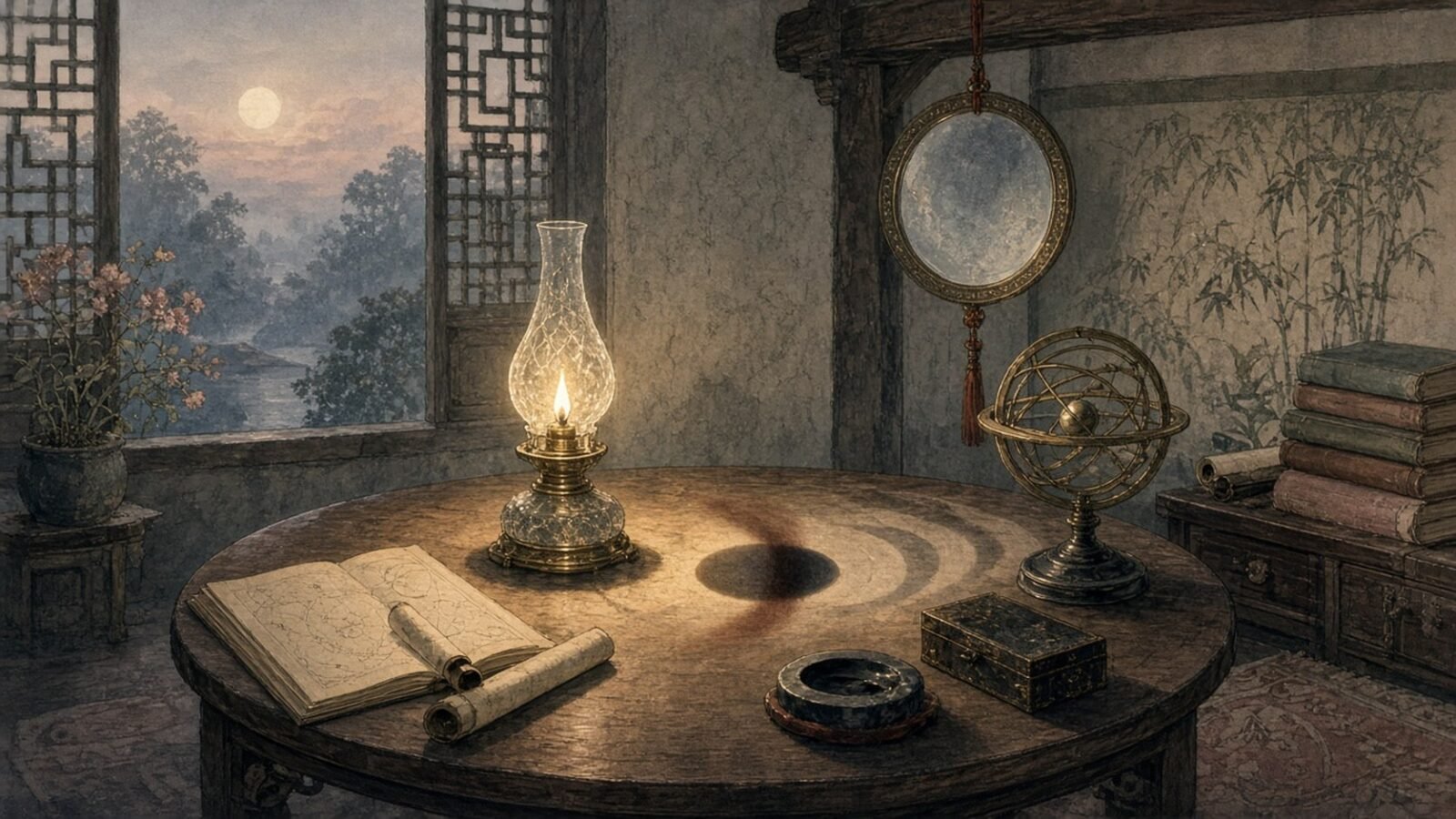
In the late eighteenth century, long before electric light, photography, computers or modern observatories, a young Chinese woman stood in a room trying to recreate the movement of the heavens. She did not have a telescope powerful enough to reveal distant planets in extraordinary detail, nor did she possess the elaborate scientific equipment that would later transform astronomy. Instead, she worked with simple objects. A lamp could become the Sun. A round table could represent the Earth. A mirror could stand in for the Moon. By carefully positioning these objects, she could reproduce the geometry of a lunar eclipse and show how light and shadow created one of the most dramatic sights in the night sky. Her name was Wang Zhenyi, and although she lived for only twenty nine years, she became one of the most remarkable astronomers, mathematicians, writers and teachers of Qing dynasty China.
Wang Zhenyi was born in 1768, during the reign of the Qianlong Emperor, into a society where intellectual life was largely organised around men. The great imperial examination system offered educated men a route toward official office, prestige and participation in government. Women could receive education, particularly in scholarly or wealthy families, and some became accomplished poets, artists and writers, but the institutions that recognised formal scholarship were overwhelmingly male. For a woman to become deeply involved in subjects such as mathematics and astronomy therefore required more than intelligence. It required access to books, encouragement from family, enormous personal discipline and a willingness to move beyond the expectations that defined what women were normally supposed to study. Wang possessed all of these things. From an early age, she lived in an environment where books were treated as gateways to the wider world, and she used them with extraordinary determination.
Her family played an essential role in creating that environment. Wang’s grandfather was a dedicated collector of books and possessed an extensive personal library. In an age when information was far more difficult to obtain than it is today, access to such a collection was a tremendous advantage. Books could introduce a reader to mathematics, astronomy, geography, history, philosophy and literature, and Wang made full use of the opportunity. Her father was also educated and had studied for the imperial examinations before turning his attention toward medicine. From him she learned subjects including mathematics, geography and medical knowledge. Her grandmother helped introduce her to poetry. The result was an unusually broad education in which scientific and literary subjects existed side by side. Wang did not grow up believing that mathematics belonged in one part of life and poetry in another. She learned to see knowledge as interconnected. Numbers could explain the motions of the sky, poetry could describe human experience, geography could explain distant places, and history could reveal how ideas had changed over time.
Yet access to books alone does not explain Wang’s achievement. Plenty of people have lived near libraries without becoming scholars. What distinguished her was the way she read. She appears to have approached knowledge actively rather than passively. Earlier scholars were important sources of learning, but their words were not simply commands that had to be memorised. Wang compared explanations, worked through calculations and tried to understand the reasoning behind what she studied. This attitude became especially important in her later mathematical and astronomical writings. She was interested not merely in the correct answer but in the process by which an answer could be demonstrated. That distinction is at the heart of serious intellectual work. Memorising a fact can be useful, but understanding why the fact is true is much more powerful. Wang repeatedly tried to move from one level to the other.
Her education also extended far beyond the family library. Travel exposed her to regions, communities and ways of life that would later shape both her scientific imagination and her poetry. Following the death of her grandfather, Wang and her family spent time in northern China. During these years she continued reading extensively, but she also experienced a world very different from the image of a secluded scholar surrounded only by books. Accounts of her life describe her learning horse riding, archery and martial skills from the wife of a Mongolian general. These pursuits were unusual for a woman of her scholarly background and reveal something important about Wang’s character. She was curious about knowledge in many forms. Learning did not have to remain confined to manuscripts and calculations. Physical skill, travel and direct experience could also become forms of education.
As Wang travelled through different parts of China, she observed not only landscapes but people. She saw communities separated by geography, wealth and social position. She encountered agricultural life and the hard work required to sustain it. She saw the contrast between wealthy households and people struggling to survive. She paid attention to the lives of women whose labour was necessary but often overlooked. These observations later entered her poetry, where she wrote about poverty, hardship, labour and inequality. This part of her life is important because it prevents us from reducing her to a scientific symbol. Wang was not simply a person who looked upward at the Moon and stars. She also looked outward at the society around her. The same habit of attention that helped her think about astronomical phenomena seems to have shaped the way she observed human life.
By the time she reached adulthood, astronomy had become one of her strongest intellectual interests. Astronomy had held a prestigious place in Chinese civilisation for centuries. The observation of celestial events was connected with the calendar, agriculture, seasonal change and imperial administration. Chinese astronomers had accumulated detailed records of eclipses, comets, stars and planetary movements over very long periods of time. By the eighteenth century, astronomical knowledge in China also reflected contact with ideas introduced from other regions, including work transmitted through Islamic astronomical traditions and European Jesuit scholars. Wang therefore entered a field with a deep history and a complicated collection of methods and theories. Her significance did not lie in being the first person to observe an eclipse or the first to recognise the regularity of celestial motion. Instead, she learned this difficult material, examined it carefully and developed ways of explaining it with unusual clarity.
Her work on eclipses became the most famous example of that talent. A lunar eclipse occurs when the Earth moves between the Sun and the Moon in such a way that the Moon passes through Earth’s shadow. Today, this explanation may seem straightforward because diagrams, videos, animations and classroom models are widely available. In Wang’s world, communicating the relationship clearly required imagination. She created a physical demonstration using familiar objects to represent enormous celestial bodies. A lamp could provide the light of the Sun. A round object could represent the Earth. Another object could represent the Moon. When they were arranged correctly, an observer could watch the shadow appear and understand why an eclipse occurred.
The importance of this demonstration lies in its simplicity. The Sun, Earth and Moon are separated by enormous distances, and the scale of their motion is impossible for a person to experience directly. Wang reduced the system to the size of a room while preserving the essential geometric relationship between the bodies. The lamp produced light. The object representing Earth blocked that light. The model Moon entered the shadow. Suddenly, a phenomenon that seemed to belong to the vast and inaccessible heavens could be understood through an arrangement of ordinary things. This was not simply an astronomy lesson. It was a statement about the nature of knowledge. The universe might be immense, but its patterns could still be examined. The heavens did not have to remain mysterious merely because they were distant.
There is something strikingly modern about this method. Science teachers still use lamps and spheres to explain eclipses and lunar phases. Museums build interactive models that allow visitors to move celestial bodies into different positions. Digital simulations perform the same task with greater visual precision. The technology has changed, but the educational principle remains identical. A difficult idea becomes easier to understand when a learner can see the relationships involved. Wang understood this centuries ago. She was not interested in making astronomy appear more mysterious than it really was. She was interested in removing unnecessary mystery.
Her astronomical interests extended beyond eclipses. Wang studied the movements of celestial bodies, the structure of the sky, the shape of the Earth and questions associated with the equinoxes. Some of the works attributed to her have survived only partially, while others are known through later references, which means that modern historians cannot reconstruct her entire scientific output. Even so, the evidence that remains is enough to show that astronomy was not a casual pastime for her. She engaged with calculations, earlier authorities and competing ideas. She belonged to a serious scholarly tradition, even though the institutions of that tradition were not designed to recognise a woman in the same way they recognised male scholars.
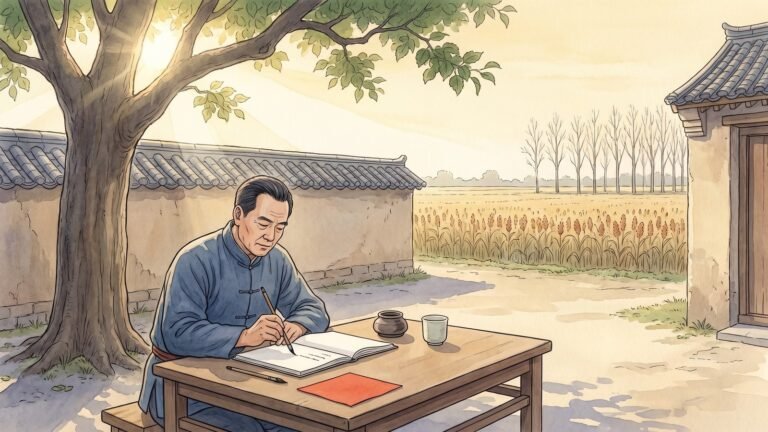
Mathematics was inseparable from this astronomical work. To understand celestial motion properly, Wang needed more than observation. She needed calculation. She therefore studied arithmetic, geometry and methods related to trigonometry, and she wrote about mathematical problems in ways intended to make them understandable to students. Among the subjects connected with her work was the relationship between the sides of a right angled triangle, known within the Chinese mathematical tradition through the gougu method. The same fundamental relationship is commonly associated in European mathematical history with the Pythagorean theorem. Wang’s engagement with such ideas shows that she was comfortable with mathematical reasoning that went far beyond basic household calculation.
One of the earlier scholars she studied closely was Mei Wending, an important mathematician and astronomer of the Qing period. Wang respected his work, but she also noticed a problem that appears in every generation of education. Knowledge can become trapped inside difficult writing. A brilliant scholar may understand a method perfectly while explaining it in a way that beginners find almost impossible to follow. Wang wanted to bridge that gap. She reorganised and simplified mathematical explanations so that people with less experience could understand the procedures more easily. This was not an attempt to make mathematics shallow. It was an attempt to remove barriers that were not necessary to the mathematics itself.
That concern with clarity is one of the strongest threads connecting all of Wang’s intellectual work. When she studied eclipses, she created a model that allowed another person to see how the shadow formed. When she studied mathematics, she tried to explain procedures in more accessible language. In both cases, she treated communication as part of scholarship rather than something secondary to it. Knowing an idea was valuable, but being able to explain that idea was another kind of achievement. Wang appears to have understood something that every great teacher eventually discovers: a subject is not made more intelligent simply by being made harder to understand.
This quality also helps explain why her story continues to feel relevant. Modern science is filled with highly specialised language, advanced instruments and enormous quantities of data. Experts need those tools, but society also needs people who can translate complex knowledge without destroying its meaning. Wang’s approach belongs to this second tradition. She was both a learner and an interpreter. Her purpose was not simply to stand above people who knew less. She wanted to create a route through which they could understand more.
Her achievements become even more extraordinary when considered within the social world of eighteenth century China. Women could become highly educated, particularly within elite families, and the Qing period produced many accomplished female writers and poets. However, the principal structures of official scholarly recognition remained dominated by men. Women could not simply follow the same route through examinations and government appointments. A woman who wanted to build a serious intellectual life therefore had to find alternative spaces in which to study, write and teach. Wang did exactly that.
She was aware that assumptions about gender shaped the way intellectual ability was judged. In some of her writing, she challenged the belief that learning, heroism or scholarly accomplishment naturally belonged to men. The most powerful argument she could offer, however, was her own work. When she performed astronomical calculations, she demonstrated that mathematical reasoning was not restricted by sex. When she wrote about eclipses, she showed that a woman could master technical scientific material. When she taught others, including men, she reversed the normal expectation about who possessed authority and who received instruction.
It is tempting to describe Wang entirely using modern categories, but doing so can distort the historical world in which she lived. She did not inhabit the political or cultural environment of the twenty first century, and her ideas should not be forced into labels that were created much later. What can be said with confidence is that she rejected narrow assumptions about women’s intellectual ability and demonstrated through her own scholarship that women were capable of advanced study. Her life therefore became evidence against the limitations imposed upon her.
Her poetry makes this picture of Wang even richer. To a modern reader, the combination of mathematics and poetry may appear unusual because education today often separates scientific and literary subjects. In the scholarly culture of Wang’s time, the division was less rigid. Poetry was a major part of educated life. Scholars used it to express personal experience, respond to political events, describe landscapes and communicate moral ideas. Wang participated fully in this literary world, but she did not restrict herself to elegant descriptions of nature or private emotion. Her travels had exposed her to the hardships experienced by ordinary people, and some of her poetry reflected what she had seen.
She wrote about economic inequality, the lives of working people and the burdens placed upon poor communities. She was attentive to the contrast between households that possessed abundant supplies and families struggling to survive. She also wrote about women’s labour, including the physical work involved in textile production and domestic tasks. These subjects suggest that her curiosity had a social dimension. The world she wanted to understand included human suffering as well as celestial motion. Her poetry gave her a language for examining questions that could not be solved through calculation alone.
There is a fascinating connection between her poetry and her science. Both depend on close observation. An astronomer watches how light changes, how bodies move and how patterns repeat. A poet watches expressions, labour, landscapes and relationships. In each case, details matter. Wang seems to have possessed a mind that naturally paid attention to them. She could look at a shadow and think about the Moon. She could look at a village and think about poverty. She did not treat observation as a narrow scientific technique. It was a way of moving through the world.
Her marriage in her mid twenties did not bring her intellectual work to an end. She continued studying, writing and teaching. Her reputation for knowledge in mathematics and astronomy developed further, and she became known as someone capable of explaining difficult subjects. The fact that she taught students is particularly significant. Teaching transformed her knowledge from a private accomplishment into something that could influence other people. Every student represented another link in the movement of ideas from one generation to another.
This is why it is misleading to imagine Wang as a completely isolated genius. Her story was filled with relationships. She learned from her grandfather’s books, from her father, from her grandmother and from earlier scholars whose writings she studied. She encountered people during her travels who introduced her to new skills and experiences. She communicated with other writers. She taught students. Knowledge flowed toward her, through her and away from her. Her achievement lay partly in what she did with what she received.
Then, in 1797, her life ended abruptly. Wang Zhenyi was only twenty nine years old. Her death remains one of the saddest parts of her story because her surviving work suggests that she had already reached an impressive level of intellectual maturity. She had written on astronomy and mathematics, composed poetry, travelled widely and taught others. Had she lived several more decades, her body of work might have been far larger. Yet there is a danger in defining a person mainly by what they were prevented from doing. Wang’s existing achievements were already substantial. She does not need an imagined longer life in order to be significant.
The survival of her writings was also uncertain. Before her death, she arranged for some of her manuscripts to be entrusted to a close friend. Those writings later passed through the hands of other scholars, helping preserve at least part of her work. Much appears to have disappeared. This loss means that the Wang Zhenyi we know today is probably only a partial version of the scholar she actually was. Some works are preserved more completely than others, while certain titles are known mainly from references. Translations of those titles can also vary. Historians therefore have to reconstruct her intellectual life carefully from the evidence that remains.
Even with those limitations, her reputation has grown. Modern historians have become increasingly interested in figures who were overlooked by traditional accounts of scientific progress. For a long time, popular histories of science concentrated heavily on European men associated with major institutions and famous discoveries. That history contains enormously important achievements, but it is not the entire story of humanity’s attempt to understand nature. Wang Zhenyi reminds us that scientific and mathematical thinking developed in many cultural settings and that women participated in those traditions even when their opportunities for recognition were restricted.
Her name has now been carried far beyond the world she knew. In 1994, the International Astronomical Union approved the name Wang Zhenyi for a crater on Venus. The crater measures more than twenty kilometres across. It is difficult to imagine a more poetic memorial. A woman who spent part of her short life studying celestial objects now has her name attached to the surface of another planet. The honour connects eighteenth century scholarship with modern planetary science across more than two centuries.
Yet the crater is not the most meaningful part of her legacy. The most important thing Wang left behind was a way of thinking. She approached difficult ideas without being intimidated by their reputation. She respected the work of earlier scholars while remaining willing to investigate for herself. She understood mathematics as a tool rather than merely a collection of rules. She recognised that physical demonstrations could reveal relationships that words alone might leave unclear. She believed that knowledge became more valuable when it could be shared.
Her eclipse experiment captures all of this in a single image. Picture a room illuminated by a lamp. Books and papers sit nearby. A woman carefully arranges objects so that one casts its shadow upon another. Outside, the real Moon may be hanging in the night sky, impossibly distant. Inside, the geometry governing that Moon has become understandable. The scale has changed, but the principle has not. Through intelligence and imagination, Wang has brought a piece of the universe down to Earth.
More than two hundred years later, astronomy operates with tools she could never have imagined. Telescopes orbit above the atmosphere. Spacecraft travel between planets. Computers simulate the evolution of stars and galaxies. Instruments can detect planets circling suns that are unimaginably far from our own. Yet every one of these achievements is built upon the same fundamental human act that Wang practised throughout her life. Someone observes something and asks why. Someone compares explanations. Someone calculates. Someone tests an idea. Someone finds a way to show that the explanation works.
That is why Wang Zhenyi deserves to be remembered as more than an interesting historical curiosity. She was an astronomer, a mathematician, a poet, an educator and an observer of society. Those identities were not separate pieces of her life. They were connected by a single determination to understand the world and make that understanding clearer. She looked at the sky and searched for order. She looked at mathematics and searched for clarity. She looked at society and noticed suffering that others could overlook. She looked at the restrictions placed upon women and refused to allow those restrictions to determine the limits of her mind.
Her life lasted less than three decades, but the questions she pursued were enormous. How do celestial bodies move? Why do eclipses occur? How can mathematics describe nature? How can difficult ideas be taught clearly? Who should be allowed to learn? What responsibilities come with seeing inequality and hardship around us? Wang approached these questions through different forms of knowledge, but her underlying method remained remarkably consistent. Look carefully, think independently and explain clearly.
That method may be the most enduring part of her story. Wang Zhenyi lived in a world very different from our own, yet the intellectual values visible in her work remain immediately recognisable. Curiosity still matters. Clear explanation still matters. Education still matters. The willingness to challenge assumptions still matters. The ability to admit that something is difficult and then keep working until it becomes understandable still matters.
There is something especially moving about the fact that one of the most memorable episodes from her life involves such ordinary objects. No palace sized observatory is required. No enormous machine dominates the scene. There is simply a lamp, a model of the Earth, a representation of the Moon and a mind determined to understand what happens when light meets shadow. It is a reminder that science begins before the laboratory and before the instrument. It begins with curiosity.
Wang Zhenyi looked into one of humanity’s oldest sources of wonder, the night sky, and responded not only with admiration but with questions. She wanted to understand what she saw. Then, having understood something, she wanted other people to understand it as well. That movement from wonder to reason and from reason to explanation is one of the foundations of science itself.
More than two centuries after her death, the Moon still crosses Earth’s shadow. Venus still moves across the sky. The mathematical relationships she studied remain unchanged. The universe continues according to principles that do not care who is permitted to study them. Wang understood that in the most practical way possible. She claimed her place in intellectual life by learning, calculating, writing and teaching.
A short life could not contain the scale of her curiosity. But it could leave behind an example.
Wang Zhenyi looked toward the heavens and discovered that distance did not have to mean mystery. With careful observation, mathematics and imagination, even the movements of the sky could be brought within reach of the human mind. And with a lamp, a few ordinary objects and a determination to understand, she showed that sometimes the universe can begin inside a single room.