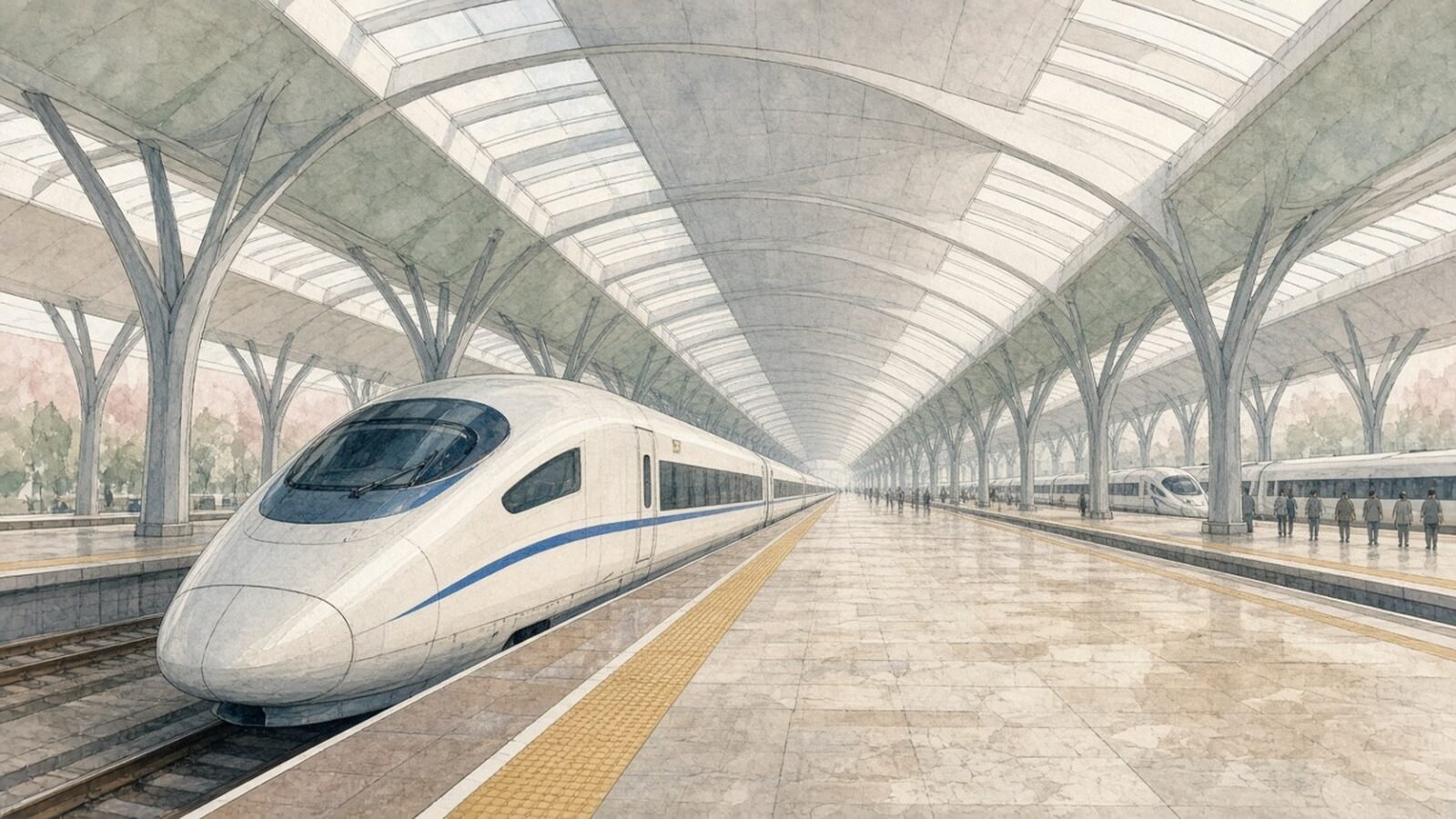
On 1 August 2008, a week before the Beijing Olympics opened, a white train left Beijing South station for Tianjin. It covered roughly 120 km in about half an hour on a line designed for 350 km/h. China had no dedicated high-speed railway before that day. By the end of 2025, according to the National Railway Administration’s statistical bulletin, it had 50,000 km of them, out of a national rail network of 165,000 km. That is more high-speed track than every other country combined.
This site has already looked at the industrial side of that achievement. China Built the World’s Train Set covers CRRC, the state-owned train maker, and the export packages built around it. China’s Railways Across Africa follows the conventional lines China has built abroad. This article looks at the network itself: the plans that shaped it and how they were overtaken, the path from licensed foreign trains to the 400 km/h CR450, and the viaducts, state finance and building methods that made the speed possible. It also covers the Wenzhou crash and the fall of Liu Zhijun, which nearly derailed the programme, the debt it left behind, and what economists actually find when they measure its effects.
From Beijing–Tianjin to 50,000 km
The headline figures are worth setting out carefully, because several versions circulate. The official figure for the end of 2024 was about 48,000 km. The International Union of Railways (UIC), whose High-Speed Atlas uses a stricter same-date count, recorded 47,803 km for China at 31 December 2024. That was out of a world total of 67,723 km in operation, or about 70%. China then opened 2,862 km of new high-speed line in 2025 and passed the 50,000 km mark on 26 December, when the Xi’an–Yan’an line opened. Xinhua reported that 12,000 km had been added during the five years of the 14th Five-Year Plan (2021–25) alone.
Growth has slowed in 2026. China State Railway Group, the national operator, reported only 355.2 km of new line of all types in the first half of the year, including the Xi’an–Shiyan high-speed railway. Investment in the first half rose 2.1% to RMB 363.2 billion. So “about 50,000 km” is still the accurate figure. It is not 48,000 km, which is the 2024 number, and the network is not yet much beyond 50,000 km.
What the network carries
Traffic has grown with the track. Chinese railways carried 4.601 billion passenger trips in 2025, up 6.7%, and 2.348 billion in the first half of 2026, a record for the period. On 1 May 2026 the railways carried 24.84 million passengers in a single day. At the end of 2025 the fleet included 5,230 standard sets of electric multiple units, the self-propelled trainsets that run high-speed services. These figures cover the whole railway, not only high-speed lines, but the growth in passenger numbers has come overwhelmingly from high-speed services.
The plans: from “four vertical, four horizontal” to “eight and eight”
China’s network was planned before it was built, and then built faster than planned. The State Council approved the first Mid- and Long-Term Railway Network Plan in 2004. Its high-speed core was a grid of “four vertical and four horizontal” (四纵四横) passenger-dedicated corridors. The north–south lines included Beijing–Shanghai and Beijing–Guangzhou; the east–west lines included Xuzhou–Lanzhou and Shanghai–Wuhan–Chengdu. The plan called for more than 12,000 km of such lines.
After the 2008 financial crisis, rail became a central part of China’s stimulus spending and construction accelerated sharply. When the plan was revised in 2016, the high-speed network had reached 19,000 km. The revision noted that by the end of 2015 China had 121,000 km of railway in total, 19,000 km of it high-speed. It replaced the 4×4 grid with “eight vertical and eight horizontal” (八纵八横) main corridors, supplemented by regional links and intercity lines. The document set targets of about 30,000 km of high-speed line by 2020 and about 38,000 km by 2025, with a long-term network of about 45,000 km. China beat all three. It reached 50,000 km in 2025, a decade ahead of the “long-term” goal.
The 2016 plan also set a design principle. New trunk lines would generally be built for 250 km/h or more, and for 350 km/h where corridors were densely populated and economically developed. In 2020 China State Railway Group published an outline for “a strong railway nation” setting new targets for 2035. It called for about 200,000 km of railway, including roughly 70,000 km of high-speed line, with high-speed rail reaching every city of more than 500,000 people. Those targets imply about another 20,000 km of high-speed line in the next decade, less than half the pace of the 2010s.
Borrowed trains and a Chinese standard
The track was built by Chinese engineers from the start. The trains were a different matter. In 2004 the Ministry of Railways ran a tender for 200 km/h trainsets under a principle often summarised as “introduce, digest, absorb, re-innovate”. Foreign bidders had to form partnerships with Chinese manufacturers and transfer technology. Bombardier’s design became the CRH1, Kawasaki’s Shinkansen E2 the CRH2, and Alstom’s Pendolino-derived design the CRH5. Siemens, which lost the first round, returned in 2005 and adapted its Velaro platform into the CRH3. The trains were branded “Harmony” (和谐号).
Chinese firms then developed these platforms further, most visibly in the CRH380 series built for the Beijing–Shanghai line, which opened in 2011. That work led to a lasting dispute. Kawasaki and other foreign partners argued that China was presenting modified versions of licensed technology as its own. Chinese officials rejected that, describing the CRH380 and its successors as re-innovation. The earlier train-set article covers the argument in more detail. The honest summary is that China began with foreign platforms and ended with a genuinely domestic industry, and both sides still dispute where one turned into the other.
Fuxing: the China Standard EMU
The answer to that dispute was a train designed from the outset to Chinese standards. The CR400AF and CR400BF “Fuxing” (复兴号, “rejuvenation”) sets entered service on the Beijing–Shanghai line in June 2017. In September that year they restored 350 km/h running on the line, a speed that had been abandoned after 2011. The Fuxing family now includes 250 km/h and 160 km/h versions, built to common standards across manufacturers.
CR450: the 400 km/h generation
The next step is the CR450. Prototypes of two versions, the CR450AF and CR450BF, were unveiled in Beijing on 29 December 2024. Xinhua reported a test speed of up to 450 km/h and a planned operating speed of 400 km/h. China Railway says the trains have 22% less running resistance and weigh 10% less than their predecessors, and carry more than 4,000 sensors. In August 2026 Caixin reported that both prototypes had completed the 600,000 km operational assessment that the National Railway Administration requires of a new trainset type. They still need certification and trial passenger running, and Caixin noted they had yet to undergo a maximum-speed test. The Chengdu–Chongqing central line is the only line so far designed for 400 km/h running. Chinese trade press expects commercial service in late 2026 or 2027, but no official date has been set.
How it was built so fast
The World Bank’s 2019 study, China’s High-Speed Rail Development, is still the most detailed outside assessment of how China did it. Its conclusion was blunt: “One of the most striking lessons for other countries is the speed with which public sector organizations can build high-quality infrastructure when given clear guidance and responsibilities.”
Standard designs and repetition
The Bank put average construction costs at $17 million to $21 million per kilometre, about two-thirds of the cost in other countries. That was despite the fact that many Chinese lines run largely on viaducts or in tunnels. Lower labour costs helped. But the Bank identified “the standardization of designs and procedures” as a key factor, along with a steady pipeline of projects that let contractors build up capacity and spread equipment costs across many jobs. Project managers stayed for the whole of a project and were paid partly by results. Once a long-term plan was approved, it changed very little.
Viaducts, land and local governments
Viaducts are the visual signature of the network. Standard prefabricated box girders, cast at trackside yards and lifted into place by purpose-built machines, let lines run straight and level across farmland, rivers and towns. The World Bank notes that viaducts and tunnels were used partly “to minimize land take”. On the Beijing–Shanghai line most of the route is on bridges, including the Danyang–Kunshan Grand Bridge, more than 160 km long.
Land was the other advantage. In China’s financing model, local governments contributed land acquisition and resettlement, along with materials support and tax relief, as their share of joint-venture railway companies. The Ministry of Railways, later China Railway, put in equity funded largely by construction bonds. Most of the rest came from bank loans, mainly from national and provincial development banks. By the Bank’s estimate, about RMB 2.5 trillion was invested in the high-speed lines in service by the end of 2015. The same arrangements that made the network fast to build left a financing burden that is still being paid off, as later sections show.
Wenzhou and the fall of Liu Zhijun
The boom nearly came apart in 2011. Liu Zhijun, railways minister since 2003 and the driving force behind the build-out, was placed under investigation in February that year. Five months later came the worst accident in the network’s history.
The crash
On the evening of 23 July 2011, lightning knocked out power to train D3115 near Wenzhou in Zhejiang province, leaving it stranded. Signalling equipment failed to show that the track was occupied, and train D301 ran into it from behind. Carriages fell from a viaduct. Forty people were killed and 172 injured. Public anger grew at reports that the authorities had rushed to clear the wreckage, including partly burying carriages at the site.
The State Council’s investigation reported in December 2011. According to Beijing Review’s account of the findings, it blamed serious design flaws in the train control equipment supplied by China Railway Signal and Communication Corp., together with relaxed safety management and a poor emergency response. Fifty-four officials were punished, among them Liu himself and his former deputy chief engineer Zhang Shuguang, who had both already been removed. The report also criticised the ministry and the Shanghai Railway Bureau for failing to disclose information on matters of public concern. Top speeds on the fastest lines had already been cut from 350 km/h to 300 km/h after Liu’s fall. After the crash, further speed reductions followed and approvals for new lines slowed.
The minister and the end of the ministry
In July 2013 a Beijing court gave Liu a suspended death sentence for taking more than RMB 64 million in bribes and abusing his power. Prosecutors said he had helped 11 people win contracts and promotions in return. The sentence was later commuted to life imprisonment. By then his ministry no longer existed. In March 2013 the State Council abolished the Ministry of Railways, one of the last industrial ministries of the planned economy. It gave regulatory functions to a new National Railway Administration under the Ministry of Transport, and passed operations to China Railway Corporation, which became China State Railway Group Co. in 2019.
The two events are usually told together, but they had different causes. The crash exposed weaknesses in signalling engineering and safety governance. The corruption case exposed a ministry that awarded contracts at great speed with little outside scrutiny. Together they ended the period of speed at any cost. The network that emerged was run more cautiously, and it has had no accident on the scale of Wenzhou since.
Who pays: China State Railway Group’s debt
The price of building a century’s worth of railway in two decades appears on China State Railway Group’s balance sheet. The company published its 2025 accounts in April 2026. It reported revenue of RMB 1.2987 trillion, up 1.2%, and net profit of just RMB 4.34 billion. Its debt-to-asset ratio was 61.98%, down 1.53 percentage points in a year. Chinese financial media, drawing on its bond disclosures, put total liabilities at about RMB 6.17 trillion, against assets of about RMB 9.96 trillion, and reported financial expenses of about RMB 144 billion for the year. For the first half of 2026 the group reported revenue of RMB 589 billion, a net profit of RMB 1.85 billion and a debt ratio of 61.83%.
How to read those numbers depends on who is reading them. The operator presents a falling debt ratio and a return to profit as evidence that market-based reforms are working, and notes that its transport revenue exceeded RMB 1 trillion for the first time in 2025. Critics point out that profits of a few billion yuan on revenue above a trillion leave almost nothing for repaying principal. Interest costs alone are dozens of times larger than net profit.
Why some lines pay and others never will
The World Bank explains the split. Busy 350 km/h lines carrying more than 40 million passengers a year can pay for operations, maintenance and debt service from fares. Many lines carrying 10–15 million passengers a year, especially 250 km/h lines with lower fares, “can barely cover train operations and maintenance”. The Bank expected those lines to be unable to contribute to their debt service for many years. The listed Beijing–Shanghai High-Speed Railway company is consistently profitable. Much of the western and north-eastern network is not, and never was expected to be. The 2035 targets push new construction further into exactly those thinner regions.
Busy trunks, quiet branches: what the research finds
Whether the network has been worth it depends on whose accounting you use, and the research genuinely points in different directions.
The case for
The World Bank estimated an economic rate of return of 8% for the network as it stood in 2015, counting time savings, lower operating costs as travellers switched from cars and planes, fewer accidents and lower emissions. It judged this “well above the opportunity cost of capital”. The same study estimated a financial return of about 6%, roughly equal to China Railway’s cost of borrowing. Many Chinese studies find positive effects on city GDP, tourism, innovation and regional integration along the main corridors. The Bank also found that some short-haul air services were withdrawn altogether once high-speed lines opened. On the Guangzhou–Changsha and Guangzhou–Wuhan routes, flights fell by two-thirds and one-half respectively.
The case against, or at least for caution
Studies of smaller places are far less encouraging. In May 2025 Xiaoxuan Zhang and John Gibson of the University of Waikato published a study in The Annals of Regional Science covering 2,342 county-level units between 2012 and 2019. Over that period the number of counties with a high-speed station rose from 91 to 460. They measured growth using both official GDP and satellite night-light data, and found that connection to the network was generally followed by lower local growth. In simple models the effect was about 2.5% on GDP and nearly 6% on the more precise night-light measure. It was concentrated in sparsely populated areas. Their conclusion: “The continued expansion of China’s HSR network may not necessarily stimulate local economic growth, even if it serves other strategic purposes.” A likely explanation, supported by earlier studies, is a “siphon effect”: faster links make it easier for people and investment to move from small places to big cities.
A 2025 paper in Transport Policy by Lyu Shuang and colleagues reached a less pessimistic but related conclusion. On average, high-speed connections had no significant effect on the economies of peripheral cities. Peripheral cities with stronger innovation capacity did benefit and lost fewer workers. The two findings are compatible. High-speed rail seems to reinforce existing strengths rather than create them, which matters for a plan that now aims to reach every city of 500,000 people.
The “ghost station” stories reflect the same pattern. Some stops in outer suburbs and small towns opened with almost no trains, and some were later closed or had services restored once feeder transport improved. The earlier train-set article discusses examples. The network is not empty: the trunk lines are among the busiest in the world. But passenger density is extremely uneven, and the financial and research findings both follow that unevenness.
Selling the system abroad
China’s high-speed exports have been fewer and more troubled than its domestic record might suggest.
Whoosh
The Jakarta–Bandung line, branded Whoosh, opened in October 2023. It was the first line outside China to use Chinese high-speed standards, trains and systems throughout, running at up to 350 km/h. By late April 2026 it had carried about 15 million passengers, according to its operator KCIC. Its finances have been painful. The project cost about $7.3 billion including overruns, and most of it was financed by loans from the China Development Bank. In September 2026 Indonesia’s finance ministry announced that it would take over the Indonesian consortium’s 60% stake at no cost and assume responsibility for the debt. The debt has been restructured over an 80-year term, with annual payments of about Rp 1 trillion (roughly $57 million). Finance Minister Purbaya said: “The total debt is large, but it has been restructured over 80 years.” He also said Indonesia wants to extend the line towards East Java, and that Beijing had shown interest.
Laos, Hungary–Serbia and Thailand
The China–Laos Railway, opened in December 2021, is a 160 km/h mixed passenger and freight line rather than a true high-speed railway. It is busy by regional standards: in the first half of 2026 it carried 10.07 million passengers and 12.6 million tonnes of freight, according to China Railway. Its roughly $6 billion cost remains a serious burden for one of Asia’s most indebted economies. The Budapest–Belgrade upgrade, built for up to 200 km/h in Serbia and 160 km/h in Hungary, opened fully on the Serbian side in 2025. On the Hungarian side freight trains have run since February 2026, but passenger services are waiting on a full timetable test on 3–4 October. Thailand’s Bangkok–Nakhon Ratchasima line, the first stage of a planned route to the Lao border, was reported in 2026 to be about 56% complete against a plan of about 90%. Its opening has slipped to around 2030–31.
There have been outright failures too. Mexico cancelled a Chinese-led contract for a Mexico City–Querétaro line in 2014, days after awarding it. Rich-country markets remain mostly closed to Chinese high-speed trains for political and security reasons. The Belt and Road has made China the default supplier for some developing countries, but has not yet produced a second Whoosh.
Conclusion
China’s high-speed network is one of the largest infrastructure projects of the modern era. Fifty thousand kilometres in seventeen years is more than the rest of the world managed in six decades. The factors behind it are not mysterious: a long-term plan that rarely changed, standardised designs built over and over, local governments supplying land, state banks supplying credit, and an industrial policy that turned licensed foreign trains into a domestic standard now heading for 400 km/h.
The costs are just as clear. The Wenzhou crash and the fall of Liu Zhijun showed what speed without scrutiny could do. China State Railway Group carries liabilities of about RMB 6 trillion and earns only a sliver of profit. Research increasingly suggests that high-speed rail rewards places that were already strong and can drain those that were not. On the main corridors the case is overwhelming. On the branches into sparsely populated areas, and in the 20,000 km still planned for the next decade, it is much weaker.
What the next phase should be judged on is not length but use. That means whether the CR450 makes 400 km/h viable in commercial service, whether the operator’s thin profits can start to pay down principal, and whether the new lines into western and north-eastern China carry enough people to justify the viaducts beneath them. The expansion is over. The question now is how well the network is used.