Between 1938 and 1941, as country after country closed its doors to Jews fleeing Nazi Germany, a Chinese port city under Japanese military pressure became one of the last places in the world they could reach. Most estimates put the number of Central and Eastern European Jews who found refuge in Shanghai at between about 18,000 and 20,000. The figure is contested, and the reasons are explained below. Most of them survived the war.
They did not arrive in a city without Jews. For almost a century Shanghai had been home to a small, extremely wealthy community of Baghdadi Jewish merchants. Two families, the Sassoons and the Kadoories, had built some of its most famous hotels, offices and mansions. This article follows both stories: the refugees who came with almost nothing, and the dynasties that were already there, how they helped, and how their fortunes diverged after 1949. The wider world of the International Settlement is described in our article on Old Shanghai and the International Settlement, and the waterfront itself in the long history of Shanghai’s Bund.
From Baghdad to Bombay to the Bund
The Sassoon story begins with David Sassoon, a Jewish merchant from Baghdad who settled in Bombay in the early 1830s and built a trading house under British protection there. His second son, Elias David Sassoon, reached Canton in 1844, soon after the First Opium War, and moved on to Shanghai in 1845, when the city had only just been opened to foreign trade. After David’s death in 1864, Elias broke away to found his own firm, E. D. Sassoon & Co., in 1867. Shanghai people came to distinguish the “old” and “new” Sassoon companies.
The Sassoon firms employed a steady stream of young men from Baghdad’s Jewish community, who travelled to Bombay, Shanghai and Hong Kong as clerks. By the 1930s this Sephardic, or Baghdadi, community in Shanghai numbered only about 700 people, according to the United States Holocaust Memorial Museum. Its wealth was out of all proportion to its size. A larger community of several thousand Russian Jews, most of modest means, had arrived after the 1917 revolution. They built the Ohel Moshe Synagogue in Hongkew, which later became central to the refugee story. A separate and older Russian Jewish community had also grown up in Harbin in the north-east, which we cover in a separate article.
Opium, Cotton and Property
The Sassoon fortune in China was built on trade, and a large part of that trade was opium. It is a fact that should be stated plainly rather than softened. Indian opium shipped into China was one of the most profitable commodities of the nineteenth century, and the Sassoon firms were among its biggest dealers, alongside British houses such as Jardine, Matheson. They also traded cotton textiles, silk, tea and metals. (The wider story of these trading houses is told in our article on the great foreign hongs.)
How large the Sassoon share was is harder to pin down. One often-quoted estimate, from a 2001 Shanghai Star article, holds that about a fifth of all the opium brought into China travelled on Sassoon ships. Other popular accounts claim the family controlled as much as 70 per cent of the Indian opium trade at its peak. These figures come from secondary and journalistic sources rather than audited trade statistics, and they should be treated as contested estimates.
What is clearer is how the business changed. Under the Ten Years’ Agreement of 1907, Britain agreed to reduce Indian opium exports to China and end them within a decade, while China suppressed domestic cultivation. By then E. D. Sassoon & Co. was moving into property, textile mills, insurance and other ventures. The historian Madhavi Thampi notes that in the nineteenth century the family’s property profits were estimated at only about one-nineteenth of its opium profits. From the early 1920s, with opium finished, Shanghai real estate became its most lucrative business.
Victor Sassoon Remakes the Skyline
The man who turned that property into a skyline was Sir Victor Sassoon (1881–1961), great-grandson of David. Cambridge-educated, he had been left with lasting leg injuries by a flying accident while serving in the Royal Flying Corps in 1916. In the 1920s he moved the centre of the family business from India to Shanghai, and poured money into the city’s property market.
His most famous building was Sassoon House on the Bund, completed in 1929, with the Cathay Hotel occupying its upper floors. It was an Art Deco block faced in granite and topped by a steep, green copper pyramid that became a symbol of Shanghai’s interwar glamour. Victor lived in a penthouse under the pyramid. He also built or owned many other landmarks, including the Cathay Mansions and Grosvenor House apartment blocks in the French Concession, and the Embankment Building on Suzhou Creek, at the time said to be one of the largest apartment buildings in Asia. In Jonathan Kaufman’s portrait, as summarised by the historian Sarah Abrevaya Stein, he appears as a racehorse owner, host of lavish parties and keen photographer whose playboy image hid a sharp business mind.
The Kadoories and the Barrel of Disinfectant
The Kadoories began as Sassoon employees. Elly Kadoorie, born in Baghdad in the 1860s, arrived in China in 1880 as a clerk with the Sassoon firm. The Kadoorie family’s own Hong Kong Heritage Project names it as E. D. Sassoon & Co., although some other accounts name David Sassoon & Sons. He was posted to several treaty ports. According to the family’s account, while he was temporarily in charge of the office in Ningbo during a plague outbreak, he took a barrel of expensive disinfectant from the company stores without permission, and was dismissed. His son Lawrence later joked that the barrel should be shown “rampant” on the family coat of arms. The story comes from the family itself, but it is consistently told.
With a small loan from his brother, Elly set up as a broker in Hong Kong. He later invested in rubber and sugar plantations, property, banking and utilities. He was one of the original subscribers to China Light & Power when it was founded in 1901, and the family became leading shareholders in what is now the Hongkong and Shanghai Hotels company. In Shanghai that company ran the Astor House and the Palace Hotel, which stood directly opposite the Cathay across Nanking Road. It also ran the Majestic Hotel on Bubbling Well Road, where Chiang Kai-shek and Soong Mei-ling held their wedding reception on 1 December 1927. The Majestic was sold around 1930 and demolished in 1932. In Hong Kong, the company opened the Peninsula Hotel in Kowloon in 1928.
In 1924 Elly completed a family mansion off Bubbling Well Road that became known as Marble Hall, after the Italian marble used in its construction. Its ballroom was said to be lit by 3,600 coloured bulbs. The house is now the China Welfare Institute Children’s Palace. Elly’s wife Laura had died in a fire at their earlier Shanghai home in 1919. Their surviving sons, Lawrence (1899–1993) and Horace (1902–1995), would carry the business into the second half of the century.
A Port That Asked for No Visa
The refugee crisis began in earnest in 1938. After Germany annexed Austria in March, around 185,000 Austrian Jews faced sudden persecution. The nationwide violence of Kristallnacht on 9–10 November 1938 was followed by the arrest of tens of thousands of Jewish men. Nazi policy at this stage still sought to force Jews out, and proof of a ticket or a destination could secure release from a concentration camp. But most countries, as the Evian Conference in July 1938 had shown, would not take significant numbers.
Shanghai was the exception because of its fractured government. The International Settlement and French Concession were run by foreign councils, the Chinese city by a collaborationist administration, and after the fighting of 1937 the Japanese military controlled much of the surrounding area, including Hongkew. No single authority checked passports at the docks, and until August 1939 no visa was needed to land. According to the Holocaust Memorial Museum, the refugee population rose from about 1,500 at the end of 1938 to nearly 17,000 a year later. Many came on Italian and Japanese liners from Genoa and Trieste. In August 1939 the authorities restricted new arrivals, requiring most newcomers to show either a deposit of 400 US dollars or a job or family sponsor in the city.
How many refugees arrived in total is uncertain. The Holocaust Memorial Museum estimates about 17,000 German and Austrian Jews, plus roughly a thousand Polish Jews who came via Japan in 1941. The Shanghai Jewish Refugees Museum speaks of about 20,000, and its memorial wall lists 18,578 names. Differences arise from how people passing through, and those who arrived before 1938, are counted. A range of 18,000 to 20,000 is the safest statement.
The Consul in Vienna
Although Shanghai did not require visas, Jews leaving the Reich needed to show that they had somewhere to go. One man who gave them that proof was Ho Feng-Shan, the Chinese consul-general in Vienna from 1938 to 1940. Yad Vashem, Israel’s Holocaust memorial, records that Ho issued visas for Shanghai to all who asked, including people who intended to travel elsewhere and simply needed a document to get out. He continued despite instructions from his superior, the Chinese ambassador in Berlin, Chen Jie, who wanted to avoid friction with Germany. A demerit entered in Ho’s file in 1939 is believed to be linked to this defiance.
How many visas he issued is unknown. Yad Vashem says the number is estimated to “run into the hundreds, perhaps even thousands”. The Jewish Telegraphic Agency reported in 2000 that visa serial numbers showed about 1,200 issued in his first months, while his daughter estimated up to 4,000 people were saved. Ho retired in 1973 and died in San Francisco in 1997. Yad Vashem recognised him as Righteous Among the Nations in 2000, after survivors’ testimony came to light.
From Kaunas to Kobe
A second route led through Japan. In the summer of 1940, thousands of Polish Jews who had fled to Lithuania were trapped as the Soviet Union annexed the country. With help from the Dutch consul Jan Zwartendijk, who provided papers for the Dutch colony of Curaçao, the Japanese consul in Kaunas, Chiune Sugihara, issued Japanese transit visas. The list he later sent to Tokyo contains 2,139 names. The often-quoted figure of 6,000 people saved includes family members travelling on one passport and other estimates; recent research suggests those who reached Japan numbered between about 2,000 and 3,000. The numbers are debated.
The refugees crossed Siberia by train to Vladivostok, sailed to Tsuruga and gathered in Kobe, where the local Jewish community helped them. Among them was the entire Mir Yeshiva, a famous rabbinical academy founded in 1815 in the town of Mir in what is now Belarus, with some 250 to 300 students and teachers. In late 1941, as Japan prepared for war, the authorities moved around a thousand refugees who had not found onward passage, including the yeshiva, to Shanghai.
There the Mir students were housed in the Beth Aharon Synagogue, built in 1927 by Silas Hardoon, one of the richest Baghdadi Jews in the city. They continued their studies throughout the war, reprinting texts in Shanghai when books ran short. According to the Holocaust Memorial Museum, the Mir became the only Eastern European yeshiva to survive the Holocaust intact. Its leaders and remaining students left for the United States in 1946 and 1947.
Life in Hongkew
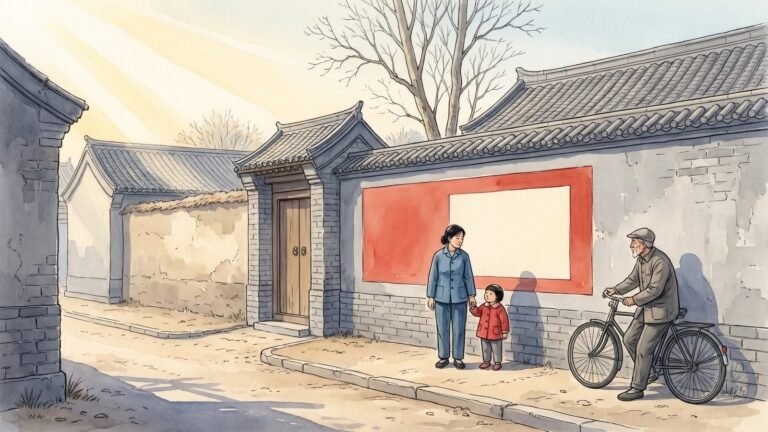
Most refugees arrived with very little, because Nazi rules had stripped them of their assets. They settled in Hongkew, today’s Hongkou district, north of Suzhou Creek. It had been badly damaged in the fighting of 1932 and 1937, and rents there were cheaper than anywhere else in the foreign areas. The core of their district lay around Tilanqiao, with its brick lane houses and crowded alleys, among Chinese families who were themselves living through war and occupation.
Relief quickly became a necessity. A committee of established Shanghai Jews, backed by the American Jewish Joint Distribution Committee, opened group shelters known as Heime. By the end of 1939 about 2,500 people lived in them and around 4,500 more ate in their soup kitchens, according to the Holocaust Memorial Museum. Victor Sassoon turned parts of the Embankment Building into a reception centre for new arrivals. Accounts of the period describe a fund of about 150,000 US dollars he set up to help refugees start businesses and find work. Kaufman, as reported by reviewers, portrays Sassoon as initially reluctant and pressed into helping by the Kadoories. That is his interpretation, and it should be read as such.
Horace Kadoorie’s main contribution was education. He founded the Shanghai Jewish Youth Association in 1937, and in November 1939 it opened a school for refugee children on Kinchow Road in Hongkew, soon known as the Kadoorie School. It taught around 700 children in English to prepare them for emigration to English-speaking countries, alongside sport, clubs and vocational training. Refugees also opened cafés, bakeries and workshops, published newspapers and staged plays and concerts. Doctors, lawyers and musicians often took whatever work they could find.
The Designated Area
After Pearl Harbor in December 1941, Japan took over the whole International Settlement. British and American residents, among them Elly Kadoorie and his family, were later interned. Elly died in February 1944. Victor Sassoon had left for India in 1941 and spent the war there.
On 18 February 1943 the Japanese army and navy proclaimed a “designated area for stateless refugees”. The proclamation did not use the word “Jew”, but it applied to stateless people who had arrived since 1937, which in practice meant the Central European and Polish Jewish refugees. They had until 18 May to move into an area of Hongkew of roughly a square mile. Some sources give around 2.5 square kilometres. Many Chinese residents, often put at around 100,000, continued to live there too. There were no walls; signs at the boundaries read “Stateless Refugees are Prohibited to Pass Here without Permission”. Passes to leave were issued by Japanese officials, notably a man named Ghoya who styled himself “King of the Jews”, and who was notorious for humiliating and sometimes striking applicants.
Life inside was hard: overcrowding, poor sanitation, hunger and disease. Yet the Holocaust Memorial Museum stresses that it did not resemble the ghettos of Nazi-occupied Europe. There were no deportations and no systematic killing. A persistent story claims that the Gestapo officer Josef Meisinger, attached to the German embassy in Tokyo, proposed a plan in 1942 to exterminate Shanghai’s Jews. It stems mainly from one postwar testimony popularised by the 1979 book The Fugu Plan. Recent research by the historian Kenji Kanno, using wartime Japanese naval records, finds no documentary evidence for such a plan, and concludes that the designated area was a Japanese initiative. The Meisinger plan should be regarded as unproven at best.
The worst loss of life came near the end of the war. On 17 July 1945 an American air raid on Hongkew, aimed at Japanese military targets, killed dozens of refugees and hundreds of Chinese residents. The Holocaust Memorial Museum gives 40 Jewish dead; other sources give about 31.
Leaving China, Staying in Hong Kong
When the war ended, the refugees learned what had happened to the families they had left behind. Few wanted to stay in a China sliding into civil war. Between 1946 and the early 1950s almost all left, mainly for the United States, Australia, Palestine and, after 1948, Israel. By the mid-1950s only a small remnant remained.
The great Baghdadi families left too, but with very different outcomes. Victor Sassoon never rebuilt his Shanghai empire. After 1949 his Chinese property passed out of his hands, and Sassoon House reopened in 1956 as the Peace Hotel. He moved his base to Nassau in the Bahamas, where he died in 1961. The E. D. Sassoon business faded, and the family’s name in China survives mainly on buildings.
The Kadoories had already turned towards Hong Kong. Lawrence Kadoorie rebuilt China Light & Power into one of Hong Kong’s main utilities. Decades later it partnered with China in the Daya Bay nuclear power station, and the family’s hotel company expanded the Peninsula brand internationally. Horace founded agricultural aid programmes in Hong Kong’s New Territories. In 1981 Lawrence became the first Hong Kong-born person to be made a British peer. The family returned to Shanghai in 2009 with the Peninsula hotel on the Bund, a short walk from Sassoon House. Marble Hall, like the Sassoon properties, had been taken over by the state.
Rivals or Parallel Lives
It is tempting to tell this as a story of rival dynasties, and Kaufman’s 2020 book is subtitled The Rival Jewish Dynasties That Helped Create Modern China. The sources support a more modest picture. The families competed in the same markets: both built luxury hotels, and the Kadoorie Palace Hotel faced the Sassoon Cathay across Nanking Road. The Kadoories had also started out as Sassoon employees, and reviewers note that by the late twentieth century the Kadoories had become the richer family. Kaufman also contrasts Victor Sassoon’s bet on Shanghai with Lawrence Kadoorie’s decision to shift the family’s wealth to Hong Kong.
But the reviews, family histories and other sources consulted for this article offer little evidence of personal enmity. The families knew each other, moved in the same small community and supported the same refugee relief. The “rivalry” is best understood as parallel competition and diverging fortunes, not a feud.
In Hongkou, the old Ohel Moshe Synagogue at 62 Changyang Road now houses the Shanghai Jewish Refugees Museum. It opened in 2007 and reopened after a major expansion in December 2020, surrounded by the preserved lanes of the Tilanqiao Historic Area. Its wall of names, and the Kadoorie hotels still operating in Hong Kong and Shanghai, are reminders that Jewish Shanghai contained both extremes: some of the richest families in Asia and thousands of people who arrived with nothing, alive because a city far from Europe had, briefly, let them in.