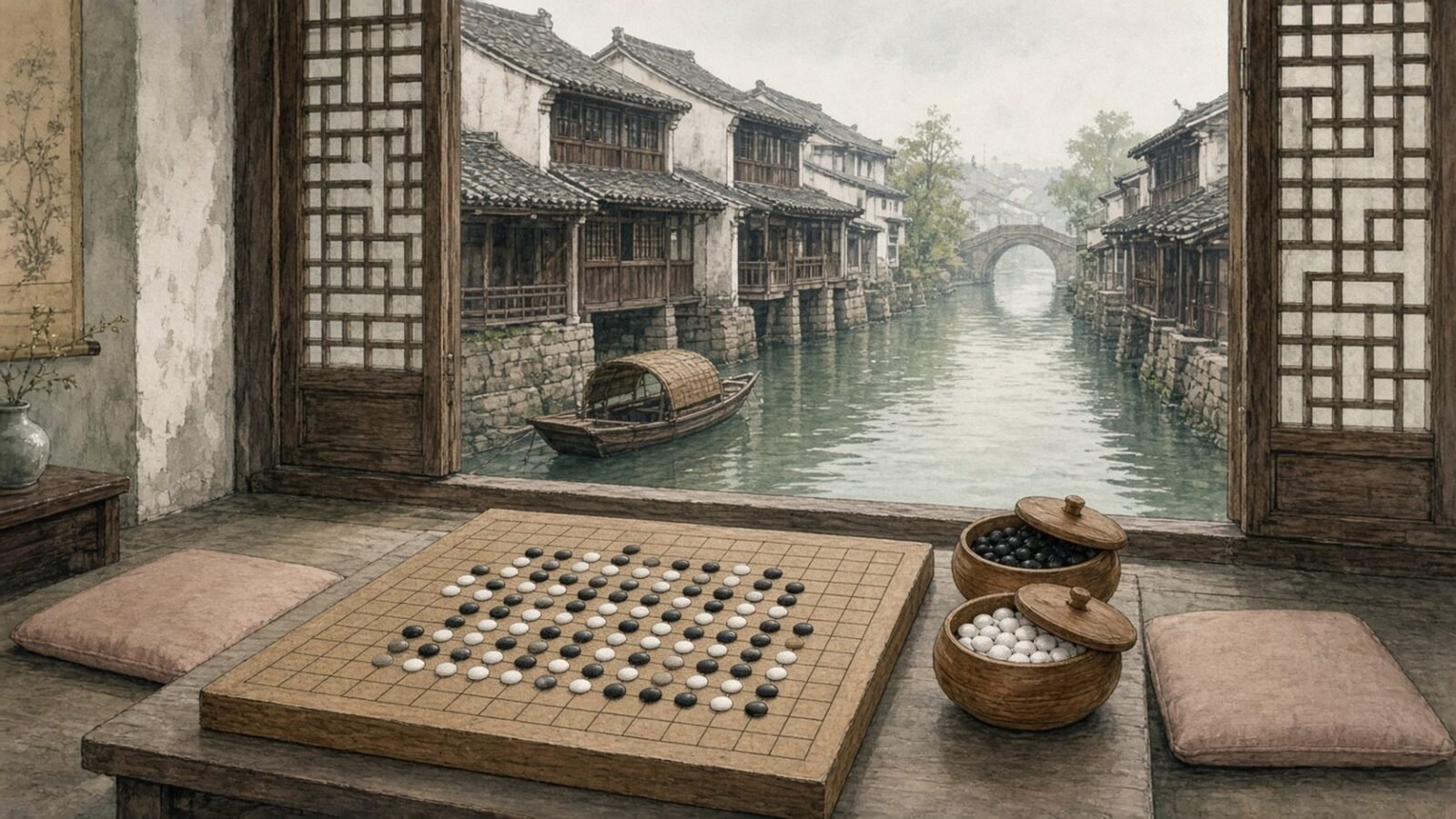
In the last week of May 2017, in the canal town of Wuzhen, a place of whitewashed walls and stone bridges that China had lately turned into the venue for its World Internet Conference, the best player alive sat down to the oldest board game on earth. Ke Jie was nineteen years old, the world number one in weiqi, the game the West knows as Go: brash, funny, unbeatable when it mattered, and he had come to play three games against a program called AlphaGo. He lost the first by the smallest margin in the rules, half a point. He lost the second in a fight the commentators called the finest game a human being had ever played. In the third, mid-game, he left the table for twenty minutes, stood in the corridor with his head in his hands, came back, and lost again. He wept at the press conference afterward. “AlphaGo is perfect,” he said. The moment was reported around the world as a story about artificial intelligence, and it was. But it was also something quieter and stranger: a Chinese invention two and a half thousand years old, carried for centuries on bamboo and silk and paper, had just produced the occasion for a machine to become the strongest player in the game’s history. To understand what was on that board in Wuzhen, you have to go back to the beginning, because weiqi is not a pastime in China. It is a way of thinking, and it has been teaching the country to think in territory since before there was a China to speak of.
The game itself can be taught in a minute and not mastered in a lifetime. The board is a grid of nineteen by nineteen lines, 361 intersections. Two players, Black and White, place stones on the points, one at a time, never moving them again. A stone, or a connected army of stones, lives while it touches an empty point and dies when completely surrounded. When neither player can profitably add a stone, the game ends, and the winner is whoever has surrounded more territory. That is nearly all there is to it: no piece types to learn, no special moves, no luck at all. And from that simplicity explodes a depth no other game approaches. The number of possible legal games is on the order of ten to the power of one hundred and seventy, more than the number of atoms in the observable universe by a margin so large the comparison fails to mean anything. Chess, the West’s deepest game, is a pocket calculator by comparison. Weiqi is the deepest rulebook ever written, and it fits on one page.
The origin stories are legends, and lovely ones. The most repeated credits the sage-emperor Yao, around 2200 BC, who invented the game to civilise his son Danzhu, a boy more interested in brawling than in the arts of rule; the board failed, as Danzhu lost the throne to Shun, but the game outlived them both. The other founding myth is the melancholy one. A woodcutter named Wang Zhi, gathering firewood in the mountains in the Jin dynasty, came upon two immortals playing at a stone table and stopped to watch. When the game ended and he reached for his axe, he found its handle had rotted away; he walked home and discovered a hundred years had passed. The Chinese still call weiqi lanke, the rotten axe handle, the game that eats time. It also answers to shoutan, hand conversation, a dialogue conducted without speech, in which two minds learn each other stone by stone. Any game that accumulates names like these across two millennia is not merely played. It is inhabited.
The solid record begins, as the solid record of so many Chinese things begins, with the classics. Confucius mentions the game once, in the Analects, with magnificent grudgingness. A disciple asks whether the man of leisure has nothing to occupy him, and the Master concedes the floor:
Is it not better to play weiqi than to do nothing at all?
It is the most lukewarm endorsement in the history of sport, and it is also the game’s certificate of antiquity: a game dismissed by Confucius in the fifth century BC was already old enough to be disreputable. A century or two later Mencius gives us the first named player in world history, Yi Qiu, the finest player in the land, who appears in a parable about attention: Yi Qiu teaches two students, and the one who listens while the other daydreams of shooting swans is the one who learns. The point of the story is concentration, but the historian notices something else. By Mencius’s day the game already had national champions, and they were famous enough to carry a metaphor.
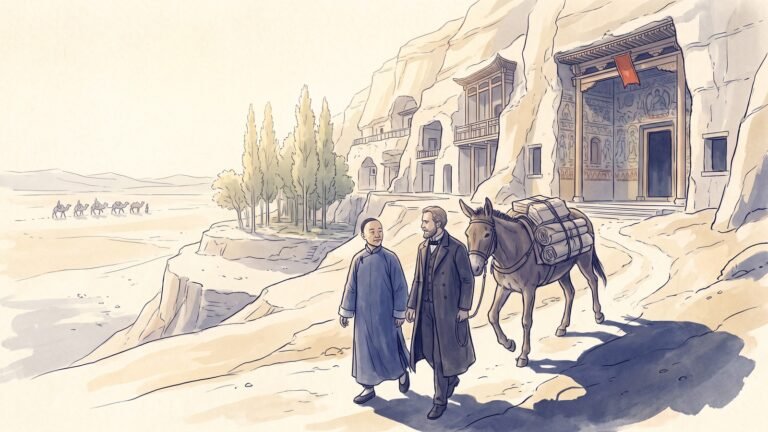
The archaeology and the libraries fill in the rest. Han dynasty tombs have surrendered stone boards with a seventeen-line grid, and pottery figurines of players hunched over their stones; by about the sixth century the modern nineteen-line board had become standard, and it has not changed since. Under the Liang dynasty, in the sixth century, players were classified into nine grades, consciously mirroring the nine ranks of the civil service, and the game took its place among the four arts of the cultivated person: the qin, the zither this series has already visited in its tomb; weiqi; calligraphy; painting. When the Tang dynasty’s great library at Dunhuang was sealed and forgotten, among the scrolls waiting in the dark was a weiqi manual, the oldest surviving treatise on the game, now in the British Library with the rest of the cave’s plundered treasures. By the Song dynasty the literature was rich enough to support the classic collection whose title alone explains the game’s grip: the Wangyou Qingle Ji, the Book of Forgetting Sorrow and Pure Joy. Empires fell, capitals burned, and the board stayed exactly as it was, the one piece of Chinese furniture two thousand years of upheaval never rearranged.
A culture this old grows rituals around its objects. The classic equipment is itself a syllabus: boards of yellow Catalpa wood so prized that whole boards were sawn from single ancient trees; black stones of Yunnan stone, the yunzi, made to a Song dynasty recipe that remains a Yunnan specialty; in Japan, white stones cut from Hamaguri clamshells, graded by the fineness of their grain until the best cost more than a car. The etiquette is just as settled. The weaker player takes Black and moves first; a lost game is resigned without rancour; and when the counting is done comes the most instructive custom of all, the fupan, the replay, in which the two players reconstruct the game together move by move and find out where it was won and lost. The word has escaped the board entirely: in the offices of China’s technology companies, a project post-mortem is simply called a fupan, a replay, and the young engineers running them are, knowingly or not, conducting the oldest review ceremony in Chinese intellectual life.
What did the game teach? Start with the difference from chess, because the difference is the whole argument. Chess is a battle that ends in regicide: pieces are slaughtered, the army is depleted, and the king is cornered and killed. Weiqi is a campaign for land. Stones are captured, yes, but the score is counted in territory, in the empty points your influence has enclosed, and the game is usually decided by margins: you win by one point, by five, not by annihilation. There is no king to kill. There is only a map to fill, slowly, stone by stone, with influence that radiates from strong positions into unsettled corners of the board. A chess master thinks in combinations; a weiqi master thinks in shape, thickness, balance, and timing, in questions of when to fight and when to be content with a profit and move elsewhere. The vocabulary sounds like Sunzi because it is Sunzi’s world: the supreme excellence, the Art of War says, is to subdue the enemy without fighting, and a game of weiqi played at the highest level is a war in which barely a battle is fought, decided by positions acquired so patiently that defeat arrives as a surprise to the loser.
The men who made modern China noticed. Mao Zedong, in his 1938 lectures on strategy in the war against Japan, reached for the game by name: the contest between the combatants, he told his officers, resembled nothing so much as a game of weiqi, a struggle of encirclement and counter-encirclement, in which the guerrilla bases planted deep behind Japanese lines were stones placed in the opponent’s territory, too strong to remove, feeding on the board’s emptiness until the opponent discovered he had lost the corners while fighting for the centre. The analogy was not decoration. Mao’s armies actually fought that way, trading space for time, conceding the cities, surrounding them from the countryside, and Chinese strategists have read their own history through the board ever since. When Henry Kissinger came to write his book On China in 2011, after forty years of dealing with Beijing, he opened with the same comparison: the West plays chess, seeking total victory in a single campaign; China plays weiqi, seeking relative advantage through protracted encirclement. It is a metaphor, and metaphors should not be mistaken for policy. But it is not an accident that it is the metaphor the country’s own marshals reached for first.
Like silk and porcelain and printing, the game was too good to keep. It crossed to Korea, where it is baduk, and reached Japan by the sixth century, where it became go, the name the world would eventually learn. Japan did to weiqi what Japan has often done to Chinese imports: refined it into an institution. Under the Tokugawa shoguns, from the early seventeenth century, four great Go houses were established and salaried by the state, the Honinbo chief among them, and the houses battled for generations in official matches played before the shogun in his castle, the castle games, with stipends and honour at stake. The golden age produced its own legends, none better than the ear-reddening game of 1846, when the seventeen-year-old prodigy Shusaku, playing the fearsome senior master Gennan Inseki, placed a stone of such unobtrusive brilliance that Gennan’s ears went visibly red, and a doctor watching the match remarked that he knew then who would win, because only a losing man blushes like that. The boy became the sage of Go. The game became, in the world’s eyes, Japanese.
Which is why the twentieth century reads, in retrospect, like the long set-up to Wuzhen. In 1928 a fourteen-year-old boy from Fujian named Wu Qingyuan arrived in Japan, and as Go Seigen he proceeded to become the greatest player of the modern age. Between 1939 and 1956 he played a series of ten-game matches against every top master Japan had, and beat them all, forcing each opponent down in rank, one after another, for seventeen years. The finest Go player of the twentieth century was Chinese-born, and everyone in China knew it, and waited. The revival came through politics, as everything in that century did: Marshal Chen Yi, the foreign minister, loved the game and bankrolled its recovery, and in the mid-1980s the China-Japan Super Go matches turned a young Beijing player named Nie Weiping into a national hero, as he strung together impossible winning streaks against the Japanese establishment on live television. The Nie whirlwind, the newspapers called it. Tens of millions took up the game. When the Korean genius Lee Chang-ho built a wall China could not climb in the 1990s, the country built Go schools until it produced Gu Li, and then Ke Jie, and by the 2010s China had regained, by most measures, the summit of the game it had invented.
The board has always had a second life in the country’s imagination. In Dream of the Red Chamber, the great eighteenth-century novel of a family in decline, the young masters while away their afternoons at weiqi while the household’s fortunes quietly collapse around them; in Jin Yong’s martial arts epics, the unfathomable zhenlong puzzle position stands for two hundred chapters as a trap no hero can solve, until a monk solves it by the one move no master would consider, sacrificing his own stones. When the Japanese manga Hikaru no Go serialised a ghost teaching a schoolboy to play at the turn of the millennium, it sold by the million in China and filled the Go schools with new children. The painterly 2006 film The Go Master carried Wu Qingyuan’s life back to his homeland’s screens. The pattern repeats across the centuries: whenever China needs a figure for patience, for depth, for the long game, it reaches for the board. No other object in the culture carries that much meaning per gram.
Against that summit the machine was aimed. Go had been the last citadel of human board-game supremacy for a simple reason: it could not be calculated. Chess fell in 1997, when IBM’s Deep Blue beat Garry Kasparov by searching millions of positions a second, but a Go board offers too many branches for brute force; the average position has hundreds of legal moves where chess has dozens, and evaluating a position was an act of judgement, of intuition, the very thing machines were supposed to lack. Go players said so, with some complacency, for twenty years. In March 2016, in a Seoul hotel, DeepMind’s AlphaGo played the Korean legend Lee Sedol, holder of eighteen world titles, and won four games to one. In the second game the machine played a move, the thirty-seventh, that no professional would have considered, a shoulder hit on the fifth line that the commentators called ugly, then strange, then beautiful, then decisive. An estimated 280 million people watched. In China, where the game is a heirloom rather than a hobby, the result landed somewhere between a scientific event and a national one.
Then came Wuzhen. In January 2017 a mysterious online player named Master won sixty consecutive games against the world’s best professionals, sixty to zero, before revealing itself as AlphaGo. Four months later Ke Jie got his three games in the canal town, in front of his home crowd, and the machine won all three, and DeepMind’s founder Demis Hassabis announced that AlphaGo would retire from competition, unbeaten in its final form, the strongest player in the history of the game it had spent three years learning. Ke Jie cried, and then he did the most human thing available: he went back to the board. He said later that the machine had shown him moves he would never otherwise have seen, and he went on a winning streak against humans armed with ideas borrowed from it.
That is the aftermath nobody predicted. The game did not die. It deepened. Within a few years open-source engines, KataGo and its rivals, put superhuman strength on every laptop, and the opening library of three thousand years was rewritten: moves condemned by generations of masters as vulgar proved sound, and formations revered since the Song proved slack. Children in Go schools in Beijing and Seoul now grow up studying with the engines the way their grandfathers studied the castle games, and the strongest human players are those who best learned the machine’s lessons while keeping the human nerve the machine does not need. The oldest game on earth became, in its third millennium, a collaboration between the species that invented it and the machines that mastered it, which is either a defeat or the strangest compliment a tradition has ever received.
The board, meanwhile, keeps its older counsel. Somewhere in China at this hour, on plastic boards in primary schools and slate boards in teahouses, the stones are still falling, one at a time, never moving again, each one a small claim on an empty map. The game that Confucius dismissed, that immortals played while axe handles rotted, that marshals used to explain guerrilla war, that a boy from Fujian carried to Japan and a boy from Zhejiang defended against the future, is still played by the rules the Liang dynasty knew. Nothing else that humans play is so old and so unchanged. And the lesson it has been teaching all along, the one Wuzhen only underlined, is the lesson the whole series keeps finding in China: the map is filled patiently, the margins are what matter, and the game is won by whoever is still placing stones when the counting is done.