The International Dunhuang Project, renamed the International Dunhuang Programme in 2024, is a collaboration among libraries, museums and research institutes in Asia, Europe and North America that hold manuscripts, paintings, printed documents and other objects from the ancient sites of the eastern Silk Road. It was founded at the British Library in London in 1994, after a conference of curators and conservators held the previous year, with the aim of bringing back together, in catalogue records and in photographs, a body of material that had been divided among several countries in the early twentieth century. The largest part of that material came from a single small chamber at the Buddhist cave temples of Mogao, near the oasis town of Dunhuang in Gansu province, which had been sealed around the beginning of the eleventh century and opened in 1900. Other parts came from the ruined towns, monasteries and watch-posts of the Tarim Basin and the Gobi, from Khotan and Niya in the south to Turfan and Kucha in the north and Khara-khoto in the east. Over the following three decades the Project grew from a secretariat of a few people into a network of more than thirty-five partner institutions, with centres in Beijing, Dunhuang, St Petersburg, Kyoto, Berlin and Paris as well as London, and its website became one of the principal means by which scholars of medieval China, Tibet and Central Asia consult the original documents of their fields. This article describes the history of the collections that the Programme brings together, the circumstances in which they were formed and divided, the foundation and development of the Programme itself, and its work in cataloguing, conservation, digitisation and research.
Dunhuang and the cave temples of Mogao
Dunhuang lies at the western end of the Hexi Corridor, the narrow strip of habitable land between the Qilian Mountains and the Gobi that connected the Chinese heartland with the oases of what is now Xinjiang. The town was established as a commandery of the Han empire at the end of the second century BCE, in the period of westward expansion that followed the missions of Zhang Qian, whose journeys are described in Zhang Qian and the Opening of the Silk Road. Beyond Dunhuang the routes divided. One road ran north-west to Hami and Turfan and along the southern foot of the Tianshan to Kucha, Aksu and Kashgar; another ran south-west along the edge of the Kunlun Mountains through Miran, Niya and Khotan; a third, used in early centuries, crossed the Lop Nor region by way of Loulan. Travellers, merchants, envoys, soldiers and monks passing in either direction stopped at Dunhuang, and the town became a place where Chinese, Indian, Iranian, Tibetan and Turkic peoples and their languages, religions and goods met.
About twenty-five kilometres south-east of the town, a cliff of conglomerate rock faces the dry bed of the Daquan river. According to a later inscription, a monk named Le Zun began cutting a meditation cave in the cliff in 366, and over the following thousand years hundreds of caves were excavated, plastered, painted and furnished with clay sculpture by monks, local officials and lay donors. Several hundred decorated caves survive, ranging from small chapels to large halls with colossal seated Buddhas, and together they form one of the largest bodies of Buddhist art in the world. The site, the history of the town and the discovery of the cave library are described at greater length in The Library in the Sand at Dunhuang, and the arrival of Buddhism in China, without which none of this would exist, in Buddhism Came as a Foreign Religion. A general account of the site is given in the Grokipedia entry on the Mogao Caves.
The cave now numbered 17 is a small square chamber opening off the right-hand wall of the entrance corridor of Cave 16, a large cave of the late Tang period. According to the account published by the International Dunhuang Programme in its history of the Chinese collections, the small chamber was originally made as a memorial cave for a ninth-century monk, the senior cleric of Dunhuang under the local Guiyijun regime, and it still contains a clay portrait statue of him seated in meditation, with painted trees and attendant figures on the wall behind. At some time around the beginning of the eleventh century the chamber was filled with manuscripts, paintings and other objects, its entrance was blocked and plastered over, and the corridor wall was painted, so that the existence of the chamber was forgotten. Why this was done has never been established. Explanations proposed by scholars have included the fear of invasion by the Tangut or Karakhanid states, the disposal of worn-out sacred texts that could not be destroyed, and the storage of material that a monastery no longer needed but wished to preserve. Whatever the reason, the dry climate kept the contents in good condition for nine centuries.
The opening of the cave in 1900
In the 1890s a Daoist priest from Shanxi named Wang Yuanlu settled at Mogao, which was then largely abandoned as a place of worship, and appointed himself guardian of the caves. He collected donations from local people and used them to clear drifted sand from the caves and to repair and repaint some of them. In June 1900, while workmen were clearing the corridor of Cave 16, a crack appeared in the painted wall, and behind it Wang found the sealed chamber, packed from floor to ceiling with bundles of scrolls and paintings. The account given by the Programme’s history of the Chinese collections records what followed. Wang reported the discovery to the local magistrate, Yan Ze, and later took examples of the manuscripts to officials in the region, including a crate brought to Suzhou, the present Jiuquan. A later magistrate of Dunhuang, Wang Zonghan, instructed him to guard the cave. Some manuscripts passed to officials and scholars as gifts, and the epigrapher and education commissioner of Gansu, Ye Changchi, described some of them in his book on inscriptions, the Yu shi. In 1904 the provincial authorities ordered the Dunhuang administration to protect the manuscripts in place, but no arrangements were made to remove them, partly because of the cost of transport across the desert at a time when the Qing government was beset by other difficulties.
the opening of the library came at a moment when the region was attracting new attention from abroad. In the last decades of the nineteenth century the British empire in India and the Russian empire in Central Asia had competed for influence in the lands between them, and both had sent surveyors and agents into the region. By the end of the century scholars in Europe had begun to receive manuscripts from the desert sites of the Tarim Basin, and expeditions were being prepared in London, St Petersburg, Berlin, Paris and Kyoto. Within a few years of 1900 the contents of the library cave, and the finds from many other sites, had been divided among these capitals and Beijing. The history of that division, told on its own terms, is the background to the foundation of the Programme nearly a century later.
The British in Central Asia and the Hoernle collection
The Programme’s history of the British collections begins with the intelligence work of the nineteenth century. The British in India employed local men, known as pundits, to travel into Tibet and Central Asia and to make surveys and reports. The first of them, Mohamed-i-Hameed, reached the Taklamakan in 1863 and reported ancient cities buried in the sand; he died on the way back. The surveyor William Johnson, who investigated his death, travelled to Khotan in 1865, visited a ruined site nearby and reported that he believed there were many more. In 1870 and again in 1873 Thomas Douglas Forsyth led missions to Yakub Beg, the ruler of the short-lived independent state that had been established in the western Tarim Basin, and the report of the second mission, published in 1875, included early photographs of the region and descriptions of antiquities brought out of the buried cities.
The event that turned this attention towards manuscripts came in 1889. Treasure hunters found a cache of manuscripts at a site south of Kucha and sold some of them to a local man, Haji Ghulam Qadir. One group, fifty-one leaves of birch bark, was bought from him by a British army intelligence officer, Lieutenant Hamilton Bower, who sent it to the Asiatic Society of Bengal in Calcutta. There it was studied by Rudolf Hoernle, the principal of the Calcutta Madrassah and a scholar of the Indo-Aryan languages, who found that it contained Buddhist and medical texts in Sanskrit and recognised that it was among the oldest Indian manuscripts then known. Its publication drew the attention of orientalists in Europe to the possibility that much older material lay in the desert.
From 1893, at Hoernle’s request, the British political officers in Gilgit, Chitral, Kashgar and Leh were instructed to obtain any manuscripts they could find and send them to Calcutta. These consignments formed what became known as the Hoernle Collection, or the British Collection of Antiquities from Central Asia, and they are now in the British Library. Among the manuscripts were texts in two languages then unknown to scholarship, later identified as Khotanese and Tocharian. The collection was deposited in the British Museum in 1902. Altogether the collection, as described by the Programme, contains more than two thousand Sanskrit, twelve hundred Tocharian and about two hundred and fifty Khotanese items, with a few in Chinese, Persian and Uighur.
Many of the consignments came from George Macartney, a young man of Scottish and Chinese parentage who had gone to Kashgar in 1890 as interpreter to a British mission led by Francis Younghusband, and who remained there as the unofficial British representative after the mission left in 1891. His Russian counterpart, Nikolai Petrovsky, had been in Kashgar since 1882 with the rank of consul; Macartney did not receive the same status until 1909. In 1896 Macartney was approached by a man from Khotan named Islam Akhun, who offered him manuscripts said to come from ancient sites in the desert. Macartney bought them and sent them to Calcutta, where Hoernle tried to decipher their scripts, which resembled Indian Brahmi but could not be read. Hoernle considered the possibility of forgery in his report of 1899 and rejected it. Not all scholars were persuaded, and in April 1901 Aurel Stein, then working at Khotan, found Islam Akhun and questioned him until he admitted that he and his associates had made the books themselves, dyeing modern paper, printing it from carved wooden blocks in invented scripts, smoking it and binding it in imitation of old books. The forged books and blocks are kept in the British Library with the shelfmark Or.13873, and the episode later became the starting point for the Programme’s own work on forgeries. Macartney and his successors in Kashgar continued to acquire manuscripts and objects, many of which are now in the British Library and the British Museum.
Aurel Stein and his expeditions
Marc Aurel Stein was born in Budapest in 1862, studied Persian and Sanskrit in Austria and Germany and then in England, and in 1887 took up a post in Lahore in British India; he later became a British subject. As a scholar he was especially interested in the meeting of Iranian, Indian, Turkic and Chinese cultures along the southern Silk Road. The pilgrim whose route he followed is the subject of Xuanzang’s Pilgrimage to India and the Translation Bureau of Tang Chang’an. The publication of the Bower Manuscript, the news of Islam Akhun’s finds and the reports of the Swedish explorer Sven Hedin led Stein to propose an expedition to Chinese Central Asia, which the Government of India agreed to support. A general account of his life is given in the Grokipedia entry on Aurel Stein.
Between 1900 and 1930 Stein made four expeditions to the region. The first, which lasted eleven months in 1900 and 1901, concentrated on the sites around Khotan, including the abandoned Buddhist settlement of Dandan-oilik in the desert to the north-east, and on Niya, further east, where he found hundreds of wooden tablets inscribed in the Kharosthi script in a form of the Gandhari Prakrit language. These documents, many still in their original clay-sealed wooden covers, turned out to be the administrative records of a small kingdom of the third and fourth centuries, the kingdom of Shanshan, and they remain the principal source for its history. Stein published a full report of the expedition in 1907, under the title Ancient Khotan, and a popular account, Sand-buried Ruins of Khotan, in 1903.
The second expedition, from 1906 to 1908, took Stein again along the southern route, through Khotan and Niya to the Lop Nor region, where he excavated at Loulan and at Miran. At Miran, in the ruins of Buddhist shrines that had stood within the territory of the Shanshan kingdom, he found wall paintings in a style derived from the Hellenistic and Roman art of the eastern Mediterranean world as it had developed in Gandhara, including a frieze of winged figures and a painting signed by an artist whose name, Tita, was written in Kharosthi. In the Tibetan fort at the same site, which dated from the period of Tibetan rule over the region in the eighth and ninth centuries, he found large numbers of Tibetan documents on wood and paper. From Lop Nor he went on to Dunhuang, where he surveyed the line of watchtowers and walls that had marked the western frontier of the Han empire and recovered from them wooden documents, some of them dated, concerning the garrisons that had manned them two thousand years before. In one of the towers he found a group of letters written in Sogdian on paper, the so-called Ancient Letters, sent by merchants from Central Asia living in China in the early fourth century.
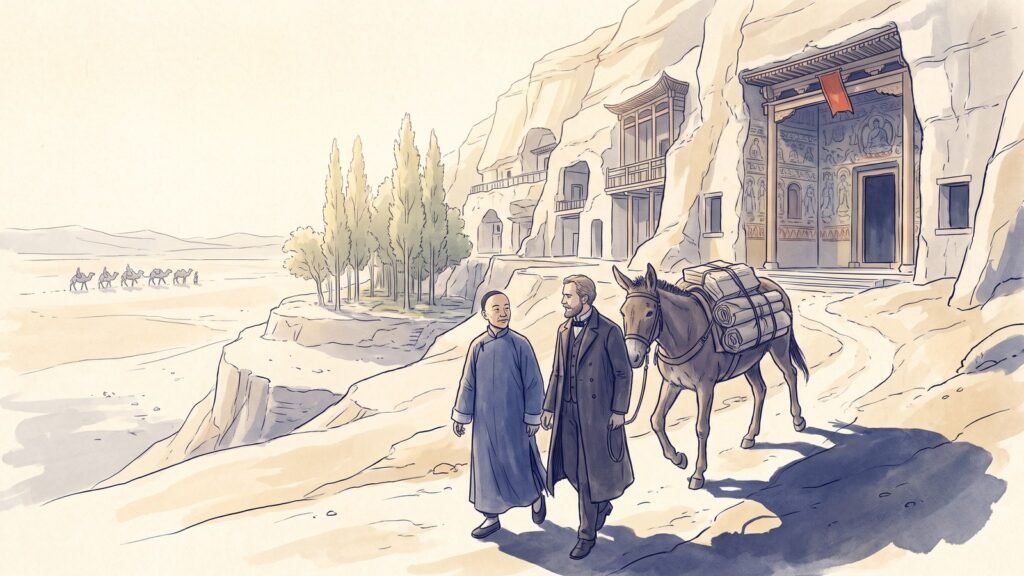
Stein had heard of the cave library from a merchant at Urumqi, and when he reached Mogao in the spring of 1907 he set about persuading Wang Yuanlu to show it to him. He was assisted by his Chinese secretary, Jiang Xiaowan, who conducted many of the negotiations. Stein presented himself as a follower of Xuanzang, whose pilgrimage to India he had traced, and Wang, who venerated the pilgrim, agreed to let him examine the contents. Over several weeks Wang brought out bundles of scrolls and paintings, which Stein and Jiang examined and selected in a side chapel, and in return Stein made a donation towards Wang’s restoration work. He left with some seven thousand complete manuscripts and about six thousand fragments, together with several hundred paintings, embroideries and other items, for which he had paid a sum usually reckoned at about £130. The negotiations and the payment are described in the huaxia account of the library cave, and Stein’s own account was published in his popular narrative Ruins of Desert Cathay in 1912 and in the scholarly report Serindia in 1921.
The ethics of the transaction were understood by those involved in terms that differed from those of later times. Stein and his contemporaries in Europe regarded the removal of manuscripts and paintings to the museums and libraries of their own countries as an act of preservation and scholarship. In their view the material was at risk where it lay, from neglect, theft, fire or the indifference of the authorities, and it could be studied properly only in institutions that had the specialists, the libraries and the means of publication required. The governments that sent the expeditions also saw them as contributions to national prestige and, in some cases, to the knowledge of a strategically important region. Wang Yuanlu, for his part, regarded the sale of manuscripts as a means of funding the restoration of the caves to which he had devoted his life, and he kept careful accounts of his expenditure. Later in the century, and particularly in China, the episode came to be seen as the loss of a national heritage. The Programme was founded at a time when both views were well established, and it was conceived as a means of making the material accessible to everyone, wherever it was kept, without attempting to settle the question of where it ought to be.
On the way back from Dunhuang in 1908, Stein crossed the Kunlun Mountains to survey the sources of the Khotan river and suffered severe frostbite, losing the toes of his right foot. He returned to Europe in 1909, and the finds of the expedition were shipped to London. The third expedition, from 1913 to 1916, was the longest. Stein returned to Dunhuang in 1914 and acquired from Wang Yuanlu a further group of about five hundred and seventy manuscripts that Wang had kept back. He then travelled east to Khara-khoto, the ruined Tangut town on the Etsin Gol, where he excavated Buddhist texts and other documents, and north to Turfan, where he excavated tombs at Astana, the burial ground of the inhabitants of the ancient town of Gaochang, and removed sections of wall painting from the cave temples of Bezeklik. He returned to India by way of the Pamirs, Persia and Sistan, where he investigated sites on the borders of Persia and Afghanistan. The report of the expedition, Innermost Asia, was published in 1928.
Stein’s fourth expedition, undertaken in 1930 and 1931 with the support of Harvard University and the British Museum, ended without results. The Nationalist government in Nanjing, which had come to regard foreign excavation in China as a matter for strict control, revoked his permission to excavate, and the material he had collected was left at Kashgar and was not released to him. By this time the scholarly and political climate in China had changed. In 1927 the Sino-Swedish Expedition of Sven Hedin had been obliged to accept Chinese scientists as members and to leave its finds in China, and a Society for the Preservation of Cultural Objects had been founded in Beijing to oppose foreign removals. Stein continued to travel and write. His summary of his Central Asian work, On Ancient Central-Asian Tracks, appeared in 1933, and he later surveyed Roman frontier works in Iraq and Jordan and the ancient sites of Iran and Pakistan. In 1943, at the age of eighty, he travelled to Kabul, having long wished to explore Afghanistan, and died there shortly after his arrival. He is buried in the foreign cemetery in the city.
The division of the Stein collections
The cost of Stein’s first three expeditions had been shared by the Government of India and the British Museum, and their finds were divided between the two. The Programme’s history of the British collections describes the subsequent arrangements. The material allotted to London was divided again, according to its nature, among the British Museum, which took the paintings, coins and many objects; the India Office Library, which took documents in Tibetan and in some other languages; and later the Victoria and Albert Museum, which received a share of the textiles and other objects. The material allotted to India went to a museum in Delhi built for the purpose and is now in the National Museum, New Delhi. When the British Library was established in 1973 the manuscripts of the British Museum passed to it, and the India Office Library and Records followed in 1982, so that by that date most of the Stein manuscripts in Britain were in a single institution.
The British Library’s Stein collection now contains more than forty-five thousand manuscripts and printed documents, from Dunhuang, Khotan, Niya, Miran, Loulan, Turfan, Khara-khoto and other sites, in Chinese, Tibetan, Sanskrit, Khotanese, Tocharian, Sogdian, Uighur, Tangut and other languages. Among them are about fourteen thousand Chinese scrolls and fragments, the largest Chinese collection from Dunhuang outside China, and several thousand Tibetan documents. The British Museum holds almost four hundred paintings, most of them from the library cave, and more than four thousand coins. The Victoria and Albert Museum holds about six hundred textiles and some seventy other objects. Stein’s papers, including his diaries and correspondence, are in the Bodleian Library in Oxford, and his photographs and part of his library were left to the Library of the Hungarian Academy of Sciences in Budapest. Taken together, the British holdings amount to about fifty thousand items, making Britain the largest holder of the material outside China. In September 2023 the Programme’s database recorded 47,188 items in British collections, of which 36,191 had been digitised.
Paul Pelliot and the French mission
The French expedition to Central Asia was led by Paul Pelliot, a young sinologist who held a chair at the French School of the Far East, the École française d’Extrême-Orient in Hanoi. Pelliot, who was born in 1878, had a command of classical Chinese unusual among European scholars of his generation and had learned a number of other Asian languages. He had been in Beijing during the siege of the legations in 1900, where he had taken part in the defence and had been decorated for it. The Programme’s history of the French collections records that he left Paris on 15 June 1906 with two companions, Louis Vaillant, an army doctor who was responsible for surveying and mapping, and Charles Nouette, a photographer. The mission travelled through Russian Central Asia to Kashgar, and in the autumn of 1906 excavated at Tumshuk, between Kashgar and Kucha, where it uncovered the remains of Buddhist monasteries and sculptures.
From Tumshuk the mission went on to Kucha, where it spent eight months in 1907, excavating at the monastic sites of Duldur-aqur and Subashi and documenting the cave temples of the district. Among its finds were documents in the Tocharian B language, the language of the kingdom of Kucha, including wooden permits issued to caravans passing through the kingdom’s checkpoints. These permits, which name the travellers and the number of their men and animals, are among the few administrative documents in the language and have been important for its decipherment and for the study of the economy of the oasis. The Buddhist kingdom of Kucha and its cave temples are described in the Grokipedia entry on Kucha.
Pelliot had heard at Urumqi about the discovery at Dunhuang and had been shown a manuscript from the cave, and he went there directly. He reached Dunhuang on 12 February 1908 and entered the library cave on 3 March. Unlike Stein, he could read the manuscripts himself, and he spent three weeks in the chamber, examining every bundle, by his own account, at a rate of about a thousand items a day, and working by candlelight. A photograph taken by Nouette shows him crouched among the bundles. He set aside the documents he considered most important, giving preference to those in languages other than Chinese, to dated documents and to texts not included in the Buddhist canon, and he bought them from Wang Yuanlu for a sum reckoned at about £90. The mission remained at Dunhuang until 7 June, while Nouette photographed the caves; his photographs, published in six volumes as Les grottes de Touen-houang between 1914 and 1924, are a record of the paintings and sculptures as they appeared at the time.
From Dunhuang the mission went to Beijing, where Pelliot bought about thirty thousand Chinese books for the Bibliothèque nationale. In 1909, while in Beijing, he showed some of the Dunhuang manuscripts he had with him to Chinese scholars, among them Luo Zhenyu. Their recognition of what had been found at Dunhuang, and their realisation that a large quantity remained, led to a request that the government secure what was left, and in 1910 the Ministry of Education ordered the remaining Chinese scrolls to be sent to Beijing. The transfer and its consequences are described below and in the huaxia article on the library cave. Pelliot returned to Paris in October 1909, and his later career, as professor of the languages, history and archaeology of Central Asia at the Collège de France from 1911, made him one of the leading sinologists of the twentieth century. He died in Paris in 1945.
The Pelliot collections in Paris
On the return of the mission the manuscripts were deposited in the Bibliothèque nationale, now the Bibliothèque nationale de France, and the paintings, sculptures and other objects in the Louvre. The Programme’s history of the French collections records that the objects were transferred in 1945 and 1946 to the Musée Guimet, which became the national museum of Asian art, while the manuscripts remained in the library’s department of manuscripts, where they form the Pelliot collections. The largest are the Pelliot tibétain collection, with 4,174 numbered items, and the Pelliot chinois collection, with about three thousand scrolls and many fragments. There are also about four thousand Sanskrit fragments, about two thousand fragments in Kuchean, the Tocharian B language of Kucha, and smaller groups of manuscripts in Sogdian, Uighur, Khotanese and Hebrew.
Because Pelliot had selected the material himself, the Paris collection has a different character from the London one. It contains a high proportion of secular documents, including contracts, letters, registers and administrative records, and of non-Buddhist texts, among them Confucian classics, Daoist scriptures, histories, dictionaries, poetry and popular literature. The cataloguing of the collection was a long undertaking. The Tibetan manuscripts were catalogued by Marcelle Lalou, whose inventory began to appear in 1939 and was completed in three volumes by 1961. The catalogue of the Chinese manuscripts was begun in 1952 by a team of French and Chinese scholars and has been published in several volumes since 1970. At the time of the Programme’s account, its database recorded 9,631 items in French collections, of which 7,900 had been digitised.
The transfer to Beijing and the Chinese collections
The Ministry of Education’s order of 1910 brought the remaining Chinese scrolls from the cave to Beijing, where they were placed in the Metropolitan Library, the predecessor of the National Library of China. The transport was poorly supervised, and the account in the huaxia article on the library cave describes the losses along the way, when officials and others removed scrolls for themselves and in some cases divided long scrolls to make up the numbers. About eight thousand scrolls reached the capital. Manuscripts that had passed into private hands at Dunhuang, at Lanzhou and in Beijing later entered other collections, in China and abroad, and some forged or altered items entered the market at the same time. Wang Yuanlu himself had kept back a quantity of material, part of which he later sold to Stein and to the Japanese and Russian expeditions.
The National Library of China now holds the largest single collection of Dunhuang manuscripts, more than sixteen thousand items, and smaller collections are held by the Dunhuang Academy, the Palace Museum, the Shanghai Museum, the Tianjin Museum, Peking University and a number of other libraries, museums and universities in China. The study of these manuscripts in China began almost as soon as the first examples were seen in Beijing, with the work of Luo Zhenyu, Wang Guowei and their contemporaries, who published facsimiles and transcriptions of documents shown to them by Pelliot and later of material from the Beijing collection. In the following decades Chinese scholars travelled to Paris and London to copy and photograph the manuscripts kept there. The field that resulted, known in Chinese as Dunhuangxue, the study of Dunhuang, became one of the most active areas of Chinese scholarship in the twentieth century. The National Library of China became a partner of the Programme in its early years, and an IDP centre was later opened at the library in Beijing with its own website in Chinese.
The Japanese expeditions of Otani Kozui
The Japanese expeditions to Central Asia were organised not by a government or an academy but by the head of a Buddhist sect. Otani Kozui, who was born in 1876, became in 1903 the twenty-second abbot of the Nishi Honganji, the head temple of one of the two main branches of Jodo Shinshu, the True Pure Land school of Japanese Buddhism. He had travelled to Europe as a young man and had seen the collections from Central Asia beginning to arrive there, and he resolved to send expeditions to trace the routes by which Buddhism had reached Japan from India by way of China. The Programme’s history of the Japanese collections describes three expeditions, between 16 August 1902 and 10 July 1914, staffed largely by young monks of the temple.
The first expedition set out from London in 1902. Otani himself travelled with it as far as Kashgar and then went on to India, where he visited Buddhist sites and received the news of his father’s death and his own succession. Two members of the party, Watanabe Tesshin and Hori Kendo, went on to Khotan and then spent four months at Kucha, working at the cave temples of Kizil and Kumtura and at the monastic site of Subashi. The second expedition, of 1908 and 1909, was undertaken by Tachibana Zuicho, then still in his teens, and Nomura Eizaburo. They worked at Turfan and then separated. Nomura went to Kucha, where he found at Kumtura a document dated 782, and Tachibana crossed the desert to the Lop Nor region, where he found near Loulan the letter of Li Bo, a Chinese official of the Western Regions, dated 328, which is one of the most important documents of the period.
The third expedition, from 1910 to 1914, was again led by Tachibana, who travelled from London with an English assistant, Hobbs, who died of smallpox at Kucha. A second member, Yoshikawa Koichiro, was sent from Japan to find Tachibana, from whom no news had been received, and reached Dunhuang on 5 October 1911. Tachibana joined him there in January 1912, and between 30 January and 1 February they bought from Wang Yuanlu 369 scrolls, for a sum of 400 taels, together with sculptures and other objects. They also excavated in the tombs at Astana near Turfan, from which they recovered textiles, documents and other grave goods. Tachibana travelled back to Japan by way of Siberia with the Dunhuang manuscripts.
The collections of the Otani expeditions were dispersed within a few years of their return. In 1914 Otani Kozui resigned as abbot after a financial scandal in which the temple was accused of bribery, and the debts of the temple obliged him to sell or move much of what had been collected. Part of the collection, which had been kept at his villa near Kobe, the Villa Niraku, was sold with the villa to the businessman Kuhara Fusanosuke, who gave a large group of objects to the Japanese governor-general of Korea, Terauchi Masatake; these are now in the National Museum of Korea in Seoul, which holds about two thousand objects. Another part was moved to Lüshun, then the Japanese-administered Port Arthur, where Otani had moved, and remained there in the museum of the Japanese administration; in 1954 a group of 620 manuscripts was transferred from it to the National Library of China, and the rest remains in the Lüshun Museum. A further part was found in Otani’s own possession after the Second World War, and in 1949 about nine thousand items were given to Ryukoku University in Kyoto, the university of the Nishi Honganji. Other objects passed through private owners to the Tokyo National Museum, which acquired them in the 1960s.
Ryukoku University, which had kept the Otani material since 1949, signed an agreement with the Programme in 2005, and a Japanese IDP centre opened at the university’s research institute, with a website in Japanese, early in 2006. At the time of the Programme’s account, its database recorded 8,465 items in Japanese collections, all of them digitised. The dispersal of the Otani collections among Japan, China and Korea made them a particular instance of the problem the Programme was established to address, since the records and photographs of objects from a single expedition could be brought together only in a shared database.
The German Turfan expeditions
The German expeditions concentrated on the northern route of the Silk Road, and particularly on Turfan and Kucha. The Programme’s history of the German collections relates that the decision to send them followed the International Congress of Orientalists held in Rome in 1899, at which the Russian scholars Wilhelm Radloff and Dmitry Klementz reported on Klementz’s survey of the Turfan oasis in 1898, and at which an international association for the exploration of Central and East Asia was proposed. The first German expedition left Berlin on 11 August 1902, financed with forty thousand marks, of which a large part was given by the industrialist Friedrich Alfred Krupp and the collector James Simon, together with money from the Prussian government and the Ethnological Museum.
The first expedition, from December 1902 to April 1903, was led by Albert Grünwedel, the director of the Indian department of the Ethnological Museum in Berlin, with the Sanskritist Georg Huth and the museum technician Theodor Bartus. It worked at the ruined city of Khocho, the Gaochang of the Chinese sources and the capital of the Uighur kingdom of Qocho from the ninth century, and at other sites in the oasis, and it returned with forty-six crates of finds. The second expedition, of November 1904 to December 1905, was led by Albert von Le Coq, with Bartus, and worked at Khocho, at the cave temples of Bezeklik and at Toyuk; it brought back 103 crates. The third, from December 1905 to 1907, was led again by Grünwedel and extended the work to Kucha, especially to the cave temples of Kizil and Kumtura; it brought back 118 crates. The fourth, of June 1913 to February 1914, was led by Le Coq and worked at Kucha and Tumshuk, and brought back 156 crates. The oasis on which these expeditions concentrated, and the successive states that ruled it, are described in the Grokipedia entry on Turpan.
The German expeditions differed from the British and French in the attention they gave to wall paintings. At Bezeklik, Kizil and other cave sites the members of the expeditions, and above all Bartus, cut sections of painted plaster from the walls and packed them for transport to Berlin, where they were reassembled in the galleries of the Ethnological Museum. The practice was regarded at the time as a means of preserving paintings that were being damaged by local people, by treasure hunters and by the weather, and it was followed in varying degrees by other expeditions, including Stein’s at Miran and Bezeklik. In Berlin the paintings were displayed in a reconstruction of the cave temples from which they came, and the Museum of Asian Art in Berlin today displays a reconstruction of Cave 123 at Kizil with its original paintings. During the Second World War some of the largest paintings, which had been fixed to the museum walls and could not be moved, were destroyed in the bombing of the city.
The texts from the expeditions had a separate history. In 1912 the Prussian Academy of Sciences formed an Oriental Commission to study them, and in 1914 the manuscripts were transferred from the Ethnological Museum to the Academy. The collection contains about forty thousand fragments, written in more than twenty scripts and languages, including Sanskrit, Tocharian, Sogdian, Middle Persian, Parthian, Bactrian, Old Turkic, Uighur, Mongolian, Tibetan, Tangut, Syriac and Chinese. Among them are the largest surviving group of Manichaean texts, many of them written in a script derived from Syriac and decorated with illumination, and important groups of Christian texts of the Church of the East in Syriac and Sogdian. These finds were evidence that the communities of the Turfan oasis under Uighur rule had included followers of several religions, and they were the source of much of the twentieth-century study of Manichaeism.
During the Second World War the collection was moved for safety to salt mines and other places of storage. Afterwards, in the division of Germany, part of it came to the Academy of Sciences of the German Democratic Republic in East Berlin and part to West Berlin, and some fragments were taken to the Soviet Union and returned only later. After German reunification the Academy’s holdings passed in 1992 to the Berlin-Brandenburg Academy of Sciences and Humanities, which continues the Turfan research, while most manuscripts are kept in the Berlin State Library. The digitisation of the Turfan collection was carried out in a project funded by the German Research Foundation from 1997 to 2005, and in June 2005 an agreement was signed under which the German collections joined the Programme and an IDP centre was established in Berlin. At the time of the Programme’s account, its database recorded 31,713 items in German collections, of which 31,079 had been digitised.
The Russian expeditions and Khara-khoto
The Russian contribution to the collections came from scholars, diplomats and military explorers. Nikolai Petrovsky, the Russian consul in Kashgar from 1882, collected manuscripts from the southern oases at the same period as Macartney, and his collection, which includes Sanskrit and Khotanese texts, was among the first to reach Europe. Other consuls and officials, among them Nikolai Krotkov at Urumqi, sent further material from Turfan and Kucha, and the expeditions of Dmitry Klementz in 1898 and of the brothers Mikhail and Nikolai Berezovsky in 1905 and 1906 surveyed and excavated in the northern oases. The study of this material was organised by the Russian Committee for the Study of Central and East Asia, founded in St Petersburg in 1903 on the initiative of Radloff and others in response to the proposals of the Rome congress.
The most important single Russian discovery was made in 1908 and 1909 by the military explorer Pyotr Kozlov, who was leading an expedition of the Imperial Russian Geographical Society in Mongolia and the Gobi. At the ruined town of Khara-khoto, on the lower course of the Etsin Gol in the west of present-day Inner Mongolia, he opened a stupa outside the city walls and found in it a large library of books, manuscripts, paintings and sculptures, most of them in the Tangut language, the language of the Xi Xia state, which had ruled the Hexi Corridor and the lands to the north from the eleventh century until its destruction by the Mongols in 1227. The finds, which also included Chinese books and documents of the Xi Xia and Yuan periods, were taken to St Petersburg, where the texts are now in the Institute of Oriental Manuscripts of the Russian Academy of Sciences and the paintings in the State Hermitage Museum. The Tangut texts became the basis for the decipherment of the Tangut script, a complex system of several thousand characters devised in the eleventh century on the model of Chinese, by Russian and other scholars, among them Nikolai Nevsky, and for the modern study of Tangut history and Buddhism. Stein visited Khara-khoto in 1914 and recovered a further collection, which includes several thousand Tangut fragments now in the British Library. The site and its history are described in the Grokipedia entry on Khara-Khoto.
The Russian collection from Dunhuang came from an expedition led by the Indologist Sergei Oldenburg, the permanent secretary of the Russian Academy of Sciences, in 1914 and 1915. Oldenburg had led an earlier expedition to Turfan in 1909 and 1910. At Dunhuang his party, which included the artist and photographer Samuil Dudin, made a detailed survey of the caves, with plans, photographs and drawings, and acquired manuscripts and fragments, including material from the library cave that had remained in the hands of Wang Yuanlu and local people. The Russian Dunhuang collection, now in the Institute of Oriental Manuscripts in St Petersburg, consists of many thousands of items, most of them fragments, and is one of the four largest collections of Dunhuang Chinese manuscripts, with those in Beijing, London and Paris. Because it was for a long time little known outside Russia, its publication in facsimile in the 1990s, in a joint Russian and Chinese project, was a significant event in Dunhuang studies. The Institute became a partner of the Programme and an IDP centre was established in St Petersburg.
Other collections
Besides the major expeditions of Britain, France, Germany, Russia and Japan, a number of smaller expeditions and individual collectors acquired material from the region. The Finnish officer and later president of Finland, Carl Gustaf Mannerheim, travelled through Xinjiang and northern China in 1906 to 1908 on a reconnaissance for the Russian general staff and acquired manuscripts and objects that are now in Helsinki. The Swedish explorer Sven Hedin, whose journeys of the 1890s had first drawn attention to the buried cities of the Taklamakan, discovered the site of Loulan in 1900 and excavated there in 1901, recovering Chinese documents on wood and paper of the third and fourth centuries; his later Sino-Swedish Expedition of 1927 to 1935 added further collections, divided between Sweden and China. The American art historian Langdon Warner, of the Fogg Art Museum at Harvard, visited Dunhuang in 1924 and removed sections of wall painting and a sculpture, an episode described in the huaxia article on the library cave. Smaller groups of Dunhuang and Central Asian manuscripts are held in Denmark, Hungary, Ireland, Taiwan, the United States and elsewhere, and others have appeared on the market over the past century, among them a number of later forgeries.
The dispersal of the material among these countries was, in the context of its time, the normal outcome of archaeological exploration. Excavated material was customarily shared between the expedition and the country in which it worked, or removed entirely when the local authorities did not claim it, and the institutions that received it saw themselves as holding it on behalf of world scholarship. But the result was that documents found together, sometimes the parts of a single scroll or a single archive, came to be kept thousands of kilometres apart, catalogued in different languages and according to different systems, and inaccessible to scholars who could not travel. A Buddhist sutra might begin in London and end in Beijing; the pages of a Khotanese text might be divided between Paris and St Petersburg; the documents of a single Tibetan military office might be split among three collections. Scholars who wished to study such material had to visit several countries, often without being certain what each collection held. It was this problem that the founders of the Programme set out to solve.
The Diamond Sutra of 868
The best-known single object among the collections is a printed copy of the Diamond Sutra, the Vajracchedika Prajnaparamita Sutra, found by Stein in the library cave in 1907 and now in the British Library. It is a scroll about five metres long, made of seven sheets of paper pasted together, with a frontispiece showing the Buddha preaching to his elderly disciple Subhuti and an assembly of monks, bodhisattvas, guardians and donors. At the end of the text is a colophon stating that it was made for universal free distribution by Wang Jie on behalf of his two parents, on the thirteenth day of the fourth month of the ninth year of the Xiantong era, a date corresponding to 11 May 868. It is the earliest complete printed book to carry a date. The quality of the printing, and in particular of the frontispiece, shows that woodblock printing was by then a well-developed craft, and it is likely that printing had been practised in China for a considerable time before. The history of printing in China and the later invention of movable type are described in Bi Sheng Beat Gutenberg by Centuries, and the making of the paper on which such books were printed in The Secret China Kept for Three Thousand Years. A general account of the text and its place in Mahayana Buddhism is given in the Grokipedia entry on the Diamond Sutra.
When Stein found the scroll it was already damaged, and the first sheet had become detached. In the course of the twentieth century it was repaired and backed more than once, using the methods of the time, and it was for many years displayed in the British Museum and later in the British Library. Earlier repairs, carried out with adhesives and backing materials that later proved unsuitable, had made the scroll stiff and caused new stresses in the paper. The British Library’s conservators undertook a programme of work on the scroll in the early twenty-first century, removing earlier linings and repairs, cleaning and flattening the sheets and remounting it with traditional East Asian materials, in consultation with specialists in the conservation of Chinese scrolls, and the work was documented by the Programme. The Diamond Sutra has since been shown in exhibitions at the British Library, including the exhibition on Dunhuang in 2024 and 2025, and it has been fully digitised, so that it can be examined on the Programme’s website in more detail than is possible for visitors to an exhibition.
The scroll is only one of many printed items from the library cave. Others include printed calendars, charms and images of the Buddha and bodhisattvas, some of them dated in the tenth century, and a small printed edition of the Diamond Sutra in booklet form. Taken together with the many thousands of manuscript copies of Buddhist texts from the cave, they show the coexistence of manuscript and print in the Buddhist culture of the period, and the use of both for the merit that the making and distribution of sacred texts was believed to bring.
The foundation of the Project
By the 1980s the curators of the major collections were aware that the condition of the manuscripts was causing concern. Much of the material had been handled heavily by scholars for most of the century, some of it had been repaired with materials that were themselves damaging it, and techniques of conservation for Chinese and Central Asian paper had developed considerably. At the same time, the opening of China to foreign scholars after the end of the Cultural Revolution, and the renewal of Dunhuang studies within China, brought increasing numbers of researchers to London, Paris and other collections, and with them the question of how the collections could be made accessible without further damage to the originals.
According to the account of its own history published by the Programme, the immediate origin of the Project was a conference of conservators and curators from the main collections held at the Isle of Thorns, the training centre of the University of Sussex in Sussex, in October 1993, under the auspices of the British Library. The participants discussed the conservation of the Dunhuang and Central Asian manuscripts and the need for international cooperation in their cataloguing and care. One of the conclusions of the meeting was that a means should be found of making information about the manuscripts, and images of them, available to scholars in all the countries concerned. On 11 April 1994 a steering group drawn from the institutions represented at the conference met for the first time, and this is taken as the date of foundation of the International Dunhuang Project. Its secretariat was established at the British Library in London, and its first director was Susan Whitfield, a historian of the Silk Road who had worked on the Chinese collections of the Library and who led the Project for more than two decades.
The institutions that took part in the Project from its early years included the British Library, the National Library of China, the Bibliothèque nationale de France, the Institute of Oriental Studies in St Petersburg, now the Institute of Oriental Manuscripts, and the Dunhuang Academy, together with other collections in Europe and Japan. The aim, as stated in the Project’s early documents, was to promote the study and preservation of the Dunhuang and Central Asian material through international cooperation, beginning with a shared database of catalogue records. The founders also wished to share information on conservation and to agree common standards for the description of the material, so that a scroll in one collection could be compared with a fragment in another. Over the following years the Project held regular conservation conferences, whose proceedings were published, and newsletters in English and Chinese reported on its progress and on new research in the field.
The database and the first website
The early work of the Project was concentrated on the database. Catalogue records of the British Library’s Chinese manuscripts, which had been catalogued by Lionel Giles in a printed catalogue published in 1957, were entered and expanded, and records were created for items that had not previously been catalogued in detail. The database was designed to record not only the text of each manuscript but its physical characteristics, including its paper, format, ruling, script and condition, as well as its history and the literature about it. Information from the catalogues of other collections was added as partners joined. In the late 1990s, when the World Wide Web made it possible to present images and records to a worldwide public, the Project began to digitise the manuscripts themselves, beginning with the Chinese scrolls in London. The first IDP website, which went online in the late 1990s, allowed users to search the database and view digital images of the manuscripts, at a time when such resources were rare.
The development of the website was accompanied by the establishment of IDP centres at partner institutions. Each centre had its own digitisation studio, its own staff and its own website in the local language, linked to the shared database, so that the records and images of each collection were produced and maintained by the institution that held it. The Beijing centre at the National Library of China, the St Petersburg centre at the Institute of Oriental Manuscripts, the centres in Kyoto at Ryukoku University and in Berlin at the Berlin-Brandenburg Academy, both established in 2005 and 2006, and the Dunhuang centre at the Dunhuang Academy, established in 2007, followed the London centre. By the early twenty-first century the websites of the Project were available in several languages, including English, Chinese, Russian, Japanese and German, and the database contained hundreds of thousands of images.
The decentralised organisation of the Project reflected the conditions in which it had been founded. The collections belonged to institutions in different countries, with different legal frameworks, policies and resources, and none of them was prepared to transfer its responsibilities to another. A system in which each partner digitised and catalogued its own holdings, according to agreed standards and within a common database, allowed the collections to be brought together for users while remaining where they were. The cooperation of the Chinese institutions was of particular importance, since the largest collections in Chinese were in Beijing and Dunhuang, and since it was in China that the removal of the manuscripts had been felt most strongly. The participation of Chinese libraries and research institutes in the Project, and the opening of IDP centres in Beijing and Dunhuang, made it a joint enterprise in which the institutions that had lost material and those that had acquired it worked on equal terms.
Cataloguing and the reconstruction of the library
The shared database made possible kinds of research that had previously been very difficult. One of the most important was the reconstruction of manuscripts divided among collections. Long scrolls had been cut up on their way to Beijing in 1910, and others had been torn or divided at Dunhuang or in later trade, so that parts of a single text might be held in several countries. By recording the dimensions, paper, script and text of each fragment, the catalogue allowed scholars to identify pieces that had once belonged together and to reunite them, digitally, on the screen. Similar work was done on the fragments from Turfan and Khotan, where many manuscripts had survived only in pieces, sometimes found by different expeditions at the same site.
A second line of research concerned the original arrangement of the library cave itself. Stein and Pelliot had described the cave as it was when they saw it, but Wang Yuanlu had already moved and rearranged the contents several times, and the expeditions had removed the material in different selections. By studying the wrappers, labels and bundles in which manuscripts had been found, and the records of the expeditions, scholars have attempted to reconstruct how the material was stored in the cave, which monasteries it came from and what it represented. These studies have suggested that much of the material came from the libraries of the monasteries of Dunhuang, and particularly from the Sanjiesi monastery, with which Wang’s temple was associated, and that it included both working libraries and collections of damaged or superseded texts. The Programme’s database, which records the original numbers assigned by the expeditions and the history of each item, has been an essential tool for this work.
A third concerned forgeries. Since the opening of the cave, manuscripts claimed to come from Dunhuang have appeared on the market, and some of them, particularly in Japan and in private collections, were later suspected of being forgeries made in the early twentieth century. In 1997 the Project held a conference in London on Dunhuang manuscript forgeries, whose proceedings were published in 2002, and the techniques of examination it promoted, including the analysis of paper, ink and script, were applied to manuscripts in several collections. The British Library’s collection of the forgeries of Islam Akhun, which had been preserved as evidence since Stein’s investigation at Khotan in 1901, gave the subject a historical context and a set of examples for comparison.
Conservation
Conservation was the subject from which the Project began, and it remained one of its principal concerns. The manuscripts from the library cave are for the most part written on paper made from hemp, mulberry or other bast fibres, often dyed yellow with an insect-repelling dye, and many are long scrolls formed of sheets pasted end to end and rolled on wooden rods. Those from Turfan, Khotan and Kucha include paper, birch bark, palm leaf, wood and leather, and some survive only as small, brittle fragments. In the first half of the twentieth century many items were repaired with materials then considered suitable, such as silk gauze, starch or animal glues and machine-made backing papers, or were mounted between sheets of glass, and some of these treatments were later found to have caused discoloration, stiffening or tearing. The conservation conferences organised by the Project brought together conservators from Europe, China, Japan and Russia to compare methods, and the British Library’s conservation studio developed and published techniques for the removal of old repairs and for the rehousing of scrolls and fragments in archival boxes and folders. The digitisation of the collections was itself a measure of conservation, since the availability of high-quality images reduced the need for scholars to handle the originals.
The new website of 2024
By the 2010s the website on which the Project’s database had been presented for two decades was becoming difficult to maintain. Its software had been developed in-house and was not compatible with the standards for digital images and metadata that had since been adopted by libraries and museums around the world. In the early 2020s the British Library and its partners undertook the development of a new website, and on 4 March 2024 the Programme announced its launch. According to the announcement, the new site was built over two years. It uses viewers compliant with the International Image Interoperability Framework, known as IIIF, including the Mirador and Universal Viewer applications, which allow images from different institutions to be displayed, compared and annotated side by side, and it provides search across the records of all partner collections, with new pages describing the collections, the sites, the languages and scripts and the history of the Programme. The British Library had suffered a cyber-attack in October 2023 which disrupted many of its online services, and the announcement explained that the content of the old website had been restored and that the ingestion of records and images from the partners was continuing.
With the launch of the new website the Project changed its name to the International Dunhuang Programme, keeping the abbreviation IDP, to reflect the long-term and continuing character of its work. Its site, at idp.bl.uk, includes a series of articles on the history of the collections in each country, which have been drawn on for this account, a blog reporting on research and events, and educational resources. The figures given in these articles for the number of items recorded and digitised, ranging from the 47,188 items in British collections to the 8,465 in Japanese ones, are a measure of the scale of the enterprise, and of the work that remained to be done in some collections when they were published.
The thirtieth anniversary
The thirtieth anniversary of the Programme was marked in April 2024 by a conference at Dunhuang, the International Symposium on Overseas Dunhuang Cultural Relics, organised jointly by the Programme and the Dunhuang Academy and held on 19 and 20 April, which was opened by Su Bomin, the director of the Academy. The Programme’s account of the occasion records that the conference was followed on 21 April by a workshop of the IDP partners, the first such meeting since one held in London in 2018. The British Library delegation was led by its chief executive, Roly Keating, and included the head of the Programme, Mélodie Doumy. During the visit the Library renewed its memorandums of understanding with the Dunhuang Academy and, on 15 April in Beijing, with the National Library of China. The choice of Dunhuang as the place of the anniversary, and of the Dunhuang Academy as joint organiser, reflected the importance that the Chinese institutions had come to have in the Programme and the role of the Academy, which since its foundation as the Dunhuang Art Research Institute in 1944 had been responsible for the care of the caves.
Later in the same year the British Library opened an exhibition, A Silk Road Oasis: Life in Ancient Dunhuang, which ran from 27 September 2024 to 23 February 2025. According to the Library’s announcement, it brought together more than fifty items from the Library’s collections and from those of its partners, many of them shown in public for the first time. They included the Diamond Sutra of 868; a star chart dated to between 649 and 700, which is among the earliest complete star charts known from any civilisation; a rubbing of the Stele of Sulaiman, dated 1348, recording donations to the caves in six scripts; a copy of the Diamond Sutra written in the blood of the copyist; a manuscript of the Old Tibetan Annals; a fragment mentioning Zoroaster; a book of divination in Old Turkic runic script, the Irk Bitig, dated 930 or 942; the Xuastuanift, a Manichaean confession text in Old Turkic; and a painting of the eleven-headed bodhisattva Avalokiteshvara. The exhibition was supported by the Klein Family Foundation and the Dunhuang Foundation, and it was accompanied by a book by Mélodie Doumy. The range of the material shown, in Chinese, Tibetan, Old Turkic, Sogdian and other languages and representing Buddhism, Manichaeism, Christianity and Zoroastrianism, illustrated the diversity of the society of Dunhuang that the Programme’s collections document.
What the collections contain
The material brought together by the Programme is of exceptional variety. The library cave alone contained, by the most common estimates, between fifty and sixty thousand manuscripts and fragments, together with paintings on silk and paper, banners, embroideries and printed items. The great majority of the manuscripts are Buddhist texts in Chinese, copied between the fifth and the early eleventh centuries, many of them with colophons recording the name of the copyist or the donor and the purpose of the copy. Among them are copies of the Lotus Sutra, the Diamond Sutra, the Sutra of Golden Light and other Mahayana scriptures in very large numbers, as well as commentaries, monastic rules, liturgies and apocryphal texts composed in China that were not included in the printed canons and were known only from the cave.
Besides the Buddhist texts there are works of every kind of Chinese literature of the period: Confucian classics with their commentaries, histories, geographical works, dictionaries, medical and astronomical texts, calendars and almanacs, poetry, including early copies of poems of the Tang period, and popular literature, such as the transformation texts, bianwen, in which Buddhist and historical stories were told in alternating prose and verse for oral performance. There are also many documents of everyday life: contracts for the sale of land, slaves and animals, loan agreements, household registers, letters, model letters and school exercises, accounts of monasteries and lay associations, and records of the local administration. Such documents, rare in other sources, have made Dunhuang one of the best-documented places in the medieval Chinese world. The Tibetan manuscripts, from the period of Tibetan rule over Dunhuang from about 786 to 848 and later, include the earliest surviving historical and literary texts in the Tibetan language. The Old Turkic, Sogdian, Khotanese, Sanskrit, Uighur and Hebrew documents testify to the presence of other communities in the town.
From the other sites of the region come documents in languages that would otherwise be almost unknown. The Tocharian A and B texts from Turfan and Kucha preserve two Indo-European languages, distantly related to the languages of Europe, which were spoken in the northern oases in the first millennium. The Khotanese texts preserve a Middle Iranian language written in Brahmi script. The Kharosthi documents from Niya and Loulan record the administration of the Shanshan kingdom. The Sogdian, Manichaean and Christian texts from Turfan and Dunhuang document the trading communities and religious missions that crossed Asia, and the Tangut books from Khara-khoto preserve the literature of a state whose language was deciphered only in the twentieth century. The travels of the people who used these routes, among them a Tang woman whose journey west is described in The Maid Who Rode West on the Silk Road, and the wars that shaped the region, such as the one recounted in The Battle of Talas River and the East-West Turn of 751, can be traced in part through such documents.
Scholarship and access
For most of the twentieth century the study of the Dunhuang and Central Asian material depended on access to the collections themselves or to published facsimiles, catalogues and microfilms. The British Library’s Chinese manuscripts were microfilmed in the 1950s, and copies of the films were acquired by libraries in China, Japan and elsewhere, and large facsimile editions of the London, Paris, St Petersburg and Beijing collections were published in China from the 1980s onwards. These made it possible for scholars to study the texts without travelling, but the reproductions were often of poor quality and could not show the colour, texture and physical features of the originals. The Programme’s high-resolution digital images, freely available on its website, transformed this situation. Scholars, students and members of the public anywhere can now view a manuscript in full colour, enlarge it to examine details of the script and paper, and compare it with related items in other collections, without permission or charge.
The effect of this access on scholarship has been considerable. Studies of the paper, codicology and palaeography of the manuscripts, which require close examination of their physical features, have become possible for scholars who cannot visit the collections. The identification of fragments belonging to the same manuscript, and the reconstruction of divided texts, have been greatly facilitated. Research on the less studied languages of the collections, such as Khotanese, Tocharian, Tangut and Old Uighur, has been aided by the availability of images of the whole of the material, rather than of selected items. The Programme’s partners have also undertaken specific projects, such as the cataloguing and study of the Lotus Sutra manuscripts in several collections and collaborative projects with universities on the Tibetan and other documents, and the Programme has supported workshops and training for younger scholars.
Access has also had a wider public dimension. The Programme’s website, its exhibitions and its educational resources have made the material known to a far larger audience than the specialists who studied it in the twentieth century, and the Diamond Sutra in particular has become one of the best-known objects in the British Library. The renewed cooperation with the Dunhuang Academy and the National Library of China, and the participation of the Chinese institutions in the anniversary of 2024, showed that the Programme had become a means by which the institutions holding the dispersed material could work together on its preservation and study.
The Programme in historical perspective
The International Dunhuang Programme is the product of two very different periods. The collections it brings together were formed in the decades before the First World War, when the scholars and explorers of the European empires and of Japan travelled into Central Asia in search of antiquities and manuscripts, and the governments and institutions that supported them regarded the acquisition of such material as an advance of knowledge and a matter of national prestige. The division of the library cave and the other sites among London, Paris, St Petersburg, Berlin, Kyoto and Beijing was the result of the circumstances of that time: the weakness of the late Qing state and the early Republic, the rivalries of the powers, the interests of the expeditions and the decisions of the local guardian of the caves. The Programme itself was formed at the end of the twentieth century, when the institutions holding the collections, and the scholars who studied them, had come to see the dispersal as an obstacle to research and the shared care of the material as a common responsibility.
Its method, the creation of a shared catalogue and image database maintained by the holding institutions themselves, made it possible for the collections to be reunited virtually without any change in their ownership. In this respect the Programme was among the earliest and most extensive examples of a type of cooperation that has since been adopted for other dispersed collections. After three decades, the manuscripts, paintings and documents that were sealed in a small chamber at Mogao a thousand years ago, and those excavated from the ruined towns and monasteries of the Tarim Basin and the Gobi, can be studied together by anyone with access to the internet, in a form that their makers, the monks, officials, merchants and scribes of the ancient Silk Road, could not have imagined.
References
International Dunhuang Programme. International Dunhuang Programme website. British Library, London.
International Dunhuang Programme. IDP collections in Britain.
International Dunhuang Programme. IDP collections in France.
International Dunhuang Programme. IDP collections in Germany.
International Dunhuang Programme. IDP collections in Japan.
International Dunhuang Programme. IDP new website launch, 4 March 2024.
International Dunhuang Programme. IDP celebrates its 30th anniversary with a conference in Dunhuang and a reunion of the IDP partners, 2024.
International Dunhuang Programme. IDP Dunhuang.
British Library. A Silk Road Oasis opens at the British Library, press release, 2024.
Further reading
Stein, M. Aurel. Sand-buried Ruins of Khotan. London, 1903.
Stein, M. Aurel. Ruins of Desert Cathay. 2 vols. London, 1912.
Stein, M. Aurel. Serindia: Detailed Report of Explorations in Central Asia and Westernmost China. 5 vols. Oxford, 1921.
Stein, M. Aurel. Innermost Asia. 4 vols. Oxford, 1928.
Stein, M. Aurel. On Ancient Central-Asian Tracks. London, 1933.
Giles, Lionel. Descriptive Catalogue of the Chinese Manuscripts from Tunhuang in the British Museum. London, 1957.
Whitfield, Susan, and Ursula Sims-Williams, eds. The Silk Road: Trade, Travel, War and Faith. London: British Library, 2004.
Doumy, Mélodie. The book accompanying the British Library exhibition A Silk Road Oasis: Life in Ancient Dunhuang. London: British Library, 2024.
Related reading on huaxia: The Library in the Sand at Dunhuang; Zhang Qian and the Opening of the Silk Road; Buddhism Came as a Foreign Religion; Bi Sheng Beat Gutenberg by Centuries.