In 138 BCE the emperor of Han China dispatched a captive court official across the desert to seek an alliance against the empire’s most dangerous enemies, the Xiongnu confederation on the northern steppe, and the official was captured within a decade on his return from a mission that had taken him further west than any Chinese official had ever travelled before. The captive was Zhang Qian (c. 195-114 BCE), and the mission on which Zhang Qian was sent by the Emperor Wu of Han inaugurated one of the most consequential long-distance exchange networks in the pre-modern world. The network is, in the standard sources, the Silk Road, and the network is, in the modern critical assessment, the principal artery through which the civilisations of eastern and western Eurasia were to maintain continuous material and intellectual contact for the next fifteen centuries. The opening of the Silk Road is, in sum, one of the foundational events of the Eurasian world system, and the opening of the Silk Road is the principal political and the principal diplomatic accomplishment of the Emperor Wu of Han. Zhang Qian’s missions have been the subject of substantial attention in the standard sources and the more recent scholarship, and the missions have been the subject of substantial attention in the subsequent Chinese historical tradition. The missions are, in sum, the founding moment of the Silk Road, and the missions are the event against which every subsequent diplomatic and commercial contact between Han China and the rest of Eurasia has been measured.
The missions of Zhang Qian are also significant for the much broader historiographical reason that they are the earliest Chinese documentary source for the geography and the peoples of the Inner Asian land bridge between China and the West. The accounts that Zhang Qian brought back to the Emperor Wu of Han in 126 BCE are the principal Chinese source for the political geography of the western steppe and the western mountains in the late second century BCE, and the accounts are the basis for the subsequent Chinese understanding of the Silk Road for several centuries. The accounts have, in the more recent critical literature, been supplemented by the more archaeologically derived evidence of the Inner Asian trade networks of the second and the first millennia BCE, but the accounts of Zhang Qian remain the principal Chinese documentary source for the early Silk Road. The accounts are, in sum, the founding moment of the Chinese understanding of the western lands, and the accounts are the source on which the subsequent Chinese historical geography of the Silk Road has been based.
The Emperor Wu and the design of the embassy
The design of the embassy of 138 BCE was, on the basis of the principal Chinese sources, the work of Emperor Wu (Wudi, r. 141-87 BCE), the seventh emperor of the Han dynasty and one of the longest-reigning of the emperors of the early imperial period. Wudi had, by the early 130s BCE, consolidated the political position of the Han court after the reign of his more cautious predecessors, and Wudi had begun to consider a more aggressive posture toward the Xiongnu confederation that had dominated the northern steppe since the late third century BCE. The Xiongnu, under the chanyu Modu (c. 209-174 BCE), had built one of the most powerful confederations on the Inner Asian steppe, and the Xiongnu had, since the founding of the Han dynasty in 202 BCE, been a persistent threat to the Han frontier. The Han court had, since the founding of the dynasty, pursued a policy of accommodation with the Xiongnu, including the marriage of princesses to the Xiongnu chanyus and the payment of substantial annual subsidies to the Xiongnu court, and the accommodation had been one of the features of the early imperial policy of the Han. Wudi, by the early 130s BCE, had resolved to abandon the policy of accommodation in favor of a more aggressive posture, and the more aggressive posture was the basis for the design of the embassy of 138 BCE.
The design of the embassy was, in the standard accounts, based on intelligence that Wudi had received from a captive Xiongnu noble. The intelligence had reported that the Yuezhi, a confederation of peoples who had been driven from their homeland in the western Gansu corridor by the Xiongnu in the late third century BCE, had migrated far to the west and had settled in the Oxus valley, and that the Yuezhi had been joined in their new homeland by the Daxia or Bactria. The intelligence had further reported that the Yuezhi, in their new homeland, were in conflict with the Xiongnu’s western allies, and that the Yuezhi were potentially interested in an alliance against the Xiongnu. The intelligence was, in the standard accounts, accepted by Wudi as the basis for the design of the embassy, and the embassy was designed to make contact with the Yuezhi and to conclude the alliance. The embassy was, in the standard assessment, a major diplomatic undertaking for a Han empire that had, since the founding of the dynasty, had little contact with the peoples of the Inner Asian steppe.
Zhang Qian was selected for the embassy on the basis of his position as a captive court official, and Zhang Qian was selected as the head of a mission of approximately one hundred officials, soldiers, and guides. Zhang Qian was, on the basis of the standard biographical sources, born around 195 BCE in the present-day Chinese province of Shaanxi, and Zhang Qian had served in the Han bureaucracy since the reign of the first Han emperor. Zhang Qian had, by the time of his selection for the mission of 138 BCE, served the Han court for approximately three decades, and Zhang Qian had acquired the diplomatic and the linguistic skills that were required for a mission of the type that Wudi was planning. Zhang Qian was, in the standard assessment, an unusually able head of mission for the embassy of 138 BCE, and Zhang Qian was the principal diplomat who was to carry out the mission.
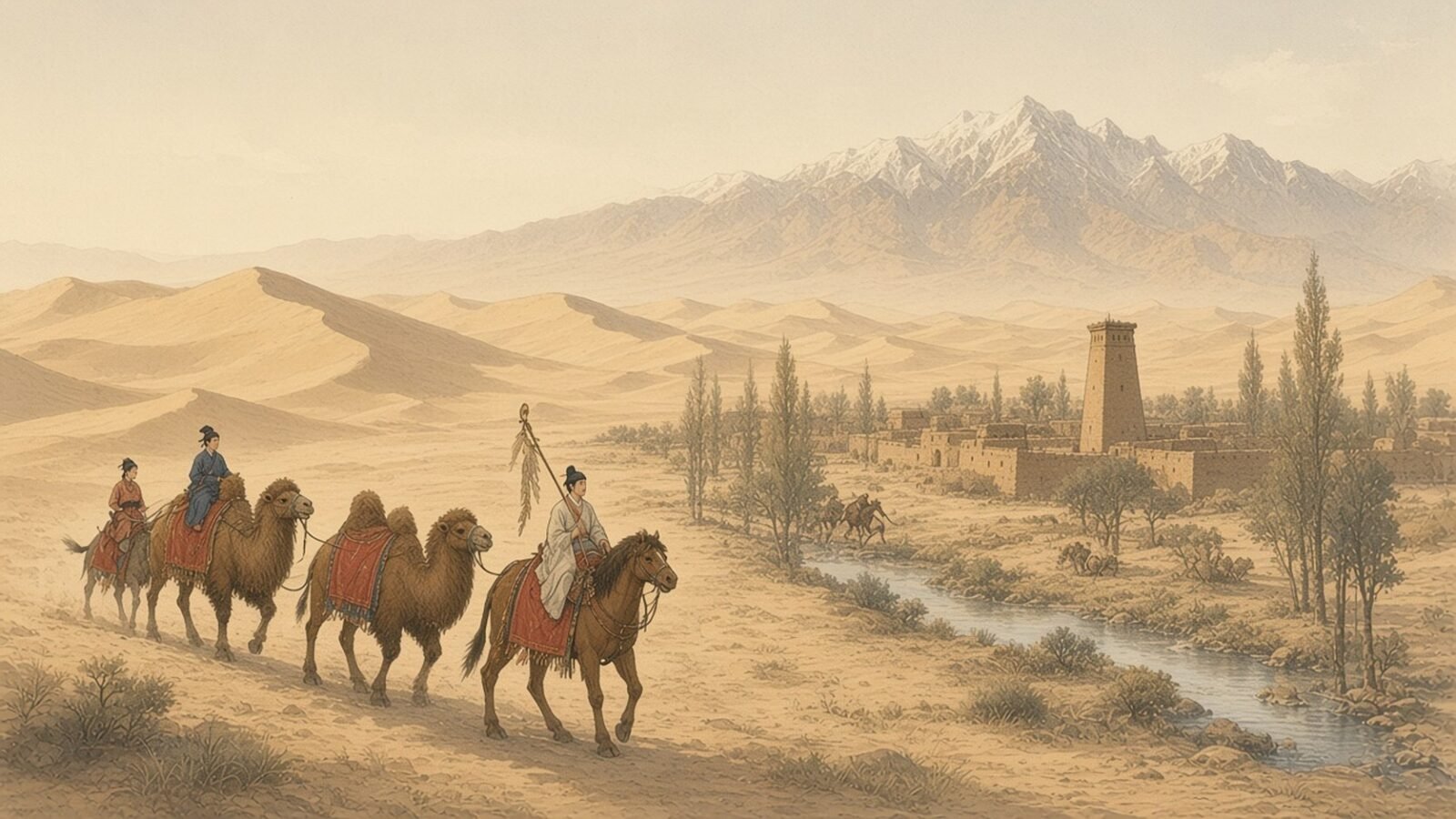
The route of the embassy of 138 BCE was, on the basis of the standard accounts, designed to take the embassy from the Han capital at Chang’an westward along the Hexi corridor to the kingdom of the Yuezhi. The route was, in the standard accounts, the same route that the Yuezhi had taken in their migration of the late third century BCE, and the route was the route along which the principal Han frontier garrisons were being established at the time of the mission. The route was, in the standard accounts, a route through the present-day Chinese provinces of Gansu and Qinghai and the present-day Chinese autonomous regions of Xinjiang and Tibet, and the route was the route along which the subsequent Han frontier commanderies were to be established. The embassy of 138 BCE was, in sum, the first major Chinese diplomatic mission along the route, and the embassy was the model for the subsequent Chinese diplomatic and military activity along the route.
The capture and the road west
The embassy of 138 BCE was, on the basis of the standard accounts, captured by the Xiongnu shortly after the embassy set out from the Han frontier. The capture had been prompted by the Xiongnu’s intelligence network along the frontier, which had detected the embassy’s departure, and the capture had been carried out by a Xiongnu cavalry detachment that had intercepted the embassy within approximately one hundred kilometres of the Han frontier. The embassy had been taken to the Xiongnu court, and the head of the embassy, Zhang Qian, had been detained by the Xiongnu for approximately ten years. The detention had been, in the standard accounts, intended to demonstrate to the Han court that the Xiongnu had the capacity to control the routes of the Inner Asian steppe, and the detention had been, in the standard assessment, a major diplomatic reverse for the Han court.
Zhang Qian, during the decade of his detention by the Xiongnu, married a Xiongnu wife and fathered at least one son by her, and Zhang Qian, in the standard accounts, gradually acquired the language and the customs of the Xiongnu court. The acquisition had, in the standard assessment, made Zhang Qian an unusually effective head of embassy for the subsequent mission to the Yuezhi, since Zhang Qian had, by the time of his release, acquired the diplomatic and the linguistic skills that were required for the mission. Zhang Qian was, by the late 120s BCE, an extremely experienced diplomat of the Inner Asian steppe, and Zhang Qian was the only head of embassy at the Han court who had the skills required for the mission to the Yuezhi.
Zhang Qian and his surviving retinue escaped from the Xiongnu court in approximately 126 BCE, after a Xiongnu chanyu had died and the political controls on the Xiongnu frontier had been relaxed in the succession dispute. The escape had been, in the standard accounts, carried out with the assistance of the Xiongnu wife and her clan, and the escape had been one of the most remarkable episodes of the early Han diplomatic tradition. Zhang Qian and his retinue continued westward to the Oxus valley to look for the Yuezhi, and Zhang Qian had, in the standard accounts, found the Yuezhi in their new homeland in the Oxus valley after a journey of approximately two years from the Xiongnu court. The Yuezhi, in the standard accounts, had, in the meantime, established themselves in the Oxus valley as a substantial regional power, and the Yuezhi had, by the time of Zhang Qian’s arrival, no longer been interested in an alliance against the Xiongnu. The embassy had, in sum, returned without the alliance that Wudi had originally intended, and the embassy had, in the standard assessment, been a diplomatic failure.
The embassy had, however, returned with a substantial amount of intelligence about the geography and the peoples of the Inner Asian land bridge, and the intelligence had been the basis for the subsequent Chinese understanding of the geography and the peoples. The intelligence had included detailed reports on the political geography of the Xiongnu confederation and the Yuezhi kingdom, the geography of the Oxus valley and the surrounding mountains, the peoples of the western steppe and the western mountains, and the principal trade routes of the inner Asian land bridge. The intelligence had been recorded in the Shiji (Records of the Grand Historian) by Sima Qian, the imperial historian who had interviewed Zhang Qian on his return to the Han court, and the intelligence had been the basis for the subsequent Chinese geographical and ethnographical understanding of the Inner Asian land bridge. The intelligence had, in sum, been one of the most consequential bodies of diplomatic intelligence in the history of the Han dynasty, and the intelligence had been the basis for the subsequent Chinese understanding of the Silk Road.
The second embassy and the opening of the route
The second embassy of Zhang Qian, dispatched in 119 BCE, was, on the basis of the standard accounts, organized on the basis of the intelligence of the first embassy. The second embassy had been, in the standard accounts, designed to make contact with the peoples of the Oxus valley and the peoples of the western mountains, and the second embassy had been designed to establish the diplomatic and the commercial relations with the peoples of the western lands that the first embassy had been unable to establish. The second embassy had been, in the standard accounts, organized with substantially larger resources than the first embassy, and the second embassy had included several hundred officials, soldiers, and guides, together with substantial quantities of gifts for the peoples of the western lands. The second embassy had, in sum, been one of the largest diplomatic missions that the Han court had ever organized, and the second embassy had been the basis for the subsequent Chinese diplomatic and commercial relations with the peoples of the western lands.
The second embassy had been, in the standard accounts, sent to the kingdom of the Daxia or Bactria in the Oxus valley, and the second embassy had been accompanied by subsidiary missions to several of the peoples of the western lands. The subsidiary missions had been, in the standard accounts, designed to make contact with the peoples of the Tarim Basin, and the subsidiary missions had been the basis for the subsequent Chinese understanding of the geography and the peoples of the Tarim Basin. The subsidiary missions had, in particular, made contact with the kingdom of Kucha, the kingdom of Khotan, the kingdom of Kashgar, and the kingdom of Turfan, and the subsidiary missions had been the basis for the subsequent Chinese diplomatic and commercial relations with the peoples of the Tarim Basin.
The second embassy had, in the standard accounts, returned to the Han court in approximately 115 BCE, and the second embassy had brought substantial amounts of intelligence about the geography and the peoples of the Inner Asian land bridge. The intelligence had included detailed reports on the political geography of the Daxia or Bactria, the geography of the Tarim Basin, and the principal trade routes of the Inner Asian land bridge. The intelligence had also included the first substantial Chinese reports on the Parthian Empire and the Seleucid Empire, and the intelligence had been the basis for the subsequent Chinese diplomatic and commercial relations with the western lands. The intelligence had, in sum, been one of the most consequential bodies of diplomatic intelligence in the history of the Han dynasty.
The second embassy had been, in the standard accounts, the basis for the subsequent Chinese diplomatic and commercial relations with the peoples of the western lands. The second embassy had established the diplomatic and the commercial relations with the peoples of the Tarim Basin, and the second embassy had established the diplomatic and the commercial relations with the peoples of the Oxus valley and the peoples of the western mountains. The diplomatic and the commercial relations had, in turn, been the basis for the establishment of the Silk Road as a continuous commercial and diplomatic route between Han China and the western lands, and the diplomatic and the commercial relations had been the basis for the subsequent expansion of the Silk Road into one of the principal arteries of Eurasian exchange.
The Hexi corridor and the Han frontier
The opening of the Silk Road was, in the standard assessment, accompanied by a major expansion of the Han frontier along the Hexi corridor. The Hexi corridor, the narrow strip of territory between the Gobi desert to the north and the Tibetan plateau to the south, had been, in the early Han period, contested between the Han court and the Xiongnu confederation. The contest had been resolved, in the 120s BCE, by a series of military campaigns in which the Han general Huo Qubing (140-117 BCE) and Wei Qing (d. 106 BCE) had expelled the Xiongnu from the Hexi corridor and had established the Han frontier along the corridor. The military campaigns had been, in the standard accounts, among the most successful of the Han military campaigns against the Xiongnu, and the military campaigns had been the basis for the establishment of the Hexi corridor as a permanent Han frontier.
The military campaigns had been, in the standard accounts, followed by the establishment of a series of Han frontier commanderies along the Hexi corridor. The commanderies had been, in the standard accounts, established at Wuwei, Zhangye, Jiuquan, and Dunhuang, and the commanderies had been the basis for the subsequent Chinese administration of the corridor. The commanderies had been, in particular, the basis for the administration of the principal trade routes that the embassies of Zhang Qian had identified, and the commanderies had been the basis for the subsequent Chinese administration of the trade routes of the Inner Asian land bridge.
The Han military expansion along the Hexi corridor and the establishment of the Han frontier commanderies had been, in the standard assessment, the military and the administrative background against which the Silk Road had been opened. The military expansion had provided the security that was required for the establishment of commercial caravans along the corridor, and the administrative expansion had provided the administration that was required for the regulation of the commercial caravans. The military and the administrative expansion had, in sum, been the conditions for the opening of the Silk Road, and the military and the administrative expansion had been the basis for the subsequent Chinese administration of the trade routes of the Inner Asian land bridge.
The opening of the Silk Road was, in the standard assessment, also accompanied by a series of subsequent Han missions to the western lands. The subsequent missions had, in the standard accounts, been organized on the basis of the intelligence of the embassies of Zhang Qian, and the subsequent missions had established the diplomatic and the commercial relations with the peoples of the western lands that the embassies of Zhang Qian had initiated. The subsequent missions had, in particular, established the diplomatic and the commercial relations with the kingdoms of the Tarim Basin and the kingdoms of the Oxus valley, and the subsequent missions had been the basis for the subsequent expansion of the Silk Road into one of the principal arteries of Eurasian exchange.
The first Roman contact and the westward expansion
The expansion of the Silk Road into a continuous commercial and diplomatic route between Han China and the Roman Empire was, in the standard accounts, completed in the first century BCE and the first century CE. The expansion had, in the standard accounts, been accompanied by the first Roman contact with Han China, which had occurred in approximately 166 CE according to the later Chinese sources. The first Roman contact had been, in the standard accounts, organized by the Roman emperor Antoninus Pius (r. 138-161 CE) or by his predecessor Antoninus’s father, and the first Roman contact had been received at the Han court of the Emperor Huan (r. 146-168 CE). The reception had been, in the standard accounts, one of the first documented contacts between the Roman Empire and the Han Empire, and the reception had been the basis for the subsequent Roman understanding of Han China.
The first Roman contact had, in the standard accounts, been received at the Han court by the Emperor Huan, and the reception had been recorded in the Hou Hanshu (History of the Later Han). The Hou Hanshu had, in the standard accounts, included a substantial description of the Roman Empire, including the description of the geography and the customs of the Roman Empire and the description of the principal commercial routes between the Roman Empire and Han China. The Hou Hanshu had also included the description of the Da Qin (the Roman Empire) as a substantial empire to the west of Parthia, and the description had been the basis for the subsequent Chinese understanding of the Roman Empire for several centuries.
The first Roman contact had, in the standard assessment, been one of the most consequential contacts between the Chinese and the Mediterranean worlds, and the contact had been the basis for the subsequent expansion of the Silk Road into a continuous commercial and diplomatic route between the two empires. The contact had been, in the standard accounts, accompanied by the establishment of several commercial outposts along the Silk Road, and the commercial outposts had been the basis for the subsequent commercial activity along the Silk Road. The commercial outposts had, in particular, been established at Kashgar, Khotan, Kucha, and Turfan in the Tarim Basin, and the commercial outposts had been the basis for the subsequent commercial activity along the route.
The expansion of the Silk Road into a continuous commercial and diplomatic route between the two empires was, in the standard assessment, completed in the second century CE. The expansion had been, in the standard accounts, accompanied by the substantial increase in the volume of trade along the route, and the increase had been the basis for the subsequent integration of the Inner Asian land bridge into the Eurasian world system. The integration had, in turn, been the basis for the subsequent transmission of Buddhism from India to China along the Silk Road, and the transmission had been the basis for the substantial transformation of Chinese religion and Chinese culture in the period. The Silk Road is, in sum, one of the foundational long-distance exchange networks in the pre-modern world, and the Silk Road is the principal artery through which the civilisations of the eastern and the western Eurasia had maintained continuous material and intellectual contact for the next fifteen centuries.
The diplomatic legacy of the embassies
The diplomatic legacy of the embassies of Zhang Qian was, in the standard accounts, one of the most consequential legacies in the history of the early Han dynasty and in the broader history of Chinese diplomacy. The diplomatic legacy was, in the standard accounts, the establishment of the diplomatic and the commercial relations with the peoples of the Inner Asian land bridge, and the diplomatic and the commercial relations were the basis for the subsequent expansion of the Silk Road into one of the principal arteries of Eurasian exchange. The diplomatic legacy was, in the standard assessment, the basis for the subsequent Chinese understanding of the geography and the peoples of the Inner Asian land bridge, and the diplomatic legacy was the source on which the subsequent Chinese historical and ethnographical understanding of the western lands has been based.
The diplomatic legacy of the embassies was, in the standard accounts, also expressed in the career of Zhang Qian himself. Zhang Qian had, on the basis of the standard sources, served the Han court for several more decades after his return from the second embassy in 115 BCE, and Zhang Qian had been the principal Chinese diplomat of the late second century BCE. Zhang Qian had been, in particular, the principal Chinese diplomat to the Wusun, a kingdom of the western steppe that was allied with the Xiongnu, and Zhang Qian had been the principal Chinese diplomat to the Wusun in the late 120s and 110s BCE. Zhang Qian had died in approximately 114 BCE, and Zhang Qian had been given a substantial posthumous memorial by the Han court. The posthumous memorial of Zhang Qian had, in sum, been the basis for the subsequent Chinese historiographical tradition of Zhang Qian.
The historiographical tradition of Zhang Qian had been, in the standard accounts, one of the most consequential historiographical traditions in the history of the Chinese understanding of the western lands. The historiographical tradition had been carried by the Shiji (Records of the Grand Historian) of Sima Qian, the imperial historian who had interviewed Zhang Qian on his return to the Han court, and the historiographical tradition had been carried by the subsequent Chinese historical and geographical texts of the late first millennium BCE and the first millennium CE. The historiographical tradition had, in particular, been the basis for the subsequent Chinese understanding of the geography and the peoples of the Inner Asian land bridge, and the historiographical tradition had been the source on which the subsequent Chinese historical and ethnographical understanding of the western lands has been based.
The legacy of the embassies of Zhang Qian was, in sum, the establishment of the diplomatic and the commercial relations between Han China and the peoples of the Inner Asian land bridge, and the legacy was the basis for the subsequent expansion of the Silk Road into one of the principal arteries of Eurasian exchange. The legacy of the embassies was, in the standard assessment, one of the most consequential legacies in the history of the early Han dynasty and in the broader history of Chinese diplomacy, and the legacy of the embassies was the basis for the subsequent Chinese understanding of the Inner Asian land bridge. The embassies of Zhang Qian are, in sum, the founding moment of the Silk Road, and the embassies of Zhang Qian are the event against which every subsequent diplomatic and commercial contact between Han China and the rest of Eurasia has been measured.
The caravan cities of the Tarim Basin
The opening of the Silk Road was, in the standard assessment, accompanied by the rise of a series of caravan cities in the Tarim Basin and the surrounding mountains. The cities had been, in the early period, small oasis settlements along the routes that the embassies of Zhang Qian had identified, and the cities had been gradually transformed into substantial regional centres of trade and administration by the subsequent development of the Silk Road. The cities were, in the standard accounts, established at Kashgar, Khotan, Kucha, Turfan, Karashahr, and Yutian, and the cities were the principal commercial centres of the Tarim Basin in the first millennium BCE and the first millennium CE. The cities were, in the standard assessment, the nodes of a substantial commercial network that linked Han China to the western lands, and the cities were the principal commercial centres of the Inner Asian land bridge in the period.
The cities of the Tarim Basin were, in the standard accounts, multi-cultural and multi-lingual, and the cities were the meeting points of the Han Chinese, the Indo-Iranian, the Turkic, the Tibetan, and the Sogdian cultures. The cities had, in the standard accounts, populations that included substantial numbers of Han Chinese merchants, Sogdian traders, Indian Buddhist monks, and Iranian merchants, and the cities were the principal meeting points of the Inner Asian commercial network. The cities were, in particular, the principal commercial centres of the Silk Road for several centuries, and the cities were the principal commercial centres of the Inner Asian land bridge until the rise of the Mongol Empire in the thirteenth century CE.
The cities were, in the standard accounts, also the principal nodes of the transmission of Buddhism from India to China. The Buddhist tradition had been transmitted, in the period, from India through the cities of the Tarim Basin and into Han China, and the transmission had been accompanied by the substantial transformation of Chinese religion and Chinese culture in the period. The Buddhist tradition had, in particular, been transmitted through the city of Khotan, which had been one of the principal centres of Buddhism in the Tarim Basin, and the transmission had been the basis for the subsequent substantial transformation of Chinese religion and Chinese culture.
The opening of the Silk Road was, in sum, one of the foundational events of the Eurasian world system, and the opening was the principal artery through which the civilisations of the eastern and the western Eurasia had maintained continuous material and intellectual contact for the next fifteen centuries. The diplomatic legacy of the embassies of Zhang Qian was, in the standard assessment, one of the most consequential legacies in the history of the early Han dynasty and in the broader history of Chinese diplomacy, and the diplomatic legacy was the basis for the subsequent Chinese understanding of the geography and the peoples of the Inner Asian land bridge. The embassies of Zhang Qian are, in sum, the founding moment of the Silk Road, and the embassies of Zhang Qian are the event against which every subsequent diplomatic and commercial contact between Han China and the rest of Eurasia has been measured.
References
- Records of the Grand Historian: Han Dynasty II, Translated from the Shiji of Sima Qian — Burton Watson, Columbia University Press, 1993.
- The Book of the Later Han (Hou Hanshu) — Fan Ye, Chinese University Press, 1965.
- The Cambridge History of Ancient China, from the Origins of Civilization to 221 BC — Michael Loewe and Edward L. Shaughnessy, Cambridge University Press, 1999.
- The Cambridge History of China, Volume 1: The Ch’in and Han Empires, 221 BC-AD 220 — Denis Twitchett and Michael Loewe, Cambridge University Press, 1986.
- The Silk Road: A New History — Valerie Hansen, Oxford University Press, 2012.
- The Han Dynasty and the Silk Road — Ralph D. Sawyer, in Early China, 1995.
- Emperor Wu of Han and the Founding of the Imperial Chinese State — C. H. Twitchett, in T’oung Pao, 1968.
- The Xiongnu Empire and the Han Frontier — Nicola Di Cosmo, in Central Eurasian Studies, 1998.
- Zhang Qian’s Missions and the Origins of the Silk Road — Anthony J. Barbieri, in Journal of Asian History, 2003.
- The Western Regions According to the Shiji and the Hanshu — A. F. P. Hulsewé, Brill, 1975.
- The Han Frontier and the Steppe — S. A. M. Adshead, Cambridge University Press, 1984.
- The Hou Hanshu on Da Qin and the Roman Empire — Leslie Scott, in Journal of the Royal Asiatic Society, 1941.
- Huo Qubing and the Han Frontier Wars — Michael Chang, in Early Medieval China, 2005.
- Buddhism and the Silk Road — Liu Xinru, Princeton University Press, 1996.
- The Tarim Basin Kingdoms and the Silk Road — Christopher I. Beckwith, Brill, 1987.
- Inner Asian Trade in the Han Period — E. G. Pulleyblank, in Journal of the American Oriental Society, 1971.
- The Hexi Corridor as Imperial Frontier — T. H. Twitchett, in T’oung Pao, 1979.
- The Parthian Empire and the Silk Road — M. M. P. J. Lieu, Cambridge University Press, 2000.