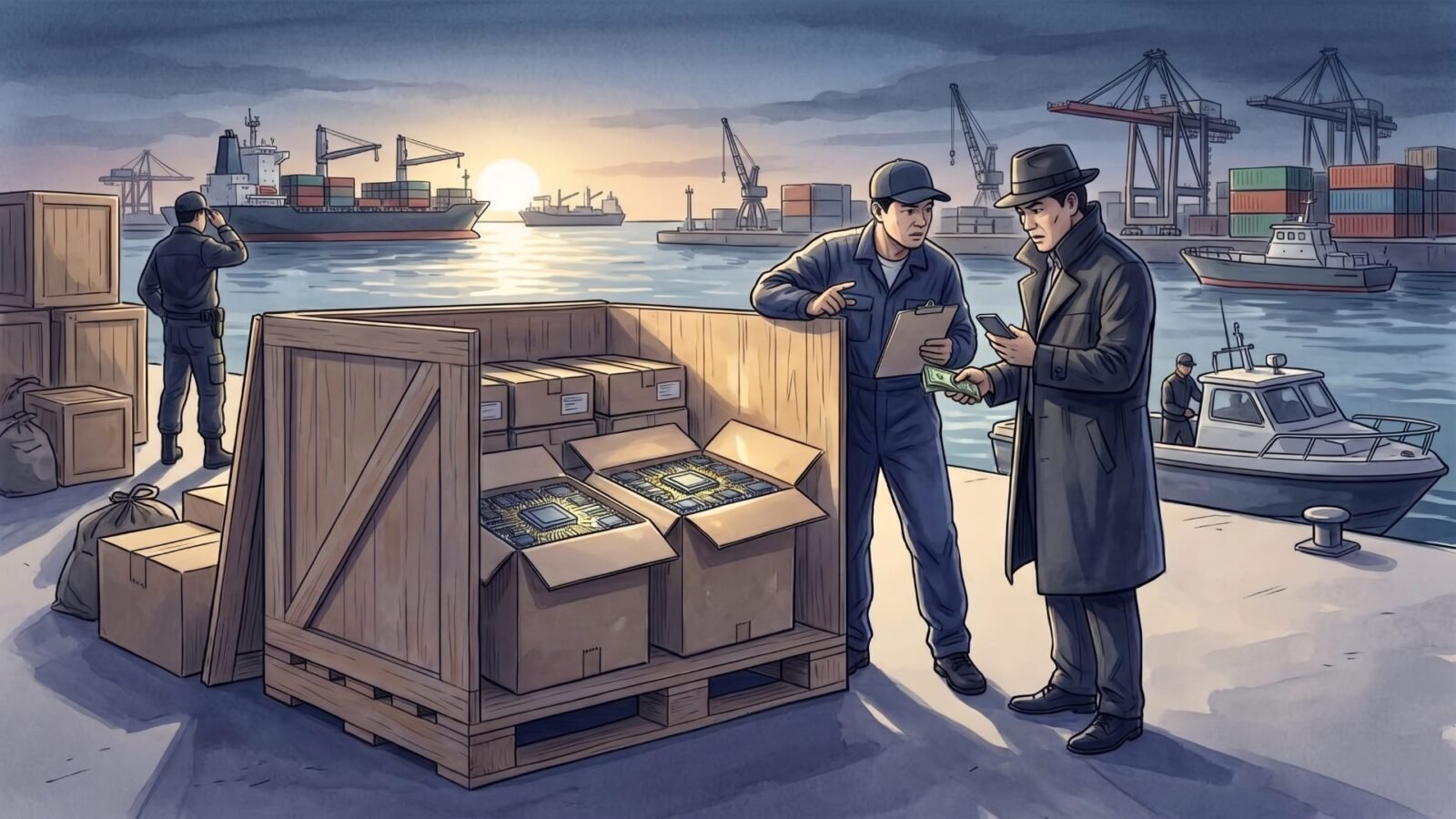
Since October 2022 the United States has tried, by a series of increasingly detailed regulations, to stop the most capable computer chips and the most advanced chipmaking machinery from reaching the People’s Republic of China. The rules have been joined, in part, by the Netherlands and Japan, which are home to the makers of several kinds of equipment that cannot easily be obtained anywhere else. Over the same period a trade has grown up that moves controlled processors, and the servers built around them, into China by indirect routes: through distributors in Singapore and Malaysia, through freight forwarders in Hong Kong, through companies created for a single purpose, and through the electronics markets of Shenzhen. A parallel channel, lawful under most readings of the rules, has given Chinese users remote access to the same hardware through cloud computing services located outside China.
This article describes that trade and the controls that gave rise to it. It sets out what the American, Dutch and Japanese rules actually require, how goods are said to have moved around them, and what has been established in the criminal cases that have come to court or to public indictment in the United States, Singapore and Taiwan. It then turns to the Chinese response, which has combined a large state investment programme with efforts by firms such as Huawei, SMIC, CXMT and YMTC to build substitutes, and to the Chinese government’s own view of the controls. It ends with the historical precedent most often cited in these debates, the Cold War system of multilateral export controls known as CoCom and the smuggling cases it produced, and with the policy arguments now under way in Washington about how, or whether, enforcement can be made to work.
Each part of the subject is contested. American officials describe the controls as a narrow measure to deny a strategic rival the computing power needed for advanced weapons, surveillance and military planning. Chinese officials describe them as an abuse of export control law to hold back a competitor’s economic development, and as a breach of the principles of the multilateral trading system that China joined in 2001. Chipmakers and equipment suppliers have argued at different times both that the rules are too broad, costing them revenue that funds research, and that they are too porous to achieve their stated purpose. The account below presents these positions as their holders put them. Allegations in criminal cases are described as allegations unless a court has accepted a guilty plea or returned a verdict.
Several earlier articles on huaxia cover related ground and are not repeated here. The development of Chinese accelerator chips is described in China’s AI Chip Industry Grows Around US Curbs and Huawei Ascend, SMIC, and the Chinese AI Chip Industry. The geography of the global supply chain is the subject of Chip War and the World’s Chokepoints and How TSMC Came to Underpin the Chip Race. China’s lithography programme, its memory makers and its graphics and neural processor designers have their own entries, linked where they arise below.
Why chips became a controlled good
Export controls on technology are old. What changed after 2018 was the identification of a single class of commodity product, the advanced semiconductor, as the point at which a technological lead might be defended. Two features of the industry made this plausible. The first is concentration. The design software used to lay out modern chips is supplied overwhelmingly by three companies, two of them American. The most advanced logic chips are fabricated by a small number of foundries, of which TSMC in Taiwan is by far the largest. The machines that make those chips come from a short list of suppliers in the United States, the Netherlands and Japan, and the extreme ultraviolet lithography systems needed for the smallest features are made by only one company, ASML of Veldhoven. A government that controls, or can persuade its allies to control, these points can in principle restrict an entire industry downstream.
The second feature is that the most valuable chips of the 2020s are not general processors but accelerators designed for the parallel arithmetic used to train and run large machine-learning models. The market for these is dominated by Nvidia, whose graphics processors, originally made for video games, became the standard hardware for artificial intelligence research after about 2012, supported by its CUDA programming platform. A data centre capable of training a frontier model requires tens of thousands of such accelerators connected by high-speed networks. Because the chips are physically small and individually valuable, a restriction on them is a restriction on goods that can be carried in a suitcase, shipped in a crate of servers, or bought and resold many times before they reach their final user. That combination, strategic significance and portability, is the root of the smuggling problem.
The legal instrument the United States used is the Export Administration Regulations (EAR), administered by the Department of Commerce’s Bureau of Industry and Security (BIS) under the Export Control Reform Act of 2018. The EAR controls items listed on the Commerce Control List by technical parameters, and it controls exports to particular parties through the Entity List, a register of foreign companies, institutions and individuals for which licences are required and usually denied. A third mechanism, the foreign direct product rule, extends American jurisdiction to items made outside the United States if they are the direct product of American technology or software, or are made in plants that use certain American equipment. Since almost every advanced fab in the world uses American tools somewhere in its process, the foreign direct product rule is the reason a Taiwanese or Korean foundry may need an American licence to sell a chip it has made to a Chinese customer.
The first large use of these tools against a Chinese technology company came before the chip controls proper. In 2016 and 2017 the telecommunications equipment maker ZTE was penalised for shipping American components to Iran and North Korea, and in 2018 it was briefly barred from buying American parts altogether, a measure that halted its main operations until a settlement was reached. In May 2019 Huawei was added to the Entity List, and in May and August 2020 BIS amended the foreign direct product rule so that chips made anywhere with American technology could not be supplied to Huawei without a licence. The effect was to cut Huawei off from TSMC, which had been fabricating its Kirin smartphone processors. SMIC, China’s largest contract chipmaker, was placed on the Entity List in December 2020. These measures were aimed at named firms. The rules of October 2022 were different in kind: they were aimed at technologies and at a country.
The Chinese government’s position, stated repeatedly by its Ministry of Commerce and Ministry of Foreign Affairs, is that these measures stretch the concept of national security beyond recognition, that they are discriminatory, and that they damage the interests of companies and consumers in all countries, including American firms that lose a large market. Chinese officials also argue that the controls have strengthened rather than weakened China’s resolve to build an independent industry. The American position, set out in BIS press releases and congressional testimony, is that China’s policy of military-civil fusion makes it impossible to separate civilian and military users of advanced computing in China, so that controls must be placed on the technology itself rather than on known military end users alone.
The October 2022 rules
On 7 October 2022 BIS announced what its press release called new export controls on advanced computing and semiconductor manufacturing items to the People’s Republic of China, published in the Federal Register on 13 October as an interim final rule (BIS press release, 7 October 2022; Federal Register 2022-21658). The rule had two halves. The first concerned chips and computers. It added certain high-performance chips, and computers and other items containing them, to the Commerce Control List under a new classification, 3A090 for the chips and 4A090 for the computers, and it imposed new licence requirements on items destined for supercomputers or for semiconductor development and production in China. It also expanded the foreign direct product rule to cover advanced computing items and supercomputer end uses, and applied it to 28 Chinese entities already on the Entity List, so that foreign-made items destined for them would also need licences.
The chip thresholds were set by a combination of processing performance and the bandwidth of the links between chips. In practice this captured Nvidia’s A100, then its leading data-centre accelerator, and the newly announced H100, as well as AMD’s MI250. Nvidia had disclosed at the end of August 2022 that it had been informed of a new licence requirement for the A100 and H100, so the market knew what was coming. Within weeks Nvidia announced versions for the Chinese market, the A800 and later the H800, which kept most of the computing power of the originals but reduced the chip-to-chip interconnect speed below the controlled level. This was lawful under the rule as written, and it became the first of several rounds in which a manufacturer designed a product to the threshold and BIS later moved the threshold.
The second half of the rule concerned manufacturing. It added certain semiconductor manufacturing equipment to the Commerce Control List and required licences for exports of any item subject to the EAR to fabs in China that produce logic chips with non-planar transistor architectures at the 16 or 14 nanometre generation or below, DRAM memory at a half-pitch of 18 nanometres or less, or NAND flash memory with 128 or more layers. Licence applications for facilities owned by Chinese companies would face a presumption of denial, and those for facilities owned by multinationals would be reviewed case by case. American persons were also restricted from supporting the development or production of chips at such facilities without a licence, a provision that caused American engineers working at Chinese fabs to stop work or resign within days. Temporary general licences allowed some activity to continue while companies adjusted, and the advanced computing provisions took effect on 21 October.
On the same day BIS moved 31 Chinese organisations, including the memory maker Yangtze Memory Technologies (YMTC), to its Unverified List, a step that precedes Entity List designation if the government cannot check how exported items are used. YMTC was added to the Entity List in December 2022 together with 35 other Chinese entities. Its story is told in YMTC and the Chinese 3D NAND Memory Story.
The October 2023 update
A year later BIS revised the rules in response to what it described as attempts to get round them (BIS press release, 17 October 2023). The most important change was that interconnect bandwidth was removed as a control parameter, which closed the route by which the A800 and H800 had been designed. Instead, controls were based on total processing performance, a measure of arithmetic throughput, and on a new measure of performance density, which takes account of the area of the silicon die. Under the revised classification 3A090.a, a chip with total processing performance of 4,800 or more was controlled, as was a chip with 1,600 or more and a performance density of at least 5.92. A lower tier, 3A090.b, caught chips just below those thresholds and made them subject to a notification process rather than an outright licence requirement in some destinations. The new rules took effect in mid-November 2023. According to analyses by the Center for Strategic and International Studies and by law firms advising exporters, they captured the A800, H800 and L40S from Nvidia and Intel’s Gaudi2 accelerator (CSIS, “Updated October 7 Semiconductor Export Controls”).
Several provisions of the 2023 update addressed diversion directly. Licence requirements were extended beyond China and Macau to the 22 other countries under American arms embargoes, so that a chip could not lawfully be shipped to, for example, Iran or Belarus and then onward. For a larger group of countries that were not embargoed but were judged to present diversion risk, licences would be required but would carry a presumption of approval. The rules also applied worldwide to companies headquartered in China or Macau, or whose ultimate parent was headquartered there, so that a Chinese-owned subsidiary in a third country could not buy controlled chips without a licence. Foundries were given red flags to watch for when a customer ordered chips that might exceed the thresholds. BIS asked for public comment on the risks posed by infrastructure-as-a-service, that is, by Chinese customers renting computing power in data centres outside China, which the rules did not then cover.
The 2023 rules also reached consumer products. Some high-end gaming graphics cards, most notably Nvidia’s GeForce RTX 4090, had performance figures that brought them under the new thresholds, and their export to China required notification or a licence. Nvidia responded with a reduced version for the Chinese market, sold as the RTX 4090D. This matters for the smuggling story, because gaming cards are sold through retail channels in large numbers, are not tracked as closely as data-centre accelerators, and can be reworked. Chinese and international technology outlets reported during 2023 and 2024 that workshops in China were removing the graphics processors and memory from imported RTX 4090 cards and remounting them on server-style boards suitable for installation in racks, and later that modified cards with doubled memory were being offered for machine-learning work. These reports came from trade press and online listings rather than from court records, and their scale is not known.
For manufacturing equipment, the 2023 update tightened the controls on tools used to make advanced chips, extended the list of controlled items, and broadened the countries to which licence requirements applied, partly to stop Chinese firms buying tools through subsidiaries abroad. Two Chinese graphics processor designers, Biren and Moore Threads, were added to the Entity List at the same time. Moore Threads is the subject of Moore Threads and the Chinese GPU Story.
Nvidia’s response to the 2023 rule was to develop a further set of products for China, the most important of which was the H20. The H20 had much less arithmetic throughput than the H100, and so fell below the 3A090 thresholds, but it retained large amounts of high-bandwidth memory and a fast interconnect, which made it well suited to running, rather than training, large language models. It became Nvidia’s main product for Chinese customers during 2024.
December 2024 and the turn of the administration
On 2 December 2024 BIS issued a further package, published as two rules in the Federal Register (BIS press release, 2 December 2024). It placed controls on 24 types of semiconductor manufacturing equipment and three types of software tools used to develop or produce chips. It controlled high-bandwidth memory, the stacked DRAM placed beside accelerators to feed them data, above a memory bandwidth density of 2 gigabytes per second per square millimetre, which covered all current generations of the product. It added 140 entries to the Entity List and modified 14, among them the Chinese equipment makers Naura, Piotech and ACM Research’s Shanghai subsidiary, and the design software company Huada Jiutian. It created two new foreign direct product rules aimed at equipment, so that foreign-made tools incorporating American content would be controlled for designated Chinese fabs. The Netherlands and Japan, whose own rules are described below, were not subject to the new equipment foreign direct product rule, reflecting the expectation that they would act under their own law.
In January 2025, in the last days of the Biden administration, BIS issued two further measures. The Framework for Artificial Intelligence Diffusion, published on 13 January, would have divided the world into three tiers, with most allies able to buy advanced accelerators freely, a large middle group subject to country quotas, and China and other arms-embargoed countries effectively excluded. It also proposed controls on the weights of the most capable closed AI models. A second rule, published on 15 January and known as the foundry due diligence rule, required chip foundries and outsourced assembly and test companies to apply stricter checks before making chips at advanced nodes for customers not on an approved list. Both rules were designed in large part to close diversion routes: the first by capping the number of chips that could flow to countries with a record of transshipment, and the second by making it harder for a Chinese designer to obtain advanced chips from a foreign foundry through an intermediary.
That second problem had become concrete in October 2024. The research firm TechInsights, which dismantles chips to analyse their construction, examined a Huawei Ascend 910B accelerator and found a die manufactured by TSMC. Reuters reported that TSMC informed the Commerce Department, traced the die to an order placed by the Chinese chip designer Sophgo, and suspended shipments to that customer (Reuters, 26 October 2024). In November 2024, according to Reuters, the Commerce Department ordered TSMC to stop shipping chips of 7 nanometres or more advanced designed for AI applications to Chinese customers. Reuters later reported that TSMC could face a fine of one billion dollars or more in a related export control investigation. The case showed that diversion did not only take the form of finished chips moving through ports; it could also take the form of a fabrication order placed under one company’s name for the benefit of another.
2025: rescission, the H20 and a revenue share
The incoming Trump administration kept the existing controls on chips and equipment but rejected the diffusion framework. On 13 May 2025 BIS announced that it would rescind the AI Diffusion Rule, arguing that it would have stifled American innovation and burdened relations with dozens of countries (BIS press release, 13 May 2025). In the same announcement BIS issued guidance on several points, of which two bear on diversion. The first stated that using Huawei’s Ascend 910B, 910C or 910D chips anywhere in the world risked violating the EAR’s General Prohibition 10, because those chips were in BIS’s view likely to have been produced in violation of American controls (BIS guidance on General Prohibition 10). The second warned of the consequences of allowing American AI chips to be used for training or running Chinese models, and set out diversion red flags for companies. The Chinese Ministry of Commerce responded that the guidance on Huawei chips was a further abuse of export controls and warned that anyone implementing it could be breaking Chinese law.
Earlier, in April 2025, the administration had imposed a licence requirement on the H20 and on AMD’s equivalent, the MI308, for export to China. Nvidia disclosed in a filing with the Securities and Exchange Commission that it had been informed on 9 April that the requirement would apply indefinitely, and on 15 April it said it expected to take a charge of up to about 5.5 billion dollars on inventory, purchase commitments and related reserves (Nvidia Form 8-K; Reuters, 15 April 2025). For the first time since 2022, there was no current Nvidia data-centre accelerator that could be sold lawfully into China without a licence. In the following months press reporting suggested that the smuggling trade expanded. The Financial Times reported in July 2025 that Nvidia processors worth at least one billion dollars, including the newer B200, had entered China in the three months after the H20 restriction, sold by distributors in Guangdong, Zhejiang and Anhui, often in pre-assembled racks (Reuters summary of the Financial Times report, 24 July 2025). Nvidia said in response that building data centres with smuggled products was a losing proposition, technically and financially, because it provided no service or support for them.
In July 2025 the administration reversed course on the H20 and indicated that licences would be granted. In August it was reported, and later confirmed by the President, that Nvidia and AMD had agreed to pay the federal government 15 per cent of revenue from H20 and MI308 sales to China as a condition of their licences (BBC, August 2025). The arrangement was without precedent in American export control practice, and legal scholars questioned whether the Constitution’s prohibition on export taxes permitted it; a later Congressional Research Service analysis set out the competing arguments. The Chinese side responded in its own way. On 31 July 2025 the Cyberspace Administration of China summoned Nvidia to explain what it described as security risks in the H20, including the possibility of tracking, location and remote shutdown functions, citing proposals in the United States to require such features in exported chips (Cyberspace Administration of China statement, 31 July 2025). Nvidia denied that its chips contained backdoors, and its chief security officer published a statement that there were no kill switches or spyware in its products. Reporting in the following weeks described Chinese authorities discouraging large companies from buying the H20, and Chinese demand for it did not recover to earlier levels.
On 29 September 2025 BIS published what became known as the Affiliates Rule, which extended Entity List restrictions automatically to any foreign entity owned 50 per cent or more by one or more listed parties (BIS press release). The change addressed a known gap: a listed Chinese company could create a subsidiary that was not itself listed and buy through it. The Chinese government treated the rule as an escalation, and in October 2025 announced a broad expansion of its own export controls on rare earths. After the meeting between Presidents Trump and Xi Jinping in South Korea at the end of October, the two governments agreed to a pause in a range of measures. BIS suspended the Affiliates Rule for one year from 10 November 2025 (Federal Register 2025-19846). At the time of writing, in late October 2026, the suspension is due to expire on 10 November 2026; law firm commentary in October 2026 reported that a short extension had been announced but not yet published in the Federal Register.
On 8 December 2025 President Trump announced that the United States would allow Nvidia to ship its H200, the predecessor of the Blackwell generation, to approved customers in China, with 25 per cent of the proceeds going to the United States (Reuters, 8 December 2025). The policy was implemented in January 2026 through a combination of case-by-case licensing and a 25 per cent tariff applied to the chips as they passed through the United States for security testing before re-export (Reuters, 13 January 2026). Supporters of the change argued that the H200 was well behind Nvidia’s newest products, that Chinese companies would otherwise turn entirely to Huawei, and that it was better for Chinese developers to depend on American hardware and software. Opponents in Congress and in policy institutes such as the Center for a New American Security argued that the H200 remained far more capable than any Chinese-made chip, and that its sale would narrow the computing gap that the controls had been designed to preserve (CNAS, “Unpacking the H200 Export Policy”).
The Chinese response to the H200 decision was again cautious. Reuters reported in January 2026 that Chinese customs officers had been told that the H200 was not permitted to enter, and that companies had been advised to buy only when necessary (Reuters, 14 January 2026). In March 2026 Reuters reported that Chinese authorities had approved H200 purchases by many customers (Reuters, 18 March 2026). The episode illustrated a feature of the trade that is often overlooked in discussion of smuggling. Beijing’s policy has been to favour domestic chips wherever they are adequate, and to admit foreign chips where they are needed, on terms that do not deepen dependence. The demand that sustains smuggling is therefore concentrated in the classes of product that remain prohibited, which since 2025 has meant chiefly Nvidia’s Blackwell generation and the servers built around it.
The Dutch and Japanese controls
American rules alone could not cover the most important chipmaking machines, because several of them are not American. ASML’s extreme ultraviolet scanners had never been licensed for export to China: the Dutch government had withheld a licence since 2019, reportedly after American representations. The more difficult question concerned deep ultraviolet immersion scanners, older but still capable of producing chips at 7 nanometres when used with multiple patterning, a technique that exposes the same layer several times. In January 2023 the United States, the Netherlands and Japan reached an understanding, never published, on equipment controls, and over the following months the two allies announced their own rules (CSIS, “Japan and the Netherlands Announce Plans for New Export Controls on Semiconductor Equipment”).
Japan’s Ministry of Economy, Trade and Industry amended its export regulations to add 23 types of semiconductor manufacturing equipment, including tools for cleaning, deposition, annealing, lithography, etching and inspection, with effect from 23 July 2023. The Japanese rules are formally country-neutral, requiring licences for exports to all destinations other than a list of close partner countries, a list on which China does not appear. They affected Tokyo Electron, Japan’s largest equipment maker, and others such as Screen and Nikon. Japan’s government stated that the measures were for the purpose of preventing military use and were not directed at any particular country.
The Dutch government announced its measures on 30 June 2023, and they took effect on 1 September 2023 (Rijksoverheid, 30 June 2023). Exporters of certain advanced deposition and immersion lithography equipment needed a national licence. ASML stated that the rules would apply to its most advanced immersion systems, the TWINSCAN NXT:2000i and later models, and that it did not expect a material effect on its 2023 results (ASML statement, 30 June 2023). In 2024 the Dutch government extended the national licence requirement to the NXT:1970i and NXT:1980i, which until then had been controlled only by the American rules. Chinese customers had placed large orders for ASML equipment during 2023 and early 2024, in anticipation of the restrictions, and China became for a period ASML’s largest market by revenue.
Both governments argued that their measures were based on their own security assessments and their own law. The Chinese government protested to both, warning of damage to the stability of supply chains and to bilateral trade. The Dutch and Japanese controls differ from the American ones in an important respect for the present subject: they apply to the export of machines, not to the servicing of machines already installed, and not, at least initially, to spare parts. Equipment is large, installed by the manufacturer’s engineers, and logged by serial number, so outright smuggling of complete lithography systems is not a practical route. The equipment question has turned instead on the supply of components and services, on sales through subsidiaries and distributors, and on the ability of Chinese manufacturers to make their own tools. China’s lithography programme is described in China’s Push for Its Own Lithography.
How chips are moved
The methods described in indictments, government guidance and investigative reporting fall into a small number of patterns. None is new. Each is a version of a technique used for other controlled goods, adapted to a product that is small, valuable and sold through a long chain of intermediaries.
The first and most common is transshipment. Controlled chips, or servers containing them, are exported lawfully, or with false declarations, to a country for which no licence is required, and are then sent on to China. Singapore and Malaysia appear in most American cases. Both are major centres for data centres and for the electronics trade, both have large and legitimate demand for servers, and neither, until recently, required its own licence for re-export of American chips. Hong Kong appears often as the final staging point or as the location of the companies that pay. Thailand, Indonesia, Japan, Vietnam and the United Arab Emirates have also appeared in cases or reporting. Nvidia’s own published revenue figures by billing location show very large sales attributed to Singapore. The company has stated that most of this reflects the billing addresses of customers who take delivery elsewhere, chiefly in the United States, and that shipments to Singapore itself are a small share; critics have treated the figures as a sign of how difficult it is to know where chips finally go.
The second method is the front company. Many of the cases described below involve a company created shortly after a control took effect, with little or no trading history, which buys hardware in its own name and declares itself, or a nominee in a third country, as the end user. Payment often comes from companies in Hong Kong or mainland China rather than from the declared customer. A variant uses established companies with legitimate business, whose staff are alleged to have placed orders on behalf of undisclosed Chinese buyers. In the largest case, described below, the server orders passed through a Southeast Asian company acting for brokers whose customers were in China.
The third is false description. Shipping paperwork may describe accelerators as generic computer parts, as graphics cards for gaming, or as goods of lower specification. In one case the chips were relabelled with the name of a company that did not exist. In another, according to the indictment, non-working replicas of servers were staged in a warehouse to satisfy auditors that the real equipment was still where the paperwork said it was. False end-user certificates, in which a buyer certifies to the seller that goods will remain in a particular country and will not be used for prohibited purposes, are a recurrent feature.
The fourth is fragmentation. Rather than moving a complete data centre, buyers acquire chips in small quantities from many sources: retailers, system integrators, resellers of second-hand hardware, and businesses that have bought more than they need. Chips can also be moved as components: a graphics processor and its memory removed from one board and mounted on another, or a server stripped down and reassembled after crossing a border. The resale market for used accelerators, which has grown as data centres upgrade to newer generations, adds another layer between the original buyer and the final user.
The fifth, and in a strict sense not smuggling at all, is remote access. A Chinese company that cannot import chips can rent their use from a cloud provider whose data centre is in another country. The EAR control exports, re-exports and transfers of items, not the provision of a computing service, and so a Chinese customer that runs software on servers in Malaysia or the United States is not, under the rules as they stood for most of the period, receiving an export. Reuters reported in August 2024 that state-linked Chinese organisations, including universities, had used Amazon Web Services and other providers to obtain access to advanced Nvidia chips and to AI models (Reuters, 23 August 2024). Reuters noted that the practice was not itself a violation. BIS had asked for comment on the issue in 2023, and the House of Representatives considered legislation to give the Commerce Department authority over remote access. A related practice involves Chinese companies building or renting capacity in data centres in Southeast Asia and the Middle East, staffed and owned locally, and training models there.
Huaqiangbei and the grey market
The Huaqiangbei district in Futian, Shenzhen, is among the largest electronics markets in the world. It grew from the industrial zone established in the early years of the Shenzhen Special Economic Zone, whose history is told in How Shenzhen Was Built From Border Villages. Its multi-storey malls, of which SEG Plaza is the best known, contain thousands of stalls selling components, from resistors and connectors to processors and memory, alongside repair shops, assemblers and traders in surplus and refurbished parts. Much of the business is done in cash or by mobile payment, in small lots, between traders who know one another. For decades the market has supplied the hardware start-ups, repair technicians and small manufacturers of the Pearl River Delta, and it has also been a place where goods of uncertain origin are bought and sold.
In June 2023 Reuters reported from Shenzhen that vendors in Huaqiangbei, including at SEG Plaza, were quietly offering Nvidia A100 processors, then subject to American controls for eight months, at around 20,000 dollars each, roughly twice their normal price (Reuters, 19 June 2023). Reuters said it had spoken to ten vendors in Shenzhen and Hong Kong who said they could obtain A100s in small quantities, typically a few at a time. Vendors suggested that the chips came from stock acquired before the ban, from surplus held by companies outside China, or from chips diverted after legitimate sale abroad. Only one vendor said the H100 was available. Buyers were mainly start-ups, university laboratories and research groups that needed modest numbers of chips. Later reports in the South China Morning Post and other outlets described a similar trade in later generations, often conducted through online platforms and messaging groups rather than stalls.
The Huaqiangbei trade illustrates the difference between the two ends of the smuggling problem. At the retail end, chips move in small lots, through people who may not know or ask about their origin, at prices that reflect the risk. This trade is persistent and difficult to stop, but it does not by itself provide the tens of thousands of accelerators that a frontier training run requires. At the wholesale end, a small number of transactions involve thousands of servers, hundreds of millions of dollars, and corporate counterparties. These are the cases that have come before courts, and they are where most of the volume appears to lie. Chinese officials have generally declined to comment on the grey market, beyond stating that China opposes American controls and that Chinese companies operate in accordance with law. Chinese law does not prohibit the import of American chips, and a buyer in China who acquires a chip exported in breach of American rules does not, by that act alone, break any Chinese law.
The economics of the trade follow from the difference between controlled and uncontrolled prices. When a chip is lawfully available in China, as the H20 was for most of 2024, there is little incentive to smuggle it, and smuggling concentrates on the next tier up. When nothing comparable is lawfully available, the premium rises. Reported premiums have ranged from modest margins on servers to roughly double the list price for individual processors in short supply. Against that premium must be set the costs of the route: the fees of intermediaries and freight forwarders, the risk of seizure, the absence of manufacturer warranty or support, and the difficulty of building a large cluster from hardware of mixed origin without the software updates and networking equipment that normally come with it. Nvidia has repeatedly argued that this last point makes smuggling of large data centres impractical. Researchers at institutes such as CNAS have argued in reply that the indicted cases, involving servers worth hundreds of millions or billions of dollars, show that the practical obstacles have been overcome.
Documented cases
The cases below are those for which a primary record, such as a press release from a prosecutor or a government statement, is publicly available. They are described in chronological order of their public disclosure. In each American case except where noted, the facts are allegations set out in a charging document, and the defendants are presumed innocent unless and until proven guilty.
Singapore, February 2025
On 27 February 2025 three men were charged in Singapore with fraud by false representation in connection with transactions involving servers. They were Aaron Woon Guo Jie, 41, and Alan Wei Zhaolun, 49, both Singaporean, and Li Ming, a Chinese national. The charge, under section 424B of the Penal Code, carries a maximum sentence of 20 years. Prosecutors alleged that the men had misrepresented to suppliers the identity of the ultimate users of servers, which had been supplied by Dell and Supermicro and moved from Singapore to Malaysia. The Minister for Home Affairs and Law, K. Shanmugam, said at a press conference that the case was part of a wider investigation involving 22 individuals and companies, that the servers might contain Nvidia chips and that Singapore was conducting its own independent investigation (Ministry of Home Affairs transcript). Reuters reported that transactions worth some 390 million dollars were being examined. Some media reports linked the case to the Chinese AI company DeepSeek; that connection was not made by Singaporean authorities and has not been established.
The case is significant less for its scale than for its legal basis. Singapore does not enforce American export controls as such. It charged the men with fraud against the suppliers, on the basis that they had obtained goods by misrepresenting who would use them. Singapore’s government said that it expected companies operating there to comply with all applicable laws, including foreign export controls where they bound those companies. In 2025 both Singapore and Malaysia took further steps: Malaysia announced in July 2025 that exports and transshipments of American AI chips would require a permit under its strategic trade law, a measure it described as closing a gap in its own legislation.
ALX Solutions, California, August 2025
On 5 August 2025 the Department of Justice announced the arrest of Chuan Geng, 28, of Pasadena, and Shiwei Yang, 28, of El Monte, on a complaint charging them with violating the Export Control Reform Act (Department of Justice, 5 August 2025). According to the affidavit, between October 2022 and July 2025 the two, through their El Monte company ALX Solutions, exported graphics processors to China without licences. The company was founded shortly after the 2022 licence requirement took effect. Export records showed a December 2024 shipment and at least 20 earlier shipments to freight forwarders in Singapore and Malaysia, which the Justice Department described as commonly used as transshipment points. ALX Solutions, the complaint said, did not receive payment from the companies to which it purportedly exported, but from companies in Hong Kong and China, including a payment of one million dollars from a China-based company in January 2024. Seized phones were said to contain messages about shipping controlled chips to China through Malaysia.
Florida, November 2025
In November 2025 the Justice Department announced the arrest of four men in the Middle District of Florida: Hon Ning “Mathew” Ho, 34, of Tampa; Brian Curtis Raymond, 46, of Huntsville; Cham “Tony” Li, 38, of San Leandro, California; and Jing “Harry” Chen, 45, of Tampa (Department of Justice, November 2025). The indictment alleged a conspiracy from September 2023 to November 2025 in which a Tampa company, Janford Realtor LLC, served as a front for buying and exporting controlled Nvidia hardware to China through Malaysia and Thailand. It alleged that 400 A100 processors were exported between October 2024 and January 2025, and that attempted exports of ten Hewlett Packard Enterprise supercomputers containing H100 processors, and of 50 H200s, were stopped. The conspirators were alleged to have received 3.89 million dollars in transfers from China. The charges included conspiracy to violate the Export Control Reform Act, smuggling and money laundering.
Operation Gatekeeper, Texas, December 2025
On 8 December 2025 the Justice Department announced the results of an investigation it called Operation Gatekeeper (Department of Justice, 8 December 2025). Alan Hao Hsu, 43, of Missouri City, Texas, and his company Hao Global LLC had pleaded guilty on 10 October 2025 to smuggling and unlawful export. According to the court documents, between October 2024 and May 2025 Hsu and others exported or tried to export at least 160 million dollars’ worth of Nvidia H100 and H200 processors, falsified paperwork to misclassify the goods and their recipients, and received more than 50 million dollars in wire transfers originating in China. The government said it had seized more than 50 million dollars in Nvidia hardware and cash.
Two further men were charged. Fanyue “Tom” Gong, 43, a Chinese citizen living in Brooklyn, was alleged in a criminal complaint to have obtained Nvidia processors through straw purchasers, shipped them to American warehouses, had his workers remove the Nvidia labels and replace them with the name “SANDKYAN”, a company that did not exist, and prepared them for export as generic computer parts. Benlin Yuan, 58, a Canadian citizen and chief executive of a Virginia IT services company that is the American subsidiary of a large Beijing IT company, was alleged to have organised inspectors for a Hong Kong logistics company and to have directed them not to say that the goods were bound for China. The announcement coincided, as several outlets noted, with the President’s statement the same day that H200 sales to approved Chinese customers would be permitted.
The Super Micro employees, New York, March 2026
The largest case so far by value was unsealed in the Southern District of New York on 19 March 2026 (Department of Justice, 19 March 2026). It charged Yih-Shyan “Wally” Liaw, 71, of Fremont, California, a co-founder, board member and senior vice president of a publicly traded American server manufacturer; Ruei-Tsang “Steven” Chang, 53, a general manager in the manufacturer’s Taiwan office; and Ting-Wei “Willy” Sun, 44, a Taiwanese broker described as a “fixer”. The Justice Department did not name the manufacturer, but Reuters and other outlets identified it as Super Micro Computer. The company was not named as a defendant (Reuters, 19 March 2026). Liaw and Sun were arrested; Chang was described as a fugitive.
According to the indictment, the defendants directed executives of a company in Southeast Asia to order servers with controlled graphics processors, purportedly for its own use. The servers, many assembled in the United States, were shipped to the manufacturer’s facilities in Taiwan, delivered to the Southeast Asian company, repackaged by a logistics company in unmarked boxes and sent on to China. Between 2024 and 2025 the Southeast Asian company bought about 2.5 billion dollars’ worth of servers, and between late April and mid-May 2025 alone at least about 510 million dollars’ worth were diverted to China. To deceive the manufacturer’s compliance team during an audit in August 2025, the defendants were alleged to have staged thousands of non-working replica servers in a rented warehouse, and some of the same replicas were later staged for an inspection by the Commerce Department. Surveillance cameras were said to have recorded Sun and a broker using a hair dryer to remove and reattach serial-number labels. Each defendant was charged with conspiracy to violate the Export Control Reform Act, conspiracy to smuggle and conspiracy to defraud the United States.
Taiwan, August 2026
On 24 August 2026 prosecutors in Keelung, Taiwan, announced indictments of nine people in connection with the export of servers equipped with Nvidia B300 processors (Keelung District Prosecutors Office press release; Straits Times/Reuters, 24 August 2026). Eight, including one employee of Nvidia’s Taiwan unit and two of Super Micro’s, were charged with breach of trust and forgery of documents; a ninth was charged in a related matter involving funds of a distributor. Prosecutors said that 130 servers had been ordered from Super Micro on the basis of false end-user documents stating that they would be installed in a rented facility in Taiwan. Of these, 74 were delivered to Chinese customers, by direct shipment and through Indonesia, Japan and Hong Kong, while Taiwanese customs detected irregularities and stopped the remaining 56. The prosecutors said the defendants had colluded for profit, raising companies’ compliance costs and damaging Taiwan’s international reputation.
Earthmade Computer, California, October 2026
On 1 October 2026 the Justice Department announced the arrest of Greg Lui, also known as Yiu Kong Lui, 38, of San Gabriel, California, owner of Earthmade Computer Inc. of City of Industry (Department of Justice, 1 October 2026). The indictment, returned on 29 September, charged him with conspiracy to violate the Export Control Reform Act, outbound smuggling and conspiracy to commit money laundering. It alleged that in 2023 and 2024 Lui and others bought servers containing controlled processors on the basis of false documentation, shipped them to Malaysia and Singapore, and re-exported them to China, and that between January and October 2024 Earthmade received more than 176 million dollars from two Malaysian shipping companies. In one example, Lui ordered 27 servers for about 7.6 million dollars in January 2024 and had them shipped from Los Angeles to Kuala Lumpur; in March 2024, according to the indictment, a co-conspirator told a Malaysian government official in an email that the servers had been transshipped to a buyer in China. The Justice Department put the total value of the servers at more than 300 million dollars.
Taken together, the cases show a progression. The early cases involve individual processors and small companies. The later ones involve complete servers, established manufacturers and their employees, and sums in the hundreds of millions or billions of dollars. They show the same few routes, Malaysia, Singapore, Thailand, Hong Kong and Taiwan, and the same few techniques: false end-user statements, relabelling, front companies, and payment from China through third parties. They also show where the controls catch diverters. In most cases the evidence came from export records, bank transfers, seized phones and, increasingly, from the compliance departments of manufacturers, rather than from interception at a border.
The Chinese response
China’s answer to the controls has had three parts: diplomatic and legal objection, retaliation in kind, and an industrial programme to build domestic substitutes. Smuggling sits uneasily among them. Chinese officials do not acknowledge it as a policy and do not discuss it, and Chinese state policy in the period since 2023 has increasingly pushed firms towards domestic hardware rather than towards imported chips of any kind.
The objection has been consistent. China’s Ministry of Commerce has described each American rule as a violation of market principles and of international trade rules, and in December 2022 China filed a complaint at the World Trade Organization against the October 2022 controls. The United States has maintained that its measures fall within the exception for essential security interests in the General Agreement on Tariffs and Trade, which it regards as self-judging. The background to that disagreement is described in China’s Accession to the WTO in 2001. In the Chinese account, American controls are an attempt to preserve a technological monopoly, are directed at China’s development rather than at any specific military threat, and harm global supply chains.
The retaliation has drawn on China’s own position in supply chains. In July 2023 the Ministry of Commerce announced export licensing for gallium and germanium, two minor metals used in compound semiconductors and of which China is the dominant producer, with effect from 1 August 2023. Controls on some graphite products followed. In December 2024, the day after the American equipment rules, China banned exports of gallium, germanium and antimony to the United States. China placed Micron Technology under a cybersecurity review in 2023 and then advised operators of critical information infrastructure not to buy its products. In 2025 China adopted broader export controls on rare earths and related technologies, announced a preliminary finding that Nvidia had breached Chinese antitrust law in connection with its acquisition of Mellanox, following an investigation opened in December 2024, and opened anti-dumping and anti-discrimination investigations into American analogue chips and American chip policy. Several of these measures were suspended after the October 2025 summit.
The industrial programme is the largest part. Its financial core is the National Integrated Circuit Industry Investment Fund, known as the Big Fund, established in 2014. Its second phase was raised in 2019, and its third, Big Fund III, was registered on 24 May 2024 with capital of 344 billion yuan, about 47.5 billion dollars, larger than the first two combined, with six large state banks among the contributors (Reuters, 27 May 2024). Provincial and municipal funds, subsidies, tax concessions and procurement preferences add to the central government’s spending. The first Big Fund was the subject of a corruption investigation in 2022, which led to the detention of several officials, and Chinese commentators themselves have debated whether earlier money was well spent.
At the level of firms, the most important developments have been in logic chips, memory and accelerators. In August 2023 Huawei released the Mate 60 Pro smartphone. TechInsights found that its Kirin 9000S processor had been made by SMIC on a 7 nanometre class process, which TechInsights designated N+2, without extreme ultraviolet lithography (TechInsights). The result was taken in Washington as evidence both that the controls had failed to stop Chinese progress, and that Chinese production at that node was likely to remain limited in yield and volume, since multiple patterning with deep ultraviolet tools is slow and expensive. SMIC had acquired many of those tools before the Dutch and Japanese controls took effect. The same process, and later refinements, have been used for Huawei’s Ascend accelerators, described in Huawei Ascend, SMIC, and the Chinese AI Chip Industry.
Huawei’s strategy for AI computing, set out by its executives in 2025, is to compensate for the weaker performance of each chip by connecting very large numbers of them. Its CloudMatrix 384 system links 384 Ascend 910C processors, and Huawei has described plans for larger clusters in later years. The engineering approach behind this is the subject of Huawei’s UnifiedBus Bet on Giant Clusters. Other designers, including Cambricon, Moore Threads, Biren, Hygon and the chip units of Alibaba and Baidu, have produced accelerators for domestic customers (see Cambricon and the Chinese NPU Story and Alibaba’s New AI Chip Takes Aim at NVIDIA). A recurring constraint has been high-bandwidth memory, which was brought under American control in December 2024 and which Chinese suppliers have been working to produce.
In memory, ChangXin Memory Technologies (CXMT), based in Hefei, has become a large producer of DRAM and is reported to be developing high-bandwidth memory. It was notable for not being added to the Entity List in December 2024, an omission criticised by some members of Congress. Its progress is described in CXMT Has Reached the Flagship Tier. YMTC, despite being placed on the Entity List in 2022, has continued to produce advanced 3D NAND with domestically developed bonding technology, drawing increasingly on Chinese equipment. Chinese equipment makers such as Naura, AMEC and Piotech have grown rapidly, helped by demand from Chinese fabs that are unable or unwilling to rely on foreign suppliers.
Chinese AI developers have also adapted their methods. DeepSeek, whose models attracted worldwide attention in January 2025, stated in its technical report for the V3 model that it had been trained on a cluster of 2,048 Nvidia H800 processors, a chip that was lawfully exported before the October 2023 update. The company’s emphasis on efficiency in training and inference was read by some as a product of the controls, which forced developers to do more with less. American officials and some analysts questioned whether DeepSeek had access to more hardware than it disclosed, and in 2025 a House committee report suggested that it may have obtained chips in breach of controls. Those claims have not been tested in any court. The story of DeepSeek and other open models is told in DeepSeek and the Open-Source Chinese AI Moment.
The relationship between the Chinese industrial programme and smuggling is therefore indirect. Smuggled chips relieve shortages for Chinese developers in the short run, especially for the training of the largest models, where Nvidia’s lead is greatest. But Chinese policy, in its procurement guidance, in the security reviews of Nvidia products, and in the customs treatment of the H200, has sought to ensure that domestic chips are used wherever possible, in order to give Chinese makers the scale and feedback they need. From Beijing’s perspective, the problem the controls pose is a long-term one of building a complete domestic supply chain; dependence on smuggled foreign chips is at best a bridge. The contrasting strategies of Nvidia and Huawei are compared in Jensen Huang and Ren Zhengfei’s Rival AI Empires.
Historical precedent: CoCom and the Cold War trade
Discussion of chip smuggling often refers back to the Cold War, when the United States and its allies maintained a common system of export controls against the Soviet Union, its allies in Eastern Europe, and China. The Coordinating Committee for Multilateral Export Controls, known as CoCom, was set up in late 1949 and began work in Paris in January 1950. It had no founding treaty and no public charter; its lists and decisions were confidential, and it operated by unanimity among its members, which came to include most NATO countries, Japan and Australia. It maintained three main lists, covering munitions, atomic energy items and dual-use industrial goods, and its members agreed to require national licences for exports of listed items to proscribed destinations. The American Congress supported the system with the Mutual Defense Assistance Control Act of 1951, which threatened to cut American aid to countries that traded strategic goods with the Soviet bloc.
China occupies a particular place in this history. After the outbreak of the Korean War, CoCom members created a China Committee, known as ChinCom, which applied stricter controls to China than to the Soviet Union, a gap known as the China differential. Britain and Japan, which had commercial interests in trade with China, pressed for its removal, and in 1957 Britain unilaterally brought its controls on China into line with those on the Soviet Union, after which the differential lapsed among most members. In the late 1970s and 1980s, after the normalisation of relations between Washington and Beijing, the United States moved China into a more favourable control category than the Soviet Union, and American companies were licensed to export many dual-use items that remained prohibited for Moscow. After 1989 that trend was partly reversed by sanctions, some of which remain on the books.
CoCom was dissolved on 31 March 1994, after the end of the Soviet Union, and was succeeded in 1996 by the Wassenaar Arrangement, which has a wider membership, including Russia, and works by national discretion rather than by veto. The contrast between the two systems is part of the present debate. CoCom gave the United States a means of persuading allies to adopt controls they might otherwise have rejected, and it rested on a shared view of a common adversary. Wassenaar cannot take decisions that any member opposes, which in practice has meant that it cannot add controls aimed at China or Russia. The American, Dutch and Japanese controls on semiconductors were therefore adopted outside it, by national measures coordinated bilaterally, a mechanism that some commentators have described as a CoCom of the willing.
Soviet technology acquisition
The Soviet Union obtained Western technology through a combination of open purchase, licensed trade, espionage and smuggling. Within the KGB, the First Chief Directorate’s Directorate T was responsible for scientific and technical intelligence, and its officers in Western capitals worked in sections known as Line X. The scale of the programme became known to Western governments in 1981 and 1982, when a Directorate T officer, Vladimir Vetrov, passed several thousand documents to French counter-intelligence. The material, known as the Farewell dossier after Vetrov’s code name, was shared with the United States and other allies, and it showed that the Soviet military industry relied on a systematic programme of acquisition, much of it involving Western electronics and machine tools. It also led to the expulsion of a large number of Soviet officials from several Western countries.
Smuggling by private intermediaries was an important part of the trade. One of the best-documented cases concerns Richard Mueller, a West German businessman who was accused by American authorities of running a network of companies in Western Europe and South Africa that bought American computer equipment and diverted it eastward. In November 1983 West German customs officers in Hamburg seized a Digital Equipment Corporation VAX 11/782 computer system aboard a Swedish freighter shortly before it was due to sail, and Swedish authorities detained further parts of the shipment at Helsingborg (New York Times, 21 November 1983). The equipment, which American officials said had been destined for the Soviet Union by way of South Africa and Sweden, was returned to the United States, where it was put on public display. Mueller himself remained beyond the reach of American courts. The case had many of the features of modern chip diversion cases: a valuable dual-use computing product, a chain of front companies in third countries with no controls of their own, and a declared end user who was not the real one.
Toshiba and Kongsberg
The case most often compared to modern chip smuggling is that of Toshiba Machine and the Norwegian state arms company Kongsberg Vaapenfabrikk, which became public in 1987. Between 1982 and 1984 Toshiba Machine, a subsidiary of the Toshiba Corporation, supplied the Soviet Union with eight computer-controlled milling machines of the kind used to cut large ship propellers, four of them with nine axes of movement and four with five, together with numerical control equipment and software supplied by Kongsberg. The machines were installed at the Baltic Shipyard in Leningrad. Their export was prohibited under CoCom rules, and the companies’ paperwork described them as less capable machines. An analysis of the case published by King’s College London describes it as a deliberate scheme that involved the falsification of export applications in both countries (King’s College London, “The Toshiba-Kongsberg case”).
The case came to light after a former employee of a Japanese trading company involved in the deal reported it to CoCom at the end of 1985. American officials argued that the machines had allowed the Soviet navy to produce quieter submarine propellers, making its submarines harder to detect, and that the cost to the West of restoring its advantage in anti-submarine warfare would run to billions of dollars. Others, including some Japanese officials and later historians, argued that Soviet submarine quieting had other causes as well, among them information passed by the American spy ring led by John Walker, and that the effect of the machines had been overstated. The political response was nonetheless severe. The chairman and president of Toshiba Corporation resigned in July 1987. Members of Congress smashed a Toshiba radio with sledgehammers on the lawn of the Capitol, a scene that was widely broadcast. Congress imposed sanctions on Toshiba Machine and Kongsberg in the trade act of 1988, barring them from American government contracts for three years. Japanese courts convicted Toshiba Machine and two of its executives of export control violations, imposing a fine and suspended sentences, and Japan and Norway both strengthened their export control laws.
The Toshiba-Kongsberg case is cited in present debates for several reasons. It showed that a single diversion of production equipment could have consequences, in this case for naval warfare, far greater than the value of the goods. It showed that the companies involved were established, respectable and in part state-owned, rather than criminal networks. And it showed that a diversion detected years later could still be punished, with consequences for the parent company’s business in its most important market. The contrast with the present is also instructive. The milling machines were large, few in number and individually identifiable. Advanced chips are small, produced in millions and resold freely. A control system designed around machines must be adapted, with difficulty, to a commodity.
The enforcement debate
The cases described above have sharpened a long-running argument in Washington about whether export controls on chips can be enforced, and if so how. The argument has several strands, and the positions on each do not divide neatly along party lines.
Resources
The first strand concerns the capacity of the enforcing agency. BIS is a small bureau. Its Office of Export Enforcement has a few hundred agents and analysts responsible for the whole range of controlled goods worldwide, and it has very few export control officers stationed abroad to carry out end-use checks, the visits in which an American official confirms that an exported item is where its buyer said it would be. Successive BIS leaders, including Alan Estevez under President Biden and his successors under President Trump, have told Congress that the bureau needs more money and more staff to keep up with its expanding responsibilities. Critics, including members of the House Select Committee on the Chinese Communist Party, have argued that BIS has been too slow to act on information about diversion and too accommodating to industry. Defenders of the bureau reply that it has been given a task, the policing of a commodity produced in millions, for which it was never designed or funded, and that the increase in prosecutions since 2023, many of them brought with the Justice Department’s Disruptive Technology Strike Force, reflects real progress.
Location verification
The second strand concerns technology. If chips are hard to track once sold, one solution is to make the chips themselves report where they are. Proposals of this kind, often described as location verification, take several forms. The simplest relies on the fact that signals cannot travel faster than light: a chip that responds to a challenge from a server at a known location within a short interval must be within a certain distance of it. Other proposals rely on secure hardware within the chip that records and reports its identity and status, or on licensing schemes in which the chip must periodically receive an authorisation to continue working. Researchers at think tanks such as the Center for a New American Security and the Institute for Progress have published technical proposals, and some argue that existing features of Nvidia’s chips could support such a scheme with modest changes to firmware.
The Chip Security Act, introduced in both houses of Congress in May 2025, would require the Commerce Department to mandate location verification mechanisms on advanced AI chips before they could be exported, and would require exporters to report credible information about diversion or tampering (H.R. 3447, Chip Security Act). The House Foreign Affairs Committee approved the bill by a vote of 42 to 0 in March 2026, according to the House Select Committee on the Chinese Communist Party, which supports it (Select Committee press release). At the end of October 2026 it had not been enacted.
Supporters argue that location verification would allow governments to detect diversion after the fact, deter it by raising the risk of detection, and permit more generous export policies to allied countries, since chips that went astray could be identified. Nvidia and its trade associations have opposed mandatory mechanisms, arguing that any feature that allows a chip to be tracked or disabled would be a security weakness that hostile parties could exploit, that customers around the world would refuse to buy chips containing it, and that it would push buyers towards competitors. Nvidia’s chief security officer wrote in August 2025 that the company’s chips contained “no backdoors, no kill switches, no spyware”, and that building them in would be a gift to attackers. The Chinese government’s response, in the Cyberspace Administration’s summons of Nvidia in July 2025, showed the commercial risk from the other side: Chinese regulators cited American proposals for tracking features as a reason to doubt the safety of American chips. Reporting in late 2025 and 2026 indicated that Nvidia had developed software capable of estimating a chip’s location for fleet management purposes, offered on an optional basis to customers.
Allies and transit countries
The third strand concerns other governments. Every case described above passed through at least one country other than the United States and China, and in each the evidence of diversion depended in part on the cooperation of that country’s authorities or companies. Singapore prosecuted under its fraud law; Malaysia introduced its own permit requirement in July 2025; Taiwan prosecuted under its law on breach of trust and forgery, and its customs officers stopped part of the shipment. The governments concerned have stressed that they act under their own law, in their own interest, and not as agents of American policy. Their willingness to act depends on a balance between their relations with the United States, their trade with China, and their own ambitions as centres for data centres and AI investment, which require access to American chips and therefore the confidence of American regulators. The rescinded AI Diffusion Rule would have linked chip allocations directly to such confidence; its successor policy, conducted largely through bilateral agreements with countries such as the United Arab Emirates and Saudi Arabia, does so case by case.
Companies
The fourth strand concerns the manufacturers themselves. Export control law places the obligation to know the customer primarily on the exporter, and several of the recent cases were detected through, or concealed from, company compliance departments. The Super Micro case alleged that senior employees deliberately deceived their own company’s compliance staff. Critics argue that manufacturers have commercial incentives not to look closely at very large orders from intermediaries, and that the law should require more of them; the foundry due diligence rule of January 2025 and the reporting requirements in the Chip Security Act are expressions of that view. Manufacturers reply that they comply with the law, that they cannot be expected to police their customers’ customers, and that the obligation to detect crime lies with governments.
Whether controls work
Beneath these questions lies a broader disagreement about whether the controls themselves are achieving their purpose. One view holds that they have worked as intended: Chinese developers have had access to far less advanced computing than their American counterparts, Chinese chips remain one or more generations behind, and the volume of smuggling, while large in dollars, is small relative to the hundreds of thousands of accelerators installed each year in American data centres. On this view enforcement matters because the gap is real and can be preserved. A second view holds that the controls have done more harm than good to American interests: they have cost American firms revenue in their largest foreign market, encouraged China to invest heavily in substitutes, and failed to prevent Chinese laboratories from producing competitive AI models. Nvidia’s chief executive, Jensen Huang, has expressed versions of this view publicly. A third view holds that the controls are necessary but must concentrate on the narrowest and most important points, chiefly the most advanced manufacturing equipment, rather than on chips that are widely sold and inevitably leak.
The Chinese position on this question is distinct from all three. In the Chinese account, whether the controls work in the American sense is beside the point. They are illegitimate in principle, and their effect has been to persuade Chinese companies and the Chinese state that dependence on American technology is a strategic risk to be eliminated. Chinese commentators frequently note that the controls have given domestic suppliers a protected market they would not otherwise have had, and that the long-term result may be a Chinese semiconductor industry that competes with the American one in third markets.
Conclusion
The smuggling of chips to China is the product of a particular policy choice: the decision by the United States, followed in part by the Netherlands and Japan, to treat the most advanced computing hardware as a strategic good and to deny it to China. The trade that has grown up in response follows routes familiar from earlier eras of export control, through third countries, front companies and false paperwork, and it has been met by the familiar tools of prosecution and regulation. What is new is the scale of the commodity involved, the speed with which its generations succeed one another, and the degree to which its control has become a central question in relations between the two largest economies.
The documented cases since 2025 suggest that diversion has moved from individual chips to entire servers, and from small traders to corporate insiders, and that the sums involved have grown from millions to billions of dollars. They also show that enforcement has improved, and that transit governments in Southeast Asia and Taiwan have become more willing to act. Whether the result will be to preserve a lasting difference in computing capability between the United States and China, or to accelerate the construction of a separate Chinese supply chain, is the question on which the participants in the debate most clearly disagree, and which the coming years are likely to decide.
References
Bureau of Industry and Security. Commerce Implements New Export Controls on Advanced Computing and Semiconductor Manufacturing Items to the People’s Republic of China. Press release, 7 October 2022.
Federal Register. Implementation of Additional Export Controls: Certain Advanced Computing and Semiconductor Manufacturing Items. Document 2022-21658, 13 October 2022.
Bureau of Industry and Security. Commerce Strengthens Restrictions on Advanced Computing Semiconductors, Semiconductor Manufacturing Equipment. Press release, 17 October 2023.
Bureau of Industry and Security. Commerce Strengthens Export Controls to Restrict China’s Capability to Produce Advanced Semiconductors for Military Applications. Press release, 2 December 2024.
Bureau of Industry and Security. Department of Commerce Announces Rescission of Biden-Era Artificial Intelligence Diffusion Rule. Press release, 13 May 2025.
Bureau of Industry and Security. Guidance on Application of General Prohibition 10 to People’s Republic of China Advanced-Computing Integrated Circuits. 13 May 2025.
Bureau of Industry and Security. Department of Commerce Expands Entity List to Cover Affiliates of Listed Entities. Press release, 29 September 2025.
Federal Register. One Year Suspension of Expansion of End-User Controls for Affiliates of Certain Listed Entities. Document 2025-19846, 12 November 2025.
Nvidia Corporation. Form 8-K, filed April 2025.
Cyberspace Administration of China. Statement on the summoning of Nvidia concerning H20 security risks (in Chinese). 31 July 2025.
Ministry of Home Affairs, Singapore. Transcript of media conference with Mr K Shanmugam regarding the case involving the three men charged on 27 February 2025.
US Department of Justice. Two Chinese Nationals Arrested on Complaint Alleging they Illegally Shipped to China Sensitive Microchips Used in AI Applications. 5 August 2025.
US Department of Justice. U.S. Citizens and Chinese Nationals Arrested for Exporting Artificial Intelligence Technology to China. November 2025.
US Department of Justice. U.S. Authorities Shut Down Major China-Linked AI Tech Smuggling Network. 8 December 2025.
US Department of Justice. Three Charged with Conspiring to Unlawfully Divert Cutting Edge U.S. Artificial Intelligence Technology to China. 19 March 2026.
US Department of Justice. California Man Arrested for Smuggling More Than $300 Million in Export-Controlled Computer Servers to China. 1 October 2026.
Keelung District Prosecutors Office. Press release on the indictment in the illegal export of high-end servers case (in Chinese). 24 August 2026.
US Congress. H.R. 3447, Chip Security Act. 119th Congress.
House Select Committee on the CCP. House Committee Passes Chip Security Act. March 2026.
Rijksoverheid. Kabinet publiceert aanvullende exportmaatregelen geavanceerde productieapparatuur voor halfgeleiders. 30 June 2023.
ASML. Statement regarding Dutch government’s export control regulations announcement. 30 June 2023.
Center for Strategic and International Studies. Updated October 7 Semiconductor Export Controls. October 2023.
Center for Strategic and International Studies. Japan and the Netherlands Announce Plans for New Export Controls on Semiconductor Equipment. 2023.
Center for a New American Security. Unpacking the H200 Export Policy. 2026.
TechInsights. TechInsights Finds SMIC 7nm (N+2) in Huawei Mate 60 Pro. September 2023.
King’s College London. The Toshiba-Kongsberg case.
Reuters. Inside China’s underground market for high-end Nvidia AI chips. 19 June 2023.
Reuters. China sets up third fund with $47.5 bln to boost semiconductor sector. 27 May 2024.
Reuters. Chinese entities turn to Amazon cloud and its rivals to access high-end US chips, AI. 23 August 2024.
Reuters. TSMC suspended shipments to China firm after chip found on Huawei processor. 26 October 2024.
Reuters. Nvidia expects up to $5.5 billion charge. 15 April 2025.
Reuters. Nvidia AI chips worth $1 billion entered China despite US curbs, FT reports. 24 July 2025.
BBC News. Nvidia and AMD to pay 15% of China chip sales to US government. August 2025.
Reuters. US to allow Nvidia H200 chip shipments to China, Trump says. 8 December 2025.
Reuters. US approves Nvidia H200 chip exports to China with some conditions. 13 January 2026.
Reuters. China’s customs agents told Nvidia’s H200 chips are not permitted. 14 January 2026.
Reuters. Nvidia gets Beijing’s nod for H200 chip sales. 18 March 2026.
Reuters. US charges 3 tied to Super Micro Computer with helping smuggle billions of dollars of AI chips to China. 19 March 2026.
The Straits Times. Taiwan indicts nine over alleged illegal export of AI servers to China. 24 August 2026.
New York Times. Moscow-bound computer is seized. 21 November 1983.
Grokipedia entries: Nvidia; ASML Holding; Tokyo Electron; SMIC; Huawei; CXMT; YMTC; Huaqiangbei; Entity List; Bureau of Industry and Security; CoCom; Wassenaar Arrangement.
Further reading
Miller, Chris. Chip War: The Fight for the World’s Most Critical Technology. New York: Scribner, 2022.
Mastanduno, Michael. Economic Containment: CoCom and the Politics of East-West Trade. Ithaca: Cornell University Press, 1992.
Cain, Frank. Economic Statecraft during the Cold War: European Responses to the US Trade Embargo. London: Routledge, 2007.
Zhang, Shu Guang. Economic Cold War: America’s Embargo against China and the Sino-Soviet Alliance, 1949–1963. Stanford: Stanford University Press, 2001.
Kostin, Sergei, and Eric Raynaud. Farewell: The Greatest Spy Story of the Twentieth Century. Las Vegas: AmazonCrossing, 2011.
Related reading on huaxia: Chip War and the World’s Chokepoints; China’s AI Chip Industry Grows Around US Curbs; China’s Push for Its Own Lithography; Silk Smuggling Was a Capital Crime.