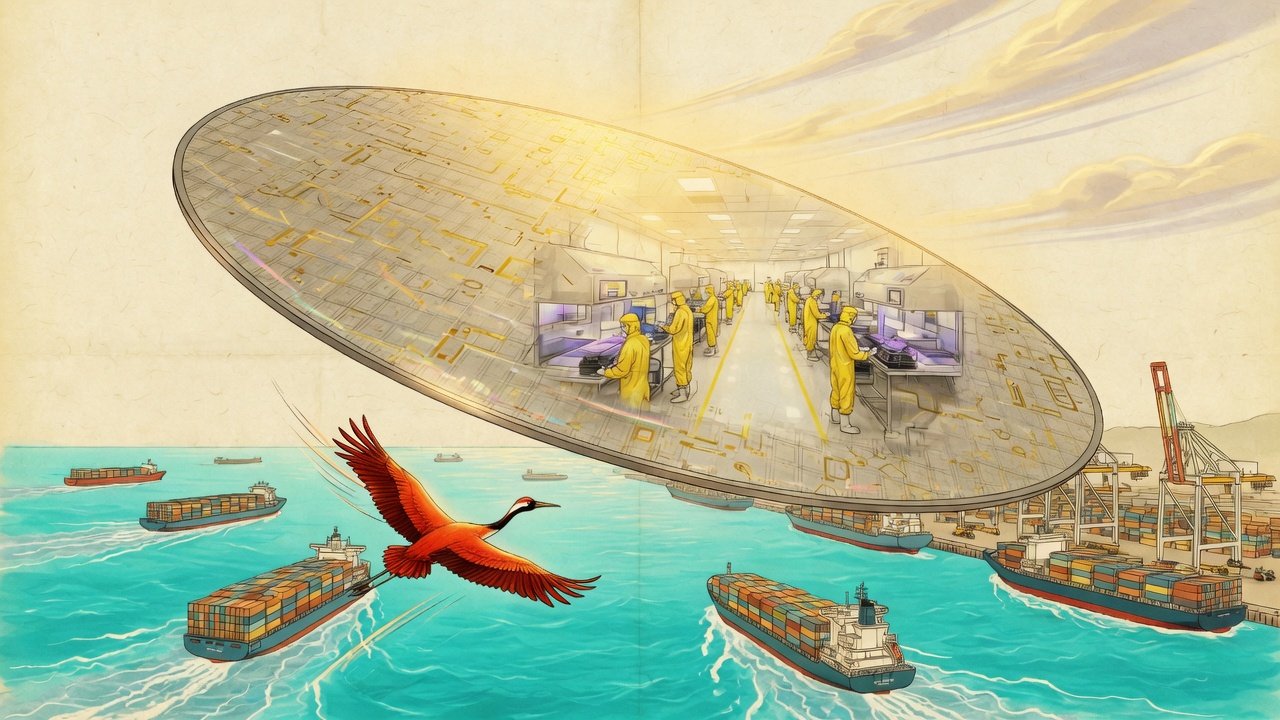
Chris Miller’s Chip War: The Fight for the World’s Most Critical Technology, published by Scribner in 2022, is not a gadget book. It is a political history of a commodity so small that most readers never see it and so concentrated that a handful of firms now sit across the world’s computing, weapons and industrial systems. Miller, an economic historian at the Fletcher School at Tufts University, started from Soviet microelectronics and ended with a claim that has become common sense in Washington, Taipei, Seoul, Tokyo, Eindhoven and Beijing: the rivalry between the United States and China may be decided by computing power, and computing power is made in a supply chain that can be counted on one hand.
The book’s usefulness for a China-watching reader is not that it discovered semiconductors. It is that it puts the industry back into geography. Chips are designed in California, patterned with Dutch machines whose optics come from Germany and whose light sources were born in San Diego, fabricated at scale in Taiwan, packed with Korean memory, assembled into devices in China, and consumed everywhere. Miller’s thesis is that this map is not a neutral efficiency story. It is a sequence of political choices, military purchases, industrial policy, trade wars and corporate bets. Whoever sits on the chokepoints sits on the future. That is a stronger claim than “chips matter.” It is a claim about leverage.
A history of scarcity, not abundance
Miller’s opening move is to reverse a popular intuition. Digital goods feel infinite. Semiconductors are not. Fabricating a leading-edge chip requires capital on a scale that would have been unthinkable to the transistor’s inventors, process knowledge that is still partly tacit, and tools that only one company in the world can build. The industry’s economics are brutal: enormous fixed costs, collapsing unit prices, and a treadmill named after Gordon Moore. Sixty years ago a chip held a handful of transistors. Today a leading processor holds tens of billions. The excitement of that curve, and the precarity of keeping it going, give Chip War its pace.
The book is organised as a long chain of episodes rather than as a treatise. Fairchild, Texas Instruments, Intel, Sony, Samsung, TSMC, ASML, Huawei and the Pentagon appear as characters in a single plot: how a Californian industry became an East Asian manufacturing system, and how that system became a great-power problem. Miller writes in short chapters. The method is journalistic history, built from archives and more than a hundred interviews, not from a formal model of industrial organisation. Readers who want a theory of the firm will not find one. Readers who want to know why a Dutch lithography monopoly and a Taiwanese foundry now sit inside every serious national-security briefing will.
The numbers he uses to set the stakes have been widely quoted because they are designed to be remembered. Chips from Taiwan, he writes, provide 37 percent of the world’s new computing power each year. Two Korean companies produce 44 percent of the world’s memory chips. ASML, in the Netherlands, builds 100 percent of the extreme ultraviolet lithography machines without which the most advanced chips cannot be made. Japan, in his count, still makes about 17 percent of the world’s chips. China, despite years of subsidies, made about 15 percent when he was writing. Those shares move. The structure they describe has not: a few nodes, extreme concentration, and no easy substitute if one of them fails.
Shockley, Fairchild, and the Pentagon as first customer
The American origin story is familiar and still worth retelling in Miller’s register, because he insists that the military was never a sideshow. William Shockley’s transistor work at Bell Labs, the defection of the “traitorous eight” to Fairchild Semiconductor, and the later founding of Intel by Robert Noyce and Gordon Moore are the Valley’s creation myth. Miller adds the customer that made the myth solvent. Early integrated circuits were too expensive for consumer markets. They were cheap enough, and precise enough, for missiles, aircraft and later the Minuteman programme. Texas Instruments and others learned to make chips because the Pentagon would buy them. Precision-guided munitions in Vietnam were not a late militarisation of a civilian industry. They were one of the industry’s founding use cases.
That point matters for the present. When Washington now describes semiconductors as a strategic sector, it is recovering a language it used at the birth of the technology and then half-forgot during the personal-computer boom. Intel’s later alliance with Microsoft made x86 the brain of the PC. The consumer market dwarfed defence. American firms offshored assembly to Hong Kong, Singapore, Malaysia, South Korea and Taiwan in search of wages measured in cents. Charlie Sporck at Fairchild is one of Miller’s agents of that shift. The political theory at the time was that assembly was low value and design was the prize. The later theory, which Miller’s whole book exists to complicate, is that manufacturing process knowledge is itself a prize, and that giving it up is not the same as buying a cheaper shirt.
Intel’s missed iPhone is Miller’s corporate parable. Paul Otellini, then chief executive, later admitted he “couldn’t see” the handset as a chip market worth the margin hit. Apple went to foundries. ARM’s low-power architecture ate the mobile world Intel declined to enter. A generation of computing could be designed in California and fabricated in East Asia without Intel’s factories.
Copying is not catching up: the Soviet lesson
Miller’s Soviet chapters are the book’s least fashionable and among its most useful. Moscow understood early that semiconductors would decide military electronics. It tried to steal and clone American devices rather than build a competitive design-and-process culture. The result, in Miller’s account, was a permanent lag. Espionage can move a blueprint. It cannot move the yield of a fab, the discipline of a process engineer, or the feedback loop between designers and the people who have to print their ideas in silicon. Soviet chips remained behind the leading edge. The Cold War’s computing race was not won by the side with the better slogan about science. It was won by the side that could iterate in volume.
That lesson is now routinely applied to China, sometimes too neatly. Beijing is not 1970s Moscow. It has a huge domestic market, private and mixed-ownership firms, and a talent pipeline that the Soviet Union never possessed. It also has, as Miller notes and as later events confirmed, a structural dependence on foreign tools, software and leading-edge capacity. The Soviet analogy is not “China cannot innovate.” It is that a strategy of substitution by copying, if it remains only that, reproduces yesterday’s node at a penalty. How China is building an AI chip industry around U.S. restrictions is the contemporary version of the same problem: genuine catch-up under constraint, not a clone of Silicon Valley and not a replica of the Soviet dead end.
Japan’s DRAM war, and why it did not become destiny
In the 1980s Japan looked, to American politicians, like the country that would eat Silicon Valley. Japanese firms took DRAM. Quality, capital cost and coordinated industrial policy produced a genuine shock. Washington responded with the Semiconductor Industry Association, trade pressure, and a Pentagon that rediscovered microelectronics as a national-security input. Miller is good on the fear, and equally good on the anticlimax. Japan’s asset bubble burst. The PC-Windows-Intel stack, which Japanese firms did not own, became the mass market that mattered. South Korea, with Samsung, took much of the memory business that Japan had seemed destined to keep. The “Japan as unstoppable chip hegemon” thesis lasted about a decade. That is worth remembering whenever today’s forecasts treat a single national subsidy programme as fate.
The United States defended design, software and, unevenly, equipment. It did not defend commodity memory as a hill to die on. Korean firms and later Taiwanese foundries filled the space. American companies still captured extraordinary rents in design software, core IP and architecture. Miller treats that split as political economy, not conspiracy.
Morris Chang and the foundry that ate the world
The hinge of Chip War is Taiwan. In 1985, after being passed over for the top job at Texas Instruments, Morris Chang was hired by the government in Taipei, with a brief that Miller renders as a blank cheque to build a semiconductor industry. Chang’s idea, which TI had not wanted, was a pure foundry: a factory that would make other companies’ chips and never compete with its customers by designing its own. Philips became a cornerstone investor and transferred process technology. That accident of corporate history later tied TSMC’s fabs to a European equipment ecosystem, including the Dutch firm that would become ASML.
The foundry model looks obvious now. It was not. Integrated device manufacturers, Intel above all, believed that design and fabrication in one house was the source of advantage. Chang bet the opposite: that specialists in process, running at enormous scale for many customers, would out-invest any single product company. Apple, Nvidia, AMD, Qualcomm and a generation of fabless firms proved him right. TSMC’s neutrality was a commercial promise and a geopolitical fact. Customers would not give their crown-jewel designs to a manufacturer that sold competing chips. They would give them to a manufacturer that sold only manufacturing.
By the time Miller is writing, TSMC fabricates on the order of 90 percent of the world’s most advanced processors. Taiwan as a whole, in his formulation, supplies more than a third of new computing power each year. Samsung in Korea is the only other firm in the same conversation at the leading edge, with Intel a generation or two behind after a disastrous decade of process delays. Foxconn built Apple’s floor; TSMC built the world’s silicon is the Huaxia version of the same split: assembly can move; leading-edge logic has not. Miller’s contribution is to show that this was not destiny. It was Chang, state capital, Philips, a customer revolt against Intel’s integration, and two decades of yields that rivals could not match.
ASML, EUV, and the machine that only one country sells
If TSMC is the foundry chokepoint, ASML is the tool chokepoint. Extreme ultraviolet lithography etches features that older deep-ultraviolet light cannot. Miller’s account of EUV is one of the book’s technical successes. The light source is tin plasma. The optics are among the flattest mirrors ever made, from Zeiss in Germany. The lasers come from Trumpf. Crucial source work was done in San Diego. Intel funded much of the early research, then hesitated. ASML, spun out of Philips, assembled the monopoly. A single machine costs hundreds of millions of dollars. There is no second vendor.
This is the opposite of a garage industry. It is a transnational machine that happens to be integrated in Veldhoven. Miller uses it to kill two myths at once. Myth one: “the West” still makes chips the way it makes software, in a cloud of interchangeable firms. Myth two: China, or anyone else, can recreate the stack by throwing money at a national champion. You can subsidise a fab. You cannot, on any relevant timetable, recreate Zeiss’s optics, ASML’s integration skill, and TSMC’s process recipes as if they were modules on a spreadsheet. China’s lithography push is the policy response to that fact, and Miller would recognise it as the predictable behaviour of a state that has read the same map.
The EUV story also explains why export controls have bite. Deny a country the machine and you do not merely slow one factory. You force it onto older light, with more multi-patterning, worse yields and higher cost. That is not a complete blockade of computing. It is a blockade of the cheap, dense, leading-edge computing on which phones, accelerators and some weapons now depend. Miller wrote before the full AI training boom. The logic he describes is why those controls were aimed at tools and advanced logic rather than at every dormitory that assembles a handset.
China in the book: market, copier, and constrained climber
Miller’s China is three things at once, and he is more careful than some of his reviewers. First, it is the world’s largest semiconductor market, the place where phones, base stations and industrial electronics are consumed and assembled. Second, it is a latecomer that tried, through national IC funds and local government parks, to buy its way into fabrication. Third, it is a set of firms, Huawei above all, that moved from selling other people’s chips to designing their own and then discovered, after the 2019 Entity List designation, that design without foreign manufacturing and tools is a stall.
Ren Zhengfei appears as the entrepreneur who understood that telecoms would be a chip business. Huawei’s rise, in Miller’s telling, is not a cartoon of theft. It is a cartoon of dependence revealed. Like every other Chinese electronics firm of its generation, it was “fatally dependent on foreigners to make the chips upon which all modern electronics depend.” The United States still had a stranglehold on silicon, even if it no longer poured the wafers itself. Entity-list pressure converted that stranglehold from a market fact into a policy instrument. The book’s late chapters describe the first rounds of that conversion. They do not describe SMIC’s later DUV workarounds, Huawei’s domestic Kirin returns, or CXMT’s climb in DRAM. Those post-date Miller’s reporting. They do not cancel his structural point. They test how far a constrained climber can go on mature nodes and heroic engineering.
China was never going to stay at the thin end of the smile curve. That is this site’s argument about assembly, batteries and brands. Chip War is the complementary argument about the one layer of the smile that has not moved onshore with the same speed: leading-edge logic and the tools that print it. Made in China 2025 named semiconductors as a core weakness. Dual circulation and the later export-control war made that weakness a national project. Miller’s warning, which Chinese planners would not dispute in private, is that money and engineers are necessary and still not sufficient if the lithography, EDA and speciality chemicals remain elsewhere.
The Taiwan dilemma, without the romance of a shield
The book begins and ends in the Strait. Miller is unimpressed by the comforting idea of a “silicon shield”: the notion that TSMC’s indispensability deters an attack because China, the United States and the rest of the world would all lose too much. He notes that the hypothesis assumes economically rational behaviour in a crisis. That is an assumption, not a law. A blockade, a quarantine, a missile campaign against power and water, or a seizure that cannot operate the fabs, would not be a neat nationalisation of a cash cow. It would be, in his phrase, a disaster whose costs could be measured in the trillions, possibly worse than the Covid shock to supply chains. Everyone is hostage. Hostages are not the same as a security guarantee.
This is the part of Chip War that has aged least. TSMC’s Arizona and Kumamoto projects, Samsung’s Texas plans, and Intel’s foundry rhetoric are attempts to thicken the map. They have not, as of the years after Miller wrote, moved leading-edge volume off the island. Advanced packaging remains tight in the same geography. A Huaxia reader does not need lectures about the politics of cross-Strait relations to see the industrial fact. The world’s new computing power is not a cloud. It is an address.
What the book gets right, and where it stops
Miller is at his best when he treats firms as states’ instruments without treating states as the only actors. TSMC is a corporate machine with yields, customers and a culture of process. It is also a national project. ASML is a listed company. It is also a chokepoint that Dutch and American export-control lawyers can turn. Huawei is a private firm in a political system that does not treat telecoms as private. The book refuses the choice between “it’s just business” and “it’s just geopolitics.” The chip industry is where those two sentences describe the same factories.
He is weaker where the American vantage becomes the plot. Allied industrial policy in Japan, Korea and Taiwan is narrated as it appears from Washington: sometimes as a threat, sometimes as a solution, rarely as a history with its own domestic politics. Chinese technical communities are thinner on the page than American and Taiwanese ones. The 2022 cutoff means the book cannot see the AI accelerator boom that turned Nvidia into a geopolitical object, nor the CHIPS and Science Act’s actual disbursements, nor the European anti-subsidy duties on Chinese electric vehicles that turned “industrial policy” into a transatlantic argument. Those omissions are dates, not errors. They do mean that Chip War should be read as a map of 2022, not as a briefing on 2026.
A second limit is military. Miller is convincing that chips are now as strategic as oil, and more concentrated. He is less interested in how many systems still run on mature nodes, automotive microcontrollers and industrial chips that China can and does make. The leading edge is a chokepoint. It is not the whole of electronics. A war, a blockade or a sanctions regime would smash the leading edge first and then discover, as Covid already did, that the “boring” chips in cars and factories can halt production too. The book’s drama is EUV and TSMC. The world’s bill of materials is wider.
A third limit is political economy inside China. The difference between a private battery champion and a state-owned foundry project is mostly offstage. That is fair if the book is about global chokepoints. It is a gap if the question is why batteries and solar ran ahead of logic chips. Less dependence on a single foreign toolset is part of the answer. Miller’s map predicts that pattern even if he does not linger on it.
How to read it from this site
For Huaxia, Chip War is best read as a prequel. It explains why lithography is a national obsession, why using AI to design chips is a wager on software compensating for tools, and why export controls target ASML and EDA rather than the assembly floor. It also explains why “decoupling” is a slogan that the physical world refuses. You can move a final-assembly line to India or Vietnam faster than you can move a leading-edge recipe. You can ban a machine and still import the device the machine made, until you ban that too. Each turn of the screw makes Miller’s map more, not less, relevant.
The book will not tell you whether Beijing’s industrial policy is legitimate or whether Washington’s is panic. It will tell you that both capitals are behaving as if semiconductors were the resource of the age, and that they are not wrong about the concentration even if they are often wrong about the morality play. Oil could be pumped in many places. Leading-edge silicon is patterned by one company’s light, in a small number of buildings, on an island in a contested sea. That is Miller’s lasting image. It is also, four years on, still the industrial fact that every other argument about AI, weapons and “Made in China” has to walk through.
Read Chip War for the history of how that fact was made. Then read the present as a set of attempts, American, Chinese, Japanese, Korean, Dutch and Taiwanese, to redraw a map that does not want to be redrawn. The attempts will continue. The chokepoints will move slowly, if they move. That is the book’s real prediction, and it did not require a crystal ball. It required looking at who can actually print the next node.