
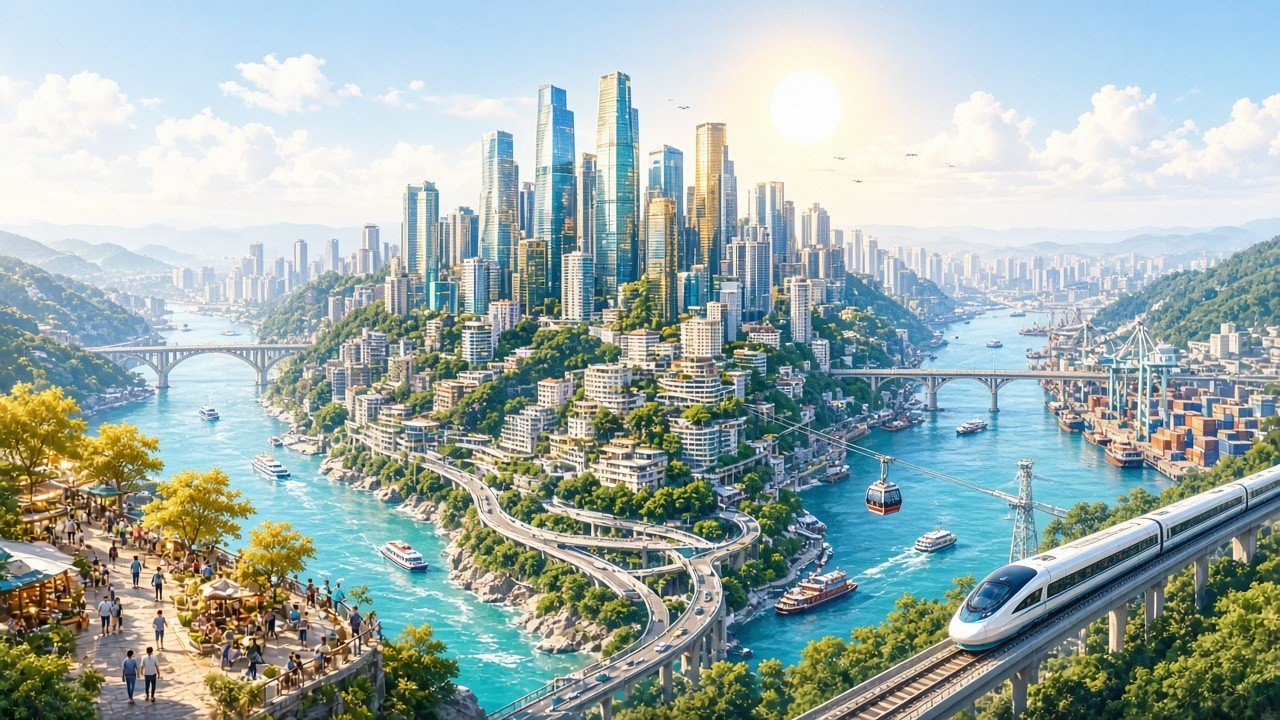
Chongqing is often introduced with a number that sounds impossible: more than thirty million people, an area larger than many countries, skylines that look like science fiction layered onto cliffs. Some of that image is true. Much of it is a category error. Chongqing is a mountain and river city at the confluence of the Yangtze and the Jialing, and it is also a provincial level municipality whose boundaries swallow satellite towns, farming counties, reservoir shores and empty hills. The continuous urban fabric that visitors photograph around Yuzhong and the riverfronts is large and dense. It is not the same thing as the municipality on the map. Sorting those units is the first step toward understanding why Chongqing matters in China’s rise. What follows treats geography, wartime history, the 1997 elevation to municipality status, industrial specialisation, everyday vibrancy and the city’s place beside Chengdu as mechanisms with ordinary evidence, not as slogans.
Rivers, mountains and an inland gateway
The historic core sits where the Jialing joins the Yangtze. Hills force streets into layers, tunnels and bridges. Fog and summer heat are part of the climate story: the city belongs to the humid subtropical belt of the Sichuan Basin’s eastern edge and has long been grouped with Wuhan and Nanjing among the Yangtze “furnace” cities. For traders and administrators, the site was never chosen for comfort. It was chosen because river boats could reach deep inland and because the surrounding basin needed a gateway toward the middle and lower Yangtze.
That gateway function still shapes the municipality. The Yangtze runs hundreds of kilometres through Chongqing’s territory. Upstream lies the agricultural and industrial density of Sichuan. Downstream lie the Three Gorges and, beyond them, the central and eastern Chinese markets that container ships and river freighters serve. Before modern expressways and high speed rail, distance from the coast was a penalty. Chongqing could not copy the Pearl River Delta bargain of same day trucking to a container yard. It could, however, specialise in what rivers, later dams, and still later rail corridors made possible: bulk goods, heavy industry, and eventually high value electronics that could leave by train as well as by water. The municipality also borders Hubei and Hunan to the east, Guizhou to the south and Shaanxi as well as Sichuan to the north, which made it a hinge between southwestern basins and the central Yangtze rather than a closed mountain pocket.
The municipality’s land area is about 82,400 square kilometres, a figure often compared with Austria. That comparison is useful only if it is kept administrative. Inside those borders sit the main urban districts around the confluence, larger outlying cities such as Wanzhou and Fuling, mountain counties, and rural hinterland. A commonly cited built up area of roughly 5,500 square kilometres, with about 9.6 million people on the 2020 built up measure, is already a very large city by world standards. It is still a fraction of the municipality’s land and far below the headline permanent population near thirty two million. Academic work that tries to map physical urban extent from buildings or roads often finds an even tighter footprint measured in the low thousands of square kilometres. Urban permanent population, reported above twenty three million in 2025, is a third category again: it counts people classed as urban across many districts and counties, including places that are towns rather than one joined skyline. When people say Chongqing is “immense,” they are usually mixing the province sized municipality, the urban statistical count, and the continuous core that tourists film at night.
From regional centre to wartime capital
Long before the twentieth century the site mattered as a southwestern stronghold linked to the old state of Ba and later prefectures whose abbreviated name, Yu, still marks the city. In the late Qing it became an inland treaty port after the 1890s opening to foreign trade, though steamer traffic up the Yangtze remained difficult for years. Consulates followed. The commercial pattern was already inland facing: goods moved between basin and river rather than between factory and ocean berth in the Shenzhen sense.
The Second Sino Japanese War made Chongqing nationally famous. After Japanese forces advanced and the government left Nanjing and then Wuhan, the Republic of China used Chongqing as its wartime seat. Operations in the city are commonly dated from late 1937; the formal designation as auxiliary capital, or peidu, came in September 1940. From 1938 onward the city absorbed relocated factories, universities and officials. Japanese air raids were sustained and destructive. Shelters cut into hillsides, fog and distance from the coast all featured in contemporary accounts of survival. Britannica’s older narrative put the wartime urban population above a million from a prewar base well below a quarter of a million, an order of magnitude jump that turned a regional port into a crowded command city. Allied liaison also used the place: after December 1941 it sat inside a wider anti fascist command geography even while remaining far from any seacoast. The episode does not explain today’s laptop plants, but it did harden a political memory: Chongqing could serve as a national rear base when the coast was lost.
After 1949 the city passed through southwest regional administration and then long years as a large city inside Sichuan province. The decisive modern administrative break came on 14 March 1997, when the National People’s Congress approved a new Chongqing Municipality directly under the central government. The former Chongqing city was combined with the Fuling, Wanxian and Qianjiang areas it had already been helping to govern. The new unit held about thirty million people across tens of thousands of square kilometres. The first official ceremony followed on 18 June 1997.
Elevation mattered for two practical reasons. First, provincial level rank put Chongqing on the same political plane as a province, with stronger access to central attention, fiscal channels and, in later years, a Party Secretary who often sat at Politburo level. Second, the timing matched two national projects: western development and the Three Gorges Dam. The reservoir required large scale resettlement and restructuring along the upper Yangtze, with the Chongqing reservoir region bearing a large share of displacement counted in the wider project’s million plus relocatees by the late 2000s. A municipality carved out of eastern Sichuan was designed to manage that burden and to act as a spearhead for inland investment rather than leaving the task inside ordinary prefecture politics. In June 2010 the Liangjiang New Area was established as a national level new area, the third of its kind at the time, adding another preferential zone for manufacturing and services along the two rivers. Chongqing also entered the list of National Central Cities around the same period, a label meant to mark inland hubs that could balance the coastal giants. Administrative rank is not growth by itself. In China’s political economy it is a mechanism that changes which ministries return calls and which industrial parks get labelled national.
Municipality scale beside Chengdu and Shanghai
Official bulletins give the current scale clearly. In 2025 Chongqing’s GDP was 3.376 trillion yuan, up 5.3 percent in real terms. The final verified figure for 2024 was 3.205 trillion yuan, up 5.6 percent. Per capita GDP in 2025 reached about 105,900 yuan. The industrial structure was roughly 6 percent primary, 35 percent secondary and 59 percent tertiary. Permanent residents numbered 31.87 million at year end, of whom 23.27 million were counted as urban, for an urbanisation rate of 73 percent. A year earlier the permanent total had been 31.90 million with 72 percent urbanisation. Natural population growth was negative in both years. Working age adults still form a majority, but people aged sixty and over already exceeded a quarter of the population in the 2024 age breakdown. The municipality is large, industrial and services heavy, and it is also ageing.
Comparisons need unit discipline. Chengdu, a prefecture level city and Sichuan’s capital, reported about 2.476 trillion yuan of GDP and 21.5 million permanent residents in 2025. Chongqing’s municipality totals are larger, yet the comparison is not like for like: Chengdu does not include a province sized rural and industrial hinterland of the same kind. Shanghai, a compact coastal municipality, reported about 5.671 trillion yuan of GDP and 24.9 million permanent residents in 2025. Shanghai is richer in aggregate output and far denser on a much smaller land area. Chongqing’s claim to be “bigger” than many countries usually refers to municipal land or to the thirty million population count. It should not be read as a continuous urban fabric larger than Tokyo or as an economy larger than Shanghai. Local materials for 2025 also note that the Main Urban Area alone produced about 2.65 trillion yuan, or roughly four fifths of the municipality’s GDP. Even inside Chongqing, output concentrates in the core.
Riverfront density and ordinary city life
What visitors call vibrancy is mostly a property of the core, not of every county. Steep slopes pack housing, roads and commerce into vertical stacks. The monorail that runs through a residential block at Liziba became an internet emblem for that packing. Hongya Cave, a rebuilt riverside complex of stilt style commercial floors above the Jialing, supplies the neon postcard. Hotpot restaurants, night markets and late opening streets follow from a food culture that leans heavily on chilli and Sichuan pepper. None of that needs brochure language. Dense riverfront districts create foot traffic; spicy shared pots create long evenings; tourism overlays an older working harbour geometry with lights.
The economic mix underneath is less romantic. Manufacturing still matters, especially vehicles and electronics, while services now contribute most of GDP. Private firms account for a bit over three fifths of output. Migration into the urban districts continues even as the municipality’s natural growth turns negative, which is a common Chinese pattern: people move toward jobs while births fall. In the 2024 age structure, people aged sixteen to fifty nine were about 60 percent of permanent residents, enough to staff factories and services, while those aged sixty and over already exceeded 25 percent. The workforce is still large; it is no longer young in the old coastal migrant sense. The “cyberpunk” label popular on social media is a camera angle on fog, LEDs and layered infrastructure. It is useful as a reminder that Chongqing’s core looks different from a flat coastal export town. It is not a statistical category.
Industry, shipping and western logistics
Chongqing’s industrial identity has several layers. In the 1960s and 1970s China pushed defence and heavy plants into the interior under the Third Front campaign. Sichuan and Chongqing received large transfers of workers and equipment. Steel, machinery, shipbuilding and related trades thickened an inland base that reform later commercialised. Vehicle making became a signature. Changan Automobile, headquartered in the municipality, is one of China’s major car groups. Municipal statistics for 2025 put automobile output at about 2.79 million vehicles, up nearly ten percent, including about 1.30 million new energy vehicles, up more than a third. Company reports put Changan’s own sales near 2.68 million units in 2024 and about 2.91 million in 2025. Motorcycles were an earlier mass export and domestic staple; the “motorcycle capital” reputation is older than the electric car wave but belongs to the same mechanical cluster.
Electronics arrived as a deliberate inland bet. From about 2008 Chongqing officials courted Hewlett Packard; by 2009 plans with Foxconn for large laptop capacity were public, including talk of tens of millions of units of annual capacity aimed heavily at export. Acer, ASUS and a set of Taiwanese original design manufacturers followed, including names such as Quanta, Inventec, Compal, Wistron and Pegatron alongside Foxconn. Local economic commissions later claimed that Chongqing held roughly thirty percent of world laptop output and led global production for several years after 2014, with notebook related output value pushed above 300 billion yuan in pandemic demand years. Those shares and peaks should be treated as local promotional figures, not as audited customs truths. The directional fact is still solid: high volume notebook assembly did move inland when land, labour, supplier parks and logistics packages beat a crowded coast, and the cluster needed a land bridge to Europe if it was to escape pure dependence on coastal ports.
Logistics closed the loop. The Three Gorges project deepened and regularised navigation so that larger vessels could work further upriver, tying Chongqing’s ports more firmly into Yangtze freight. Rail mattered even more for electronics timed to European shelves. In March 2011 the Chongqing to Duisburg freight service, known as Yuxinou, launched what became the pioneer China Europe Railway Express corridor: about 11,200 kilometres via Xinjiang and Central Asia, typically thirteen to sixteen days, faster than sea and cheaper than air. The line was built with laptop exports in mind and later carried a wider mix of machinery, vehicles and parts. By late 2024 Chinese official reporting associated a national milestone, the 100,000th China Europe freight train, with a Chongqing departure toward Duisburg. Belt and Road language followed the tracks; the tracks themselves were a practical answer to inland location.
None of this made Chongqing a second Shenzhen. Coastal export cities still specialise more tightly in processing trade, container turns and supplier density measured in kilometres. Chongqing’s advantage was different: municipality rank, western policy, a river artery improved by the dam, an auto and electronics cluster, and a rail bridge to Europe. The contrast is the point. China’s rise used ports first. It also used inland hubs that could not wait for a seacoast.
Growth, upgrading and hard limits
Recent growth has been steady rather than spectacular. Real GDP rose 5.6 percent in 2024 on the final verified number and 5.3 percent in 2025, with services contributing the larger share of expansion while industry upgraded toward vehicles, especially new energy models, and continued electronics work. Air quality data for 2025 reported 324 days rated good or excellent and an average fine particle reading near 31 micrograms per cubic metre. That is a material improvement on the city’s older reputation for coal smoke and basin haze, not a claim of alpine air. Terrain remains expensive: bridges, tunnels and elevated transit are not optional decorations.
Local public finance is a quieter constraint. Budget materials for recent years have described tight balancing and a high reported government debt stock relative to local fiscal resources, with a 2023 debt figure near 1.23 trillion yuan and a debt ratio cited around 148 percent on the official narrow measure. Across China, hidden financing vehicle debt has forced restructuring, and Chongqing has taken part in that wider clean up rather than standing apart from it. The municipality is not unique in the pressure, and a full audit of off balance liabilities is beyond bulletin arithmetic. The honest point is simpler. A mountain city that builds bridges, industrial parks and western logistics corridors at speed accumulates claims on future revenue. Growth rates in the mid single digits help service those claims. They do not erase them. Demography adds a slow second constraint: permanent population edged down from 2024 to 2025 even while urbanisation rose, which means the labour story is redistribution toward the core more than endless natural increase.
Beside Chengdu without copying Chengdu
Chengdu and Chongqing are routinely paired as western China’s twin engines. Central leaders elevated a Chengdu and Chongqing dual city economic circle in 2020, and the planning outline published in 2021 cast the pair as an inland pole for high quality development. The policy language stresses complementary, differentiated roles rather than a single merged city. In practice the sibling rivalry never disappears. Both court factories, headquarters labels, university talent and tourist attention.
Their specialisms differ in emphasis. Chengdu leans harder on provincial capital functions, universities, digital content, games and a lifestyle brand that retains graduates, alongside electronics packaging. Chongqing leans harder on municipality politics, Yangtze port functions, automobiles and motorcycles, heavier industrial inheritance, and the early China Europe rail corridor. Chengdu’s prefecture level GDP is smaller than Chongqing’s municipality GDP; Chengdu’s urban brand is often softer. Treating them as interchangeable “western megacities” flattens both. Treating Chongqing’s thirty two million people as one streetscape flattens Chongqing itself.
The useful summary is mechanical. Chongqing’s rise rests on a river confluence, wartime capital experience, a 1997 provincial level boundary drawn for western development and Three Gorges management, Third Front industrial skills, vehicle and electronics plants, improved Yangtze access, and a freight railway that shortened the penalty of inland location. The immense numbers are real as municipal statistics and misleading as skyline poetry. Relative to coastal export orthodoxy, Chongqing is another inland chapter: not a seaport miracle, but a deliberately ranked mountain city asked to carry western China’s industrial and logistical weight. Dongguan could live on processing fees beside a harbour. Chongqing had to sell rank, rivers, parks and rail. That assignment explains both the neon photographs and the counties that never appear in them.