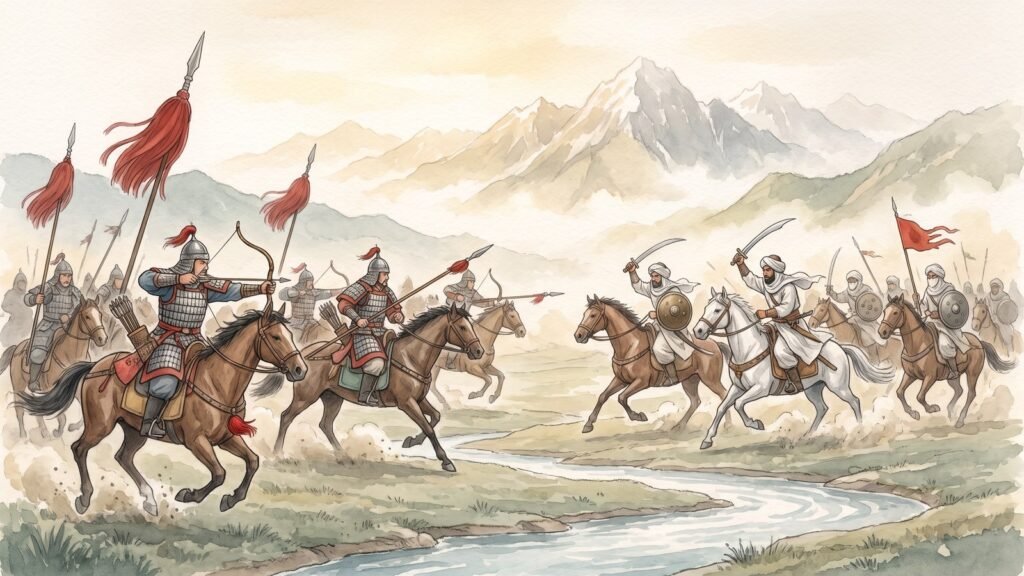
In the summer of 751, somewhere in a river valley north of the Syr Darya, an army of the Tang dynasty of China and an army of the newly proclaimed Abbasid Caliphate fought a battle that, by most accounts, lasted a single day. The Tang general who commanded it had marched west with the best soldiers the empire could find. By the end of the day his army no longer existed as an army, and the western frontier he had come to defend had ceased to be a frontier at all.
The battle of Talas has since been asked to carry a weight far heavier than a day’s fighting. It has been called the moment paper-making passed from China to the Islamic world and onward to Europe, the moment Chinese power in Central Asia ended for good, and the hinge on which the balance of East and West tipped. Some of these claims rest on evidence. Several rest on much later invention. Talas is worth studying precisely because it is both, because a genuine turning point and a manufactured one have grown together around it for thirteen centuries, and because disentangling them tells us a great deal about how the eighth-century Eurasian world was put together and how later generations have wanted to remember it.
Two Empires Facing Each Other Across the Oxus
Almost nothing about the confrontation was inevitable. Twenty years before it, the two powers had been neighbours rather than enemies, and their relationship was complicated by a third, and in some ways more dangerous, empire sitting on top of them all.
Consider first what the Abbasids were in 751. The revolution of 750 that brought them to power had begun, in the conventional telling, among the clients and partisans of the late Umayyads in the eastern provinces, and had been carried by non-Arab troops, Iranian in origin, whose commander Abu Muslim is one of the great contested figures of Islamic history. The Umayyad caliph Marwan II was killed in August 750, and with him the dynasty founded in Damascus ended. What followed was not a smooth transfer of authority but a scramble, in which the victorious Abbasids immediately discovered that they had inherited a legitimacy problem of the first order. Their claim rested on descent from the family of the Prophet, not on conquest, and their support base lay a long way from the old centres of Arab power. Scholars have long argued that the Abbasids solved this problem by redirecting the empire’s energy outward, into a chain of wars against the Byzantines in Anatolia, against the Tang in Central Asia, and later against the Turks on the Oxus. The battle of Talas belongs to that pattern. It was not merely a clash of arms. When al-Mansur took the caliphate in 754, three years after the fighting in the valley, the new ruler’s early coinage carried a formula about peace in the land, and there is a reasonable case that the memory of the eastern victory was folded into it. It was, at least in part, the manufacture of a dynasty’s claim to universal kingship at the far edge of the caliphate, where the frontier armies of Khorasan met an empire that had never before stopped at the Pamirs.
The Tang, for their part, were at the far edge of their own long western push. Their presence in the region was not ancient. The decisive expansion had happened little more than a century earlier, when the campaign against the Western Turks in 657 broke the power of the steppe confederation that had long policed the eastern frontier of Central Asia. In the decades that followed, Tang officials appeared in the oasis states of the Tarim basin, and then, more surprisingly, in the cities of Sogdiana itself. By the early eighth century the empire had a protectorate at Kucha, in the northern Tarim, and a string of fragile arrangements across the mountains: kings installed or confirmed in Kesh and Kang, the Sogdian cities of modern Uzbekistan, whose rulers ruled in the name of the Son of Heaven and paid the sort of homage that later Chinese sources describe with a straight face.
The Arab conquests had already swept through this landscape. In the first decades of the eighth century, Arab armies pushed east across the Oxus, took Merv, and pressed into Transoxiana, the land between the two great rivers. Chinese sources record an Arab attack on the Tang protectorate in the Tarim in 715, and Chinese involvement in the relief of Kang in the early 720s, in which an Arab force withdrew from the region under pressure from a coalition of Tang troops and local allies. Read carefully, these episodes describe an unstable overlap rather than a settled border. Neither empire had the strength to exclude the other, and both were content, at times, to use the other’s presence as leverage against local rulers who preferred to play one side against the other.
What ended that overlap was not the Abbasid revolution but the crisis it created in China. In 755 the general An Lu-shan rebelled against the emperor Xuanzong, and the eight-year revolt that followed nearly destroyed the Tang state. Talas, in other words, happened four years before the catastrophe, and that timing matters enormously. The Tang army that fought in the valley of the Talas River was a Tang army fighting at the far end of a system that was about to break. The same empire that could not hold Luoyang in 756 could hardly be expected to hold the frontier in Transoxiana indefinitely, and it did not try for long.
The third empire is the one most accounts of Talas leave in the background, which is a mistake. The Tibetan Empire under Trisong Detsen was in 750 one of the most formidable states in Asia, stretching from the Tarim across the Tibetan plateau into Yunnan. Tibet had seized the Chinese capital itself in 756, and before that, in 749, had briefly occupied Chang’an, the first time in four centuries that a non-Chinese army had held the city. The Tibetans had absorbed the Tarim basin, they were pressing the Tang frontier along the Hexi corridor, and they were reaching westward into exactly the Pamir region where the Tang and the Abbasids were about to collide. Every side in this drama was, in the broadest sense, fighting for the same high ground, and the Tibetan presence is the reason the eighth century looks like a period of extraordinary pressure on Chinese frontiers everywhere at once.
It is worth adding one more layer of caution before the battle itself. Almost none of our sources are neutral, and none are contemporary in the modern sense. The Chinese histories were compiled a century or more after the events, within a political framework that had every reason to explain defeat in terms of incompetent generals and treacherous allies. The Arabic sources were written under rival caliphs and, in several cases, drew on informants with their own axes to grind. The Tibetan documents, in Tibetan, are only now beginning to yield a full narrative. Anyone who describes the battle with confidence is telling us about the sources as much as about 751.
The Road to Talas and the Karluk Turn
The Tang army that entered the valley in 751 had already been fighting for years. Its commander, Kao Hsien-chih, was a man of remarkable origin and improbable career. He was ethnically Korean, a descendant of the Goguryeo kingdom that the Tang had conquered in the early seventh century, and he had come to adulthood as a captive. He entered Tang service as a soldier, rose through the frontier commands, and by the 740s held the two posts that mattered most for the western campaign: the military governorship of Kucha in the Tarim, and the governorship of Beiting, the headquarters of the northern protectorate. He was, by any measure, the empire’s most experienced frontier commander, and he had spent his career in precisely the region where he was about to lose everything.
His first great success came in 747, when he took the war into the high Pamirs against the so-called Little Bolu, the small Yuezhi principalities that had been raiding the protectorate. The expedition crossed passes that Chinese armies had not crossed in generations, took the ruler of Shughnan and the ruler of Bolu, and extracted promises of submission. It was a remarkable achievement and it produced a particular kind of confidence: the sense that the far west could be disciplined by demonstration. Over the following years Kao extended that policy into Sogdiana. Local rulers who had been friendly to the Tang were replaced or removed, and Tang-backed kings were installed. Later historians have read this as a shift from indirect influence to clumsy direct rule, and the judgement is a plausible one, though the Chinese records are too thin to establish that the policy was consciously abandoned in favour of annexation.
The army that marched west in 751 was large, or at least it was described as large. The standard histories give figures in the tens of thousands, and while such numbers are always inflated, everyone who wrote about the campaign agreed that Kao brought what he regarded as an overwhelming force. He moved through the Tarim, over the Pamirs, and into the Kang valley, and in 751 he encountered Ziyad ibn Salih.
Ziyad was one of the great commanders of the early Abbasid state, and his role has been somewhat overshadowed by that of his patron, Abu Muslim. He had been appointed governor of Khorasan, the Abbasids’ eastern province, and it was from that base that he conducted the campaigns which brought the caliphate’s authority over Transoxiana, which had never been fully secure since the conquests of the 710s. Arabic sources credit him with a string of victories against local rulers and rival claimants, and with the reduction of the Sogdian cities to Abbasid obedience. He appears in the Chinese records under a transcribed form of his name, and the two literatures, Arabic and Chinese, agree on very little beyond his name and his success. On the Arab side the fullest narrative is the chronicle of al-Tabari, supplemented by the conquests of al-Baladhuri, the history of Bukhara compiled by Narshakhi, and the geographical dictionary of Yaqut, all of which preserve the eastern campaigns of the caliphate in fragmentary and secondhand form. By the time the two forces met, Ziyad had assembled an army drawn not only from Arab and Khorasani troops but from the Turkic and Iranian peoples of the region, men who knew the ground and had every reason to prefer a ruler in Merv or Baghdad to a distant emperor in Chang’an.
Between the two armies stood the Karluk.
The Karluk are one of the most consequential and least well-documented peoples in Eurasian history. Originally a constituent part of the Turgesh confederation, they had risen in the eighth century to form a khaganate in their own right, centred on the Zhetysu, the steppe country east of the Syr Darya and north of the Talas. In modern scholarship, Peter Golden’s work on the Central Asian Turks is the place to start, and the later collection of essays on the Turkic peoples that he edited carries the discussion further. That work establishes two things at once: that the Karluk were a coherent and formidable political force, and that our evidence for them is thinner and more oblique than for almost any of their neighbours. Tang sources describe them as having been subjects of the empire at some point in the seventh century, and later, in the eighth, as settled within or near the Tarim frontier, where they were used, as the Chinese liked to say, as military settlers.
This last point is where the battle becomes intelligible. The Karluk had a homeland, and it was not the Tarim. Kao’s campaign had drawn them into orbit of the Chinese frontier, or had at least involved them in a political structure that pushed them there, and they were being asked to fight, far from their own country, against an enemy whose territory they knew better than the Chinese did. When the moment came, they did not fight.
The Chinese account describes a battle fought in stages. There was an engagement in which the two sides closed, and in which the Tang advance held. Then, as the fighting continued, the Karluk moved against the Chinese rear, or against the Chinese flank, and the Tang line came apart. The Arabic accounts agree, with variations and embellishments, that the battle turned on the defection of subject peoples who had been placed in the Chinese line and chose, at the critical moment, to change sides. Modern historians generally accept the substance of both traditions while rejecting the symmetrical confidence with which each narrates the moment of collapse.
Whatever the precise sequence, the outcome was unambiguous. The Tang army was destroyed as a fighting force. A few thousand men, under an officer named Li Cheng-shi, were able to re-form, to begin with, into something coherent enough to fight their way back to the Tarim. The Chinese records report that Kao himself returned, and that he did so under circumstances that led to his disgrace and, eventually, to his execution. Whether the defeat in Transoxiana was really what killed his career, or whether the disasters of 755 and 756 simply removed the political protection he had enjoyed, is a question the sources cannot settle. It is a reminder that careers in the Tang state, like careers in most imperial states, were made and unmade by proximity to the throne as much as by competence in the field.
It is worth being precise about what Talas was not. It was not the meeting of two great civilisations, and neither army was, in any meaningful sense, representative of one. The Abbasid force was a provincial army of a caliphate whose real centres of gravity were in Iraq and Syria, assembled on the far frontier for a war its commanders understood in local terms. The Tang force was an expeditionary army drawn from a mixed empire, operating four years before the beginning of its civil war. The decisive actors were neither, or at least not primarily. The battle was decided in the mountains by peoples who wanted neither empire to have the valley.
Even the location is approximate. The Talas river rises in the Talas range in present-day Kyrgyzstan and flows north-west through the Talas valley toward the Syr Darya, near the Kyrgyz-Kazakh border. Nobody knows precisely where the army of Kao fought the army of Ziyad, and the identification of the site has moved as understanding of the frontier geography has improved. What is striking, and what was not obvious until excavations conducted in the region in the early twenty-first century and reported by Zaydin and Muminov, is that the valley contains Karluk-period warrior burials, grave goods including gold bracteates inscribed in scripts associated with Sogdian and Arabic-speaking communities, dating to the period immediately surrounding the battle. Archaeology does not resolve the ancient argument. It does show that the valley was a place where very different communities met, and met violently.
Captives, Paper, and the Myth of the Transfer
Of all the things that are supposed to have happened at Talas, none has had a longer afterlife than the story of the paper-makers.
The story is well known. Chinese papermakers were captured at Talas and carried off to Samarkand, where they were set to work, and where they taught the craft to the local population. Samarkand became a paper city, and the technique travelled from there westward through the Islamic world to Europe. The reference to captured Chinese craftsmen at Samarkand is so widely repeated, in textbooks and popular histories, that it has the status of a fact rather than a claim. It is, however, a claim, and a claim with a documented history of its own.
The classical source is an eleventh-century Arabic scholar, al-Tha’alibi, who reported that the first paper mill in the Islamic world was established by Chinese prisoners of war at Samarkand. Al-Tha’alibi was writing roughly three hundred years after the battle he was describing, in a work that was explicitly a compilation of anecdotes about the customs of earlier peoples, and in a genre that had its own logic: the story of how the Muslims, as inheritors of the ancient world, had acquired the refinements of the civilisations they had conquered. Read in that context, the paper story is doing specific work. It is a claim about Muslim mastery of the ancients, told through the figure of the imported craftsman, and its plausibility at the time had little to do with the events of 751.
The physical evidence points a different way. The earliest Arabic paper documents that can be securely dated belong to the eighth century, before the battle or around it, and the growth of paper in Abbasid lands looks like the ordinary diffusion of a craft along trade routes by people who move for a living, rather than the sudden transplantation of a secret by prisoners of war. Paper had a long prior history in China, but it had also had a long prior history of gradual transmission, and the eastern Islamic world had commercial and religious contacts with China that predate 751 by centuries. Crafts travel with merchants, monks, artisans and administrators. They travel with captives too, but captives are not the only mechanism, and historians who find the mechanism elsewhere need better evidence for the prisoner story than a late anecdote.
This is not a fringe position. The paper transfer has been reassessed in the economic history of Tang China, where Hans Ulrich Vogel has argued that the spread of papermaking was a long, gradual and largely undocumented process rather than a single transfer event, and in the broader literature on the Silk Roads, where scholars working on Central Asian material culture have tended to replace a single dramatic episode with a long and complicated exchange. Peter Golden’s survey of the idea of China in the Silk Roads volume puts the same point in a wider frame. The specific claim that a battle in 751 handed paper-making to the Islamic world is difficult to sustain. What can be sustained is the more general and more interesting claim that the eighth century was the period in which paper, and with it the bureaucratic and literary cultures that paper makes possible, moved decisively into the world of Islam, and that this was a process, not an episode.
It is worth setting the paper story beside a second, more solid piece of the same picture. Chinese and Central Asian finds show that Chinese ceramic wares were being exported westward throughout the eighth century, and that they were being exported to exactly the places the story of Talas points to: the great commercial cities of Islamic Central Asia and Iraq, and the markets of the Mediterranean. The wares in question are the robust stonewares of the kind produced in the kilns of the south and south-east, the high-fired, soot-coloured ceramics that were cheap, durable and easy to stack. Islamic potters saw them, handled them, imitated them, and improved on them, developing their own traditions in the centuries that followed, in which Chinese shapes and Chinese glazes, in a sequence that Valerie Hansen and others have traced, are an influence but never the whole story. The cobalt-blue-and-white porcelain that everyone associates with the meeting of the two traditions is a much later arrival, a product of the Mongol period and the fourteenth century, and it is a separate story that should not be folded back into 751.
The transmission of technology between the two worlds was not in any case a one-way process. The Abbasid world was the more advanced metallurgical civilisation of the period, and Chinese sources of the eighth century show considerable interest in western fighting methods and equipment. What travelled west from China was, above all, the enormous and complicated infrastructure of statecraft that the Tang had spent eight centuries building: paper administration, standardised coinage, the bureaucratic register, the register of households. What travelled east was the enormous and complicated infrastructure of a commercial empire that connected the Oxus to the Mediterranean: the coinage, the credit, the professional military households of Khorasan and Syria, the administrative habits that came with them.
Captives, meanwhile, were simply part of how war worked. Both sides took prisoners, both sides used them, and both sides occasionally returned them. The Chinese records make clear enough that men were taken at Talas; they say nothing that would allow anyone to count the craftsmen among them, or to show that any of them were set to work in Samarkand. The prisoner story is therefore not a story that the evidence contradicts. It is a story the evidence has never supported.
This distinction matters, because the paper story does not stay a story about paper. It has become a general explanation of the eighth century: a moment at which the East gave something to the West and then withdrew, a technical contribution that travelled on while Chinese political influence did not. It is a beguiling shape, and its appeal is obvious. But the history of technology is a history of slow, cumulative, and often reversible movement, and the evidence for it is scattered across excavation reports, documents in four languages, and the chemical analysis of fibres and glazes, not across the accounts of a single day of fighting. To tell that history, Talas is not where one should start. If anything, Talas is a good illustration of how a small and complicated event gets recruited, centuries later, to carry an argument about a very large thing.
Tibet, Memory, and the Uses of a Turning Point
What happened next is the part of the story that is most often left out, and it is the part that makes the mid-eighth century intelligible.
Talas removed the Tang from Transoxiana. It did not remove them from Central Asia, because Central Asia in these decades was above all Tibetan country. As Christopher Beckwith’s study of the Tibetan presence in Central Asia shows, the Tibetan Empire had taken the Tarim basin, and the Tang, once they had survived the An Lu-shan revolt, were in no position to take it back; the protectorate at Kucha was effectively abandoned in the last decades of the eighth century, and when the Tang finally reasserted themselves along the Hexi corridor at the end of the century, it was into a region the Tibetans had spent fifty years absorbing. Tibet pushed west into the Hindu Kush, and the Tibetans and the Arabs came into contact with each other in the plains of the Indus, where sources as late and as distant as the Bower Manuscript, a Sanskrit manuscript from the north-west India, record an encounter between the two powers in the years shortly after Talas. That manuscript, discovered in the twentieth century in what is now Pakistan, is one of the few documents that treats the eighth-century confrontation of China, Tibet and Islam as a single event rather than three separate stories.
The Tibetans were, in other words, the winners of the mid-century collapse of the Chinese western position, and they knew it. Their empire now faced the caliphate across a frontier no one else was contesting, and the diplomatic exchanges between the two are recorded, obliquely, in both Tibetan and Arabic sources. A letter attributed to a Tibetan ruler, transmitted through Arabic intermediaries in the middle of the century, describes the Tibetans as a people of the west who had heard of the Franks and the Rum, which tells the reader as much about the geography of the letter’s writer as about the letter. These are documents in which everyone is reporting someone else, and they have to be read with exactly the scepticism that their preservation deserves.
The second question is how the battle has been remembered, and the answer differs sharply between the places that fought it. In the Chinese tradition, Talas is a defeat, recorded in the standard histories within the biography of a general, and it is remembered as one of several frontier disasters that marked the decline of the Tang western campaigns. The histories are not indifferent to it, but they do not treat it as a civilisational turning point. It was a campaign that went wrong, in a period when campaigns went wrong, and the moral the histories draw is about leadership and about the folly of trusting foreign auxiliaries, not about the fate of a world.
That framing is not the only one. An article by Hugh Scott published in 1954 in the Journal of the Royal Central Asian Society set the Chinese and Arabic narratives side by side and tried to weigh them against each other, and it marks an early stage in the conversion of this battle into an object of historical study rather than a piece of frontier grievance. In the wider English-language literature of the nineteenth and twentieth centuries Talas became something much larger. It was the moment Chinese power in Central Asia ended, and therefore the moment the balance of East and West tilted, and therefore the hinge on which the modern world turned. The framing was attractive precisely because it was simple, and it was attractive to writers living in a century in which the question of whether China would become a great power was the defining question of world politics. The paper story travelled with it, because the paper story made the same argument in miniature: a single battle, a single transfer, a single hinge.
Both readings are worth resisting to some degree. Talas was not the end of Chinese interest in Central Asia, which persisted in trade and in embassies long after the military presence had gone, and it was not the moment at which the East ceased to matter to the West, which is a claim no historian of the period would seriously make. What Talas was, was the end of one particular kind of Chinese power in Central Asia: the power of the expeditionary army, projected eight thousand kilometres from its base, sustained by local allies whose loyalty was a function of their own interests. It was the end of an empire’s reach into a region it could dominate when it was winning and could not afford when it was not.
Which is the lesson people draw from it today, when they draw it at all. The Belt and Road Initiative, launched in 2013, has been compared to the Silk Road and to the Tang presence in Central Asia so often that the comparison has become a genre. There are genuine points of contact. Both are periods in which a Chinese state projects power and interest far beyond its own borders, into a Central Asia whose other great powers have their own claims on it. Both involve the argument, in public, that the restoration of a route across Eurasia serves everybody’s interests. Both involve the reality that the further such a project goes from the Chinese centre, the more it depends on the consent of local states and on the acquiescence of the powers that have been in Central Asia for a very long time.
There are also differences that matter more than the similarities. The Tang state was a premodern empire whose reach was limited by what its armies could march to and what its couriers could reach, and which maintained its frontier order through tribute, hostages and garrison towns. A modern state has a global financial system, a global shipping industry, and a balance sheet on which such ventures can be financed, and diplomatic instruments that premodern states did not possess. The comparison becomes useful only if it is used to ask questions, such as what happens when the distance between the centre and the frontier grows, and what happens when local allies recalculate. It becomes misleading the moment it is used to suggest that the present is a repetition of the past, or that history offers a verdict on anyone’s foreign policy.
The Karluk are the most useful part of the comparison, and they are also the most frequently forgotten. At Talas, the decisive actor was not the Tang and not the Abbasids but a people who had been brought into someone else’s orbit, who had their own reasons, and who chose their own moment to act. Almost every account of the battle, whether Chinese, Arabic or modern, has a version of that moment, and almost every version has been shaped by the writer’s assumptions about who actually decides the fate of a frontier. The peoples of Central Asia, in that reading, are not the terrain on which the great powers collide. They are the ones who decide.
Which returns us to the papermakers, and to the reason this battle is worth an essay rather than a paragraph. Talas was a small thing. A few thousand men died in a valley. The strategic consequences were real but limited: one empire withdrew from one region, and another consolidated a frontier it had been contesting. The historical consequences were larger and less certain, because a battle is never only itself. It is a story that later writers use to make an argument about the rise and fall of empires, about the movement of technologies, about the relationship between the steppe and the sown, about the character of China and the character of Islam. Those arguments are worth having. They should just not be smuggled in through a story that the evidence does not quite support.
References
- The Old Book of Tang (Jiu Tang Shu) — compiled by Liu Xu and others, 945; Zhonghua shuju critical edition, Beijing, 1975 (in Chinese).
- The New Book of Tang (Xin Tang Shu) — compiled by Ouyang Xiu and Song Qi, 1060; Zhonghua shuju critical edition, Beijing, 1975 (in Chinese).
- The History of al-Tabari, Volume 3: Ancient Times — Abu Ja’far al-Tabari, translated by H. Albert C. Bosanquet, SUNY Press, 1988.
- Kitab Futuh al-Buldan (Conquests of the Countries) — al-Baladhuri, edited by de Goeje, Leiden, 1866; English translation by M. A. Shah, Calcutta, 1911.
- The History of Bukhara (Narshakhi) — Muhammad ibn Mahmud Narshakhi, translated from the Persian by R. N. Frye, Encyclopaedia Iranica, 1972.
- Mujam al-Buldan (Dictionary of Countries), s.v. Samarkand and Talas — Yaqut al-Hamawi, completed 1228; ed. W. Wustenfeld, Leipzig, 1866-73.
- Chinese and Arabic Sources on the Battle of Talas (751) — Hugh Scott, Journal of the Royal Central Asian Society, vol. 41, 1954. Bound volume held at the Royal Asiatic Society Library, London.
- The Background of the Rebellion of An Lu-shan — Edwin G. Pulleyblank, Oriental Series 35, Brill, Leiden, 1955.
- An Introduction to the History of the Central Asian Turks — Peter B. Golden, Cambridge University Press, 1999.
- The Karluk Khaganate and the Kalach People — Peter B. Golden, in Studies on Central Asian Turkic Peoples, ed. Peter B. Golden, Cambridge University Press, 2009.
- Sui-Tang China and Its Turko-Mongol Neighbours — Jonathan Karam Skaff, Brill, Leiden, 2003.
- The Tibetan Empire in Central Asia — Christopher I. Beckwith, University of California Press, 1984.
- Tibet and Central Asia: Being a Record of the Missions of G. B. Mainwaring and George Hayward to Gilgit and Kashmir in 1891 and 1892 — Frederick Drew and George Hayward, edited by Charles A. Bell, London, 1897.
- The Open Empire: A History of China to 1800 — Valerie Hansen, W. W. Norton, 2012.
- Toward a History of Paper and Paper-Making in Eurasia — edited by Hidemichi Tanaka, Brill, Leiden, 2012, including Hans Ulrich Vogel on the early history of Chinese paper.
- Trade, Travel, War and Faith: The Silk Roads in World History — edited by Valerie Hansen, Northern Illinois University Press, 2006, including Peter B. Golden, “The Myth of China”.
- Life along the Silk Road — Stephen Whitfield, 2nd edition, Reaktion Books, 2015.
- The Antiquity of the Silk Road: A Reappraisal — Stephen Peacock, in The Silk Roads: Trade, Travel, War and Faith, Northern Illinois University Press, 2006.
- Treasures of the Silk Road — Zoltan Sarraf, British Museum Press, 2012.
- On the Eve of the Battle of Talas: Archaeology of the Karluks — Alexander Zaydin and Farhod Muminov, proceedings of the International Conference on Turkic Studies, 2003; excavations in the Talas valley reported in the associated site reports.
- T’oung Pao: A Review of Sinological Studies — journal, Leiden: Brill; archive of articles on Tang frontier history and Chinese-Western Asian contacts.
- Journal of Chinese History — journal, Cambridge University Press; archive of articles on Tang and Central Asian frontier studies.
- About the Silk Roads Programme — UNESCO, Paris, current digital edition.
- The Royal Asiatic Society Library, London — holding institution for the bound Journal of the Royal Central Asian Society, vol. 41, 1954.
- The British Library: Central Asian and Chinese manuscripts — holding institution for Dunhuang and Central Asian material relevant to Tang western expansion.