In 81 BCE, in a palace at Chang’an, scholars summoned from the provinces by the regent Huo Guang argued with the senior officials of Emperor Wu’s dead government about who should make money from salt and iron. Almost nobody expected the argument to survive. That it did, in a short book called the Yan Tie Lun, the Discourses on Salt and Iron, is one of the accidents of history on which a great deal of our understanding of the early Chinese empire rests.
It is also one of the easier texts to misread. The Salt and Iron Debate is now routinely summoned as though it were a dress rehearsal for a modern quarrel between free marketeers and state socialists, with the Confucians standing in for one side and the technocrats for the other. That reading is easy to remember and almost entirely wrong. Nothing in the text suggests that anyone present was arguing about liberty, or socialism, or the modern state. They were arguing about a specific and urgent question, and the positions they took make sense only inside the world that produced them.
The question was this. For most of the Han dynasty the state had governed by an ideal of deliberate non-interference, the principle called wu wei. Under that bargain, salt and iron were made by private households and the throne collected a modest land tax. Then Emperor Wu, who reigned fifty-four years, reversed the arrangement. He nationalised the mint, the salt pans and the furnaces, instituted a price stabilisation scheme and taxed private capital. He needed the money, and he needed it for the war against the Xiongnu. The question put to the scholars of 81 BCE was whether to go on doing it.
The two answers were both serious, and both are still serious. The reformers held that a state which competes with its people for profit has misunderstood its own purpose, and they offered a theory of legitimate government grounded in what the ruler owes his subjects. Their opponents held that an empire under sustained military pressure cannot safely assume that private wealth will remain peaceful, well made and evenly spread, and they offered a theory of the state as an instrument of war and coordination. That is not a debate between left and right. It is a debate between two defensible visions of what the state is for.
Before going further, one piece of vocabulary deserves clearing up, because the standard English label for the pro-monopoly faction is misleading. Those officials are routinely called the modernists. The word is a scholarly convenience, and it refers only to their identification as advocates of Emperor Wu’s activist, Legalist-inflected economic programme. It does not suggest that they were modern in any other sense. They were Han courtiers of the first century BCE. They read the same classics, spoke the same language, and were as Confucian in their moral formation as their opponents, even though their prescription for the state looks, from a distance, uncannily like a programme of state-led industrial policy.
The Bargain and Its Undoing
The early Han state was small on purpose. The founding emperors governed under wu wei, a term translatable as non-action or effortless action, which in a political context denotes an ideal of spontaneous and non-aggressive rule. This was not anarchism. There was still a bureaucracy, a nobility, a penal code and a functioning coin economy. But the economic policy of the state was deliberately hands-off, in a way later generations found almost impossible to credit.
The fiscal record of the early decades is startling if you are used to governing through tax. The land tax on agricultural production was reduced in 168 BCE from one-fifteenth of the crop yield to one-thirtieth, and abolished outright the following year, before being reinstated in 156 at the lower rate. The labour service owed by peasants was cut from one month every year to one month every three years. The Qin taxes on salt and similar commodities were removed. The government had money and declined, in effect, to ask for more of it.
Coinage was private too. The founding emperor Gaozu closed the government mints in favour of coin currency struck by the private sector, and although private minting was briefly abolished in 186 BCE it was permitted again from 175 under Emperor Wen. The state’s posture towards money began as one of refusal.
Merchants and industrialists prospered out of all proportion to their legal standing. Merchant families had always been politically suspect; the early Han legislated against them, levying higher commercial taxes, forbidding them to wear silk and barring their descendants from office. The laws were hard to enforce, and the wealthiest men in the empire in the early second century BCE were the merchants who produced and distributed salt and iron. The sources describe their fortunes as rivalling the annual tax revenues collected by the imperial court.
Those fortunes were not abstract. A single salt or iron industrialist could employ more than a thousand peasants to work liquid brine, sea salt, rock salt or iron ore. This was not an assembly line. It was a company town in everything but name: a master who owned the pans or the furnace, a workforce of dependents, and a ledger. The numbers matter constitutionally. A government that depended for its tax revenue and its military manpower on small landholders could not be relaxed about men who commanded a thousand other men for their own profit.
What these industrialists did with their money made them more alarming still. Having made their fortunes in trade, they invested in land, becoming great landowners as well as manufacturers. Land in the post-Qin world could be bought and sold, and the rich bought. Small owner-cultivators, the fiscal and military base of the state, could slip into debt through a bad harvest and sell their fields, their houses, and eventually their children, ending as tenants or hired hands on estates they had once worked themselves.
An official of the mid-second century BCE named Chao Cuo did the arithmetic that later administrators loved to quote: if an independent family of five could cultivate no more than about four and a half hectares and produce no more than about two thousand litres of grain in a year, then natural disaster and ordinary taxation would together force them into debt. It is a reminder that wu wei was a doctrine of restraint applied to a peasantry living close to the edge.
None of this is a story about a rich state. It is a story about a small state with a narrow revenue base, a population that could not easily be taxed harder, and a northern frontier across which a nomadic confederation periodically came south. The bargain of the first seventy years was coherent under those conditions, precisely because the empire had not yet asked anything of it that money could not otherwise supply.
What changed was not the philosophy. The Xiongnu changed. And once the empire began asking for sustained military expenditure on a scale no tax rise could fund, the whole architecture of deliberate non-interference came apart at once, leaving the state to find a revenue base that did not depend on the goodwill of the people it governed.
Emperor Wu took the throne in 141 BCE and held it fifty-four years, a span unmatched among Han emperors of any ethnicity until the Kangxi emperor. His reign produced the greatest territorial expansion in the dynasty’s history, from the Fergana valley in the west to northern Korea in the east and northern Vietnam in the south. The finance for all of this had to come from somewhere, and at first it came from nowhere.
By the middle of the reign the campaigns against the Xiongnu had drained the reserves built up by his predecessors, and the court entered what amounts to a fiscal crisis. The instinctive response, taxing the peasantry harder, risked the one asset the state could not afford to lose: a healthy population of registered smallholders who could be assessed, conscripted and sent to work on the walls. In 120 BCE the Minister of Agriculture Zheng Dangshi proposed the alternative. State monopolies on iron and salt, with two powerful salt and iron magnates brought into government service to administer them nationally. It was an attempt to solve the crisis by recruiting the people who knew how to do the work, not by substituting state agents for them.
Sang Hongyang, an official the emperor had assigned to assist those two magnates in planning, is the most important person in this story and the one we know least about. He was born around 152 BCE at Luoyang, one of the dynasty’s major commercial centres, into a family of merchants, and in youth was noted for mathematical skill. When Wu ascended in 141 BCE he came to the emperor’s notice, and at thirteen by East Asian reckoning he was invited to become a Palace Attendant, remaining in that post for twenty-six years. That appointment tells you what sort of man was about to run the state’s finances. Sang was not a Confucian scholar. He was a merchant’s son with a talent for figures, admitted to the palace, where attendants were a normal route into government service.
The salt and iron industries were nationalised by 117 BCE. Coinage was centralised alongside them: the commandery mints were closed, and from 119 BCE the government issued the bronze wushu, a coin of about three grams that remained the standard currency of China until the Tang dynasty seven hundred years later. The government had experimented before with a lighter coin and with token notes of embroidered white deerskin of very high face value. The wushu was the version that stuck, which says something about how thoroughly the state’s grip on money was tightened.
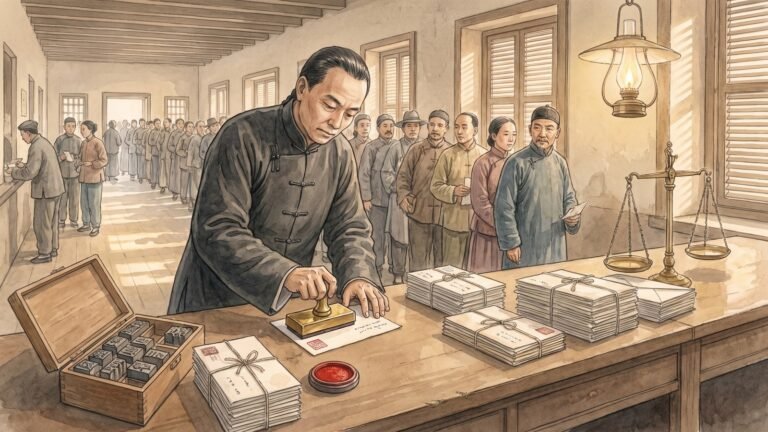
Then came the price stabilisation scheme, established in 110 BCE and designed by Sang Hongyang. Government bought grain when it was plentiful and cheap, stored it in granaries or shipped it to districts where it was scarce, and released it at a standard price. The intent was to suppress speculation, level prices across the empire and produce revenue. Merchants who disliked it disliked it for a specific reason: Sang placed government officials in the market stalls. The state was no longer regulating commerce. It was competing with it, with its own hand on the scales.
The asset tax came alongside. Tax was assessed on the property of merchants, artisans, bankers and owners of carriages and boats, and in 119 BCE the merchant rate was raised sharply, from 120 coins for every ten thousand coins-worth of property to 120 coins for every two thousand. Smallholders were charged at half the official rate, which is how the government could claim, with some justice, that it was not taxing the peasantry to fight the frontier.
The enforcement was harsher than the principle. Concealing assets or misreporting their value became punishable by confiscation and exile to the borders for a year, and citizens were encouraged to report one another, half of every confiscated property going to the informer. A government claiming to take from the wealthy was building an apparatus for mobilising its own subjects against them, and one that could not distinguish between a merchant who had hoarded and a village ruined by weather: both arrived at the same district office with the same deficiency on the register.
What the money bought was real. It paid for the campaigns that broke the Xiongnu confederacy’s ability to raid the northern plain, for the embassy Zhang Qian sent into the Western Regions in 139 BCE seeking allies against them, and for the colonisation of the Hexi Corridor. The corridor was the narrow strip of relatively arable plain west of the Yellow River’s Ordos loop, a string of oases along the northern foot of the Qilian Mountains linking China proper to the oasis states of Central Asia, which became the spine of the northern Silk Road. In the 120s BCE the state put some six hundred thousand settlers onto government land there, lending them seed, animals and tools.
The Regent’s Question
Emperor Wu died in 87 BCE. His successor was his youngest son, Liu Fuling, Emperor Zhao, who was eight years old by East Asian reckoning. Real power passed to Huo Guang, a palace aide to the old emperor and younger half-brother of the general Huo Qubing, who became principal co-regent and, through political skill and the installation of loyalists in key posts, the dominant state official for the next two decades.
Zhao’s reign of thirteen years, ended by his death at twenty in 74 BCE, was in its way a partial refutation of the reformers. The old emperor’s constant warfare had depleted the empire’s coffers, and under Huo’s tutelage the boy emperor lowered taxes and reduced government spending. The sources report that citizens prospered and the dynasty enjoyed a period of peace. The monopolies stayed in place. Peace did not, on this evidence, require their abolition.
It was Huo Guang, not the child emperor, who called the scholars. That detail gives the debate its shape. A boy on the throne cannot commission a defence of policy, and a regent securing his own position has every reason to hear the loudest criticisms of his late master’s treasury, provided the criticism ends before the treasury does. The conference was not convened to reverse Emperor Wu’s policies. It was convened to find out what a critical assessment of them looked like.
The summons went out across the empire to its scholars. Provincial Confucian officials and learned men of the kind the Han would later formalise as a class of scholar-officials were invited to the capital to state their objections, and the delegates who attended arrived in two groups. On one side stood the literati, who had come to make the moral and administrative case against the monopolies. On the other stood the officials of the central government, who had to answer them, led by the man who had designed the policy.
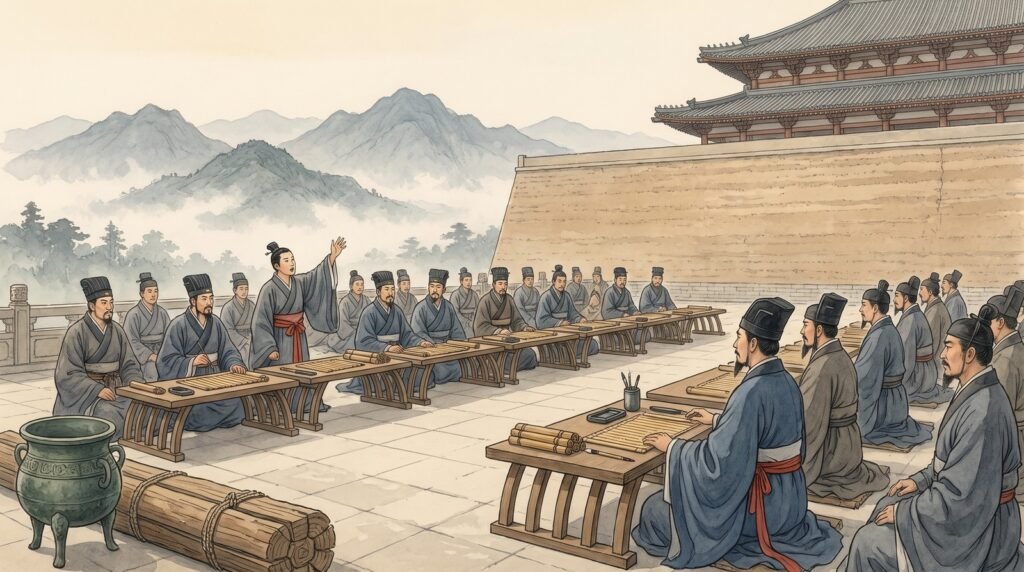
We should be careful about the room, because almost nothing about it is recorded. The text does not describe the hall, the seating or the faces, and it does not say how many scholars came or how long the sessions ran. Anyone offering a vivid reconstruction is reconstructing. What can honestly be said is that Han documents were written on bamboo strips and read in sequence, and that a text arranged as a long sequence of speeches, objections and replies has the shape a formal conference takes when someone writes it down for circulation.
What the record does establish, and what is most worth knowing, is that the scholars were not silenced and not permitted to speak only briefly. They hold the floor for substantial stretches, they are answered point by point, and the replies are given at comparable length by officials of real standing. Whatever the etiquette was, this was not an audience before which a provincial Confucian could be waved away. The regent wanted their objections recorded.
That willingness is easier to explain once you see how strange the social position of the literati was. These were provincial men, many with a formal education in the classics and little else, arriving in a capital of some hundreds of thousands dominated by court ritual, palace service, military households and the buying and selling of office. Their authority was entirely intellectual in a city where influence ran through proximity. The awkwardness of their position is implicit in the moral register they use: they speak about obligations while the men opposite them speak about revenues.
The Arguments, Properly Stated
It is tempting to treat this as a debate about one question, whether the salt and iron industries should be state-owned. It was not. Ownership was where the argument surfaced. Underneath it, the two parties held incompatible views about what the state was for, and nearly every particular disagreement falls out of that deeper disagreement. To state the positions properly means to give each side the case its own adherents thought they were making.
The reformers’ central principle is compact and famous: the state should not compete with the people for profit. The proposition is often mistranslated into a claim for economic freedom, but that is not what it says. It is a claim about proper activity. Mercantile ventures were not among the things the state was fitted to do, and in entering them it entered as a competitor to its own subjects, producing goods in order to sell them and making its fiscal health depend on outbidding the people it governed. The reformers were not asking for the state’s retreat from the economy. They were asking it to stop a particular kind of commerce.
Their strongest practical argument was about quality. Private smelting, organised in small family enterprises, produced better implements, in their view, because of the pride of workmanship of the maker and because the workshop stood close to the user. A man who knows what his neighbours need, and whose reputation travels with him, makes the ploughshare that suits the soil of his own district. This is an argument about information, about incentives, and about the distance between decision and consequence, and it remains recognisable long after the specific tools have changed.
Against that they set the state workshop, whose output was, in their description, large, impractical, made to satisfy a quota rather than to be used, and inferior in quality. The peasant had to pay for it regardless. A man does not need a plough of a particular shape and weight; he needs a plough that works, and a state that produces iron by counting rather than by using will produce iron that is counted. The reformers were not merely complaining about shoddy goods. They were describing an organisation in which the only signal reaching the producer was a number set by an official in the capital.
The related charge was that the monopolies could not coordinate production to match local need. Every commandery required a different quantity and a different specification of iron, and the apparatus had no mechanism for learning them. Some districts overproduced and were left with a surplus the state then compelled peasants to buy, in a place where nobody wanted that much iron and everybody needed a little more. A centralised plan without local information produces mountains of the wrong thing beside shortages of the right thing.
The deepest challenge, though, was to the foreign policy itself. Here the reformers did not concede the premises. They held that the aggressive campaigns against the Xiongnu had weakened rather than strengthened the empire, and that the costs of the northern war did not justify the benefits obtained from it. This is the point at which the debate stops being administrative and becomes dangerous, because it says that the central achievement of Emperor Wu’s reign was not worth what it cost.
That critique was made in a moral register rather than an economic one. The vocabulary the reformers reached for was the classical one of loyalty and righteousness, the received moral language of reciprocal obligation between ruler and subject as the standard accounts of the concept set it out. The argument ran that government exists for the people’s benefit, that a ruler who taxes his subjects into misery while pursuing a distant military glory has inverted the natural order of obligation, and that a state’s purposes are properly measured against the welfare of those it rules. This was not an appeal to abstract principle. It was a claim about who the state serves.
It deserves to be put at full strength, but it also deserves a fair hearing of its limits. The reformers offered a theory of what government should be, not a theory of how to pay for a war already under way. Their answer to the Xiongnu was, in effect, that it should not have been undertaken on that scale, or in that manner. Historians who admire the free early Han have generally thought them right, but that is not an answer to a regent sitting on a northern frontier in 81 BCE with garrisons to feed and an empire to hold together.
The modernists’ case must be given in the same register and with the same seriousness. It rested on a single premise: that an empire facing sustained pressure from the Xiongnu cannot afford a private economy. The salt and iron trades were not incidental to the question. They were where the money was, and money was what the frontier consumed. The modernists did not argue that private enterprise was wicked. They argued that it was unsafe.
On scale and specialisation they were simply better informed than their opponents. Private workshops were, they said, too small, too unspecialised and too poorly equipped to produce iron and salt at the volume the empire now required. A state with the whole country behind it could concentrate capital, standardise output, employ skilled workers on terms the countryside could not match, and guarantee that the tools a peasant needed were actually produced. This is an argument about economies of scale and comparative advantage, made by a man who had spent his career inside the apparatus he was defending.
On the danger, they were blunter and probably more prescient. The salt and iron industrialists of the previous century are described in the text as brutal and tyrannical, and the point is not mainly moral. It is that these men employed thousands of workers. A private master with a thousand dependents and a private balance sheet is not an economic agent; he is an army waiting for a pretext. Put the same thousand men under a state payroll, with state discipline and state justice, and the same work produces a fiscal resource instead of a rebellion. That is the difference between a workshop and a warlord’s retainer company.
On price and quality they claimed the state could do both at once: distribute good iron to the peasant at a price he could afford, and stabilise the price of essential goods so that a bad harvest in one district did not become a famine in three. If the reformers were right about the cost of quotas and of fixed rates, the modernists’ answer was that a badly run state programme is a reason to run it better, not a reason to hand the trade back to the people who caused the crisis.
Finally, and most consequentially, they made the fiscal argument the reformers could not answer. By taking the profit of salt and iron into the treasury, the state could defend the empire without new burdens on the peasantry. The peasants had already been assessed to their limit. The additional levy had to come from somewhere, and the modernists asked, reasonably, why it should come from the one class of Chinese subjects who could not pay it again. A state that funds a frontier by taxing villages will, in a bad year, destroy the base it is trying to defend.
Their blind spot is equally plain in retrospect. They assumed the emergency was permanent and that the monopoly’s yield was a fixed sum, available in perpetuity for whatever the next court wanted. They did not solve the problem of what happens when the frontier becomes cheaper, or when a court decides to spend the proceeds on something other than the frontier, and nothing in the system compelled revenue to be spent on defence. A financial instrument created in emergency tends to outlive the emergency and acquire purposes of its own.
At the bottom of the argument there is a question neither side asked out loud. Should the state be doing this at all? Both sides assumed an active role in the economy and disagreed only about its shape: the reformer’s ideal was a state that governed well and left trade alone, the modernists’ a state that governed well and organised production. What they could not agree on was the test by which governing well was judged. For one side the measure was the condition of the people at the bottom. For the other it was the survival of the realm.
What Happened Next
The verdict was mixed, and mixed is the honest summary. The modernists left the conference largely successful, and their policies continued through most of the Western Han. The single concession was the monopoly on liquor, instituted in 98 BCE and abolished in 81 BCE, in the debate year, in an effort to reduce government intervention in the private economy. One monopoly out of three, given up in the year the argument was heard.
Sang Hongyang did not long outlive the victory. In 87 BCE, the year Emperor Wu died, he was appointed Imperial Secretary, one of the three Excellencies, the most senior posts in the government, and became a key politician of the regency alongside Huo Guang, Jin Midi and Shangguan Jie. In 80 BCE he was executed by Huo Guang on charges of treason, arising from the attempted coup by Liu Dan, King of Yan, which the regent’s enemies said he had helped. There is a detail about his end that shapes everything we can say about the debate itself: because of the manner of his death, his biography was not included in the Book of Han. He does not appear in the dynastic history with a career and a judgment, as most officials of the period do. We have his words because the discussion of 81 BCE was preserved, and almost nothing else.
The clearest attempt to act on the reformers’ position came in 44 BCE, when the salt and iron monopolies were abolished. The closure was abrupt, and produced significant losses of government revenue and disruption of the private economy. By 41 BCE the monopolies had been reinstated. Seven years, in which the question was settled not by argument but by arithmetic. It is the most instructive outcome in the whole affair: an essentially empirical verdict on a policy, reached by the simplest possible experiment.
The debate had one more answer to give, and it was given by a man who thought he could have it both ways. Wang Mang, a Han official of great learning who seized the throne in 9 CE and founded the Xin dynasty, preserved the central monopolies and fused what the sources call the modernists’ economic interventionism with the reformers’ egalitarianism. He abolished slavery and attempted a land redistribution programme in which the government owned the land and guaranteed every peasant an equal share to cultivate. Within three years, complaints from wealthy landowners and nobles forced him to repeal it. His regime did not last. The late years saw large-scale peasant rebellions, among them the revolt of the Lulin and the Red Eyebrows. In October AD 23 the capital was overrun and the imperial palaces sacked, and Wang Mang was killed in the battle.
The irony is exact. Wang Mang answered the question of 81 BCE by choosing neither answer, and the dynasty that resulted lasted fourteen years. The state workshop did not survive him, and neither did the peasant proprietor. Every subsequent attempt to hold the middle position between a command economy and a free one in China has been made under similar conditions, and has met similar results.
What followed the restoration was closer to the reformers’ deepest wish than to their stated policy. The later Han resumed the earlier laissez-faire approach and relinquished the salt and iron industries, giving them to local commandery governments and private entrepreneurs. Emperor Zhang briefly reintroduced the central monopolies between 85 and 88 AD and abolished them again in the last year of his reign. After Emperor Zhang the Han never returned the salt and iron industries to government ownership.
The long-run consequences ran in a direction neither side would have predicted. The later Han lost a major source of revenue by giving up the industries and buying its soldiers’ swords and shields from private manufacturers, and compensated by levying higher taxes on merchants. The result was a weakened commercial class and an agrarian order in which the great landowners dominated, ensuring for centuries that China’s economy would remain essentially rural. So the reformers won the argument they actually made, which was about ownership, and lost the argument that mattered, which was about what the state should be responsible for. The state they handed back to private hands was a state that had withdrawn from the part of the economy it was best at regulating and remained deeply involved in the part it could not afford to.
How the text survived is itself a small story about how texts are saved. The Discourses were not a Han book. They were compiled by the official Huan Kuan during the reign of Emperor Xuan, while Huan was serving as assistant to the Administrator of Lujiang, far to the southeast. A provincial assistant officer gathered up the record of a debate and arranged it into a book.
The reason he did it is the reason it is not what any participant would have wanted. The debate was not preserved as a neutral transcript because the compilers wanted an accurate record of both sides. It was preserved because the text could be used. They were offering a warning about court economics to a young emperor, assembling the voices of the defeated so that the danger of state monopolies would be legible to a reader at the top. The debate survived because it was packaged as advice. Even its physical form is unsettled: standard accounts describe two principal recensions, one associated with the received scholarly transmission and one associated with a later scholar, Zhang Zhonghe, and they differ in their arrangement of the speeches and in places in their wording. What we have been reading for nearly two thousand years is therefore a version, not an original. The room is lost; even the words of the room are lost.
What is left is a habit of thought, and the habit is the point. In 81 BCE two groups of competent men, each convinced that the other was endangering the empire, sat down and made their case at length to each other, and the case of each survives. The reformers were right that pride of workmanship is destroyed by quotas, and that a state which competes with its people degrades the very competence it depends on. The modernists were right that a thousand men under one private master is a political fact, and that a frontier has to be paid for by somebody.
Neither side was right in general, because there is no general answer. What the text supplies is the rarer thing: two defensible visions of what the state is for, stated with enough seriousness that a reader two thousand years later can still choose between them and find the choice difficult. For that reason the Salt and Iron Debate is worth reading not as a rehearsal for arguments we already know how to have, but as a demonstration that we do not know how to have them.
References
- Discourses on Salt and Iron – Wikipedia, Wikimedia Foundation, accessed 20 October 2026
- Sang Hongyang – Wikipedia, Wikimedia Foundation, accessed 20 October 2026
- Emperor Wu of Han – Wikipedia, Wikimedia Foundation, accessed 20 October 2026
- Emperor Zhao of Han – Wikipedia, Wikimedia Foundation, accessed 20 October 2026
- Huo Guang – Wikipedia, Wikimedia Foundation, accessed 20 October 2026
- Wang Mang – Wikipedia, Wikimedia Foundation, accessed 20 October 2026
- Xiongnu – Wikipedia, Wikimedia Foundation, accessed 20 October 2026
- Hexi Corridor – Wikipedia, Wikimedia Foundation, accessed 20 October 2026
- Wu wei – Wikipedia, Wikimedia Foundation, accessed 20 October 2026
- Economy of the Han dynasty – Wikipedia, Wikimedia Foundation, accessed 20 October 2026
- Loyalty and righteousness – Wikipedia, Wikimedia Foundation, accessed 20 October 2026
- The Cambridge History of China, Volume 1: The Ch’in and Han Empires, 221 B.C. to A.D. 220 – Michael Loewe, “The Former Han Dynasty” (1986), Sadao Nishijima, “The Economic and Social History of Former Han” (1986), and Hans Bielenstein, “Wang Mang, the Restoration of the Han Dynasty, and Later Han” (1987), Cambridge University Press; WorldCat catalogue record
- Kuan Huan, Discourses on Salt and Iron – translated by Esson McDowell Gale, E. J. Brill, Leiden, 1931; WorldCat catalogue search