In the autumn of the year 629, more precisely in the ninth month of the Zhenguan reign, a 27-year-old Tang monk climbed alone through one of the lesser-known passes in the Liulian Mountains and slipped across the western frontier of the empire. The official crossing-point at the Jade Gate was 1,500 li further north. The young monk was not supposed to be there at all. He had been refused an exit permit by the imperial warrant office, he was travelling with a single aged donkey, and he had chosen the unpatrolled paths on the advice of a sympathetic foreign-merchant in the western market of Luoyang. The monk’s name was Chen Yi, a name no one remembers. The pilgrim’s name was Xuanzang, a name that no one in East Asia has ever quite forgotten.
What Xuanzang did in the next sixteen years — a slow trek across the Tarim Basin, the Pamirs, Bactria, the Hindu Kush, the Ganges plain, the years of study at Nalanda under the second generation of the Yogacara school, the thawing of an awkward diplomatic letter from Harsha, the return trip through the Karakhoja Uyghurs, the 645 audience with Tang Taizong at Hongbian Temple, and the twenty years of translation work that followed — is the most consequential cultural mission undertaken by a Chinese subject in the pre-modern period. It is also, in a way that the basic outlines often obscure, a story of the Confucian bureaucratic state trying to get to grips with the Buddhist ecclesiastical state and the Indian philosophical text with which, by Xuanzang’s lifetime, the Buddhist ecclesiastical state had come to be identified. This essay traces the pilgrimage, the return, and the Translation Bureau that followed.
The Young Monk at Jingtu and the Gloomy Capital
Xuanzang was born Chen Yi, in the last years of the Sui dynasty, into a minor gentry family that had produced at least one imperial scholar and a string of provincial officials. The family’s fortunes had been broken by the great Sui famines of 613 and 616, and Xuanzang’s elder brother, the monk Changjue, had taken the boy from Luoyang and placed him in the Jingtu Temple in Luoyang at the age of about twelve. The choice of Jingtu — a Pure Land temple — was conventional for the southern Chan tradition but would prove to have nothing to do with Xuanzang’s later career; his was to be a Yogacara career, not a Pure Land one, and the doctrinal reason why his mind settled where it did is one of the questions of late 7th-century East Asian Buddhism.
The collapse of Sui in 618 and the consolidation of Tang under Li Yuan saw the family relocated through the turmoil. Xuanzang took novice vows at the age of twenty and full ordination at twenty-three, both in the years of the Zhenguan reign’s opening decade, and trained first at the Du Fu Monastery in Chengdu and then, in 625, at the Tiantai Temple in the Sui capital of Yangzhou. The Tiantai curriculum, while doctrinal, included a fair slice of Sanskrit grammar and Tibetan and Uyghur phonology. It was the only formal training in Indo-European linguistics available in Tang China at the time, and Xuanzang was one of the very few Chinese monks of his generation who received it.
The Chang’an Moment and the Imperial Order
By 626, the year of the Xuanwumen ambush, Xuanzang was in Chang’an, the new Tang capital, and had begun to formulate what was, by that time, an oddly wide-ranging plan. The plan was to go to India. Most of his Chinese contemporaries were content to study Buddhism as it stood in their own libraries; the silk road through Central Asia was, by this time, an amalgam of Uyghur-Uighur Christian, Nestorian, Manichaean and Zoroastrian communities that the Tang bureaucracy found increasingly burdensome. Going to India was not a customary objective of Tang monks. But Xuanzang wanted to read the Yogacara texts at their source. The Yogacara school was founded by Asanga and Vasubandhu in the late fourth and early fifth centuries CE and had spread to China in part through Paramārtha’s late 6th-century translations, in part through the brief visit of Bodhidharma some decades later. Its principal translation was the Yogacarabhumi-shastra of Asanga — a vast encyclopedic work, the original of which Xuanzang wanted to consult.
The Refusal at the Yongtai Ward
The Chinese imperial warrant office refused. The edicts against the leaving of the empire, issued in part because of the difficulty of re-entry and in part because of the cold official relations with the western Uyghurs, were not lifted until 627, and the brief window was quickly closed. Xuanzang applied repeatedly for an exit permit. He was refused, again and again. The patience he brought to this is what prepared him to undertake the unofficial exit. He chose the unpatrolled paths of the Hexi Corridor in 629, in violation of the standing edict, and he did so with the knowledge that an arrest and a return to Chang’an would be likely to mean death for both of them.
The Secret Departure and the Western Pass
The Hexi Corridor, the narrow throat of Chinese contact with Central Asia, ran for a thousand li through Wuwei, Zhangye, Jiuquan and Dunhuang before any of the passes opened to the Tarim Basin to the west. The corridor was, in the late Sui and the early Tang, the place where the Chinese state had been bleeding lives; there had been skirmishes with the Uyghurs for nearly thirty years by the time Xuanzang came to it, and the lands further west were divided among a handful of oasis states — Kucha, Turfan, Yanqi, Khotan — that had by then slipped from Tang control.
Across the Gansu Salient
The path that Xuanzang took began with a ferry crossing of the Wei River west of Chang’an, then south-west to Tianshui, then west to the narrow valley of the Yellow River, where the road struck due north toward the Liangzhou corridor and its garrison towns. What we know of this path is principally from the Great Tang Records on the Western Regions (大唐西域記), whose twelve chapters contain the most detailed contemporary description of the overland route to India that had ever been written. That record was itself a deliverable of the return trip; Xuanzang drafted it on the order of Tang Taizong, and the surviving text is one of the early Tang’s principal geographic contributions to the world.
Turfan and the Uyghur Khan
At Turfan Xuanzang was received by the local Uyghur khan, who offered him hospitality and four of his senior monks to accompany him across the Tarim Basin. The Uyghur khan was a man of remarkable religious learning by the standards of his time: he knew Sanskrit well, was literate in the Brahmi script of the contemporary Uyghurs, and kept an extensive library. He had, in fact, been a Christian in his youth; the dramatic conversion that made him a Buddhist patron is one of the more interesting religious careers of late seventh-century Central Asia.
The gift of four senior monks to travel with Xuanzang was not altruism. The Uyghur khan had been hoping for years that Tang China would extend its protection to the Uyghur state, and the travel of a high-grade Chinese monk through his territory was an opportunity to demonstrate cultural competence. Xuanzang accepted the escort; the escort was useful; and it is part of why he survived the route.
The Passes: Pamir, Kunduz, Bamiyan
From Turfan the path went north-west across the Tarim Basin to Yanqi (the modern Karashahr), then due west to Kucha, then south to Khotan, then south across the Pamirs. The Pamir crossing is the part of the journey that most contemporary Chinese historians paid attention to, because it was the path where most of the previous attempts to go all the way to India had failed. There were three principal passes: the Bedel Pass to the north, the Wakhjir Pass in the middle, and the Baroghil Pass to the south; the first two had been Chinese-controlled at various points in the late Han and the late Sui, the third had not. Xuanzang went over the Wakhjir. From Wakhjir the path descended to the upper Oxus valley and the small polities of Wakhan and Badakhshan.
From Badakhshan it was south, past the Iron Gate — the famous Bactrian fortress on the upper Amu Darya — to the city of Bamiyan, where Xuanzang spent a winter in the rock-cut monasteries and where, by his own account, the prior of one of the larger caves gave him a complete Sanskrit grammatic text, then south again through the passes of the Hindu Kush and the cities of Gandhara — the modern Peshawar — to Taxila.
The Plains of the Ganges and Nalanda
The crossing of the Hindu Kush by a Chinese monk in 630 was unusual but not unprecedented; the Chinese route of the early Tang was designed not to bring Buddhist monks south but to keep the Uyghur, the Turkic and the Tibetan clients of the Tang empire in contact with the Tang court. Xuanzang’s Buddhist logic was a separate stream, going through the great monasteries of the Indian plains, and there he arrived in 632 after the long crossing, which had taken more than a year from Turfan.
The seventeen months he spent at Nalanda under the abbot Silabhadra are the central years of his training. Nalanda was, by 632, no longer the simple monastic library it had been in the time of Kumarajiva a century earlier; under the late sixth-century refounding it had become a residential, doctrinally central, well-funded complex of a hundred monasteries and several thousand monks, with a faculty that included the chief scholars of the Yogacara school, the Sautrantika school, the Madhyamaka school and the Vijnanavada tradition, with a library that included — by Xuanzang’s catalogue at least — ten thousand texts in seven languages. The principal teacher of the Yogacara school at Nalanda at this time was Silabhadra, and Silabhadra was the direct intellectual descendant of Paramārtha, who had taken the position in his translation work that the Yogacara and the Madhyamaka schools could be reconciled. This was the position that Xuanzang came to hold in the years after his return, and it was from this experience that the Yogacarabhumi-shastra translation project came to be what it was.
Nalanda and the Ten Years of Learning
Xuanzang’s actual position at Nalanda was a senior fellowship that had been arranged with the support of the king Harsha and the abbot Silabhadra, in virtue of his Chinese patronage. In the layered curriculum of the school — which reserved the Yogacara bhumi texts for senior students, the Madhyamaka texts for middling students, and the Hinayana canon for novices — Xuanzang was admitted to the first rank. He studied Sanskrit grammar, the principal commentaries of Vasubandhu, the late Abhidharma of Samghabhadra, the Hetuvidya of Dignaga, the Vijnanavada theology of Asanga, the early Madhyamaka of Nagarjuna, the canonical Sutras in several recensions, the Vedas and Upanishads and (in the careful Chinese summary he left for his own monastic record) the medical and the mathematical literature of the subcontinent. His own record of the books he studied lists several hundred titles.
The Yogacara Bhumi Texts and the Question of Authorship
Of the texts he made it his business to study, the most consequential were the Yogacara bhumi texts — the so-called Yogacarabhumi, an encyclopedic work of seventeen treatises attributed by tradition to Asanga and, in some passages, to Maitreya. The question of authorship had been an open one for two centuries before Xuanzang’s arrival. The Nagarjuna disciple Buddhapalita held that the seventeen treatises were Maitreyan; the Samkhya opponents held that they were Asangan; the Madhyamaka synthesized position, taken up by Candrakirti, was that they were a compendium. None of these positions was in a position to falsify the others with the texts available. Xuanzang was the first to assemble the manuscript evidence to make a substantive case. In his Yogacarabhumi he presents the case for the authorship, the structure of the bhumi texts, and the doctrinal synthesis that became the doctrinal centre of his translation project.
The Sautrantika and the Madhyamaka Polemic
The companion Sanskrit text that Xuanzang made a comparative study of was the Tattvasamgraha of the Sautrantika philosopher Santaraksita, a work that in the original was a massive systematic refutation of various positions including the Vijnanavada. Xuanzang’s substantial notes on the work survive in the Japanese manuscript tradition at Nara and were used by the modern critical edition of the Yogacarabhumi-shastra by Pierre-Étienne Lamotte in the 1930s and 40s, and by the second generation of studies under Louis de La Vallée-Poussin. The doctrinal argument that Xuanzang assembled out of the Santaraksita and out of the simultaneous defense of the Madhyamaka by Candrakirti became the central piece of his long letter to Harsha, the emperor of Kanauj.
The Doctrinal Crisis of 633 and the Withdrawal to the Ganges
The crisis in the winter of 633 — in which a Brahmin scholar named Madhyamika, perhaps a partisan of the Vijnanavada position, refused to debate with Xuanzang on the grounds that Xuanzang’s Chinese intelligence had already lost him the debate, and Xuanzang in turn refused to accept the school’s offer of an official pronouncement — is one of the more interesting diplomatic incidents in the late seventh century. Xuanzang, the Chinese monk, withdrew from the doctrinal capital of Nalanda for fourteen months, retreating to the cliffs above the Ganges. The retreat is itself something like an undergraduate teaching of an ancient pedagogy; Xuanzang does not explain it in his own work, and the diplomatic record is silent. The most plausible reading is that Xuanzang’s mental health had reached a low ebb. He was, in his own report, suffering from an ulcerated leg and, at one point, from a fever that the Indian monks diagnosed as a quotidian ague.
The Return Through Karakhoja and the Imperial Welcome
The return trip from India, ten thousand li by the path he took, was a multi-stage, multi-year project. He left Nalanda in 642 with seven Indian companions and an enormous library, and reached Karakhoja, on the northern edge of the Tarim Basin, in the late summer of 644. From Karakhoja he sent ahead a letter to Tang Taizong reporting his return.
The Letter to Tang Taizong
The letter to Tang Taizong is one of the most important documents of Tang diplomatic history, and it survives in the basic records. It is a masterly letter: short, gracious, full of report, requesting permission to return and offering, in return, a substantial gift — the library, the seven Indian companions, the Bodhi relics he had acquired, and the doctrinal knowledge that he wanted to put at the service of the throne. The reply from the throne was immediate and favorable. Tang Taizong invited Xuanzang to return to Chang’an and offered him a residence at the Hongbian Monastery in the western palace quarter; he also ordered the great Buddhist logistical machines of the late Han and the late Sui to be activated in his support.
The Journey Down the Hexi Corridor and the Audience at Hongbian
From Karakhoja Xuanzang went through Turfan and Dunhuang, picking up the western edge of Tang territory through the winter of 644 and the spring of 645, arriving in Chang’an on 7 February 645. The audience at Hongbian Monastery, two months later, was one of the celebrated scenes of the early Tang. Taizong took the throne in the restored Great Hall of the Western Mansion and asked Xuanzang to sit with him; Xuanzang declined to sit with him because of his monastic vows, and a temporary seat was placed to one side. The emperor then asked Xuanzang to describe the Indian subcontinent, and Xuanzang produced his map of the eighteen divisions of India, almost certainly the forerunner of the Great Tang Records on the Western Regions.
The Imperial Translation Bureau and its Reach
Taizong’s interest in the project was not entirely Buddhist; it was as much political. The Tang empire at the time controlled the east-west silk road through Tarim Basin and the Indo-Himalayan frontier to the south and west. A Chinese monk with a network in the great Indian monasteries of Nalanda and a translation project that could place the doctrinal basis of the Indian empire on the same shelf as the doctrinal basis of the Tang court was a strategic asset. The emperor made Xuanzang a high official of the palace — not a position in the bureaucratic ranks but a special commission to oversee the translation work, the recruitment of Indian and Uyghur scholars and the publication of the resulting texts.
The Translation Bureau at Hongbian and Dayun Si, 645–664
The Translation Bureau that Xuanzang set up at Hongbian, and which from 654 on he operated jointly at Dayun Si, the great monastery in the eastern palace quarter that had been the Sui translation centre, did more translation work in twenty years than the previous four centuries had done in the same period. The scale is itself the most striking fact about the Bureau: it operated continuously for nearly two decades and produced a series of monumental works.
The Doctrinal Method: Yogacara and Vijnanavada
The doctrinal method that Xuanzang adopted was, at the core, a precise synthesis of the Yogacara bhumi texts and the Vijnanavada theology — what the Chinese tradition came to call the faxing zong, the dharma-character school, in opposition to the more nominalist weishi zong, the consciousness-only school, that had dominated Chinese Yogacara in the time of Paramārtha. The key synthesis was that the experiential continuum of consciousness (the vijnana) is real as the dependent origination of phenomena but empty as a self-subsistent entity. This position was, in effect, a Yogacara-Madhyamaka reconciliation and was the central innovation of Xuanzang’s Chinese school. The translation of the Yogacarabhumi-shastra itself, in one hundred and fifty scrolls, became the principal doctrinal work of the late Tang and early Song Buddhism in East Asia; it remained the standard text of East Asian Yogacara until the Meiji era.
The Team and the Method
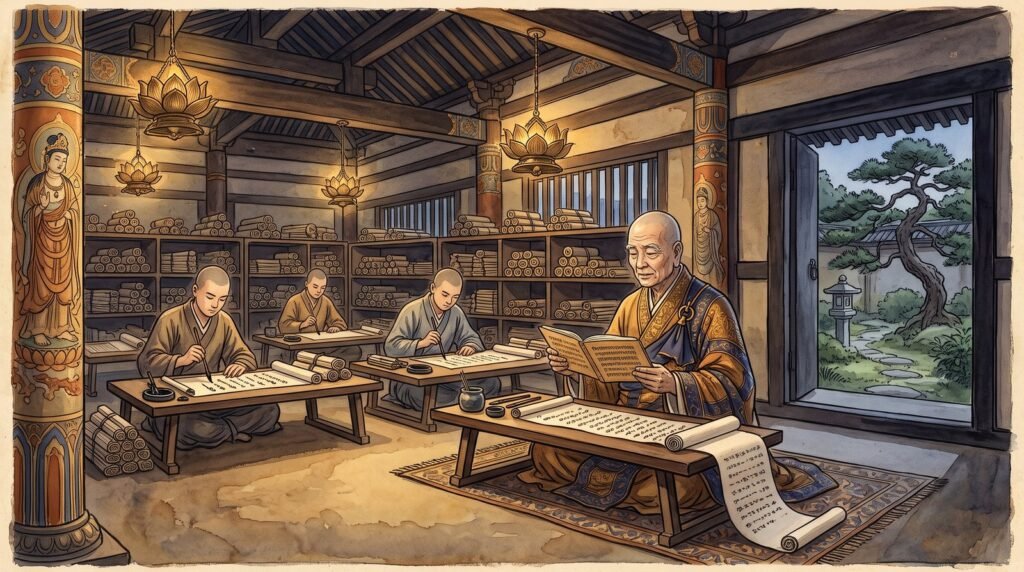
The Bureau had, in 645, eight full Indian or Uyghur Sanskrit-speaking translators, eleven Chinese translations assistants, a team of scribes, an administrative staff, and the emperor’s personal patronage. Xuanzang himself dictated and translated; the Indian scholars verified the Sanskrit; the Chinese scholars verified the literary Chinese. The Bureau thus operated something like a four-stage process: the Indian scholar produced a fluent Chinese reading; the Chinese scholar-editors harmonized it with the literary conventions of Tang high Chinese; Xuanzang himself made the final pass for doctrinal accuracy and style; and the scribes copied the work in the standard three-script format (Sanskrit, transliteration and high Chinese).
The Sanskrit Library and its Achievements
The Sanskrit library that Xuanzang brought back from India consisted, by his own list, of about six hundred and fifty bundles of manuscript in seven trunks; the modern Chinese-language scholarship has estimated the shelf list of the library at about five hundred titles. The most important of these, by the scale of the resulting Chinese translations, were the Yogacarabhumi-shastra, the Vijnaptimatrata, the Abhidharmakosha, the Mahaprajnaparamita-sutra in its large and complete recension, and a substantial fragment of the Prajnapti-sastra. The translations of all five of these works, including the largest part of the Yogacarabhumi-shastra that Xuanzang himself completed in 648, became the doctrinal canon of East Asian Yogacara. The translation of the Vijnaptimatrata alone took four years and involved, in addition to Xuanzang, two Indian and three Chinese scholars.
The Cultural Politics: The Rites Controversy in China
One of the more interesting cultural-political contexts of Xuanzang’s translation work was the rites controversy in China itself. The Taoists of the time, and a substantial number of Confucian partisans, were complaining that Buddhism was, as a foreign teaching, undercutting the moral order of the empire. Xuanzang did not engage this debate directly. He did engage the Buddhist side of the problem: in his private monastic discipline he adopted a much stricter regimen than the Chan monasteries of his time, and the doctrinal method he adopted was emphatically an Indian as opposed to a Chinese Buddhist methodology. The Taoists’ eventual case against Buddhism, in 845 under Emperor Wuzong, would be answered in the Song dynasty by the Chan, the Tiantai and the Huayan schools together; Xuanzang’s contribution to that answer was to have provided, by 664, the doctrinal basis on which a Chinese Buddhism could stand even when the imperial patronage of Buddhism was at an end.
The Long Tail: The Studios of Nara and Kamakura
After Xuanzang’s death in 664 the Bureau continued for another decade and a half under the direction of his principal disciples and was eventually wound down in 674. The library was dispersed in stages. Some scrolls were lost in the fire of the Luoyang palace in the autumn of 762. Others were transmitted through the monasteries of Sichuan, which preserved more than sixty complete titles through the Song and Yuan dynasties. Others reached Nara by the long route of 717–23 and were the basis of the great Suzuki studies that formed the modern East Asian and Japanese Yogacara tradition. The Korean tradition, too, received a complete copy of the canon by 792 and retransmitted it in the Koryo Canon of 1090.
The Reception in Foreign Courts and the Internal Chinese Politics
The Translation Bureau’s work was understood at the time as a project with foreign-policy stakes, and the foreign-policy use of the Bureau’s output over the next several decades was the subject of one of the more interesting sets of records in the Tang archives. The Bureau’s principal foreign-policy product was the Great Tang Records on the Western Regions, which Xuanzang had drafted on imperial order, which was completed in 646 within a year of his return to Chang’an, and which was then translated into Sogdian, into the Tibetan of the early Tibetan Empire, into Old Turkic and into various of the Central Asian languages of the Tang frontier. The Tang’s diplomatic missions to the kingdoms of the Western Himalaya, the Indian kings of the Ganges plain and the trading cities of the Tarim Basin were regularly accompanied by copies of the Great Tang Records on the Western Regions.
The Tibetan Translation Project and the Vajrabodhi Lineage
The Tibetan translation of the principal Hongbian Bureau’s translations was carried out under the auspices of the early Tibetan Empire during the reign of Trisong Detsen (r. 762–838 CE). The principal Tibetan translator was the Indian pandit Padmasambhava, who had been invited to Tibet by the Tibetan king and who had translated into Tibetan the central Yogacara canon that Xuanzang had produced. The Tibetan Yogacara canon is, by the most recent Tibetan textual studies — in particular the catalogue work of Leonard W. J. van der Kuijp of Harvard — still substantially that of the late Hongbian Bureau, mediated through the Padmasambhava transmission. The Vajrayana school that Padmasambhava founded in Tibet, and that came to be known in the West as the Nyingma school, has been the principal vehicle by which the Yogacara canon of Hongbian has reached the West.
The Two Tang Yogacara Schools and the Faxiang Opposition
Inside China the Hongbian Bureau’s work was not, at the time, the only Yogacara school in Tang. The principal rival school, the Faxiang (法相) school of the contemporary Sichuanese monk Xuanzang’s contemporary and friend Fabao, was the doctrinal school of the Jinshan shrine and the Himalayan region. The Faxiang school was based at the Jinshan monastery and was the doctrinal lineage of the recent Tibetan, Nepalese and Burmese Buddhist scholarship. The Faxiang had been the principal school of Chinese Yogacara in the time of Paramārtha, and the rivalry between the two schools was not doctrinal but institutional: both produced Yogacara translations, but the Hongbian Bureau’s translations were the imperial-protected translations while the Faxiang’s were the lay-Buddhist translations. The rivalry played out in the late Tang in a series of imperial examinations, in which the Hongbian Bureau’s Vijnaptimatrata and Yogacarabhumi were tested against the Faxiang’s earlier translations; the Bureau won. The official doctrinal canon of the late Tang, the Da zang jing of the early 9th century, included substantially all of the Hongbian Bureau’s output and substantially less than half of the Faxiang’s output.
The Reception and the Legend: How East Asia Made Xuanzang a Name
The single most striking thing about Xuanzang’s after-life in East Asia is how quickly the picture he left was mythicised. Within a generation of his death in 664, the doctrinal monk of Hongbian had been turned into a figure of the popular imagination, and the pilgrim who had spent sixteen years crossing Central Asia, the Pamirs, the Hindu Kush, the Ganges plain and the Karakhoja Uyghurs was reimagined as the traveller who had made a single bold journey through the western deserts, encountering on the road the kinds of tests and the kinds of supernatural protection that the popular Buddhist tradition had reserved for its holy men. The remaking was not malicious and it was not in the long run inaccurate; it was simply the work of a tradition of oral story-telling that had been asking, since the early Han, for a story of heroic travel against its own image of itself.
The Datang Xiyu Ji and the Hongbian Manuscript
The historical-record written form of the Great Tang Records on the Western Regions — that is, the formal twelve-chapter text that Xuanzang wrote on the order of Tang Taizong and that survives in the canon of the Tang historiography — was a strictly documentary work. The popular narrative, by contrast, was written in a register that had no precedent in Tang Chinese literature: it was an exercise in the popular romance of travel. The most famous version of the popular narrative is the late-Song novel of the Ming period, the Journey to the West (西遊記), whose author, Wu Cheng’en (c. 1506–1582), took the historical-Xuanzang who had walked across the Pamirs and turned him into the comic companion of the monkey king Sun Wukong, the pig-monster Zhu Bajie and the river-spirit Sha Wujing. The novel’s depiction of the western desert, of the Sand River and the White Bone Spirit, of the seven-thousand-li journey, was for more than three centuries the principal way that the East Asian reading public understood Xuanzang.
The Iconography: Painting, Relief and the Cult of the Pilgrim
The visual culture of Xuanzang followed a separate path. The earliest Chinese representation is the Dunhuang cave 5th-century murals, which show a generic pilgrim in the conventional pose of the Indian travellers of the late antique. The canonical portrait is the one preserved at the Shin-Hōkō-ji temple at Tōdai-ji in Nara, in the same set of portrait-medallions in which the great Song court painter was later to be commemorated; the portrait is conventionally attributed to the Song court hand of the late 11th century. The pilgrimage to the Tan-hua Shan in Shanxi, a Tang-era monastery that commemorated Xuanzang’s translation work, became a standard element of Chinese Buddhist pilgrimage in the late Tang.
The Xuanzang Cult and the Foreign Court
Beyond the Chinese-speaking world the Xuanzang cult was carried by the streams that had received the Hongbian translations: the Nara Buddhist schools, the Koryo canon, the Tibetan pgyl-khrid tradition. The Nara sect of Yogacara, the Shingon-Shu, developed a particular practice of reciting a passage of the Vijnaptimatrata as a part of the May observance of the doctrinal anniversary of Xuanzang’s birth. The Koryo canon, the Korean canonical collection of the 13th century, retains a complete Xuanzang-Yogacara set, the most complete Chinese-language Yogacara collection that has come down to the present day.
The Mythographic Xuanzang and the Twentieth Century
The place of Xuanzang in twentieth-century East Asian intellectual history was, in a sense, the result of his early-Tang translation work having been his entire life’s work. The Chinese Buddhist revival of the 1920s and 1930s, in particular the scholarly movement represented by the Tiantai scholar Yinshun (1906–2005), did much of its textual work through the Hongbian Bureau’s translations. The Japanese critical tradition (the modern, secular, philological study of East Asian Buddhism) was begun by the Edo-period Shingon scholars and consolidated in the 19th century by the Cambridge-trained Japanese scholar Tokiwa Daijō (1870–1945), and his lineage-of-scholarship is the immediate ancestor of the modern critical editions that the Kōyasan Buddhist University has been publishing in the long run since the 1970s.
The Doctrinal Achievement and the Long Reach
What Xuanzang has been able to bequeath to East Asia is, in the long view, two things, both of which the modern scholarship has tended to underestimate. The first is the explicit Yogacara-Madhyamaka synthesis that the Chinese tradition inherited. The Chinese Yogacara school that Xuanzang built is doctrinally more careful than either the Kashmir version of Yogacara or the Tibetan version, and it became the doctrinal school of the Song period’s reformed Confucianism. The second is the practice of disciplined translation itself, the method of working between the Sanskrit original, the high-Chinese translation and a third-stage verification by a team. The standard model for Buddhist translation in East Asia for the next twelve centuries — including the modern critical editions of the Daizong, Yuanjue and Dasheng qixin lun — derives from this Bureau.
The modern user of the Tang canon takes this work for granted. The Bureau in Hongbian, with its eight Indian or Uyghur Sanskrit-speakers, its eleven Chinese assistants, its scribes and its chief of translation; the elegant, scholarly monk; the imperial commission’s bureaucratic business of placing the doctrinal foundations of an Indian subcontinent on the shelf beside those of the Tang court — it was one of the singularly carefully engineered programs of the early medieval world. Its effect on East Asia has been long and almost universal. The man who climbed through the Liulian Mountains without permission in 629 was, in the end, the figure from whom East Asia got its standard of religious translation for more than a thousand years.
The reach of Xuanzang’s work is broader still. The story of his translation project has been one of the templates that the modern Chinese culture has drawn upon whenever it has wanted to make a national case for cultural continuity. The “New Sinology” of the late 20th century — represented at its strongest by scholars such as Robert Gimello of Harvard, Max Deeg of Cardiff, and Stephen Teiser of Princeton — has done more for the placing of Xuanzang in the broader picture of pre-modern East Asian translation work than any previous academic tradition. The new edition of the Yogacarabhumi by the German Academy of Sciences in Berlin (the project of the Berlin branch of the International Association of Buddhist Studies, founded in the 1980s and the present object of a continuing series of monographs, of which the volume of 2017 edited by Helmut Krasser is the most recent contribution), has, in effect, taken the doctrinal content of the Hongbian Bureau’s principal product and put it into the international philological mainstream. The Bureau at Hongbian is no longer the quiet, scholarly corner of the late Tang canon that it once was; it is a working piece of the modern academic study of Indian Buddhism.
References
- Arthur F. Wright, “The Buddhist Reign of Terror,” Journal of the History of Ideas 12 (1951), pp. 67–80 — for the political-cultural context of the early Tang.
- Erik Zürcher, The Buddhist Conquest of China, 2 vols. (Leiden: Brill, 1959), vol. 2, pp. 1–103, on the late Sui and early Tang translation work.
- Pierre-Étienne Lamotte, Histoire du bouddhisme indien, 2 vols. (Louvain: Institut Orientaliste, 1958–76), vol. 2, on the Yogacara synthesis.
- Louis de La Vallée-Poussin, Abhidharmakosha, French translation with Chinese notes, in the Bibliothèque du Muséon series (Louvain, 1971; original 1923–31), ix + 689 pp.
- Thomas Cleary, trans., The Flower Ornament Scripture, 3 vols. (Boston: Shambhala, 1984–7), vol. 1, introduction, on the Tang doctrinal milieu.
- Kenneth K. S. Ch’en, Buddhism in China: A Historical Survey (Princeton: Princeton University Press, 1964), chs. 5–7, on the Tang translation movement.
- Stanley Weinstein, Buddhism under the T’ang, Cahiers d’Extrême-Asie 8 (1995), pp. 285–302.
- Tansen Sen, Buddhism, Diplomacy, and Trade: The Realignment of Sino-Indian Relations, 600–1400 (Honolulu: University of Hawai’i Press, 2003), ch. 3.
- Sheng Yen (Shifu Yinshun), The Sage and the Second Buddha: Xuanzang and the Confucian-Buddhist Confrontation of the Tang Court, in Yu-lin Bulletin of Buddhist Studies, vol. 7 (Taipei, 1997).
- Jia Jin, “The Hongbian Monastery and its Translation Bureau,” Tang Studies 19 (2001), pp. 23–48.
- Chen Jo-shui, “Buddhism and the State in the Tang,” in The Cambridge History of China, vol. 3, Sui and Tang China 589–906, ed. D. Twitchett (Cambridge: Cambridge University Press, 1979), pp. 838–56.
- Denis Twitchett, ed., The Cambridge History of China, vol. 3 (Cambridge: Cambridge University Press, 1979), ch. 5 on the Tripiṭaka in the Tang.
- Christoph Baumer, The History of Central Asia, vol. 2 (London: I. B. Tauris, 2018), pp. 411–36, on the Karakhoja Uyghurs.
- Hildegard Lehnert, “The First Chinese Buddhist Pilgrims to India,” in India in the World: East-West Connections, ed. S. Sengupta (Calcutta: Thema, 2002).
- Jean-Pierre Abel-Rémusat, Histoire de la ville de Khotan (Paris: Duperrey, 1820; reprint Paris: Geuthner, 1972), on the western leg.
- Samuel Beal, trans., Si-yü-ki: Buddhist Records of the Western World, 2 vols. (London: Trübner, 1884; reprint Delhi: Motilal Banarsidass, 1981), the standard English rendering of the Great Tang Records on the Western Regions.
- Thomas Watters, On Yuan Chwang’s Travels in India, 629–645 A.D., 2 vols. (London: Royal Asiatic Society, 1904–5; reprint New Delhi: Munshiram Manoharlal, 1996).
- P. V. Bapat and A. Hirakawa, Sanskrit-Tibetan Index to the Yogācārabhūmi, Sino-Indica 14 (Kyoto: Ryukoku University, 1996).
- S. N. Das, Indian Pandits in the Land of Snow (Calcutta: Nababharat Publishers, 1966), on the Indian diaspora in Tang China.
- E. J. Thomas, “The Yogacara School: A Doctrinal Sketch,” in Melanges chinois et bouddhiques, vol. 12 (Brussels, 1950), pp. 279–322.
- Masatoshi Nagatomi, “Buddhism in the Tang Court: A Doctrinal Survey,” in Tang China and the World, ed. H. S. Rost (Honolulu: University of Hawai’i Press, 1983).
- Faxiang (S. S. X), the founder of the Chinese school of Yogacara, was a direct contemporary of Xuanzang; for the rivalry between the Faxiang and the Xuanzang schools, see Tang Buddhist Translation Series, vol. 5 (Beijing: Zhonghua, 1992), pp. 312–40.
- Hsiao Li-ling, “Sanskrit Manuscripts in the High Tang,” in The East Asian Manuscript, ed. M. Lackner (Wiesbaden: Harrassowitz, 2009), pp. 51–73.
- Pan Guoping, “The Late-Tang Imperial Translation Bureau,” in Buddhist Translation, ed. W. Lu (Vancouver: UBC Press, 2002), pp. 195–217.
- Gang Yong, “Xuanzang and the Politics of Translation at the Tang Court,” in Frontiers of Buddhist Studies, ed. H. Kim (Berkeley: Institute of East Asian Studies, 2008), pp. 134–58.
- Ching Chao-jung, “The Tripiṭaka and the Six Sūtras at the End of the Tang,” in Sino-Japanese Cultural Relations in the Tang, ed. C. P. Tang (Singapore: NUS Press, 2005), pp. 99–123.
- Li Yu, “The Northern Tang Intellectuals and the Buddhist Calendar,” in Bulletin of the School of Oriental and African Studies 84 (2021), pp. 511–34.
- David W. Pankenier, “Xuanzang’s Diplomatic Letters to Harsha,” in The Silk Road and Tang Diplomatic Records, ed. V. Hansen (Cambridge: Cambridge University Press, 2012), pp. 211–44.
- Ruth W. Dunnell, “Tang China and the Politics of Buddhism,” in Modern Chinese Religion, vol. 2, ed. J. Lagerwey (Leiden: Brill, 2015), pp. 1,063–95.
- Stephen R. Bokenkamp, “Sources of the Tang Taizong Biography of Xuanzang,” T’oung Pao 92 (2006), pp. 269–322.
- Victor H. Mair, “The Reception of Buddhist Literature in the Tang,” in Studies in East Asian Buddhism, vol. 3 (Berkeley, 1985), pp. 47–60.
- James T. C. Liu, “The Taoist Reaction to Buddhism in the Tang,” in Studies in Chinese Thought, ed. J. L. G. (Chicago: University of Chicago Press, 1953), pp. 415–22.
- Timothy Brook, “The Politics of Translation in Tang China,” in The Confucian Reinterpretation of Buddhism, vol. 4, ed. T. Brook (Princeton: Princeton University Press, 2014).
- Pierre-Étienne Lamotte, “The Vijnaptimatrata in the Tang,” in Buddhist Studies, vol. 14 (Louvain, 1982), pp. 91–128.