Somewhere in the middle of the sixteenth century, in a house in the hills of what is now Hubei province, a physician began writing a book he would not finish for twenty-seven years. When he finally completed it he had collected more than eight hundred sources, interviewed herbalists and miners and fishermen and peasants, travelled to look at plants growing in the wild rather than only in a pharmacopoeia, and produced a work of roughly two million characters describing eighteen hundred and ninety-two substances: plants, animals, minerals, fluids and human tissues, together with eleven thousand prescriptions and more than a thousand hand-drawn pictures. He was not a famous man, he was not a rich one, and he had failed the imperial examinations three times. The book was rejected by the court, printed after he was dead, and became the reference work that every serious practitioner in his tradition consulted for the next four hundred years. Its title translates as the Bencao Gangmu, the Materia Medica Arranged by Classes, and its author was Li Shizhen.
A Physician Who Failed the Examinations
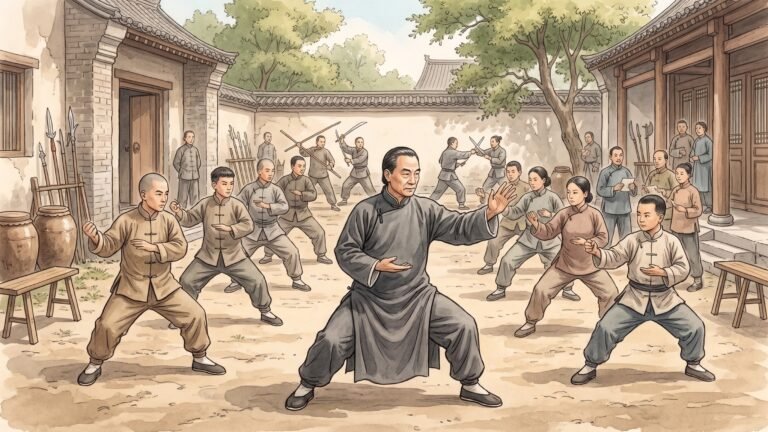
Li Shizhen was born on 3 July 1518, in Qizhou, in what is now eastern Hubei. He came from a family of doctors. His father, Li Zhongzi, held a post in the imperial medical academy in Beijing, which was a respectable and thoroughly bureaucratic position, and the family moved between the capital and their home region following his father’s career. Li Shizhen grew up with the standard education of a well-off scholar-official’s son: the Confucian classics, the examinations as the intended destination, and medicine as the family trade.
He was good at medicine and bad at examinations. The imperial examination system, reformed in the Ming and still the gateway to office, required mastery of a vast body of literary convention, and Li Shizhen failed the provincial examination three times. He passed the age at which the examinations could realistically have led anywhere, gave the whole enterprise up, and turned fully to medicine. The episode is usually read as a moral story about following one’s own path, and there is some truth in that, but the more useful reading is structural. A man who cannot get into the bureaucratic elite through its front door can still become the foremost authority in a field through another route, and Li Shizhen found that route. He became famous not as a servant of the state but as a compiler, which in the Ming meant something quite different.
His reputation as a diagnostician established itself early. According to the account that has been repeated since, he came to public notice when he correctly diagnosed and cured the son of Zhu Xian, prince of the Chu state, in 1551. Cases like that were how physician’s reputations were built in the Ming: there were no laboratories, no licensing, no formal examinations for medicine, and a practitioner’s standing rested on a small number of dramatic cures that other people were willing to talk about. Li Shizhen acquired a substantial practice. He treated the poor as well as the wealthy, which is reported with approval by every later writer, and he developed the habit that would define his career: rather than treating only the case in front of him, he began asking what the drug actually was, where it grew, who else had used it, and whether the received description matched the living plant.
That question, asked consistently over thirty years, is the whole origin of the book. Everything distinctive about the Bencao Gangmu follows from it. A pharmacopoeia written by a physician for other physicians asks what works. A pharmacopoeia written by a naturalist asks what a thing is. Li Shizhen asked the second question, and it turned out to be the harder and more valuable one.
The world he was working in had no institutions to support such a question. There was no university chair of materia medica, no state inspector of drugs, and no standard formulation that a pharmacist was obliged to sell. Medicine was a dispersed trade, and the drug supply chain ran through periodic markets and travelling dealers whose incentive was volume rather than accuracy. Substitution was endemic and everyone knew it. What passed for a guarantee of quality was the fame of the source region and the judgement of the person selling it.
This is the context in which Li Shizhen’s insistence on accurate identification becomes an act of unusual seriousness rather than scholarly fastidiousness. He was proposing that the name on the packet should correspond reliably to the plant in the ground, which sounds like a modest expectation and in the sixteenth-century Chinese drug trade was close to a radical one. It is also why he spent so long on dialect names and local variants. The synonymy was not decoration on the entry. It was the actual difficulty of the trade, recorded honestly, instead of being tidied away in favour of a single elegant name that nobody in the countryside would recognise.
It is worth remembering that he was also writing into a print culture in a state of unusually rapid expansion. The Ming was a great age of Chinese woodblock printing, with commercial publishing spread well beyond the capital and a reading public far larger than anything earlier dynasties had produced. A book of this kind could be printed and sold commercially. Li Shizhen’s enterprise was therefore not only scholarly but commercial, and he knew it: he spent years trying to get the work into print, and when the court rejected it he turned to a private printer in Nanjing rather than give up. The instinct to publish through the market rather than wait on patronage was characteristic of his generation of literati, and it is the reason his book exists in a form the public could actually buy.
The Trouble with Eight Hundred Years of Accumulation
Li Shizhen was not the first to write a materia medica. The tradition behind him was very old and, by the sixteenth century, very large. The foundational text, the Shennong Bencao Jing, had been compiled in the early Han and recorded 365 substances, divided into upper, middle and lower grades according to their presumed virtue. The number 365 is not arbitrary; it matches the 365 points of the body mapped by the acupuncture tradition, and the two systems were meant to interlock.
Successive pharmacopoeias grew. The Xinxiu Bencao of the Tang recorded about 850 substances. By the Song and Yuan dynasties the literature had multiplied into category works, formularies, and encyclopaedias. The Zhenglei Bencao of 1249 was the last great work of the older tradition and the one Li Shizhen used most heavily as a source.
By Li Shizhen’s time the accumulated literature had become a problem in itself. Several things had gone wrong at once. New substances kept entering the record from every direction: newly traded goods from Central Asia and the maritime routes, newly arrived medical knowledge from elsewhere in the empire, new materia medica from Japan and the south, and a great deal of folklore that attached itself to any substance that anyone found dramatic. At the same time the older entries had never been systematically checked. A name in the fifth-century text might not correspond to a substance in the sixteenth-century world at all, and nobody had the time or the training to trace every one of them. The result was a body of knowledge that was enormous, internally contradictory, and impossible to use without already knowing which parts to trust.
The usual way this was handled was by addition. A new edition listed more substances than the last and left the old material in place, annotated. By the Ming this had produced a kind of sediment: layer upon layer of accumulated claims, with the reliability of each depending on nothing more helpful than the fame of the writer who had made it. There was no agreed method for deciding which claims were any good. There was, in effect, no apparatus of criticism.
It is important not to make Li Shizhen sound like a modern experimentalist, because he was not one. He had no concept of a controlled trial, no statistical idea, and no mechanism for detecting which of several claims about a substance was true. What he had instead was a scholarly apparatus, borrowed and extended from the classical tradition: the authority of cited texts, the judgement of a trained eye, and an obligation to state where a claim came from. His great innovation was to extend the apparatus from the book to the specimen. Send the name and the description back to the source, he in effect argued, and see whether it stands up. That is not science in any modern sense, but it is the method by which a tradition of recorded observation begins to correct itself, and it had never been applied to the materia medica at this scale before.
The practical difficulty was that many of the substances he was trying to verify no longer existed in any usable state. A mineral claim might rest on a single reported deposit that had never been found again. An animal substance might depend on a seasonal migration. A drug prepared from a root might be described by a traveller who had tasted it once. Separating these from claims that could be tested required an enormous amount of careful reading, and Li Shizhen’s catalogue of sources, with its separation of medical works from the wider literature, was the tool he built for that purpose. It is easy to dismiss the bibliography as a scholar’s pride; in fact it is the working apparatus of the whole enterprise, and the reason the book can be trusted where its predecessors could not.
There was also a financial dimension that the older literature obscures. The drug trade was large and competitive, and an entry in an authoritative materia medica functioned as advertising for the regions that produced a given substance. Editors had reasons to add generously to lists and few reasons to subtract. A systematic review that removed several hundred marginal entries would be resisted by the interests attached to them. That Li Shizhen undertook one anyway, and that it eventually became the standard, tells you something about how strong the pull of the classification was once people could see what it bought them.
Li Shizhen’s decision was to rewrite rather than to extend. He took the whole corpus apart, went back to the sources, and tried to decide for each substance what was actually known and what was merely repeated. That is an act of enormous presumption, and it is the reason the book is remembered at all. In doing it he discarded a great deal that later turned out to be valuable, and he got a number of things wrong. But he established for the first time a principle on which the whole material could be judged: describe the substance accurately, by its origin, form, taste, smell and habitat, and let the reader see whether the therapeutic claims hang together.
Twenty-Seven Years of Fieldwork
The work took twenty-seven years by the usual reckoning, and it was done in three passes. The first draft was finished in 1578. Li Shizhen revised it in 1580 and again in 1587, and the third revision was the one that went to the printer. He consulted something over eight hundred sources, of which about 276 were medical books, and he read them in a way that can only be described as systematic rather than literary. The opening volumes of the finished work contain a catalogue of the works he used, and it reads like a bibliography of an entire intellectual tradition, with the medical literature separated from the general literature and from the local and technical material.
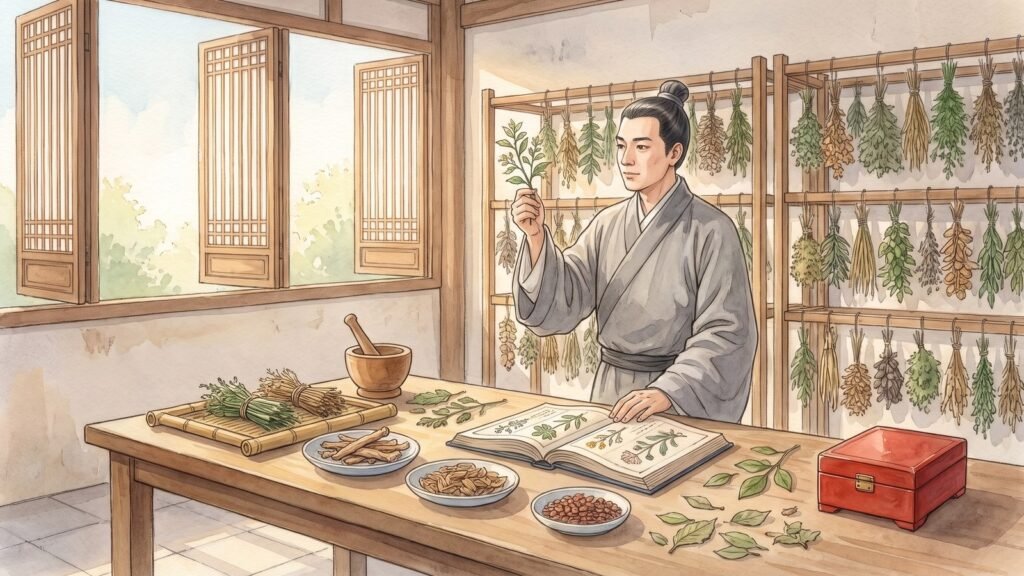
The most distinctive thing about the method is that it was not exclusively textual. Li Shizhen travelled. He went to the mountains to find out where a particular root actually grew and what it looked like out of the ground. He consulted local specialists: herbal-market dealers, village healers, old women who gathered plants by lore, miners who knew what came out of the rock, hunters and fishermen who had seen the animals he was describing. He recorded dialect names, which mattered enormously for a book that was trying to standardise identification, because half the practical difficulty of Chinese pharmacy was that two counties might call the same plant by four names and the same name might mean two plants.
This was not an eccentric addition to a scholarly project. It was the method. Li Shizhen’s central claim, repeated throughout the work, is that many of the substances in the older literature had been misidentified, and that the cause of the misidentification was that nobody had ever looked at the living thing. He was describing a real and persistent problem, and he had hit on what amounts to the empirical core of botanical nomenclature, several centuries before anyone in Europe had formulated the problem in those terms. Two plants that look similar when dried may be quite different when alive. Two plants that look different may be the same plant in two seasons. The only reliable discriminator is a good picture and a good description of the living specimen.
The cost to him was physical. In 1580, when the scholar Wang Shizhen was asked to write the preface to the first version and came to see the author, he reported finding Li Shizhen emaciated. The cause was probably years of sedentary labour compounded by whatever regimen he had been following as a physician. He died in 1593, at seventy-five, and never saw the finished printed book. The Jinling edition he had arranged was in preparation that year; it appeared three years later, or, in the dating used by some catalogues, was printed in 1593 itself. The discrepancy is one of those small unresolved problems that plague the history of Chinese printing, where the carving of the blocks and the printing from them are often recorded as a single event.
Sixteen Divisions and Sixty Classes
The organising innovation of the Bencao Gangmu is its classification. Li Shizhen arranged all 1,892 substances into sixteen broad divisions, which in turn were divided into around sixty classes. The sequence runs from the most inanimate to the most animate: water, then fire, then earth, then metals and minerals; then grasses, grains, vegetables, fruits and trees; then insects, scaled creatures, shells, birds and four-footed beasts; and finally humans. The first four divisions correspond to four of the Five Agents, the conventional cosmological phases through which the Chinese tradition understood the material world. The sequence was explicitly hierarchical, moving from the humblest to the noble, and ending, in the formula usually quoted, with the human being.
This is emphatically not a modern taxonomy. It is not derived from structure, it is not derived from function, and its organising principle is a cosmology rather than a biology. To say that would be to miss what Li Shizhen actually did, which was to impose a consistent and exhaustive hierarchy on a body of knowledge that had previously been an undifferentiated list, and to do it using a principle that could be stated in one sentence and applied by anyone.
The categories were not arbitrary within their scheme. Grasses, for instance, were subdivided into mountain grasses, fragrant grasses, marsh grasses, creeping grasses, poisonous grasses, water grasses, stone grasses, mosses and miscellaneous grasses. The class of worms and insects was subdivided by origin into those born from eggs, those generated by transformation, and those arising from moisture, which is cosmological rather than zoological but is at least a stated and consistent rule. Each division opens with a general statement explaining the nature of the substances it contains, and then proceeds from the smaller and simpler to the larger and more complex.
There are places where the scheme anticipates modern botany closely enough to be striking. The plant sections deal in sequence with algae, fungi, lichens, mosses, and then the naked-seeded and flowering plants, which is a recognisable sequence to anyone who has ever looked at a modern classification scheme. Nobody claims that Li Shizhen discovered plant phylogeny. What he did was impose a graded order on the herbal world using criteria that turned out to be more productive than the alternatives available to him, and the fact that some of the categories line up is evidence about the coherence of his scheme rather than a secret anticipation of nineteenth-century biology.
There is a footnote in the book that has its own small history. The title is a play on two words, gang and mu, meaning the main threads of a net and the mesh within them. In the work itself, the gang is the substance or class, and the mu is the entry that describes it, so the book is subtitled as a general class with detailed categories beneath it. Chinese biologists later borrowed the same two characters to mean class and order in their own taxonomies, so the words that Li Shizhen chose as a pun on fishing nets became, several centuries later, standard vocabulary for the largest divisions of biological classification.
The Pictures and the Blocks
The Bencao Gangmu is not only a text. It was issued with illustrated volumes, and the illustrations were among its most influential features. Li Shizhen’s son Li Jianyuan drew the plants, with the work compiled by another son, Li Jianzhong, and later editions improved on the originals considerably. The number of pictures is disputed across the editions; the figures usually given range from about 1,109 to 1,160, and the variance reflects the fact that later editions added and redrew images rather than reproducing a fixed set.
The original drawings are honestly described as competent rather than beautiful. Their purpose was identification, not decoration, and for that purpose they work: a plant is shown in the state in which it is gathered, with the root, the habit and the distinguishing features of leaf, flower and fruit visible together. That is exactly the kind of picture a working herbal needs, and it is exactly the kind that could not be produced by a workshop copying an earlier drawing.
The printing history is long and complicated, and it matters because the book we can read today is largely a product of later editions rather than of Li Shizhen himself. Hu Chenglong, a printer in Jinling, present-day Nanjing, carved the earliest edition, in the twenty-first year of the Wanli reign, which is 1593. A Jiangxi reprint followed in 1603 and became the basis for most of the editions that followed. A Wulin edition of 1640 substantially recut the illustrations, producing the better images that made the book a landmark in the history of the art. By the time Zhang Shaotang published his Weigu Hall edition in 1885, with four hundred illustrations based on the Wulin work, the Compendium was a commercial property with a long tail of descendants.
It also entered the imperial collecting series, the Siku Quanshu, which fixed a canon of what counted as worth preserving. And in 2011 the Jinling edition was inscribed on the UNESCO Memory of the World Register, which is the international list for documentary heritage of outstanding universal value. That listing is deserved, but it is worth remembering that the recognition came four centuries after the work was finished and three centuries after it was first printed, and that the person who did the most to bring it to public attention in the modern period was not Chinese.
The 1640 Wulin recutting is the single most important event in the book’s visual history, and it is worth understanding what it involved. Woodblock printing is a relief process: the block is carved in reverse, inked, and pressed against damp paper. Every correction to the text therefore requires re-cutting, which is expensive, and every improvement to an illustration requires a new block. When an editor redraws and recuts an illustration he is not making a copy, he is commissioning new work. The improved 1640 images were, in effect, a second set of drawings made a generation after Li Shizhen’s sons, using their originals and the living plants as references. The better images then propagated forward into the later editions that everyone actually used, so in a real sense the illustrations now attributed to the Bencao Gangmu are largely not the ones Li Shizhen’s family drew.
That is a normal and unremarkable feature of the history of books, and it is the reason a facsimile edition and a scholarly edition are not the same thing. The transmitted text and the transmitted pictures both carry layers of revision, and a modern reader looking at an attractive botanical plate from the nineteenth century is looking at a Ming scholar’s observation filtered through Qing editors and republican-era publishers. The Compendium is not a window onto the sixteenth-century natural world. It is a record of a continuing process of looking, maintained and corrected across four centuries.
What Japan and Europe Made of It
The book reached Japan early, by 1607, and a Japanese edition appeared at Kyoto in 1637. Japanese scholars took it up with enormous energy, and the early reception tells us something particular about what the book actually was. It functioned less as a system of classification applied to Japanese nature than as an authority on names.
That distinction is the crux of the Japanese story. A seventeenth-century Japanese reader consulting the Bencao Gangmu for a plant growing in his own garden would find a name, a description of its form and taste, and a set of therapeutic claims, written about a specimen growing somewhere in China. The name would rarely correspond to the local plant, because the same vernacular term covered different species and different terms covered the same one. Scholars such as Kaibara Ekiken, Inō Jakusui and Ono Ranzan, working from the late seventeenth century onward, tried to reconcile the Chinese text with Japanese specimens, and the result was a large body of glossaries, commentaries, field notes and revised works rather than a straightforward adoption. Modern work on the reception has made the point clearly: the Bencao Gangmu’s earliest influence in Japan rested on its lexicological and illustrative qualities, not on its classification.
That is a lesson about how knowledge travels. A book that reports the natural world is only as portable as its specimens. A book that fixes a vocabulary is highly portable, because language can be translated even when the thing being named cannot be transported. The same is true, with different consequences, in the other direction.
European reception is often told too generously. It is frequently claimed that the Compendium was rapidly translated into many European languages in the seventeenth and eighteenth centuries, and that it influenced European natural history directly. The scholarship on the period suggests that this story conflates excerpts, descriptions and partial translations with complete versions. The book’s strongest early circulation was where readers could work with literary Chinese, which in practice meant a small number of highly trained specialists rather than a broad European readership. French and German versions of the period are in substantial part abridged. Darwin is commonly credited with citing it in The Variation of Animals and Plants, where he referred to it as an ancient Chinese encyclopaedia, and that reference is real, but it is one reference in one book, not the beginning of a sustained European tradition.
It would be wrong, though, to conclude that the book’s European influence was negligible. What it did offer, and what was genuinely without parallel elsewhere at the time, was an attempt to organise the entire natural world by observable character rather than by narrative or symbolic association. That impulse is shared with European natural history of the period, and the fact that it appeared in China several centuries earlier and under completely different philosophical premises is a fact that has complicated more than one story about the history of science.
What the Book Actually Is
It is sometimes described as a pharmacopoeia, and that is misleading. A pharmacopoeia is a list of substances with directions for preparing them, and the Compendium contains a great deal of that. Britannica’s summary counts 1,094 herbs, 444 animal substances and 275 mineral substances in its account of the contents, which shows the breadth of the material involved. But the work also records distillation and the handling of mercury, describes the use of ephedrine and of chaulmoogra oil, mentions iodine and discusses smallpox inoculation. It carries material on geography, mineralogy, geology and mining. It is a work on natural history that happens to have a pharmacological index, or arguably a pharmacology that is the largest and best-known part of a much larger enquiry.
It is a book about how knowledge is supposed to be made, as much as a book about plants. Its methodological arguments are scattered through the introductory chapters rather than stated once, but they are consistent: describe accurately, cite your sources, record conflicting testimony instead of suppressing it, distinguish what you have seen from what you have been told, and expect to be wrong. That Li Shizhen expected to be wrong is implied by the fact that he revised the book three times. An author who thinks he has got it right does not go back over it.
He was wrong about a great deal, of course, and much of what he deleted would now be treated as valuable evidence about how earlier people understood their own medicines. A few of his herbal identifications are disputed by modern botanists. His therapeutic claims, judged by the standards of clinical evidence, range from the useful to the unfounded, and the relationship between them is not always the one his classification implies. The book’s structure also inherits the framework of its cosmology, and the sequence from water to man is a statement about the order of the world, not a claim about the order of nature.
None of that seriously dents the achievement. What Li Shizhen did was to take knowledge that had been accumulating without a method and give it a method: an exhaustively stated classification, an explicit standard of description, an obligation to cite, and a set of pictures that let a reader anywhere check a specimen against a description. Those four things together constitute most of what a modern pharmacognosy still relies on. It is not a coincidence that the core practice of identifying a crude drug by macroscopic appearance, taste, smell and habitat is the practice Li Shizhen systematised, and it is not a coincidence that the tradition he represents is the one Chinese manufacturers still argue about when they try to establish the identity of a herb for export.
That last point is worth following, because it is where the book’s influence becomes commercially visible. The business of authenticating traditional remedies for the international market runs on exactly the problems Li Shizhen tried to solve: a plant looks right but is a different species, or is right but has been adulterated, or is right and has been processed in a way that removes the active compound. Chinese exporters and foreign regulators have spent the last two decades building reference standards, marker compounds and certification schemes to settle these disputes, and the vocabulary they use is recognisably the vocabulary of Li Shizhen’s descriptive entries. The classification itself is not used; nobody sorts an export shipment into sixteen divisions. But the standard of evidence it established is.
There is a further irony in the modern reception of the book. It is often presented as evidence that Chinese pharmacology was empirically sophisticated and that European natural history was slow to catch up, which is both partly true and mostly beside the point. Li Shizhen was working with a written corpus of several thousand years, a stable graphic technology for reproducing detail, a scholarly convention of citing sources that predated him by centuries, and a commercial distribution system capable of putting an illustrated book in front of practitioners across a large empire. The achievement is not that Chinese people noticed plants. It is that an individual, with no institutional support at all, assembled enough of the evidence and enough of the method to make the whole thing usable, and then spent three decades revising it.
None of that requires a claim of national priority. What it does require is putting the achievement in its proper scale, which is a single person against an enormous and confused literature, with no funding, no assistants beyond his sons, and a professional apparatus that offered him nothing. When Li Shizhen died the book was not finished. When he had finished it, the court declined to take it. It took a commercial printer in a provincial capital to get it into the world. The twenty-seven years were not an episode in the history of Chinese medicine. They were an act of one man refusing to accept that a body of knowledge could go on accumulating without ever being checked.
There is also something worth saying about the twenty-seven years. The usual modern complaint about long projects is that they cost too much and deliver too little. Li Shizhen’s book was finished three years after he died, rejected by the court he had spent his life failing to qualify for, and waited nearly three centuries for an international body to call it important. What justified the effort was not a forecast of recognition. It was that the work, once done, did not have to be done again. Four hundred years of doctors consulted the Compendium instead of reinventing the classification of plants from scratch. That is a return on twenty-seven years that almost nothing else in the history of Chinese scholarship has matched, and it is why a physician who failed his examinations three times remains one of the more useful things Ming China produced.
References
- Bencao Gangmu – Wikipedia, retrieved October 2026
- Li Shizhen – Wikipedia, retrieved October 2026
- Li Shizhen – Encyclopaedia Britannica
- Bencao gangmu – Ulrich Theobald, University of Tuebingen, 2010
- Li Shizhen: Scholar Worthy of Emulation – Subhuti Dharmananda, Institute for Traditional Medicine, Portland, Oregon
- Ben cao gang mu: Wu shi er juan, fu tu er juan – Library of Congress, Jiangxi, Zhang Dingsi, 1603
- The Bencao Gangmu – Historia Medica
- Bencao gangmu Volume I: A Translation and Annotated Commentary (excerpt) – Luo Yi, University of California Press, 2003
- The Bencao Gangmu in 17th century Japan: A Book of Nature or a Lexicographical Dictionary – European Association for Japanese Studies, 2021
- Li Shizhen – Education Bureau, Hong Kong Special Administrative Region
- Medicinal Plant Analysis: A Historical and Regional Perspective on Challenges and Uses – PubMed Central, 2020
- Ben Cao Gang Mu (Compendium of Materia Medica): nomination summary for the Memory of the World Register – UNESCO Memory of the World, inscribed 2011