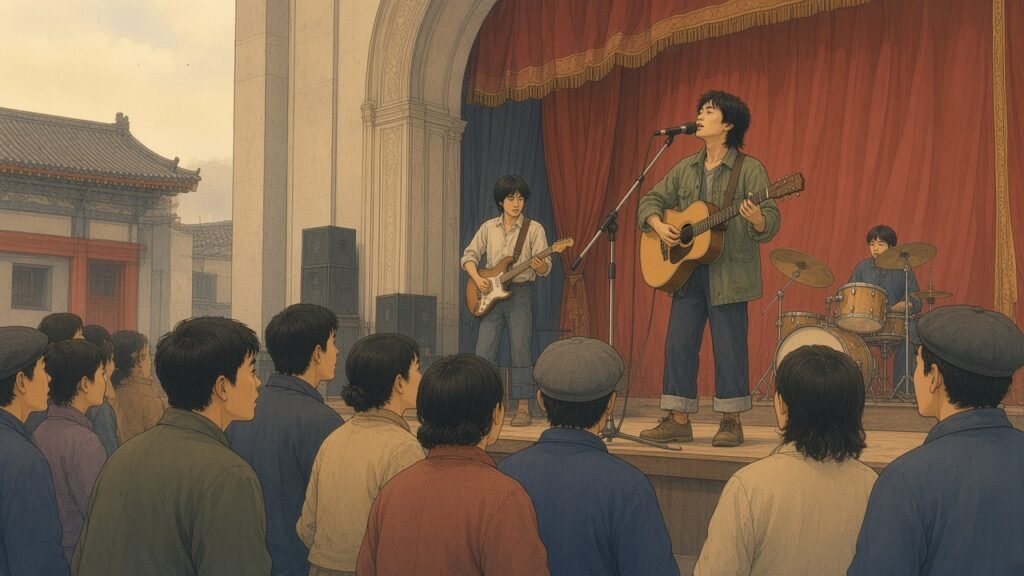
In May 1986 a concert was held at the Workers’ Gymnasium in Beijing to mark the International Year of Peace declared by the United Nations. The venue, the Beijing Workers’ Gymnasium, is an indoor arena in the Chaoyang district north-east of the old city, built in 1961 to host the 26th World Table Tennis Championships, the first world championship held in the People’s Republic. It stands beside the larger open-air Workers’ Stadium, completed in 1959 for the tenth anniversary of the People’s Republic, and the two buildings were for decades the principal venues in the capital for large sporting events and officially sanctioned concerts. More than a hundred popular singers took part, performing songs in the sentimental and patriotic styles that dominated Chinese popular music at the time. Late in the programme a young trumpeter from the Beijing Symphony Orchestra walked onto the stage in an old army jacket, with one trouser leg rolled up, carrying a guitar. He sang a song he had written himself, called “Yiwu suoyou”, usually translated as “Nothing to My Name”, in a rough, half-shouted voice over a driving rock accompaniment. The audience had heard nothing like it. The performer was Cui Jian, and the song, which was soon copied on cassettes and sung across the country, is generally regarded as the beginning of Chinese rock music. Over the following years Cui Jian became the most influential figure in the music, and the songs he wrote in the late 1980s and the 1990s formed a body of work that has remained central to the history of Chinese popular culture in the reform era.
Popular music after the Cultural Revolution
During the Cultural Revolution, from 1966 to the mid-1970s, popular music in China had been reduced almost entirely to revolutionary songs, the model operas and works in praise of Mao Zedong, the Communist Party and the People’s Liberation Army. Western popular music and the songs of Hong Kong and Taiwan were banned, and the urban dance halls and cabarets of the Republican period, where the jazz-influenced popular songs of Shanghai had been born in the 1920s and 1930s, had long since closed. After 1976 the restrictions eased gradually. Traditional and pre-revolutionary forms reappeared, and with the opening of the country’s economy and the spread of cassette recorders, music from Hong Kong and Taiwan began to circulate, at first unofficially and then increasingly openly.
The most popular voice of the period was that of Teresa Teng, the Taiwanese singer whose soft, intimate love songs, in a style descended from the Shanghai popular songs of the 1930s, were copied on cassette tapes and listened to by millions of people on the mainland in the late 1970s and early 1980s. Her music was criticised in the official press as decadent “yellow music” and was for a time restricted, but its popularity was impossible to suppress, and a saying of the period held that by day people listened to old Deng, meaning Deng Xiaoping, and by night to little Deng, meaning Teresa Teng. Mainland singers began to adopt similar styles, and a form of light popular song known as tongsu music, gentle in tone and often sung to backing tracks in television studios, developed under the supervision of the state broadcasting organisations and the official music associations.
Western rock music was known only to a small minority. Students and young people with connections to foreigners in Beijing, including diplomats, foreign students and teachers, obtained recordings of the Beatles, the Rolling Stones, Bob Dylan, the Talking Heads and other groups, which were copied and passed around. In 1985 the British group Wham! performed in Beijing and Guangzhou, the first Western pop group to give concerts in the People’s Republic, before audiences who were reported to have watched in puzzled silence. A few groups of young musicians in Beijing began to play Western-style music in the early 1980s, including one called the Wanlimawang, formed by young musicians in 1980, and others who performed covers at parties and in the few venues frequented by foreigners.
A trumpeter of Korean descent
Cui Jian was born in Beijing on 2 August 1961. His parents were members of China’s Korean minority, the Chaoxianzu, whose communities are concentrated in the province of Jilin near the border with North Korea. His father was a professional trumpeter, and his mother had been a dancer in a Korean-minority performing troupe. He began to study the trumpet with his father at the age of fourteen, and in 1981 he joined the Beijing Symphony Orchestra as a trumpeter. In the course of the early 1980s he came into contact with Western popular and rock music through recordings brought by foreign students and travellers, and he began to learn the guitar and to sing. He was particularly drawn to the music of the Beatles, the Rolling Stones, Simon and Garfunkel, and later the Talking Heads and the Police.
In 1984 he and a group of fellow musicians formed a group known as the Qiheban, or “Seven-Ply Board”, which performed light popular music and some early songs of Cui’s own, and in the mid-1980s he recorded an album of songs in the popular style of the time, released under the title Return of the Prodigal Son, with little indication of what was to come. His career as a trumpeter continued in parallel. The circle of musicians around him included foreigners resident in Beijing, among them the Madagascan guitarist Eddie Randriamampionona, and Chinese musicians who would later form the core of his band, including the saxophonist and suona player Liu Yuan. Liu Yuan’s playing of the suona, a loud double-reed wind instrument used at village weddings and funerals in northern China, became one of the distinctive sounds of Cui Jian’s music.
“Nothing to My Name”
The song with which Cui Jian made his name was written in 1985 or early 1986. Its lyrics are spoken by a young man to a young woman who has repeatedly laughed at him because he has nothing; he asks how long she will go on laughing, and declares that he wants to give her his dreams and his freedom, though he has nothing. “I want to give you my pursuit, and my freedom too,” he sings, “but you always laugh at me, for having nothing to my name.” The song ends with an outburst in which he cries that he will take her hand and she will go with him. The music combines a heavy rock rhythm with melodic phrases drawing on the folk songs of northern and north-western China, and the arrangement, as it developed in later performances and recordings, included the wailing suona of Liu Yuan.
The song was performed in public for the first time at the Workers’ Gymnasium concert of May 1986, which was organised to commemorate the International Year of Peace under the title “Let the World Be Filled with Love”. It was the first time most of the audience had heard rock music performed live, and the first time a Chinese singer had performed a song of this kind before a large public. Recordings of the performance and of the song circulated quickly, and within months “Nothing to My Name” was being sung by students in university dormitories and by young people in cities across the country.
The meaning of the song was discussed widely. On its surface it was a love song, but many listeners heard in its theme of a young man with nothing, mocked by those around him and demanding a freedom that he could not define, an expression of the situation and feelings of the generation that had grown up during the Cultural Revolution and come of age at the start of the reform era. Critics and scholars of Chinese popular culture have since described it as an anthem of that generation, and the phrase “nothing to my name” entered everyday speech. Cui Jian himself generally resisted political interpretations of his songs, saying that they were about personal feelings and individual experience.
Rock ‘n’ Roll on the New Long March
After the concert of 1986 Cui Jian left the Beijing Symphony Orchestra, reportedly under pressure because of his new activities, and devoted himself to rock music. He formed a band with Liu Yuan, Eddie Randriamampionona and other musicians and performed at small venues, parties and university events in Beijing, often in circumstances of uncertain legality, since public performances required the approval of cultural authorities who were suspicious of the new music. In 1988 his performances in Beijing and elsewhere attracted growing audiences, and in 1989 he released his first album of rock music, Xin changzheng lu shang de yaogun, or Rock ‘n’ Roll on the New Long March, which included “Nothing to My Name” and eight other songs.
The album’s title referred to the Long March of 1934 and 1935, the epic retreat of the Red Army that had become one of the founding myths of the People’s Republic, and to the phrase “the new Long March”, which the party had used since the late 1970s to describe the drive for modernisation. Its title song set a parody of revolutionary march rhythms to lyrics about a journey whose destination was uncertain. Other songs on the album included “Yi kuai hong bu”, or “A Piece of Red Cloth”, in which the singer describes being blindfolded with a piece of red cloth by a lover and led along a road whose destination he cannot see, an image that many listeners understood as an allegory of the relation between the people and the party; “Hua fang guniang”, or “Girl in the Flower House”; and “Bu shi wo bu mingbai”, “It’s Not That I Don’t Understand”, a fast, half-spoken song about confusion and change. The music mixed hard rock with elements of punk, funk and reggae and with Chinese folk melodies and instruments.
The album was released by a state publishing company and sold widely, both in its legitimate edition and in pirated copies. It is generally regarded as the first Chinese rock album and as one of the most important records in the history of Chinese popular music. In the decades that followed it regularly appeared at or near the top of lists compiled by Chinese critics of the greatest Chinese albums.
The northwest wind and the culture of the late 1980s
Cui Jian’s music appeared at a moment of intense cultural ferment. The years from 1984 to 1989 were a period of debate and experiment in Chinese literature, art and film, sometimes called the “culture fever”. Writers of the “root-seeking” school explored the cultures of rural China and the minority regions, avant-garde painters and sculptors staged exhibitions that culminated in the China/Avant-Garde exhibition at the National Art Museum in Beijing in February 1989, and film-makers of the so-called Fifth Generation made films such as Chen Kaige’s Yellow Earth of 1984 and Zhang Yimou’s Red Sorghum of 1987, the latter adapted from the fiction of the writer whose career is described in the post on Mo Yan and the 2012 Nobel Prize in Literature.
In popular music the same period saw the rise of a style called xibeifeng, the “northwest wind”, in which songs drawing on the folk music of Shaanxi and the loess plateau were sung in a loud, open-throated manner over modern arrangements with strong rhythms. The style was influenced both by Cui Jian and by the music of the Fifth Generation films; the song “Sister, Go Boldly Forward” from Red Sorghum, sung by the actor Jiang Wen, was among its best-known examples. Xibeifeng was briefly the most popular style in China in 1987 and 1988, and it marked a change in the sound of mainland popular music away from the soft styles imported from Hong Kong and Taiwan towards a rougher and more assertive voice.
Young audiences in the cities embraced rock music as a form of self-expression and of identification with a wider world. Cui Jian’s songs were played at student parties, and his concerts drew audiences who sang along, danced and waved their arms in a manner unfamiliar at Chinese performances. Foreign journalists in Beijing reported on the phenomenon, and Cui Jian was sometimes described in the Western press as the “Chinese Bob Dylan” or the “Chinese Bruce Springsteen”, comparisons that he did not encourage.
The musicians of the scene learned their craft with great difficulty. Electric guitars, amplifiers and drum kits were scarce and expensive in the China of the 1980s, and many musicians built or repaired their own equipment or borrowed instruments from foreign friends and from the bands of hotels and state troupes. Recordings of Western music, the main source of instruction, were copied from cassette to cassette until their sound was blurred. Rehearsal spaces were found in courtyards, basements and the rooms of work units after hours. The rapid development of a recognisable Chinese rock style in a few years, under such conditions, was in part a result of the training many of the first musicians had received in state orchestras and conservatories, which gave them a command of their instruments that they adapted to the new music.
1989
In the spring of 1989 students in Beijing and other cities began the demonstrations that culminated in the occupation of Tiananmen Square. “Nothing to My Name” was sung widely in the square, and in May Cui Jian performed there for the students on hunger strike. After the suppression of the protests on 3 and 4 June, cultural policy became more restrictive, and his position became more difficult. Performances of rock music were discouraged, and for a time he was unable to give large public concerts in Beijing.
In 1990 he was permitted to undertake a national tour, nominally to raise funds for the 11th Asian Games, which Beijing was to host in September of that year. The tour, under the title “Rock ‘n’ Roll on the New Long March”, visited several cities, among them Chengdu, Xi’an, Wuhan and Zhengzhou, playing to large and enthusiastic audiences. It was cut short after only part of the planned schedule had been completed, reportedly because of the authorities’ concern at the response of the crowds and at aspects of Cui’s performances, including his practice of singing “A Piece of Red Cloth” with a red cloth tied over his eyes. The planned remaining concerts were cancelled.
The albums of the 1990s
Cui Jian’s second album, Jiejue, or Solution, was released in 1991. It was harder and darker than the first, with songs such as “Wild in the Snow” and “The Last Shot”, the latter a lament built around the image of a soldier killed in battle, which many listeners connected with the events of 1989. His third album, Hongqi xia de dan, or Balls Under the Red Flag, released in 1994, had a title that played on the word dan, meaning both “egg” and, in slang, “testicle”, and its songs explored the experience of a generation raised under socialism and adapting to a market society. Musically it drew increasingly on funk and on the rhythms of rap. Wuneng de liliang, released in 1998 with the English title The Power of the Powerless, borrowed the phrase from an essay by the Czech dissident and president Václav Havel, and it showed Cui moving further towards electronic and hip-hop influences. In 2005 he released Gei ni yi dian yanse, or Show You Colour, which made extensive use of samples, rap and traditional instruments, and in 2015 Frozen Light.
Throughout this period his relationship with the authorities was uneven. Large concerts in Beijing were difficult to arrange for much of the 1990s, and his appearances on state television were rare, but he toured extensively in other cities and abroad, performing in Hong Kong, Japan, Europe and the United States, and his recordings were officially published in mainland China. He spoke publicly against the practice of lip-synching at concerts and on television, which was widespread in China, and campaigned in the early 2000s for live performance, arguing that it was a matter of honesty to the audience.
The first wave of Chinese rock
Cui Jian was the first and most famous Chinese rock musician, but he was soon joined by others. The years after 1989 saw the formation of many bands in Beijing, where a community of rock musicians developed around rehearsal rooms, bars and private parties, and around the rented rooms of the villages on the city’s edge where musicians and artists lived. Tang Dynasty, formed in 1988, played heavy metal with long, elaborate compositions and lyrics evoking the grandeur of classical Chinese history and poetry, and its first album, A Dream Return to Tang Dynasty, released in 1992, sold widely across the Chinese-speaking world. Black Panther, formed in 1987, played melodic hard rock and became one of the most popular bands of the 1990s; its first singer, Dou Wei, later left to pursue a solo career in more experimental directions. Other singers of the period included He Yong, whose album Garbage Dump of 1994 was an angry punk-influenced work, and Zhang Chu, whose songs were quieter and more literary.
A decisive role in the commercial success of these musicians was played by record companies from Taiwan and Hong Kong. Magic Stone, a label established by the Taiwanese company Rock Records, signed many of the Beijing musicians in the early 1990s and released albums by Dou Wei, Zhang Chu and He Yong, promoting them as the “three outstanding” of mainland rock. In December 1994 Magic Stone organised a concert at the Hong Kong Coliseum featuring these three and Tang Dynasty, under the title “Rock China Power”, which was received with great enthusiasm and is often regarded as the high point of the first wave of Chinese rock.
The wave did not last. In the middle and late 1990s the market for Chinese rock declined. Piracy reduced the income from recordings, the authorities restricted large concerts, several leading musicians suffered personal difficulties, and popular taste shifted towards the glossy pop music of Hong Kong and Taiwan and later towards new mainland pop stars. Tang Dynasty’s guitarist Zhang Ju died in a motorcycle accident in Beijing in 1995. For a time rock music appeared to have returned to the margins from which it had emerged.
Rock and the cultural authorities
The position of rock music within the cultural system of the People’s Republic was ambiguous from the beginning. Public performances required permission from the cultural bureaus of the cities and provinces, recordings had to be issued by licensed publishing companies, and broadcasts on radio and television were controlled by state organisations. Rock was never banned outright as a genre, and Cui Jian’s albums were issued by official publishers, but large concerts were approved only occasionally, and musicians whose lyrics or performances were considered objectionable could find their concerts cancelled or their access to broadcasting withdrawn. Official commentators in the late 1980s and 1990s were divided. Some criticised rock as a Western import associated with decadence and disorder, while others argued that Chinese rock could be a legitimate form of popular art expressing the feelings of young people.
For musicians these conditions meant that much of the music’s life took place in informal settings. Performances known as “parties”, held in hotel ballrooms, restaurants and rented halls and sometimes advertised by word of mouth, were a characteristic form of the Beijing rock scene of the late 1980s and early 1990s, and they allowed bands to play to audiences of several hundred people without the formalities required for public concerts. In the 1990s small bars and clubs took over this role. Musicians also depended on income from other sources, playing in hotel bands, writing music for television and advertisements, and teaching. The relationship between the musicians and the authorities was one of continuing negotiation rather than of fixed rules, and it varied over time and between cities.
The songs and their language
Much of the power of Cui Jian’s songs lies in their lyrics, which use the plainest everyday Chinese and avoid the polished, literary diction of most popular songs of the time. “A Piece of Red Cloth” opens with the image of a lover covering the singer’s eyes and covering the sky with a red cloth, and asking him what he sees; he replies that he sees happiness. He describes the sensation of being led, of not being able to see the road, of thirst that he cannot quench, and of a feeling that the place where he lives is comfortable, so that he forgets that he has nowhere to live. The song is written as a love song, and its imagery is open to many readings; its use of red, the colour of the revolution and of the national flag, encouraged listeners to hear political meanings, while Cui Jian himself declined to give a single interpretation.
“Rock ‘n’ Roll on the New Long March” takes the language of the revolutionary past and turns it into the language of a personal search. The singer describes walking on the road with “a head full of revolutionary songs”, remembering the heroes and the slogans of his childhood, and finding that the road ahead is unclear. “It’s Not That I Don’t Understand” speaks of a world that changes too quickly to grasp: the singer says that once he could not understand the world, and now that it has changed he still does not understand it. “Nothing to My Name” itself is constructed around the opposition between material poverty and the gifts of dreams and freedom that the singer offers.
In the 1990s his lyrics became more allusive and more satirical. “Balls Under the Red Flag”, the title song of the 1994 album, observes that money has replaced ideals and describes a generation that has grown up under the red flag, like eggs being hatched, without a clear sense of what it will become. Songs on the later albums address subjects such as urban alienation, commercialisation and the relation between the individual and the crowd. His rapid, half-spoken delivery on many of these songs anticipated the development of Chinese hip-hop, and later rappers acknowledged his example.
Women in Chinese rock
The Beijing rock scene of the late 1980s and 1990s was dominated by men, but women musicians took part from the beginning. The all-woman band Cobra, formed in 1989, was the first prominent female rock band in China, and it performed in Beijing and toured in Europe in the 1990s, attracting attention from foreign journalists and scholars as an example of the new music’s possibilities. The singer Luo Qi became one of the best-known voices of Chinese hard rock in the 1990s. Later decades saw many more women in bands and as singer-songwriters on the independent scene, among them the drummer Shi Lu, known as Atom, of the band Hedgehog, and the folk-rock musicians of the festival circuit.
A wider audience
Chinese rock reached audiences beyond China through tours, recordings and documentaries. Cui Jian toured abroad from the late 1980s, performing at festivals and concert halls in Europe, North America and Asia, and his albums were released in Hong Kong, Taiwan and Japan. Foreign scholars of Chinese culture, including the ethnomusicologists and cultural historians who wrote the first studies of Chinese popular music in English in the 1990s, treated his work as central to the subject, and his songs were translated and discussed in books on the culture of the reform era. For Chinese communities overseas, especially students who had left China in the late 1980s, his music was a powerful reminder of the atmosphere of those years.
Punk, festivals and a new generation
A second generation of rock musicians emerged in the late 1990s. In Beijing a punk scene grew up around a bar called the Scream Club in the university district of Haidian and around bands such as Brain Failure, Reflector and the Catcher in the Rye, whose music, fast, loud and often sung partly in English, owed more to British and American punk than to the folk-inflected rock of the 1980s. Their records were issued by new independent labels, among them Modern Sky, founded in Beijing in 1997, which became the most important label of the new scene. The Midi School of Music, a private school for rock and jazz musicians founded in Beijing in 1993 by Zhang Fan, began in 2000 to hold an annual outdoor festival, the Midi Music Festival, which was the first large rock festival in mainland China. It grew rapidly in the 2000s, and in 2009 Modern Sky launched its own Strawberry Music Festival. By the 2010s outdoor festivals had become common across the country, drawing tens of thousands of spectators, and bands such as Second Hand Rose, which combined rock with the northern folk theatre called errenzhuan, Re-TROS, Carsick Cars and the Mongolian folk-rock band Hanggai found audiences in China and abroad.
The growth of the internet changed the circumstances of the music once again. Musicians could distribute recordings online, and music streaming services and video sites gave independent bands an audience far beyond the clubs. In the late 2010s a television competition, The Big Band, broadcast online, introduced many independent bands to a mass public for the first time. Cui Jian was treated in this new world as a founding figure, and the musicians of the later generations frequently cited him as the person who had shown that rock could be sung in Chinese and about Chinese experience.
Cui Jian in the new century
Cui Jian continued to perform and record. In 2003 he was due to appear with the Rolling Stones when the British band planned its first concerts in mainland China, but the concerts were cancelled because of the SARS epidemic. When the Rolling Stones finally played in Shanghai in April 2006, their first concert in mainland China, Cui Jian joined them on stage to sing “Wild Horses” with Mick Jagger. He also turned to film. He had acted in films in the 1990s, including Zhang Yuan’s Beijing Bastards of 1993, which featured his band, and in 2013 he directed a feature film, Blue Sky Bones, combining music, fantasy and the history of a family over several decades. In 2014 he was invited to perform “Nothing to My Name” on the Spring Festival Gala of China Central Television, the most widely watched television programme in the country, but he withdrew after the producers reportedly asked him to substitute a different song; the episode was widely discussed in the Chinese press.
In April 2022 he gave a concert broadcast online through a video channel of the WeChat platform, performing songs from throughout his career with his band. The concert drew an audience reported at more than forty million viewers, many of them people in middle age who had listened to his music in their youth, and its success was widely remarked upon as evidence of his continuing place in the memory of a generation.
The music and its legacy
Cui Jian’s songs are remarkable for the way they combine Western rock with Chinese musical materials. His melodies often draw on the pentatonic scales of northern Chinese folk song, and his bands used Chinese instruments, the suona, the bamboo flute and the zheng, alongside electric guitars, saxophones and synthesisers. His vocal delivery, harsh and declamatory, owed something to the singing of the north-west and something to Western rock and rap. His lyrics, in plain colloquial Chinese, employed images drawn from everyday life, from the language of revolutionary songs and from the political vocabulary of the People’s Republic, often turned in new directions. Scholars of Chinese culture have discussed his work as an example of the creation of an individual voice in a culture that had long emphasised collective expression, and as a record of the experience of young urban Chinese in the period of reform.
His influence is apparent throughout later Chinese popular music, not only in rock but in folk, hip-hop and pop. The army jacket in which he appeared in 1986 and the red blindfold of “A Piece of Red Cloth” became familiar images of the period, and phrases from his songs passed into everyday speech. The neighbouring Workers’ Stadium was rebuilt between 2020 and 2023 and reopened as a football stadium and concert venue, while the gymnasium in which he first sang “Nothing to My Name” still stands beside it; the concert of May 1986 is still remembered as the moment when Chinese rock music began.
Rock music and the reform era
The history of Chinese rock is closely bound up with the wider history of the reform era. Its first audiences were the students and young urban workers of the 1980s, the first generation to grow up with access to cassette recorders, foreign broadcasts and the products of the new consumer economy, and its themes, of individual desire, uncertainty and change, reflected the transformation of their society. The sale of cassettes and later compact discs in the new private shops of the cities, the spread of bars and clubs, the commercial ambitions of record companies from Hong Kong and Taiwan and the later rise of festivals and streaming services all followed the development of a market economy in culture, as in other spheres. The economic changes of the same decades, from the rural reforms of the late 1970s to the growth of cities such as the one described in How Shenzhen Was Built From Border Villages, created the urban public for which the music was made.
Cui Jian occupies within this history a position that no other popular musician has held. He was the first to perform rock music in Chinese before a mass audience, the author of its best-known songs and, over four decades, its most consistent representative. His music has been the subject of academic study in China and abroad, and of retrospective exhibitions, documentaries and anniversary concerts. For many listeners the rough voice that sang “Nothing to My Name” at the Workers’ Gymnasium in 1986 remains the sound of the beginning of a new period in the life of the country, a period in which a young man with nothing to his name could stand on a stage before a crowd and sing about his own feelings in his own words.