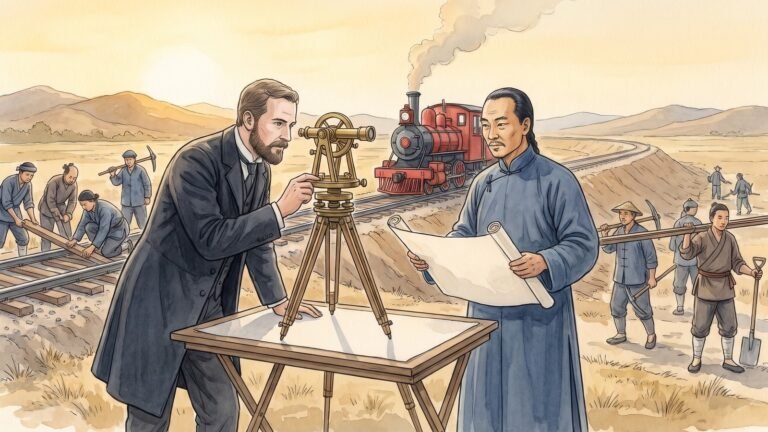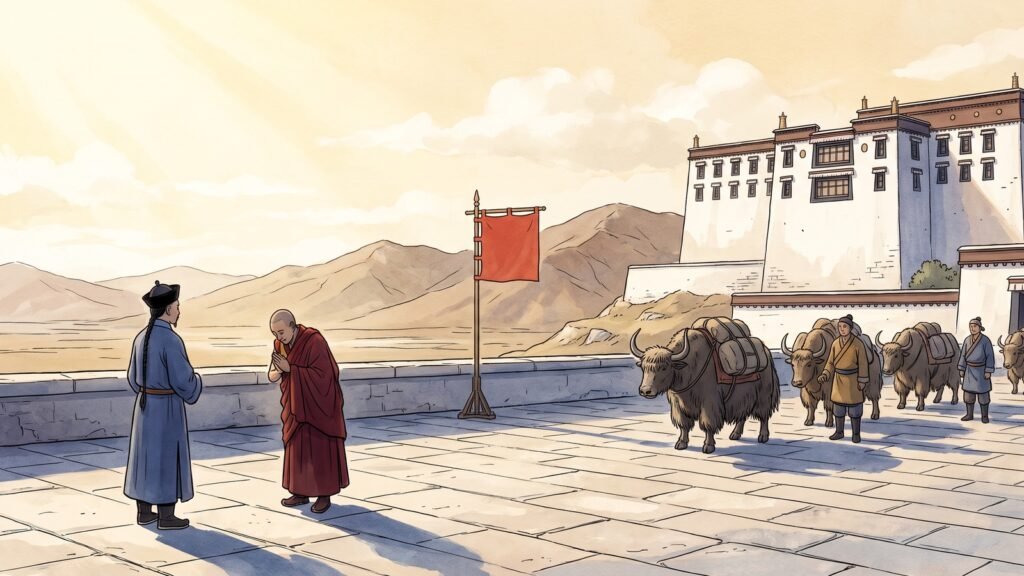
The road up to Lhasa in the autumn of 1720 was lined with the dismantled walls of a city that had just been taken by an army it had never seen. The Qing force that came over the passes that September was small by the standards of conquest, a few thousand men under the command of a Manchu general named Fuca, and their leader was a seven-year-old boy from a monastery in Qinghai who had been brought to the Qing court at Beijing the previous year and given the title of the Lama of the Great Peace. The boy was the seventh Dalai Lama, and the army was there to put him back on the throne of Lhasa and to ensure that nobody else sat on it. The walls came down, the guns were removed from the Potala, and a garrison was left. It took the Qing court a further half century to turn that expedition into a system, and then another half century for the system to be dismantled, and the dismantled version is what most people think of when they think of Qing Tibet. But the version that began in 1720 is the one that matters, because it was written into the institutions of the plateau and it outlived the dynasty that created it by decades.
Before the Protectorate
Tibet before the Qing was not a single thing and it was not a Chinese possession pretending to be independent. What existed on the plateau in the seventeenth century was a Buddhist ecclesiastical state with a complicated relationship to the Mongols, whose authority extended across the plateau as a loose overlordship exercised through the Mongol Khoshut clan and their Lhazang Khan. The institution that governed the country was the Ganden Phodrang, formally established in 1642 by the fifth Dalai Lama, Ngawang Lobsang Gyatso, after the defeat of the rival Tsang dynasty and with the support of the Khoshut. Its seat was the Potala Palace on the hill above Lhasa, its executive was the Kashag, a council of lay and monastic officials, and its head was a religious figure whose authority was as much a matter of recognition and consensus as of appointment.
The Ganden Phodrang was a confederation rather than a state in the modern sense. The great aristocratic houses of Tibet, among them the Sakya, the Phagmodru and the family of Jangchub Gyaltsen that had ruled the Tsang, retained their own lands, their own courts and their own armed retainers, and the monasteries held enormous endowments of land worked by tenant farmers. Government in Lhasa was conducted through endless negotiation between the monasteries and the noble houses, and the Dalai Lama’s word was decisive because it was heard in the monasteries rather than obeyed from a palace. The Mongols had held the plateau together by force for most of the previous century, and their withdrawal in the early eighteenth century left a question that the Qing were careful to answer very quickly: who would hold it together now? The seventh Dalai Lama inherited this in the 1720s, and he inherited it with the Dzungar Mongols pressing in from the north.
What the Kangxi Emperor faced in 1717 was a rival claim as well as a foreign invasion. The Dzungar leader Tsewang Rabtan had invaded Tibet, killed the Lhazang Khan, and installed a boy of his own as a puppet Dalai Lama, in a manoeuvre that was as much about Mongol politics as about Tibet. The Qing court’s answer was to find the real one. The seventh Dalai Lama, Kelzang Gyatso, was identified at Kumbum monastery in Qinghai and brought to Beijing, where he was received by the Kangxi Emperor in 1719 and given a title that translated, roughly, as the Lama of the Great Peace. In the following year he was escorted back to Lhasa with a Qing army, entered the city in September 1720, and was restored.
What the emperor understood, and what the paper he authorised a year later expressed, was that a religious restoration was not enough. The ground had been lost because the Lhasa government had no capacity to defend itself and had therefore been vulnerable to any neighbouring power that chose to press. So the Qing did what it had done in China proper for a century: it substituted a garrison for a militia and an administration for an arrangement. In 1721 the court issued the Twenty-Nine Articles for the pacification of Tibet, which set out the terms of the new order. The Dalai Lama was to preside over religion and take no part in state affairs. State affairs were to be conducted by the Kashag, with its officials chosen and dismissed by the Qing court and answerable to it. And there would be troops. The number of soldiers is given differently in different accounts, and is generally somewhere between two and three thousand, drawn from the Manchu, Mongol and Han banners and stationed in and around Lhasa on the far side of the Drichu river, with a standing instruction, repeatedly emphasised, that they were not to cross the river into the Tibetan-occupied ground.
Two ambans arrived in 1727. They were the visible face of the whole arrangement: one Manchu, one Mongol, each with the authority of a vice-royal, seated in Lhasa for the long term, holding the seal of the office and supervising the Kashag. Their arrival was not welcomed, and the Tibetans found ways to make their lives difficult. But the arrangement held for more than two centuries, which is a longer working life than most Qing institutions, and it worked by a combination of garrison, patronage and ritual that can be seen, even now, in the shape of the Potala and in the layout of the Barkhor street.
The arrangement was also, in its own terms, remarkably light. The Qing did not attempt to govern the plateau directly; there was no attempt to tax the Tibetans, to resettle them, to station a civil bureaucracy across the country, or to alter the local monastic economy. The amban supervised the Kalons of the Kashag, confirmed and confirmed the succession of the high lamas, arbitrated the endless quarrels between the monasteries and the lay nobility, and stood between Tibet and the rest of the world. In return, the Qing court gave the Ganden Phodrang what it most needed: recognition, subsidy and the removal of the Dzungar threat. The protectorate, in other words, was not a conquest. It was a guarantee.
The Second Intervention
The system was tested to destruction in 1750, and what the test revealed was not that Tibet was ungovernable but that the Qing were willing to kill to preserve it. On the evening of 5 October 1750 an argument in Lhasa over the sale of a palace between the ambans’ party and that of the Lhabzang Khan escalated into a fight in which both ambans, Fuqing and Labodun, and most of their retinues were killed. The Lhabzang Khan, Polhan Dorje, was the Mongol chief who had been the protector of the Ganden Phodrang since the Khoshut, and the ambans’ arrival had displaced his authority; the killing was in some sense the last act of a rivalry that had been running for a decade.
The Qianlong Emperor, who had acceded in 1735 and was still in his early thirties, did not treat this as a frontier incident. He sent an expedition, and unlike the discreet operation of 1720, this one was meant to be seen. The force that eventually entered Lhasa was smaller than the numbers first proposed, which is itself a point worth noticing: the court had enough authority in Lhasa that it could send a smaller force and still be obeyed. The Lhabzang Khan and seven of his associates were executed in Lhasa in 1751, publicly, in a ceremony staged to make the meaning unmistakable.
There was also a strategic logic that the Qianlong Emperor pressed on his ministers and they did not press on him. The Qing had spent the eighteenth century destroying the Dzungar power in the north, and the plateau was the southern flank of that campaign. The ambans and the garrison were the insurance policy, and when the British expedition of 1904 showed that the insurance had lapsed, the court at Peking was not making an abstract point about sovereignty; it was renewing a policy ninety years old.
The ambans were not administrators; they were resident supervisors, and the form they took was ritual as much as administration. Twice a year they went through the streets of Lhasa in procession to the Potala, and the whole city turned out to watch them, and the ceremonies were the public demonstration that the last word on the plateau lay in the yamen of a Manchu and a Mongol. In their private residence they received the Kalons, who reported to them, and they carried their disputes up to Peking. The distance between those two things, the procession and the petition, is the whole architecture of the protectorate in a single image: Tibet was allowed to go on governing itself in full view, under the eyes of two men who had the authority to report anything and to decide anything that mattered.
What followed was not a punishment but a redesign. The Thirteen-Article Ordinance of 1751 set out the new constitutional arrangements, and it is the document that most directly created the Tibet that the twentieth century would recognise. The Kashag was reconstituted as four Kalons rather than three. The gyadzom, the great assembly of lay and monastic officials that had been the Lhazang Khan’s instrument, was formally re-established, and the Lhazang Khan’s court was abolished. The Dalai Lama was restored to the throne and confirmed as the head of the Ganden Phodrang, with the religious authority that went with it. And the ambans were confirmed in their supervisory role, with the Kashag answerable to them, so that the responsibility for what happened in 1750 could not again be discharged onto a Tibetan who could then be executed.
The design has a certain coldness to it, and the historians have different views of it. Luciano Petech, whose 1972 study of the eighteenth century remains the standard account of the establishment of the protectorate, reads the arrangement as a genuine accommodation: a real division of authority between the ecclesiastical and the administrative, with the amban supervising but not governing. Other scholars read the Thirteen Articles as the reduction of a once-independent Tibetan aristocracy to a set of functionaries appointed from outside. Both readings can be supported, and the truth is probably that the Qing built exactly what they wanted, which was a system in which no Tibetan power could grow strong enough to require another expedition, and in which the Emperor of China rather than any Tibetan lord was the ultimate authority on the plateau.
The system that followed was bureaucratic, and it was quietly corrosive. The ambans supervised the Kalons. The Kalons supervised the districts. The high lamas, whose succession required the ambans’ formal confirmation, found themselves with less and less practical authority as the Qing extended its direct supervision of the Kalons. A Tibetan government that had been a council of aristocratic houses became an administration staffed by officials whose appointment depended on the imperial court in Beijing, and the aristocracy that had been displaced in 1750 had no institution in which to make its case. That is the mechanism by which a protectorate becomes something else, and it took a century for the something else to become visible.
The Golden Urn and the Articles of 1793
The second shock to the system came from outside the Qing. In 1791 the Gurkha state of Nepal, under the aggressive leadership of Amar Bir Bikram Shah, invaded Tibet and routed the Tibetan army, and in 1792 the Qianlong Emperor sent a large Chinese expedition into Nepal itself, fought a campaign that crossed the Himalayas in winter, and compelled a treaty that left Nepal a tributary state and left the British alarmed about the possibility that the Chinese would next come south. The Qing could not simply have left the defeat unpunished, because the consequence of a Chinese failure in Tibet would have been a Dzungar or a Gurkha or somebody else’s protectorate, and the whole point of the garrison was to prevent that.
There was another kind of Qing presence in Tibet that is easier to miss than an amban. In the 1690s the Kangxi emperor paid for a complete set of the Tibetan Buddhist canon to be printed at Lhasa, with the help of Jesuit missionaries who had been at the Potala for some years, and the printing house at the northern end of the palace produced edition after edition of the scriptures and of the works of Tsongkhapa for the rest of the Qing rule. The enterprise cost the imperial treasury a great deal of money and was not well understood in Beijing at the time, and it is now generally recognised as one of the most successful acts of cultural patronage in the history of the dynasty. It bought the court on the plateau a decisive share of the loyalty of the monks who mattered most, because the texts they recited every day had been printed at the emperor’s expense.
So the Qianlong emperor used the crisis to issue the document that remains the Qing constitution of Tibet. The Twenty-Nine Articles for the Better Government of Tibet, drawn up in 1793, is a long and detailed instrument, and its provisions are remarkable for their precision. The ambans were given the rank of the Dalai and Panchen Lamas themselves, and were to be addressed as such. The high lamas were forbidden from sending petitions or requests directly to the imperial court; all communication between Lhasa and Beijing was to run through the ambans, who could veto it. The Tibetan army was fixed at three thousand men and the garrison at Lhasa was confirmed at two thousand, with a fixed cost and a fixed location. The Kalons were given prescribed duties and the rules of their appointment were spelled out. The gold mines that had been worked under the influence of the Gurkhas were closed. And in a provision that is the most famous of all, the succession of the Dalai and Panchen Lamas was to be decided by drawing lots from a golden urn.
The Golden Urn is the one piece of Qing machinery that everybody knows. Two urns of gold were made, one for the Dalai Lama and one for the Panchen, each containing numbered ivory lots with the names of the candidates, and the lots were to be drawn in the presence of the amban, so that the choice was formally random and in practice supervised. The arrangement was not invented out of nothing. It addressed a real problem, which was that the search for a reincarnate child could be manipulated by interested parties, and Qing officialdom had been manufacturing certified reincarnates for decades. The urn made the process regular and, in the Qing view, incorruptible, and it was used in 1820 to select the ninth Dalai Lama, Tsewang Gyatso, and again in 1873 for the eleventh Panchen Lama, and once more, for the twelfth Dalai Lama, in 1895. That last was the final use. The twelfth Dalai Lama, Thupten Gyatso, was a boy of three and was recognised by lot in 1895, and the institution that had been created in 1793 to make the succession honest and centralised was abolished by the Chinese government in the 1950s.
The urn solved a problem that the Qing had manufactured. The search for a reincarnate boy was a delicate business, and before 1793 the court at Peking had itself been obliged to interfere in it more than once. The eighth Dalai Lama, Jamyang Gyatso, was found in 1758 after a search in which the Qianlong emperor took a personal and intrusive interest, and the discovery of a rival candidate for the same throne in 1787 caused an embarrassment that the authorities dealt with by removing the rival from the scene. The urn’s neatness was in part a cover for exactly that kind of intervention. What the Tibetans objected to was not the drawing of lots, which was an orthodox Buddhist practice, but the fact that the lots were drawn in the presence of the amban, and that the amban had the power to say where the urn should stand.
It is worth being clear about what the Articles of 1793 did and did not do, because the point is usually blurred. They did not annex Tibet; they did not station a Qing civil administration in the Tibetan districts; they did not abolish the Kashag, the monasteries, or the Tibetan army as such. They did something cleverer and more durable than annexation. They made the Qing court the arbiter of every political dispute on the plateau, because every important office in Lhasa, and every succession, and every quarrel between the Kalons and the monasteries and the noble houses, was now a question on which the ambans had the last word. Tibet continued to be administered by Tibetans in Tibet for another century and a half. What it was not allowed to be was autonomous.
The End of the Protectorate
It was the British who broke the mechanism open. In 1904 Colonel Francis Younghusband led a fighting column from India into Tibet, occupying the Potala in August in the campaign that is still remembered in Britain as the Younghusband Expedition and in China as the invasion of Tibet. The thirteenth Dalai Lama fled to Mongolia and then to India. The Treaty of Lhasa of 29 April 1904 made the point with unusual bluntness: it declared that the British Government had taken “a decisive step for the peace of the world” and asserted that the foreign relations of Tibet were a matter for the British Government alone. The treaty was one of the low points of British imperial diplomacy and one of the high points of the imperial confidence of the period; the Qing government, unable to resist, had nothing to do but sign.
The Qing’s answer was to accelerate the reforms that the presence of the British had made necessary, in the hope that a modernising Tibet would be a Tibet that could not be described as a protectorate. In 1906, the year of the Anglo-Chinese Convention on Tibet, the court at Peking issued a series of edicts reorganising the government of Lhasa. The two Internal Ministries, the two Tibetan offices that had handled the Dalai Lama’s own administrative business, were abolished and their functions absorbed into the Kashag. The ambans were given an enlarged staff, with a secretary and a school for the training of Tibetan officials in the new administrative manner. The Three Tribes, the old divisions of the prefecture that had included Shigatse and Dartsamdo, were reorganised. The whole programme was announced, and partly implemented, as a measure of responsible government, and the term used for it was the same term that would be used a century later for the reforms of the second half of the twentieth century.
The vocabulary is worth pausing over. The reforms of 1906 announced that the Tibetan people would be established as a self-governing body, that the people of every tribe would be granted their right to assemble, and that the obsolete and obstructive customs of the Tibetan nobility would be abolished. The court meant the abolition of the Lhasa noble houses and of the old tribal levies, and it meant to do it through Chinese officials. It is the great irony of the programme that it proposed to abolish the very institutions, the Kashag and the Kalon, on whose cooperation the protectorate had depended for two centuries, and to replace them with officials appointed from outside who had no local standing at all. A system designed to make the governor’s orders carry more weight ended by making them carry less, because the men who delivered them were not the men the Tibetans had dealt with for a hundred and eighty years.
The reforms produced the worst outcome available, which is what happens when a reforming court has a frontier it cannot afford to lose. The governor of Sichuan, Zhao Erfeng, was given the task of securing the eastern approaches, and he secured them with a thoroughness that made the Qing state’s name synonymous with a massacre in every Tibetan community east of the capital. The new troops, the new administration, the new schools and the new Qing officialdom were all experienced by the Tibetans as instruments of a foreign occupation. In 1910 a Qing force entered Lhasa itself and the ambans reoccupied the Potala. The thirteen-year-old thirteenth Dalai Lama, who had been with the British and then in India, was summoned back to his own capital in the summer of that year and took up residence in the Potala as a state prisoner in his own palace. By the spring of 1912 he had fled, crossing the frontier into India, and the Chinese garrison at Lhasa had been withdrawn, and the ambans had gone with it. The protectorate was over in the space of a few months.
Britain and Russia settled their own differences about Tibet in 1907, in a convention by which each accepted the other’s position and neither pressed the Chinese government on the question of trade. That agreement removed the last substantial reason for Britain to press the protectorate question at Peking, and it left the Chinese position in Lhasa more exposed than before. In 1908 and 1909 the court drew the garrison of eastern Tibet back towards the capital and reorganised the administration of Kham, and the Tibetan government, which had been drawn into an alliance with the British in the hope of an international guarantee, found itself alone. The consequences of that isolation are visible in the volatility of the years from 1909 to 1912, when the reforms and the troops together produced the rising that made the end of the protectorate unavoidable.
What followed was a claim that the rest of the twentieth century would be spent arguing about. On 13 February 1913, in a proclamation issued from the Potala, the Dalai Lama declared that Tibet was independent. Britain, which had spent two years trying to decide what its own position in Tibet was, concluded the Simla Conference of 1914 with the Sino-British Convention, under which it recognised Chinese suzerainty over the outer part of the plateau while the inner part, which included Lhasa and most of what the Qing had administered, was placed within the sphere of British influence. The Simla Convention was never ratified by the Chinese government, which regarded it as the product of British connivance with the Dalai Lama, and it was overtaken by events. The Chinese government repudiated it, the Panchen Lama declared for the Chinese side, and the two claims of sovereignty sat unresolved and unreconciled for the next thirty-seven years.
Two Settlements, 1951 and 1955
The military situation in the plateau was decided long before it was argued. In 1950 the People’s Liberation Army crossed the Salween and advanced into Kham, and in October took Chamdo, the last major town held by the Tibetan government, whose capture removed any possibility of a negotiated settlement on the old terms. The Seventeen Point Agreement, signed in Peking on 17 May 1951 by the Central People’s Government and representatives of the Tibetan region, was concluded in that context, and its seventeen clauses are best read in that light as well as in their own words.
The Agreement is an odd document, and it is odd in a way that tells you something about the political settlement it represented. It provided that the region of Tibet should be organised as an area of autonomy, that the Dalai Lama and the Panchen Lama should be invited to return to Lhasa, that religious belief and customs should be respected, that the Tibetan people’s own leaders should be in charge of local government, that the Chinese People’s Liberation Army would be withdrawn and garrisoned at a few points, and that the reforms of the Tibetan government were to be carried out. It provided, in other words, for the Tibetan religious and political leadership to retain their positions and for the region to be brought into the structure of the Chinese state, and it is careful to say almost nothing about what the Chinese state would then do inside that structure. The Tibetan negotiators at the time appear to have believed they were agreeing to the terms on which they had been asked to agree, and the language of the seventeen points was written to permit that belief.
What the Agreement did not do is tell the Tibetans when, or whether, the Chinese would begin to reorganise the monastic administration, the land system, the schools and the monasteries, which is what then happened over the following years. The working arrangements of the later 1950s removed the religious leadership from the administration of the monasteries, and the campaigns against the monasteries, in the years that followed, are the most violent and the most contested part of the twentieth-century history of the plateau. In 1959 the Dalai Lama, who had returned to Lhasa and was interviewed by a correspondent of the New York Times in the Potala in his last month there, crossed the border into India and did not return.
The second of the two settlements the question asks about was signed four years after the first. On 23 September 1955, the Agreement on the Measures for the Peaceful Liberation of Tibet was concluded between the Central People’s Government and the Preparatory Committee for the Tibetan Autonomous Region, and at the same time the Preparatory Committee was formally constituted, with the Kashag’s secretary, Ngapoi Ngawang Jigme, as its chairman and the Dalai and Panchen Lamas as vice-chairmen. The Ten Articles of this agreement were in substance the Chinese state’s statement of what the seventeen points of 1951 had been taken to mean: that the area was to be integrated into the structure of the People’s Republic, that the feudal system of the nobles and the monasteries was to be abolished, that the land and the herds would be redistributed to the peasants, and that the monasteries would be transformed. It was a settlement, in the sense that it was the instrument by which the two sides stopped shooting at each other; it was not a settlement in the sense that it recorded a mutual understanding about the future of Tibetan religion and culture, because on that subject it recorded the opposite.
The international reaction was instructive if unhelpful. The Dalai Lama’s appeals to the governments of the world produced statements of sympathy and, in the end, no action; the recognition that did not come, and the refusal of the new government in Peking to accept any settlement that treated Tibet as anything other than a part of China, left the Tibetan leadership with no external leverage at all. It was in those circumstances, and with the military situation already decided, that the Seventeen Point Agreement was concluded. Its clauses are set out in translation in the standard reference accounts of the Seventeen Point Agreement and of the Agreement on the Measures for the Peaceful Liberation of Tibet, and the institutions it built, the amban and the Golden Urn, are described at length in the reference entries on the amban and on the Golden Urn, and in the general encyclopaedia accounts of Tibet, including the Britannica article on the country.
The two settlements are treated at length in the standard modern studies, among them Tsepon Shakabpa’s political history, which was written from inside the Tibetan government and is the fullest account of the working of the Ganden Phodrang, and Melvyn Goldstein’s study of the struggle for Tibet, which follows the diplomatic and military record of the second half of the twentieth century. Petech’s study of the eighteenth century remains the standard account of how the protectorate was established, and it is the source that any account of the ambans and the garrison has to argue with.
It is tempting to read the whole arc of Qing Tibet as a story of steady Chinese expansion, and there is a truth in that. The ambans who arrived in 1727 and the ambans who were withdrawn in 1912 look like the same institution with opposite outcomes, and the distance between them is exactly the distance between a protectorate and a colony. But the shape of the two centuries between them is more interesting than the moral of the story suggests. The Qing did not annex Tibet and were not, for most of that time, trying to. They paid for it. The garrison was expensive, the subsidy to the Potala was expensive, the annual ceremonies and the gifts and the pilgrimages and the patronage were expensive, and the court at Peking was quite capable of deciding at some points that the Tibetans were not worth it. What they wanted from Tibet was a buffer that could not be taken by a third power, and what they got, for a hundred and fifty years, was a working arrangement that gave the local elite everything they wanted except the one thing they wanted: the certainty that the arrangement would outlast the dynasty. It did not, and the ambans went home with the Republic, and what followed was a long argument about which of two claims to a place on the plateau was the better founded. The Qing’s own record is the best evidence that the answer was complicated, because the protectorate lasted because both sides kept deciding that it was the least bad option available, which is a fragile foundation for anything and a particularly fragile one for a country.
References
- Tibet — Encyclopaedia Britannica, Toronto, undated
- Amban — Wikipedia, the free encyclopedia, revised 2026
- Golden Urn — Wikipedia, the free encyclopedia, revised 2026
- Seventeen Point Agreement — Wikipedia, the free encyclopedia, revised 2026
- Treaty of Lhasa — Wikipedia, the free encyclopedia, revised 2026
- Ngapoi Ngawang Jigme — Wikipedia, the free encyclopedia, revised 2026
- Simla Convention — Wikipedia, the free encyclopedia, revised 2026
- Tibet — Wikipedia, the free encyclopedia, revised 2026
- China and Tibet in the Early XVIIIth Century: History of the Establishment of Chinese Protectorate in Tibet — Luciano Petech, Istituto Italiano per il Medio ed Estremo Oriente, Rome, 1972
- Tibet: A Political History — Tsepon W. D. Shakabpa, Yale University Press, New Haven, 1967
- The Snow Lion and the Dragon: China, Tibet, and the Dalai Lama — Melvyn C. Goldstein, University of California Press, Berkeley, 1993