On a clear, hard morning in the autumn of 1903, a train came down off the plateau west of Harbin and out onto the flat white plain of the Sungari, where the thermometer read twenty degrees below zero and the wind crossed the frozen fields without meeting anything to slow it. The engine was a Russian locomotive of the kind built for the Moscow yards, squat and wide-tracked on a three-foot gauge, and it hauled a short consist of wooden carriages with the wooden shutters of the Russian lines still in place. Along the ballast, Chinese track gangs in padded cotton jackets stood aside and watched it go, and the hiss of the shovels stopped for a moment. The line had been driven across a thousand miles of Manchurian steppe, over the branching rivers that freeze in October and thaw in April, through the black cut of the Greater Khingan range where the grade climbs too steeply for anything but low gear, and it had arrived. It ran now unbroken from the railhead at Zabaykalsk on the Trans-Siberian, past Harbin, past Suifenhe where the line turns south toward the border, and on to the harbour at Vladivostok, ice-free for most of the year and closed to the Russian fleet for the rest of it. Trains like this one would cross the continent and cross it again for the next half century. They would also carry artillery, and they would be the reason that a war began in Manchuria that turned into a world war. The railway was called the Chinese Eastern. It was built on Chinese soil, under a Chinese concession, at Chinese expense in part, and it was owned, in every sense that mattered, by nobody in China at all.
A Line Drawn on Paper
The idea began as a memorandum. In the winter of 1890, Sergei Witte, the Russian director of railways and a forceful advocate of Siberian settlement, sent a paper to the tsar arguing that the enormous economic potential of the Amur basin could only be unlocked if the trans-Siberian route were shortened by carrying it through Chinese territory rather than around the northern curve of the river. The tsar’s rescript of February 1891 approved the idea in principle and asked the minister of finance to work out how to pay for it. Witte’s answer took a decade and needed a war to complete.
What Russia wanted was not merely track but a corridor: a continuous railway from the Trans-Siberian at Zabaykalsk through Manchuria to Vladivostok, with a southern branch dropping down to the Liaodong peninsula and the two ports Russia had just taken from China, Port Arthur and Dalny. The concession had to be extracted from the Qing government at a moment when, after China’s disastrous war with Japan in 1894-95, Beijing had lost much of its bargaining power and was scrambling for loans. In June 1896, Li Hongzhang, the Chinese plenipotentiary then negotiating a treaty with Russia, signed a secret convention with the Russian envoy in Peking. The agreement was known to very few people outside the two delegations, and the Chinese side obtained it in exchange for a Russian diplomatic promise to act as a friendly mediator in future Sino-Japanese disputes. That promise was worth little; the concession was worth a great deal.
The instrument that followed was a company, not a railway. The Chinese Eastern Railway Company was constituted as a joint-stock undertaking with a nominal Chinese head office in Peking and a real one in St Petersburg. Chinese capital was to hold part of the share register; Chinese subjects were to hold part of the board; the company was to revert to Chinese ownership, free of charge, eighty years after the line was placed in operation, and China would be entitled to buy it outright after thirty-six years. Article One of the 1896 contract stated the principle in a phrase that would be quoted for half a century: the ownership of the railway should remain in the hands of Chinese and Russians together.
What happened to the share register afterwards is the whole story of the line in miniature. According to the contemporary account published in Foreign Affairs in 1933, the shares were printed in St Petersburg and bought up by the tsar’s own agent as soon as they came off the press, so that the Russians became in practice the sole shareholders and secured the entire proprietary control of the railway. The Chinese retained a nominal half on paper and nothing at all in the counting house. The loan that paid for the construction was raised in Russia: five million taels, disbursed through the Russo-Chinese Bank. It is one of the clearest cases in the history of the period of a contract being honoured in its letter while being hollowed out in its substance.
None of this was a secret in the sense that outsiders could not see it. Britain, which had its own ambitions in northern China, read the 1896 agreement closely and objected to it for a decade. The United States had no treaty rights in Manchuria at all and responded to the concession with the Open Door notes of 1899, demanding that no power claiming a sphere of influence in China should close the region to others. The railway was the reason the notes were written. Whatever else the Chinese Eastern was, it was the clearest object lesson in the argument that the railway, not the army, was the real instrument of the imperialism of the nineteenth century.
The line was not, of course, the only thing in Manchuria that the war of 1904-05 settled. The Treaty of Portsmouth recognised Japanese paramount interests in Korea and transferred Russian leases in the Liaodong peninsula and the railway with them, and the Chinese government was careful to say, in the exchange of notes that followed, that it had never recognised the validity of any agreement that placed Russian or Japanese rights in Manchuria on a footing that excluded Chinese sovereignty. The note was necessary for Chinese public opinion and it accomplished nothing in practice. The line had been carved in two by men who had fought over it with artillery, and the Chinese were not at that table.
Building Through the Manchurian Plain
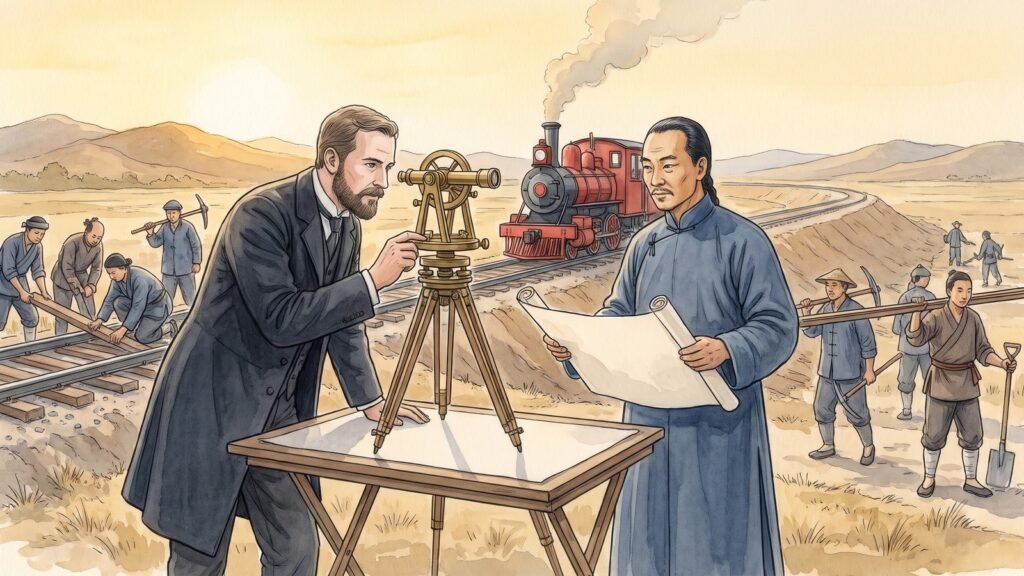
The work began in the late 1890s and moved with the seasons. Track was driven north from Harbin toward Manzhouli at the far end of the Chinese plain, and east toward Suifenhe and the border with the Russian Maritime Province, while the southern branch was pushed down the long valley of the Liao River toward the Liaodong peninsula. Chinese labour did most of the earthwork, recruited in numbers from the villages of the plain and from Shantung, and paid by the piece; the ballast, the culverts, the girder bridges over the tributaries of the Sungari and the Songhua were built by hand with almost no mechanical assistance at all. Russian engineers surveyed the route and set out the alignment. Chinese foremen laid the sleepers and drove the spikes. The gauge was Russian, five feet, or in places simply the Russian broad gauge of the Trans-Siberian itself, and this would matter enormously a few years later when two incompatible systems of rails met at the frontier.
Harbin was a muddy provincial town on the banks of the Songhua when the railway arrived, and it was never the same afterwards. The company built its administration there, and around the administration grew the city: Russian officials and their families, engineers and contractors, a great many Russian and Polish exiles, and eventually some eighty thousand Russian subjects in the province by the early 1920s, a community that depended on the line for its livelihood and created a distinctive, famously volatile culture in the middle of Manchuria. The Chinese population, both the long-settled farmers and the workers who came for the construction, lived alongside it in a city that was, in effect, administered from outside China. The railway zone around Harbin, which the Chinese Eastern administered as a special jurisdiction with its own police, courts, and posting of armed guards along the right of way, was the physical expression of the 1896 contract. A railway company with a foreign sovereign immunity, on Chinese ground, under Chinese flag.
The southern branch reached Port Arthur in 1901 and the whole route was finished by 1903. The economic argument was overwhelming: the line cut the journey from Europe to the Pacific, cut the cost of moving tea, silk, timber and grain, and made the Russian Far East a market rather than a garrison. Britannica’s account of the railway puts the completion of the line in 1903 and the division in 1905 into the space of a paragraph, which is about the right proportion for the outline of it. In the same period Russia pushed on with a railway across Siberia itself and had completed the Amur section of the trans-Siberian by 1916, which meant that the Chinese Eastern, once complete, could be bypassed or not, depending on which route was cheaper and which season. That the line was a commercial triumph was never in doubt. That it was also a strategic vulnerability, sitting in Manchuria where it could be cut in a day and interposed between two great powers, was the thing that the war of 1904 proved.
The gauge question was the sleeper under everything else. The Russian main line used the broad gauge of five feet, and on the Chinese Eastern the company laid track to suit itself, so that a train from Zabaykalsk could run through to Vladivostok without a change of cars, while a train from Harbin to Peking had to be regauged at the frontier. When the line was divided in 1905 the gauge became a political fact as well as an engineering one, and the junction at Changchun, where five-foot Russian track met four-foot-eight-and-a-half Japanese track, acquired the disagreeable distinction of being the place where two empires changed their minds in the space of a mile. Everything that later happened on this railway happened because of what it carried and because of where it crossed, and the gauge was the visible proof of both.
What the line actually carried was mostly grain, timber, beans, coal and soy, north from Manchuria and south from the Russian ports, plus the mail and the official traffic of the empire. Chinese tea and silk went north to Russia by it; Russian flour, kerosene and cast iron came south. The company’s returns were healthy enough that the railway became one of the largest employers in the region, and by the 1920s the Russian and Polish population of Manchuria, numbering well over a hundred thousand by some counts, depended on the line for its livelihood in a way that made Soviet and Chinese claims on it into a livelihood question for thousands of families. There were over twenty thousand Russian employees on the Chinese Eastern by the early 1900s, according to contemporary accounts, and a quarter of Manchuria’s population was in one way or another dependent on the railway. This is the context in which the 1929 seizures happened: a strike in a company town, in effect, and the strikers were Russian and Chinese workers who wanted the same thing.
The Line Split in Two
When the Russo-Japanese war opened in February 1904, both halves of the Chinese Eastern mattered at once. Russia could move troops up the northern line from Manzhouli to the Amur; Japan could land at the terminus of the southern branch at Port Arthur and push north along it toward the railhead at Harbin. The fighting of the next eighteen months was, in a sense, a race to seize the tracks. The Japanese took Port Arthur after a siege that lasted most of a year and cost them some twenty thousand men. Russian and Japanese engineers and engineers’ mates fought over the line itself, and in the winter of 1905 the battle of Mukden was fought around the railway junctions south of the Manchurian capital, with the South Manchuria line as the hinge of the operation. By the summer of 1905 the Japanese held the southern branch and the Russians the northern, and the single enterprise built in 1896 had become two hostile halves of a railway in a war that was, in the end, a Japanese victory.
The settlement was the Treaty of Portsmouth, signed on 23 September 1905. Russia renounced its lease of the Liaodong peninsula, ceded the southern branch of the Chinese Eastern from Port Arthur through Dalny north to Kuanchengtzu, now Changchun, and agreed to pay Japan thirty million roubles as compensation for the transfer. The northern line, from Harbin to Manzhouli and from Harbin east to Suifenhe, stayed with Russia, administered from Harbin, along with the jurisdiction over the railway zone. The Japanese then reorganised their half as the South Manchuria Railway Company, a private company chartered in 1906 and closely controlled by the Japanese government, which ran the line out of Dalian and extended it southward through the Kwantung Leased Territory and eventually into Korea.
What the division did was to make two railways out of one, with two foreign sovereigns sitting on Chinese territory, separated by a single junction station at Changchun. That junction was to become the most consequential piece of railway infrastructure in East Asia. Through it passed the traffic of the South Manchuria line, which by the 1930s carried the overwhelming majority of Japan’s exports to China; through it also passed the traffic of the northern line, which served the Soviet Far East. A train at Changchun could change gauge, change flag and change ownership in the space of a few hundred yards. And in September 1931, it was near a junction on that southern branch, at a place called Liutiaohu, that a small explosion was set on the permanent way, and that explosion is the reason a Chinese military officer’s name is known to every schoolchild in China and a Japanese army became the instrument of a continental war.
Japan did not simply inherit a railway. It rebuilt one. The South Manchuria Railway Company, incorporated in 1906 and run with the closeness of a ministry, treated the line as the first item in a programme of imperial construction rather than as a prize to be exploited. It doubled the track between Mukden and the Korean frontier, electrified it in stages, laid new sidings at the coal mines of Fushun and at the port of Dalian, and used the railway company’s own surveyors, engineers and armed police as the advance guard of the Japanese state on the Chinese mainland. The SMR ran schools, ran a hospital, ran its own police force along the right of way, and published a lavish monthly magazine about its own achievements. It was, in effect, a government in disguise, and it was staffed by men who had come out of the military railway battalions of the Japanese army. By the mid-1930s the South Manchuria Railway was the single largest carrier of Japan’s trade with China and the most important Japanese institution on the mainland. That is what the 1905 treaty had created, in the two decades after it was signed.
The northern line, meanwhile, had a harder time of it. It lost its southern traffic when the line was cut at Changchun, because most of the commercial freight between Russia and China ran by way of the southern ports, and it became what the Russian side of the argument called a line to the interior, carrying what the southern branch could not. Its finances were never sound. It required subsidy from the Russian treasury in its early years, and the amounts involved were large enough to appear in Soviet archival accounts of the 1935 sale as a matter of some bitterness.
Buying the Line Back
The Chinese case for taking the railway back was made as soon as there was a Chinese government willing to make it. The 1896 contract had promised reversion after eighty years and purchase after thirty-six, which put a date in the early 1930s on the calendar. From the beginning the Chinese government treated the joint-stock fiction as a fraud and the arbitration clause as the real business, and the argument was made through the courts of foreign capitalism as well as in Peking. It was also made in London, New York and Tokyo, because the only way to buy a railway was to borrow money, and in the 1920s borrowing money meant finding a banking consortium.
There was precedent for what happened next, and it was bitter. The short line the British merchants built from Shanghai to Wusong in 1876 was bought back by the Chinese government for 285,000 taels and torn up within a year; the railway question in China had a history of being settled by demolition as often as by negotiation. What was different about the Chinese Eastern was its scale, its international legal personality and the fact that the party holding it had just been through a revolution. The Beijing government of the 1920s had inherited the claim and the machinery to press it, and it had a new argument to press it with: that a railway with extraterritorial jurisdiction over Chinese territory was incompatible with Chinese sovereignty.
The scramble for Chinese railway finance in those years was one of the great financial manoeuvres of the age. After the Boxer indemnity and the war indemnity had left the Qing government with no credit worth the name, the foreign banks formed the China Consortium, first in 1909 and again in 1920, to lend to China on acceptable terms and to divide the business among themselves. The second consortium, signed in October 1920, brought together the Hongkong and Shanghai Banking Corporation, the Banque de l’Indochine, the Yokohama Specie Bank and a substantial group of American banks including J.P. Morgan & Co. and the National City Bank of New York. The United States secretary of state was in frequent cable correspondence with the minister in Peking about what the consortium would and would not lend to, and the cables make the logic plain: the consortium would not take piecemeal business, and Chinese loans could only be marketed abroad if they were for “constructive purposes, particularly railways.” The membership of the consortium, the terms on which it would lend, and its liquidation at the end of the war are set out in the standard reference entry on the China Consortium, and the American cable traffic about what it would lend for, and for what, was printed in the Foreign Relations of the United States for 1920.
American ambition in Manchuria had its own vehicle in E. H. Harriman, the railway magnate, whose plan was to place the southern branch and a railway down the coast under an international syndicate financed in the United States and operated jointly with Japan, in the spirit of the Open Door. The scheme was never realised; it was blocked in Tokyo, and Harriman died in 1909 with the round-the-world line unbuilt. But the general shape of the attempt kept repeating. Every government in Peking wanted the same thing, which was to redeem the railway with a foreign loan and keep the foreign lenders at arm’s length. Foreign bankers wanted the same thing, which was to lend against the security of the railway and manage it until the loan was paid. Those two desires were never quite compatible, and the Chinese discovered this at some cost.
The political upheaval of 1917 and the retreat of the Russian regime changed the arithmetic. Chinese troops entered Harbin at the end of that year, and in March 1920 they occupied the railway’s buffer security zone along its length, in effect ending the railway’s own armed protection. In September 1920 the Chinese government annulled the extraterritorial rights of Russian envoys and consuls in China, and in 1921 the zone was converted into a Special Region of the Eastern Provinces. For a period Chinese troops guarded the line and Russian trains still ran over it. Then the diplomacy caught up with the fait accompli. On 31 May 1924 the Soviet government and the government at Peking signed an agreement on general principles, restoring diplomatic relations and formally renouncing Russian special rights and privileges in China, and two secret agreements followed, one with Peking and one with Zhang Zuolin in Manchuria, signed on 20 September 1924, which are among the better-documented pieces of Soviet improvisation of the period. Under them the railway became a joint enterprise, a “purely commercial enterprise” with a board of five Chinese and five Soviet directors, six votes required for any positive action, a Chinese director-general, a Russian manager, and the concession period cut from eighty years to sixty, so that the line would fall to China free of charge in 1962 rather than 1976. China could also redeem it with Chinese capital at a fair cost, at any time, though no one seriously expected the money to be found.
Nothing about the arrangement worked, and everyone involved could see why. Five Chinese directors who spoke no Russian and five Russian directors who spoke no Chinese could not run a railway between them. Every disagreement had to be referred back to two governments, which meant that every operational decision became a diplomatic incident, and the two governments were not exactly on speaking terms. A study of the Soviet Union’s secret diplomacy over the railway, published in the Journal of Asian Studies, sets out the parallel negotiations on the Soviet side and the difficulties the Soviet government had in agreeing a deal with Peking. The arrangement broke down badly in 1925 and 1926, when the Soviet general manager, A. N. Ivanov, prohibited the carriage of military cargoes and troops and was arrested by Zhang Zuolin’s men; the Chinese took control of the southern branch, and Zhang Zuolin began expelling Soviet citizens. Lev Karakhan, the Soviet ambassador in Peking, handled the matter with a toughness the historian Nikita Vul has described as rash and undertaken without seeking advice from Moscow, and the standoff convinced the Chinese that they could take stronger measures against Soviet institutions without the worse consequences. That confidence, as Vul argues, was one of the factors that made the crisis of 1929 possible, and the crisis of 1929 in turn sharpened Japanese anxiety about Soviet strength in the region, which fed directly into the Japanese decision to take Manchuria in 1931.
The incidents of 1926 were not merely a squabble over freight. Ivanov’s prohibition on carrying troops and military cargoes asserted that the railway was a commercial enterprise and not a military pipeline for Zhang Zuolin’s army; Zhang’s arrest and expulsion of the Soviet staff asserted that the railway’s zone was Chinese territory. Both claims were formally correct, which is precisely why they could not be reconciled.
There was one attempt to solve the problem by adding to it. In 1920 the Chinese had established a university at Harbin on the railway’s own land, staffed largely by Russian and other émigré academics who had fled the Revolution, and it ran until 1922, when the funding and the politics dried up together. It was an odd little institution, a European-style university with a Chinese official at its head and a foreign staff in its lecterns, and it tells you a good deal about how unusual the Chinese Eastern was: a private railway company operating an educational establishment, a police force, a postal system and a customs house along a thousand miles of foreign soil. It was, as one observer put it, a state in miniature, and it was Chinese only in the sense that it happened to be located inside the borders of China.
The Tracks at Mukden
On the night of 14 September 1929 the Chinese forces under Zhang Xueliang took the Chinese Eastern Railway, detaining the Russian manager and Russian personnel, and within days Moscow had severed diplomatic relations and delivered an ultimatum in the formal language of the previous century. China formally complained to the League of Nations. Germany, which had assumed the rights of both countries on each other’s territory, attempted a mediation in Berlin. By December the Chinese had given way, the railway was restored to its pre-July status, and the railway had become the most heavily armed and most diplomatically radioactive stretch of track in the world.
The settlement restored the status quo ante, which was to say it restored an arrangement that had already failed. The Chinese side’s position after the crisis was worse than before it: the railway had been shown to be unusable as a lever of sovereignty without risking war, the Chinese government had been forced to back down under a Soviet ultimatum, and the case of Zhang Zuolin’s Manchurian government as a separate diplomatic entity had been settled in favour of Moscow in a way that made the Chinese position in Manchuria weaker than at any time since 1905. In Moscow and Tokyo alike, the reading was the same: the railway was in Manchuria because China was not strong enough to dislodge it. And in Japan the reading had a further edge to it, because the railway had demonstrated that China would not fight for anything in Manchuria. The South Manchuria Railway’s own planners were drawing exactly the conclusion that would be acted on four years later.
The end of the story of the northern line came not from the Chinese but from the Japanese. In 1933 the Soviet government, under pressure and unwilling to be drawn into a war in Northeast China, offered to sell its interest in the railway. Japan suggested that the purchase should be made by Manchukuo rather than by Japan directly, and in March 1935 an agreement was signed transferring the Soviet interest to the Manchukuo government for one hundred and forty million yen, with Japan guaranteeing the payment. Manchukuo paid 23.3 million yen immediately. The Chinese government protested that the 1924 agreements gave it a veto over any transfer to a third party; the Soviet reply was that China had forfeited its rights by ceasing to be a partner in the management of the railway. The railway was regauged to the European standard and in October 1936 was merged with the South Manchuria Railway into a single system with its headquarters at Mukden. The line built by Russia in Manchuria had become a Japanese railway. The Korean scholarship on the sale, by Kim Ji-hwan, is the standard modern analysis of the Sino-Japanese and Soviet diplomatic consequences of the 1935 transfer, and the standard reference entries for the Chinese Eastern Railway and for its return to Chinese control set out the skeleton of the whole transaction.
But it was the southern line, and a junction near Changchun, that produced the pretext for the war that followed. In the early hours of 18 September 1931 a small explosive charge blew a section of the South Manchuria Railway’s track near Liutiaohu, a few miles north of Mukden, close to the branch that served the Fushun coal mines. Chinese troops under Zhang Xueliang, operating under Chiang Kai-shek’s instructions to guard the line, were blamed. The Kwantung Army officers who had planned the operation attributed the explosion to Chinese saboteurs and used it as the justification for a full-scale incursion into Manchuria. The railway, which had been built as an instrument of Russian imperial penetration and then split by Japan into a Japanese instrument, supplied the excuse for the seizure of the whole province and the establishment of the puppet state of Manchukuo. Within five years the line carried the invasion of China proper. It is one of the more uncomfortable facts of the twentieth century that a piece of transport infrastructure built by a foreign power on Chinese soil, under a Chinese concession, ended by determining the fate of a continent.
After the war, the Soviet Union recovered its position by agreement. The Moscow conference of February 1945 provided that the Chinese Eastern and the South Manchuria Railway would be jointly operated by a joint Soviet-Chinese company for thirty years, with the Soviet interests safeguarded and Chinese sovereignty retained in Manchuria; the fourteen-point Sino-Soviet agreement of 14 August 1945 carried the same principle into effect and united the two lines as the Chinese Changchun Railway. On 31 December 1952 the Soviet Union transferred its interest in the Chinese Changchun Railway to the People’s Republic of China without compensation, and the line that had been the object of so much fighting and so much accounting finally became, in law as well as in fact, a Chinese railway. The original terms, on paper, had been generous to China. It took forty-five years to collect on them. The American record of the Potsdam settlement, in the two volumes of the Foreign Relations of the United States for the Berlin conference of 1945, sets out the joint company and the competing Soviet and Chinese claims in full.
Manchukuo was built on the line. Within months of the occupation, the South Manchuria Railway was running the administration of the new state almost as effectively as it ran its own trains: the company’s police, its surveyors, its engineers and its armed guards supplied the personnel of a government that had no other administrative capacity of its own. The rail line was the instrument of the annexation and the thing that made it stick, in the literal sense that control of the permanent way was control of the country, because a railway line can be defended, patrolled and taxed in a way that a province cannot. Zhang Xueliang’s forces were scattered from the line outward, and the argument in Japan that followed the Mukden incident was not really about sovereignty at all; it was about whether the South Manchuria Railway could be operated in peace, and the answer the Kwantung Army gave was that it could not be operated at all without the extension of Japanese control over the whole of Manchuria.
References
- Chinese Eastern Railway — Encyclopaedia Britannica, Toronto, undated
- Chinese Eastern Railway — Wikipedia, the free encyclopedia, revised 2026
- The Soviet Union’s Secret Diplomacy Concerning the Chinese Eastern Railway, 1924-1925 — Journal of Asian Studies, Cambridge University Press
- He, Who Has Sown the Wind: Karakhan, the Sino-Soviet Conflict over the Chinese Eastern Railway, 1925-26, and the Failure of Soviet Policy in Northeast China — Modern Asian Studies, Cambridge University Press
- The Sale of the Chinese Eastern Railway — Foreign Affairs, Council on Foreign Relations, October 1933
- Foreign Relations of the United States: Diplomatic Papers, The Conference of Berlin (The Potsdam Conference), 1945, Volume II — United States Department of State, Office of the Historian, Washington, 1945
- Foreign Relations of the United States: Diplomatic Papers, The Conference of Berlin (The Potsdam Conference), 1945, Volume I — United States Department of State, Office of the Historian, Washington, 1945
- Foreign Relations of the United States, 1920, Volume I: The Far East, No. 663 — United States Department of State, Office of the Historian, Washington, 1920
- The Sale of Chinese Eastern Railway and Sino-Japan-Soviet Diplomatic Relations — Kim Ji-hwan, in Chungse(history) sahoe no. 37, Central Historical Institute, Seoul, 1998
- China Consortium — Wikipedia, the free encyclopedia, revised 2026
- Return of the Chinese Eastern Railway — Wikipedia, the free encyclopedia, revised 2026