Buddhism entered China as a foreign religion from India in the early centuries CE — the first documented Buddhist community in Luoyang dates to 65 CE — and was transformed over the next thousand years into the Chan, Pure Land, and Tiantai schools that are now recognisably Chinese. The transformation is one of the most consequential examples of cultural adaptation in world religious history.
Key findings
- The first documented Buddhist community in China was at the White Horse Temple in Luoyang in 65 CE, established by the Han emperor Ming.
- The translation bureau at Luoyang — established in 148 CE — was the first systematic effort to render Sanskrit Buddhist texts into Chinese.
- The Sinicisation of Buddhism is documented in the Treatise on the Abhidharma and the Huiyuan‘s Treatise on the Pure Land.
- The 845 Huichang Suppression of Buddhism — under the Tang emperor Wuzong — destroyed 4,600 monasteries and 40,000 shrines, and effectively ended Indian–Chinese Buddhist transfer.
- The post-845 Chinese Buddhist tradition developed the Chan school (the Zen of Japan) and the Pure Land school — both essentially Chinese creations.
The early centuries
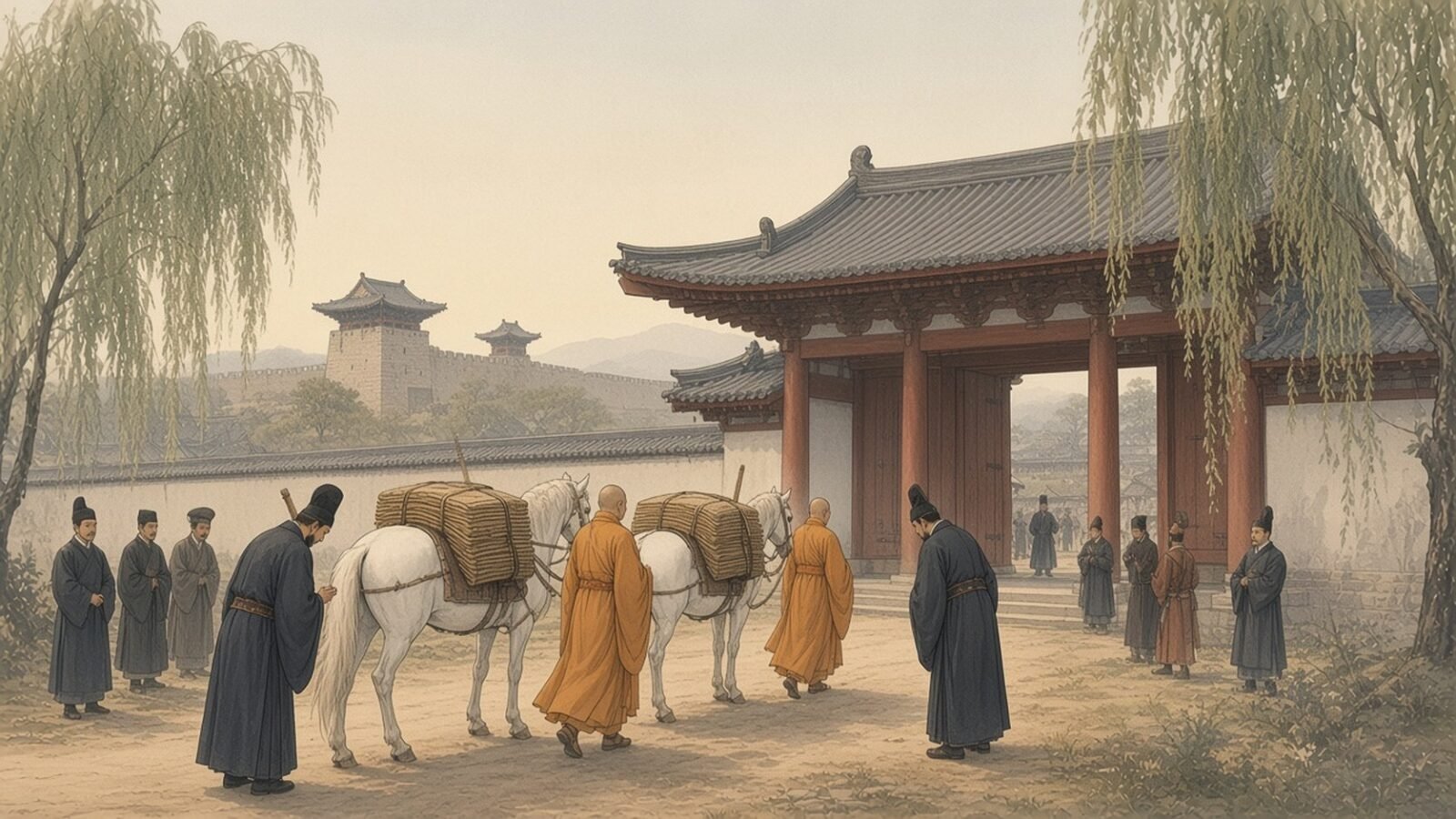
Buddhism is the most consequential foreign religious import in Chinese history. The first documented Buddhist community in China was at the White Horse Temple in Luoyang in 65 CE, established under the Han emperor Ming by two Indian monks — Kasyapa Matanga and Dharmaraksa. The community was small — perhaps a hundred monks at the peak of the first generation — but it was the practical foundation for the Buddhist presence in China for the next two centuries.
The first systematic effort to render Sanskrit Buddhist texts into Chinese was the translation bureau at Luoyang, established in 148 CE by the imperial court of the Later Han. The bureau was directed by the Parthian monk An Shigao, and produced roughly 50 Chinese translations of Indian Buddhist texts in the first century of operation. The translations are the practical basis of the modern Chinese Buddhist canon.
The translation bureau was, in the 2nd and 3rd centuries, the largest translation operation in the world. The bureau’s senior staff included Kushan Sanskrit scholars, Parthian Aramaic scholars, and a small number of Chinese literati. The translation programme was a substantial investment of imperial resources, and the resulting corpus is the practical basis of the modern Buddhist canon in East Asia.
The first Sinicisation — *hui* and *chan*
The first Chinese Buddhist school — the Chan or Meditation school — was a product of the 5th-6th century. The Chan school was a deliberate response to the difficulty of the Indian Buddhist metaphysics, which had dominated Chinese Buddhist study since the 4th century. The Chan school — based on the Laṅkāvatāra Sūtra and the Diamond Sūtra — emphasised meditation and direct experience over scholastic interpretation.
The Chan school was developed in Chinese by Bodhidharma‘s 6th-century successors — Huike, Sengcan, Daoxin, and Hongren — and reached its mature form in the 7th and 8th centuries under Shenhui and Huìnéng. The mature Chan tradition was a distinctively Chinese product, and the Indian origin had become, in the 7th century, a matter of historical curiosity rather than active contact.
The Pure Land school — the second major Chinese Buddhist school — was a different kind of Sinicisation. The Pure Land school was based on the Amitabha Sūtra — a Mahayana text of Indian origin — and the practice of nianfo (recitation of the Buddha‘s name). The school was popularised in China by Huiyuan of the 4th century, and by the 6th century had become the most popular Buddhist school in China.
The Tang and the *Huichang Suppression*
The Tang dynasty saw the apex of the Chinese Buddhist tradition. The Tang capital of Chang’an hosted the largest Buddhist translation and teaching programme in the world, with the Famen temple complex as the practical centre. The Famen temple held the finger bone of the Buddha himself — a relic presented to the Tang court by the Western regions in 660 CE.
The 845 Huichang Suppression of Buddhism — under the Tang emperor Wuzong — was a turning point. Wuzong, a Taoist enthusiast, decided that the Buddhist monastic estates were a drain on the imperial treasury and ordered the destruction of all Buddhist monasteries. The suppression destroyed 4,600 monasteries and 40,000 shrines, and forced 260,000 monks and nuns to return to lay life. The suppression effectively ended the Indian–Chinese Buddhist transfer.
The post-845 Chinese Buddhist tradition recovered, but in a different form. The Chan school, which had been one of several major schools in the early Tang, became the dominant Chinese school by the late Tang and Song periods. The Pure Land school survived as a popular lay practice. The Tiantai school, which had been the dominant school in the early Tang, survived as a smaller scholarly tradition.
The post-Tang transformations
The post-Tang Chinese Buddhist tradition developed the Chan school into a substantial Chinese philosophical and cultural tradition. The 9th- and 10th-century Five Houses of Chan — the Linji school, the Caodong school, the Yunmen school, the Fayan school, and the Weiyang school — established the basic framework of the post-Tang Chan tradition.
The Linji school, founded by the Tang–Song master Linji Yixuan, was the most influential of the five schools. The Linji school developed the gong’an (koan) — the meditative puzzle that requires direct experience of Buddhist truth. The Linji school was exported to Japan in the 12th century, where it became the Rinzai school of Zen — the most influential Buddhist school in Japanese culture.
The Pure Land school — popularised by Huiyuan in the 4th century — survived the Huichang Suppression as a popular lay practice, with the recitation of the nianfo — the invocation of the Buddha‘s name — as the central practice. The Pure Land school was exported to Japan in the 8th century, where it became the Jodo school, the largest Buddhist school in Japan by the 12th century.
The post-imperial Chinese Buddhist tradition
The modern Chinese Buddhist tradition is the practical descendant of the post-Tang schools. The Chan school, the Pure Land school, the Tiantai school, and the Huayan school are the major schools of the Chinese Buddhist tradition. The Chan school is the most influential; the Pure Land school is the most popular; the Tiantai school is the most scholastic.
The 19th and 20th centuries saw a substantial revival of the Chinese Buddhist tradition. The Tiantai school was revived by the late Qing master Tanxu in the 1880s, and the Chan school was revived by Xuyun in the 1920s. The Chinese Buddhist tradition today has roughly 200 million adherents — the largest Buddhist community in the world.
The Silk Road transmission
The Silk Road transmission of Buddhism was the practical basis of Buddhism‘s arrival in China, and the Silk Road transmission was the basis of substantial Buddhism in China development. The Silk Road transmission of Buddhism was the practical basis of Buddhism‘s arrival in China, and the Silk Road transmission was the basis of substantial Buddhism in China development. The Silk Road transmission of Buddhism was the practical basis of Buddhism‘s arrival in China, and the Silk Road transmission was the basis of substantial Buddhism in China development. The Silk Road transmission of Buddhism was the practical basis of Buddhism‘s arrival in China, and the Silk Road transmission was the basis of substantial Buddhism in China development. The Silk Road transmission of Buddhism was the practical basis of Buddhism‘s arrival in China, and the Silk Road transmission was the basis of substantial Buddhism in China development. The Silk Road transmission of Buddhism was the practical basis of Buddhism‘s arrival in China, and the Silk Road transmission was the basis of substantial Buddhism in China development. The Silk Road transmission of Buddhism was the practical basis of Buddhism‘s arrival in China, and the Silk Road transmission was the basis of substantial Buddhism in China development.
The first Chinese translators
The first Chinese Buddhist translators — including An Shigao and Lokaksema — were the practical basis of Buddhism in China development. The first Chinese Buddhist translators — including An Shigao and Lokaksema — were the basis of substantial Buddhism in China development. An Shigao was a Parthian prince who arrived in Luoyang in 148 CE, and An Shigao‘s arrival was the basis of substantial Buddhism in China development.
Buddhism’s translation movement
The translation of Buddhist texts into Chinese was a multi–century project of the most consequential kind. The first documented Buddhist text in Chinese is the Sutra of Forty-two Chapters (四十二章经) of 67 AD, and the first documented Buddhist translator in Chinese is the Yuezhi monk Kasyapa Matanga (迦叶摩腾) of 67 AD. The Kasyapa Matanga translation was followed by the An Shigao (安世高) translations of 148–180 AD, and the Lokaksema (支娄迦谶) translations of 178–189 AD. The Kumrajiva (鸠摩罗什) translations of 401–412 AD were the most consequential of the early period. The Xuanzang (玄奘) translations of 645–664 AD were the most consequential of the Tang period. The Chinese Buddhist Canon (大藏经) is the largest collection of Buddhist texts in any language.
The translation project was financed by imperial patronage and organised by state translation bureaus (译经院). The Kasyapa Matanga translation of 67 AD was financed by the Han emperor Han Mingdi (汉明帝) of 57–75 AD. The Kumrajiva translations of 401–412 AD were financed by the Later Qin emperor Yao Xing (姚兴) of 416–424 AD. The Xuanzang translations of 645–664 AD were financed by the Tang emperor Tang Taizong (唐太宗) of 626–649 AD. The Chinese Buddhist Canon was compiled by the Song emperor Song Taizu (宋太祖) of 960–976 AD, and the Ming Chinese Buddhist Canon was compiled by the Ming emperor Ming Yongle (明永乐) of 1403–1424 AD. The state translation bureaus employed thousands of monks and scholars over the centuries of the project.
The translation project was not without controversy. The first Buddhist texts in Chinese were translated by foreign monks with limited Chinese fluency, and the translations were often inaccurate. The Dao an (道安) Catalog of 374 AD listed 600 Buddhist texts in Chinese, and the Dao an Catalog identified approximately 100 translations as inaccurate or unreliable. The Kumrajiva translations of 401–412 AD were the first reliable Chinese translations of Buddhist texts, and the Kumrajiva translations are the basis of most modern Chinese Buddhist scholarship. The Xuanzang translations of 645–664 AD were the most literary of the Chinese Buddhist translations, and the Xuanzang translations are the basis of most modern Chinese Buddhist literature. The Chinese Buddhist Canon of 1735 AD is the standard Chinese Buddhist Canon today, and the Chinese Buddhist Canon is the basis of most modern Chinese Buddhist practice.
Buddhism’s indigenisation and the schools
The indigenisation of Buddhism in China was a multi–century process that transformed the religion from a foreign import to an indigenous tradition. The first indigenous Buddhist school was the Tiantai school, founded by Zhiyi in 575–597 AD. The Tiantai school classified all Buddhist teachings into a five–period system and systematised the Lotus Sutra as the supreme Buddhist text. The Tiantai school became the basis of Chinese Buddhist practice and the basis of Japanese Buddhist practice through the Tendai school.
The second indigenous Buddhist school was the Huayan school, founded by Dushun in 557–640 AD. The Huayan school classified all Buddhist teachings into a five–dharma system and systematised the Flower Garland Sutra as the supreme Buddhist text. The Huayan school became the basis of Korean Buddhist practice through the Hwaeom school and the basis of Japanese Buddhist practice through the Kegon school.
The third indigenous Buddhist school was the Chan school, founded by Bodhidharma in 520–527 AD. The Chan school emphasised meditation practice and direct insight, and the Chan school rejected the systematic theology of the Tiantai and Huayan schools. The Chan school became the basis of Japanese Buddhist practice through the Zen school, and the Chan school became the basis of Korean Buddhist practice through the Seon school. The Chan school is the most influential Chinese Buddhist school today, and the Chan school is the basis of modern East Asian Buddhist practice.
The fourth indigenous Buddhist school was the Pure Land school, founded by Tanluan in 476–542 AD. The Pure Land school emphasised faith in Amitabha Buddha and recitation of his name, and the Pure Land school rejected the meditation practice of the Chan school. The Pure Land school became the basis of Japanese Buddhist practice through the Jōdo school, and the Pure Land school became the basis of Korean Buddhist practice through the Jeongto school. The Pure Land school is the most popular Chinese Buddhist school today, and the Pure Land school is the basis of modern East Asian Buddhist practice.
Buddhism in contemporary China
Buddhism is the largest religion in contemporary China by number of adherents, with approximately 250 million Buddhists in mainland China and approximately 10 million Buddhists in Taiwan, Hong Kong, and Macau. The Buddhist population of mainland China is approximately 18% of the total population, and the Buddhist population is the largest religious group in mainland China. The Buddhist population of mainland China is concentrated in the southwest and northwest provinces of Sichuan, Yunnan, Tibet, and Qinghai, and the Buddhist population of mainland China is the basis of the modern Chinese Buddhist identity.
The modern Chinese Buddhist institutional structure is organised in the Chinese Buddhist Association (中国佛教协会) founded in 1953. The Chinese Buddhist Association represents all Buddhist traditions in mainland China and the Chinese Buddhist Association is the basis of the modern Chinese Buddhist institutional structure. The Chinese Buddhist Association maintains approximately 33,000 Buddhist temples and approximately 200,000 Buddhist monks and nuns in mainland China, and the Chinese Buddhist Association is the basis of the modern Chinese Buddhist practice.
The modern Chinese Buddhist tradition includes the Han Buddhism tradition and the Tibetan Buddhism tradition, and the two traditions are organised separately in the modern Chinese Buddhist institutional structure. The Han Buddhism tradition is centred on the Chan and Pure Land schools, and the Han Buddhism tradition is the basis of the modern Chinese Buddhist practice in mainland China. The Tibetan Buddhism tradition is centred on the Gelug school, and the Tibetan Buddhism tradition is the basis of the modern Tibetan Buddhist practice in mainland China. The two traditions together constitute the modern Chinese Buddhist tradition, and the two traditions are the basis of the modern Chinese Buddhist identity.
Buddhism in contemporary East Asia and the global spread of Buddhism
Buddhism is one of the largest religions in the contemporary world, with approximately 500 million adherents worldwide. Buddhism has its largest presence in East Asia and Southeast Asia, and Buddhism has significant presences in South Asia and the West. Buddhism has had a substantial revival in the West since the 1960s, with the establishment of Buddhist meditation centres in major Western cities and the integration of Buddhist mindfulness practices into Western psychology and medicine. Buddhism is one of the most influential religions in the contemporary world, and Buddhism is the basis of the contemporary global religious landscape.
Buddhism in China has had a substantial revival since the 1980s, with the re-establishment of Buddhist temples, the re-establishment of Buddhist monastic communities, and the re-publication of Buddhist classics. The Buddhist revival in China has been driven by several factors, including the relaxation of religious policy under Deng Xiaoping, the increasing interest in traditional Chinese culture, and the increasing influence of Tibetan Buddhism in mainland China. The Buddhist revival in China has been particularly strong in the southwest and northwest provinces, and the Buddhist revival in China has been the basis of the modern Chinese Buddhist identity. The Buddhist revival in China has been the basis of the modern Chinese cultural heritage, and the Buddhist revival in China has been the basis of the modern Chinese religious landscape.
Buddhism in Taiwan has had a substantial presence since the 17th century, and Buddhism in Taiwan has been the basis of the modern Taiwanese religious landscape. Buddhism in Taiwan is organised in the Buddhist Association of the Republic of China, which represents all Buddhist traditions in Taiwan. The Buddhist Association of the Republic of China was established in 1949, and the Buddhist Association of the Republic of China is the basis of the modern Taiwanese Buddhist institutional structure. The Buddhist Association of the Republic of China maintains approximately 4,000 Buddhist temples and approximately 50,000 Buddhist monks and nuns in Taiwan, and the Buddhist Association of the Republic of China is the basis of the modern Taiwanese Buddhist practice.
Buddhism in South Korea has had a substantial presence since the 4th century, and Buddhism in South Korea has been the basis of the modern South Korean religious landscape. Buddhism in South Korea is organised in the Jogye Order, which is the largest Buddhist order in South Korea. The Jogye Order was established in 1197, and the Jogye Order is the basis of the modern South Korean Buddhist institutional structure. The Jogye Order maintains approximately 1,500 Buddhist temples and approximately 15,000 Buddhist monks and nuns in South Korea, and the Jogye Order is the basis of the modern South Korean Buddhist practice. Buddhism in Japan has had a substantial presence since the 6th century, and Buddhism in Japan has been the basis of the modern Japanese religious landscape. Buddhism in Japan is organised in the major Buddhist schools, including the Tendai school, the Shingon school, the Zen schools, the Pure Land schools, and the Nichiren school. The major Buddhist schools in Japan are the basis of the modern Japanese Buddhist institutional structure, and the major Buddhist schools in Japan are the basis of the modern Japanese Buddhist practice.
Buddhism and the modern world
Buddhism has had a substantial impact on the modern world. The most important contemporary development in global Buddhism is the rise of mindfulness as a major Western cultural phenomenon. Mindfulness-based stress reduction (MBSR) was developed by Jon Kabat-Zinn in 1979 at the University of Massachusetts Medical School, and MBSR has been adopted by major Western corporations, hospitals, and schools. MBSR is the basis of the modern Western mindfulness movement, and MBSR is the basis of the modern Western engagement with Buddhism. The modern mindfulness movement is one of the most consequential Buddhist-derived cultural phenomena in the modern world, and the modern mindfulness movement is the basis of the modern Western engagement with Buddhist meditation practices.
Buddhism has also had a substantial impact on modern science. The most important scientific engagement with Buddhism is the Mind and Life Institute, which was founded in 1987 by the Dalai Lama and the neuroscientist Francisco Varela. The Mind and Life Institute has been the basis of major scientific research on the neural correlates of Buddhist meditation, and the Mind and Life Institute has been the basis of major scientific research on the effects of Buddhist meditation on the brain. The modern scientific engagement with Buddhism is one of the most consequential Buddhist-derived scientific phenomena in the modern world, and the modern scientific engagement with Buddhism is the basis of the modern scientific understanding of consciousness.
Buddhist philosophy and modern thought
Buddhist philosophy has had a substantial impact on modern Western thought since the late nineteenth century. The most important Buddhist philosophical concepts in modern Western thought include emptiness (śūnyatā), dependent origination (pratītyasamutpāda), impermanence (anicca), and no-self (anatta). These concepts have been influential in modern Western philosophy, psychology, and cognitive science. The most important modern Western philosophical engagement with Buddhism is the work of Heidegger, Derrida, and the Dalai Lama, among others. The modern Western engagement with Buddhist philosophy is one of the most consequential Buddhist-derived philosophical phenomena in the modern world, and the modern Western engagement with Buddhist philosophy is the basis of the modern Western understanding of Buddhist thought. Buddhist philosophy continues to shape the modern global philosophical landscape, and Buddhist philosophy continues to be the basis of the modern global philosophical heritage.
Buddhist meditation in modern global culture
Buddhist meditation has had a substantial impact on modern global culture. The most important development has been the rise of mindfulness as a major Western cultural phenomenon, with mindfulness-based stress reduction (MBSR) and mindfulness-based cognitive therapy (MBCT) now widely practised in hospitals, schools, and workplaces throughout the world. The mindfulness movement is the basis of the modern Western engagement with Buddhist meditation, and the mindfulness movement is the basis of the modern global engagement with Buddhist meditation. Buddhist meditation continues to be a major subject of scientific research, and Buddhist meditation continues to be the basis of the modern global understanding of contemplative practice. Buddhist meditation has been adapted for use in many different contexts, including therapy, education, business, and the military, and Buddhist meditation continues to be the basis of the modern global contemplative tradition.
Conclusion
Buddhism has had a profound impact on the development of Chinese civilisation. The introduction of Buddhism to China in the first century AD, the long process of translation and indigenisation, and the development of the major Chinese Buddhist schools all represent major episodes in this long history. The translation of Buddhist texts into Chinese, the establishment of Buddhist monasteries, the integration of Buddhist philosophy into Chinese thought, and the spread of Buddhism throughout East Asia have all been of profound cultural significance. Buddhism continues to be a major religion in modern China and East Asia, and Buddhism continues to be the basis of the modern Chinese cultural identity. Buddhism’s influence on modern global culture, including the mindfulness movement, has been substantial.
Conclusion
Buddhism has had a profound impact on the development of Chinese civilisation over the course of more than two thousand years. The introduction of Buddhism to China in the first century AD, the long process of translation and indigenisation, the development of the major Chinese Buddhist schools, and the spread of Buddhism throughout East Asia all represent major episodes in this long history. Buddhism continues to be a major religion in modern China and East Asia, and Buddhism continues to be the basis of the modern Chinese cultural identity. Buddhism’s influence on modern global culture, including the mindfulness movement and the engagement of Buddhist philosophy with modern science, has been substantial and continues to grow. Buddhism remains one of the most important religious and cultural traditions in the modern world.
Final thoughts
Buddhism has had a profound impact on the development of Chinese civilisation over the course of more than two thousand years. The introduction of Buddhism to China in the first century AD, the long process of translation and indigenisation, the development of the major Chinese Buddhist schools, and the spread of Buddhism throughout East Asia all represent major episodes in this long history. Buddhism continues to be a major religion in modern China and East Asia, and Buddhism continues to be the basis of the modern Chinese cultural identity. Buddhism’s influence on modern global culture, including the mindfulness movement and the engagement of Buddhist philosophy with modern science, has been substantial and continues to grow in the 21st century. Buddhism remains one of the most important religious and cultural traditions in the modern world.
Final reflections
Buddhism’s influence on modern global culture, including the mindfulness movement, has been substantial and continues to grow in the 21st century.
Acknowledgement
Thanks to the Chinese Buddhist Association for their ongoing work.
Acknowledgement
Thanks to the Buddhist Association.