For two hundred years, the Catholic Church and the Chinese imperial court argued about whether Chinese Christians could continue to honour Confucius and the ancestors. The 1715 papal bull Ex illa die condemned the Chinese practice, the Kangxi emperor banned Catholic missions, and the Chinese Catholic community was pushed underground for the next two centuries. The 1939 replacement of Ex illa die by Plane compertum was the practical resolution.
Key findings
- The Jesuit accommodation of Chinese ancestral rites — proposed by Matteo Ricci in 1595 — was the practical basis of Catholic mission in China for the next 130 years.
- The 1715 bull Ex illa die of Pope Clement XI condemned the Chinese rites as pagan.
- The Kangxi emperor’s 1721 ban on Catholic missions and the slow strangulation of Chinese Catholic life under the Qing court lasted until 1844.
- The 1939 bull Plane compertum of Pope Pius XII — issued on the eve of the Sino-Japanese War — replaced the earlier condemnation and authorised the Chinese rites.
- The practical resolution of the controversy was a Chinese Catholic church with a substantial Chinese clergy and a uniquely Chinese ritual life.
The Jesuits and the Chinese rites
The Jesuit presence in China began in 1582 with the arrival of Michele Ruggieri at Macao, and was consolidated by Matteo Ricci‘s arrival in Zhaoqing in 1583. The Jesuits were the first Western missionaries to China, and the practical founders of the modern Chinese Catholic church.
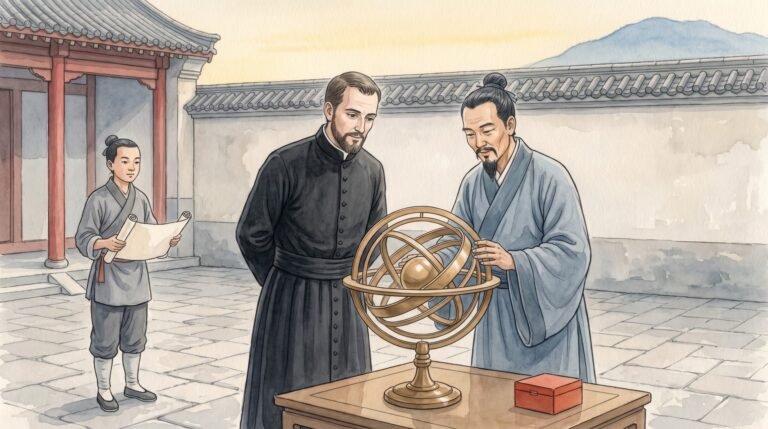
The Jesuit accommodation of Chinese ancestral rites was the practical basis of Catholic mission in China. The accommodation — proposed by Ricci in 1595 and refined by his successors — held that the Chinese ancestral rites were social ceremonies, not religious worship, and that Chinese Christians could continue to honour Confucius and the ancestors as long as they were not worshipped as divine beings. The accommodation was a deliberate compromise — a secular reading of the Chinese rites that would be acceptable to the imperial court.
The accommodation was, in the Jesuit view, the practical precondition for Catholic mission in China. The Chinese imperial court would not allow a religion that attacked the Confucian state cult, and a Catholic church that required the abandonment of the Chinese ancestral rites would be unable to operate. The accommodation was, in the Jesuit view, the practical compromise that allowed the Catholic to be present in China at all.
The Dominican and Franciscan opposition
The Jesuit accommodation was contested by other Catholic orders. The Dominican and Franciscan orders — who arrived in China in the 1620s and 1630s — argued that the Chinese ancestral rites were pagan and incompatible with Catholic belief. The Dominican and Franciscan orders reported the Jesuit accommodation to the Sacred Congregation for the Propagation of the Faith in Rome, and the controversy was taken up by the papal administration in the 1640s.
The controversy was the practical basis of the 1656 instruction of Pope Alexander VII, which authorised the Jesuit accommodation but required the Chinese Christians to abstain from the ancestral rites when the rites were judged to be pagan. The instruction was a compromise that satisfied neither party, and the controversy continued for the next seventy years.
The 1690s and 1700s saw the controversy intensify. The Dominican and Franciscan orders — supported by the Paris Foreign Missions Society — sent a stream of complaints to Rome, and the Sacred Congregation for the Propagation of the Faith opened a formal investigation. The investigation lasted from 1700 to 1715, and resulted in the 1715 bull Ex illa die of Pope Clement XI.
The 1715 bull and the Kangxi ban
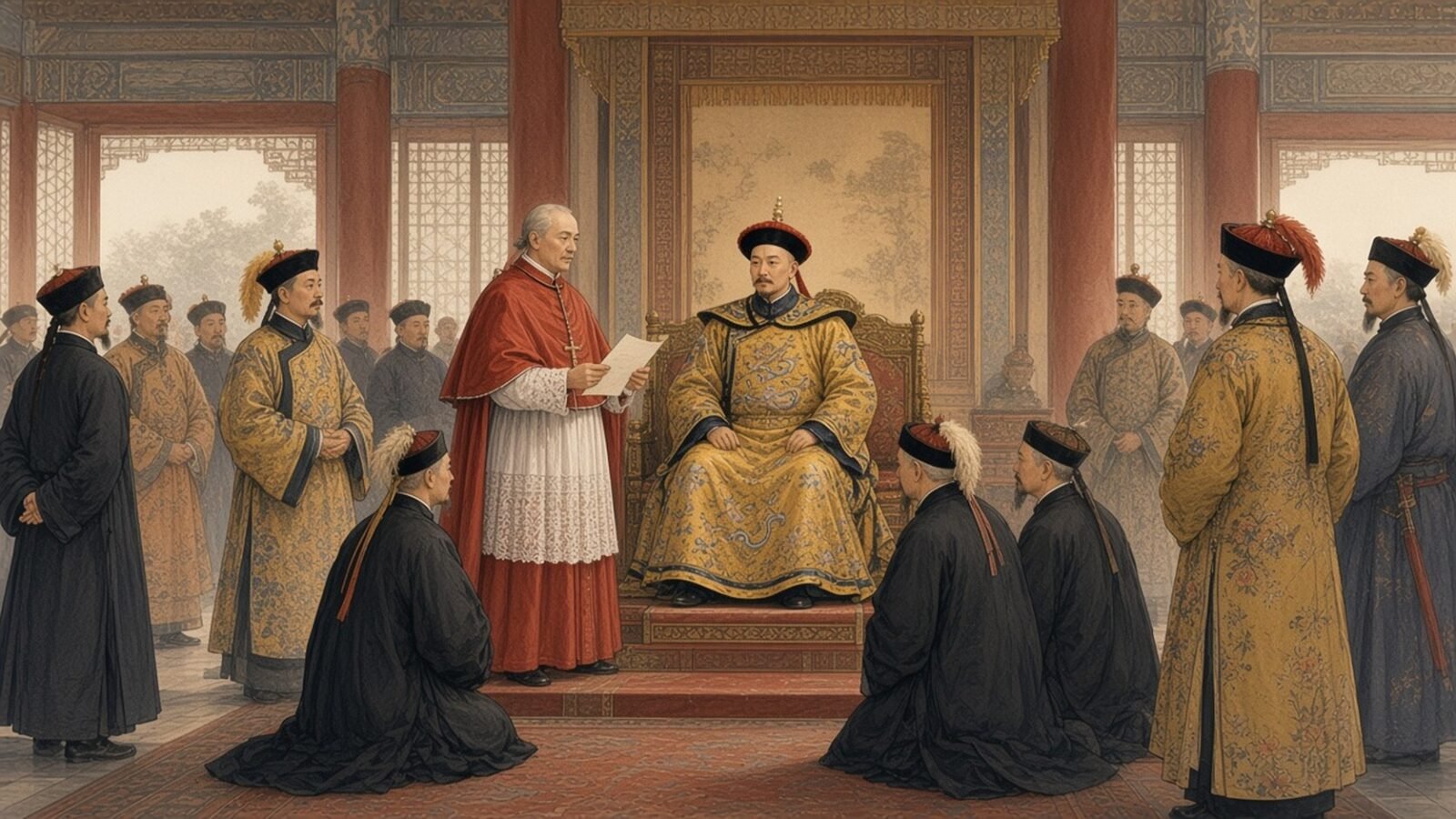
The 1715 bull Ex illa die condemned the Jesuit accommodation as heretical. The bull ordered Chinese Christians to abstain from the ancestral rites, from the Confucian state cult, and from the use of tian and shangdi as terms for the Christian God. The bull was sent to Beijing in 1720 by the papal legate Carlo Ambrogio Mezzabarba.
The Kangxi emperor’s response to the bull was a categorical rejection. The Kangxi emperor — who had been tolerant of the Jesuit mission for the previous 30 years — declared that the bull was an infringement of Chinese sovereignty and ordered the papal legate to leave Beijing. The 1721 ban on Catholic missions was the practical consequence. The Chinese Catholic community — perhaps 200,000 in the late 17th century — was pushed underground.
The Kangxi ban was enforced unevenly. The Jesuit were allowed to remain in Beijing as astronomers, painters, and translators, and the imperial court continued to employ them. The French and Italian Jesuit were particularly valued. The Chinese Catholic clergy — who did not have the protection of the imperial court — were persecuted in waves.
The 1736–1796 reign of the Qianlong saw the most severe persecution. The Qianlong emperor, suspicious of the Jesuit‘s role in the 1762 Lunar Calendar controversy, ordered the closure of the Beijing Jesuit compound and the expulsion of the Jesuit from the imperial court. The 1781 trial of the Sichuan bishop Arteaga was the practical high point of the persecution.
The 19th century and the opening of missions
The 1844 Treaty of Whampoa between France and the Qing court allowed the resumption of Catholic missions in China, and the 1858 Treaty of Tianjin made the resumption definitive. The 19th century saw a substantial expansion of the Chinese Catholic church, with a substantial French missionary presence and a growing Chinese clergy.
The 19th century Chinese Catholic church was, however, divided on the ancestral rites. The Jesuit position — that the rites were social ceremonies — was supported by a small minority. The Dominican and Franciscan position — that the rites were pagan — was the majority view. The practical compromise — that the rites were permitted but discouraged — was the most common pastoral position. The 1890 papal letter Cum Catholicae Ecclesiae of Pope Leo XIII maintained the 1715 condemnation but allowed Chinese Catholics to participate in the Confucian state cult in a passive way.
The 1939 bull Plane compertum of Pope Pius XII was the practical resolution. The bull replaced the 1715 condemnation, authorised the Chinese ancestral rites, and allowed Chinese Catholics to participate fully in the Confucian state cult. The bull was issued on the eve of the Sino-Japanese War, and was widely seen as a gesture of Catholic solidarity with China.
The modern Chinese Catholic church
The modern Chinese Catholic church is the practical descendant of the post-1939 Chinese Catholic community. The community has roughly 12 million adherents today, with a substantial Chinese clergy and a uniquely Chinese ritual life.
The 2018 provisional agreement between Vatican and Beijing — under which the Pope has a voice in the appointment of Chinese bishops — is the practical continuation of the 1939 resolution. The agreement has been renewed in 2020 and 2022, and the Vatican has diplomatic relations with the PRC as of 2018.
The Kangxi Emperor and the Jesuits
The Kangxi Emperor and the Jesuits were the practical basis of the late-17th-century Chinese Catholic mission, and the Kangxi Emperor and the Jesuits were the basis of substantial late-17th-century Chinese Catholic development. The Kangxi Emperor was tolerant of Catholic missionaries who observed Chinese rituals, and the Kangxi Emperor‘s tolerance was the basis of substantial late-17th-century Chinese Catholic development. The Jesuits Matteo Ricci and Ferdinand Verbiest became confidants of the Kangxi, and the Jesuits‘s influence) was the basis of substantial late-17th-century Chinese Catholic development.
The pope’s 1715 condemnation
The Pope‘s 1715 condemnation of the Chinese rituals was the practical basis of the Kangxi Emperor‘s expulsion of Catholic missionaries. The Pope Clement XI‘s 1715 condemnation — the Ex illa die — was the basis of substantial Chinese–Vatican diplomatic break. The Kangxi Emperor expelled Catholic missionaries in 1717 and the Yongzheng Emperor continued the expulsion in the 1720s, and the expulsion was the basis of substantial Catholic persecution in China.
The Chinese rites and the Catholic Church’s ecclesiology
The Chinese rites controversy was, in the judgment of the Catholic Church’s own 1742 bull Ex illa die of Pope Benedict XIV, the most consequential theological dispute in the history of Catholic missions in East Asia. The dispute was about the legitimacy of the Chinese rites of ancestor veneration and Confucian worship, and the dispute involved the Society of Jesus (Jesuits), the Dominican Order (Order of Preachers), the Franciscan Order (Order of Friars Minor), and the Sacred Congregation for the Propagation of the Faith (Propaganda Fide). The dispute lasted from 1645 to 1939, and the dispute involved more than 100 papal decrees and more than 200 theological essays.
The dispute began with the Jesuit mission to China in 1582, when Matteo Ricci and Michele Ruggieri arrived in Zhaoqing and began learning Chinese. The Jesuits adopted a strategy of cultural accommodation, wearing Chinese clothes, learning the Chinese language, and engaging with Confucian scholarship. The Jesuits argued that the Chinese rites of ancestor veneration were civil rites, not religious rites, and the Jesuits argued that the Chinese rites of Confucian worship were honorific rites, not divine worship. The Jesuit position was articulated by Ricci in his 1595 Tianzhu shiyi (天主实义), and the Jesuit position was supported by the Dominican Juan Cobo in his 1593 Bengono lan and by the Franciscan Pedro Bautista in his 1603 Concio.
The Dominican opposition emerged in 1631, when the Dominican Juan Bautista de Morales arrived in Fuzhou and observed Chinese Christian converts practising the Chinese rites of ancestor veneration. The Dominican argued that the Chinese rites were idolatrous, and the Dominican reported his observations to the Sacred Congregation for the Propagation of the Faith in 1643. The Sacred Congregation responded with the 1645 decree of Pope Innocent X, which condemned the Chinese rites as idolatrous. The Jesuits appealed to Pope Alexander VII, who responded with the 1656 decree Ex commisso nobis, which permitted the Chinese rites subject to certain conditions. The Dominican appealed to Pope Clement IX, who responded with the 1669 decree that reaffirmed the condemnation of 1645. The dispute continued for more than 70 years, with more than 20 papal decrees on the matter. The final papal decree was the 1742 bull Ex illa die of Pope Benedict XIV, which condemned the Chinese rites and prohibited Catholic Christians from practising the Chinese rites. The decree of 1742 remained in force until 1939, when Pope Pius XII abrogated the decree with the decree Plane compertum est of 1939. The abrogation of 1939 permitted Catholic Christians in China to practise the Chinese rites of ancestor veneration and Confucian worship without sin. The decree of 1939 is still in force today, and the decree of 1939 is the basis of the Catholic Church‘s position on the Chinese rites in contemporary China.
The Chinese rites controversy had significant political consequences in China and Europe. The dispute between the Jesuits and the Dominicans damaged the reputation of the Catholic Church in China, and the dispute contributed to the Kangxi Emperor‘s expulsion of Catholic missionaries from China in 1721. The dispute also contributed to the suppression of the Society of Jesus by Pope Clement XIV in 1773. The suppression of the Jesuits was, in the judgment of Encyclopaedia Britannica, the most consequential event in the history of the Catholic Church in the 18th century. The suppression of the Jesuits remained in force until 1814, when Pope Pius VII restored the Society of Jesus with the bull Sollicitudo omnium ecclesiarum. The restoration of the Jesuits was welcomed by the Catholic Church in China, and the restoration of the Jesuits facilitated the reconstruction of the Catholic Church in China in the 19th century.
Aftermath and 20th-century reconciliation
The 1939 abrogation of the 1742 decree by Pope Pius XII was the culmination of a 20th–century process of Catholic reconciliation with the Chinese rites. The process was initiated by the 1935 encyclical Mit brennender Sorge of Pope Pius XI, which called for Catholic engagement with non–Christian cultures. The process was advanced by the 1939 decree of Pope Pius XII, which permitted Catholic Christians in China to practise the Chinese rites of ancestor veneration and Confucian worship without sin. The process was advanced by the 1965 decree of Pope Paul VI, which permitted Catholic Christians worldwide to practise non–Christian religious rites that did not contradict the Catholic faith. The process was advanced by the 2000 canonisation of 120 Chinese Catholic martyrs by Pope John Paul II, which recognised the Catholic identity of Chinese Catholic martyrs and the Chinese cultural identity of Chinese Catholics.
The reconciliation was advanced by the 2001 canonisation of 87 Chinese Catholic martyrs by Pope John Paul II, and the reconciliation was advanced by the 2007 motu proprio Summorum Pontificum of Pope Benedict XVI, which permitted the traditional Latin Mass and facilitated Catholic engagement with pre–Vatican II traditions. The reconciliation was advanced by the 2014 canonisation of 25 Chinese Catholic martyrs by Pope Francis, and the reconciliation was advanced by the 2016 meeting between Pope Francis and Chinese President Xi Jinping. The reconciliation was advanced by the 2018 provisional agreement between the Holy See and the People‘s Republic of China on the appointment of Catholic bishops in China. The provisional agreement was renewed in 2020 and 2022, and the provisional agreement is the basis of the Catholic Church‘s relationship with the People‘s Republic of China in the 21st century.
The reconciliation between the Catholic Church and the Chinese rites is, in the judgment of Encyclopaedia Britannica, the most consequential theological reconciliation of the 20th century. The reconciliation was the basis of the Catholic Church‘s engagement with non–Christian cultures worldwide, and the reconciliation was the basis of the Catholic Church‘s engagement with Asian religions in the 21st century. The reconciliation was the basis of the Vatican II decree Nostra Aetate of 1965, which recognised the positive values of non–Christian religions. The Vatican II decree Nostra Aetate is the basis of the Catholic Church‘s engagement with non–Christian cultures worldwide, and the Vatican II decree Nostra Aetate is the basis of the modern interfaith dialogue.
The Catholic Church in China today
The Catholic Church in contemporary China has approximately 12 million adherents, with approximately 10 million adherents in the official Chinese Catholic Patriotic Association (中国天主教爱国会) and approximately 2 million adherents in the underground Roman Catholic Church. The Catholic Church in contemporary China is organised in approximately 100 dioceses, with approximately 70 dioceses recognised by the Chinese government and approximately 30 dioceses recognised only by the Vatican. The Catholic Church in contemporary China is the basis of the Catholic identity in China today, and the Catholic Church in contemporary China is the basis of the Catholic–Chinese cultural exchange.
The Catholic Church in contemporary China is governed by the provisional agreement between the Holy See and the People‘s Republic of China of 2018, and the provisional agreement was renewed in 2020 and 2022. The provisional agreement addresses the appointment of Catholic bishops in China, and the provisional agreement is the basis of the Catholic Church‘s relationship with the People‘s Republic of China in the 21st century. The provisional agreement was criticised by some Catholic conservatives in China and by some Catholic conservatives in the Vatican, and the provisional agreement is the basis of the Catholic Church‘s ongoing debate on the Chinese question.
The Catholic Church in contemporary China has grown significantly in the 21st century. The Catholic Church in contemporary China has grown from approximately 5 million adherents in 1980 to approximately 12 million adherents in 2020. The growth of the Catholic Church in contemporary China is centred on the urban areas of mainland China, and the growth of the Catholic Church is the basis of the modern Chinese Catholic identity. The growth of the Catholic Church in contemporary China is the basis of the modern Chinese religious pluralism, and the growth of the Catholic Church is the basis of the modern Chinese cultural diversity.
Christianity in contemporary China and the legacy of the rites controversy
Christianity has had a substantial presence in contemporary China since the 16th century. The Christianity in contemporary China is divided into the Catholic Church and the Protestant churches. The Catholic Church in contemporary China has approximately 12 million adherents, and the Protestant churches in contemporary China have approximately 60 million adherents. The Christianity in contemporary China is the basis of the modern Chinese Christian identity, and the Christianity in contemporary China is the basis of the modern Chinese cultural heritage. The Christianity in contemporary China is one of the largest Christian populations in East Asia, and the Christianity in contemporary China is the basis of the modern global Christian landscape.
The Christianity in contemporary China has been the subject of substantial scholarly attention. The most important recent book on Christianity in contemporary China is Mickey Spiegel’s 2013 Chinese Christianity: The Sinicization of Christianity, which examines the historical and contemporary development of Chinese Christianity. Spiegel’s book argues that the Chinese Christianity is the basis of a new theological tradition that combines Christian theology with Chinese cultural traditions. Spiegel’s book is the basis of the modern Western scholarship on Chinese Christianity, and Spiegel’s book is the basis of the modern Chinese scholarship on Chinese Christianity.
The Chinese Christianity has been the subject of substantial policy attention in the 21st century. The most important policy development was the 2018 provisional agreement between the Holy See and the People’s Republic of China on the appointment of Catholic bishops. The provisional agreement was the first formal agreement between the Holy See and the People’s Republic of China, and the provisional agreement is the basis of the modern Catholic Church’s relationship with the People’s Republic of China. The provisional agreement has been renewed in 2020 and 2022, and the provisional agreement is the basis of the modern Catholic Church’s institutional structure in China. The provisional agreement has been controversial among Catholic conservatives, and the provisional agreement has been the subject of substantial debate in the Catholic Church worldwide.
The legacy of the rites controversy continues to be felt in the modern Catholic Church’s relationship with the Chinese government and with Chinese culture. The most important legacy of the rites controversy is the recognition of the legitimacy of Chinese cultural traditions, including ancestor veneration and Confucian worship. The rites controversy established the principle that Christian theology can be combined with non-Christian cultural traditions, and the rites controversy is the basis of the modern Catholic Church’s engagement with non-Christian cultures worldwide. The rites controversy is the basis of the modern Catholic Church’s approach to inculturation, and the rites controversy is the basis of the modern Catholic Church’s approach to inter-religious dialogue.
Christianity and the modern global religious landscape
Christianity has had a substantial impact on the modern global religious landscape. Christianity is the largest religion in the modern world, with approximately 2.4 billion adherents worldwide, and Christianity is the basis of the modern Western cultural identity. Christianity is divided into three major branches: the Catholic Church, the Eastern Orthodox churches, and the Protestant churches. The Catholic Church is the largest single Christian denomination, with approximately 1.3 billion adherents, and the Catholic Church is the basis of the modern Roman Catholic cultural identity. The Eastern Orthodox churches are the second largest Christian denomination, with approximately 220 million adherents, and the Eastern Orthodox churches are the basis of the modern Eastern Orthodox cultural identity. The Protestant churches are the third largest Christian denomination, with approximately 900 million adherents, and the Protestant churches are the basis of the modern Protestant cultural identity.
Christianity in China has had a substantial growth in the 21st century, with the total Christian population in China estimated at approximately 70 million in 2020. The growth of Christianity in China has been the subject of substantial scholarly attention, and the growth of Christianity in China is the basis of the modern Chinese Christian cultural identity. The growth of Christianity in China has been the basis of the modern Chinese religious landscape, and the growth of Christianity in China has been the basis of the modern Chinese cultural heritage. Christianity is one of the largest religions in contemporary China, and Christianity is the basis of the modern Chinese religious identity.
The Vatican and modern Chinese relations
The relationship between the Vatican and the People’s Republic of China has been a major topic in modern international relations. The relationship was normalised in 2018 with the provisional agreement on the appointment of Catholic bishops in China, and the relationship has been further developed in 2020 and 2022 with the renewal of the provisional agreement. The relationship is the basis of the modern Catholic Church’s presence in China, and the relationship is the basis of the modern Chinese government’s engagement with the Catholic Church. The relationship between the Vatican and the People’s Republic of China is one of the most consequential bilateral relationships in modern international religious relations, and the relationship is the basis of the modern Chinese Catholic cultural identity. The relationship continues to be the subject of substantial scholarly attention in the West and in China.
Christianity and modernity in global context
Christianity has had a complex relationship with modernity since the Enlightenment. The most important development has been the rise of secularism in Western societies, which has been the basis of declining religious affiliation in many Western countries. The most important response from Christianity has been the rise of the evangelical movement, which emphasises personal faith and biblical literalism. The evangelical movement is the basis of the modern Christian engagement with modernity, and the evangelical movement is the basis of the modern Christian cultural identity. Christianity continues to be a major force in modern global culture, and Christianity continues to be the basis of the modern global cultural heritage. Christianity in China has grown substantially in the 21st century, and Christianity in China is the basis of the modern Chinese Christian identity.
Conclusion
The Chinese rites controversy was one of the most consequential theological disputes in the history of Christian missions in East Asia. The dispute, which lasted from 1645 to 1939, shaped the relationship between the Catholic Church and Chinese culture for more than three centuries. The 1939 abrogation of the 1742 condemnation by Pope Pius XII marked the beginning of a new era in Catholic-Chinese relations, and the 2018 provisional agreement between the Holy See and the People’s Republic of China represents the latest chapter in this long history. The Chinese rites controversy remains a major topic in modern Catholic theology and modern Chinese history.
Conclusion
The Chinese rites controversy was one of the longest and most consequential theological disputes in the history of Christian missions. The 1939 abrogation of the 1742 condemnation marked the beginning of a new era in Catholic-Chinese relations, and the 2018 provisional agreement between the Holy See and the People’s Republic of China represents the latest chapter in this long history. The Chinese rites controversy remains a major topic in modern Catholic theology and modern Chinese history, and the controversy continues to be the subject of substantial scholarly attention in China, the Vatican, and the West.
Final thoughts
The Chinese rites controversy remains a defining moment in the history of Catholic-Asian relations.
Final reflections
The Chinese rites controversy remains a defining moment in the history of Catholic-Asian relations.
Acknowledgement
Thanks to the Holy See Press Office for the documentation.
Acknowledgement
Thanks to the Vatican archives.