
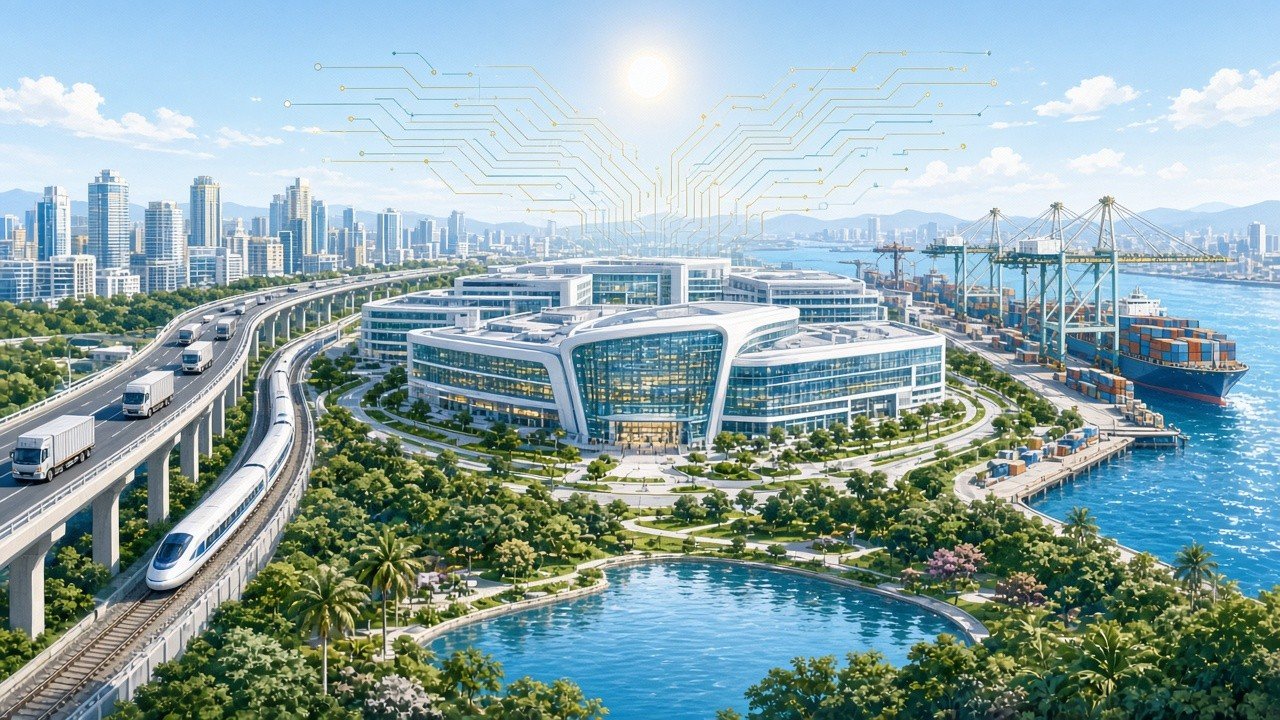
Dongguan sits on the eastern bank of the Pearl River Delta, between Guangzhou to the north and Shenzhen to the south. Before reform it was a Guangdong agricultural county of paddies, orchards and fishing villages. After reform it became one of the densest clusters of light industry and electronics assembly on earth. The path was not the Shenzhen special zone story. Shenzhen received special economic zone status in 1980 and national branding as a reform laboratory. Dongguan kept ordinary county and then city administration, but it had something Shenzhen could not monopolise: land, village collectives willing to rent sheds, and a short truck ride to Hong Kong’s trading houses. The hinge was geography plus processing trade. Understanding Dongguan’s rise is a way to understand how China turned coastal counties into an export engine without every place becoming an SEZ.
Geography and the starting point
The city covers roughly 2,465 square kilometres. Its urban centre lies about fifty kilometres from Guangzhou and about ninety kilometres from Shenzhen, and roughly forty seven nautical miles by water from Hong Kong. Before the 1980s the place that is now Dongguan was a county under Huiyang prefecture. Industry was thin. Households lived from grain, fruit and aquaculture. Many young people looked across the estuary toward Hong Kong’s higher wages, and local histories record illegal crossings in the decades before reform. That fact matters because the later investment wave did not arrive as abstract capital. It arrived as Hong Kong manufacturers who already knew Cantonese, already had customers in Europe and America, and already faced rising costs in the colony. Dongguan was the nearest large pool of land and labour on the mainland side of that commercial world.
Administrative elevation followed economic change rather than leading it. Dongguan became a county level city in September 1985 and a prefecture level city on 1 January 1988. It still has an unusual structure: no county level divisions underneath, only subdistricts and towns under the municipal government. That town based layout suited rural industrialisation. Factories spread across Humen, Chang’an, Houjie, Tangxia, Qingxi and dozens of other settlements rather than concentrating in a single planned CBD. The map of Dongguan today is still a map of former townships that filled with workshops. Cultural geography mattered too. The core was Cantonese speaking. Parts of the southeast were Hakka. Mandarin later dominated shop floors because migrants arrived from Hunan, Sichuan, Jiangxi and beyond. The city that foreigners called a factory town was also a machine for absorbing inland labour into coastal export work.
The relationship with Shenzhen needs a clear distinction. Shenzhen’s SEZ offered preferential tax rules, national political attention and a border with Hong Kong that made it a showcase. Dongguan was not that showcase. It was the manufacturing hinterland along the Guangzhou–Shenzhen corridor: cheaper land, more dispersed sites, and a willingness by township cadres to treat every village as a potential industrial park. Investors who needed prestige or immediate border access leaned toward Shenzhen. Investors who needed large sheds and flexible local partners often chose Dongguan. Over time both places urbanised and both made electronics. The institutional starting points remained different.
Processing trade and the 1980s boom
The decisive policy tool was processing trade, known in Chinese as sanlai yibu: processing with supplied materials, samples or parts, plus compensation trade. In July 1978 the State Council issued trial rules on processing and assembly. Guangdong made Dongguan one of the pilot counties, alongside Nanhai, Shunde, Panyu and Zhongshan. On 15 September 1978 the Taiping Handbag Factory in Humen began production under a Hong Kong contract, often cited as the mainland’s first come and process plant, though Shunde’s Dayjin garment factory also claims an earlier start. The model was simple. The foreign partner supplied designs, materials and machines. The Chinese side supplied land, buildings and workers. Finished goods went straight back out. The local side collected processing fees and rent. Risk was limited because the Chinese partner did not need its own export brands or overseas sales offices. Hong Kong remained the “front shop.” Dongguan became the “back factory.”
Dongguan moved fast to institutionalise the bargain. In December 1978 the county set up a one stop foreign processing office covering negotiation, registration, customs and Hong Kong through train paperwork. Village and township enterprises became the main partners because state factories were scarce. Cadres competed to attract Hong Kong money by offering sheds, power connections and flexible labour. In 1984 the county framed a strategy of marching toward rural industrialisation, pushing infrastructure and standard factories so that foreign firms could plug in quickly. By 1983, according to Dongguan’s reform chronicle, the county had signed 2,021 processing contracts worth about 7.11 billion dollars, opened more than a thousand new firms, and earned 1.26 billion dollars in processing fees in a year when county GDP was only about 13 billion yuan. Official industrial statistics later summarised the take off: industrial firms rose from 1,290 in 1978 to 12,449 in 1993, industrial output from 4.2 billion yuan to 267.67 billion yuan, and cumulative foreign investment to 1993 reached about 10.49 billion dollars.
Hong Kong capital dominated the first decade. After Taiwan eased travel and investment rules in 1987 and 1988, Taiwanese manufacturers followed, often registering first in Hong Kong and then entering as processing firms. A local saying claimed that a third of Taiwanese firms in China were in Guangdong and a third of those were in Dongguan. The Dongguan Taiwan Business Association grew from a few hundred members in the early 1990s to more than 3,500 at its mid 2000s peak. Electronics, wire and cable, shoes, furniture and metal parts joined garments and toys. Piece rates replaced older egalitarian pay habits on many floors. Managers learned to chase orders rather than plan output for a state quota. The social machinery underneath was migrant labour. Young workers from inland provinces filled dormitories. Townships that had been rice and fruit villages became continuous industrial belts. The slogan that journalists later repeated, “when Dongguan is jammed, the world runs short,” was crude advertising, but it pointed to a real concentration of export assembly.
Infrastructure that rose with the factories
Export manufacturing of this kind is a logistics business as much as a production business. Materials arrive under bonded arrangements. Orders change weekly. Buyers in Hong Kong and overseas expect containers to leave on schedule. Dongguan therefore built roads, power, ports and later rail in parallel with the sheds. The Guangzhou–Shenzhen corridor already carried the main land route between the provincial capital and the SEZ. Local governments added standard factories and feeder roads so that trucks could reach customs and ports without long inland hauls. Power stations and substations mattered as much as asphalt: overtime night shifts and continuous electronics lines fail when voltage is unreliable. Telecom links let managers take Hong Kong orders the same day. None of this was ornamental. Processing fees and land rents depended on factories that could ship.
The Humen Pearl River Bridge opened on 9 June 1997, linking Dongguan more tightly to Guangzhou’s bank of the estuary with a main span of 888 metres. A second major crossing, the Nansha Bridge, opened in 2019. In 1997 local ports at Taiping and Shatian were also merged into Humen Port, later renamed Dongguan Port. By 2024 the port handled about 4.02 million twenty foot equivalent units of containers. That is modest beside Shanghai or Shenzhen, but enough to give local exporters a nearby water gate rather than total dependence on neighbours. Rail and metro came later, after the factory landscape already existed, and served both commuting and regional integration. Humen railway station on the Guangzhou–Shenzhen–Hong Kong high speed line opened on 26 December 2011. Dongguan Metro Line 2 opened in May 2016 along the western industrial towns toward Humen. The Guangzhou–Shenzhen intercity railway began service in December 2019. Metro Line 1 opened on 28 November 2025. Songshan Lake, approved as a provincial high tech park in 2001 and upgraded to a national high tech zone in 2010, was the policy attempt to add an organised research and industry campus to a city that had grown by township sprawl.
The denser the cluster became, the more valuable each new bridge, berth and substation was. Factories and infrastructure rose together because each made the other profitable. Just in time export manufacturing needs that mutual reinforcement. A shed without a road is a warehouse. A highway without factories is a fiscal burden. Dongguan’s local state specialised in packaging both at once.
What Dongguan made
The product ladder followed classic coastal China. Early years were handbags, garments, toys, wigs, furniture and shoes. Local and press accounts have long described thousands of toy related enterprises in the city. Taiwanese footwear groups such as Yue Yuen’s large complex at Gaobu became symbols of the labour intensive peak, with tens of thousands of workers on single campuses before costs rose and capacity moved inland or abroad. From the 1990s electronics and information technology overtook light consumer goods as the leading pillar: printed circuit boards, connectors, computer peripherals, handsets and the endless small parts that a finished device needs. International names in chemicals, logistics and consumer goods also planted facilities, but the distinctive texture of Dongguan remained the thick middle of suppliers rather than a few flagship brand headquarters.
Two firm stories need careful geography. Foxconn’s famous Longhua and Guanlan campuses sit in Shenzhen, not Dongguan. Hon Hai has operated Dongguan area subsidiaries and parks, but the global image of Foxconn as an iPhone city belongs next door. Dongguan’s distinctive phone story is indigenous. In 1995 Duan Yongping founded BBK Electronics in Chang’an town. From that base came OPPO and vivo, both headquartered in Chang’an, and later related brands such as OnePlus, realme and iQOO. Secondary industry tallies put sales by this family of brands around 262 million phones in 2020, a large world share, though such figures are estimates rather than audited city statistics. Huawei, whose main corporate identity remains tied to Shenzhen, shifted major consumer device and research functions into Songshan Lake from about 2014, building the Ox Horn campus on the lake’s south shore at a reported cost near 1.5 billion dollars and staffing it with tens of thousands of research workers. Press coverage of the Mate 60 in 2023 noted “Dongguan Manufacturing” on devices that carried domestic chips.
Around these anchors sit component makers for batteries, casings, cameras and connectors. Industry commentary often claims that more than ninety percent of a smartphone’s parts can be sourced within about an hour’s drive of Dongguan. Treat that as a cluster estimate, not a census. The mechanism is still clear. A brand can design in Shenzhen in the morning, seek quotes from Dongguan suppliers by midday, and run a pilot line the same week. Overflow assembly spills into neighbouring Huizhou and Zhongshan. Design and trading may sit in Shenzhen or Hong Kong. Dense manufacturing and supplier matching sit in Dongguan’s towns. That is why relocating “a factory” is easier to announce than relocating the ecosystem.
Export engine and China’s rise
Dongguan’s contribution to China’s rise was not a single invention. It was scale, timing and learning. From 1996 to 2002 the city ranked third among Chinese large and medium cities by export value, behind only Shenzhen and Shanghai. Those years cover the run up to World Trade Organization entry in December 2001 and the early WTO boom, when American and European retailers ordered Asia’s coastal factories as if they were extensions of their own warehouses. Guangdong as a whole became the public face of the “world’s factory.” Dongguan supplied a large share of that face: processing fees, migrant employment, and a thicket of suppliers that lowered the cost of starting the next production line. Foreign direct investment statistics from the early reform decades understate the real transmission channel, because much of the action was processing fees rather than equity joint ventures. The city still learned management, quality control and logistics from that channel.
Learning by doing mattered as much as cheap wages. Workers and line managers learned piece rates and just in time discipline from Hong Kong and Taiwanese bosses. Local firms and later national brands learned how to organise suppliers. Village collectives learned how to package land and power for investors. The result was supply chain depth. Moving one assembly plant is easier than moving a whole ecosystem of mould shops, plating lines, packaging firms and logistics agents. That depth helped China absorb foreign orders after WTO accession and helped some Chinese brands climb from contract work into their own labels. Dongguan was therefore both hinterland to Shenzhen’s SEZ and a manufacturing city in its own right. Confusing the two erases the point: China did not industrialise only through special zones. It industrialised through counties that turned themselves into workshops for global brands.
Rising costs, upgrading and recent figures
By the mid 2000s the original bargain was under stress. Wages and land rents rose. The renminbi appreciated. Environmental rules tightened. Guangdong’s provincial policy of “vacate the cage, change the birds” encouraged low value labour intensive plants to leave the Pearl River Delta core while localities tried to attract higher value industry. The phrase was bureaucratic, but the mechanism was ordinary: rising costs plus policy pressure pushed shoes, low end garments and simple assembly toward inland provinces and Southeast Asia, while Dongguan tried to keep electronics, brands and research. The global financial crisis of 2008 and 2009 cut export orders sharply. Factories closed or suspended lines. Migrant workers went home early. Through 2009 to 2014 Dongguan’s GDP growth often missed annual targets, according to contemporary Guangdong reporting. Some Taiwanese and Hong Kong firms automated, specialised or relocated. Yue Yuen’s Gaobu campus became a visible example of a labour empire that no longer needed the same headcount on the delta. Local officials talked of machines replacing people, of Songshan Lake as a new centre, and of services growing beside manufacturing.
Official statistics show a city that remains industrial but is no longer only a processing fee collector. Dongguan’s Statistical Bureau put revised 2023 GDP at about 1.187 trillion yuan after census adjustments, then 1.228 trillion yuan in 2024, up 4.6 percent, and a preliminary 1.276 trillion yuan in 2025, up 4.0 percent. Secondary industry still accounted for about 56 percent of GDP in 2025, with services near 44 percent and agriculture negligible. Resident population rose from about 10.49 million at end 2023 to 10.57 million in 2024 and 10.80 million in 2025, with urbanisation above 93 percent. Per capita GDP in the 2025 bulletin was about 119,000 yuan, or roughly 16,700 dollars at the published average exchange rate. Goods exports fell 8.9 percent in 2023 to about 846 billion yuan, then recovered to 890 billion yuan in 2024 and 971 billion yuan in 2025. Total goods trade in 2025 reached about 1.58 trillion yuan, roughly 16.6 percent of Guangdong’s provincial total. High tech products were about 39 percent of exports. General trade has gained share against classic processing trade, while processing exports slipped in 2025. Soft years in 2022 and 2023 tracked the global electronics cycle and weak external demand. Local commentary that “when phones sneeze, Dongguan catches cold” fits those years. The 2024 and 2025 rebound shows recovery, not a fairy tale reinvention.
Costs that the boom did not erase
Honest accounts of Dongguan cannot stop at GDP. Rapid industrialisation polluted rivers and soils. Studies of industrial districts have found metal contamination and occupational disease linked to solvents and other chemicals. Enforcement improved later, but the early growth model treated the environment as a free input. Migrant workers faced long hours, dormitory crowding and weak bargaining power, especially before labour law reforms and wage rises of the late 2000s. Books such as Leslie T. Chang’s Factory Girls and labour NGO reports on keyboard and electronics suppliers documented the human price of just in time export work. Hukou rules long limited access to local schooling and welfare for inland migrants even as their labour built the city’s tax base. Dependence on foreign orders never fully disappeared. When global phone demand softens or trade barriers rise, Dongguan still feels the chill faster than a diversified service city. The sex trade that once shadowed hotel and entertainment districts was a social by product of a cash rich factory culture; crackdowns changed the public face without rewriting the deeper labour and environmental ledger.
None of this cancels the achievement. In four decades an agricultural county became a manufacturing city of more than ten million people, a major Guangdong export base, and a supply chain so thick that phone brands and component makers still cluster there. The lesson for China’s rise is mechanical rather than romantic. Hong Kong and Taiwanese capital sought cheaper land and labour. Local governments sold access to both. Migrants staffed the lines. Roads, bridges and ports made shipment reliable. WTO rules opened markets. Learning and supplier density turned temporary assembly into lasting industrial capability. Shenzhen was the special zone neighbour. Dongguan was the workshop that urbanised beside it. That division of labour, more than any slogan, is how the Pearl River Delta helped make modern China.