
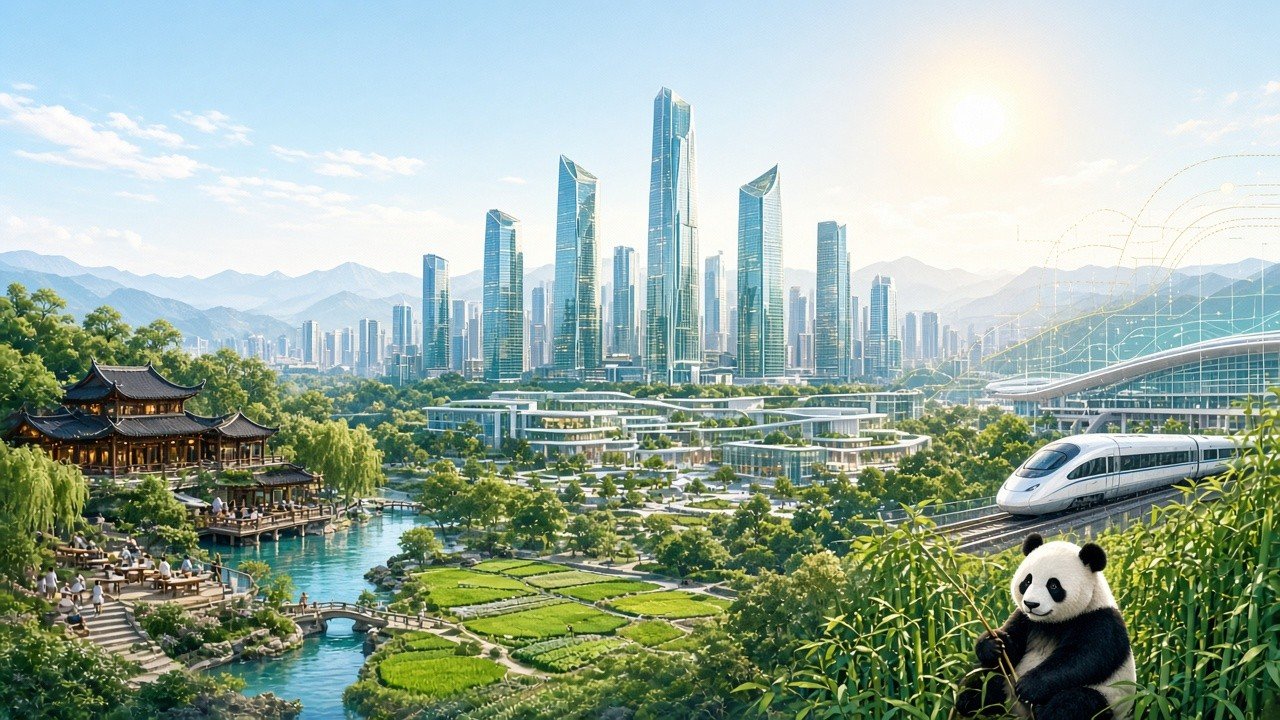
The standard story of China’s economic rise begins at the coast. Shenzhen and the Pearl River Delta grew as workshops for Hong Kong capital. Shanghai rebuilt itself as a trading and financial gateway. Export processing, container ports and special economic zones did most of the early heavy lifting. Chengdu does not fit that script. It sits in the Sichuan Basin, far from the sea, with no coastal special zone of the 1980 kind. Yet over the past two decades it has become western China’s most visible hub for electronics plants, internet and gaming studios, aviation work, and a lifestyle reputation that draws young graduates. The anomaly is real, but it is not magical. Chengdu’s inland location should have been a disadvantage for classic export manufacturing. It became an advantage for a different growth model: domestic markets, universities, state backed industrial parks, cheaper land and labour than the crowded coast, and soft pull from food, teahouses and a slower urban tempo. What follows explains the mechanisms, with ordinary evidence rather than slogans.
Geography and the inland starting point
Chengdu is the capital of Sichuan province and the main city of the Chengdu Plain, a fertile irrigated basin hemmed by mountains. For centuries it served as the political and cultural centre of China’s southwest. That history matters because the city already had administrative density, literacy and commercial habits before reform era factories arrived. It was never a fishing village waiting for a port. It was an inland capital with a large hinterland of farm counties and a long memory of being the place where southwestern elites gathered.
Distance from the sea was still a hard constraint. Rough distances put Chengdu more than a thousand kilometres from Shenzhen and further still from Shanghai. Before modern highways, rail and air freight, that meant higher logistics costs for anything that had to leave China in a container. The Pearl River Delta model of the 1980s and 1990s worked because Hong Kong trading houses could truck materials in and finished goods out within a day. Chengdu could not copy that bargain. Firms that lived on thin processing fees and just in time ocean schedules had little reason to climb into the basin. Even when western China offered cheaper wages, the saving could be eaten by days of inland haulage, uncertain power and thin local supplier networks. The coastal first story is therefore not wrong as a national average. It is simply incomplete as a map of every successful Chinese city.
Basin geography cut both ways. Mountains that complicated logistics also created a large captive regional market. Sichuan and neighbouring provinces held tens of millions of consumers who were costly to serve from the coast before expressways and e commerce warehouses filled in. A firm that sold into western China from Chengdu saved the reverse haul. That domestic facing logic became more important after China shifted policy language toward expanding inland demand, and it helps explain why retailers, platforms and consumer electronics brands treated Chengdu as a western distribution and service node rather than only as a cheap labour reserve.
Military era industrial policy left a second legacy. In the 1960s and 1970s China poured defence and heavy industry into the interior under the Third Front campaign, aiming to put factories beyond easy reach of coastal attack. Sichuan was a core province in that push. Chengdu itself was not always the preferred site for “near mountains, dispersed, concealed” plants, because the open plain was exposed. Local histories record a thinner early share of projects in the city proper, then a later wave from the mid 1980s when many relocated Third Front enterprises moved into Chengdu’s suburbs. The practical result was a thicker base of machinery, electronics and aviation skills than a pure agricultural inland city would have had. Reform later commercialised parts of that base. It did not invent it from nothing.
Reform without a coastal special zone
Chengdu was not designated a special economic zone in 1980. It did not receive Shenzhen’s border theatre or the same early package of tax experiments aimed at foreign processors. Growth came through other channels. As a provincial capital it kept universities, hospitals, state enterprises and a large domestic consumer market. Local and provincial governments courted investment with industrial parks rather than with a national SEZ brand. Foreign firms that did come inland in the 2000s were often looking for land, engineers and access to western Chinese customers, not for the shortest truck ride to a container yard.
National western policy reinforced that path. The Western Development strategy launched around 2000 directed infrastructure, industry and talent support toward China’s poorer western provinces. Early project lists emphasised highways, conventional railways, airports, pipelines and power rather than the later high speed rail network. Chengdu, already the densest urban economy in the southwest, was a natural node for those investments. Roads, rail, power and later airports reduced the friction of inland location even when they could not erase it. Local governments competed by packaging industrial land, one stop permits and university recruitment channels. In October 2014 the State Council approved Sichuan Tianfu New Area as the country’s eleventh national level new area, covering about 1,578 square kilometres across Chengdu and neighbouring cities. The Chengdu High Tech Zone, older than the new area, remained the practical core for electronics and internet firms. These were inland policy tools: parks, bonded zones and preferential land, not a coastal export franchise.
A further layer arrived in January 2020, when central leaders elevated the Chengdu–Chongqing dual city economic circle. The planning outline published in October 2021 cast the pair as a western growth pole for high quality development and as an inland base for dual circulation, the policy language for leaning more on domestic demand while staying open to trade. Chengdu and Chongqing compete as well as cooperate. The dual city frame nonetheless locked in national attention, joint infrastructure and industrial coordination that a lone inland capital would have struggled to claim alone.
Electronics and digital firms that chose the basin
The technology story is where the anomaly becomes visible to outsiders. From the early 2000s, large foreign electronics names planted packaging, testing and assembly capacity in Chengdu’s high tech west. Intel announced a Chengdu plant in 2003 and began operations around 2005, focusing on package assembly and final test rather than leading edge wafer design. Company and press accounts later put cumulative investment in the hundreds of millions of dollars, with further upgrade plans announced in 2014 and another 300 million dollars pledged in 2024 for server chip packaging and testing. Texas Instruments acquired an analog wafer factory in Chengdu in 2010 and later announced a multi year expansion budget measured in billions of dollars. Foxconn built a major campus tied to consumer electronics. Zone promotional materials have claimed that more than sixty percent of the world’s iPads and about half of MacBooks are made in the Chengdu high tech west, and that Intel’s Chengdu operations handle roughly half of global notebook CPU packaging. Those global share numbers should be treated as secondary park claims, not audited city statistics. The directional fact is still solid: high volume electronics work did locate inland when land, labour and local government packages beat a crowded coast.
Chinese technology firms deepened the cluster. Huawei established a Chengdu research presence around 2000 in the high tech west district and grew it into one of its principal inland research campuses, with laboratories for wireless, storage, cloud and related work. Press and company materials describe a large campus with many thousands of research staff. That matters because research jobs pay differently and stick differently from seasonal assembly lines. Tencent built a large Chengdu research and development base intended as its biggest western talent pool, and in 2020 agreed a cultural and creative headquarters project in the high tech zone, with announced investment of about five billion yuan, aimed at games, esports, animation and related digital content. The city’s digital creative parks now host thousands of firms. Zone figures reported in late 2025 put more than six thousand digital cultural and creative companies in the high tech zone, employing over 120,000 people and generating industrial output above 110 billion yuan. Display makers and terminal brands also thickened the hardware side. Park materials highlight flexible panel investment, including a large AMOLED line project measured in tens of billions of yuan, and list Siemens among “lighthouse” factories alongside Foxconn. Again, treat park advertising carefully, but the sector mix is clear: chips packaging, screens, devices and software content in one western corridor.
Gaming made Chengdu nationally famous among young Chinese in a way that chip packaging never could. Honor of Kings, Tencent’s enormous mobile game, was developed by TiMi Studios, with its Chengdu studio widely identified as the development home. The game’s success pulled esports events, streaming talent and supplier firms into the same orbit. Industry reporting on 2024 put Chengdu second only to Shanghai in the national share of esports events, at about 15.3 percent. That is not the same as saying Chengdu invented Chinese gaming. It is evidence that a large domestic digital market can grow a creative cluster far from any seaport, because the product ships as bits and the customers are inside China.
Universities feed the pipeline. Chengdu hosts dozens of higher education institutions, including strong engineering schools such as the University of Electronic Science and Technology of China. The 2025 statistical bulletin counted sixty six higher education institutions in the city and 1.316 million students. National innovation platforms numbered 161 by year end. High tech enterprises exceeded 15,000. Technology contract turnover reached 2.14 trillion yuan. Those figures describe a city that sells skilled labour and research density, not only cheap assembly sheds.
Aviation plants and the shortening of distance
Aviation is an older inland speciality. Chengdu Aircraft Corporation, part of AVIC, traces to a 1958 fighter plant and later became the designer and builder of the J-10 and the J-20, as well as a partner on the JF-17 export fighter. The same industrial complex has long done civil subcontract work, including noses and empennage parts for foreign airliners in earlier decades. On the commercial side, COMAC opened a heavy maintenance hangar for the ARJ21 regional jet at Chengdu Shuangliu in November 2021. Chengdu Airlines, owned by COMAC, has been a major operator of that type. Military and civil aviation therefore give Chengdu a specialised industrial identity that coastal garment towns never had.
Airports and rail changed the meaning of inland. Chengdu became the third Chinese city after Beijing and Shanghai to operate two international airports when Tianfu International Airport opened on 27 June 2021. Official design capacity for the first phase is sixty million passengers and 1.3 million tons of cargo a year, with a long term plan toward 120 million passengers. Shuangliu kept a large domestic role while Tianfu took most international and growing passenger traffic. In 2025 the two airports together handled 90.21 million passengers and 1.17 million tons of cargo and mail, with Tianfu at about 56.7 million passengers and Shuangliu at about 33.5 million. Metro and rail operations reached about 740 kilometres of mileage, and metro ridership alone was 2.23 billion trips. International rail freight trains from the city exceeded five thousand departures in 2025 and reached 133 overseas cities along western land and sea corridors. Goods trade for the year was 850 billion yuan, with high tech product exports at 341 billion yuan, up eleven percent. Air passenger turnover dominated the city’s passenger statistics, a reminder that for business travel and high value freight, flight schedules matter more than container berths. None of this turns Chengdu into Dongguan. It does mean that chips, people and parcels can leave the basin without waiting for a coastal truck monopoly.
Livability as a labour market tool
Hard industry alone does not explain why graduates stay. Chengdu’s public reputation in Chinese media is as a comfortable city: teahouses, spicy food, parks, pandas and a work culture that is often contrasted with the more brutal pace of Shenzhen or Beijing. National “happiest city” surveys have listed Chengdu for many consecutive years. Those rankings are soft products with tourism incentives, and they should not be treated as scientific proof of wellbeing. They do, however, shape migration decisions. Employers in games, internet and research repeatedly cite local lifestyle when explaining why young staff prefer Chengdu to colder or more expensive hubs. The panda brand and tourism economy amplify the same soft pull without being the main GDP engine.
Population numbers show the magnet working. Permanent residents reached 21.54 million at the end of 2025, up from 21.47 million a year earlier. Hukou population was 16.37 million. Urbanisation among permanent residents was about 81 percent. The gap between permanent and registered residents is a reminder that many people live and work in the city without full local welfare access. Livability attracts bodies. Hukou rules still ration belonging. Housing costs and school places still sort winners and losers inside the same “relaxed” city brand. Even so, a western inland capital that keeps adding people while many Chinese cities age and shrink is distinctive. For employers, the soft brand lowers recruiting friction. For the municipal government, it supports a services heavy GDP structure in which catering, culture, finance and information technology sit beside factories rather than being crowded out by them.
Scale today beside other inland giants
Chengdu’s 2025 GDP was 2.476 trillion yuan, up 5.8 percent in real terms after 2.351 trillion yuan and 5.7 percent growth in 2024. Services accounted for about seventy percent of output, and the tertiary sector contributed about 70.6 percent of growth. Industry still mattered: industrial value added rose 7.3 percent in 2025, with computer and electronics manufacturing up ten percent and high tech manufacturing up 8.9 percent. Per capita GDP was about 115,000 yuan. Resident disposable income averaged 54,363 yuan. Retail sales of consumer goods reached 1.143 trillion yuan. For comparison, Chongqing municipality reported about 3.376 trillion yuan of GDP and roughly 32 million people, but Chongqing is a provincial level municipality with a vast rural and industrial hinterland, so the comparison is not like for like. Wuhan’s 2025 GDP was about 2.215 trillion yuan with roughly 14 million residents. Xi’an’s preliminary 2025 GDP was about 1.390 trillion yuan. Among large inland centres, Chengdu sits in the top tier by economic mass and leads clearly on lifestyle branding and digital creative clustering. What it shares with peers is western catch up under national policy: infrastructure, industrial parks and a push to reduce coastal concentration. What is more distinctive is the combination of electronics packaging scale, games and esports, dual airport capacity, and a consumer facing city image that sells itself to talent.
Foreign investment remains part of the mix but is no longer the whole story. In 2025 Chengdu recorded 734 newly established foreign invested enterprises and 1.37 billion dollars of utilised FDI. Domestic private firms, state projects and platform companies matter as much. The city’s export numbers are large for an inland capital and still modest beside the Pearl River Delta’s specialised export machines. That contrast is the point of the anomaly. Chengdu rose without becoming a second Dongguan.
What the anomaly does not erase
Honesty requires limits. Chengdu is not a coastal export orthodoxy city that somehow floated inland. It is a different animal. Air quality in the basin has long been strained by industry, vehicles and winter meteorology that traps pollution. Official figures for 2025 show 295 days of good or excellent air, or 80.8 percent of the year, which is better than the city’s worse years but not a clean alpine story. Academic work on PM2.5 across the Chengdu–Chongqing region documents substantial improvement since the mid 2010s alongside persistent seasonal peaks. Hukou inequality and uneven access to schooling remain. Large state projects, from Tianfu New Area to airport megabuilds, carry fiscal and political risk if demand disappoints. Competition with Chongqing for factories, headquarters labels and central favour never disappears just because a dual city plan exists on paper.
Electronics work in Chengdu is also weighted toward packaging, testing and assembly rather than the rarest chip design nodes. That is valuable industrial capability. It is not the same as owning the frontier of semiconductor design. Gaming and internet jobs create visible youth culture, yet they sit on platforms whose headquarters remain in Shenzhen or Hangzhou. The city is a major node in other firms’ networks more often than it is the ultimate corporate centre.
The useful lesson is mechanical. Coastal export processing needed ports, Hong Kong intermediaries and migrant labour on the delta. Chengdu needed irrigated density, universities, defence era industrial skills, western development money, industrial park bargains, domestic digital demand, and a lifestyle that retained graduates. Air and rail then shortened the old penalty of distance. Land and wage gaps versus coastal peaks gave park managers something concrete to sell in the 2000s. Later, as coastal costs rose and national policy asked for inland demand, the same city looked less like a remote compromise and more like a deliberate second pole. Relative to the coastal first orthodoxy, that path still looks surprising. Relative to the incentives on the ground, it looks ordinary. An inland capital that sells brains, domestic consumers and livable density can thrive without a seaport, provided the state and firms keep paying the logistics premium and provided the soft pull does not curdle into complacency. Chengdu’s rise is therefore less a refutation of China’s coastal story than a second chapter written for the interior.