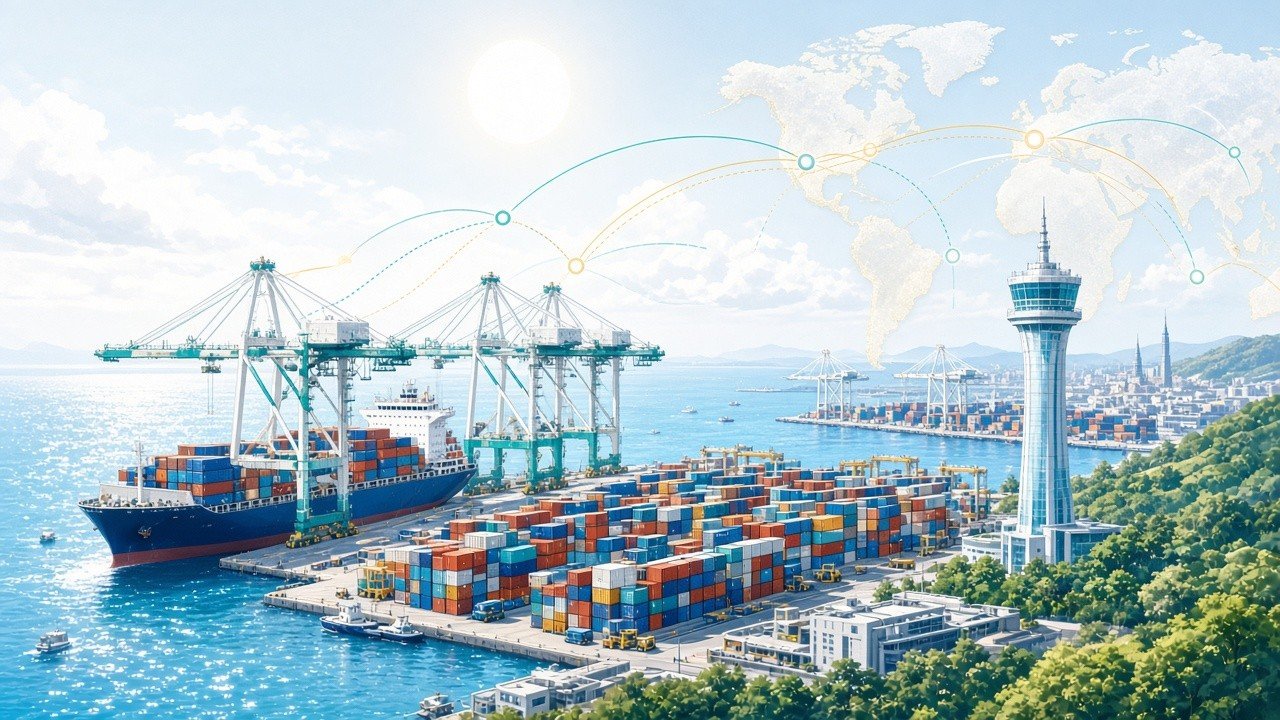
Open a ranking of the world’s busiest container ports and the pattern is hard to miss. Shanghai sits at the top. Ningbo-Zhoushan, Shenzhen, Qingdao, Guangzhou and Tianjin fill much of the rest of the upper table. People then jump from that picture to a stronger claim: that the world’s big harbours are somehow Chinese-run, Chinese-owned, or controlled from Beijing. The first observation is solid. The second mixes three different stories into one slogan. Mainland Chinese ports dominate container volumes because China’s factories and coasts do. Chinese state firms, and separately Hong Kong’s Hutchison group, are among the world’s largest terminal operators and hold real stakes from Piraeus to Colombo to Chancay. Overseas Chinese merchant networks once dominated commerce in several Southeast Asian port cities. None of that means Rotterdam, Los Angeles or Busan is a Chinese possession, and it does not turn Singapore’s PSA into an arm of the Chinese state.
Keeping those layers apart matters. Throughput rankings measure boxes moving through quays. Operator league tables measure equity-weighted terminal management. Diaspora history measures who once financed trade in Penang or Manila. Politics and commentary often blur the three. The result is either a scare story that China owns the seas, or a defensive shrug that denies how large Chinese ports and operators have become. The useful account is plainer. China’s coastal manufacturing built the volume. State balance sheets and Hong Kong capital built operator reach. Host countries still own most landlord ports, and many Chinese stakes abroad are minority or tightly regulated. Read the maps separately and the scale of Chinese port power looks large enough without the exaggeration.
Why mainland Chinese ports fill the top of the TEU tables
Lloyd’s List’s One Hundred Container Ports 2025 ranking, which reports 2024 throughput, puts Shanghai first at about 51.5 million twenty-foot equivalent units. Singapore is second at about 41.1 million. Ningbo-Zhoushan follows at about 39.3 million, then Shenzhen at about 33.4 million, Qingdao at about 30.9 million, Guangzhou at about 26.1 million, Busan at about 24.4 million and Tianjin at about 23.3 million. Jebel Ali in Dubai and Port Klang in Malaysia round out the top ten. Six of those ten ports are on the Chinese mainland. Further down the same list, Hong Kong sits near twelfth at about 13.7 million TEU, just behind Rotterdam’s 13.8 million and ahead of Antwerp-Bruges at about 13.5 million. Xiamen and the Suzhou area’s Taicang also sit inside the top twenty. Los Angeles and Long Beach, still the main United States gateways for Pacific boxes, are lower still, around the mid to upper teens in the ranking, with roughly 10.3 million and 9.6 million TEU. The same Lloyd’s table puts the combined throughput of the top hundred ports at about 743.6 million TEU in 2024, up 8.1 percent on the previous year, the strongest expansion in nearly a decade according to the compilers.
That concentration is not a trick of branding. It follows from where goods are made and how ships now call. After China joined the World Trade Organization in December 2001, export manufacturing thickened along the coast at a speed that older industrial nations took generations to match. The Yangtze River Delta funnels cargo toward Shanghai and Ningbo-Zhoushan. The Pearl River Delta feeds Shenzhen and Guangzhou. The Bohai Rim supports Qingdao and Tianjin. Factories, component suppliers, trucking yards and bonded warehouses sit within a few hours of deep berths. Once carriers moved to ships of 20,000 TEU and more, they preferred a short list of ports that could dredge channels, turn mega-ships quickly and connect inland by rail and road. State investment matched that logic. Local and central governments poured money into quay walls, gantry cranes, automation and hinterland links because ports were treated as national infrastructure, not as optional private amenities. Shanghai’s rise from a mid ranking Asian port in the 1990s to the world’s busiest container harbour by 2010 is the clearest single illustration: Kuehne+Nagel’s historical sketch puts Shanghai near 5.6 million TEU in 2000, about 18 million by 2005 and almost 30 million by 2010, when it overtook Singapore at the top of the table.
Hong Kong’s slide inside the same rankings is the clearest local proof that volume follows factories, not historic prestige. At the turn of the century Hong Kong was still one of the world’s premier gateways, handling about 18 million TEU in 2000 and more than 23 million around 2010. By 2024 Lloyd’s-linked figures put it near 13.7 million TEU, around twelfth place, while Shenzhen alone handled more than twice as much. As mainland ports deepened and costs rose in the older Pearl River workshop districts, cargo increasingly left through Shenzhen and Guangzhou rather than crossing into Hong Kong for river and ocean transhipment. Labour intensive plants also shifted inland or toward ASEAN. Hong Kong remained a sophisticated logistics and finance city. It ceased to be the indispensable physical exit for South China’s boxes. The lesson for outsiders who only remember Hong Kong’s old number one status is that Chinese port dominance today is a mainland industrial story first, not a continuation of the colonial entrepôt alone.
So the first layer of the popular claim is right in a narrow sense. Many of the world’s busiest ports are Chinese because China became the workshop whose exports fill containers. TEU tables track that industrial geography. They do not, by themselves, tell you who owns a terminal in Greece or who runs the landlord authority in the Netherlands.
Chinese state firms as global terminal operators
The second layer is about companies that invest in and manage terminals, often far from home. Drewry’s global terminal operator tables for 2024 put Singapore’s PSA International first on an equity-adjusted basis, with about 67.2 million TEU. China Merchants Port and COSCO Shipping Ports sit among the next places in the same league; Lloyd’s List’s framing of the top box port operators likewise places the two Chinese groups immediately behind PSA. Across nineteen operators that Drewry counts as global, portfolio throughput rose about 7.2 percent to 928 million TEU in 2024, equity-adjusted volumes rose about 7.7 percent, and those firms’ share of the world market edged up to about 49.2 percent. China Merchants’ own filings say Drewry credited it with about 61.2 million TEU of equity throughput in 2024, and that the group had a presence in 51 ports across 26 countries and regions. COSCO Shipping Ports reported, as of the end of 2024, interests spanning 40 ports, 434 berths and a designed annual container capacity of roughly 143 million TEU. Those are large numbers. They are still the numbers of competing commercial operators, not a single ministry that holds every quay.
Those portfolios are not folklore. COSCO’s published structure lists full ownership of the Piraeus container terminal operation, a 90 percent stake at Zeebrugge, 51 percent at Valencia, 60 percent at Chancay in Peru, 40 percent in Abu Dhabi, about 40 percent in Bilbao, 20 percent stakes in Antwerp and Suez Canal terminals, 49 percent in the COSCO-PSA terminal in Singapore, and 24.99 percent in Hamburg’s Container Terminal Tollerort after German politics forced a smaller deal than COSCO first sought. Separately, COSCO acquired 51 percent of the Piraeus Port Authority in 2016 for about €280.5 million and later raised that holding to 67 percent. Piraeus became the best known European exhibit of Chinese port capital under the Belt and Road label, and its container throughput has run around four million TEU in recent years, though Red Sea disruption cut volumes in 2024 and 2025. China Merchants’ overseas map includes an 85 percent stake in Colombo International Container Terminals, about 90 percent of Brazil’s TCP at Paranaguá, the Lomé Container Terminal in Togo, interests around Djibouti and Hambantota, and a newer majority move into Indonesia. TCP has handled more than 1.6 million TEU in a strong recent year. These are commercial terminals and concessions, usually under host-country law, not floating pieces of Chinese territory.
Belt and Road commentary sometimes casts this map as a “string of pearls” meant to encircle sea lanes. The investments are real, and Chinese planners do talk about corridors and hubs linking the Indian Ocean, the Mediterranean and Latin America’s Pacific coast. Chancay, on Peru’s coast, is expressly sold as a shorter bridge between South America and Asia for COSCO’s network. The conspiracy tone usually fails on the details. Many stakes are minorities. Rich host states still regulate foreign control, as Hamburg showed when COSCO’s planned share was cut to just under a quarter. Landlord ports typically keep public ownership of land and water even when a private or foreign operator runs the cranes. Carrier-linked operators such as MSC’s Terminal Investment Limited and CMA CGM’s terminal arms have expanded aggressively with pandemic profits, so Chinese firms are competing in a crowded field, not monopolising it. Drewry notes that China Merchants’ equity growth from 2019 to 2024 came largely from raising shareholdings inside other Chinese port groups, with only one overseas investment in that window, while MSC added far more overseas equity volume through acquisitions. Scale at home still dwarfs the overseas story for the Chinese state owned groups, even as their foreign terminals grab headlines.
Hong Kong’s Hutchison is not a mainland state enterprise
A third operator often pulled into “Chinese ports abroad” talk is Hutchison Ports, the ports arm of CK Hutchison. That group is a Hong Kong conglomerate with roots in the nineteenth-century Hongkong and Whampoa Dock Company and in Hongkong International Terminals at Kwai Tsing, where container handling began in 1969. Hutchison Ports was set up in 1994 to run a growing international network. CK Hutchison’s own materials describe roughly 53 ports in 24 countries and a combined 2025 throughput of about 90.1 million TEU. Singapore’s PSA has long held a minority interest in the Hutchison Ports structure. This is Hong Kong corporate capital and professional terminal management, not the balance sheet of a Beijing ministry. The network historically stretched through Felixstowe and other British terminals, Low Countries ports, Barcelona, parts of Mexico and the Middle East, and the Panama Canal approaches. That reach made Hutchison, for years, the private face of “Chinese” port talk in Western newspapers, even when the legal owner was a Hong Kong listed group controlled by the Li family rather than a mainland state owned enterprise.
The distinction became sharper in March 2025, when CK Hutchison announced an in-principle agreement to sell its 80 percent effective interest in a Hutchison Ports perimeter covering 43 ports and 199 berths in 23 countries to a consortium of BlackRock, Global Infrastructure Partners and Terminal Investment Limited, at an enterprise value near US$22.8 billion for the full perimeter. The sale perimeter explicitly excluded the Hutchison Port Holdings Trust assets in Hong Kong, Shenzhen and South China, and other mainland Chinese ports. Separate drama around the Panama Canal terminals showed how quickly great-power politics can attach itself to Hong Kong-linked concessions, with later court and concession fights in Panama remaining fluid into 2026. Whatever the final shape of those deals, treating Hutchison as simply “China” collapses Hong Kong’s commercial history into the PRC state. After 1997 the legal and political lines have grown more contested, but the ownership category still matters for any accurate map of who runs what quay.
Overseas Chinese merchant history is another story again
A still older layer sits underneath talk of “Chinese” ports in Southeast Asia. From the Spanish period in Manila, where the Sangley community mediated silver and silk exchanges, through the Straits Settlements, Hokkien, Teochew and other dialect groups built merchant networks that linked South China with Penang, Singapore, Bangkok and the Dutch East Indies. Credit, kinship, remittances and dialect associations financed rice, tin, rubber and shipping long before the People’s Republic existed. Penang’s commercial Chinese families and Singapore’s agency houses and Chinese banks were central to regional trade. Those cities became prosperous partly because diaspora capital and labour made them so. Bangkok’s commercial districts and Manila’s Binondo likewise carried Chinese trading institutions that outlasted successive colonial and national regimes.
That history explains why Chinese language, temples and surnames are woven into the fabric of many Asian port cities. It does not mean those ports are owned by Beijing today. Singapore’s PSA is a Singaporean national champion, usually associated with Temasek and the city-state’s own developmental model. Ethnic Chinese business success in Malaysia, Thailand or the Philippines is not evidence of PRC terminal control. A Hokkien shipping family in Penang in 1890 and a COSCO concession in Greece in 2016 belong to different centuries and different political economies. Conflating diaspora commerce with state ownership is how a useful observation about historical trading networks turns into a false claim about contemporary geopolitics.
What the strong claim gets wrong
The strongest version of the claim says, in effect, that the world’s biggest and busiest harbours are Chinese-run or Chinese-owned abroad. That version fails as soon as you look at the systems that still sit high in the TEU tables without Chinese sovereign control. The Port of Rotterdam Authority is owned by the municipality of Rotterdam and the Dutch state, with the city holding roughly two thirds and the state about one third. COSCO’s interest in Euromax is a minority shareholding inside that public landlord system. Antwerp-Bruges is a public landlord port whose terminals are operated by firms such as PSA and MSC-linked entities; COSCO’s Antwerp interest is a minority stake in one terminal, not ownership of the port. Los Angeles and Long Beach are American municipal harbour systems governed through local harbour commissions, not through foreign equity. Busan is run through Korean public authority; COSCO’s published Busan stake is a few percent. Singapore’s main operator is Singaporean, even though COSCO partners with PSA in one joint terminal. Even where COSCO, China Merchants or Hutchison hold berths inside those complexes, the landlord, the regulation and usually the majority of capacity remain local.
The analytical split is simple. Container volume is heavily China-weighted because manufacturing is. Terminal operator equity is shared among PSA, China Merchants, COSCO, Hutchison, DP World, APM Terminals, MSC’s terminal arm and others. Sovereign ownership of the great Western and Northeast Asian gateways is mostly not Chinese. People who notice only the Shanghai to Tianjin block on the ranking chart overstate Chinese control of foreign harbours. People who notice only Rotterdam’s municipal ownership understate how much Chinese capital now sits inside the global terminal industry and how completely Chinese coasts dominate box generation. “All” is the word that breaks the claim. “Many of the busiest, and several strategically watched terminals abroad” is the wording that survives contact with the evidence.
The mechanisms that produce both the volume and the overseas stakes
Containerisation is the technical hinge. Once cargo moved in standard boxes, ports competed on crane productivity, yard density and connections rather than on break-bulk labour gangs. China’s export surplus after the 1990s and especially after WTO entry filled those boxes at a scale no other country matched. Coastal geography helped: long shorelines, river deltas and dredgeable approaches sit next to dense industrial clusters. State owned enterprises could fund long concessions and greenfield projects such as Chancay because they had access to patient capital and political backing for overseas logistics. Hong Kong’s earlier commercial freedom let Hutchison turn Kwai Tsing expertise into a global operating brand in the 1990s, a bridge between Chinese coastal learning and foreign concessions. Scale economies then reinforced themselves. The same terminal operating systems, training regimes and liner relationships travel from one port to another inside a group, which is why a handful of global operators hold nearly half of equity-weighted world throughput on Drewry’s count.
Liner synergy matters for COSCO in particular. A shipping line that also holds terminal stakes can promise itself berthing priority and can steer cargo toward ports where it earns both freight and terminal fees. That is ordinary vertical integration, practised in different forms by Maersk’s APM Terminals and by MSC’s Terminal Investment Limited as well. China Merchants, less tightly fused to a single liner brand in the same way, has leaned on the older China Merchants tradition of infrastructure investment and on partnerships in Africa, South Asia and Latin America. Both models ride the same underlying surplus: Chinese trade volumes that make terminal assets look bankable to state lenders and to listed shareholders in Hong Kong and Shenzhen.
None of those mechanisms requires a plot. Factories produce containers. Containers need deep berths. Deep berths need capital. Chinese SOEs and Hong Kong conglomerates had capital and operating skill when many emerging market ports sought investors. European and American landlord ports remain public for political reasons that have little to do with Chinese absence from the industry. The Belt and Road frame adds strategic language to investments that also have ordinary commercial motives: feeders for COSCO’s liner network, returns on terminal fees, and footholds on routes between Asia, Europe, Africa and Latin America. Host governments still set concession terms, labour rules and security screens. That is why Chinese overseas port power is best described as large, uneven and contested, not total.
The accurate summary is therefore double sided. China’s ports really do dominate the busiest end of the container rankings, and Chinese operators really do matter abroad, especially COSCO at Piraeus and Chancay, China Merchants at Colombo and Paranaguá, and historically Hutchison across a wide private network. The claim that the world’s big harbours are therefore all Chinese-run or Chinese-owned collapses under ordinary ownership facts. Volume is one map. Equity operators are another. Sovereign landlords are a third. Diaspora merchant history is a fourth. Read them separately and the picture is large enough without the slogan.