
A policy note that changed the launch business
On 26 November 2014 the State Council of the People’s Republic of China published Document 60, a wide investment and financing guideline covering seven strategic sectors. Section 7.24 was only a paragraph long, but it did something Chinese space officials had spent years resisting: it invited private capital into civil space infrastructure, including remote-sensing satellites and commercial launch services. For most of the previous six decades the Chinese launch business had been a closed shop, run by two state-owned primes, the China Aerospace Science and Technology Corporation (CASC) and the China Aerospace Science and Industry Corporation (CASIC). Document 60 did not privatise either of them. It simply opened the door beside them. The opening was narrower than Western reporting sometimes suggested. The clause covered launch services and remote-sensing satellites but left more profitable sectors such as satellite communications largely closed. A 2019 report by the Institute for Defense Analyses noted that several founders of the first commercial rocket firms said in interviews that they were unaware of Document 60 when they set up shop. What mattered more, in practice, was the cluster of supporting documents that followed: the 2015 to 2025 Medium- and Long-Term Development Plan for National Civilian Space Infrastructure, the 2016 Space White Paper, and eventually a 2019 notice that codified how commercial vehicles would be licensed under the older 2002 Interim Measures. Once that lattice was in place, provincial governments, state guidance funds, and venture capital all began to flow into a sector that had not existed in name a year earlier. The money was unusually patient by Chinese start-up standards, and unusually state-heavy by Western start-up standards. Huzhou in Zhejiang, where LandSpace built its engine plant, is a city that has spent two decades recruiting aerospace firms with cheap land and direct subsidies. Beijing’s Yizhuang district, where i-Space is headquartered, runs an Economic and Technological Development Zone that has financed rocket and satellite firms with both grants and below-market loans. Wuhan in Hubei, Changsha in Hunan, and the new HICAL complex in Wenchang have all built competing offers. By the time the first orbital successes arrived in 2019, several of these local governments had already absorbed sunk costs they were determined to recover. That is part of why no major commercial rocket firm that flew a vehicle has yet been allowed to fail completely out of the market.
The 2015 to 2019 first wave
The first wave of founders read the signals the same way. LandSpace (蓝箭航天) was set up in Beijing in June 2015 by Zhang Changwu, a young investor who had read about SpaceX and saw a gap. OneSpace (零壹空间) was founded in 2015 by Shu Chang, also in Beijing, with an early injection of venture capital that reached about 119 million US dollars by mid 2018. LinkSpace, founded in 2014, is sometimes called China’s first commercial rocket company but it pursued suborbital vertical take-off demonstrators and never reached orbit. i-Space (星际荣耀, officially Beijing Interstellar Glory Space Technology) followed in October 2016, founded by Peng Xiaobo and Yao Bowen, both alumni of CALT, the China Academy of Launch Vehicle Technology, the Long March house. Each of these firms picked a slightly different propellant strategy. OneSpace and early Galactic Energy bet on small solid-fuel rockets because solids are simpler to manufacture. LandSpace and i-Space bet on liquid methane, the propellant SpaceX had begun using on Raptor. The bet would not pay off for years. The early years were marked by failure. On 27 October 2018 LandSpace flew its first vehicle, the solid-fuel Zhuque-1, from Jiuquan. It reached space but failed in the third stage and did not achieve orbit. On 27 March 2019 OneSpace tried a four-stage solid rocket called OS-M1, also called the Chongqing Liangjiang Star, designed to lift about 112 kilograms into a 500-kilometre sun-synchronous orbit. About a minute after lift-off, shortly after first-stage separation and second-stage ignition, the vehicle veered off course and crashed. A preliminary investigation traced the failure to a velocity gyroscope malfunction. LandSpace had tried a small rocket in October 2018 and OneSpace had tried in March 2019, and both had failed. The race to be China’s first private firm in orbit was still open.
i-Space puts a private Chinese rocket in orbit
i-Space won it. On 25 July 2019, at 05:00 UTC, the company’s four-stage solid-fuel Hyperbola-1 (also known as SQX-1 Y1) lifted off from pad LS-95A at Jiuquan and placed multiple small payloads, including the CAS-7B amateur radio satellite, into a low Earth orbit about 300 kilometres up. The vehicle was 20.8 metres tall, 1.4 metres in diameter, weighed 31 tonnes at lift-off, and was capable of carrying about 260 kilograms to a 500-kilometre sun-synchronous orbit. State media called it China’s first commercial satellite launch. The success gave i-Space something none of its rivals yet had: a flight record. The next three Hyperbola-1 attempts, two in 2021 and one in 2022, all failed, but the first success bought time to design the next vehicle.
Methane as the chosen propellant
By the time i-Space was flying solids, LandSpace had already pivoted to liquid methane. In May 2019 the company test-fired its TQ-12 methane-liquid oxygen engine at Huzhou in Zhejiang, the first privately owned carrier rocket factory in China and, at the time, the largest of its kind in Asia. Methane is harder to engineer than kerosene, but it burns cleaner, is cheaper per kilogram, and is easier to reuse because it does not leave heavy hydrocarbon residues. SpaceX had chosen methane for Starship. Blue Origin had chosen it for BE-4 and New Glenn. China had, until then, stuck largely on UDMH and nitrogen tetroxide for its state launchers. LandSpace wanted a piece of the long-run cost curve SpaceX was chasing. On 14 December 2022 LandSpace tried. Its Zhuque-2 Y1 left Jiuquan pad 96 and reached space, the first methane-fueled rocket in the world to attempt orbit. The four TQ-12 engines on the first stage completed their burn, the second-stage main engines fired, and then a small vernier engine failed: a liquid oxygen pump low-pressure outer casting broke under impact from the second-stage main-engine shutdown. The payload did not reach orbit. The failure was diagnostic and fixable.
The first methane rocket to reach orbit
LandSpace rebuilt, returned to Jiuquan pad 96, and on 12 July 2023 at 01:00 UTC the second Zhuque-2 reached orbit. The flight did not carry an active payload, but it crossed every line that mattered: orbital velocity, orbital altitude, and the methane propellant combination. It was the first methane-fueled launch vehicle anywhere in the world to put mass into orbit. SpaceX’s Starship had not yet done so. Blue Origin’s New Glenn had not yet flown. The Chinese commercial sector had beaten both to a record that mattered most to engineers chasing reusability. LandSpace’s CEO Zhang Changwu used the post-launch briefing to declare that methane gave a cost advantage from the first launch and that the company aimed for a reusable rocket in the second half of 2025.
The first low-altitude hops
Reusability was the next bottleneck. The cheapest path to a methane first stage you can fly again is to land it the same way SpaceX lands Falcon 9, by vertical propulsive return. Before that you prove you can land a small demonstrator at low altitude. On 2 November 2023 i-Space flew its SQX-2Y, a single-stage methalox demonstrator powered by the JD-1 engine, on a low-altitude vertical take-off and landing test from Jiuquan. The vehicle flew, returned, and set down. On 10 December 2023, 38 days later, the same SQX-2Y vehicle flew again to 343.12 metres altitude, hovered briefly, and touched down with about 0.295 metres of horizontal error and a touchdown speed of 1.1 metres per second. Back-to-back reuse of the same airframe was a Chinese first and a global milestone for methalox test articles. The test showed that the company could inspect, refuel, and fly a methane vehicle inside a single month. It was a thin building block for an orbital booster, but it was the right building block.
The mid-air mishap that pushed reusability testing
The next major event in the chronology was a setback rather than a success. On 30 June 2024 Space Pioneer (Beijing Tianbing Technology, 天兵科技) attempted a planned 30-second static fire of the nine-engine first stage of its Tianlong-3 kerolox rocket at the company’s Gongyi engine test facility in Henan. The stand was rated for about 600 tonnes of hold-down force. The nine TH-12 engines together produced roughly 820 tonnes of thrust. The stage broke free from its clamps and made an unintentional suborbital hop, flying about 1.5 kilometres before crashing into a hillside about a kilometre and a half southwest of the stand. The test stand was five kilometres from the centre of Gongyi, a city of about 800,000 people, and under a kilometre from a small village. No casualties were reported. Videos went viral. The accident was the loudest single moment in the commercial sector’s history. It was also a useful diagnostic. Investigators eventually identified the root cause as a weak tail section, the part of the airframe that bears the full brunt of vertical thrust, lateral stress, engine vibration, and any future landing loads. The stand itself was demolished after local officials determined the company had modified it without an environmental impact assessment. Engine testing resumed in November 2024 under tighter supervision. There was no broader crackdown on Space Pioneer; the company raised a substantial new round the following year and proceeded.
A commercial spaceport at last
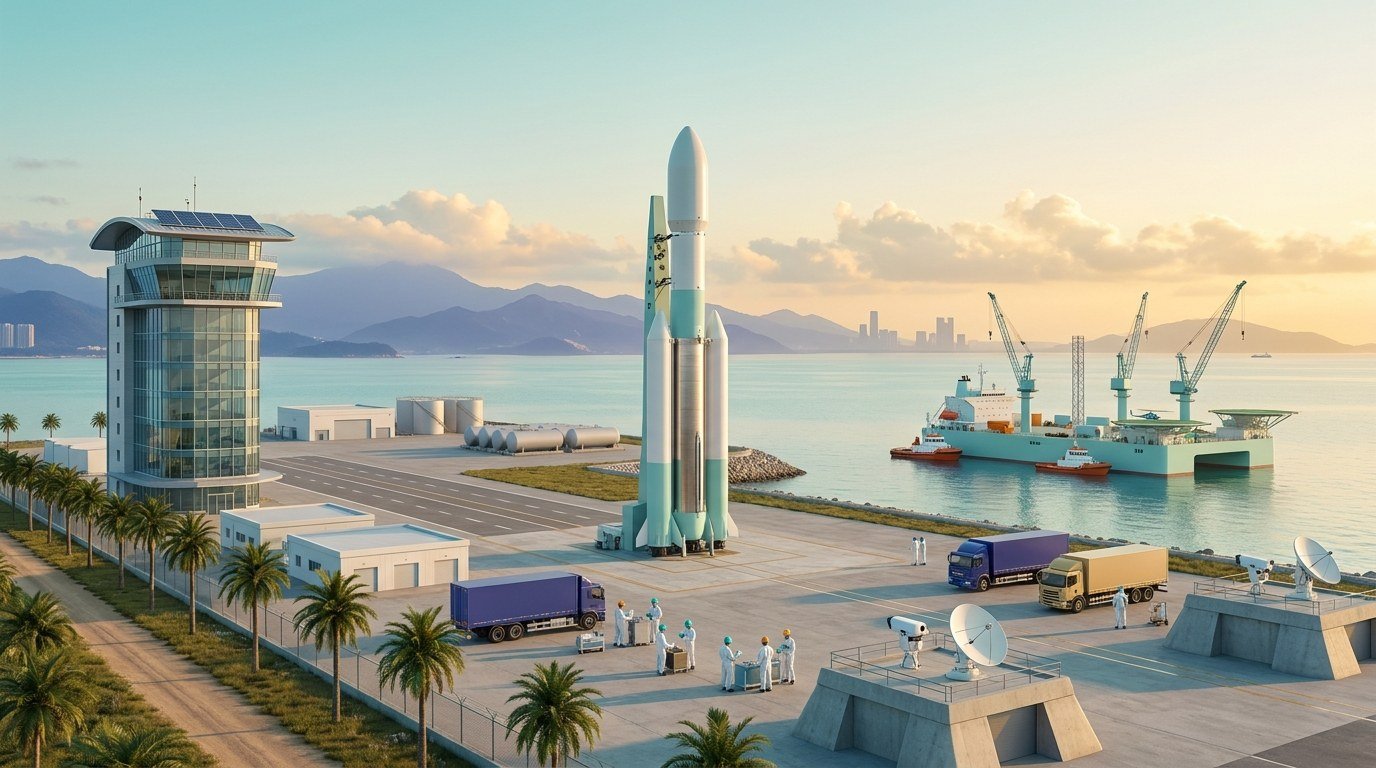
The other piece of infrastructure the commercial sector had been missing was a launch site of its own. China’s four major launch centres, Jiuquan, Xichang, Taiyuan, and Wenchang, are state-run and built around state launch cadence. For years commercial operators had to negotiate pad time and ride alongside Long March vehicles. In July 2022 a separate commercial launch complex began construction at Wenchang in Hainan, on the island province’s southern coast, where rockets can be delivered by ship rather than by rail. The site was built and operated by Hainan International Commercial Aerospace Launch Co. (HICAL), a state-owned company whose job was to be a launch landlord for private tenants. Total investment was over four billion yuan, about 553 million US dollars at the prevailing rate. On 30 November 2024, at 14:25 UTC, a Long March 12 rose from pad LC-2 at the new complex, marking both the rocket’s maiden flight and the first launch from China’s first dedicated commercial spaceport. Two experimental internet satellites, one of them built by Galaxy Space, a Beijing satellite unicorn, reached orbit. The site has been busy ever since. By mid-2026 HICAL had hosted 21 launches and 221 satellites, accounting for over 30% of China’s commercial satellite launches in 2025, and had supported China’s first offshore rocket-booster recovery. Pad LC-1, which opened in March 2025, hosts Long March 8 and Long March 8A flights for the Qianfan (also called Spacesail or G60) constellation, a state-backed broadband megaconstellation based in Shanghai. Pad LC-2 is now home to Long March 12 and Long March 10B, and is reserved for a queue of private reusable rockets: Space Pioneer’s Tianlong-3, Galactic Energy’s Pallas-1, Deep Blue Aerospace’s Nebula-1, Orienspace’s Gravity-2, and CAS Space’s Kinetica-2. The Long March 12 itself deserves a closer look because it shows what the state side is willing to share with the commercial complex. It is a two-stage kerolox rocket about 60 metres tall with a 3.8-metre diameter core, designed to lift about 12 tonnes to a 700-kilometre sun-synchronous orbit, and it is the first Long March with a kerosene-liquid oxygen first stage to debut in the commercial era. The fact that CASC chose to debut the LM-12 at a commercial pad, rather than at Jiuquan or Xichang, signals that the line between the state and commercial sectors is now drawn by where you launch, not by who built the rocket. HICAL runs the pad; CASC supplies the rocket; the payload is an experimental internet satellite from a Beijing unicorn. The boundary is operational rather than proprietary.
Booster landings as the new bottleneck
Booster recovery has now overtaken launch cadence as the constraint on the sector’s ambition. China put 92 rockets into orbit in 2025, of which roughly 50 are classed as commercial by German trade-and-investment analysts. That is more than Russia managed in the same year and only a few behind the United States. But almost all of those flights were expendable. As of mid-2026 only one orbital-class first stage had been recovered on legs by a Chinese commercial operator. On 18 August 2026 LandSpace’s methalox Zhuque-3 lifted off from Jiuquan, delivered its payload to orbit, and returned its first stage to a vertical landing. It was the third company in the world, after SpaceX and Blue Origin, to land an orbital booster on legs. The recovery had been a long road. Zhuque-3 had completed a 10-kilometre vertical take-off and landing test in September 2024. An earlier orbital-class attempt in December 2025 reached orbit but the booster suffered an “abnormal combustion” event on the landing burn. The August 2026 success was the second attempt. The other reusable demonstrators have been slower. i-Space’s Hyperbola-3 is a two-stage partially reusable methalox vehicle designed to carry up to 13,600 kilograms to low Earth orbit when expendable, or about 8,600 kilograms when reused. Its first flight was postponed from December 2025 into 2026, with a planned first-stage splashdown at sea and a reflight target of June 2026. Galactic Energy’s Pallas-1, a two-stage partially reusable kerosene vehicle designed for about 8,000 kilograms to low Earth orbit, completed its first orbital launch in 2025 and is targeting a first-stage recovery attempt in late 2026. Space Pioneer’s Tianlong-3, after the Gongyi accident and 127 corrective measures including doubled hold-down arms, completed a successful 30-second static fire on a sea platform off Haiyang in Shandong on 15 September 2025. Its first orbital flight, on 3 April 2026, failed about 33 seconds after lift-off when one of the nine TH-12 kerolox engines over-expanded. The vehicle’s next attempt has not yet returned the booster. None of these programmes is yet at SpaceX cadence. None is yet close.
The market is not yet SpaceX
The economics behind all of this are more state-driven than the headlines suggest. The single largest customer for Chinese commercial launches in the second half of the 2020s is two state-aligned megaconstellations. Guowang (国网, or SatNet, run by China Satellite Network Group) has filed plans for roughly 13,000 satellites with the International Telecommunication Union. Qianfan (千帆, also called Spacesail, run by Shanghai-backed companies) is targeting a similar number. Both are placing satellites on Long March 8, Long March 12, and Long March 8A launches from Wenchang, but both are also shopping for commercial medium-lift capacity because the Long March family cannot lift the constellation cadence alone. That demand is what is pulling the private sector through to first-stage recovery. It is worth being honest about what the state pull does and does not buy. Megaconstellation contracts are large, multi-year, and denominated in renminbi, which gives commercial operators a revenue base they can take to a STAR Market listing. But constellation contracts are also lumpy and politically driven: when a state customer slows its launch orders, the private launcher feels it within a quarter. Foreign commercial demand for Chinese launches remains thin, partly because of US ITAR-style restrictions on satellite components, partly because insurance markets in New York and Lloyd’s of London still treat Chinese launches as a separate risk pool. The Chinese commercial sector is, for the moment, a domestic industry serving a domestic market that happens to want very large numbers of small satellites in orbit very quickly. The capital is following. Through 2025 the Chinese commercial space sector had attracted more than eight billion US dollars in venture and strategic investment. LandSpace alone raised a fresh 900-million-yuan round in late 2024, filed for a STAR Market listing at the end of 2025 seeking about 7.5 billion yuan (about 1.1 billion US dollars), and projected profitability by 2029 against 2025 revenue of just 52 million yuan and a net loss of 1.71 billion yuan. Galactic Energy began IPO counselling in October 2025. i-Space raised about one billion yuan in a Series E first tranche, following a five-billion-yuan D++ round earlier in the year, and is targeting a second-half 2027 STAR Market listing. The funding pattern is closer to European or American space start-ups than to a true market sector: deep losses, long horizons, and state-backed patient capital filling the gap between venture and revenue. The regulator is now openly courting the sector. On 18 November 2025 the China National Space Administration published an Action Plan for Promoting the High-Quality and Safe Development of Commercial Space (2025 to 2027). The plan establishes a National Commercial Space Development Fund, removes the requirement for commercial satellite makers to hold a weapons-and-equipment research and production licence, mandates third-party liability insurance for launches, and accelerates a long-pending national Space Law. The framework still treats “private” firms as part of a state-led industrial policy rather than as freestanding companies, but it gives the commercial sector something it has not had: a written regulatory horizon. What the chronology shows, in plain terms, is a sector that grew up around a single engineering choice. Document 60 opened the door in 2014. Founders arrived in 2015 and 2016. They picked methane almost immediately, because methane was the propellant that made the next move, reusable first stages, technically feasible. i-Space flew the first private Chinese orbital rocket in 2019. LandSpace flew the first methane-fueled orbital rocket anywhere in 2023. The same vehicle, or its successor, has now landed an orbital booster on legs. The bottleneck has moved from regulatory access to propellant to landing reliability, and it is now sitting at landing reliability. That is, on the calendar of spaceflight, a normal place to be roughly a decade after the policy door opened.