
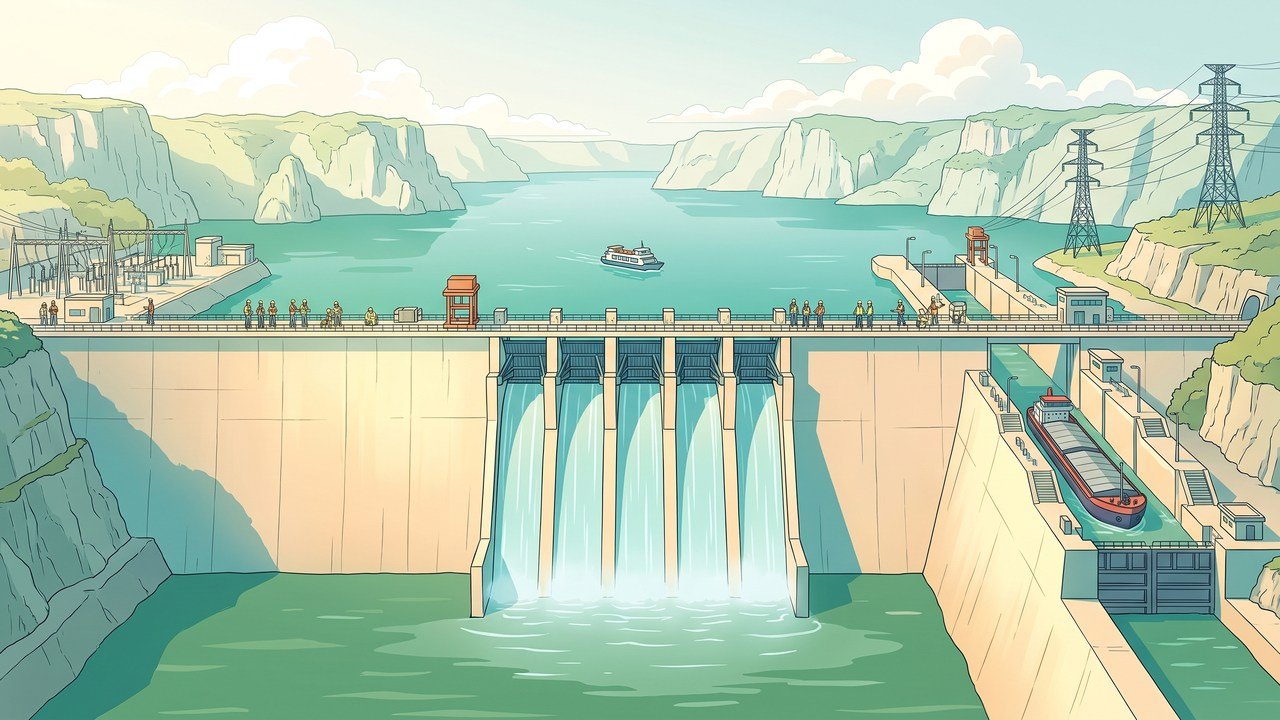
China does not build small. The Three Gorges Dam, where the Yangtze River cuts through the last gorge before it opens into the middle plain, is twenty two and a half thousand megawatts of installed capacity wedged into a concrete wall almost two hundred metres high and more than two kilometres across. It is the largest power station on Earth by nameplate capacity. It is also a flood control structure, a navigation system, a reservoir that holds back almost forty cubic kilometres of water, and the most expensive single piece of civil engineering the country has ever built. To understand why it exists, when it was built, and what it actually does, you have to follow three stories at once: a seventy year political argument, a seventeen year construction programme, and a quiet twenty year operational record that has changed both the river and the people who live downstream of it.
This essay walks through those three stories in the order they unfolded, with the dates and figures that anchor them. It is not an endorsement or an indictment. It is a mechanism.
The plan that took seventy years to approve
The first written proposal to dam the Three Gorges came from Sun Yat-sen in his 1919 plan for industrial development. He saw the gorge as a natural bottleneck and the river as a generator of both power and shipping lanes. The country at the time could not build it. The Second World War intervened. In 1944 the Nationalist government invited the American engineer John Savage, who had helped design the Hoover and Shasta dams, to survey the site. Savage sketched a reservoir two hundred metres deep with a generating capacity of just over ten gigawatts. The civil war ended that conversation.
After 1949 the new state kept the idea on the books. The 1950s brought a series of feasibility studies and a smaller pilot project downstream, the Gezhouba Dam, which was approved in 1970 and finished in 1988. Gezhouba was a learning exercise. Three Gorges was the prize. Throughout the 1980s the Ministry of Water Resources and the Chinese Academy of Sciences argued over the design. The State Council set up a special committee of 163 experts in August 1990 to push the project to a vote.
On 3 April 1992 the National People’s Congress approved construction. The vote was unusually narrow for a flagship Chinese project: 1,767 in favour, 177 against, 664 abstaining, 25 absent. That is 67.75 per cent approval. A third of the chamber did not endorse the plan. The dissent was led by delegates who objected to the scale of displacement and to unresolved questions about sedimentation and seismic risk. The vote passed, but it passed with the kind of margin that tells you the engineering case alone had not closed the political argument.
Construction formally began on 14 December 1994, with a groundbreaking ceremony at Sandouping, a town in Hubei province in the middle reach of the Xiling Gorge. Premier Li Peng, himself a water engineer by training, gave the keynote speech. Preparatory excavation work had been under way since 1993, and resettlement programmes had begun as early as 1985 in scattered pilot phases. The official start date is 1994, the same year the project acquired its first foreign financing commitments from international export credit agencies.
The seventeen year build
The Three Gorges project was built in three formal stages, and each one was supposed to deliver something the country could switch on. The stages overlapped with each other and with the political calendar, but the headline dates are clear.
Stage one ran from 1994 to 1997. The first task was to move the Yangtze itself. Workers dug a diversion channel through the south bank and built cofferdams upstream and downstream of the dam site. On 8 November 1997 the river was closed off, and water was forced through the diversion channel. It was a public event. State television broadcast the closure. The image that stuck was of a temporary embankment giving way under the river’s weight and the brown water pouring through into the prepared channel. For the next six years the river would flow past the dam site rather than through it, while the concrete wall was poured in dry conditions on the original riverbed.
Stage two ran from 1998 to 2003. The left bank powerhouse and its permanent five-stage ship lock were built. The first commercial turbines began to generate electricity in July 2003. The reservoir started to fill on 1 June 2003. By mid 2003 the water level behind the dam had reached 135 metres, and by 2006 the north bank generators had reached their full 9,800 megawatts. The dam body itself was completed on 20 May 2006. At that point the structure was finished. It stood 185 metres above the riverbed, ran 2,309 metres along the crest, and contained roughly 65 million cubic metres of concrete.
Stage three ran from 2004 to 2012. The right bank generators were installed in parallel with the still rising reservoir. The original design called for 26 generators of 700 megawatts each, giving a total capacity of 18.2 gigawatts. In 2002 the project decided to add six more, an underground power plant cut into the mountain south of the dam. The extra six brought the total to 32 main turbines. The last underground unit, number 27, finished its final test on 23 May 2012 and the project reached its full 22,500 megawatts. The Guinness World Records entry was logged on 4 July 2012. The ship lift, a vertical mechanism for vessels up to three thousand tons, was completed separately in 2015 and finished the navigational system.
The schedule slipped. The dam body itself was finished in 2006, ahead of the 2009 target. But full generating capacity was reached in 2012, three years late, because the underground plant was a late addition. The full navigational system was finished in 2015, six years later than planned. None of those slips were unusual for a project of this size. They are typical. What was unusual was that the country kept paying for them.
The reservoir and the numbers that matter
The dam was designed to do four things. The order matters, because the four functions are in tension with each other.
First, flood control. The middle and lower Yangtze, the stretch that runs past Wuhan and on to Shanghai, has historically been the most flood prone river reach in China. The Yichang gauging station, just downstream of the dam, has recorded floods since 1877. The largest observed peak discharge at Yichang is 71,100 cubic metres per second; the empirical probable maximum flood is taken as 105,000 cubic metres per second. The dam’s design flood is the one in a thousand year event, taken as 98,800 cubic metres per second. The reservoir holds 22.15 cubic kilometres of flood storage, and during the flood season from mid June to late September it is operated down to a flood limiting level of 145 metres. When water rises above that level the reservoir impounds the difference, then releases it slowly after the peak has passed downstream. In 2010 the inflow peaked at 70,000 cubic metres per second on 20 July and the reservoir clipped the outflow to about 40,900, a reduction of nearly forty per cent. In 2012 the inflow reached 71,200 cubic metres per second and was again clipped by roughly forty per cent. Between 2009 and 2018 the dam was operated for flood control on 45 separate occasions, holding back a cumulative 141 billion cubic metres of water.
Second, power generation. The 32 main Francis turbines, each rated at 700 megawatts, plus two 50 megawatt plant service units, give the installed nameplate capacity of 22,500 megawatts. The designed annual output is 88.2 terawatt hours. In a wet year the station does much better. In 2020 the plant produced 111.88 terawatt hours, the highest annual figure ever recorded by a single hydropower station. In a dry year it produces less. The long run average sits near 95 terawatt hours, give or take twenty.
Third, navigation. The dam includes a five stage flight of locks on its north side, capable of lifting vessels up to ten thousand tons through the 113 metre head difference. A separate ship lift for smaller vessels up to three thousand tons was added and completed in 2015. Before the dam, river shipping above Yichang was seasonal and unreliable. After the dam, the reservoir is deep and slow for 600 kilometres upstream, allowing larger cargo barges to reach Chongqing year round. The harbour of Chongqing, 1,800 kilometres from the sea, became a serious inland port because of the Three Gorges reservoir behind it.
Fourth, water storage and dry season flow regulation. In late autumn the reservoir is filled back up to its normal pool level of 175 metres. During the dry winter and spring months the dam releases extra water to keep downstream channels deep enough for navigation and to push back against drought. The mechanism is the same one used in flood control, run in reverse.
The four functions cannot all be optimised at once. Holding water back for power means releasing less for flood control. Releasing more for navigation in winter means less stored for spring drought relief. Operators balance these uses with a flood limiting level of 145 metres during the wet season and a normal pool level of 175 metres during the dry season.
The cost and the people
The original 1993 budget, in May 1993 prices, was 90.09 billion yuan. That broke down as 50.09 billion for construction and 40 billion for resettlement, on the assumption that just over a million people would need to be moved. By 2006 the official budget had been revised upward to 180 billion yuan. By September 2009 Xinhua reported that total spending had reached 254.2 billion yuan, or 37.23 billion US dollars at then prevailing rates. Of that, 69.3 billion yuan went to resettlement, the rest to construction, financing, and grid connections. In real terms, the final cost was about 2.8 times the original plan.
The people side of the bill is the one that gets the most attention. The officially planned displacement figure was 1.13 million. By August 2008, 1.05 million residents had been formally resettled. The CNN Style feature on the dam quoted a higher figure, around 1.4 million, which counts people displaced by secondary flooding that followed the reservoir’s filling rather than by the original inundation. Both numbers are right in their own context. The reservoir submerged two cities, 114 towns, and 1,680 villages. Among the submerged sites were stretches of the original Three Gorges scenery that had drawn domestic tourists for decades, and several archaeological sites of regional importance. The cultural loss was real and not easily priced.
Resettlement was not a one time event. It ran in phases from the mid 1980s pilot programmes through the 1990s and into the 2000s, with a final relocation push around the time the reservoir reached its full 175 metre pool level in October 2010. Twenty one Chinese provinces and municipalities, plus a long list of large and medium sized cities and government departments, were formally tasked with absorbing a share of the displaced population. The mechanism was a quota system. Whether the compensation offered to individual households was adequate has been disputed from the start; complaints about low cash compensation, loss of farmland, and difficulty finding work in the receiving cities have appeared in academic literature, NGO reports, and official press coverage across the project lifetime.
The sediment story that was supposed to bury the dam
The technical objection that nearly sank the 1992 vote was sedimentation. Reservoirs on silt laden rivers like the Yellow River or the Mekong fill up with sediment over time. Engineers feared that the Three Gorges reservoir, on a river that historically carried close to 500 million tonnes of sediment a year past Yichang, would lose its flood storage and power head within decades.
The forecast turned out to be wrong, but not for the reason its critics expected. The reservoir does trap sediment. From June 2003 to December 2021 it deposited about 2.05 billion tonnes, an average of 110 million tonnes a year. That sounds like a lot, but it works out to an annual loss of effective flood storage capacity of about 0.74 per cent. After nearly twenty years the dam has lost less than a tenth of one per cent of its flood storage capacity to silt. The original design had feared much worse.
The reason the silt trap has been so much gentler than expected is not the Three Gorges Dam itself. It is the cascade of reservoirs upstream, particularly on the Jinsha River, that were built in the 2010s and now trap most of the sediment before it reaches Yichang. Sediment inflow at Yichang fell from 491.8 million tonnes a year on the 1956 to 2002 average to just 36.1 million tonnes a year on the 2003 to 2017 average. The dam’s apparent silt success depends on other dams. That is a real point. It means the system works, but only as long as the upstream reservoirs keep working. If they were ever silted past their design life, or if their operators changed their release regimes, Three Gorges would face the sedimentation problem its 1992 critics had warned about.
The other side of the sediment story is downstream. Clear water released from a reservoir scours the riverbed. Between 2002 and 2018 the middle Yangtze channel below Yichang lost about 1.6 billion cubic metres of material to erosion. The Yangtze delta, which had been growing for centuries, has begun to retreat in places. The estuary lost roughly eighty per cent of its sediment supply in the years after 2003. Wetlands downstream are being altered. Coastal erosion around Shanghai’s outer islands is now a measurable problem with a measurable cause.
Honest framing for the operators
The Three Gorges Dam is not the largest power station in the world by annual generation. It is the largest by installed capacity, which is the right metric for understanding how much infrastructure has been built. In 2020 it generated 111.88 terawatt hours and set a world record. In a dry year it generates less. The Chinese mega dam at Baihetan, on the same river upstream, has a nameplate capacity of 16,000 megawatts and can match or beat Three Gorges in a wet year. The hydrological record has natural variability that no turbine can override.
The dam’s flood control record is real but not unqualified. The 2010 and 2012 events, both around 70,000 cubic metres per second inflow, were clipped by roughly forty per cent. The 2016 flood, smaller by inflow but worse by water level in the middle reach, exceeded the flood control water level at Hankou by 107 centimetres on 7 July 2016, the fifth highest water level recorded there since 1870. The reservoir’s benefit to flood control is genuine, but downstream flooding is not solved.
The structural record is clean. There has been no catastrophic dam failure, no uncontrolled overtopping, no documented instance of the dam deforming beyond design tolerance. There have been landslides along the new reservoir shoreline, which is normal for a 600 km long impoundment, and there have been small scale seismic events in the reservoir area that may be induced by the weight of the water. The induced seismicity question has not been definitively answered either way.
The cost overrun is real. The project ran about 2.8 times its 1993 budget. It was approved by 67.75 per cent of the National People’s Congress, with a third of the chamber abstaining or voting against. The displacement numbers are large. The downstream delta is eroding. None of these are reasons to think the dam should not have been built. They are reasons to read the official literature with the same care one would read any large engineering prospectus.
Why the country built it
Three Gorges is a single answer to several separate problems that converged in the 1990s. The eastern seaboard needed power that did not require imported coal. The middle Yangtze needed flood control that existing levees could not deliver. Chongqing needed a reliable navigation channel to reach the interior. None of these problems had a cheaper answer. Coal fired power would have required new mines, new rail lines, and new ports. Levees alone could not have absorbed a 70,000 cubic metre per second flood. Locks on the natural river could not have given Chongqing year round access to oceangoing barges.
The dam does all four things at once. It generates enough electricity in a wet year to match several large coal fired power stations. It clips flood peaks by forty per cent in big events. It holds back a reservoir that lets three thousand ton barges run from Shanghai to Chongqing. It regulates dry season flow. The same concrete wall serves four masters. That is the engineering logic. The political logic was that a project of this scale had been on the national plan since 1919, and the country that built it wanted to prove it could build the things its predecessors had only imagined.
The legacy of a dam that took a hundred years to approve and seventeen years to build
Three Gorges is finished. The dam body is finished. The turbines are finished. The locks and lift are finished. The cost is paid. The people who were moved have been moved. What remains is operation, which is its own twenty year story and continues. The reservoir traps sediment, releases clear water, holds back floods, and generates electricity. The river downstream of it has been permanently changed. The delta erodes. The wetlands alter. The flood plains downstream see different water levels in summer and winter than they did before 2003.
In a sense the dam is no longer news. It does the same job every year. The interesting questions are now upstream, where the cascade of Jinsha River reservoirs has taken over the role of sediment trap that the dam itself was once expected to play, and downstream, where the Yangtze estuary is adjusting to a sediment supply that will never return to its twentieth century level. The dam is one piece of a much larger river system, and the system’s behaviour cannot be read off the dam’s nameplate alone.
What the dam does prove, plainly and without slogan, is that a country that decides to build something very large and very expensive can build it. The political argument took seventy years. The construction took seventeen. The cost overrun was about 2.8 times. The displacement was over a million people. The downstream effects are still being measured. None of those numbers are hidden. None of them are small. The dam stands anyway.