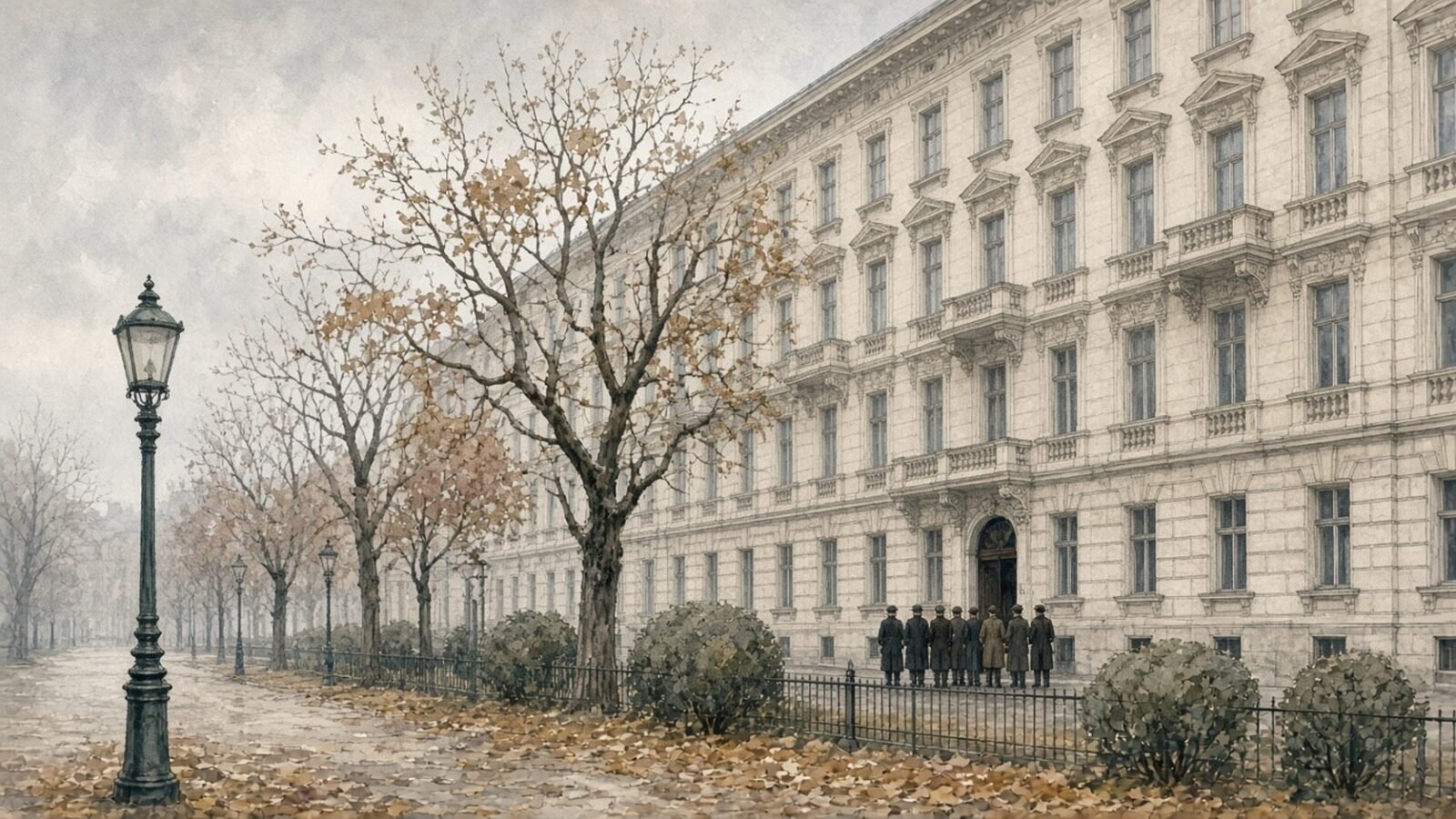
In the summer of 1938, a seventeen-year-old Jewish boy named Eric Goldstaub set out to find his family a way out of Vienna. He went from consulate to consulate along the Ringstrasse, fifty of them by his own later count, and at each he received the same elegant regret: the quotas were full, the forms were lacking, nothing could be done. Then someone mentioned the Chinese consulate, and there, in an office on Beethovenplatz, he met a soft-spoken Chinese diplomat who asked a few questions, took his application, and within days had issued visas not just for the boy but for his entire extended family, twenty visas, for a journey to a Chinese city none of them had ever seen. The diplomat’s name was Ho Feng-Shan, and he did this not once but continuously, for nearly two years, in open defiance of his own ambassador, issuing hundreds and very likely thousands of visas that unlocked the escape route from the Third Reich. Then he went on with his career, never spoke of it, and died in San Francisco in 1997 aged ninety-six, taking the story so completely with him that it emerged only from his own funeral notices. He is remembered now as China’s Schindler, a comparison he never heard and would probably have found embarrassing. This is the story of the consul who kept stamping.
From Hunan to Vienna
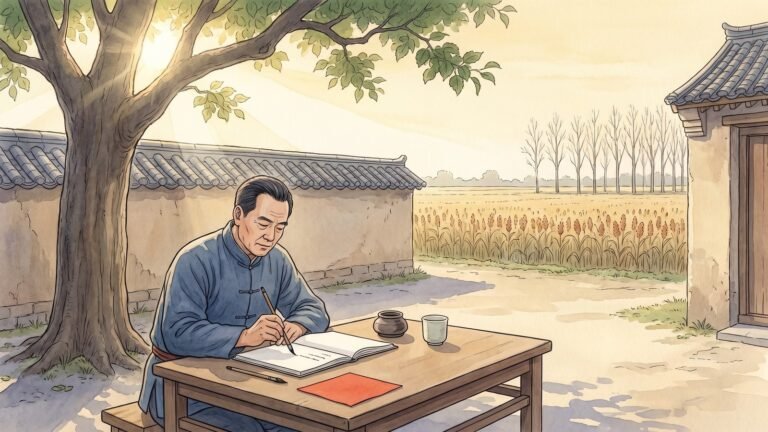
Ho Feng-Shan was a self-made man of a recognizably May Fourth type, and his formation matters to what he did. He was born in 1901 in Yiyang, in Hunan province, into a family of modest means that lost its father early, the classic biography, in that generation, of the boy who studied his way out. His path ran through the institutions of China’s engagement with the West: the Yali school in Changsha, the American-run academy founded by Yale graduates, where he received a rigorous bilingual education, and then, improbably for a boy from inland Hunan, the University of Munich, where he took a doctorate in economics in 1932. He was, that is to say, one of the new China hands the republic was producing: fluent in English and German, trained in both classical Chinese letters and Western social science, Christian by education, cosmopolitan by temperament, and committed, in the manner of his whole cohort, to the project of making China a modern country among modern countries. He entered the foreign ministry in 1935, served his apprenticeship in Turkey, and in 1937 was posted to Vienna as first secretary of the Chinese legation. He was thirty-six when history put him at the window.
The timing was exact and terrible. In March 1938 Germany annexed Austria, and the Chinese legation in Vienna was downgraded to a consulate-general, with Ho Feng-Shan in charge. The Anschluss turned Vienna’s one hundred and eighty thousand Jews into prey within weeks. The city that had been the capital of Jewish culture in Central Europe, Freud’s city, Mahler’s, Wittgenstein’s, became the laboratory of forced emigration: Adolf Eichmann’s Central Office for Jewish Emigration was established there in 1938 and pioneered the assembly-line technique of stripping Jews of everything they owned and expelling them penniless, on condition that they produce, at each stage, proof that some other country would take them. That was the choke point. To leave, a Jew needed an entry visa for somewhere, anywhere; and the world’s consulates, as Eric Goldstaub discovered on his fifty rounds, were closed. The doors shut not with hatred but with forms.
The terror that drove the queues had a rhythm the consulates could watch from their windows. After the Anschluss came the pogrom atmosphere on the streets, Jews scrubbing pavements on their knees while crowds laughed, the suicides, the flight of those who could bribe their way out early. Then, in November 1938, came Kristallnacht: Vienna’s synagogues burned, its Jewish shops were smashed, and some six and a half thousand Jewish men from the city were arrested and sent to Dachau and Buchenwald, from which release could be bought only with proof of imminent emigration. The proof, again, was paper. A visa to anywhere was literally a ticket out of a concentration camp, and the offices that could issue such paper became, overnight, places where lives were priced in stamps. It was into this queue, lengthening by the week through the autumn of 1938, that Eric Goldstaub’s fifty refusals and one acceptance must be set. The Chinese consulate was not the only office that helped, a handful of other diplomats, a Dutchman here, a Swiss there, bent their rules, but it was the only one that helped at scale, systematically, as policy set by the man in charge.
The open window
The question that hung over every family in that queue, where can we go, received from this one office the only answer in Europe that came with a stamp. What Ho Feng-Shan did was simple in description and rare in fact: he issued visas to Shanghai to every Jewish applicant who asked. The oddity of the arrangement has been explained in the previous essay on this site: Shanghai, in its wartime legal limbo, required no entry visa at all, so Ho’s visas admitted no one to anywhere, technically, that was not already open. But the visa was the key that unlocked the rest of the machinery of escape. The German authorities required proof of destination before granting an exit permit; the shipping lines required it before selling a ticket; the Italian authorities required it before allowing transit to the ships at Genoa and Trieste. A Chinese visa, any visa, any consular stamp indicating a destination, released the whole chain. Ho understood this perfectly, and he used his consulate’s authority to the full: he issued visas in quantity, to individuals and to whole families, and when his stock of visa forms ran low he improvised. Survivors’ testimonies, gathered decades later, converge on the same picture: an unhurried, courteous Chinese official, treating terrified applicants as valued visitors to his country, asking no questions that could be used against them, and stamping, stamping, stamping. Some families he saved entire; some applicants he advised on routes; on at least one occasion, when the Gestapo menaced the consulate itself over Jewish property connected to visa applicants, he faced them down with diplomatic cover. The count of his visas was never kept, he destroyed no records because he kept none that mattered, and the estimates of the living saved through his office run from the high hundreds into the thousands.
His government did not thank him. The Nationalist ambassador in Berlin, Chen Jie, was pursuing a policy of accommodation with Germany, China still depended on German military advisers and German arms even as Japanese guns fired on Chinese cities, and he regarded a consul handing out visas to Jews as an irritant to relations with Berlin at the worst possible time. Chen ordered Ho to stop; Ho, citing humanitarian duty and the absence of any law against his actions, declined; the embassy despatched an investigator to Vienna to build a case, found irregularities where it wanted to find them, and Ho carried a black mark on his service record for the rest of his career. He was transferred out of Vienna in 1940. The visa window, without its consul, narrowed. By then the war had begun, the sea route closed, and the epoch of the open window was ending anyway. But in the two years it stood open, the man at the desk had made the Chinese consulate on Beethovenplatz one of the most effective rescue stations in Europe, an office in which a mid-ranking diplomat, armed with nothing but a stamp and his own conviction, outdid most of the governments of the earth.
The view from the burning country
One dimension of the story is easy to miss from the European side: what Ho Feng-Shan’s own country was going through while he stamped. The years of the open window in Vienna, 1938 and 1939, were the years of China’s own catastrophe, the fall of Nanjing and the massacres that followed, the burning of Wuhan, the flight of the government to Chongqing, the firebombing of Chinese cities. Ho’s dispatches from Vienna went to a foreign ministry of a government in exile from its own capital; the consul issuing haven-visas to Europe’s refugees belonged to a nation generating refugees by the tens of millions. Historians of the episode have often noted the symmetry without quite knowing what to do with it, but Ho’s own scattered remarks suggest it was not lost on him. A diplomat of a people being burned out of its cities did not need to be instructed in what it meant to be declared surplus by a powerful state. There is no evidence he ever made the comparison aloud; he was not a man for speeches. But the empathy has a geography to it, and it runs, visibly in retrospect, from the lanes of wartime China to the queue on Beethovenplatz.
It is also worth registering, as the previous essay did, that the rescue was a Chinese institution’s achievement as well as one man’s. Ho operated under the flag of a republic that was fighting for its life, and the visa he issued was not a private letter but an act of the Chinese state, exploiting, with a grin one can only imagine, the treaty-port anomaly that a century of Chinese patriots had cursed. The open door at Shanghai, forced on China by the gunboats of 1842, had become, by 1938, a door China held open for others. The consul in Vienna and the harbour without a visa office were two halves of one machine, and neither half knew the other existed.
The long silence
What happened to the visas themselves, and to the truth about how many there were, is a story of paper doing what paper does in violent centuries: vanishing. The consulate’s own records did not survive the war’s chaos and the consulate’s closure; the German exit files were consumed by the regime’s end; the refugees, penniless and moving, kept their lives and lost their documents. What remained, for the historians who reconstructed the episode in the 1990s, was the testimony of survivors and the serial numbers on the few visas that families had preserved, certificates whose numbers run into the hundreds within single months, implying a continuous, high-volume operation. On that basis scholars speak of hundreds of visas directly issued by Ho’s consulate, with the total of those saved through his office, counting the family members each visa carried, reasonably estimated in the low thousands, a figure that places him, by the cold arithmetic of rescue, in the first rank of the diplomats who acted. He never supplied the number himself. Asked, in his one recorded reflection, why he had done it, he reached not for heroism but for the plainest humanitarianism: the people were being treated unjustly, and it was natural to help. The word he used, natural, deserves to be taken literally: he experienced the choice as no choice at all.
Then comes the part of the story that defines the man: the silence. Ho Feng-Shan returned to a diplomatic career of respectable obscurity, postings after the war as ambassador to Egypt, and later in Latin America, Mexico, Bolivia, Colombia, retirement in 1973, and a long quiet old age in San Francisco. He wrote a memoir, My Forty Years of Diplomatic Life, published in 1990, in which the Vienna years receive a modest mention: he records that he issued visas to Jews, that the poor people were being treated unjustly, and that helping them seemed to him the natural thing to do. Natural. The word is the whole man. He never applied for recognition, never gave interviews about it, never wrote to a newspaper, never, so far as his family could tell, even told his children the scale of what he had done. When he died in September 1997, it was the obituary, drafted by his daughter Ho Man-li, that mentioned the visas, and the obituary that was read by a researcher of the era, and it was only then that the survivors’ grapevine, the scattered families of Toronto, New York, Tel Aviv, connected the courteous consul of their memories to a name, a face, and a funeral in California. Eric Goldstaub, by then an elderly man in Canada, came forward to describe his twenty visas. Others followed. The historians did their work, and in 2000 the state of Israel conferred on Ho Feng-Shan, posthumously, the title Righteous Among the Nations, the honour reserved for non-Jews who risked themselves to save Jewish lives, awarded at a ceremony his daughter attended in his place.
The honours multiplied as the story spread, and their geography is itself a map of the story. In Jerusalem his name joined the Wall of Honour in the Garden of the Righteous at Yad Vashem, alongside Wallenberg and Sugihara. In Vienna, the city that had burned its synagogues, a plaque marks the site of the consulate where the queue once stood. In Shanghai, the Jewish Refugees Museum gives him a place of honour at the head of the story, the man who handed out the keys to the open door. In his native Hunan, which had not known what to make of him in his lifetime, he is now taught to schoolchildren. And in San Francisco his grave draws visitors who leave, in the Chinese manner, small offerings, and in the Jewish manner, stones. His daughter, who carried the story out of the funeral notice into the light, spent her own later years as its custodian, corresponding with survivors, standing in for the father at ceremonies, and completing, with a biographer’s persistence, the archive he had never bothered to keep.
The discovery made, in its way, as much noise as the man had avoided. He was honoured by the United States Congress, celebrated in Shanghai’s Jewish Refugees Museum, commemorated in Vienna, and pressed into service as a symbol, of Chinese humanitarianism, of the Shanghai story, of the individual conscience. All of that is true and none of it is quite the point. The point is narrower and more demanding. Ho Feng-Shan was not a rebel or a hero in his own mind; he was a professional doing his job in a way his superiors had not authorized, at real cost to his career, for people he would never see again, and he found in this nothing whatsoever to remark upon. The natural thing to do. In an era when the machinery of the world was arranged to make rescue difficult and deniable, he simply declined the arrangement, quietly, daily, one stamp at a time. And the manner of the doing matters as much as the act. The survivors remember not only that he issued the visas but how: without humiliation, without delay, without the small cruelties of power that the desperate learn to expect at official windows. He received the hunted as though they were guests of his country, which, in his own mind, they were about to become. The courtesy was part of the rescue. A man fleeing for his life who is treated at the last window as a human being has been given two things, not one, and the second thing, dignity at the moment of deepest indignity, is the one the survivors still talk about first.
What the stamp was worth
It is worth dwelling on the instrument itself, because Ho’s story is, at bottom, a story about the moral weight of small official acts. A visa is a trivial object, a stamp, a signature, a few seconds of a clerk’s day. In 1938 it was the exact hinge between life and death, and everyone in the system understood this, which is why the forms multiplied. Bureaucracy is usually described as the enemy of humanity, and at Evian and in the quota offices it was. But the same machinery, in one office on Beethovenplatz, ran the other way: Ho’s stamps did not fight the system, they exploited it, feeding its own requirement, proof of destination, back into it until the requirement saved the people it was designed to exclude. There is a lesson in there for every age that processes human beings in paper: the system is never only the system. It is also the person at the window, and the person at the window always has a choice about how to read the rules. Ho read them mercifully, at personal cost, and then went home to dinner.
His story also completes a circle this site has been tracing. The Shanghai essays have shown the treaty-port city as fantasy, as industry, as architecture and as refuge; the long series before them showed how the port was forced open by arms. Ho Feng-Shan is the human counter-signature to all of it: a son of Hunan who had gone out into the world, learned its languages, and when the moment came, used the world’s own machinery to pry open the door that China’s humiliation had, by accident, left ajar. The open port of Shanghai saved eighteen thousand lives; the consul in Vienna showed that the door also needed someone willing to hand out the keys. Between them they make the century’s most hopeful pairing: the city that asked no questions, and the man who answered only the right ones. He asked, in effect, just one question of each terrified family at his window: where do you need to go? And then he stamped, and stamped again, and went on stamping until they took the window away.