In July 1938, at the French resort of Evian, the delegates of thirty-two nations met to discuss the Jewish refugees of Germany and Austria, and almost every one of them, expressing the deepest sympathy, explained why his own country could take no more. The doors of the world were closing with bureaucratic precision: quotas, affidavits, transit visas, landing money, each requirement designed to fail. And yet, within a year, some eighteen thousand Jewish refugees from Germany, Austria, Poland and Czechoslovakia had found safety in the unlikeliest refuge on earth: Shanghai, a Chinese city already half-destroyed by war, whose own people were fleeing by the million. The reason was an accident of sovereignty. After the battle of 1937, the Shanghai harbour frontage sat in a legal limbo, the International Settlement’s old rules had lapsed, the Japanese occupiers of the Chinese city did not bother with entry formalities, and no visa of any kind was required to land. It was, as the refugees called it, the port of last resort, the only place on the planet where a Jew could simply arrive. This is the story of the most improbable sanctuary of the Holocaust, and of the city that, at its own lowest ebb, with its own people hungry and its own districts in ruins, kept a door open when every other door was shut.
Three communities
The refugees did not arrive in a city without Jews. Shanghai already had two distinct Jewish communities, and their existence was the scaffolding onto which the third was built. The oldest were the Baghdadi Jews, merchants from Baghdad and Bombay who had followed the flag east after 1842 and built some of the great fortunes of the treaty ports: the Sassoons, whose Cathay Hotel anchored the Bund; the Hardoons, the Kadoories. Their synagogues and their charities were long established, and their buildings, the Ohel Rachel synagogue on North Shaanxi Road, endowed by the Sassoons, and the great marble residences along the Bund, were among the city’s landmarks. The second community were the Russian Jews, refugees of an earlier catastrophe, who had fled pogroms and then revolution down the Trans-Siberian to Harbin and on to Shanghai, a few thousand of them by the 1930s, shopkeepers and musicians and doctors, with their own synagogue, Ohel Moshe, opened in 1927 in Hongkew, the working-class district north of Suzhou Creek. Between them, the Baghdadis with their money and the Russians with their numbers, the city possessed the institutions, burial societies, soup kitchens, schools, ritual baths, that would make rescue practical when the great wave came. It is one of the quiet lessons of the story: refuge is infrastructure before it is sentiment. The sanctuary worked because someone had already built the kitchens.
The doors that closed and the one that didn’t
The mechanism of escape from the Reich ran on paper, and by 1938 the paper was nearly impossible to obtain. Germany’s Jews had been pauperized by design, their property seized, their professions closed, and every potential destination demanded documents, entry visas, transit visas, proof of funds, that a pauperized family could not supply. Kristallnacht, the pogrom of 9-10 November 1938, when synagogues burned across Germany and Austria and thirty thousand Jewish men were sent to camps, converted the question from emigration to escape: any country would do, any ship, any port. Shanghai’s peculiar loophole became common knowledge in the community within weeks. No visa required. The phrase appears in memoir after memoir with the same incredulity: no visa required.
The statistics of the contrast are worth setting down plainly. The MS St. Louis, carrying nine hundred and thirty-seven Jewish refugees from Hamburg in May 1939, was refused landing in Cuba and then the United States, and sailed back to Europe, where a quarter of its passengers later died in the camps; its voyage became the symbol of the world’s refusal. Shanghai, in the same two years, took in roughly twenty times that number. No other jurisdiction approached it: not Britain, which admitted children but rationed adults, not the United States, whose quotas went unfilled, not the Latin American republics whose promises evaporated on contact with their own foreign ministries. The Dominican Republic offered a hundred thousand visas at Evian and delivered a few hundred settlers. Only Shanghai actually absorbed people at scale, and it did so because it had no mechanism for refusing them, a fact that cuts both ways and should be stated honestly: the open door was an accident of collapsed sovereignty, not a policy. But the refugees did not experience it as an accident. They experienced it as their lives.
Two diplomats wrote themselves into the story at this point, and both deserve their paragraphs. In Vienna, the Chinese consul Ho Feng-Shan spent 1938 and 1939 issuing entry visas to Shanghai to Jewish applicants, hundreds of them, possibly thousands, the full count was never recorded, in open disregard of instructions from his own ambassador, who feared offending Germany and straining relations. Ho’s visas were technically unnecessary, since Shanghai required none, but they were practically priceless, because they were the piece of paper that unlocked everything else: the German exit permit, the Italian transit, the shipping ticket, the document that let a family walk to the ship as emigrants rather than be stopped as stateless persons. Ho issued them until he was recalled, took a black mark on his career for it, never mentioned it afterward, and was found by researchers only decades later; in 2000 Israel named him Righteous Among the Nations. His counterpart on the other route was Chiune Sugihara, the Japanese consul in Kaunas, Lithuania, who in 1940, equally against instructions, wrote transit visas by hand until his consulate closed, enabling some two thousand Polish Jews, including, astonishingly, the entire faculty and student body of the Mir Yeshiva, the only major European yeshiva to survive the Holocaust intact, to cross Siberia to Japan, whence most of them were eventually sent on to Shanghai in 1941. Two consuls, one Chinese and one Japanese, each disobeying his own government, each saving thousands, in a war in which their two countries were the bitterest of enemies. The twentieth century was not short of irony, but that one stands out.
The voyage and the arrival
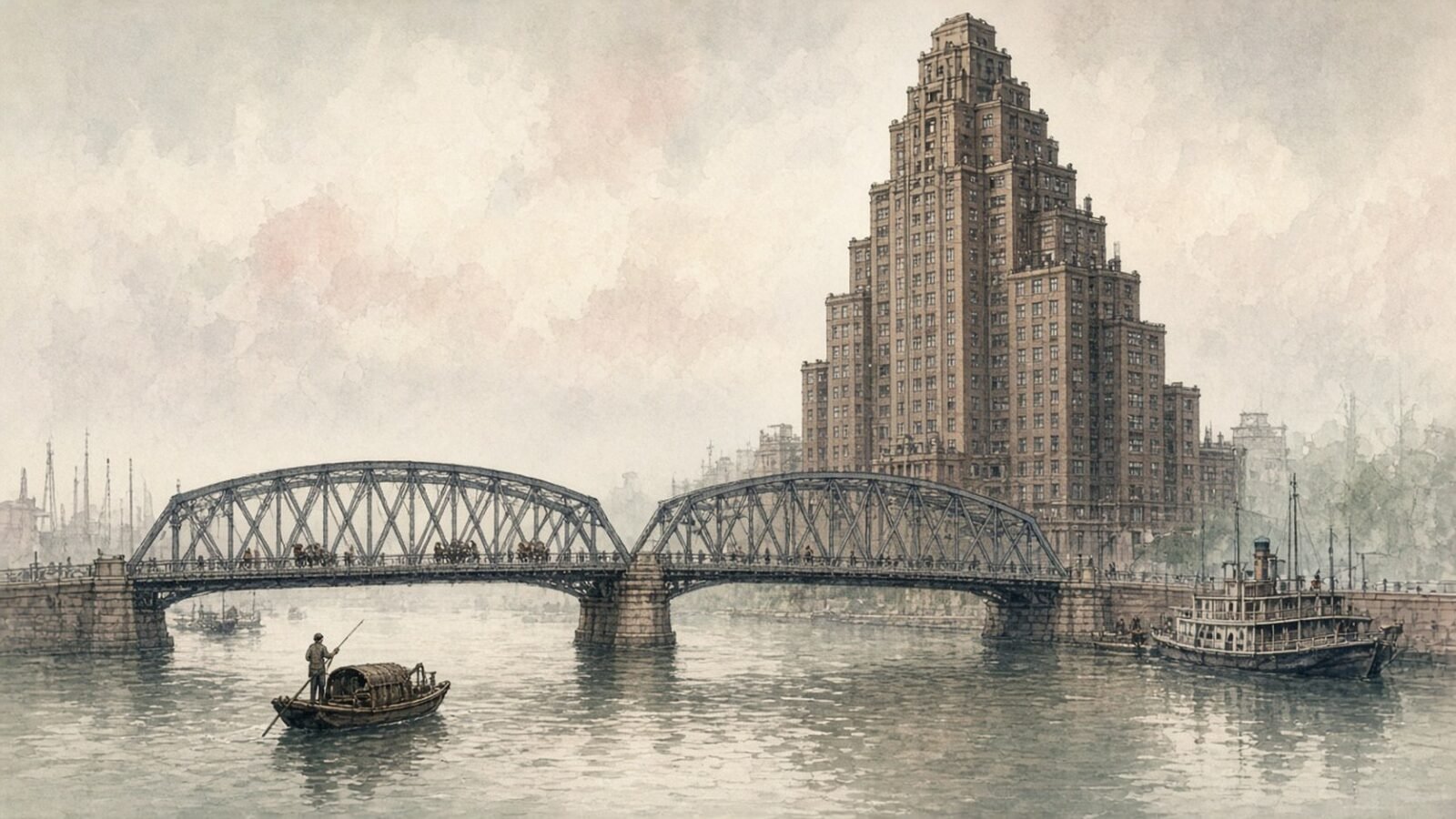
The main route, until Italy entered the war in June 1940, was by sea: Italian liners from Trieste and Genoa, the Conte Biancamano and her sisters, three weeks through the Suez Canal and across the Indian Ocean, the refugees travelling in whatever class their stripped finances allowed, watching the Europe that had expelled them slide astern. The arrival was recorded by nearly all of them in the same terms: the stupefying heat, the smells, the masses of humanity, the junks and the sampans, and then the Bund sliding past, the same waterfront panorama this site has described in its other essays, and the first sight of Hongkew, where they would live. Hongkew had been ground zero of the 1937 battle and was a district of shattered streets and cheap rents, which was precisely why the refugees were steered there: it was what they could afford. The first arrivals were housed in heime, hostels run by the relief committees in converted schools and warehouses, dormitories of double bunks, sausage and rice, lice and dysentery, a brutal landing for the doctors, lawyers, concert musicians and professors who made up a population that was, as one observer noted, the most overqualified slum on earth.
And then they did the thing that makes this story what it is: they built Vienna. Within two years the lanes of Hongkew around Zhoushan Road had been remade by refugee enterprise into a working European quarter that residents nicknamed Little Vienna: coffeehouses with marble-topped tables and newspapers on rods, bakeries producing proper bread and cakes, Kosher butchers, tailors advertising in German, a Yiddish and German-language press of scrappy little newspapers, a theatre company doing cabaret and operetta, a symphony drawn from refugee musicians, schools for the children, including one endowed by the Kadoorie family, and medical practices run by refugee doctors who could not legally practise but practised anyway. The refugees and their Chinese neighbours, themselves among the poorest people in the city, crowded into the same lane houses, shared the same water taps and the same chamber-pot economy, and by the testimony of both sides got along with a matter-of-fact decency that neither has ever forgotten. There was no money for frills and there were no frills, but there was a society: lectures, football teams, Zionist youth groups and Bundist debating circles, weddings, babies, and chess in the coffeehouses. Historians of the Holocaust have a dry phrase for what Shanghai offered: not safety in comfort, but survival with dignity. The dignity was built by the refugees themselves, out of nothing, in a bombed-out district of a foreign city, and it is the most moving part of the story.
The texture of that dignity survives in the memoirs, and it is dense with vocation. The refugee doctors, among them men who had held chairs in Vienna and Berlin, staffed clinics and a refugee hospital where surgery was done by lamplight and surgeons of European eminence boiled their own instruments. The lawyers became waiters and peddlers, and made jokes about it in three languages. The musicians split into a symphony orchestra, dance bands for the hotels, and teachers who took students by the hour; more than one Shanghai resident learned the violin from a former concertmaster of a German opera house. There were kindergartens, a Talmud Torah, adult-education lectures on everything from Kant to Chinese, a lending library, chess tournaments, amateur boxing, and a football league whose results the little German-language newspapers reported with full seriousness. Weddings were celebrated in borrowed halls, babies were born by the hundred, the community’s birth announcements are one of the strangest and happiest features of its press, and on summer evenings the lanes filled with people sitting out on stools in the European and Chinese manner alike, escaping the heat of the tiny rooms, arguing, courting, and fanning themselves, in a district that had contrived to become, against all probability, a neighbourhood.
The designated area
Pearl Harbor changed everything and nothing. When Japan went to war with the Western powers in December 1941, the remittances from America that had kept the relief committees afloat were cut off overnight, and the refugees’ legal position darkened: they were now stateless persons under the control of Germany’s ally. In February 1943 the Japanese authorities proclaimed the Restricted Sector for Stateless Refugees, a district of about a square mile in Hongkew into which all refugees who had arrived since 1937 were ordered to move by May, and from which they could leave, for work, for school, for a doctor, only with a pass. It was a ghetto, though the word must be used with care: there was no wall, no barbed wire, the Chinese residents of the district stayed and mixed freely, and the passes, issued by a capricious Japanese official named Ghoya, whom the refugees nicknamed the King of the Jews, were arbitrary but obtainable. What it was, above all, was a squeeze: twenty thousand people compressed into the poorest square mile of an occupied, hungry city, through the brutal summers of 1943, 1944 and 1945, with disease, malnutrition and, in the last year, American bombs, one raid on Hongkew in July 1945 killed hundreds, refugees and Chinese together.
The darkest what-if of the story surfaced in 1942, when the Gestapo’s man in East Asia, Josef Meisinger, arrived with proposals for the final solution of the Shanghai Jewish problem. The plans discussed, the details come from postwar testimony and vary, ran to barges, to starvation, to camps up the Yangzi. The Japanese did not implement them. The reasons were mixed and human: Japan’s odd, philo-Semitic strain of policy dating to its loans from Jewish bankers in 1904, a reluctance to adopt European racial doctrine wholesale, the interventions of the community’s leaders, and simple bureaucratic inertia. The result was the thing itself: of the eighteen thousand or more Jewish refugees who reached Shanghai, virtually all survived the war. In the middle of the century’s worst crime, on the doorstep of its perpetrator’s ally, in a ghetto of an occupied city, an entire community lived, aged, married and multiplied. The Mir Yeshiva students studied Talmud in a Beth Midrash transplanted entire from Poland to the lanes of Hongkew, and when the war ended they printed books again, the famous Survivors’ Talmud has a Shanghai prehistory, in a city that had just saved the oldest continuously studied text tradition of Europe along with its students.
Departure and memory
The end came quickly. Liberation in August 1945 dissolved the designated area; the American relief agencies returned; and within a few years the community scattered to the four winds that had blown it together: to the United States, to the new state of Israel, to Australia, to Canada. By the early 1950s the exodus was essentially complete, and Shanghai’s third Jewish community faded into memory, leaving behind its buildings, its gravestones, and, in thousands of families across the world, a peculiar inheritance: children born in Hongkew who grew up in Tel Aviv or Melbourne speaking of Shanghai as the place where the family survived. Some of those children became notable in their new countries, the most prominent being W. Michael Blumenthal, who arrived as a thirteen-year-old refugee from Berlin, sold bread in the lanes of Hongkew, and went on to become United States Secretary of the Treasury and, later, the founding director of the Jewish Museum Berlin, a life that ran from the designated area to the cabinets of the West. The refugees never forgot. Neither, in time, did the city. The Ohel Moshe synagogue, the heart of Little Vienna, was restored and in 2007 reopened as the Shanghai Jewish Refugees Museum, with a wall inscribed with the names of more than fourteen thousand of the refugees, a list compiled decades after the fact by survivors who remembered each other. Israeli prime ministers and German presidents have stood in front of it. The lanes of Zhoushan Road have been preserved as a historic district, the coffeehouse streetscape lovingly reconstructed, and the story has entered the official memory of both China and Israel as a shared bond: in the darkest decade, the Chinese city asked nothing and turned no one away.
What the open door meant
It is worth being precise about the lesson, because the story is sometimes sentimentalized into a simple tale of Chinese compassion, and the truth is more interesting. The people of Hongkew were indeed, by every testimony, decent neighbours to the refugees, sharing poverty without resentment, and that decency was real and is remembered. But the sanctuary itself was made by a stack of contingencies: a legal anomaly created by the collapse of the treaty-port order, the philanthropy of the established communities, the disobedience of two consuls, the stubbornness of the refugees themselves, and the refusal of an occupying power to import a genocide it did not understand. No one planned it. It was, in that sense, the opposite of Evian: the doors that closed had been closed deliberately, by committees, with regrets, and the door that stayed open had simply never been shut. The contrast carries the moral. In 1938 the civilized world, meeting in comfort, found thirty-two reasons why rescue was impractical. Shanghai, a city at war, occupied, starving and ruined, did not find a reason. It just let people off the ships.
There is a final, quieter point about what kind of refuge this was. The refugees were not guests; nobody had invited them, and nobody waited on them. What they received in Hongkew was not hospitality but room: room to rent a corner, open a surgery, argue about Zionism, marry, mourn, and wait for the world to come to its senses. They brought Europe with them, and for a few years a working fragment of it, its medicine, its music, its scholarship, its coffeehouse civilization, functioned on Chinese soil, among Chinese neighbours, at a moment when Europe itself had stopped functioning altogether. When the survivors sailed away they took that fragment home, which is why the story has the strange afterglow it does: it is the only Holocaust rescue in which the rescued were numerous enough, and settled enough, to carry a whole culture through the fire intact. The ark metaphor the survivors themselves use is exact. An ark is not a paradise. It is the thing that floats.
The ledger of this site’s long series has mostly recorded what the open door of the treaty ports cost China. Hongkew is the counter-entry, the proof that the same openness could, when the world needed it, run the other way. The city that had been forced open became, for eighteen thousand people, the one open place on earth, and the survivors’ children and grandchildren, a number that now runs into the hundreds of thousands, are the arithmetic of that fact. On Zhoushan Road the old facades still stand; in the museum the names still gather; and somewhere in the coffeehouses of memory, the marble-topped tables are still full, the newspapers are still on their rods, and the band, as the saying of the refugee quarter went, plays on. It was not the worst of times in that square mile. It was, against everything, the best: the decade’s single great exception, made by nobody in charge, in the city that asked no questions.