Journey to the West (Xiyou ji) is usually introduced as a story about a monk, a monkey, and a road to India. That is not wrong. It is incomplete. The hundred-chapter novel that readers still open is a product of mid-to-late Ming China: of commercial woodblock publishing, of a civil-service culture that produced far more educated men than offices, of a vernacular fiction that had not yet been granted full literary dignity, and of a century in which Confucian, Buddhist, and Daoist languages of self-cultivation were expected to speak to one another. To read the book only as timeless folklore is to miss the desk, the examination hall, the Nanjing bookshop, and the hanging scroll of the Three Teachings that made this particular version of the pilgrimage possible.
What follows treats Journey to the West as Ming culture thinking in narrative form. The plot remains indispensable. The emphasis is on the world that printed it.
The dynasty that needed long books
The Ming dynasty (1368–1644) restored a native imperial order after the Yuan and rebuilt, with extraordinary rigidity and reach, the examination system that turned classical literacy into the main road to office. From the founding reign of Zhu Yuanzhang onward, the curriculum centered on the Four Books and Five Classics as interpreted through Song Learning. Poetry was stripped from the examinations for most of the dynasty. The eight-legged essay, or its Ming antecedents in “modern prose” exposition of the classics, trained generations to think in balanced periods and authorized comment. That training produced a vast reservoir of men who could write, quote, and argue — and a structural surplus of disappointment. Provincial candidate numbers rose sharply across the fifteenth and sixteenth centuries; most never became juren, let alone jinshi. Failed or stalled scholars did not vanish. They taught, wrote, edited, drifted into yamen staff work, or fed the growing market for plays, stories, and household books. Vernacular fiction in the Ming is unintelligible without that surplus.
Fiction itself occupied an awkward rank. Classical prose and regulated verse remained the prestige arts. The long chapter-novel (zhanghui xiaoshuo), written in a prose close to speech and punctuated with poems, was still widely treated as entertainment rather than high literature. That stigma is one reason the 1592 edition of Journey to the West appeared without an author’s name on the title page. Anonymity was common for novels; it also protected a man of letters from being remembered first as a writer of “vulgar” books. The paradox of Ming culture is that the same society which ranked the novel low also created the conditions — literacy below the official elite, cheap paper, urban book quarters, a public hungry for story — in which the novel became one of China’s great forms.
Journey to the West belongs with Romance of the Three Kingdoms, Water Margin, and later Jin Ping Mei among the long vernacular works that the late Ming stabilized in print. These books did not spring from a single genius working in isolation. They are accumulations: oral cycles, drama, earlier short narratives, then a shaping intelligence and a publisher willing to invest in a deluxe or at least complete edition. The Ming achievement was not inventing Xuanzang’s journey. It was giving the journey a hundred-chapter body and selling it.
Jiangnan, Huai’an, and a name that may be the author’s
The man most often credited with that shaping is Wu Cheng’en (c. 1500–1582), courtesy name Ruzhong, a native of the Huai’an region in what was then Nan Zhili. His father had education and artisan work; the son inherited a love of both classical letters and popular anecdote. Wu sat the examinations more than once and did not rise as the system promised. He entered the imperial university in Nanjing only in middle age, held minor posts, including time in Changxing, and withdrew toward writing and local reputation. The profile is almost typical of the Ming vernacular author: enough classical training to load a page with verse and allusion, enough official frustration to look at hierarchy with a cold eye, enough attachment to local story to keep the jokes and the gods in the same sentence.
Whether Wu wrote every chapter remains a live scholarly argument. A gazetteer from his home prefecture listed a Xiyou ji among his works; twentieth-century critics, Hu Shi foremost among them, made the attribution standard. The first complete printed text we can securely handle was published after the date usually given for Wu’s death. Other theories have tied the book to Daoist circles or to collective redaction. The cultural point does not depend on a courtroom identification. Journey to the West sounds like the work of a Ming provincial literatus who knew the examination world from the underside, who had walked Nanjing, and who could move without strain from a regulated poem to a slapstick quarrel. That social type is more important than the signature.
Huai’an sat on the Grand Canal. Nanjing, the southern capital, was a few days’ cultural weather away. For a book like this, geography is destiny. The lower Yangzi in the sixteenth century was the richest print ecology in the empire: paper, carvers, booksellers, opera troupes, and readers who were neither peasants nor grand secretaries. Wu’s possible education in Nanjing and the novel’s first great printing there are not coincidences. They are the same map.
Sanshan Street and the 1592 book
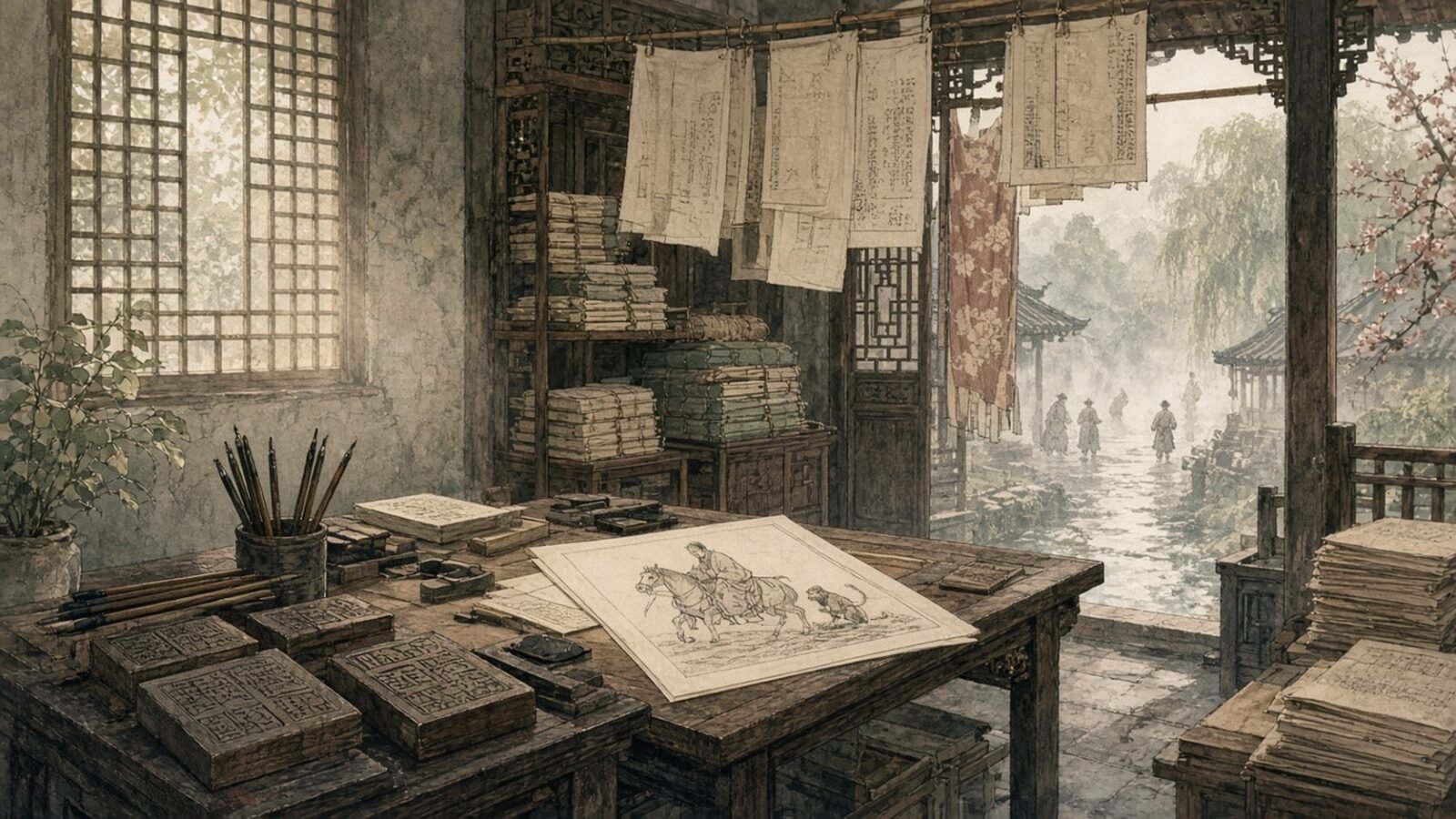
The earliest surviving hundred-chapter edition was issued in Wanli 20 (1592) by the Shidetang, the Hall of Generational Virtue, a Nanjing house associated with the Tang family of commercial publishers. Its advertising title is a little essay in Ming marketing: Newly Printed, Illustrated, Deluxe and Large-Character Journey to the West. Twenty juan, one hundred hui, large type, pictures. The book announces itself as both official-looking (“guanban”) and new. That combination — prestige format plus popular story — is late Ming publishing in a phrase.
Nanjing’s book trade clustered around Sanshan Street and related quarters. Houses there printed drama, historical romances, household encyclopedias, and illustrated fiction for a stratified market. Jianyang in Fujian produced cheaper picture-above-text editions that traveled widely; Jiangnan houses increasingly aimed at readers who wanted finer cutting and a more “literary” page. Journey to the West moved through both circuits. The Shidetang text is the landmark. Shorter or differently arranged versions, including Zhu Dingchen’s Chronicle of Deliverances, show that the story was already a commercial property being sliced and expanded for different purses. A later note that a Jianyang printer recut part of the Nanjing blocks reminds us that Ming books were not sacred objects. They were stock.
Illustration was not decoration. Woodblock pictures taught new readers how to see a scene, marked chapter turns, and made a long book feel like a performance you could hold. The Ming eye was already trained by opera costume, temple murals, and narrative hanging scrolls. When a reader in Wanli Nanjing opened the deluxe Xiyou ji, he was not encountering a private psychological novel. He was buying a portable stage.
After 1592 the novel kept being remade by the same print culture that launched it: commentary editions, Daoist-leaning recensions in the early Qing that claimed the book as an inner-alchemy treatise, abridgments that treated it as a picture-story. The Ming did not freeze the text. It created the conditions in which a fluid legend could look, for the first time, like a single monumental book.
A Tang road rewritten by Ming imagination
The historical Xuanzang left Chang’an in 629, studied in India, and returned with manuscripts and a translator’s vocation. His Great Tang Records on the Western Regions is empirical, devout, and human in scale. Ming storytellers inherited a pilgrimage that had already passed through shihua, temple tale, and Yuan drama, and they completed the transformation. In the novel the monk is Tang Sanzang, also called Tripitaka: chosen by court and bodhisattva, timid in the face of danger, steadfast in the vow. The journey is no longer a scholar’s unauthorized quest. It is an imperial commission framed by Emperor Taizong’s tour of the underworld and by the Buddha’s wish that Mahayana scriptures reach the East. Heaven and the dynasty speak the same administrative language. That is a Ming instinct. The founding emperor himself had written on the complementarity of the Three Teachings; later courts lived inside a cosmology where ritual, office, and salvation were neighboring departments.
The novel’s four-part architecture is as designed as a Ming palace compound. Chapters 1–7 give Sun Wukong his education, his rebellion against heavenly appointment, and his imprisonment under Five Elements Mountain. Chapter 8 sends Guanyin along the future road to recruit the company. Chapters 9–12 supply Sanzang’s origin and the emperor’s mandate. From chapter 13 through the late nineties the pilgrimage advances as a sequence of eighty-one preordained tribulations — nine nines, a number of completion dear to Chinese numerology and to any culture that thinks in ritual sets. The close canonizes the travelers into a hierarchy of Buddhist offices. Even paradise, in this telling, has posts.
That last joke is Ming to the bone. A society organized by rank cannot imagine ultimate success except as a better rank.
Persons of the pilgrimage, persons of the age
Ming readers did not need a modern theory of allegory to see types.
Sanzang is sincerity in office. He has the commission, the robes, and the moral credit. He does not have operational competence. He recites, weeps, misreads faces, and depends on disciples he cannot quite control. In a culture that made the official the moral center of the realm and then watched officials fail, he is an uncomfortable ideal: the good intention that cannot travel without help.
Sun Wukong, the stone monkey of Flower–Fruit Mountain, student of the Patriarch Subodhi, wielder of the compliant golden-hooped staff, is talent without a satisfactory title. He learns transformation and the cloud-somersault; he strikes his name from the registers of death; he accepts and then explodes the posts heaven offers. The Jade Emperor’s solution to a problem of genius is always another appointment. Wukong’s solution is to declare himself Great Sage Equal to Heaven. Ming official culture is full of men who felt overqualified for the stool they were given and under-recognized by the men above them. The monkey is not a treatise on that feeling. He is that feeling with a staff.
The Tight-Fillet spell with which Sanzang disciplines him is one of the book’s most Ming inventions: moral authority that works by constraint. Compassion here is not merely softness. It is a technology of government.
Zhu Bajie, once a heavenly marshal, now a pig-spirit with a nine-toothed rake, is appetite in a culture that preached restraint and practiced plenty. Late Ming Jiangnan was famous for consumption — food, theater, fashion, collecting. Bajie wants dinner, a nap, and a marriage. He is comic because the culture recognized him. He is useful because the same culture knew that raw energy, properly yoked, moves luggage down the road.
Sha Wujing, former court attendant punished and reassigned, is the quiet functionary: loyal, burden-bearing, short on arias. Every yamen needed him. Every pilgrimage does.
The White Dragon Horse is the journey as vehicle — will reduced to service.
Guanyin, who assembles this unlikely staff, practices a very Ming form of mercy: she does not recruit the already pure. She redeploys the fallen. The Jade Emperor’s court, with its memorials, delays, and borrowed troops, is the examination-and-ministry world raised to the sky. Laozi’s furnace and the Buddha’s palm belong to different teachings; both are resources a Ming narrator felt entitled to use in one chapter.
The Three Teachings as the air the book breathes
If one phrase names the intellectual climate of the sixteenth century, it is sanjiao heyi: the Three Teachings are one. The formula is older than the Ming, but the Ming gave it unusual public density. The founder had argued that Confucianism, Buddhism, and Daoism each had a function in ordering a world of ordinary people. Wang Yangming’s philosophy of innate knowledge, spreading through the century, made mind-nature a common ground on which Confucian self-cultivation could converse with Buddhist and Daoist interior practice. Lin Zhaoen (1517–1598) went further and organized a Three-in-One teaching. Painters produced images of the three sages walking together. Playwrights such as Tu Long put immortals and Buddhas on the same path. Matteo Ricci, arriving into this weather, found the synthesis so pervasive that he felt obliged to attack it.
Journey to the West is that climate narrated rather than argued. The quest is Buddhist in destination and in the rhetoric of emptiness, karma, and compassion. The techniques of transformation, the language of essence and spirit, the furnaces and elixirs, the very idea that a body can be rewritten, draw on Daoist cultivation. The imperial charge, the master–disciple ethics, the concern with right names and right posts, are Confucian. Commentators have spent centuries trying to declare a winner. Daoist readers found an inner-alchemy diagram. Buddhist readers found a parable of the path. Confucian and later Neo-Confucian readers found a psychomachia of mind. Hu Shi, impatient with all three, insisted the book was first humor and satire. The Ming text can bear every one of those readings because Ming culture itself refused to keep the three libraries in separate buildings.
The most intuitive mapping still works as Ming moral psychology. Sanzang is the directing heart-and-mind. Wukong is the monkey of the mind — a phrase with Buddhist roots that Ming thought had already syncretized. Bajie is desire. Wujing is the stabilizing will. The horse is intention put in motion. The eighty-one tribulations are not random adventure. They are a curriculum. In a dynasty obsessed with self-cultivation as the link between inner order and public order, a pilgrimage that educates a whole committee of the self is the right genre.
Heaven’s yamen and the joke of rank
Satire in the novel is not an extra flavor. It is how Ming readers recognized their institutions when those institutions were painted gold and set on a cloud. Heaven responds to crisis by convening, promoting, and passing responsibility upward. Powerful patrons reclaim their wayward servants after the pilgrims have done the dangerous work. Titles proliferate faster than competence. Wukong’s early career is a study in the emptiness of honorifics: Bimawen, Great Sage, prisoner. The final canonization restores rank, but only after service. That sequence — talent, misrecognition, punishment, labor, corrected title — is the plot of countless Ming lives, including, if the attribution holds, Wu Cheng’en’s.
The book is not a call to abolish hierarchy. Ming culture almost never is. It is a demand that hierarchy mean something. A post should follow virtue and work, not merely ancestry or proximity to a furnace. When the first scriptures issued at Thunderclap Monastery prove wordless, even the Western paradise is caught in a petty economy of giving less than was asked. The pilgrims must go back and insist. Readers who had dealt with clerks would have smiled without being told to.
Speech, verse, and the stage in the page
The prose of Journey to the West is vernacular, the living written language of storytelling rather than the compressed classical of the examination essay. That choice is a cultural act. It places the book with the audience of the playhouse and the teahouse, not only with the studio. Then, repeatedly, the narrative stops for poetry: scene-setting verse, hymns, comic doggerel, catalogues of palaces and mountains. There are well over a thousand such insertions. A Ming reader trained to value verse as the mark of education is being offered a hybrid feast: street energy and literati garnish on the same plate.
This hybrid matches Ming performance culture. The Xuanzang cycle had already been a theatrical property. Gesture, painted face, acrobatic combat, and aria prepared the public for Wukong before many of them owned the novel. The chapter-novel, with its tag lines and tableau moments, reads as if it expects to be spoken. Jiangnan in the Wanli era was thick with troupes and with printed play-texts from the same houses that sold fiction. Journey to the West is not opera, but it is unthinkable without opera’s habits of scene and type.
Popular religion supplied the rest of the furniture: local temple gods who behave like magistrates, animal spirits who have stolen a practice and set up as kings, mountain cults, the always-available Guanyin of the South Sea. The Ming state tried to register and restrain cults even as households and market towns multiplied them. The novel’s crowded unseen world is the religious landscape of the dynasty, not a private fantasy.
What Ming culture wanted from the West
Why this story, at this length, in this century?
Because Ming China was simultaneously devout, bureaucratic, theatrical, and commercially literate. It needed a narrative that could be sold in large characters and still talk about mind. It needed a hero of outrageous ability who could be taught to serve. It needed a holy man who justified the journey without being able to complete it alone — a picture of virtue that requires company. It needed the Three Teachings to share a plot the way they already shared festivals, patronage, and the interior lives of many literati. And it needed, after so many examination essays on order, a long comic book in which order is both mocked and, at the last page, restored in a different key.
The historical Xuanzang walked into India as a scholar of rare stamina. The Ming Sanzang would not have finished the first range without a monkey who had already lost an argument with the sky and a publisher in Nanjing willing to set that argument in deluxe type. The staff can shrink to a needle. The culture that made the book did the opposite. It took a pilgrimage and enlarged it until it could hold a dynasty’s ideas about print, office, appetite, and the cultivation of the heart.
That is why Journey to the West still feels crowded when you open it. You are not only on the road west. You are in a Wanli bookshop, in an examination culture that produced more readers than magistrates, and in a studio where the Three Teachings hang on one scroll while, outside the lattice, the pilgrims keep walking.